Photos from demo in Totnes today with a few local faces you will probably recognise.
No Tories from East Devon then?
Thought not!

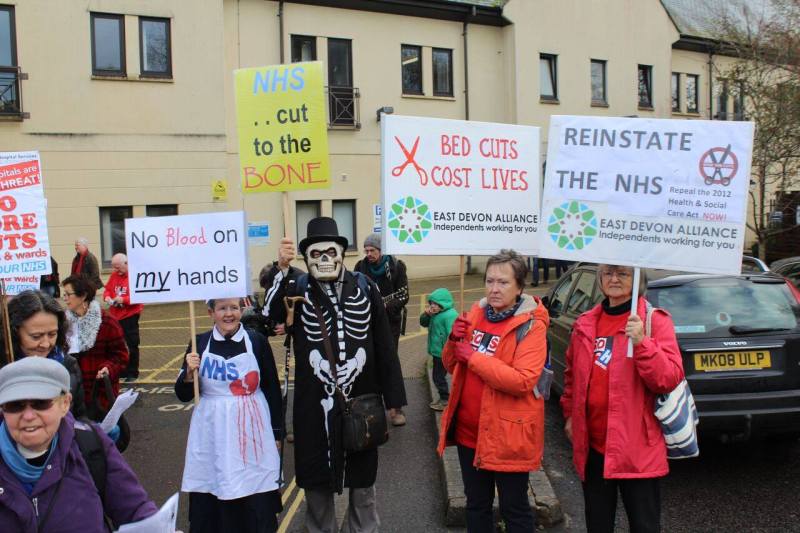

Photos from demo in Totnes today with a few local faces you will probably recognise.
No Tories from East Devon then?
Thought not!
Owl says: LOTS and LOTS of things Dave didn’t solve …..
“David Cameron has expressed regret he was unable to do more to deal with the “huge” challenge funding social care for Britain’s ageing population.
The former prime minister – who has since become president of Alzheimer’s Research UK – said a way had to be found to meet the “catastrophic” costs of caring for people with dementia.
“There is a huge social care funding challenge we have to answer, and I accept that we’ve made some steps forward, but we didn’t solve that problem,” Mr Cameron told the Financial Times.
“Everyone knows it’s a difficult conundrum. Lots of effort has been made to try and solve it but we haven’t got there yet.”
In office Mr Cameron sought to introduce a £72,000 cap on the costs an individual would have to pay towards care home charges with the state picking up any further bills.
Ministers had hoped insurance companies would develop products that would enable people to insure themselves against their care costs up to the £72,000 limit.
However the plans were put on hold in July 2015 after insurers proved reluctant to enter the market.
“The disappointment I had was I was hoping that a combination of the cap on care costs would help to deliver an insurer’s model, where a market would grow up where everyone could insure themselves against the cost of long-term care. And we just haven’t cracked that yet,” Mr Cameron said.
“I’m not in politics any more but we’ve got to find an answer. (Given) the catastrophic cost of care that people face from dementia, and I saw this with constituents, we’ve got to find a better answer there.”
“Scottish Widows is the sort of unassuming pensions company that rarely likes to publicly criticise government policy. But an analysis it published this week is a stark warning about the ticking time bomb that will explode in 10 to 20 years’ time. And it’s not pension incomes that are the worry – it’s the fact that so many of tomorrow’s pensioners who never got on to the property ladder in the 2000s and 2010s will have to find huge amounts of money to pay ever-escalating rents to private landlords.
Scottish Widows skirts around the issue by suggesting that non-homeowners currently in their 50s should start saving an extra £6,000 a year now to be able to afford their rent in retirement. As if people on low incomes are going to find that sort of money. The reason they are renting is that they were never able to find the savings for a deposit on a house in the first place, or didn’t earn enough to qualify for a mortgage.
The reality is that these people are likely to retire with little more than the state pension plus a small bit of private pension. Maybe they will be picking up about £200 a week once they are 67. Given that the average rent in England and Wales is £845 a month – and in London it’s about £1,250 a month – then the whole lot will be gobbled up by the landlord. So the taxpayer will have no alternative but to step in and pay most of the rent, and we are then on the hook for payments going on for maybe 20 or 30 years. All so that the buy-to-let landlord with multiple properties can enjoy a lavish retirement themselves.
This is the lunacy of promoting buy to let as a long term form of tenure for millions of people. Even in developed countries where renting is common, such as Germany, most people are living in a home they own by the time they reach retirement. Renting all the way through retirement, funded by the taxpayer, to a landlord who has the power to evict without reason and at short notice, is the worst possible situation. And it’s one we are hurtling towards.
Make no mistake about the dramatic change in the retirement landscape that is coming. Scottish Widows projects that one in eight retirees will be renting by 2032 – treble today’s figure. After that it will continue rising. It says there is a £43bn gap between the income and savings people have now and what the rent bill will be in retirement. That’s more than one-third of the entire NHS budget for a year – to be squandered on rent.
Dan Wilson Craw of campaign group Generation Rent says: “The common perception is that retirees either own their home outright or have a council tenancy, so the government will be in for a nasty shock as more of us retire and continue to rent from a private landlord. Many renters relying on pensions will qualify for housing benefit which will put greater strain on the public finances.”
Aviva, the UK’s biggest pensions company, also publishes figures on Saturday on the colossal financial issues facing non-homeowners currently in their 50s. While those who have bought their homes feel pinched – and expect to use the equity in their home to pay for a better retirement – the outlook for non-homeowners is so grim that 20% believe their only hope is having a lottery win. Most non-homeowning workers aged above 50 say they have no money left after basic costs to put aside extra money for a pension.
There was some good news on pensions this week: the Resolution Foundation said that auto-enrolment schemes will mean tomorrow’s pensioners will enjoy a roughly similar income (about £300 a week) to today’s pensioners. But they didn’t account for the large number that will now have to pay rent out of that money.
The solution? Build more houses, of course. But even 300,000 a year won’t solve this problem if they are snapped up by landlords. That only leaves us with rent control and much higher taxes on buy to let.”
https://www.theguardian.com/money/blog/2017/dec/02/pensions-timebomb-rents-homeowners
“Jeremy Corbyn is leading a cross-party effort to force ministers to publish details of the impact of their policies broken down by gender, race, age, disability, class and region, after analysis showed women continue to bear the brunt of austerity.
The Labour leader has signed a letter with 126 other MPs, including members of his own party, the Lib Dems, SNP and Greens, calling for an immediate equality assessment of all government policies.
The letter to the education secretary, Justine Greening, whose brief covers equalities, accuses the government of failing in its duty to sufficiently consider the impact of its actions on all groups in society.
Labour said its analysis showed that men received 46% more spending in Philip Hammond’s autumn budget.
A financial model developed by Yvette Cooper, a senior Labour backbencher, and House of Commons library statisticians found that 86% of savings to the Treasury from tax and benefit changes since 2010 had come from women.
Labour said the latest budget did nothing to change that, meaning women had been hit six times harder by austerity measures than men since the Conservatives came to power in 2010.
The letter, co-signed by Corbyn, Dawn Butler, the shadow equalities secretary, Jo Swinson, the deputy Lib Dem leader, Angela Crawley, the SNP spokeswoman on equalities, and Caroline Lucas, the co-leader of the Greens, said: “If the government continues in this manner there can be no public confidence that the public sector equality duty is being fulfilled.
“We are calling on the government to undertake and publish a comprehensive cumulative equality impact assessment of all government policies. This assessment must include analysis of the impact of all its policies in relation to gender, race, age, disability, class and region. …”
“… HuffPost UK has discovered that tucked away in the Office for Budget Responsibility’s analysis of the Chancellor’s Budget last week is the truth about where that £2billion money is coming from.
It is not new money, and is instead being raised “by reducing spending on ‘accelerated construction’ and ‘starter homes’ across the four years from 2017-18 to 2020-21. …
… The OBR claimed his policy of scrapping stamp duty for first-time buyers on the first £300,000 of a home would actually drive up prices – although this was disputed by the Chancellor.
Housebuilding figures released today by the Government show 199 homes for social rent were completed between April and September this year, compared to 10,597 completed over the same period in 2009.”
Guardian letter:
“Why does nobody address crippling private rent (Nils Pratley, 21 November)? Why is it OK for my daughter and boyfriend to pay someone else’s mortgage by renting and having to share with several other people, only living in a room, sharing a bathroom and small kitchen and no communal area, not being able to afford to rent a place of their own or to get a mortgage, despite both working. If people can afford to pay rent they should be able to get an affordable mortgage. My daughter could never afford a property over £250,000, so a new allowance for properties up to £300,000 is an irrelevance.
My husband and I both work more than full time. I work two jobs and we only scrape by; we could not afford a mortgage now if we were first-time buyers. I am guessing that the young people who can afford £300,000 on a house are young professionals on a very high wage or are from a wealthy background where they have help? My daughter and her boyfriend both have degrees and have been saddled with debt. Sadly, we, like many parents, are not in a position to be able to help. The government needs to look at more social housing, charging people who own more than one property extra tax for each additional property, and ensure rents are capped.
Stephanie Lovatt
Liverpool”
“Children from deprived backgrounds face the worst prospects in some of the richest parts of the country, according to a damning new study that lays bare deep geographical divisions across Britain.
An annual report by the government’s own social mobility watchdog warns that while London and its suburbs are pulling away, rural, coastal and former industrial areas are being left behind.
The State of the Nation report finds that some of the wealthiest areas in England – including west Berkshire, the Cotswolds and Crawley, deliver worse outcomes for their disadvantaged children than places that are much poorer, such as Sunderland and Tower Hamlets. …
… Other findings include that:
51% of children on free school meals in London achieve A* to C grades in English and maths GCSE compared with a 36% average in all other regions.
There is a gulf between the highest figures of 63% in Westminster and the lowest, 27% on the Isle of the Wight
Meanwhile in Kensington and Chelsea, 50% of disadvantaged youngsters make it to university compared with just 10% in Hastings, Barnsley and Eastbourne
Some of the worst performing areas, such as Weymouth and Portland, and Allerdale, are rural not urban
In fact, in 71, largely rural areas, more than 30% of the people earn below the voluntary living wage – with average wages in west Somerset just £312 a week, less than half of the best performing areas
In Bolsover just 17% of residents are in jobs that are professional and managerial positions compared with 51% in Oxford
The study says that a critical factor in the best performing councils is the quality of teachers available, with secondary teachers 70% more likely to leave the profession in deprived areas.
Although richer parts of Britain do tend to outperform more deprived areas overall in the social mobility index designed by researchers, that isn’t always true. Some of the most affluent areas do worse for the poor kids than some of the least well off.
Coastal areas are a focus of the report, with warnings about schools being isolated. Recommendations include more collaboration between schools and subsidised travel for disadvantaged young people in isolated areas. The commission also calls for central government to fund a push for schools in rural and coastal areas to work together.
They also say that the government should rebalance the national transport budget to help tackle regional disparities. …
…. The report calls for the Department for Education’s £72m funding for opportunity areas to be matched by the Department for Business, Innovation and Skills in order to link up schooling and workplace opportunities.”
Unfortunately, we have heard this all before – words do not seem to get translated into actions:
Page 223:
“… We remain firmly committed to Local Enterprise Partnerships. From next year, the Prime Minister will chair a biannual ‘Council of Local Enterprise Partnership Chairs’. This will provide an opportunity for Local Enterprise Partnership leaders to inform national policy decisions.
While Local Enterprise Partnerships across the country have played an important role in supporting local growth, feedback suggests that their performance has varied.
We are reviewing the roles and responsibilities of Local Enterprise Partnerships and will bring forward reforms to leadership, governance, accountability, financial reporting and geographical boundaries. We will work with Local Enterprise Partnerships to set out a more clearly defined set of activities and objectives in early 2018. These will be driven by influential local leaders, acting as figureheads for their area’s economic success, and a clear strategy for local and national partnership.
We will agree and implement appropriate structures for holding Local Enterprise Partnerships to account. We will work with Local Enterprise Partnerships to review overlapping geographies and ensure people are clear as to who is responsible for driving growth in their area. We recognise that in order to deliver their role effectively, Local Enterprise Partnerships need financial support. We will make additional financial resources available to Local Enterprise Partnerships that demonstrate ambitious levels of reform following the review. …”
Owl says: But, of course, there WILL be a railway to Hinkley C!
“Transport secretary Chris Grayling ready to break up railways
Transport secretary Chris Grayling is this week set to unveil a blueprint for overhauling the railways — including splitting two of the biggest routes.
It is part of a fightback against Labour’s popular policy of renationalisation.
His strategy is expected to advocate splitting the Great Western franchise, which runs from London to south Wales and the southwest.
The route could be split into an inter-city franchise and a separate Devon and Cornwall business.
The mammoth Thameslink, Southern and Great Northern franchise is also likely to be split, with the strike-hit Southern route between London and the south coast set to be carved out.
Grayling is also keen to reform state-backed Network Rail, which owns and maintains the 20,000 miles of track, 40,000 bridges and most of the big stations. He has advocated closer union between Network Rail and the private companies that operate routes to crack the problems of divided loyalties and poor co-ordination.
The strategy comes ahead of a huge increase in some rail fares from January, with the rise tied to July’s 3.6% retail prices index inflation rate.”
“Almost 100,000 households in England are being priced out of the property market each year because of a shortage of affordable homes to rent or buy, according to a report. …
… About 96,000 households are unable to afford homes at the market rate, either to buy or rent, Savills said, with the vast majority in London and the south. It said varying approaches were needed to address the shortfall in different parts of the country: low-cost rented homes were needed more in markets in which incomes were smaller, while a mixture of homes, including shared ownership, would help in more expensive areas.
In London, 20% of the households affected have incomes above £35,000, Savills said, while the same proportion earn less than £10,000.
Over the past three years, 55,000 fewer affordable homes have been built each year than were needed, the research found. Although 42,500 households in the capital required below market rate housing, only 8,800 affordable homes a year had been delivered. In the south outside London, 15,500 affordable homes a year were being built while 34,100 were needed.
Meanwhile, in the north of England, low incomes were locking out 9,600 households a year, with 8,900 homes being delivered.
A speech by the prime minister, Theresa May, at the Conservative party conference in October made a commitment of £2bn over four years to fund social housing. However, to house 100,000 emerging households over this period would need funding of £7bn a year, Savills said.
Paying for the new homes would reduce the housing benefit bill by £430m a year. …”
OUR money. To be spent on tourism in Northern Ireland and cushioning them from Brexit problems.
The first tranche of £1 billion earlier this year allowed Northern Ireland to increase its NHS spending by more than 5%.
“Theresa May has started to work on a new deal worth hundreds of millions of pounds with the Democratic Unionist Party to stop her Government collapsing in just over 18 months’ time.
Mrs May’s Government will set out plans to cut Air Passenger Duty and VAT on hotels and restaurants in Northern Ireland in the new year.
The new cash will be on top of the £1billion which Mrs May agreed to spend in Northern Ireland after the DUP’s 10 MPs agree to support her minority administration.
The Treasury has promised to publish its response to the consultation at the next Budget in Autumn next year to allow the changes to be introduced in the 2019/20 tax year.
The talks were signalled in this week’s Budget Red Book, which said: “Early in 2018, the government will publish a call for evidence which will consider the impact of VAT and APD (air passenger duty) on tourism in Northern Ireland, to report at Budget 2018.”
“Tory plans for tax-free childcare are in disarray, with an uptake of less than eight per cent.
The flagship policy launched in 2013 was meant to help 415,000 parents by last month but only 30,000 signed up.
That means this year the Government has only spent £37million and saved £800million.
Budget documents out last week show next year’s spending forecast is being revised down by 90 per cent.
The low response is being blamed on ministers failing to give additional funding for nurseries and childminders. More than 500 wrote to Chancellor Philip Hammond before the Budget asking for more money – but in vain. …”
http://www.mirror.co.uk/news/politics/tory-flagship-childcare-policy-flop-11587487
Local media knew about this for YEARS but refused to take it up or investigate, leaving a lone Grenfell Tower blogger to document the unfolding disaster. One so-called “local” journalist was actually filing copy from Dorset!
“[Edward] Daffarn [a social worker who had lived in Grenfell Tower for 15 years] is understandably emotional when reflecting on the last few months, but more than that he is angry. Angry with the way he feels Grenfell residents were treated by the Kensington and Chelsea Tenant Management Organisation – the people who were entrusted to maintain the estate and keep its residents safe. Angry with the Royal Borough of Kensington and Chelsea Council, which was meant to scrutinise the KCTMO. Angry with a society which didn’t seem to care about people like him – people who live on housing estates – until it was too late.
“The reality is if you’re on a housing estate it’s indifference and neglect, two words that sum up everything about the way we were treated,” he says. “They weren’t interested in providing housing services, keeping us safe, maintaining the estate. They were just interested in themselves.”
It wasn’t for us to tell the council what they should be doing we were just trying to raise an alarm.
Edward Daffarn, Grenfell Action Group blog
Daffarn and fellow Grenfell resident Francis O’Connor had been blogging on behalf of the Grenfell Action Group since 2012. They wrote about issues that concerned their tight-knit community – air pollution, the closure of the local public library, and their fears that corners were being cut during the refurbishment of the tower.
“We wanted to record for history how a community on a housing estate in the fifth richest country in the world could be ignored, neglected, treated with indifference. We never thought we could make change. We just wanted to record what was happening,” he says.
Daffarn and O’Connor shared a theory that Kensington and Chelsea – a London borough more widely known for its museums, designer shops and flower shows – actually wanted its council estates to go into decline, so that the residents would leave and expensive flats could be built in this sought-after location. For this they were described as fantasists.
“We weren’t fantasists,” he says, visibly hurt. “We were trying to raise genuine concerns about how our community was being run down.”
The natural consequence, he concluded, would be loss of life. Which is why on 20 November 2016, frustrated and desperate, Edward wrote the blog post KCTMO – Playing with fire!
“It is a truly terrifying thought but the Grenfell Action Group firmly believe that only a catastrophic event will expose the ineptitude and incompetence of our landlord.”
A few months earlier a fire had ripped through five floors of a tower block in Shepherd’s Bush, just down the road. Edward was worried that if a fire broke out in his tower block residents wouldn’t know what to do. They had been given no proper fire safety instructions from the KCTMO. There were no instructions on individual floors on how residents should act in the event of a fire, there was only a recent newsletter saying residents should remain in their flats – advice which in the case of the Shepherd’s Bush fire would have led to fatalities.
There’s a lot of abusive behaviour evidenced forensically about what was happening to our community, but it wasn’t sexy so it never got picked up.
In March 2017 the KCTMO installed fire safety instruction notices in the entrance hallway to Grenfell Tower and outside the lifts on every floor of the building, again urging residents to “stay put” unless the fire was “in or affecting your flat”.
It wasn’t the first time the Grenfell blog’s authors had raised concerns about fire safety.
Before the blog began, when a school was built on the only green space the residents had, they wrote to the borough pointing out that access for fire and emergency vehicles had been compromised.
Later they blogged about the blocking of a fire exit with mattresses during the refurbishment and the power surges in 2013 that manifested in flickering lights, computers and stereos blowing up, and entire rooms filling with smoke. These continued for three weeks, Daffarn says.
“We were tenants we weren’t fire safety specialists but we were switched on enough to feel this was important and it was not being dealt with on our estate and that’s why we were blogging. It wasn’t for us to tell the council what they should be doing., We were just trying to raise an alarm.”
An alarm that went unanswered. The November 2016 blog post represented the last moment at which something might have been done to avert the disaster which followed six months later. But why didn’t anyone heed or investigate Daffarn’s claims?
Hidden within the story of the Grenfell blog is another story of the decline of local media. There simply was no local press on the ground in the borough of Kensington and Chelsea scrutinising the authorities and helping to amplify the voice of people like Edward Daffarn.
The last time he had the attention of a local journalist was in 2014 when Camilla Horrox, the reporter for the Kensington and Chelsea Chronicle ran front page stories about Grenfell residents’ concerns regarding the possible presence of asbestos on the site of the new school and about the power surges.
She had met Daffarn several times, and had been concerned about KCTMO’s dealings with the residents of the properties it managed.
But when the newspaper was closed down later that year Horrox was made redundant and all her Grenfell articles disappeared from the web. The Kensington and Chelsea Chronicle was incorporated into a website that reports on 29 west London districts.
Horrox’s replacement was expected to report on three boroughs – Kensington and Chelsea, Westminster and Hammersmith and Fulham – while based in Surrey, an hour’s drive away.
Some residents of the borough might have been under the mistaken impression that they did have a local newspaper. In 2015 a free paper, The Kensington and Chelsea News, was established to fill the gap left by the closing of the Chronicle.
But when I tracked down its reporter he explained that he was the sole reporter working on the paper, and on two other local newspapers – his salary was £500 a week and he did almost all his reporting from home in Dorset, 150 miles away. He made it to the borough only twice in two-and-a-half years, and the one story he ever published about Grenfell was from a council press release about the installation of the new cladding.
Though he always searched for a “good front page splash” for each of the three editions, he also made sure to find two pages of royal stories and two pages of entertainment stories.
Edward Daffarn didn’t take his concerns to the media in November 2016 because he no longer thought anyone would listen. But the blog was out there for everyone to see, he points out, if only they had been looking.
“We’d been blogging for three or four years and you go back over that time there’s a lot of abusive behaviour evidenced forensically about what was happening to our community, but it wasn’t sexy so it never got picked up.”
For Edward, what was going on at Grenfell wasn’t just a local story, but a national one. A story about invisible people in a society that cared more about celebrity and wealth than its most vulnerable residents.
Close to tears, he admonishes the nation’s journalists.
“If you look back now our whole community of North Kensington, the policy that the local authority was taking every public space and privatising it, that that could be missed by the BBC, by Channel Four, by these wider news agencies… The question should be for you, why did you miss it?
“Why aren’t our lives important enough for you?”
See part 2 (above) for Owl’s cynical view. Things MUST be bad if The Times and The Guardian agree!
“MPs have accused the government of failing to protect consumers over the price it has promised to pay for power from the Hinkley Point C nuclear plant.
The Commons public accounts committee said the subsidy contract for Hinkley Point C, agreed in 2016 after years of delays, would hit poorest households hardest.
The power station is expected to cost billpayers £30bn over the lengthy of the 35-year contract, adding £10-£15 to the average household energy bill.
Hinkley nuclear site radioactive mud to be dumped near Cardiff
But an assessment by the committee concluded that no one in Whitehall was championing consumers’ interests during negotiations with French company EDF Energy.
The final bill for consumers was exacerbated by government not renegotiating the guaranteed power price for fear that EDF and its Chinese partner CGN would walk away from the project, which the MPs said was a questionable assumption.
Officials agreed a price of £92.50 per megawatt hour in 2013 but fossil fuel price projections fell between then and the contract being signed in 2016, pushing the cost to consumers up fivefold from £6bn to £30bn.
At the time the Department of Energy and Climate Change – now the Department for Business, Energy and Industrial Strategy – did not consider a ceiling on the guaranteed price, the MPs were told.
Meg Hillier, chair of the group of MPs, said: “Billpayers have been dealt a bad hand by the government in its approach to this project.”
The criticism from the committee follows a damning report by the UK’s spending watchdog, the NAO, which found the contract for Hinkley had locked consumers into a “risky and expensive project”.
The NAO attacked the government for failing to explore alternative financing models, such as taking stake in the project, a criticism that the MPs echoed.
The public accounts committee said it was also disappointed that the government appeared to have no plan in place to maximise the wider benefits of the project, beyond the clean power it will provide.
“The department does not know to what extent UK workers and companies will benefit from Hinkley Point C and the wider follow-on new nuclear programme, and has no plan in place to show how it will maximise the wider benefits of the project,” the report said.
A BEIS spokeswoman said: “The government negotiated a competitive deal for the construction of the first new nuclear power station in a generation as part of our energy mix, which ensures consumers won’t pay a penny for any construction overruns and until the station generates electricity in 2025.”
The MPs urged the government to publish a plan B for keeping the lights on, in the event the power station does not come online in 2025 as planned. EDF has already warned that the plant could be completed 15 months late.
French, Japanese and Chinese developers hope to secure financial incentives from the UK to build other new nuclear power plants, but the MPs said the government should re-evaluate the strategic case before going ahead with more projects.
“The government made some grave strategic errors here and must now explain what it will do to ensure these are not repeated,” said Hillier of the Hinkley contract.
EDF defended the deal and said Hinkley would help cut costs for other future nuclear power stations, such as the one it hopes to build at Sizewell in Suffolk.
A spokesman said: “The agreed price is lower than 80% of other low carbon capacity contracted so far and the project has restarted UK nuclear construction after a quarter century. Construction is fully under way and is already delivering a huge benefit to British jobs, skills and industrial strategy.”
https://www.theguardian.com/uk-news/2017/nov/22/hinkley-point-c-subsidy-consumers-mps-contract
“… Hammond is one of Parliament’s richest MPs with a net worth estimated at £8.2million in 2014.
He made much of his money after setting up housing and nursing home developer Castlemead in 1984.
He still benefits from a trust that controls the firm, alongside his £143,000 salary for being a minister and MP.
But he refused point-blank to publish his tax return – leaving it difficult to estimate what he’s worth now. …”
http://www.mirror.co.uk/news/politics/who-philip-hammond-what-net-11560679
Another one of those Tory “funds” (this one supposedly £2.3 billion) that achieved NOTHING.
Question: Where DID the money go?
“A flagship government programme to deliver 200,000 discounted new homes to first-time buyers is yet to see a single one built.
The 2014 Starter Home initiative was touted as part of “a major push” to help people on the housing ladder, but officials admit delivering any properties under the scheme remains an “ambition”.
It promised to achieve its target by pushing councils and developers to bring forward unused land and build on old industrial sites, measures that Chancellor Philip Hammond will again pledge to carry out as he makes housing a key plank of his Budget on Wednesday.
The Starter Home initiative’s lack of concrete progress also comes as Labour claimed Conservative spending plans since 2010 have stripped some £20bn out of UK housebuilding projects, robbing the country of an extra 280,000 homes.
It was just before Christmas three years ago that David Cameron announced the Starter Home project, promising to build 100,000 properties and offer them to young people at a 20 per cent discount.
At the Autumn Statement in 2015, then-Chancellor George Osborne said a £2.3bn fund would help boost the number to 200,000, “in addition to those delivered through reform of the planning system”.
None have been built despite officials in 2014 saying work would begin on the homes the following year.”
“Funding for public services in rural communities is “outdated and chronically unfair” when compared to towns and cities, the County Councils Network has stated.
The body, which represents county councils, has demanded the government address the ‘postcode lottery’ of government funding.
It says there are large disparities between resources allocated to rural public services and their urban counterparts.
Paul Carter, chair of the CCN, will tell the network’s annual conference today that 26 million countryside residents receive almost 50% less funding for their public services compared to their neighbours in England’s largest cities.
“Our services are threatened and under pressure like never before.
“Unless these inequalities are addressed, many of the highly valued services to our public will diminish or disappear,” he warned.
Carter highlighted that this year, collectively, England’s 37 county areas received £3.2bn less than the English average, including London and towns and cities outside rural areas.
He added: “This impacts on the daily lives on our residents, all whilst they unfairly subsidise services enjoyed in other parts of the country through higher council tax bills.
“This is outdated and chronically unfair.”
The inequality in the current system means that, on average, county councils received £650 per person for public services in 2017-18 however a city or metropolitan borough resident receives £825 for their services, whilst those in inner London enjoy £1,190 per person, the CCN said.
This gulf in funding received by different communities comes at a time when county authorities face a funding black hole of £2.54bn by 2021, caused by austerity and these funding inequalities between rural and urban areas, according to the CCN.
Carter is also expected to warn that the government’s review of local government finance will not resolve historical inequalities, and is likely to “fudge” the issue.
The CCN noted that these historical quirks mean a rural taxpayer in Leicestershire gets £428 per person for their public services, but those living, in some cases, less than a mile away in Leicester, a unitary city council, get £1,107 per person for their services – 61% more.
County leaders say they have little choice but to raise council tax to make sure the shortfall, meaning that their residents are unfairly subsidising the services enjoyed in other parts of the country.”

 East Devon Watch