Seaton heritage building – no stay of execution

(photos: Midweek Herald)

Word reaches Owl that, despite a last-minute attempt by Seaton Town Council to delay the auction of the Seaton beach searchlight building until alternative ideas for its use can be explored, EDDC CEO Mark Williams has decided it will go ahead to public auction tomorrow.

https://www.devonlive.com/news/devon-news/historic-seafront-building-used-detect-2169000

Question marks over the Greater Exeter Strategic Plans?

The Greater Exeter Strategic Plan seems not to be going to plan for the team!

Teignbridge, Mid Devon and East Devon District Councils in Feb 2017 teamed up with Exeter City Council to produce a “Greater Exeter Strategic Plan” (GESP). Recently they announced a delay to the ambitious plans which now puts the completion date to around 2022.

It was stated the delay was because of the substantial number of sites coming forward for consideration together with the complexities of the funding gap for infrastructure projects.

Historically

Devon councils and the Government have underinvested the roads and rail network in this area except for the passing through traffic for the last 60 years. Only the artery roads of the M5, A38, A30 and A361 were constructed and hardly any improvement to rail services with only “quick fix” solutions to storm events at Cowley Bridge and Dawlish.

Large housing development in Exeter, Exminster and Exmouth in the 1970s was encouraged with new roads promised for Exminster to the centre of Exeter and a dual carriageway to Exmouth. The houses were built but then funding withdrawn!

The consequences of the underinvestment throughout the area, have heavily impacted Exeter now recognised as one of the worst congested cities in the UK.

The plan was to build substantial housing providing a levy which would help fund the urgently needed infrastructure, with extra funding being provided from government in exchange for delivering extra housing numbers over the planned housing numbers

Housing Numbers

But now there are question marks over the housing numbers, with the Government deciding to calculate the required “build out” numbers for housing rather than each individual authority calculating their own housing needs.

East Devon’s requirement is to build 844 per year. This is under East Devon’s own Local Plan target figure of 950 each year up to 2031.

This week the Devon section of CPRE (Campaign for the Protection of Rural England) announced they are challenging all of Devon’s Planning Authorities housing requirement figures with a 60-page document by the leading planning consultants Opinion Research Services.

They are also challenging the way the Government arrive at their figures and conclude that:

The overall housing need for Devon produced by the Government standard methodology remains an over estimate.

Their report concludes that far too many homes are being planned and claim that the combined Devon Local Plan Housing Target is overstated by at least 25% with 1500 houses too many each year.

In the case of East Devon, the percentage is an estimated oversupply of 40% of homes required against the Local Plan Target of 950 suggesting a required buildout figure of only 570 homes per year.

There is a massive funding gap for the GESP area infrastructure projects. East Devon’s underfunding gap alone is around £70M just to provide for what is needed for their current plan!

The GESP aspiration was to approach the government with a proposal to build even more houses in the GESP rural areas (as Exeter is nearly full) and to ask for extra funding to pay for the extra infrastructure requirements for Exeter.

On top of road and rail improvements, health, education and social care investment which are also critically underfunded the Council Leaders recently proposed a £20M plus Music Arena to hold 20,000 people to be included in these infrastructure requirements.

However last week the government announced plans to grant 10 cities throughout England extra multimillion funds to assist in Infrastructure projects, unfortunately Exeter is not Included.

So, the Housing numbers are now being questioned and the extra government funding seems not to be forthcoming.

East Devon’s problem of accommodating extra housing

Although in the last 10 years East Devon has outperformed all other Local Authorities except Plymouth to build new houses (8169 units), the GESP proposal hopes to build substantially more in this area.

However East Devon is restricted with 2/3 of East Devon being a special area of designation “Area of Outstanding Natural of Beauty.” where development is strictly controlled.

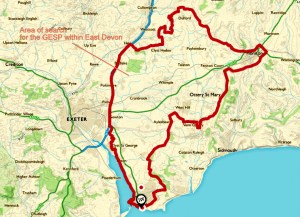
Therefore, the area of search known as the “Exton to Honiton Arc” is restricted into the small area of East Devon that is not restricted by the AONB. Already there is the developing town of Cranbrook, and Exeter Airport, but this is where the GESP planners propose to develop.

Already the rural communities of Clyst St Mary, Feniton, West Hill, Woodbury and the town of Ottery St Mary have questioned the emerging GESP strategy for even more housing. The very reason why people migrate to this area is its rural nature and beautiful countryside. They claim this will be lost with mass development of the scale that the GESP Planners suggest.

The GESP proposals future for East Devon

• The Authorities’ own estimated build out figures and the Government own figures are questionable and being challenged.

• The massive Infrastructure costs to help deliver extra housing and ease congestion are not being supported by recent Government grants.

• There is only a small area of East Devon that can be developed which is not supported by the local communities.

Is the GESP deliverable, is all this extra housing needed in this area especially this small area of East Devon?

The CPRE report published this week claims:
“The current local plans are planning far too many homes.”

Quality and width – part 2 – do not as we do …

A reader with a forensic memory of EDDC matters, on reading Owl’s post below, points out that our ruling party is no stranger to councillors not attending meetings.

From the Exmouth Journal of October 2010. And, what do you know, it was another member of the EDDC’s Planning Committee and the East Devon Business Forum shirking his other duties! And, from the remarks of a current sitting EDDC councillor (Tom Wright – Con) at the time, it seems he feels it is OK for members of HIS party to go missing from meetings!

“At this month’s Budleigh Salterton town council meeting members responded with ‘who, who?’ whenever councillors Ray Franklin and Malcolm Florey were mentioned.

Some residents have questioned how Councillor Florey, who recently moved from East Devon to France, can adequately serve the town.

A Budleigh Salterton resident, who did not want to be named, said many in the town felt misrepresented by Cllrs Florey and Franklin.

She said: “I think it’s quite surprising how Cllr Franklin attends East Budleigh meetings and very rarely attends Budleigh Salterton meetings.

“I would also like to know how can a man who lives in France know what’s going in his ward?”

After the meeting, Budleigh town councillor John Shiel said: “We are not being represented by our ward members. One’s a Francophile and one’s Where’s Waldo.

“The other one is working his socks off for us. We’d be better off just keeping the one.”

The town council has called for a meeting with the district council to discuss its ward member concerns.

District councillor Ray Franklin said he worked hard for the town’s future investment through his role sitting on the district council’s planning committee.

He said: “They have got their view and I have got mine. Malcolm and myself are always positive.

“I hope a meeting takes place and I hope that something constructive comes out of it.”

Budleigh mayor Tom Wright said: “Since I have been mayor, Councillor Franklin’s not appeared to have shown any interest in Budleigh Salterton affairs, but that’s not to say he doesn’t do things behind the scenes for the people he represents.

“When Malcolm Florey was living in East Budleigh he was very active. He got the farmers’ market off the ground, he was behind the opening of the East Budleigh shop and very active and energetic in pursuing the youth club.

“Malcolm Florey did attend our meetings when he was here, but not now he’s living in France. I can’t remember Ray Franklin attending a meeting.”

Malcolm Florey was unavailable for comment at the time of going to press.”

http://www.exmouthjournal.co.uk/news/we-are-not-being-represented-1-677070

Another (lack of) productivity headache for our Local Enterprise Partnership

How fortunate that ex-EDDC Leader Paul Diviani and current DCC Leader John Hart have managed to pass on responsibility for DOUBLING growth in Devon and Somerset by 2030 (not forecast for any other part of the UK economy) to our Local Enterprise Partnership – of which their councils are now very minor members!!! The parcel passed.

The tragedy being that this spurious forecast is now indelibly integrated into “unicorn under magic money tree” thinking at all levels.

“Productivity went into reverse in the first quarter of the year, raising questions over why Britain is no longer churning out the efficiency gains of the past.
Output per hour worked fell by 0.4 per cent in the three months to March compared with the previous quarter, the Office for National Statistics said.
Compared with the first quarter of last year, productivity was 0.9 per cent higher, but this was still very sluggish against the trend rate of growth of almost 2 per cent a year that was routinely chalked up before the financial crisis.
The ONS said that the productivity puzzle remained unsolved and raised possible concerns about inflationary pressures building. Earnings and other labour costs grew by 3.1 per cent over the year, up from 2.9 per cent in the previous quarter.
With wages growing faster than productivity, firms face potential profit constraints in the short run and longer-term pressure to raise prices.
Over the past ten years, productivity growth has been the weakest since modern records began and appears to be the slowest since the early 1820s, when Britain was emerging from the Napoleonic wars.
After previous downturns, productivity has initially stalled but subsequently recovered to trend rates of growth. Productivity is the key factor for a lasting rise in living standards.
Economists have proffered a number of possible explanations for the productivity freeze, including the relatively low level of business capital investment and the reluctance of banks to lend since the crisis.
Others believe the productivity number is understated because of the difficulty of measuring intangible output benefits from the digital economy.
In the ten years since the last productivity peak in the fourth quarter of 2007, output per hour worked is only 1.5 per cent higher. It would have been 20 per cent higher by now if pre-crisis trends had continued.
The Chartered Institute of Personnel and Development said the latest figures were “disappointing but not surprising” given the strong job creation numbers in the quarter and weak economic growth.
Other analysts said that wintry weather in the first quarter would have hit productivity levels in some industries.
The ONS next week reveals the first of its estimates for monthly GDP as well as a rolling three-month figure. Previously it had stuck to quarterly numbers. Britain will be the first advanced economy to try to estimate total national output every month.
One drawback, however, is that it will delay publication of the traditional calendar quarterly number. The Bank of England will not have the benefit of the full second-quarter GDP number when it decides whether to raise base rate early next month.”

Source: http://www.thetimes.co.uk
2 mins read
Patrick Hosking, Financial Editor
July 7 2018, 12:01am, The Times

EDDC Planning: One rule for the businesses, one rule for residents?

How very differently EDDC planners seem to have treated an Ottery St Mary resident with a basic and simple planning question, demanding £40 to start a conversation, compared to an out of Devon business person who may be seen as saving their hide over the Exmouth Seafront debacle!

The Sidmouth Herald reports how EDDC planners tried to get £40 out of Ottery local Adrian Forster who just wanted to know if he needed to go through building regulations to renew his roof.

http://www.sidmouthherald.co.uk/news/fees-for-planning-advice-virtually-a-scam-says-householder-1-5580051

He is apparently not the first to be charged for the privilege of speaking to a planner. (Tip – ask a decent builder not EDDC or, if you can wait for an answer, put in a Freedom of Information request (FOI)!).

Contrast this with how a planning inquiry and subsequent requests for information were dealt with concerning the “Exmouth Eye” business.

In a January 2018 an FOI request was made to EDDC about a planning inquiry submitted by EDDC staff member Alison Hayward (to her planning colleagues) concerning some possible irregularities in the application form for this business.

Investigation showed that the form categorically stated that a named planner had given pre-planning assistance or prior advice (17/2944/FUL). EDDC was asked by FOI for information about that advice. EDDC stated that the pre-application advice was purely verbal advice given to the agent about what needed to be submitted with the application and was not recorded in any format, so presumably the advice was given free of charge and no receipt was issued for any payment.

A business appears to get free advice, a resident has to pay.

By amazing coincidence, WhatdoTheyKnow.com published a response into two further Exmouth Ferris Wheel FOI enquiries (https://bit.ly/2tCGwX4) The answers suggest that EDDC was somewhat economical with the truth about fees being charged – originally stating that fees charged by EDDC for the wheel to take up a great chunk of Exmouth Seafront were exempt from disclosure.

When pressed, however, they did say: “We are charging £151.80 per operational day and no charge on non-operational days”. Earlier, they suggested free non-operational days were not unique to this Ferris Wheel operator and gave a link to their charging regime.

It seems the operator may be in a unique pisition – as their scheme and rates actually appear to make no mention of free days.

The denial of special treatment for their Ferris Wheel friends looks rather hollow now and the ducking, diving and avoiding providing proper answers to FOI’s might be of interest to the Information Commissioner yet again?

A lesson from pre-application planning advice on how to by-pass local objections, Historic England and the EDDC Development Management Committee

There is a very contentious planning application, an amended version of a second application, on a site in the heart of one of our historic villages.  It is in a conservation area, surrounded by listed buildings where the village has an adopted neighbourhood plan. The Grade 1 listed church overlooks the site.

obj.pdf_DocNo=3035887&PDF=true&content=obj 2

The Parish Council oppose this application because the application does not conform to the aspirations and policies within the Neighbourhood Plan. The main priority of parishioners is the preservation of the overall character of the built heritage. The Neighbourhood Plan requires new buildings should “…..respect the local character” and preferably natural traditional building materials and methods should be used. (The proposed two dwellings are contemporary with flat sedum roofs).

Historic England (watchdog of our historic environment) said, in Feb 2018, of the first application:

“… the site in question, sits to the west and is made up of two linear fields that run parallel to the road behind the dwellings. Due to their size and close association to the built environment, it is believed these may have been paddocks for livestock and were potentially connected to the pub.

In recent years, development has occurred to the east in the form of modern bungalows and housing estates. However, these fields act as an indicator of the former rural landscape that characterised the setting of [the village].

A pre-application enquiry has been undertaken with the council, who consider that some form of development may be acceptable on the site. We would highlight the importance of the site as an extant aspect of the former rural setting of the conservation area as well as the contribution it makes in terms of appreciating the former uses of the land and how the development interacted with its rural setting. Therefore, its development would result in some erosion of that quality, which contributes to the significance of the conservation area.”

In spite of this cautionary advice it appears from pre-application correspondence published on EDDC web site that EDDC planners want to facilitate development by ignoring all this, squaring the Councillors and by-passing the DMC.

Applicant’s agent to planning officer e-mail (March 2018):

“We talked about how the application would proceed from this point on, and [X- planning officer] advised that he felt that the team would be supportive of the application, though [sic] that the town council would object as they did before. This would mean that the application would need to go the Chairman’s briefing for delegated approval.

“The process works that when a parish or town council differ in opinion to that of a planning team (planning recommendation report for approval) then the chairman of the planning committee (who meets once a week) would make the decision if the planning report should be followed, and delegated approval is granted, or if it should go to committee [sic].

“The district councillor (Cllr [Y] plus 2 others) will also have a say, though they did not object last time to the two houses, and I [architectural agent for applicant] will be meeting with the Cllr this time to ensure that he understands the application, and the reason for the second application as the district Cllr is allowed to sit in and vote on the delegated chairman’s briefing.”

Historic England continue their concern (May 2018):

“We maintain reservations in respect of the proposal. The orientation of the buildings within the site, their scale and associated ground works to address this issue of height, results in a significant intervention that does not respond to the character and appearance of the conservation area, through the scale and massing of the proposal and its orientation within the plot……..”

And Historic England’s final comment is:

ou could add at the end the final Historic England recommendation:

Recommendation

Your authority should take these representations into account and seek amendments, safeguards or further information as set out in our advice.

Chances of that happening? Owl isn’t taking any bets!

“Theresa May warned plans to make ‘silver-strivers’ who work in their retirement pay NI are ‘toxic’ “

Somewhat controversial when a large proportion of East Devon’ s voters fall into this category:

https://www.telegraph.co.uk/politics/2018/05/06/theresa-may-warned-plans-make-silver-strivers-work-retirement/

Devon may soon be the only non-unitised county in this part of the South West – but for how long?

So, Somerset is moving towards a unitary authority (see below). Inevitable really, isn’t it.

The new HQ for the already combined Taunton Deane and West Somerset authority is ten minutes walk from Somerset County Hall. Taunton Deane and West Somerset are intending to spend £11 million altering their building to accommodate their merger requirements – when Somerset County Hall has a lot of spare capacity.

Meanwhile EDDC proceeds apace with Blackdown House, their new HQ in Honiton, at a minimum cost of £10m – and an ultimate cost of probably MUCH more than that – without at any factoring into their calculations of the likelihood of a unitary Devon proposal similarly coming forward with the same arguments for big savings.

EDDC’s consultants apparently estimated the open market value of Blackdown House on completion of the building to be £3 million. Given the current economic situation, even that might be optimistic.

So a potential BIG loss looming – with the local taxpayer picking up the bills? And that’s if HQ builder Interserve s

If Somerset goes unitary, that will be Somerset, Cornwall and Wiltshire all unitary and Dorset double unitary. Devon will be an anachronistic exception.

Has Devon County Council leader John Hart anything to tell us?

And Owl bets soon-to-be-ex-Leader Paul Diviani may be very pleased with the timing of his exit!

Let’s do the Tory bump and grind again … or maybe not

Javid’s first mistake within 24 hours of his new job:

“Power stance? They look as though they’ve wet themselves.
Mary Hutchison
West Kilbride, Ayrshire”

Guardian letters

Would you take business advice for your small business from our Local Enterprise Council/Serco?

The Heart of the South West Local Enterprise Partnership is obsessed with growth, mostly because it has promised an over abundance of it.

So, it is interesting to receive an email from their “Growth Hub” to see what it promises:

https://www.heartofswgrowthhub.co.uk/

Well that’s nice – they offer advice. Always helpful, though Owl guesses it depends where the advice comes from.

Is it from those “business leaders” on the Board of the LEP? Or one of the board member councillors (though many of those seem to have had either little business experience, none at all, or so long ago that computers hadn’t bedn invented).

No, scroll down to the bottom of the email and you get:

Our mailing address is:

Serco Employment, Skills and Enterprise
Envoy House
61 Longbridge Road
Plymouth, Devon PL6 8LU
United Kingdom

A company which offers outsourcing services all over the world, particularly in the UK.

So what does Wikipedia have to say about Serco?

“The 2017 Paradise Papers revealed that Appleby carried out a risk assessment of Serco and noted it had a “history of problems, failures, fatal errors and overcharging” and had faced allegations of fraud and cover-ups.”

https://en.m.wikipedia.org/wiki/Serco

and an article in The Guardian saying that, in Australia, outsourcing with Serco is “an accident waiting to happen”:

https://www.theguardian.com/australia-news/2018/apr/23/outsourcing-ndis-contact-centres-to-serco-an-accident-waiting-to-happen

and a Telegraph Business article headed:

“Serco recovery still on ‘long and winding’ road, says boss Soames”

“The boss of troubled outsourcer Serco has warned that its road to recovery will be “long and winding” as its strategy to concentrate on providing services to governments means it is exposed to political changes.

Rupert Soames said the business’s five-year plan remained on track, after its shares were hit when the company today announced that last year its revenues fell by 13pc to just over £3bn … .

https://www.telegraph.co.uk/business/2017/02/22/serco-recovery-still-long-winding-road-says-boss-soames/