Rockbeare Parish Council objects to further expansion of Cranbrook

“… Cranbrook town council’s own planning committee objection to the application last month. And now Rockbeare parish council has voted to object to the application.

The objection says that it infringes on the emerging Rockbeare Neighbourhood Plan but also is premature, does not address the issues around congestion at the M5 junction 29 junction, the density of houses is too high, and the location of the all-weather pitch, the play areas, and the gypsy sites are in the wrong place.

Jacqui Peskett, locum parish clerk to the council says: “The application infringes on the emerging neighbourhood plan as the green wedge between Rockbeare and Cranbrook is intended to include the whole area to the east and north of Parsons Lane and that any development of the area to the west of the country park as proposed would potentially cause flooding in Rockbeare village.

“The proposal is premature, since there is still no overall development plan for Cranbrook, now promised for over three years, so issuing any more development permissions may seriously prejudice the proper development of a Cranbrook masterplan.

“The proposal does nothing to address the capacity of the M5/J29 which is already reaching overload at peak times.

“The developers have not learned the lessons of the first phase of development as the density of 45 homes/hectare is too high.

“The proposals makes no provision for healthcare and would exacerbate the already inadequate education provision in the area by adding a further primary school when the capacity of the secondary provision in Cranbrook is already at the limit.”

The objections also has concerns that the location of the all-weather pitch, the play areas, and the gypsy sites are in the wrong place.

But neighbouring Broadclyst parish council decided after a lengthy meeting that they have no comment to make on the reserved matters application.

Cranbrook town council had objected on the grounds that the green wedge between towns would be too narrow, the density of housing was too high and the location of the gypsy sites were in the wrong place.

Since the build of the new town in East Devon began in 2010, 3,500 homes, a railway station, St Martin’s Primary School, play facilities, the neighbourhood centre, local shops, the education campus, the Cranbrook Farm pub, while construction of buildings in the town centre and the sports pitches are underway, while plans for the ecology park in the town have also been submitted.

The application for the southern expansion for Cranbrook would see the town get an additional 1,200 homes, but also a petrol station, a residential care home, employment land, a new primary school, and an all-weather sports facility. …”

[For detailed information see original article]
http://www.devonlive.com/rockbeare-parish-council-object-to-cranbrook-expansion-plans/story-30472214-detail/story.html

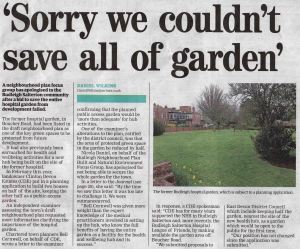
Budleigh Neighbourhood Plan group apologises for being unable to save hospital garden after being outmaneuvered by Clinton Devon Estates

“A neighbourhood plan focus group has apologised to the Budleigh Salterton community after a bid to save the entire hospital garden from development failed.

The former hospital garden, in Boucher Road, had been listed in the draft neighbourhood plan as one of the key green spaces to be protected from future development.

It had also previously been earmarked for health and wellbeing activities for a new hub being built on the site of the former hospital.

In February this year, landowner Clinton Devon Estates (CDE) put in a planning application to build two houses on half of the site, keeping the other half as a public-access garden.

An independent examiner assessing the town’s draft neighbourhood plan requested more information clarifying the importance of the hospital garden.
Chartered town planners Bell Cornwell, on behalf of CDE, wrote a letter to the examiner confirming that the planned public access garden would be “more than adequate” for hub activities.

One of the examiner’s alterations to the plan, ratified by the district council, was that the area of protected green space in the garden be reduced by half.

Nicola Daniel, on behalf of the Budleigh Neighbourhood Plan Built and Natural Environment Focus Group, has apologised for not being able to secure the whole garden for the town.

In a letter to the Journal (see page 20), she said: “By the time we saw this letter it was too late to challenge it. We were outmanoeuvred.
“Bell Cornwell was given more weight than the expert knowledge of the medical practitioners involved in setting up the hub, who know the full benefits of having the entire garden as a facility for the health and wellbeing hub and its success.”

In response, a CDE spokesman said: “CDE has for many years supported the NHS in Budleigh Salterton and, more recently, the Budleigh Salterton Hospital League of Friends, by making available the garden area off Boucher Road.
“We submitted proposals to East Devon District Council which include keeping half the garden, nearest the site of the new health hub, as a garden which would be open to the public for the first time.

“Our position has not changed since the application was submitted.”

Yarcombe Neighbourhood Plan: Inspector unhappy about throttling of new businesses

In this month’s Cabinet agenda papers (page 56) there is a report of changes that its Inspector wishes to see before EDDC accepts it.

This comment caught Owl’s eye:

It is not the role of the planning system to protect existing businesses from the impact of market forces and competition from new entrepreneurs, which would run counter to national policy to support the sustainable growth and expansion of all types of business and enterprise in rural areas. For this reason, I am not satisfied that part ii) of policy CFS2, which requires new proposals not to have a negative impact on existing businesses, has appropriate regard to national policy. Nor would it contribute to the achievement of sustainable development. I therefore propose to modify policy CFS2 to delete ii) of CFS2, paragraph 6.9 and the last part of paragraph 6.8 after ‘our community’. For the reason explained in paragraph 4.9 above, I am modifying the policy to clarify in iii) that any ‘adverse impact’ should not be ‘significant’

Click to access 140617combined-cabinet-agendapublicversion.pdf

It seems that Yarcombe puts the protection of existing businesses over and above the creation of any new ones.

Leader Paul Diviani is the district councillor for Yarcombe and lists amongst other responsibilities:

Blackdown hills Area of Outstanding Natural Beauty (AONB) joint advisory committee
SPARSE rural special interest group
Making it Local Action Group (Chairman)

Surely he supports Tory free market policies and will wholeheartedly support the Inspector’s suggested changes.

Clinton Devon Estates and Budleigh Salterton “health hub” have an unhealthy relationship

Readers will recall an earlier Owl story of landowners Clinton Devon Estates grabbing a large part of the garden to Budleigh Hospital for development, considering the garden surplus to the requirements of the new “health hub” and much more suitable for their plans for two houses:

https://eastdevonwatch.org/2017/03/20/clinton-devon-estates-pitched-against-budleigh-health-hub-in-garden-olanning-battle/

The Budleigh Neighbourhood Plan designated the Hospital garden as open green space. Neighbourhood plans can do this and this space ticks all the NPPF criteria boxes. The garden was considered an essential part of the psychological and therapeutic welfare of patients at the “health hub”.

Bell Cornwell for CDE only commented at the very last minute of the very last stage. They made a number of general comments to EDDC on 16 February 2017 suggesting a loosening of a number of policy phrases and a general comment that too many green spaces were being designated. No mention of Hospital Hubs or development of that site at all.

Click to access bell-cornwell-for-clinton-devon-estates.pdf

An application to build two houses on the hospital garden was then submitted and validated on 27 February 2017 It takes about two-thirds of the garden, rather than the half suggested.

The Plan Inspector asked the steering group for clarification of criteria used in each green space case on 18 April 2017. The steering group responded, and its response was published on the internet.

The Inspector in her report sided with CDE.

The Neighbourhood Plan steering group unanimously agreed to accept all the Inspector’s recommendations except the one where she agreed with Bell Cornwell who, of course, had no medical evidence to draw on!

The decision to accept or reject Inspector’s recommendations now lies with EDDC.

The question now is – how brave will EDDC councillors they be? There is a track record of rolling over for tummy tickles when CDE engages with them. CDE has fingers in many East Devon pies and held restrictive covenants on the seafront at Exmouth that it relinquished to allow EDDC to approve the Grenadier development and has everything from large landholdings to small ransom strips all over the district.

Strong administrative pressure will be to do the easy thing and to get the plan to Cabinet in July with no controversy and no action against CDE.

Local opinion is running strongly against “droit de seigneur” ( medeival feudal rights) in this case.

If it looks like everyone is rolling over without a fight, the plan may well be rejected at referendum.

MP criticises his own government on neighbourhood plan hypocrisy

“Responding to the decision by the Secretary of State on Thursday (16 March) to allow up to 97 houses at Hassocks, in contravention of the village’s emerging neighbourhood plan, Arundel & South Downs MP Nick Herbert said:

“I am dismayed by the Government’s decision, which actually admits that it will erode local confidence in neighbourhood planning, and I simply cannot reconcile it with what I was told in December when Ministers agreed to give more protection to neighbourhood plans.

“While the Government rightly wants to see more housing, they are now undermining the very policy of neighbourhood planning which they championed and which has delivered more homes than expected.

“Until the Government decides to protect neighbourhood plans properly, communities will see little point in going ahead with them. Ministers had better decide whether they want neighbourhood planning or not.

“The Government cannot go on encouraging volunteers in local communities to invest time and money in neighbourhood plans, going to all the trouble of holding a local referendum, if their plans are then torn up in front of their eyes.”

http://www.nickherbert.com/news.php/767/mp-government-is-undermining-its-own-policy-of-neighbourhood-planning

When planning goes horribly wrong

“The family of a businessman who helped shape the future of development in South Devon are set to make hundreds of thousands of pounds after a plot they bought at a knock-down price was designated for housing. Paignton residents have expressed concerns over the future of the land in Waterside Road.

They are unhappy that the space, which backs onto Dartmouth Road, has been cleared of trees and identified for housing in the latest draft of the Brixham Peninsula Neighbourhood Plan.

The land is owned by the family of the neighbourhood plan forum’s vice-chair Adam Billings and was bought at auction from Torbay Council as amenity land in 2014.

Neighbours say the plot would have generated far more money for the taxpayer if it has been sold with planning permission rather being designed to be a green space.

Mr Billings did not wish to comment on the plans for the land but hit out at ‘factually incorrect claims’ that had been made about his actions. He declared an interest in the land during the neighbourhood plan process. …”

http://www.devonlive.com/residents-concern-over-potential-development-of-green-land/story-30203442-detail/story.html

Recall EDDC’s senior planner recently wrote to councillors suggesting that if they had any development land hidden away now was the time to bring it forward!

The strange case of Clinton Devon Estates and the hospital garden

Clinton Devon Estate has just submitted outline planning application 17/0495, for 2 bijou residences, an access road and a small residual strip of green space.

The site is vaguely (and perhaps somewhat disingenuously) described as “east of East Budleigh Road, Budleigh Salterton.”

It is, in fact, the Budleigh Salterton Cottage Hospital garden, gifted 120 years ago in commemoration of Queen Victoria’s Diamond Jubilee. It has been used, ever since, to help patients convalesence and has been planted with an “in-memoriam” garden.

Because of this history and recreational use, the garden has been proposed as an open green space in the emerging Budleigh Salterton Neighbourhood Plan, approved this week by the EDDC Cabinet.

It ticks all the para. 77 NPPF boxes for the designation of open spaces. CDE are stakeholders in the formulation of this plan and at consultation made no comment.

So this application comes as a bit of a surprise to the people of Budleigh Salterton who have been promised an all-singing and dancing “Health Hub” with recreational facilities on the hospital site.

Villages – check if your built-up boundaries have been changed

From Strategic Planning Committee agenda (meeting on 20 February at 2pm – when most people will be at work:

“That it is recommended to Council:

1. That approval is given for the attached East Devon Villages Plan (and documentation that underpins the Plan) to be ‘published’ for a period of six weeks to allow formal comments to be made,

2. Following the six week period the East Devon Villages Plan be submitted for examination together with any comments received during that period,

3. That the Built-up Area Boundaries defined in the Publication Villages Plan, from the 23 February 2017, be used as primary policy for development management purposes instead of the boundaries on the inset plans included in the previously adopted Local Plan.

Click to access combined-agenda-spc-200217-compressed.pdf

page 9 plus appendix maps

“4.6 Main Changes from Consultation Draft Plan August 2016

The draft plan of August 2016 included justification for the approach of using BUAB’s and discussion of alternative approaches and details of how BUAB’s had been defined that is not necessary in the final plan. In terms of individual settlements the main differences between the two plans are highlighted below and full details of how individual sites were assessed against the criteria set and the refinement of this approach for Newton Poppleford and West Hill are included in the ‘Site by Site’ assessments for individual settlements.

Beer – the majority of the western part of the village and the new
housing at Little Hemphay and Bluff Terrace are now included in the BUAB. The wording of policy Beer 01 – Village Centre Vitality now reflects that of Policy E9 of the adopted Local Plan.

Broadclyst – the community orchard and car park in front of the primary school are now excluded and the new buildings at the secondary school included.

Clyst St. Mary – no change to the preferred approach boundary.

Colyton – part of the former Ceramtec site is now included together with
part of a former garage site. Policy 01 has been changed to reflect the
wording of Policy E9 of the adopted Local Plan.

East Budleigh – minor change to exclude parts of three gardens.

Feniton – the ‘Ackland Park’ site and is included but the land adjoining
the railway on the ‘nursery’ site is excluded.

Kilmington – additional land to south west of village is now included.

Musbury – both the ‘Mountfield’ land and ‘Baxter’s Farm’ site (including
village hall) are now included.

Newton Poppleford – minor change to reflect size of King Alfred Way
planning permission and preferred approach boundary followed, which excludes western part of village that was included in previously adopted local plan.

Sidbury – no changes to preferred approach boundary.

Uplyme – boundary now follows that proposed in the Uplyme Neighbourhood Plan.

West Hill – preferred approach boundary largely followed, but with some
limited expansion.

Whimple – no change to preferred approach boundary.

Woodbury – no change to preferred approach boundary.”

Sid Valley Neighbourhood Plan Public Meeting on Friday

“Invitation to the Neighbourhood Plan event, this Friday (27 Jan) at Kennaway House:

You are warmly invited to look at the results and ideas so far, and to give your feedback, at the next public event which takes place in Sidmouth on Friday this week. Details as follows:

“Define the Vision, Shape the Future” Sid Valley Neighbourhood Plan Stakeholder and Residents Event

On 27th January 2017 at Kennaway House, Sidmouth EX10 8NG.

10am -5pm (Morning Session: 10.00 – 13.00 OR Afternoon Session: 14.00-17.00)
Refreshments and a buffet lunch will be provided.

Please confirm attendance by the 23rd January 2017”

For more information on the Neighbourhood Plan either go to the website http://www.sidmouth.gov.uk/neighbourhood-plan or contact Deirdre Hounsom on 01395 576736 or Tim Salt at Sidmouth Town Council offices.

Clyst St Mary Neighbourhood Plan news

“Neighbourhood Plan (Voting this Thursday 26th January)

Following the Inspector’s Report and some amendments, the NEIGHBOURHOOD PLAN has been accepted by East Devon DC.

The Referendum to decide on the adoption of the Plan will be held on 26th January and polling cards have been sent out. Even if you have not received a polling card, all registered voters can participate in the Referendum and cast their votes at Clyst St Mary Village hall.

Please support the Plan by voting for adoption in the Referendum. Once adopted, the Neighbourhood Plan will greatly strengthen the powers of the Parish Council to resist inappropriate development.

The final version of the plan can be viewed on our website: http://www.planning.bishopsclyst.co.uk

If you have any questions on the referendum or the Neighbourhood Plan, please ring Rob Hatton on 01392 874305 or the Chairman, Mike Norman on 01392 877012.”

Greater Exeter: only 5 EDDC councillors get decision-making powers -and its another forum!

“A joint informal advisory reference forum is set up consisting of 5 councillors each from Devon, East Devon, Exeter, Mid Devon and Teignbridge to consider and make comments on draft plan proposals before they are formally considered by each council.”

AND it links seamlessly into Local Enterprise Partnership plans … none of which have been put out for public consultation:

“Role of the joint plan and relationship with other plans

o Setting out the overall scope of the plan and how it can support other related strategies such as the Local Enterprise Partnership’s policies and the results of the devolution discussions. How it relates to the existing and proposed new local plans prepared by each council and with Neighbourhood Plans. Duty to cooperate discussions.”

AND it is all-encompassing:

Plan Strategy
o Description of the overall strategy which best meets vision and the challenges facing the area. Covering the big ticket themes of where and how many homes and jobs are needed, how key environmental assets will be protected and enhanced and the need for new and improved infrastructure.

Strategic Settlements and area strategy and functions

o The implications of the vision and strategy for each of the main settlements and the
plan area as a whole. Setting out the key planning functions and role of these.  Strategic Development Proposals
o The strategic development sites allocated in this plan to meet the strategy and other area’s needs. Implications for the remaining district/city level local plans’ allocations.

Strategic Policies

o Homes – setting the strategic targets for the objectively assessed need for housing,
and considering the need for specific types of housing (including affordable, student,
custom build and accessible homes).
o Economy – considering forecast economic performance and how the plan can
guide/improve. This is likely to include consideration of particular economic sectors (and in particular the evolving role of the knowledge economy and innovation), the protection of key economic assets across the whole plan area.
o City and Town Centres – giving the overall approach to the need and best locations for retail, leisure and other “main town centre uses” taking account of the existing “hierarchy” of town and city centres in the area.
o Environment – policies concerning issues including climate change, air quality, flooding, protection of European sites, other strategic landscape and biodiversity matters and heritage protection.
o Community infrastructure – policies and proposals for the provision of community facilities and infrastructure, including information, smart systems and broadband.
o Quality of development – improving the design of new development, including consideration of density and space standards.
 Implementation, delivery and monitoring – proposals to ensure that policies and proposals happen on the ground and how their success will be measured.”

AND ordinary councillors (including Tories) will be frozen out of decision-making:

It is recognised that it might be difficult for the wider council membership to input into a joint plan through the normal committee/council channels.

It is therefore proposed that member input is provided for in two additional ways.

Firstly, it is proposed that a joint informal advisory reference forum is set up, consisting of 5 councillors from each of the five authorities (total 25 members). There would be an expectation that the councillors from each authority would be politically balanced. This joint forum would consider plan drafts and comment upon them before they are finalised and presented to the meetings of the individual councils. Secondly, officers will run member briefings before each formal committee cycle to allow all councillors to review and comment upon draft plan contents and proposals. This would help to ensure that councillors’ views can be considered before proposals are finalised.

Members should note that there is a separate proposal to set up a Greater Exeter Growth and Development Board as a formal joint committee to consider economic and other related matters across the area. This has been agreed in principle by Exeter and Teignbridge and will be considered by East Devon and Mid Devon (note that Devon County have confirmed their wish not to be involved in such a joint committee at this stage, although this does not undermine their commitment to the GESP). It is envisaged that the member steering group referred to above would have a role reporting on plan progress and strategy to the joint committee. This does not affect the recommendation referred to above to prepare the GESP under Section 28.”

Click to access 170117-combined-strategic-planning-agenda-compressed.pdf

Neighborhood planners – BEWARE

“Cheshire East Council has decided to close its grant scheme which was set up to help communities create Neighbourhood Plans, to establish local planning policy that is relevant to their communities and help shape local development.

The Council launched a programme of support for Neighbourhood Planning in July 2014 through which local town and parish councils could apply for a grant of up to £7,000 from Cheshire East Council to assist with the development of their neighbourhood plan.

The aim of the Neighbourhood Planning Grants Scheme was to support local councils with the preparation of Neighbourhood Plans, specifically to support the commissioning of technical support and specialist advice, community engagement and consultation and collating of necessary evidence.

However, Cheshire East Council has recently decided to cancel the scheme which means Alderley Edge Parish Council will have £7000 less than expected to create a Neighbourhood Plan for the village.

The Parish Council had to apply for the Government grant of £9,000 and receive it before they could apply for the Cheshire East grant of £7,000. Councillor Christine Munro applied on behalf of the council for £4,646.00 which will be use towards funding work on the Neighbourhood Plan. This was received in October 2016.

Councillor Munro explained “At the beginning of the financial year, providing we have used the amount we have received, we can apply for the remaining £4,354.00. We would then have been eligible to apply for the £7,000 from Cheshire East but unfortunately this is now no longer available.”

She added “Providing we can get enough help and advice from residents to enable us to produce a Neighbourhood Plan for Alderley Edge we should be able to produce it within the budget of £9,000.

Speaking about the decision to cancel this scheme, Councillor Ainsley Arnold, Cheshire East Council cabinet member for housing and planning, said: “Cheshire East is a high-performing council which delivers value for money and more than 500 services every day to local people.

“However, it needs to find £100m to balance the books over the next three years because of significant cuts in central government funding and rising demand for services, especially adult social care support.

“The council is a great supporter of neighbourhood planning and over the past three years has sought to build a platform within Cheshire East for communities to meaningfully participate in the plan-making system here.

“We are making good progress on the Local Plan and will continue to support our town and parish councils to deliver plan-led development.

“The council was originally one of the frontrunner authorities that supported neighbourhood planning, to get it off the ground, and has continued to be part of this important tier of plan making ever since, launching it’s own frontrunner scheme in 2014 to fund external consultancy support to the first 14 neighbourhood plans that came forward in the borough.

“Since then, the council has put in place a dedicated neighbourhood planning team, invested in a number of tools and guidance documents to ensure groups can minimise their costs, when employing consultancy support, and has directly provided high-value evidence to support neighbourhood plan policy development alongside providing professional guidance and support to groups across the authority.

“The council’s input and investment in this important area of work now means that Cheshire East is one of the top five most active authorities in the country for neighbourhood planning – with 40 neighbourhood areas either designated or being consulted on and excellent progress being made by town and parish councils across the authority.

“While regrettable that the council has now closed the grants scheme, the work it has done to date has established an excellent platform for neighbourhood planning in Cheshire East and a network of neighbourhood planners that the council will continue to work with to develop neighbourhood plans and deliver sustainable development across the borough.”

http://www.alderleyedge.com/news/article/15009/parish-left-7000-short-as-cheshire-east-pulls-the-plug-on-neighbourhood-plan-grants

Honiton Neighbourhood Plan feedback requested

In this week’s edition of the Herald, in the Honiton area, a copy of the Honiton Neighbourhood Plan questionnaire is being delivered to give residents the chance to put forward their opinions on the subject.

In a statement from Honiton Town Council, it said: “Honiton has seen a lot of housing growth in the last 30 years or so, without the community having a say.

“The Government has made it possible for local people to make a difference to their area by making a Neighbourhood Plan.

“The Honiton Neighbourhood Plan will be a document which says how local people want Honiton to be developed over the next 15 to 20 years.”

The Neighbourhood Plan Steering Group has produced a questionnaire to ask for the views of the whole community on the future of Honiton.

The chairman of the Neighbourhood Plan Steering Group said: “It is really important that everyone in the community, both young and old, has their say.

“If we don’t know what local people want or need for the future, we can’t tell the Local Planning Authority.

“We would also like to hear from people who come to Honiton to work or to use the town’s facilities.”

The responses and comments from the questionnaire will enable the steering group to start to draft the neighbourhood plan.

There will be more opportunities to have your say on the draft plan as it develops.

The final neighbourhood plan, which may take up to two years to complete, will be a planning document which sets out the vision for the town and parish of Honiton and contains policies for the development and use of land in the area.

The town council spokesman said: “Please look out for your copy of the Neighbourhood Plan questionnaire in this week’s Herald, as it is time to have your say.”

http://www.sidmouthherald.co.uk/news/chance_to_have_your_say_on_how_honiton_develops_in_the_future_1_4843733

Important case law on village development and exception sites

Parish council wins High Court planning battle over village needs

East Bergholt Parish Council has won a case against Babergh District Council that it said would affect two more planning applications in the district and potentially other rural areas.

The parish argued in a judicial review at the High Court that Babergh’s decision to allow 10 homes to be built was flawed as it did not take account of the village’s needs as set out in the local plan.

David Bowman, a senior associate at law firm Royds Withy King, which acted for East Bergholt, said: “The judge decided that Babergh had made a number of material legal errors, including misrepresenting to councillors what ‘local housing needs’ means in the context of the local plan.”

Bowman said the court also agreed with East Bergholt’s interpretation that the needs of the local area differed from those of the wider district, and that Babergh had incorrectly conducted an exercise to decide whether development on land within the Dedham Vale Area of Outstanding Natural Beauty had an exceptional reason to overrule the ordinary prohibition on development.

The area is associated with the work of the artist John Constable.

A separate decision by Babergh to allow 144 homes on another site in East Bergholt is being reconsidered and a further development of 75 homes on a third site is also affected by the ruling, Bowman said.

He said the ruling was “a major setback” for what the parish believes is Babergh’s financial dependence on the New Homes Bonus.

A Babergh statement said the council would “consider the judgment of the High Court carefully before making any further comment about the consequences of the court’s decision, or the future consideration of this planning application”.

http://localgovernmentlawyer.co.uk/index.php?option=com_content&view=article&id=29419%3Aparish-council-wins-high-court-planning-battle-over-village-needs&catid=63&Itemid=31

St Ives neighbourhood plan second homes ban lawful

Interestingly, Cornwall Council are trying to use European Law to overturn the decision – when Cornwall voted for Brexit! No doubt Cornwall Council will appeal!

http://localgovernmentlawyer.co.uk/index.php?option=com_content&view=article&id=28980%3Ajudge-rejects-challenge-over-second-homes-ban-in-neighbourhood-plan&catid=63&Itemid=31

Neighbourhood planners beware – developers are out to get you

A bit legalese but VERY IMPORTANT for those currently putting together Neighbourhood Plans.

Developers have won a High Court challenge over a district council’s decision to make a neighbourhood plan.

In Stonegate Homes Ltd & Anor, R (On the Application Of) v Horsham District Council [2016] EWHC 2512 Horsham took the decision to make the Henfield Neighbourhood Plan on 27 April 2016. This followed a referendum earlier in the month where the plan was passed with a vote of 94.3% of the voters.

The claimants were developers who were promoting a 72-dwelling site on the western side of Henfield. They have appealed Horsham’s refusal of their planning application for that site in November 2014; the decision is with the Communities Secretary for determination.

The claimants issued a claim under section 61N of the Town and Country Planning Act 1990 (as amended) (the 1990 Act) over Horsham’s making of the neighbourhood plan. They put forward three grounds, which were that:

The defendant council had failed to lawfully assess reasonable alternatives to the spatial strategy as established by the neighbourhood plan and, in particular, the alternative of permitting development on the western edge of Henfield;

The defendant had failed to consider any alternatives to the Built-Up Area Boundary (BUAB) as established in the neighbourhood plan and had failed to act rationally in the selection of the BUAB;

The defendant and/or the examining inspector failed to give any or adequate reasons as to why the neighbourhood plan met EU obligations.

The council as the defendant submitted in response:

(i) That the challenge was limited in scope by section 38A(4) and section 38A(6) of the 2004 Act to a consideration of whether the making of the neighbourhood development order would breach or would otherwise be incompatible with any EU obligation or any of the Convention rights;

(ii) Even if the scope of challenge was not so limited the option of developing land to the west of Henfield and that of including the “Barratt site” within the BUAB of Henfield had been adequately dealt with by the examiner and the defendant in a proportionate way and the reasons that had been advanced were adequate.

However, Mrs Justice Patterson found for the claimants across a number of grounds:

The plan was quashed on four grounds:

It is incumbent upon the makers of the plan, the Independent Examiner and the making authority when certifying in its opinion that the plan was compliant with EU law to employ reasoning that is sound in the public law (Wednesbury) sense.

The maker of the plan is obliged to undertake an objective assessment of the policies of the plan when discharging the above duty.

That alternatives need to be accurately presented in order for the SA/SEA of a plan to comply with European law.

All key policies of the plan need to be assessed against reasonable alternatives to have a EU law compliant SA/SEA.

http://localgovernmentlawyer.co.uk/index.php?option=com_content&view=article&id=28646%3Aboundaries-of-the-soft-touch-approach&catid=63&Itemid=31

Source: http://localgovernmentlawyer.co.uk/index.php?option=com_content&view=article&id=28643%3Adevelopers-win-high-court-battle-over-neighbourhood-plan&catid=63&Itemid=31

“East Devon continues to be one of most active districts in UK with 40 Neighbourhood Plans in production”

EDDC produced the above press release headline as spin:

http://eastdevon.gov.uk/news/2016/09/east-budleigh-with-bicton-neighbourhood-plan-undergoing-consultation/

Unfortunately, the truth is more likely that EDDC is so keen on its developers and developing anything and everything, that neighbourhoods are scrambling as fast as they can to protect what few green and pleasant places they still have left after the Local Plan hoovered most of them up, before developers get their sticky mitts on them!

What locals like least about the Sid Valley

“… In total, 88 people said the thing they liked least about the town was transport, which included parking, cars, traffic and speeding.

The second most-disliked response was East Devon District Council, said some 45 residents. This included topics such as planning, the Local Plan and Knowle.

Housing and inflated prices due to wealthy retirees, along with elderly residents and too much emphasis on their needs, were next on the list with 25 votes each.

http://www.sidmouthherald.co.uk/news/questionnaire_results_reveal_your_likes_and_gripes_about_sid_valley_1_4669051

Hill Barton and Greendale business parks to be treated as villages with built-up area boundaries

Agenda pages 95 and 99 provide indicative maps of the suggested boundaries.

“3.8 Hill Barton and Greendale Business Parks – The adopted Local Plan advises that these two business parks will feature in the Villages Plan.

3.9 Therecommendedpolicyapproachsetoutintheconsultationdocumentisforthese business parks to have what is termed a ‘Business Park Development Boundary’. Within this boundary infill development and redevelopment of existing buildings, for employment/job generating uses, will be permitted. Land beyond the Business Park Development Boundary is be classified as countryside and further employment or other development will not typically be permitted as adopted Local Plan Countryside policies will apply.

3.10 The policy approach for these two business parks is one of placing clear constraining boundaries in respect of scope for outward expansion. Whilst there could be economic benefits associated with further employment growth at these business parks the potential benefits need to be weighed against environmental consideration which specifically include potential for adverse landscape impact and poor accessibility to these places of employment for cyclists and pedestrians. There is also potential for adverse social impacts from further development on nearby residential communities, including at Woodbury Salterton in respect of Greendale and Farrington in respect of Hill Barton.”

Click to access 210716-combined-strategic-planning-committee-agenda.pdf