“BBC investigates rural hospital transport”

“Broadcast on Friday (30 March), the whole episode of BBC Radio 4’s Farming Today programme on Friday (30 March) examined the issue of hospital transport.

The programme details the impact of large-scale cuts on bus services since the introduction of austerity measures.

At the same time, medical services have been increasingly concentrated in ‘centres of excellence’ in towns and cities, with few specialist facilities available in local community hospitals.

Rural Services Network chief executive Graham Biggs told the programme more and more services were being centralised into larger towns.

“Accessing those services is increasingly difficult whilst at the same time public transport is being reduced,” said Mr Biggs.

It was true there was a shortage of medical specialists but something had to be done around accessibility – whether via public transport or some other means, he said.

Patients in rural areas needing to use public transport to get to hospital often faced painfully long journey times, reported the programme.

Presenter Emma Campbell travelled to hospital with a listener called Sandra, who has to take three buses in each direction to get from her home in Somerset to her appointment in Bath.

Sandra faced a travel time of over three hours each way, for a 10 minute appointment – a situation which was “not uncommon at all” for rural residents, said Mr Biggs.

The programme also heard from representatives of Age UK’s ‘Painful Journeys’ campaign, who also explained the extent of the problem in rural areas.

The full programme can be heard by clicking here

https://www.bbc.co.uk/programmes/b09wpn4f
(available until 28 pril 2018)

“The Greater Exeter plan has been delayed”

Owl is STILL having difficulty understanding how the Greater Exeter Strategic Plan (GESP) fits in with the Devon and Somerset Heart of the South West Strategic plan!!! So many strategies, so many plans, so many people being paid to work out how to invent what might, or more likely might not, turn out to be a wheel – though one of them MIGHT just manage to invent a square one!

“Mid Devon, East Devon, Teignbridge and Exeter City Council, in partnership with Devon County Council, are teaming up to create a Greater Exeter Strategic Plan (GESP) which focuses on the creation of jobs and housing until 2040.

… A consultation on the issues that the GESP should focus on took place 12 months ago and it was initially hoped that a consultation on a draft plan would begin in January of 2018.

But publication of the draft plan has been delayed and it is now likely that the draft GESP will be published in the summer of 2018.

Explaining the delay, a statement said: “In respect of the Greater Exeter Strategic Plan (GESP), and since our last Local Development Scheme was approved, there have been a number of factors which have delayed plan production.

“These include the fact that a great many sites were submitted through the Housing and Employment Land Availability Assessment ‘call for sites’ and these are being carefully assessed as well as further draft changes to national Government planning policy and a wish to investigate differing ways to ensure we can secure the best forms of development, including the highest quality new housing with supporting facilities, to meet our future needs.”

… The GESP will sit above District-level Local and community Neighbourhood Plans, taking a long-term strategic view to ensure important decisions about development and investment are coordinated. … “

https://www.devonlive.com/news/devon-news/greater-exeter-plan-been-delayed-1412993

“I don’t believe it!” – NHS Providers say we are short of at least 10,000 hospital beds and are treating our elderly shamefully!

“The NHS is more than 10,000 beds short of what it needs to look after older people properly, hospital leaders have said.

NHS Providers, which represents hospitals, said that it was impossible for waiting time targets to be met this year and warned that the government’s pretence that they would be met created a “toxic culture” similar to that which led to the Mid Staffordshire scandal.

This week Theresa May promised that a long-term plan for NHS budget rises would be agreed within months, and will be under pressure to agree increases of up to £20 billion over five years.

However, Jonathan Ashworth, the shadow health secretary, said that “a nod and wink from the prime minister” was not enough for patients.

The NHS has not hit any of its main targets for more than two years. Chris Hopson, chief executive of NHS Providers, said: “The levels of performance expected and the savings demanded for next year are beyond reach. While we strongly welcome the prime minister’s commitment to increase long-term funding for the NHS, it makes no immediate difference to the tough task facing trusts for next year.”

Mr Hopson’s report estimates that 3.6 million patients will not be treated within four hours at A&E over the next year and 560,000 will be denied routine surgery within 18 weeks. He said that hospitals could make £3.3 billion in savings next year but that ministers had demanded 20 per cent more than this.

“This creates a toxic culture, based on pretence, where trusts are pressurised to sign up to targets they know they can’t deliver and then miss those targets as the year progresses,” his report said.

The NHS is probably somewhere between 10,000 to 15,000 beds short on a bed base of about 100,000.”

One hospital chief executive suggested that hospital overcrowding pointed to deep social problems. He said: “As a country we don’t look after old people well. We have too many people living by themselves in houses that are unsuitable . . . In the end they get really unwell and call 999.”

Source: The Times, pay wall

Health Cheque Up

£20bn for the NHS over 5 years!

Does that mean that the CCG will cease its destruction of Devon’s NHS services? Does it mean that current numbers are now meaningless?

Or does it mean that the cash will arrive too late to prevent this or not arrive at all?

Or does it mean that most of the cash will be directed to marginal Tory seats before a General Election?

Is NHS privatisation a good idea? “Carillion bosses displayed ‘greed on stilts’, MPs claim”

We are not allowed to see or scrutinise contracts placed by the NHS with private companies. Carillion (formerly Tarmac) had many service contracts with the government.

“… When considering clawbacks – an arrangement for retrieving executive rewards in the event of poor performance after a bonus has been paid – the board opted to rule out extending the use of the device beyond a handful of its most senior directors. The papers show the remuneration committee feared more conservative pay arrangements for particular contracts “would have a detrimental impact on performance”.

The trove of information from the select committees also shows that Carillion’s adviser, Deloitte, said in September that weak provisions didn’t allow any bonuses paid in cash to be clawed back at all.

The remuneration committee extended its clawback conditions to cover serious reputational damage and failures of risk management around that time, however, the MPs said they had seen no evidence to suggest any further attempts were made to return cash from bonuses to the business.

The latest swathe of evidence against the company comes amid the continuing fallout of Carillion’s collapse in January with debts to its 30,000 suppliers worth about £2bn. …”

https://www.theguardian.com/business/2018/mar/26/carillion-bosses-displayed-greed-on-stilts-mps-claim

Should Randall-Johnson remain chair of the DCC Health and Social Care Scrutiny Committee (or even be a councillor at all?)

We all know our problems with Randall-Johnson as Chair of DCC’s Health and Social Care Scrutiny Committee (or, if not, we should). Here are just a few of many Owl posts on this councillor and her behaviour as its Chair:

https://eastdevonwatch.org/2017/08/12/conduct-of-health-committee-members-investigated-by-devon-council-diviani-and-randall-johnson-heavily-criticised-for-behaviour/

https://eastdevonwatch.org/2017/06/24/claire-wrights-report-on-the-disgraceful-dcc-nhs-meeting-and-its-disgraceful-chairing-by-sarah-randall-johnson/

https://eastdevonwatch.org/2017/08/31/councillor-calls-for-randall-johnson-resignation/

NOW, it seems, she was EXTREMELY reluctant to allow the CCG’s Sustainability and Transformation Plans to be a standing item on her committee’s agenda and inly the intervention of a “committee adviser” led to this being agreed. See Claire Wright’s blog for details:

http://www.claire-wright.org/index.php/post/sustainability_and_transformation_cuts_plan_agreed_to_be_an_item_on_every_h

“… Essentially, the NHS in Devon is looking at a £500m overspend by 2020 unless major cuts and centralisation of services take place.

It is absolutely vital that the committee keeps a very close eye on what cuts are to be made and how this is affecting patients. We are their only ears and eyes on this.

When I made this proposal yesterday – that we receive a detailed report at each committee meeting. Chair, Sara Randall Johnson appeared to be reluctant to introduce such a standing item, given all the other issues that needed to be examined.

I could not see her point of view at all. Surely, this is the most important issue facing Devon’s patients today?

Committee adviser, Anthony Farnsworth suggested that councillors have sight of the CCG’s own financial reports relating to the STP on a regular basis and this was a legitimate area of scrutiny. …

This was agreed.

Here’s the webcast – https://devoncc.public-i.tv/core/portal/webcast_interactive/318671

What is this woman’s problem? Is it simply that she knee-jerks a “no” on any and every proposal from Independent Claire Wright” – putting personalities before what is best for Devon, its healthcare and its scrutiny? We know she has problems with Ms Wright’s forthright defence of our NHS against cuts and privatisation (though the problem seems to stem from further back when the then Leader of East Devon District Council was ousted from her seat by the likeable, knowledgeable and planning policies aware winning candidate – Claire Wright).

Or is it even more dangerous than that? Putting HER personal political beliefs and ideology above those of others – including moderate DCC Tory councillors – and forcing them on others by whatever means she has at her disposal?

Questions, so many questions, and so few answers.

Campaign group forces further consideration of “integrated care” in Devon

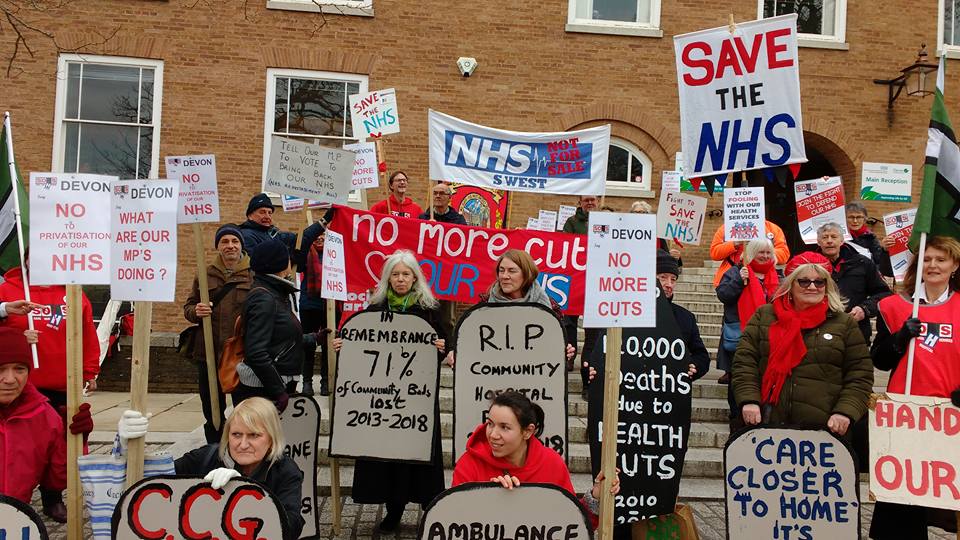
Save Our Hospital Services scored a major victory today when after its demonstrations (including another one today):

Emails, public speaking and media onslaught led to the DCC Health Scrutiny Committee refusing to agree to the commencement of the secretive and undemocratic imposition of an “Integrated Care System” (accelerating privatisation of health and social care) being forced on the county from 1 April 2018 (probably not coincidentally April Fool’s Day).

Well done SOHS!

BUT remember we are in the national local government election period and it may well be that, once this has passed, the Tory enthusiasts for this privatisation by the back door may well rediscover their taste for it!

“Councils face ‘almost impossible struggle’ to fund social care””

“Revenue from council tax and business rates in England will not keep pace with a growing social care need – and the funding gap will significantly increase, the Institute for Fiscal Studies warned today.

Even if council tax revenues increased by 4.5% a year, adult social care spending is likely to amount to half of all revenue from local taxes by 2035, the IFS has predicted.

There is “no easy way to square the circle”, the think-tank recognised in its report Adult social care funding: a local or national responsibility?, “without backtracking on reforms to local government finance and reintroducing general grant funding”.

Grant funding from government is planned to end by 2020, and councils will be expected to rely on council tax and business rates for most of their revenue.

If councils meet their social care costs through local tax revenues “the amount left over for other services – including children’s services, housing, economic development, bin collection – would fall in real terms (by 0.3% a year, on average)”, the IFS warned in the report, funded by the Health Foundation charity.

One in 10 councils are to see their share of the population aged 75 and over increase by 6 percentage points or more over the next 20 years, the IFS noted.

Potential solutions all have drawbacks, the report suggested.

These include a ring-fenced top-up grant from government but this could lead to councils cutting back on how much of their own money is allocated to these services.

If government fully funded social care, this would “remove over one-third of what councils currently spend from local control, reducing residents’ say in local spending decisions”, the report stated.

Polly Simpson, research economist at the IFS, said: “The government has to decide whether it thinks adult social care is ultimately a local responsibility, where councils can offer different levels of service, or a national responsibility with common standards across England.

“If it opts for the latter, it cannot expect a consistent service to be funded by councils’ revenues, which are increasingly linked to local capacity to generate council tax and business rates revenues.”

David Phillips, associate director at IFS, suggested the government could “decide to keep and, over time, increase the general grant funding for councils that it currently plans to abolish in 2020”.

He added: “More radically, it could devolve revenues from other more buoyant taxes, such as income tax, to councils to help fund local services.” …
http://www.publicfinance.co.uk/news/2018/03/councils-face-almost-impossible-struggle-fund-social-care

Hunt fires warning shots about social care

“Jeremy Hunt has promised an upcoming green paper will “jump start” a debate with the public about how social care should be funded in the future.

Speaking to an audience of social care workers on Tuesday, the health secretary recognised the “economics of the publicly funded social care market are highly fragile” and said care models needed to “transform and evolve”.

He said: “We will therefore look at how the government can prime innovation in the market, develop the evidence for new models and services, and encourage new models of care provision to expand at scale.”

Hunt outlined seven key principles the government is considering as it draws up its social care green paper, due to be released before the summer.

He added: “We must make sure there is a long-term financially sustainable approach to funding the whole system.”

He added that this would “take time” but “must not be an excuse to put off necessary reforms”.

“Nor must it delay the debate we need to have with the public about where the funding for social care in the future should come from – so the green paper will jump-start that debate,” Hunt promised.

He also said he would look at making paying for social care fairer and less dependent on the “lottery of which illness” a person gets.

He explained the green paper would look at giving people greater control over the care they received, announcing he would consult on personal health budgets. …”

http://www.publicfinance.co.uk/news/2018/03/hunt-vows-social-care-green-paper-will-spark-funding-debate

Campaigners in Huddersfield win right to judicial review of hospital closure

Campaigners against a hospital closure in Huddersfield have been granted a judicial review hearing of the decision.

Hands Off Huddersfield Royal Infirmary said plans from Calderdale and Huddersfield NHS Foundation Trust would see the town’s hospital demolished but not replaced.

Its chair Mike Forster said the grounds for judicial review would be flaws in the consultation, inadequate travel and transport provision to alternative hospitals, lack of community care provision and potential breach of the law on equalities.

The campaign group originally applied to the High Court in November.
Forster said: “We would like to thank the people of Huddersfield who have made this legal breakthrough possible through your long standing support.
“To those who told us this was a done deal, you were wrong. If you stand and fight, you can win. This is a huge hurdle we’ve passed but the fight goes on.”

The trust did not respond to a request for comment, but its chair Andrew Haigh told the BBC: “We note the judge’s findings today and we will continue to work with our healthcare partners, local communities, scrutiny and campaign groups.”

http://localgovernmentlawyer.co.uk/index.php?option=com_content&view=article&id=34637%3Acampaigners-secure-permission-for-legal-challenge-to-hospital-closure&catid=174&Itemid=99

“WHY WE CANNOT ACCEPT THE INTEGRATED CARE SYSTEM, by the Councillor who first exposed the CCGs’ plans”

PRESS RELEASE

“I am the County Councillor who first put the ICS (Integrated Care System) on the Council’s agenda, at the last Health Scrutiny in late January. This is what has led to the item at today’s meeting. Then, the CCGs and the Council’s leadership had failed to bring the proposals to Council ​- ​although they had been agreed since September. ​They did not want debate on the proposals in the Council – still less for the public to know what is planned.​

I shall be telling Health Scrutiny [Committee, meeting today] that even now, despite having 6 months to produce proper information, they still haven’t revealed some of the most ​worrying aspects of the ICS:

funding of services in the new system, how contracts will work, and whether these will lead to privatisation

details of the proposed Local Care Partnerships for N, S, E & W Devon and for Mental Health which are key to the system, and how they will be funded/contracted

the governance of the system – as things stand, Devon County Council could be handing over control of its social care services to unelected quangos (the CCGs)​​

plans for public engagement – the Cabinet paper says this is necessary but there are no proposals.

However, we do know there will be equalisation of funding between Eastern and Western Devon. Because the CCGs say Western Devon is relatively underfunded, this means deeper cuts in Eastern Devon – probably including closures of community hospitals. Scrutiny should reject this ‘equality of misery’.

On governance, I support the proposals of Cllr Hilary Ackland that if integrated commissioning in the ICS is to go ahead, a reformed Health and Wellbeing Board with proper all-party representation should become the integrated commissioning board. Democratic control is not an optional extra.

Devon County Council cannot support these proposals as they stand. Without full answers to our questions, Health Scrutiny should call in the plans.

I should be happy to talk to (journalists) today​. I shall be with the Save Our Hospital protestors ​outside County Hall ​between 12.30 and 1​ or you can phone me on ​07972 760254.

Martin Shaw
Independent East Devon Alliance County Councillor for Seaton & Colyton”

“Official figures mask A&E waiting times”

“Tens of thousands more patients spent more than 12 hours in A&E waiting for a bed last year than official figures suggest. Doctors and MPs called for a change to how “trolley waits” were reported in England after an investigation by The Times.

Official numbers show that 2,770 A&E patients had to wait more than 12 hours for a bed last year. These NHS statistics only capture the time between a doctor deciding a patient needs to be admitted and then being found a place on a ward. If the time is recorded between arriving at A&E and being found a bed, the number of patients who had to wait in emergency departments for more than 12 hours leaps to at least 67,406 patients, 24 times higher, according to data obtained under freedom of information laws.

The true figure is likely to be even higher, as only 73 hospitals out of 137 replied to the requests. The Times also asked hospitals for details of the longest wait they had recorded each week. Those revealed about 200 patients waiting more than a day for a bed last year. In December a 103-year-old woman spent 29 hours in A&E before she was admitted to the Great Western Hospital in Swindon, Wiltshire. The trust said that it had been one of the busiest months on record. The longest wait reported to The Times, of almost four days, was a 16-year-old boy at Barking Havering and Redbridge NHS Trust.

Sarah Wollaston, Conservative chairwoman of the health select committee, said that long waits in A&E raised patient safety concerns. “When departments are already at full stretch, having to care for individuals who may be very unwell and waiting for transfer to a more appropriate clinical setting reduces the time clinicians are free to assess and care for new arrivals and this can rapidly lead to spiralling delays,” Dr Wollaston said. “The total length of time that people are spending in emergency departments should be recorded alongside the current figures.”

Paul Williams, a Labour member of the committee, said: “If the clock doesn’t start ticking on ‘trolley waits’ until this decision has been made, then hospitals can legitimately have someone waiting for more than three hours to be seen and assessed, and then another 11 hours on a trolley without this leading to a breach of targets.” In Wales, Scotland and Northern Ireland, 12-hour waits are recorded from when a patient arrives in the department.

Rachel Power, chief executive of the Patients Association, said: “It’s clear from this data that many patients are enduring even longer waits with their safety, privacy and dignity compromised than the official statistics show.”

Taj Hassan, president of the Royal College of Emergency Medicine, said: “I think all independent observers would agree that, at the moment, the way we are describing our 12-hour trolley waits is not accurately describing the numbers.”

An NHS England spokesman said: “In the last 12 months to February 2018 the number of 12-hour trolley waits has dropped by more than 20 per cent on the previous year, and this has been achieved while hospitals also successfully looked after 160,000 more A&E patients within the four-hour target this winter compared to last winter.” NHS Digital is set to publish separate monthly statistics on the total number of patients spending more than 12 hours in A&E, whether or not they eventually needed admission. They said there were more than 260,000 during the financial year 2016-17.

Behind the story

Hospitals are expected to treat, admit or discharge 95 per cent of patients within four hours of their arrival at A&E (Kat Lay writes).

However, they have not met that target since July 2015. In January, only 77.1 per cent of people going to larger A&Es were dealt with within four hours.

For patients who require admission — “the sickest group” attending A&E, says the Royal College of Emergency Medicine — it appears to be worse.

At hospitals that provided figures to The Times, on average only 53 per cent of patients requiring admission were found a bed within four hours in January this year.

A lack of social care means that many of the beds that such patients need to be moved on to are taken up by people who do not need to be in hospital any longer, doctors complain.

Source: The Times (pay wall)

Our NHS: Demo at DCC HQ Thursday 22 March from mid-day

Join SOHS demo from midday – County Hall, Exeter – This Thursday 22nd March.

Save Our Hospital Services (SOHS) Devon are lobbying against plans to introduce structural changes in NHS delivery of services from April 1st with the introduction of an Integrated Care System (formerly known as ‘Accountable Care System’). This is yet another reorganisation of Health & Social Care services, which hasn’t been consulted on and is part of the ‘Sustainability & Transformation Plan’ imposed by the government to cut another £550 million off Devon’s Health care and introduce more privatisation…

IF YOU CARE ABOUT THE NHS COME AND JOIN US

We will also address the DCC Health & Adult Care Scrutiny Committee at 2.00pm on Thursday with 12 key questions about Integrated Care Systems (ICS)
planned for introduction by NHS England from April 1st without consultation. SOHS have sent these 12 questions to Dr Tim Burke, Chair of the NEW CCG
which meet also at 1.00pm on Thursday at County Hall.

Control of community care in Nottinghamshire falls to controversial US company

“NHS Protectors’ worst fears are being realised as USA’s Centene is likely to control Greater Nottingham Accountable Care System, by taking over the NHS Commissioner’s role in a £206m community services contract.

At the very time that its discredited subsidiary Ribera Salud – which is being kicked out of Spain by the Valencia Green/Podemos/Socialist government – has appointed former New Labour Health Secretary Alan Milburn as a Director and has sent lots of executives to UK to help Centene UK with its plan of buying primary care and mental health companies.

The UK subsidiary of Centene – a US sub-prime health insurance profiteer that has got rich off managing Obamacare’s publicly-funded Medicaid programmes which provide health insurance for people on a low income – is likely to take over the NHS commissioner’s role in the £206m, 7 year contract for out-of-hospital community services, that Nottingham City Clinical Commissioning Group recently awarded to Nottingham City Partnership Community Interest Company. …”

This seems to bear out NHS protectors’ worst fears that Accountable Care Systems or Organisations are Trojan horses designed to import US companies into key controlling positions in these new types of local NHS and social care services.

Centene UK, assisted by executives from its discredited Spanish subsidiary Ribera Salud, is also studying the acquisition of primary care and mental health companies in the United Kingdom, according to recent reports from Valencia Plaza.

Ribera Salud recently appointed the former New Labour Health Secretary Alan Milburn to its Board of Directors, to help it “continue with its expansion plans.” In addition, during the recent visit to Valencia of the United Kingdom’s ambassador to Spain, Simon Manley, a British manager of Ribera Salud contacted him to explain the company’s plans. …

Nottingham City Clinical Commissioning Group will become part of the Nottinghamshire/Greater Nottingham Accountable Care System. This will be:

“a single risk bearing entity to managing [sic] the entire care continuum. The successful provider must form part of the ACS and…will be expected to help shape and deliver its part of the single risk bearing entity.”

This sounds like the Accountable Care Organisation contract – which NHS England is not approving now and which is the subject of two Judicial Reviews in the Spring and a public consultation at some unspecified point in time.

The contract notification says that when the Accountable Care System is implemented, this will require a contract variation which:

“will require the successful provider to provide its consent to the potential future transfer of the CCG’s role under the contract.”

This contract variation will mean transferring the contract from Nottingham Clinical Commissioning Group to another provider, or the Care Integrator (Centene UK).

It seems that Nottingham City Clinical Commissioning Group has taken a gamble on the likelihood that NHS England will be approving the Accountable Care Organisation contract by the time the Sustainability and Transformation Partnership has figured out its business case to consider the options for partner organisations in managing the Accountable Care System components and has secured legal and procurement support to advise on this.”

https://calderdaleandkirklees999callforthenhs.wordpress.com/2018/03/19/usas-centene-to-take-over-nhs-commissioners-function-in-206m-community-services-contract-as-accountable-care-system-sets-up/

Seaton and Area Health Matters meeting, Friday 23 March 9 am1 pm – registration required

From the blog of DCC East Devon Alliance councillor Martin Shaw:

“A reminder to all involved in local community groups, especially those with an interest in health and wellbeing in the broadest senses, that Seaton and Area Health Matters will convene in the Town Hall on Friday 23rd March, 9 for 9.30 until 1 pm. There is still time to register!

Book here:

https://goo.gl/forms/7laMUjhByt8F0w053

You are invited to participate in this community led event with key stakeholders around the future health and wellbeing of all the people in our communities, in response to the new landscape affecting Seaton and surrounding area as a result of NHS and Government policies advocating Place-Based Care in health provision and cross-sector collaborative working with community groups

The aim: To discuss what we know, where there are gaps/challenges and how, as a community we will address these to ensure collaborative approaches to co-design and co-produce local health services/activities that meet the needs of all the people in our communities.

Invitees: Management and senior level employees and volunteers / trustees from community, voluntary and social enterprise sector as well as public and private organisations.

Area to include: Seaton, Colyford & Colyton, Beer, Axmouth, Branscombe

PROGRAMME:

Welcome: Mayor of Seaton – Cllr Jack Rowland

Community Context:
• Dr Mark Welland – Chairman of Seaton & District Hospital League of Friends
• Roger Trapani – Community Representative, Devon Health and Care Forum
• Charlotte Hanson – Chief Officer, Action East Devon

Strategic and Services Overview – Place Based Care:
• Em Wilkinson-Bryce – Royal Devon and Exeter NHS Foundation Trust
• Chris Entwistle – Health and Social Care Community Services
• Dr Jennie Button – Social Prescribing Lead – Ways 2 Wellbeing project in Seaton

Workshop, Networking and Discussion will form the main part of this event:
• Workshop 1 – What is working well and what are the challenges for Seaton and surrounding area?
• Workshop 2 – Working together to improve health and wellbeing outcomes? What support do we need?”

Reminder – Seaton and Area Health Matters meeting in Seaton Town Hall on Friday 23rd from 9.

Royal College of Emergency Medicine dismisses bad weather and flu as cause of A and E crisis

“Unacceptable A&E waits are the new normal, doctors declared today, after NHS hospitals suffered yet another worst month on record.

The Royal College of Emergency Medicine dismissed excuses about bad weather and flu and urged patients to write to their MPs to demand improvement.

A&E units saw only 85 per cent of patients within four hours in February, worse than the previous low of 85.1 per cent seen in December and January last year. In major hospitals, the figure was 76.9 per cent, also the lowest since records began in 2010, and in some units barely half of patients were dealt with in time. It means 100,000 more people suffered longer delays than last year.

NHS chiefs blamed an inexorably rising tide of sicker patients, with this winter seeing 261,000 more people coming to A&E than last year, up 5 per cent. More of these patients were also ill enough to need a bed, with emergency admissions up 6 per cent to 1.4 million. Wards were about 95 per cent full all winter, well above the 85 per cent estimated to be safe.

Taj Hassan, president of the Royal College of Emergency Medicine, said: “Performance that once would have been regarded as utterly unacceptable has now become normal and things are seemingly only getting worse for patients. It’s important to remember that while performance issues are more pronounced during the winter, emergency departments are now struggling all year round.”

In January the heads of half of England’s A&E units wrote to the prime minister to warn her that patients were dying in corridors.

Dr Hassan said: “The current crisis in our emergency departments and in the wider NHS is not the fault of patients. It is not because staff aren’t working hard enough, not because of the actions of individual trusts, not because of the weather or norovirus, not purely because of influenza, immigration or inefficiencies and not because performance targets are unfeasible. The current crisis was wholly predictable and is due to a failure to prioritise the need to increase healthcare funding on an urgent basis.”

He added: “We need an adequate number of hospital beds, more resources for social care and to fund our staffing strategies that we have previously agreed in order to deliver decent basic dignified care. We would urge our patients to contact their MP to tell them so.”

Nigel Edwards, head of the Nuffield Trust think tank, said that A&Es were in their worst shape since 2004.

“The main waiting times targets for cancer and planned treatment are being missed, and there is no sign of recovery,” he said. “Fundamentally, these pressures are driven by a lack of money and staff. If these are not addressed it is inevitable that as difficult as February has been for NHS staff and patients there will be worse to come.”

Figures from the British Social Attitudes survey last week showed dissatisfaction with the NHS up seven points to its highest level since 2007, with most people blaming the government.

A spokesman for NHS England said: “NHS staff continued to work hard in February in the face of a ‘perfect storm’ of appalling weather, persistently high flu hospitalisations and a renewed spike in norovirus. Despite a challenging winter, the NHS treated 160,000 more A&E patients within four hours this winter, compared with the previous year. The NHS also treated a record number of cancer patients over these most pressured months of the year.”

He pointed to figures showing that 22,800 routine operations had been cancelled in January, less than half the number feared.

However, the Royal College of Surgeons pointed out that 62,000 fewer operations were carried out this winter, despite rising demand, because procedures were not scheduled in the first place to help take pressure off A&Es.

Professor Derek Alderson, its president, said: “NHS England’s advice to hospitals to cancel all elective operations in January was a necessary evil under the circumstances. It meant patients avoided the distress of having their operation cancelled after turning up to hospital and it freed up NHS staff and resources to deal with patients needing emergency treatment. However, it also inevitably prevented many patients who are in discomfort or pain from having an operation when they needed it, potentially causing their condition to deteriorate.”

Jonathan Ashworth, shadow health secretary, said: “The government has let NHS patients down this winter. Every year under this government waiting times get worse and more and more patients face hours on end in overcrowded emergency departments. The brilliant staff of the NHS have been working round the clock in the wind and the snow but they’re being undermined by a government which has refused to give the NHS the resources it needs.”

Source: The Times (pay wall)

UK deaths up 10,000 over 7 weeks – even allowing for bad winter AND flu

“Ten thousand more people died in the first seven weeks of this year than would be expected, the biggest difference since the Second World War.

Loneliness, overstretched hospitals and the crumbling elderly care system could all be contributing to a sharp increase in deaths, which suggests that British life expectancy is about to start falling, academics say. They have called for an urgent investigation after the latest in a string of figures that show older people are dying earlier than expected.

Infant mortality has also risen, with dozens more babies dying in 2016 than the previous year.

After decades of rising life expectancy, progress has stalled in recent years in Britain, while it continues in many other countries. In January The Times revealed that in some struggling parts of the country life expectancy has dropped by a year since 2011.

Now provisional figures from the Office for National Statistics show that 93,990 people died in the first seven weeks of this year, up 12.4 per cent on the average for the previous five years, an extra 10,375 deaths. This is the biggest difference since 1940, when deaths were up by 16 per cent, and the fourth biggest since 1840, Danny Dorling, an Oxford professor who analysed the figures, said.

He said that it was quite remarkable, adding: “People have become a bit immune to this. Five years ago this would have got a lot more attention, this huge number of people dying.”

Writing in the BMJ, Professor Dorling linked the deaths to hospitals that were “struggling to cope” in winter as they were deluged by frail elderly patients with nowhere else to go. “It’s Alzheimer’s, dementia and so on, these are things people are dying of. It’s frail people. People are dying two or three years earlier than they would do.”

Such people may also be more isolated because bus services were reduced and relatives working longer hours during difficult economic times were unable to visit them, he speculated.

He insisted that flu and winter cold could not explain all the deaths and officials must look at deeper causes. Respiratory illness such as flu were responsible for 18.7 per cent of fatalities, barely up from 18.3 per cent in the same period last year. “It ain’t flu and it wasn’t flu before,” he said.

He wants the Commons health and social care committee to investigate, saying the government is “just not interested”.

Caroline Abrahams, of Age UK, said: “It is extremely worrying that more older people are dying during what was a relatively mild winter. Older people have felt the brunt of long-standing cuts to social care and stagnant funding for the NHS.”

Separate ONS figures yesterday showed that deaths of babies under one rose from 3.7 per 1,000 to 3.8 per 1,000 in 2016, the second year in a row they increased after decades of decline.

Norman Lamb, the Liberal Democrat former care minister, said: “The government must urgently examine the cause and what might be driving this disturbing reversal of historic falls in infant mortality. The fact that the NHS is under such strain may well be contributing to this.”

A spokesman for the Department of Health and Social Care said: “We are absolutely committed to helping people live long and healthy lives, which is why the NHS was given top priority in the autumn budget, with an extra £2.8 billion, on top of a planned £10 billion a year increase by 2020-21. Along with Public Health England, we will consider this.”

Analysis

In the first 49 days of this year, an extra person died every seven minutes compared with the five years before. This is not a one-off, because deaths were also higher than normal last year after a jump in early 2015 (Chris Smyth writes).

Because so many older people are dying sooner than expected, life expectancy has stopped increasing. If this year’s trend continues, British lives will start to become shorter, something unprecedented in modern times. The growing chorus from academics demanding investigation deserves to be heeded, but finding the reason will not be easy. The issue goes far wider than the NHS and social care — people’s health is influenced by their jobs, homes and families.

Given the lack of certainty, the risk is that the data will simply become ammunition for political skirmishes about whether “austerity kills”. This makes ministers and the officials who report to them understandably wary of looking into what is happening.

But it was Theresa May who spoke of the “burning injustice” that the poor die earlier than the rich. This gap is growing. Her government should not be afraid of asking why.”

Source: The Times (pay wall)

Devon NHS hospital all on black alert – a comment

Save our Hospital Services Facebook page comment:

“Ann Wardman:

I have a friend who was just discharged from NDDH [North Devon District Hospital] where it was code black all the time she was there. Patients waiting for further treatment , some life saving, in Exeter and Plymouth stuck in limbo as both these hospitals are also in the black. Patients still coming in the front door increasing the pressure.

Then there are also patients who are finished with their treatment but not well enough to go home that would have gone to community hospitals for further rehab prior to discharge Home. They are also stuck in limbo until fit enough to go.

There are also terminally ill patients not able to go home but who in times past would have got NHS care and be able to be nearer to friends and family in a community inpatient bed.

How stupid and short sighted to cut community inpatient beds!

Who makes these stupid decisions?

With these many cuts to our NHS – beds , services and staff – this government has caused this crisis and yes as long as they can make a personal profit they don’t actually care whether the plebs get the treatment they need, have paid for and deserve ! You are showing your true colours Phil [Philip Milton – a local controversial Conservative troll on the site] and most are disgusted at your uncaring stance.”

DCC Councillor Martin Shaw (East Devon Alliance) updates on NHS changes

This is a long article but if you want to know where we are with NHS changes in Devon this gives you all the information.

Our pressure has led to Devon NHS joining a national retreat from privatising Accountable Care Organisations. However the Devon Integrated Care System will still cap care, with weak democratic control – we need time to rethink

We must thank ALL our Independent Councillors – particularly DCC Independent Councillor Claire Wright, DCC Councillor Martin Shaw (East Devon Alliance) and EDDC Councillor Cathy Gardner (East Devon Alliance) for the tremendous work they have done (and continue to do) in the face of the intransigence (and frankly, unintelligence) of sheep-like Tory councillors.

At EDDC Tory Councillors told their Leader to back retaining community hospitals, so he went to DCC and voted to close them (receiving no censure for this when Independents called for a vote of no confidence).

At the DCC, Health and Social Care Scrutiny Committee Tory members were 10-line whipped by its Chair Sarah Randall-Johnson to refuse a debate on important changes and to vote for accelerated privatisation with no checks or balances.

At DCC full council – well Tory back-benchers might just as well send in one councillor to vote since they all seem to be programmed by the same robotics company!

That “6.5% payrise” for NHS workers deconstructed – it’s a pay cut!

“The good news: the eight year cap on NHS staff pay may finally be removed! The bad news? What’s being offered by way of “pay rise” is anything but.

Following months of negotiations between Ministers and Union officials, 1 million NHS staff are set to be offered what the Government is calling a 6.5% pay rise according to a leaked report today.

However, in practice, what that looks like is as follows: a 3% increase in salary from 2018-2019, which is simply the rate of inflation, and then a rise of 1-2% in the following two years.

The pay rise, which simply lines pay with inflation, is not a pay rise in any meaningful sense. Considering the fact that such an inadequate, paltry measure comes after eight years of pay that hasn’t even nearly matched the rate of inflation, the insult is stark.

NHS Nurse and ardent pro-NHS activist Jac Berry explained exactly why the Tories’ latest offer is so demeaning in a Facebook post, saying:

“Somebody (probably in a suit) has leaked what the government plans to offer us NHS staff over the next three years.

The chat is we will be offered a 6.5% increase which sounds good BUT ACTUALLY there are problems with what’s allegedly on the table.

1) The “award” is spread out over three years. If the rumours are true, this year we’ll be offered 3%, followed by 1-2% for the 2019-2021. The cost of living is going up faster than that, so this is in effect a pay cut.

2)In return, we must give up a day of our hard won Annual Leave. Personally I believe we need that annual leave to get rest and recuperation from doing incredibly undervalued work in increasingly challenging circumstances.

Sacrificing a day of that doesn’t just effect our pockets, it also affects our general well-being.

I do not view this as a acceptable offer so unless the 14 Health union leaders in direct negotiations can push the government back, I think we have no choice but to reject it.

On the question of strike action. No worker, let alone those of us caring for the sick and the vulnerable, withdraws their labour lightly. However, if the above is the best that (c)an be achieved through negotiations then I can’t think of any other option.”

To add more insult to the insult, in return for the paltry Government offering – some Twistian helping served up and slopped into the bowls of Britain’s most cherished workers – it is also a condition of the Tories’ offer that NHS staff sacrifice a day’s holiday. Indeed, the condition is a so-called red line.

Such a red line constitutes, in reality, a 0.4% pay cut. All this comes after a 14% real terms pay cut following years of austerity.

With an NHS suffering a massive dearth in staff: underfunded and under-appreciated, the Government’s response highlights exactly how little they truly care, and how little they appreciate the scale of the issue.

It’s symptomatic of a Government that thinks it can continue to strangulate the air out of the lungs of the institutions that make this country great and still expect it to sing in perfect falsetto.

Our NHS staff already work untold hours of unpaid overtime, already they sacrifice for strangers, and now in order to be graced with the honour of a meagre pay rise, they are expected to give up their only time to rest, to recuperate, to recover and rejuvenate so that they can continue to provide the service that they do.

After May patronised the profession by lying to them that a “magic money tree” doesn’t exist before jimmying up wads of cash for the DUP, and after she proselytised that there are myriad reasons why nurses might use food banks, this supposed ‘offer’ from the Government is truly outrageous.

It is arrogant, condescending, brutish and destructive, and NHS Staff should reject it.”

The Tories’ NHS “Pay Rise” is a CON – it’s a PAY CUT – and they plan to steal paid holiday from NHS staff for the privilege