EDDC “Council decision to sell HQ for £7.5M is worst deal ever, activists”

Activists have branded a council decision to sell its HQ “the worst deal ever” for taxpayers.

East Devon District Council is selling its offices at Knowle in Sidmouth to Pegasus Life Ltd, one of Britain’s largest retirement housing developers, for £7.5 million.

The developable value of the site – divulged in a response to a Freedom of Information request in January-has been set at £50 million, with Pegasus Life Ltd set to make a £10 million profit.

Pegasus is owned by an American firm listed in the so-called Paradise Papers, 13.4 million confidential electronic documents relating to offshore investments that were leaked to German reporters last year. Offshore investments enable companies and individuals to shelter their wealth and avoid tax. They are legal.

Paul Arnott, chairman of the East Devon Alliance campaign group, said: “Why were councillors never told that our last great piece of family silver the Knowle – would be worth a massive £50 million after development?

“If any individual person in East Devon was told their prime location property could be developed and sold on for £50 million they’d never accept £7 million.”

In December 2016, the council’s planning committee rejected Pegasus Life’s planning application for 113 extra care units, but following a four-day inquiry into the developer’s appeal in November, a planning inspector gave the firm approval for the scheme which includes a café and swimming pool. Sidmouth has been allocated only 50 extra care homes in the council’s Local Plan.

The Alliance said it was an “exceptionally bad” deal, because, in accordance with the old land buyer’s rule of thumb, the landowner of a site should expect around a third of its developable value – in this case £16.5 million.
A council spokesperson said the deal was based on the site’s land value – in its current state. The site includes the buildings, terraces and top car parks.

Moving council operations to Honiton, with a satellite office at Exmouth Town Hall, has a budget of £10 million and is being funded out of the council’s coffers and a Public Works Loan Board loan.

The council spokesperson said that “from day one”, council running costs would reduce significantly when it leaves the Knowle and during its first full year of operations at Honiton it will save £135,000, with savings increasing year-on-year.

The Alliance pointed out that because the proposed complex is considered to be a residential/care home development, as opposed to a general residential development, the developer is not required to pay Section 106 money towards providing community services. The developer is only contributing £12,000 to improve access/footpaths to the site from adjacent parkland.

However, the developer could have to comply with what is known as an overage clause: If more than a 20% profit is made from the development, the council will be entitled to 50% of any profit made over and above the 20%, to a maximum of £3.5 million.

A council spokesperson, said: “We have carried out due diligence on Pegasus Life Ltd and are satisfied that they are an established and successful company suitably financed, capable of delivering the promised development and able satisfy their contract with the council.

“Selling the Knowle and moving offices is key to continuing to serve our communities. Services to our communities are what matter, not the vanity of paying to stay in an outdated and expensive building.

Pegasus Life Ltd bosses did not comment when asked whether any of the profit of its Sidmouth development could end up in tax havens. However, Howard Phillips, its chief executive, said: “We pride ourselves on the quality of our developments and the sensitivity of our designs to ensure they fit in with the area’s achitectural vernacular.

“The UK is in the middle of housing crisis and local authorities need to make cohesive eve plans that meet the needs their local towns. This includes provision for people over 60.”

Source: Western Morning Newz

PegasusLife’s second attempt to demolish New Forest heritage property thwarted

Just one note: where PegasusLife bemoans the fact that they are being prevented from building “housing for older people” it should in Owl’s opinion read: “housing for very, very rich old people”.

A grudging offer of 15 “affordable homes” in the second application should be seen for what it is – an attempt to get their own way by any possible means with as little outlay as possible. Owl imagines – as is usual in these circumstances – that there would eventually be a “viability assessment” that rendered the affordable homes “uneconomic” after construction of the non-affordable properties was well underway.

As an aside: isn’t it time these so-called “viability assessments” were banned by the government and developers forced to sink or swim on their original costings? Imagine buying a house and, just before exchange of contracts, the buyer says: “Sorry, I’ve done a viability assessment of my (unchanged or even improved ) finances and you will have to accept a cut of 30% of the agreed price – and the seller being forced to accept!

“Sir Arthur Conan Doyle’s only surviving building has been saved by a campaign run by heritage experts.

The legendary author is best known for creating the world’s most famous fictional detective Sherlock Holmes, but Conan Doyle also designed houses and even a golf course.

After the fiction writer stayed at the Lyndhurst Park Hotel in March 1912, he sketched designs for a third storey extension and redesigned the front of the building.

The hotel sits in the heart of the pretty New Forest, Hants, just miles from his home, and though it has been vacant since 2014 the building is considered ‘highly historically significant’ thanks to his designs.

A controversial application to demolish the property and replace it with flats and affordable homes threatened the site and heritage charity The Victorian Society stepped in to criticise the plans.

Conan Doyle was a regular at the hotel in the late 19th and early 20th century.

The building was originally built as an early 19th century mansion known as ‘Glasshayes House’ but was transformed into a hotel in 1895.

Conan Doyle, who lived in the New Forest’s Brook, was a regular at the hotel in the late 19th century and early 20th century.

By the autumn of 1912 it was given a major face-lift based on ideas submitted by the world famous writer after he visited with his family earlier that year.

He designed the entire third floor extension as well as the new facade and it is his only surviving building.

Property developers PegasusLife have now submitted two applications to bulldoze the site, with both being rejected.

Their first application to build 74 homes for the elderly was declined in December 2016, and their latest attempt to create 75 new houses has also been turned down.

The new application included plans to replace the hotel with 75 flats and 15 affordable homes.

In a report on the bid, the New Forest National Park Authority ‘little consideration’ had been given by the developers to the ‘very cramped’ development.

It said: ‘Little consideration has been given to integrating the affordable housing element within the scene as a whole.

‘It demonstrates a very cramped form of development set around a courtyard dominated by parking with little in the way of amenity space.’

Despite its historic significance, the building is unlisted and therefore unprotected. Conservationists The Victorian Society say it is of ‘paramount importance’ it is saved.

The fact that Glasshayes House is thought to be the last remaining building designed by Arthur Conan Doyle makes it unique, and therefore highly historically significant and certainly worthy of reassessment.

‘In addition, no justification has been submitted to support its complete demolition.’

Speaking when the application was made, Tom Taylor, from The Victorian Society, said: ‘It is now of paramount importance that the building be reconsidered for listing, as that would offer it valuable protection against demolition and insensitive redevelopment.

A spokesman added: [Conan Doyle’s] ambitious redesign transformed the building into what you see today, the building as it currently stands is a near perfect expression of Doyle’s plans.

‘Time is swiftly running out for Glasshayes House, and the risk that it may be lost forever to be replaced with a run-of-the-mill block of flats is becoming ever more real.’

In the planning application by property developers PegasusLife, it said the building is a heritage asset of ‘minor significance’.

PegasusLife planning director Guy Flintoft said the company was ‘disappointed’ with the decision to reject a second application to redevelop Lyndhurst Park Hotel.

He said: ‘We are disappointed with the National Park Authority’s decision.
‘The rejected application included 15 affordable homes, which we would have delivered with our partners at Sovereign Housing Association, a respected provider working in the area.

‘It is disheartening that the provision of housing for older people is so often disregarded.

‘It is disappointing that this amendment to our application has been largely ignored by campaigners – despite being raised by locals as a key reason for the original refusal earlier this year.

‘We will now take some time to consider our next steps.’ “

http://www.dailymail.co.uk/news/article-5180321/Sir-Arthur-Conan-Doyles-surviving-building-saved.html

“Knowle developer will only pay for affordable housing if profits exceed expectations” – yeah, right!

Over 100 flats selling at around £400,000 or more with massive service charges. Will they make a profit? Of course not – developers never do in these circumstances!

“PegasusLife had argued its proposals should be classed under ‘residential institutions’ – branded ‘C2’ in planning terms – meaning it would not need to make a contribution.

Landowner East Devon District Council (EDDC) had contested it should be classed as C3 for housing, meaning there would normally be a payment towards off-site affordable housing.

An agreement between the parties, revealed last week, shows there is an ‘overage’ clause, so PegasusLife would only pay out if the scheme exceeds its forecasts.

An EDDC spokeswoman said: “PegasusLife has submitted viability evidence to demonstrate that the scheme would not be viable if it were to provide affordable housing, which the council has accepted.

“The council has had this information independently assessed by specialists in development viability who have confirmed that the development cannot afford to meet the council’s policy requirements for affordable housing.

“Accordingly, the council has required an overage clause to be included within the section 106 agreement, which will seek to obtain a contribution towards affordable housing in the event that the scheme is more profitable than currently envisaged.

“This approach has been used before and supported by planning inspectors at appeal. If the development is found to be C2 by the inspector then there would be no affordable housing required to be provided.

“However, the Knowle inquiry is still ongoing and is timetabled to conclude today (Tuesday).

“We anticipate receiving a final decision from the inspector in January.”

The section 106 agreement shows that the land is valued at £5.8million.

The deal with PegasusLife is worth £7.5million to EDDC, which will put the cash towards its £10million relocation to Exmouth and Honiton.

The dispute about whether the development should be classed as C2 or C3, as well as concerns about overdevelopment and the impact on the site’s listed summerhouse, led councillors to refuse planning permission last December.

The developer took its appeal to the Planning Inspectorate.

The inspector, Michael Boniface, is set to make a site visit this afternoon to inform his decision.”

http://www.sidmouthherald.co.uk/news/knowle-developer-will-only-pay-for-affordable-housing-if-profits-exceed-expectations-1-5308352

Knowle planning inquiry details

Daily updates:
https://saveoursidmouth.com/

Two councils, two very different approaches to retirement housing

It is interesting to compare the Millbrook development in Exeter with PegasusLife’s at the Knowle, Sidmouth.

At Millbrook [the retirement complex in Exeter, Exeter City Council being the planning authority] the development was considered to be C3 (dwelling houses) and therefore attracted affordable housing provision which consisted of a payment to the Council of £5.65 million plus the transfer of land at no cost to enable the Council to construct a public extra care facility on the site. In addition the developer contributed almost £300,000 towards sports facilities and £35,000 towards archeological recording.

And what are PegasusLife, who are backed by Oaktree, a billion-dollar equity giant with offshore tax-haven connnections, contributing?

Answer: nothing, whether the development is adjudged to be C2 (residential institution) or C3. Unless of course, you include an information board to tell you where the elegant lawn terraces in the public gardens used to be.

So how many “affordable” houses (or other provision) is East Devon losing out on?

Casino Capitalism comes to Sidmouth?

The recently-leaked ‘Paradise Papers’ on tax havens seem to have revealed an interesting side to the activities of the billion-dollar US equity giant behind Pegasus Life the developer currently appealing EDDC’s refusal to give it planning permission to build 113 luxury flats for old people at Knowle in Sidmouth.

As the Pegasus Life website proudly proclaims, Oaktree Capital Management founded the company in 2012:

https://www.pegasuslife.co.uk/?gclid=EAIaIQobChMIrLb85_bZ1wIVz7vtCh0bLAZkEAAYASAAEgKf3fD_BwE

The Paradise Papers suggest that, at about the same time, Oaktree was setting up a joint venture with Australian and Chinese billionaires to fund a 3.2 billion dollar casino in Macau through the offices of legal firm Appleby in the the British Virgin Islands tax haven:

http://www.abc.net.au/news/2017-11-10/paradise-papers-melco-crown-investment-money-laundering/9137232

Appleby became alarmed about the refusal of Oaktree and its partners to allow identity checks on its shareholders – the cornerstone of global efforts to stop money laundering and the financing of terrorism.

Oaktree and the others allegedly threatened to take their business elsewhere if Appleby insisted on the checks. Appleby didn’t, and the joint venture was duly incorporated in the British Virgin Isles with the shareholders remaining secret! The Casino opened in 2015.

All this is literally thousands of miles from the fond hope expressed by Philip Hammond in this week’s budget speech that local homes should be provided by small local companies with a real stake in their community.

Howard Phillips, current CEO of PegasusLife, was, until 31/08/2012, CEO of McCarthy & Stone. He led the restructuring of McCarthy & Stone’s £900M debt and under his watch the company is alleged to have engaged in the dubious practices exposed by Ch 4 Dispatches that year.

On 24 September 2012 a Channel 4 Dispatches programme on retirement leasehold was a brilliant example of television journalism that was extremely damaging to both McCarthy and Stone, and to Peverel, including their effect on this site:

https://www.betterretirementhousing.com/channel-four-dispatches-exposes-retirement-leasehold/

Housing: too many loopholes, too many abuses

A Sidmouth resident writes:

“The Prime Minister has said it is her a personal mission to mend our broken housing market and provide much-needed “affordable” housing, even though much of this is, for many, unaffordable.

We hope therefore that she will immediately address loopholes in the planning system that are regularly exploited by developers who avoid making a fair contribution to affordable housing, for example by claiming, after they have obtained planning permission, that such housing is financially unviable.

Developers who build retirement flats often claim these are “care Homes”, even though they provide no care themselves. In Sidmouth, for instance, PegasusLife is currently appealing a decision to refuse a multi-million pound development of 113 expensive retirement flats and exploiting an ambiguity in planning law as well as using a viability test to avoid paying an estimated £3 million towards affordable housing, housing money that cash-strapped Councils can ill afford to lose.

It is a myth that the country needs more houses: it doesn’t need more expensive houses, investment properties and second homes. What it needs are low-cost houses, houses for social rent and houses to buy within the reach of lower and average income earners.

Will Mrs May tighten up planning law to stamp out such abuses or are we to conclude that the private sector, as hitherto, cannot be trusted to provide low-cost and “affordable” homes?”

EDDC lays foundations for new HQ in Honiton – but who is paying?

EDDC must be feeling VERY positive about the outcome of the PegasusLife Planning appeal as the sale of Knowle land, at around £7.1 million, is meant to contribute to the £10,361,000 cost (at last years costing – who knows what it is this year).

And does it include the £1m plus cost of Exmouth town hall?

Next year’s council tax deliberations will be interesting!

http://www.midweekherald.co.uk/news/building-work-begins-on-new-district-council-hq-in-honiton-1-5206184

“Knowle plans would create ‘elderly ghetto’ “

<em“Appeal documents published this week reveal the continued strength of feeling against redevelopment plans for Knowle – with claims Sidmouth would be dealt a ‘devastating blow’.

PegasusLife has taken landowner East Devon District Council’s decision to refuse its scheme to the Planning Inspectorate.

In emotional submissions, residents said the developer’s proposals for 113 retirement flats ‘run a coach and horses’ over the site’s 50-home allocation in the Local Plan and would create an ‘elderly ghetto’.

Organisations including Sidmouth Arboretum, the Vision Group for Sidmouth, and the Knowle Residents’ Association have also responded to reiterate their calls for the application to be thrown out.

The Sid Vale Association said: “PegasusLife has clearly done its utmost to maximise the development on the site for commercial reasons.

“The appeal should be refused on the grounds that it seeks more than double the number of dwellings earmarked in the Local Plan; that it proposes buildings of a poor architectural design, and that its impacts on nearby residents and on the public parkland are unacceptable.”

Liz Fuller, the buildings at risk officer at SAVE Britain’s Heritage, restated its strong objection to the proposals, saying they represented a ‘devastating blow’ to the history and character of Sidmouth.

Knowle Drive resident Robin Fuller said: “If, at the first major test of the Local Plan, a developer succeeds in turning over its objectives by a huge margin, then the process of local planning is null and void and local democracy can be considered dead and buried.

“Approval on appeal will set a precedent for other developments to run a coach and horses through the intentions of the plan.”

PegasusLife said its scheme will only ‘materially impact’ Hillcrest and its amenity will not be adversely affected.

Homeowners Rob and Sandra Whittle challenged this, adding: “It is crucial that the planning inspector make an internal visit to Hillcrest to understand the negative impact on our home and appreciate what a permanently devastating blow this development in its present form would have on our lives.”

Submissions said 20 homes besides Hillcrest, in Knowle Drive and Broadway, would be adversely affected.

George and Ann Ellis live in Knowle Drive but were in support of the appeal. They said: “Although parts of the development will have some effect on us we feel that these will not be too much of an inconvenience in what to us seems an otherwise satisfactory and necessary scheme. We are very conscious that there is a great need for more housing in the UK with a growing and ageing population.

“Sidmouth is a very popular retirement location and there now appear to be few sites for development – hence the suitability of Knowle.

“There is a big demand for older people to downsize and the benefit of this is that more properties are freed up for younger families.”

EDDC’s development management committee defied officer advice to refuse the scheme last December – arguing it represented a departure from Knowle’s 50-home allocation in the Local Plan. Members also objected to the scale, height, bulk and massing of the proposed development.

At the appeal, PegasusLife will argue the scheme is ‘thoughtful and considered’, its benefits outweigh any potential harm to the listed summerhouse and there is a ‘compelling need’ for extra care accommodation in East Devon.

The deal is worth £7.505million to EDDC, which is relocating to Exmouth and Honiton.

The inquiry will open at 10am on Tuesday, November 28.”

http://www.sidmouthherald.co.uk/news/knowle-plans-would-create-elderly-ghetto-1-5203821

Council’s £1 million overspend investigated; our council’s multimillion overspend on new HQ not investigated!

OUR council has already spent nearly that much on its satellite HQ in Exmouth. The Honiton HQ was supposed to be cost neutral with the proceeds of the £7 Knowle sale to PegasusLife but latest estimates (some while ago and not adjusted for post-Brexit soaring costs) was around £10 million.

How come SWAP could do this in Herefordshire but not in East Devon. Or why KPMG – its new auditors – are not doing it now?

A special investigation into how the costs of establishing a joint customer services hub in a refurbished building soared from £950,000 to more than £1.9m has found evidence that officers “knowingly disregarded council process and procedures”.

The investigation into the Blueschool House refurbishment was carried out by the South West Audit Partnership for Herefordshire Council. The local authority has been working with the Department of Work and Pensions on the project. Have we ever seen the (updated) business case for the new HQ?

The business case for the hub was approved by the council’s Director of Resources on 13 May 2016 and the key decision taken on 2 June 2016 was approved by the Cabinet Member Contracts and Assets.

The SWAP report said: “Overall the council’s normal governance processes have not been followed by key officers involved in the Blueschool House refurbishment.

The key decision did follow the correct governance process however the business case to support the key decision lacked clarity over what works would be included in the £950K agreed financial envelope.

“It would appear that key staff including senior officers at Director level were aware of the council processes and procedures but these have not been applied during this project and there is evidence that officers have knowingly disregarded council process and procedure.”

The investigation found that although there were early indications from the framework provider that the project could not be delivered within the financial envelope even with value engineering, key officers failed to report this to Cabinet.

The report also said:

The rationale for the selection of the contractor could not be demonstrated as there were no records to support this. The property services team had responded to client requests without providing robust challenge, and had not followed the council procedure rules in relation to procurement.

The relationship between the property services team and contractors appeared to be informal for a capital project of this value and throughout the project there was little evidence that value for money could be demonstrated.

In line with the capital guidance, major projects should be overseen by a project board. The Accommodation Programme Board had oversight of the overall accommodation strategy until November 2016 however, there was no project board for the Blueschool House refurbishment project.

The timescale of the project was identified as a major risk in the business case as the project was subject to a time constraint pressure due to the DWP serving notice on their current property. This was a key factor in ensuring the project was progressed and had contributed to the overall poor governance.

The SWAP report said it was “for management to consider and determine whether any further action such as disciplinary action, should be taken against individual officers as it is clear there has been disregard for processes and procedures which has resulted in a significant overspend on the project”.

The report was due to be considered by the council’s audit and governance committee at a meeting this week (20 September).”

http://localgovernmentlawyer.co.uk/index.php

So, you’re thinking of buying a Knowle PegasusLife flat ….

Peggy Browning bought a new retirement flat in Devon [Exmouth] priced at £206,450 nine years ago, at the age of 89. After her death last year, the property passed to her two daughters. It is now on the market for £125,000 and is proving difficult to sell. Until a buyer is found, Lyn Field and her sister have to pay the £190 a month (£2,282 a year) management charges on the flat, even though it is empty.

Their story highlights the potential burden of retirement properties for buyers’ descendants. A significant number have lost value in recent years and come with hefty charges that fall on those who inherit the homes.

Sebastian O’Kelly of the campaign group Better Retirement Housing said: “Newly built retirement flats have an appalling reputation for value on resale. This family’s example is by no means unusual.”

Almost two-thirds of new retirement homes bought at a similar time to Browning’s were resold at a loss, research by the charity Elderly Accommodation Counsel (EAC) suggests. By contrast, the average price of a UK home has risen by more than 40%, Land Registry figures show.

Adam Hillier of EAC acknowledged that buyers were prepared to pay extra for new properties, but described the number of such homes that had fallen in value as “surprising”.

IN NUMBERS
£206,450 The value of Peggy Browning’s flat when she bought it in 2008
£125,000 The price her home is on the market for today
£190 Monthly charges that must be covered by her daughters

Additional costs typically include ground rent, paid to the freeholder, and exit fees, calculated as a percentage of the value when the flat is resold. Hillier said exit fees could be as high as 30% in developments offering care in the home and facilities such as shops and subsidised restaurants.

Browning bought her flat in the seaside town of Exmouth from McCarthy & Stone, Britain’s leading retirement home developer. The company said: “We are sorry to hear about the fall in value [of Mrs Browning’s property]. We recognise there are a small number of cases, particularly with our older properties and those sold in the recession, where the resale values of some apartments have not performed as well as we would have wished. This can be down to many reasons, including the performance of some local property markets. … ”

Sunday Times, pay wall

Thinking of buying a new, luxury retirement home? Think again

Buyer beware – that’s the message from the BBC Money Box Live programme today at midday. When buying a luxury retirement property a large part of your purchase price can disappear into thin air almost immediately!

“Half of new-build retirement homes sell at a loss.

Around half of new build retirement homes sold during a 10-year period were later re-sold at a loss, according to exclusive research for the BBC.
The research by the Elderly Accommodation Counsel charity found falls in value could be more than 50%.

It looked at thousands of Land Registry records for resale details of homes built between 1998 and 2012. The charity found many properties built after 2002 had underperformed the general property market.

Adam Hillier of the Elderly Accommodation Counsel (EAC), which advises people considering retirement housing, called the scale of the falls “startling”.

Steep falls

According to the research, 51% of retirement properties built and sold between 2000 and 2010, and then sold again between 2006 and 2016, suffered a loss in value. For those properties which declined in value, the average loss was 17%. For some, the falls are much steeper.

The EAC found that for new build retirement properties sold between 2005 and 2007, and then resold between 2012 and 2014, more than four fifths fell in value. The average loss for these properties was 25%.

Mr Hillier said it was unclear why it was happening. “It’s the million dollar question, really. “I think part of it is the new build premium – especially when it comes to retirement housing,” he said. Another reason could be under-investment from developers once they have built the properties, he said.

“The traditional model was to hand over these properties to a managing agent to run them,” he said. “Does the developer have that much of an interest in investing in the property?” The trend has continued in recent years too. For new retirement properties sold between 2008 and 2010, and then resold between 2015 and 2017, nearly two thirds were sold for less than the purchase price. The average loss here was 19%.

Money Box spoke to the residents of one development – Burlington Court, in Bridlington in East Yorkshire – where prices have more than halved since it was first built around a decade ago.

According to Land Registry figures, one flat in Burlington Court, bought new in 2006 for £166,000, was resold for just £70,000 in 2014. Another two bedroom apartment bought for £140,000, in 2008, was sold last year for £58,000.

Ken, 91, bought his flat in Burlington Court for around £180,000 in 2008.
“I thought when I bought this that if I lived for another five or six years, my children would get maybe £190,000 for it,” he said. “In actual fact they’ll be lucky to get £70,000 for it, maybe even £60,000. “It’s criminal really. When I mention it other people, they say: ‘Why should you worry, you won’t be here?’ “But I do feel my son and daughter have lost out. It’s a lot of money,” he added.

Margarete, 92, paid nearly £150,000 for her flat eleven years ago. She sold a detached bungalow in York. Like most residents of Burlington Court, she says it’s a nice place to live, with a nice community of people. But Margarete says she’s always wanted to move back to Germany, where she was born. However the value of her property means that isn’t now an option.

“My friends in Germany always wanted me to go back.” “But if I get £40,000 for this flat I’d be lucky. I couldn’t afford to go back to Germany and buy a place there.”

Incentives

The largest developer of retirement homes, McCarthy and Stone, told the BBC that the numbers did not include incentives given to the original buyers, which effectively lowers the purchase price. The company also said it had worked hard to increase resale values in recent years, including extending leases, retaining management of developments, and providing sales support.
“The vast majority of our retirement apartments increase in value on resale”, McCarthy and Stone told the BBC in a statement.

“It is also important to understand that the value of specialist retirement housing is not purely financial. It improves lives, provides peace of mind, care and support and ultimately helps older people maintain their independence.

“However, we recognise that there are a small number of cases, particularly with our older properties, where resale values of some apartments haven’t performed as we would have wished. This can be down to many reasons, including the performance of some local property markets.”
McCarthy and Stone, which also built Burlington Court, said resale values in that particular development had been hit by a lack of car parking spaces and a difficult local property market.

‘Seriously wrong’

Sebastian O’Kelly, director of BetterRetirementHousing.com, said: “Dismal resale prices for retirement properties help explain why only 2% of over-65s live in designated retirement properties – far less than the US or Australia. “Something is seriously wrong with the business model that these flats fall so drastically in value.

“The retirement housing sector will not expand notably until this is addressed. That would be more effective than attempting to deny that the problem exists.”

Listen to the full report on Money Box, midday on Saturday 9 September on BBC Radio 4.”

PegasusLife one-bed properties at Knowle could start at anything from £300,000 – £400,000 at their current prices. At their development in Cheltenham, one bed apartments start at £447,950. Service charges can start in the high thousands per year.

https://www.pegasuslife.co.uk/portfolio/onebayshillrd-cheltenham?gclid=CjwKEAjwos7NBRCW0uTH59WPp1ESJADKk0J7tjhYgbZJtyWb_Yh9_aSvbzYMEUyOMeif0jANw2xGRRoCiEjw_wcB

Closer to home, Millbrook Village in Exeter comes in at a very cheap (!)£325,000 for one bedroom, but this may be because sales appear to have been somewhat slow:

http://www.millbrookvillage.co.uk/

Knowle objections to Inspector must be in by Wednesday this week

Residents have until Wednesday (September 6) to make their representations after a developer appealed the refusal of its plans for a 113-home retirement community at Knowle.

Deadline looms on developer’s Knowle planning appeal

PUBLISHED: 19:32 03 September 2017 Stephen Sumner
Residents have until Wednesday (September 6) to make their representations after a developer appealed the refusal of its plans for a 113-home retirement community at Knowle.

PegasusLife’s proposals for the site of East Devon District Council’s (EDDC) current HQ were denied permission last year.

The Planning Inspectorate’s five-day inquiry to hear the appeal is set to open on November 28. It is not clear when a decision will be reached.

EDDC’s development management committee defied officer advice to refuse the scheme – arguing it represents a departure from Knowle’s 50-home allocation in the authority’s Local Plan.

Members also objected to the scale, height, bulk and massing of the proposed development. The developer has set out its arguments for the inquiry and will say it is ‘thoughtful and considered’.

EDDC said the development would result in a loss of light and privacy for adjoining properties, although PegasusLife says it will only ‘materially impact’ Hillcrest.

It will claim the development will not have a direct impact on Knowle’s listed summerhouse and that the scheme’s benefits outweigh any potential harm to it.

There was also a dispute with EDDC about whether the scheme should be classed as C2, care accommodation, or C3, housing, and PegasusLife will maintain that it should be the former. If the planning inspector agrees, it will not need to provide any ‘affordable’ housing or community funding for the town.

PegasusLife will argue that there is a ‘compelling need’ for extra care accommodation in East Devon. It says the development will be tailored to meet the needs of occupants as they age, with on-site communal facilities.

Under the proposals, there will also be a compulsory healthcare needs package for all residents, and an age restriction on the properties so at least one occupant is aged over 60.

The deal with PegasusLife is worth £7.505million to EDDC, subject to planning permission, although councillors have voted to press ahead with the authority’s £10million relocation to Exmouth and Honiton before any payment is made.

Comments on the application can be made at https://acp.planninginspectorate.gov.uk with appeal code 3177340.

http://www.sidmouthherald.co.uk/news/deadline-looms-on-developer-s-knowle-planning-appeal-1-5177063

Knowle development – a Premier Inn adjacent to a Travelodge next to a Holiday Inn!

A new photo-montage reveals the size and scale of the proposed PegasusLife luxury retirement complex planned for the Knowle site when EDDC decamps to Honiton.

Owl thinks it looks rather like a Premier Inn adjacent to a Travelodge next to a Holiday Inn! With maybe a soupcon of Cranbrook thrown in for good measure!

Oh unlucky Sidmouth to have such a building foisted on it.

http://futuresforumvgs.blogspot.co.uk/2017/08/knowle-relocation-project-shocked-to.html

Shortage of care home beds in Devon – except for the rich, of course

Too ill to be cared for at home or in community-bedless Devon? Tough.

But no worries for the rich in their luxurious “assisted living” apartments in places like Pegasus in Sidmouth and Millbrook Village in Exeter!

And even there no use having beds if there are no carers to take care of people post-Brexit.

“Devon and the South West is heading for a major shortfall in care home beds, a leading property expert has warned.

The region will need to create 1,350 beds a year to offset closures and pressures from an ageing population.

Anthony Oldfield, director at property consultancy JLL, which has an office in Exeter, said: “Even before we take into account the impact of bed closures, the care home sector needs to double the delivery of new beds. Demand for private pay stock set to increase across all regions of the UK, not just the wealthy prime markets, as a result of historic house price growth and no change in the threshold for publicly funded care since 2010.

“The election showed what an emotive subject social care and how it is going to be funded can be. But it is essential that the government reaches a sustainable solution as to how social care is to be funded in a way that doesn’t pass the burden to a shrinking working age population.”

JLL estimates that there will be a shortfall of nearly 3,000 care home beds in 2018 based on the current development pipeline and anticipated increase in demand due to growing demographics in the UK.

Just within the South West, the forecasts suggest a need for an extra 15,100 beds by 2026, or roughly 151 beds per year. With just over 1,200 beds lost in the market in 2016, the regional build rate could actually be closer to 1,350 new beds per year in order to offset home closures.

At the same time that demand is rising, the pipeline of planned developments in the South West suggests that just 700 beds will be built during 2018.

With about 77% of all care home beds built before modern quality standards were adopted in 2002, there is an urgent need for new development to meet demand and improve living standards for future care home residents.

Mr Oldfield said that priority should be given to care home provision in planning policy.

“A change of mindset is required that sees the development of care homes as an imperative for society and ensures that applications are resolved in a timely manner and without the frustrations that many operators report. “Attendant to reforms contained in the green paper should perhaps be protection or classification of land allocated to retirement living developments to ensure that the right type of housing is being built in the right locations. This would enable people to extend the period of independent living.”

http://www.devonlive.com/care-home-bed-build-has-to-double-to-offset-major-shortfall/story-30468122-detail/story.html

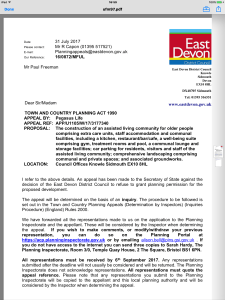
Knowle planning appeal inquiry – objections to Planning Inspector by 6 September

i

“Inspector to decide if developer should pay more Sidmouth community cash”

Recall that PegasusLife is calling it’s plans for the Knowle “assisted living accommodation”. Why? Because it doesn’t then have to contribute to affordable housing.

Does anyone recall EDDC making a fuss about that? No – they left it to local objectors to point it out!

“A government planning inspector will decide whether a developer will have to pay a share of its profits from 36 proposed sheltered apartments to the public coffers.

The matter was the subject of an inquiry this week after Churchill Retirement Living and East Devon District Council (EDDC) could not agree terms for an ‘overage’ clause.

Churchill hopes to demolish the former Green Close care home in Drakes Avenue to make way for the development. The firm launched an appeal due to non-determination of its application.

The delay in EDDC deciding the fate of the scheme was due to officers trying to apply an ‘overage’ clause that would require Churchill to pay up if its profits exceed current expectations.

EDDC documents argue plans to create the apartments for the elderly should be worth nearly £1million to the Sidmouth community – but the developer has shown it is ‘unviable’ to pay more than £41,000.

Churchill’s five-figure offer towards off-site ‘affordable’ housing was last year slammed as an ‘insult to Sidmouth’ by town councillors, who suggested the developer should pay at least £360,000.

Papers submitted to the appeal process from EDDC say there is a policy expectation that half of the site should be provided as ‘affordable’ housing and that there is a ‘substantial’ need for one- and two-bedroom units in Sidmouth.

If 18 ‘affordable’ homes cannot be provided on-site, a payment of £935,201 would be expected so the properties can be built elsewhere.

Churchill said a viability assessment showed building ‘affordable’ homes on the site was ‘impractical’ and ‘unrealistic’.

It added: “It has been demonstrated that the application development is not sufficiently viable to permit the imposition of any affordable housing or planning gain contributions above £41,208.”

An EDDC spokeswoman said: “Unfortunately, the development is not sufficiently viable to pay this [£935,201] sum and, following an independent assessment of the viability of the scheme, it was reluctantly accepted that the scheme could only afford to pay £41,208 towards affordable housing.

“Under government guidance, we are required to reduce our requirements where a development is unviable and so we have no real choice but to accept this position.”

EDDC also expected Churchill to pay £22,536 for habitat mitigation, plus an £18,400 public open space contribution. The total is nearly £1million.

At the hearing on Wednesday, a representative for the developer said a viability report showed it could not offer more than £41,208 if it wanted a competitive return of 20 per cent.

He argued such developments, both locally and nationally, did not have an ‘overage’ clause like the one proposed and added that it was not in line with national guidelines.

“We need to ensure there are competitive returns for the developer and the landowner,” said the representative.

“If the developer, through his own skill or from fortuitous circumstances, makes a larger profit than intended, then the council wants to have a proportion of it and, if they are not so fortunate and make less than 20 per cent, the entire downside is to be borne by the developer.”

Town councillor Ian Barlow argued that the £41,208 contribution was only agreed to because councillors were told it was subject to an ‘overage’ clause. He added: “If they make an obscene amount of money from our community, then they should put it back into the community. They are now saying it is not plausible.

“We only deal with common sense.

“Theoretically, if someone builds a £5million-ish place and they are only giving around £41,000 back, at the end of the day, that does not seem right.”

Cllr Barlow argued that he found it hard to believe such a successful company would make an investment which was not financially viable.”

http://www.sidmouthherald.co.uk/news/inspector-to-decide-if-developer-should-pay-more-sidmouth-community-cash-1-5100503

Expensive new HQ and luxury apartments for rich elderly people or good-quality social housing? Tough choice for EDDC

Sidmouth resident Mike Temple has the lead letter in today’s Guardian on social housing. Our council is MUCH more interested in moving into its very expensive new offices (£10 million and counting) than building, or encouraging the building of, social and truly affordable housing. As shown when it agreed to sell its Knowle site to PegasusLife for super-luxury housing for only rich, elderly people, with PegasusLife attempting to exploit a loophole via a planning appeal to avoid any on-site or off-site affordable properties.

“The fire at Grenfell Tower has highlighted a number of issues relating to government housing policy in recent years, not only the failure to apply proper safety measures but also its whole approach to social housing.

The 2012 national planning policy framework, often described as a “developers’ charter”, has given precedence to expensive private development while discouraging social housing. The result is that through land-banking, slow build-out rates and using the housing market as an investment, house prices have risen way beyond the reach of most average-wage earners. At the same time, an increasing proportion of the incomes of the lower paid is spent on rented accommodation, which is often of poor quality.

Among the 72 Conservative MP landlords who voted against the 2016 housing bill to make “rented properties fit for human habitation” were the communities secretary, Sajid Javid, housing minister Brandon Lewis (who has also said installing fire-sprinklers could discourage house-building), fire minister Nick Hurd, and David Cameron.

Official Statistics on social housing show that since 2010 the number of government-funded houses for social rent has plummeted by 97%.

Gavin Barwell, until recently housing minister and author of a white paper that offered proposals to ease development while doing little to promote social housing, has – like the government he serves – failed to act on the recommendations in the report on the fire at Lakanal House in 2009. Like previous Conservative minsters he preferred light-touch regulation so that warnings have been ignored at national and local government level.

The result is a system that has failed to protect our citizens – cost-cutting and reckless decisions were made with little fear of anyone being held responsible.
Mike Temple
Sidmouth, Devon”

https://www.theguardian.com/uk-news/2017/jun/25/grenfell-tower-tragedy-shows-social-housing-system-has-failed-uk-citizens

“Developer submits appeal to £7.5m Knowle plan refusals”

PegasusLife submitted its challenge to East Devon District Council’s (EDDC) ruling to the Planning Inspectorate on Wednesday before today’s deadline.

Councillors defied officer advice to refuse the scheme in December – arguing it would overdevelop Knowle and represent a departure from the site’s 50-home allocation in the Local Plan. They also had concerns about the lack of ‘affordable’ housing provision.

An EDDC spokeswoman confirmed that PegasusLife has lodged an appeal with the Planning Inspectorate, but said it can take weeks for the process to begin.

The developer has agreed to pay EDDC £7.505million for the site of its current HQ if the application is approved. The proceeds would go towards the authority’s £10million relocation to Exmouth and Honiton, but councillors have since voted to press ahead with the project before a buyer is guaranteed.

This means construction work, funded by a loan, will begin at Heathpark in Honiton before Knowle is sold. Work on Exmouth Town Hall is already under way.”

http://www.sidmouthherald.co.uk/news/developer-submits-appeal-to-7-5m-knowle-plan-refusals-1-5055742