Save Clyst St Mary – update

“Following the message that we received asking us to remove our banner from the fence backing onto A3052, I thought that I should write to you to let you know we are still here and continuing the fight for sustainable development in Clyst St Mary. There has been numerous items in the press regarding development in and around Exeter known as the ‘Greater Exeter Strategic Plan (G.E.S.P)’ and I have attached a copy of our latest press release which might help to explain matters a little more.

Over five years ago when we formed the Save Clyst St Mary Campaign we never expected to have received so much overwhelming support, for so many years. It really goes to show how uniting the different areas of the village can lead to a continued great outcome for everyone.

If you know someone who wants to get involved either just as a member or actively helping please let me know.”

PRESS RELEASE

“Village Life -v- Future Development

Many people favour living in a picturesque, rural village nestled in surrounding countryside with only the amenities of a village shop, post office, school, pub, hall and church. Clyst St Mary is a village where some historic areas have barely changed since late-medieval times but the settlement has expanded and progressed to incorporate the demands of the 21st century.

It is often described as a rural idyll, offering a different lifestyle than that experienced in the nearby urban City of Exeter. The old village is portrayed as charming and rustic but new contemporary designs show a progressive quality that coexists with the more traditional standards of the settlement. It remains unpretentious but with a modern, caring and vibrant neighbourhood.

This community has recently embraced considerable, sustainable housing development with the building of almost 100 new residences (a substantial quantity for a modest-sized village) to support East Devon Local Plan growth policies to 2031. However, the Local Plan also includes a further 150 dwellings allocated on brownfield land at Winslade Park awaiting planning approval, which totals approximately 250 new homes. Although it is appreciated that people need somewhere to live, such high numbers in one village go beyond growth recommendations in the Local, Villages and Neighbourhood Plans.

Crucially, there are also fears that proposals in the Draft Greater Exeter Strategic Plan (GESP) for substantial future development along the A3052 around Westpoint at Clyst St Mary will sound the death knell for this historic Devon village, with the creation of, perhaps, another new town similar to Cranbrook or building a large suburb of Exeter or a sizeable extension to the existing settlement, all of which could result in the destruction of the village identity.

The entire GESP area incorporates Exeter City, Teignbridge, Mid Devon and East Devon with a vision for the provision of new homes, jobs and infrastructure for existing and future generations while protecting and enhancing the environment. Ideally, each area would share growth, avoiding one locality being burdened by substantial, unsustainable over-development.

However, concerns are not alleviated by recent comments made by East Devon planners declaring that some communities will be detrimentally impacted by proposed GESP large scale growth recommendations, e.g. ‘…in most cases growth would have to be quite substantial to make it viable to deliver the required services and facilities to make the settlement suitably sustainable for growth and in the process could harm the character of the village and the existing community.’

http://eastdevon.gov.uk/media/2581497/040918strategicplanningcombinedagenda.pdf – (Strategic Planning Committee report – 4th September 2018, page 24, Item 9.1).

Furthermore, at the full Council meeting in October 2018 in answer to a question as to why East Devon is taking a disproportionate share of development (58% more than Exeter, 53% more than Teignbridge and nearly three times that of Mid Devon according to independent analysis conducted by CPRE), a local politician replied: “Because we have the land and we are good at it.”

Exeter City Council has just unveiled their 20-year vision for the city, which includes 12,000 new homes, cultural centres, ‘a garden bridge’ across the Exe and the creation of a comprehensive cycle and pedestrian network to tackle traffic congestion.

However, with a target of 53,200 homes proposed for the Greater Exeter areas and the propulsion for substantial business growth, surely the communities within East Devon should equally have sight of the development proposals for their localities? For example, the present Exeter Sowton Park and Ride site appears to show future development – so where will the new replacement Park and Ride facilities be located to serve Exeter?

To date, representatives from East Devon local authority, business communities and growth partnerships have maintained exclusivity regarding the proposals for the GESP large allocation sites offered by landowners for future major development. Will there be a general release to the public of this restricted information before the Local Elections in May 2019? The electorate may be reluctant to vote for expansive commercial and housing proposals that would destroy or detrimentally alter their community.

Consequently, it might be thought unwise to acquaint the populace at this time with extensive GESP growth recommendations for fear that they would be judged undesirable. Although, there will, of course, be statutory public consultation on such vast development proposals under GESP but not until after the Local Elections!

In reality, Clyst St Mary’s portrayal as an idealised village is not entirely accurate and the images below bear testimony to the daily traffic congestion which reaches unacceptable levels, where the A376 and A3052 converge at the bottleneck that is the Clyst St Mary roundabout.

At present, large volumes of HGVs serving the extensive business expansions at Hill Barton and Greendale Industrial Estates, together with huge tractors and trailers importing and exporting to an ever-increasing sized anaerobic digester, thunder through the village! Coupled with significant large levels of commuter and tourist traffic they create safety issues for residents (especially young children) accessing the village primary school, shop, village hall and play park via the toucan crossing on the A3052. Regrettably, the pedestrian footbridge is unsuitable for many users and is generally in a state of disrepair!

Only last year a resident sustained serious injuries crossing the A3052 in the village after being knocked down by a speeding car during daylight hours! Fortunately, there appears to be current medium-sized road improvements planned around the Clyst St Mary roundabout and Junction 30 of the M5 in the near future.

However, it is considered that the crucial, major road network advancement necessary in this area at present and for any future development expansion may not be forthcoming in the current uncertain and fragile financial climate. It is unacceptable for developers to build sizeable residential and business developments that access a substandard, mediocre road network. There is gridlock with the present peak time traffic let alone any future requirements. Planning cycle tracks and park and ride facilities are positive approaches but may be inadequate ‘band-aid solutions’ that will not sufficiently tackle the root causes.”

[Pictures with press release not shown here]
“Almost half of England’s bus routes ‘at risk due to lack of funds’ “

“Almost half of England’s “vital” bus routes could be scrapped due to a lack of funding, according to local authorities.

Local Government Association (LGA) analysis found the free bus pass scheme was underfunded by about £652m in 2017-18.

It said councils were having to fill the gap between government funding and the cost of the scheme, with free bus passes for off-peak travel being a legal entitlement for those over 65, or those with a disability.

However, the constraints have meant local authorities have been spending less on discretionary services such as free peak travel, post-school transport and supported rural services.

Almost half of all bus routes in England receive partial or complete subsidies from local councils.

The services are at risk as councils struggle to maintain the current levels of support, the LGA warned.

It called on ministers to bring back full funding of the costs of the concessionary travel scheme.

More from UK

“An estimated funding gap of £652m a year for concessionary travel is unsustainable for councils already struggling to protect other subsidised bus travel in rural areas, or helping young people with their travel costs,” said LGA transport spokesman Martin Tett.

“Properly funding the national free bus pass scheme is essential if the government wants councils to be able to maintain our essential bus services, reduce congestion and protect vital routes.

“If this is not addressed in the spending review it could lead to older people having a free bus pass but no bus to travel on.”

Department for Transport figures showed local bus journeys in England fell by 85 million – or 1.9% – in the year ending March 2018.

The councils say more than 3,000 supported bus services since 2010-11 have been either withdrawn, reduced or altered.

“It is for councils to decide which bus operations to support in their areas, but we help to subsidise costs through around £250m worth of investment every year,” a Department for Transport spokeswoman said.

“£42m of this is devolved to local authorities and a further £1bn from government funds the free bus pass scheme, benefiting older and disabled people across the country.”

https://news.sky.com/story/almost-half-of-englands-bus-routes-at-risk-due-to-lack-of-funds-11632137

Strategic Planning pitfalls? Certainly for Axminster

A reporter … reports:

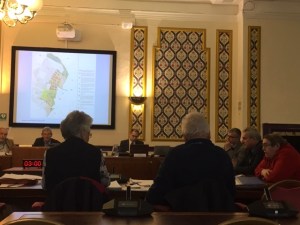
“At Tuesday’s Strategic Planning Meeting at Knowle (29 /01/2019), chaired by Paul Diviani, the masterplan for increasing Housing in Axminster by a whopping 30% , was voted through almost unanimously (there was one abstention), despite serious cross-Party criticism of the plan.

As the debate ended, the considerable number of Axminster residents in the public gallery were astonished to hear the Chair’s quip, to Cllr Jill Elson, “ I felt confident that you would come out with something that would stir things up”.

Cllr Elson (shown on right of the photo, beside Cllr Philip Skinner), had argued firmly that “the problem with plans is that they change” , citing her Ward as an example.

“Exmouth ended up with two huge estates with no play space or amenities whatsoever”, she said. Cllr Mike Howe (Con) shared her concerns, saying, (the masterplan) “doesn’t give us much credence or security that we will get the right houses”. But the Deputy Leader of the Council, Philip Skinner (Con ), expressed his view that “Give and take is needed in negotiations with a developer”.

Shortly afterwards, when Cllr Geoff Jung (East Devon Alliance, EDA) observed that the plan might not suit young families, it became apparent that Cllr Skinner was not aware that the proposal to include a primary school had been dropped.

Cllr Eleanor Rylance (Lib Dem) had noticed significant typing and other errors in the masterplan document. Cllr Rob Longhurst (Independent) observed there was no mention of the words ‘Neighbourhood Plan’ in the document.. although Cllr Moulding had told the meeting that he had designed one for Axminster… and suggested this Strategic Plan Committee would like to see “if the community wants and needs” the masterplan.

Cllr Susie Bond (Independent) asked for clarity about the legal implications for the Council if the costs for the relief road “went through the roof” (So far, EDDC has agreed to borrow £7m to ensure the road, estimated cost £16.7m, can be delivered.)

Ian Hall (Con) admitted “this masterplan doesn’t sit easily with the residents of Axminster”, which Alistair Ferguson’s speech in Public Question Time, confirms. The text is reproduced below, with Mr Ferguson’s permission):

In support of the objections, other District Councillors, Cathy Gardner and Marianne Rixson (both EDA), also attended the meeting, though not on the Strategic Planning Committee themselves.

Cllr Gardner pointed out that agreeing to a massive increase in the town’s housing numbers “would not be for the right reasons”, if it was done primarily to fund a relief road. The masterplan “was being done to the people of Axminster, not for them”, she said.

And Cllr Marianne Rixson added that “delivery of affordables does not have a good record” in East Devon.

Having listened to the comments aired, Cllr Geoff Pook (Ind) cautioned the committee not to be “persuaded by the opposition”. “There are just as many people in favour”, he opined.

Finally, the fear that the time-limited government funding for the relief road would be missed, therefore putting in jeopardy the 650 homes allocated in the Local Plan, swayed the committee members to approve the masterplan, albeit with caveats based on their misgivings.

Is this how the wrong sort of housing so often gets built in the wrong place?

In Axminster’s case, how much will the masterplan impact on the historic former deer park? As Cllr Mike Howe, Chair of the Development Management Committee (DMC) told yesterday’s meeting, there’s an urgent need to know….’

Local bus use plummets in Devon as routes cut

“”Local bus journeys in Devon are at a record low – with campaigners warning the national network is now in “crisis”.

The latest figures from the Department for Transport reveal that 24.2 million journeys were made on local bus services in Devon in 2017/18. That’s nearly two million fewer journeys than the year before, and the lowest number since at least 2009/10, when the figures were first published.

The Campaign for Better Transport say that the fall in the number of passengers taking the bus is due to ongoing cuts in funding for these services, resulting in fewer services and higher fares.

Nationally, average local bus fares across England have increased by 12 per cent since 2009, after inflation.

Darren Shirley, Chief Executive of Campaign for Better Transport, said: “The statistics back up what our research has been showing for years – that buses are in crisis.

“Local bus services are vital, linking millions of us to jobs, education, shops and services, friends and family. They open up opportunities and help to fight loneliness. …

… The Local Government Association says nearly half of all bus routes in England currently receive partial or complete subsidies from councils.

With councils in England facing an overall funding gap that will reach £8 billion by 2025, the LGA said councils will struggle to maintain current subsidies for bus routes across the country unless this is
addressed in the Spending Review.

Martin Tett, the Local Government Association’s transport spokesman, said: “Councils know how important buses are for their residents and local economies and are desperate to protect them.

“It’s nearly impossible for councils to keep subsidising free travel while having to find billions of pounds worth of savings and protect other vital services like caring for the elderly and disabled, protecting children, filling potholes and collecting bins.

“Faced with significant funding pressures, many across the country are being forced into taking difficult decisions to scale back services and review subsidised routes.” …

… Andy McDonald MP, Labour’s Shadow Transport Secretary, said: “These figures are alarming, and underline the devastating impact of Tory cuts on local bus services.

“Bus networks are in a spiral of decline, cutting people off from work and education and friends and family, particularly those in rural areas or from low income backgrounds.

“For many people, buses are the only form of public transport available. And the bulk of the people that use and rely on buses are often the poor, the young, the old and the vulnerable.

“At the same time, cutting and withdrawing services is worsening congestion, air pollution and our impact on climate change.”

“The government should give local authorities the powers to franchise and municipalise buses and boost bus funding, and allow them to take back regulatory powers so that they can set the fares, routes, and timetables that will put their communities first, ahead of the interests of private profit.”

https://www.devonlive.com/news/devon-news/crisis-local-bus-journeys-devon-2489912

“85 Million Fewer Bus Journeys Last Year Amid ‘Devastating’ Cuts”

“”Cutting and withdrawing services is worsening congestion, air pollution and our impact on climate change.”

“The number of passenger journeys made by bus in England fell by 85 million last year, amid “devastating” cuts on local services.

Passenger journeys declined by 3.2% outside London, continuing a decade-long trend, while bus use in the capital fell by 0.7%, according to the latest figures from the Department for Transport.

Out of 88 local authorities in England outside London, 70 saw a fall in bus use since 2009/10.

Labour said the new figures underlined the impact of Conservative policies, and underlined “the devastating impact of Tory cuts on local bus services”.

Andy McDonald, shadow transport secretary, said: “These figures underline the People are being denied opportunities in work and education and are cut off from friends and family, particularly those in rural areas or from low income backgrounds.”

These figures underline the devastating impact of Tory cuts on local bus servicesAndy McDonald, Shadow Transport Secretary
MacDonald added: “At the same time, cutting and withdrawing services is worsening congestion, air pollution and our impact on climate change.

“A Labour government will act in the interest of the many by putting investment back into bus services, protecting pensioners’ bus passes and introducing a new free pass for under 25s.” …”

https://www.huffingtonpost.co.uk/entry/85-million-fewer-bus-journeys-made-by-passengers-last-year-amid-devastating-cuts_uk_5c518a4ce4b0f43e410cceaa

“This Is What It’s Like To Lose Your Sunday Bus Service”

In a new series, HuffPost UK is examining how shrinking local budgets are affecting people’s daily lives. These are stories of what it’s like to lose, in a society that is quietly changing. If you have a story to tell, email basia.cummings@huffpost.com.

“When Staffordshire council announced on April 1 that they were cutting the local Sunday bus service – a lifeline for many of its regular passengers – people thought it was a bad joke.

The route was a thread connecting the local community, linking Stafford and Cannock in the West Midlands. But it was no April Fool’s Day prank.

Like so many decisions taken by local authorities in the era of austerity, it made sense on paper. Staffordshire County Council said it could no longer keep the buses running because numbers had dropped so much, the subsidies needed to make up for the loss in fares were “simply not sustainable”.

The local bus operator, Arriva Midlands, said at the time that “cuts to funding” were forcing them to withdraw the subsidised service. According to county council cabinet member Mark Deaville, “some journeys are costing taxpayers £10 a time”.

On its own, of course, the cutting of this one bus route is not worthy of a national news report. It is, at best, a local story affecting a relatively small number of people. But it is in paying closer attention to thousands of small financial decisions like this that we see the reality of government-led austerity, and the way it is quietly changing Britain.

In our HuffPost UK series, What It’s Like To Lose, we are exploring how these changes at a local level link up to paint a national portrait of austerity – from the closures of community libraries, or the centralisation of medical services or job centres, to the disappearance of affordable leisure centres or local post offices. As local authorities find themselves picking off the “low-hanging fruit” of services that have seen their use go down in recent years, what does it mean if you are one of the people for whom that still really matters?

When we visited Cannock on a grey December day, standing at a bus shelter was 80-year-old Jocie Lucas, taking refuge from the driving rain. For her, the cut was a blow to her sense of freedom. “I have a free bus pass, but I’m so confused these days as to when the buses are running that I hardly use it now,” she said. “I’ve lost some of that independence to travel where and when I want, and now I have to rely on lifts from family.”

What has happened to the residents of Cannock is happening across the country. Buses remain by far the country’s most popular form of public transport – 4.65 billion journeys are made each year, two-and-a-half times more than on the train.

But despite their levels of use, almost 17,000 bus routes have disappeared over five years across the UK, according to the Traffic Commissioner’s annual report. Tightened council budgets have made services that were under-used, but previously considered essential, vulnerable to cuts. The Campaign for Better Transport says there has been a £182m – or 45% – cut in local authority-supported bus services since 2010.

In Staffordshire, like in many councils across the UK, the changes came following a funding consultation last year. Tanya Dance, who runs the Copper Kettle cafe overlooking Cannock’s bus depot, was particularly hard hit by the decision – she had become a bus ticket vendor just months before the Sunday services were cancelled.

“There used to be queues of passengers on a Sunday, which was one on my busiest days,” she said. “A lot of the old folk with their free bus passes would only venture out on a Sunday and spend time shopping and in my cafe.”

Dance said the move has seen her takings halve in the last eight months. And the disruption, she thinks, has mainly affected her elderly customers.

For them, the service was vital. It was the only opportunity many of them had to go out and socialise, or visit church, she said. “To stop all buses on a Sunday seems way too drastic. Cannock isn’t exactly isolated but its pretty rural and buses are a lifeline for many around here,” she said.

Jocie Lucas echoes this, saying she used to enjoy travelling into town on a Sunday. “Now and I’m in other people’s hands, so that takes away some of the fun.”

But it’s not just the elderly who have had to adjust. Teenagers Alicia Slyde and Dean Mayo, both from a suburb of Cannock, said they now have to walk 45 minutes to get to town. “Sunday is the only day I can go shopping because of work commitments in the week and neither of us drive or can afford a cab, so we walk it to town and back now,” Mayo said. “It’s hard work carrying all the shopping home but we have no choice. “

Slyde added: “The bus service around here is dreadful during the week and then non-existent on a Sunday. Even getting to college every day is hit-and-miss as far as buses go. But stopping the Sunday service just doesn’t make sense. That’s the one day people get to themselves and want to travel.”

More than 2,000 people have signed a petition started by local campaigner Lee Murphy, asking the council to reverse its decision. Some of those who have signed mentioned nurses and staff working at local care homes needing to get to work.

Murphy told HuffPost UK that a regular user of one of the Cannock services relies on it to reach his brother, who is disabled. “He still requires the same care on Sundays, but how is he able to travel to him? Both Cannock and Stafford hospitals are cut off – neither train station are close enough,” the campaigner said.

“In addition to this, users paying as much as £520 a year for a Cannock/Stafford region bus pass will receive less value for money. This is unfair to hard-working commuters who deserve to use their pass for evenings and weekends too.”

Kevin Chapman, a spokesman for the Better Transport campaign, said the vast majority of the lost routes serve rural communities, like Cannock. “When the local bus service goes this often results in people in these areas becoming more isolated,” he said. “We are faced with a nasty cocktail of reduced funding for councils and operators cutting routes, while in the middle of it all we have vulnerable people who may rely on the bus to get out and about.”

But as always, decisions to cut services are complex. Staffordshire County Councillor Mark Deaville said the money saved had been directed to the services people use the most. “Our changes affect only four subsidised Sunday services from the Cannock depot, and the decision to stop all of its other Sunday bus journeys is a commercial decision for Arriva and not the county council.”

In Staffordshire, one local MP is the defence secretary and former government chief whip, Gavin Williamson, who said he is extremely concerned about the removal of the Cannock service, which he described as a “lifeline”.

Speaking to HuffPost UK, the senior Tory said it is “deeply damaging for the elderly who may rely on the buses to get them to the shops or to and from church on a Sunday,” he said. “It is important we do all we can to fight these cuts and I hope Arriva reconsider their decision.”

Teenage commuter Esme Walker, agrees. She said living in Cannock already felt “like being out in the sticks”, and losing the Sunday bus service has isolated her further.

“Me and my friends looked forward to catching a bus on Sunday and spending the day in Birmingham or Stafford,” she said. “It was really nice because we’d often meet elderly people from the town on the bus who seemed just as bored as us and we’d end up travelling together.

“I think the buses helped bring local people together in that way.”

https://www.huffingtonpost.co.uk/entry/how-it-feels-to-lose-your-sunday-bus-service_uk_5c20ef40e4b08aaf7a8b3bcc

“Need to sign on? You’ll have to walk 24 miles to the jobcentre”

A lesson for all rural dwellers unlucky enough to lose a jobm

“Twenty-four miles there and back is one hell of a hike to your local jobcentre. But when Ray Taylor, 56, had his benefits cut for 13 weeks after illness meant he missed an appointment to sign on, he had no option but to get out his walking shoes. He doesn’t have friends with cars to give him a lift, and with no money coming in, he couldn’t pay the £7 bus fare from the small Cambridgeshire town of Ramsey to Huntingdon, where he is registered for benefits. And if he missed signing on again, he would be sanctioned again.

Taylor, a former electrician – he couldn’t afford to update his qualifications after being made redundant and going freelance – is remarkably stoical about what could be a weekly trek. “If you’ve got a 9 o’clock appointment, you have to set off in the early hours to make sure you get there,” he says. There have been “quite a few times” he has set off at two in the morning to avoid penalties for lateness. (“Sanctions” can involve benefits being reduced – or stopped entirely.)

A pre-dawn start in the pitch-black of rural Cambridgeshire with cars and farm lorries rumbling along pavement-less roads doesn’t sound all that safe. Taylor, who survived being homeless in Cambridge for seven years before being housed in Ramsey, smiles as his eyes stream from the cold. “There’ve been a few moments.” The police have picked him up a couple of times and taken him home to ensure his safety, he recalls.

Come the end of March, other Ramsey residents may have to embark on this trudge that is nearly the length of a marathon. That is because the No 30 bus that is the sole public transport link between Ramsey and Huntingdon is due to be cut. The only alternative for anyone without a car will be to beg lifts from friends or family, cycle or find the £40 round-trip taxi fare. It is an impossible sum for anyone on a low income, and even most working people couldn’t find it five days a week.

To experience the route Taylor has walked “oh, maybe 20 or 30 times”, we meet at the more civilised hour of 8am by the decorative wrought-iron bus shelter next to Ramsey’s clocktower. The night before, driving across Cambridgeshire, gusts of wind hurling rain across my windscreen, I begin to dread the walk to come. Morning, however, has dawned bright but chilly. Hoiking our rucksacks on our backs, we pull our hats down and head south out of town. We are accompanied by Steve Corney, the town council’s new mayor, and Jane Sills, the chair of the Ramsey Million Big Local residents group, which has campaigned for the past 18 months against the cutting of the No 30 bus.

“For the people here, the bus means everything,” says Corney over the noise of traffic streaming out of Ramsey. There are no big employers in the town, so there is a daily exodus. “It’s frustrating because when you see it, there’s a lot of people on it.” Corney notes too that housing development means Ramsey’s population of 8,000 is expanding.

We pick up the pace as we reach the edge of town, where Corney peels off. As we march past a long-abandoned RAF station, it is the isolation suffered by older people and teenagers in cut-off rural areas that is on Jane Sills’ mind. James Palmer, the mayor of the new Cambridgeshire and Peterborough combined authority, which is reviewing all the area’s bus routes, will visit Ramsey later this month, and Sills’ group of residents intends to lobby him hard. “He should know by now just how important it is for people on low incomes and for young people that they’re not trapped in a small town with their life chances inhibited,” she says.

Sills has a strong card up her sleeve. As well as marshalling a petition that gained more than 1,000 signatures – and secured a short-term stay of execution for the route – members of her group decided to use some of the Big Local Lottery money they had been awarded to strengthen their case. A report commissioned from the Campaign for Better Transport revealed that the local authority subsidy paid to the bus operator Stagecoach to run the No 30 bus is the lowest of any on the list of proposed route closures in Cambridgeshire.

The report also showed, Sills says, “how Ramsey already compares poorly to other parts of the county” in terms of its access to buses.

If Cambridgeshire’s long-term transport strategy is ratified later this year – it is the new Cambridgeshire and Peterborough combined authority, not Ramsey town council, that will set commissioning policy until 2031 – Ramsey will be cut off from the new “hub and spoke” public transport system. There will be no buses in or out at all.

Ramsey’s residents, of course, are not alone in their plight. The Campaign for Better Transport calculates that since 2010, councils in England and Wales have cut £182m – 45% – from the support they give to bus routes that would otherwise be unsustainable. Some areas have seen particularly harsh cuts: Somerset by 50%, Leicestershire by 72%, North Yorkshire by 81%. In the past year alone, according to the charity’s recent Buses in Crisis report, more than 300 routes have been reduced or withdrawn in England and Wales, and 3,347 since 2010.

“Whole areas are now transport deserts,” says the charity’s chief executive, Darren Shirley. “The people who are the most impacted are those who are most in need of public transport. Jobseekers who are reliant on public transport to get to work. People in poor health who need it to get to hospital.” Buses, he points out, are the only form of transport in England not to have a long-term investment strategy. …”

https://www.theguardian.com/uk-news/2019/jan/07/need-to-sign-on-youll-have-to-walk-24-miles-to-jobcentre

More rural bad news: “Bus travel: Fewer passengers as funding falls”

Buses are the most common mode of public transport, accounting for 60% of all trips.

But on the buses, passenger numbers are falling.

There were 9% fewer journeys on local bus services in Britain in the first three months of this financial year than in the same period a decade ago.

The Campaign for Better Transport says this is partly down to cuts to the amount local authorities England and Wales are spending on buses.

In the past seven years, council spending on buses has fallen by 45%, according to figures released to the campaign group under the Freedom of Information law.

Outside London, buses are largely run by private companies, which make their money from passenger fares. Then, local councils pay subsidies to plug the gaps, often in rural areas where running a route is more expensive or less lucrative for companies.

Areas where running a bus service is the least lucrative for private operators will rely most on council subsidy – and so be most effected by the cuts.

In 2017-18, there were 11 councils in England that spent nothing at all on running bus services.

This has meant 3,000 routes being reduced or scrapped since 2010-11.

There are significant differences in fares, too.

Between September 2017 and September 2018 in London, fares rose by 0.4% – in the capital, buses are still public and regulated.

In other metropolitan areas in England where fares are left to the free market, there was an average 2.4% increase, while in non-metropolitan areas fares rose by 7.9%.

But if bus cuts and fare rises leave some people unable to get around, don’t councils have a duty to do something about it?

In fact, councils have very few specific obligations around buses, making them an easy target for councils as the cuts bite.

There are specific things they legally have to do, for example provide transport for children otherwise unable to get to school.

They also have to make sure there are concessionary fares for older and disabled people. Although this is partly funded by central government, the grant has been falling, leaving councils to make up the difference.

But other than that, they are not obliged to fund buses and ensure everyone has access to them.

What do councils have to do?

It’s possible a council could be challenged in the courts under equality legislation if it could be shown to be disproportionately restricting certain groups of people.

But legal guidance suggests it would be difficult to challenge a council if it could show it had assessed the needs of a local area and the impact of removing a bus service, particularly on elderly and disabled people.

If after this assessment, councils decide they need to make cuts because of a lack of funds, this would be likely to be legal.

But councils can’t let bus cuts leave a community that needs transport with no transport service at all.

And in some areas, councils have used community transport services – often minibuses driven by volunteers – to fill the gaps.

There could be other reasons for the fall in passenger numbers, though.

For the past couple of years, passenger numbers have also been falling in London, despite its relative protection from cuts.

Mayor Sadiq Khan has suggested this could be driven by fewer people going out, as Netflix and Deliveroo make staying at home easier and more tempting.”

https://www.bbc.co.uk/news/uk-46524510

Rural high-speed broadband? Better move to Spain or Portugal!

“… Ofcom said fullfibre internet is now available to 1.8m premises, a rise from 3% to 6% of homes and businesses, but the UK is still far behind countries such as Portugal, at 89%, and Spain, at 71%.

The regulator’s report also found that rural areas also face issues with mobile coverage. While 83% of urban homes and offices have so-called “complete” 4G coverage – services from all four major operators, Vodafone, EE, O2 and Three UK – it is a different story in rural areas. Just 41% of rural premises get complete mobile coverage, while Ofcom said that “in some remote parts of the country there is no coverage at all”.l …”

https://www.theguardian.com/money/2018/dec/18/uk-homes-slow-broadband-netflix-youtube-ofcom

“Want to shop online? Best have a mobile signal” (so that locks out many rural areas)

“As millions start their Christmas shopping online, there’s a warning that consumers may need to have a mobile phone, and a decent signal, to make sure their transactions go through.

UK banks are starting to introduce a new layer of security, involving passwords sent to your mobile phone.

That could be a problem for hundreds of thousands of householders without a mobile, or no proper signal.

Now banks are being urged to find other ways to check a customer’s identity.
The new rules are part of an EU directive – already adopted by the UK – which is due to come into force by September 2019.

But critics say many people are likely to be inconvenienced.

“Banks are not yet great at looking after people at the margins – because they’re disabled, or because they live with no mobile coverage,” said James Daley, the managing director of Fairer Finance.

“These systems are designed for the 95% – while the remaining 5% are hung out to dry.” …

https://www.bbc.co.uk/news/business-46399707

Penalised if you live near small branches of big supermarkets

“If you’ve ever suspected that popping into your local supermarket rather than heading to a bigger superstore is damaging your wallet, then your hunch is correct.

Big brands are cashing in on the convenience and accessibility of their in-town locations and charging around £10 more per shopping trolley.

The BBC investigation looked at Tesco, Sainsbury’s, Marks & Spencer and Waitrose and found huge variations in prices. For example, in a regular Tesco you would pay 9p for a banana versus 25p in express stores.

The supermarkets say that the price difference is due to the higher cost of running the smaller branches, but the findings offer food for thought for customers who are deciding where to pick up their shopping.

Not only are the bananas pricey but the investigation found Tesco customers would pay 91p for a bag of mixed peppers in a superstore versus a hiked price of £1.15 in the store closer to their door.

In Marks & Spencer, a banana in a regular store costs 18p versus 40p in their local stores, while red seedless grapes are £2 versus £2.80 in a local branch.

And this all has a big impact on your total bill. At Marks & Spencer the same trolley of shopping cost £103.26 at the Birmingham High Street store and £112.44 at Simply Food in Birmingham New Street Station.

Even some branded products, like Mr Kipling’s French Fancies, varied in price depending on the size of store. In Sainsbury’s the cheaper location charged £1.60 versus £1.95 in the smaller, pricier shop.

Shops were visited between September and October this year, and prices were analysed. At Sainsbury’s and Marks and Spencer stores in Birmingham, and Waitrose shops in Shropshire, 45 of 50 items cost more in the convenience location. And at the Tesco Express, 39 of 50 items cost more than in the superstore.

Although the big chains say the varied pricing is a business decision based on overheads at different locations, for those customers who are not able to access larger facilities out of town (for example, if they don’t have a car), the impact is real.”

https://www.huffingtonpost.co.uk/entry/supermarkets-hike-up-prices-in-local-branches_uk_5bf2914be4b0f32bd58b37aa

Two-thirds of bank branches have closed in the last 30 years

“A Which? survey has revealed the UK has lost two-thirds of its bank branches in the past 30 years.

The consumer group found there were 7,586 bank branches currently operating compared with 20.583 in 1988. …

… Which? money expert Gareth Shaw told the FT: “We can’t stop tech disrupting traditional models of banking.

“But this is happening at such a pace, we are concerned some people are being disenfranchised and excluded from accessing finance.”

https://www.insider.co.uk/news/uk-bank-closures-rbs-scotland-13598672

Government “Landscapes Review” call for evidence on AONBs and National Parks

“Overview

The Government has asked for an independent review of England’s National Parks and Areas of Outstanding Natural Beauty (AONBs). You can find more about the work of the review and our Terms of Reference. Already the review team, led by Julian Glover and a panel with a range of experiences and interests, has carried out visits and meetings in many parts of England.

We will do more in the months ahead – but we want everyone to have a chance to contribute, whether you live in a National Park or AONB, run a business in them, enjoy visiting, care about landscapes and biodiversity, or represent an organisation with views that might shape and improve our findings. The questions (available as a list in the related documents section below) are a guide: please do not feel you must answer them all – or have to write at great length. We have not set a word length on answers, as we know some people and organisations will want to reply in detail on specific points. However, we ask that where possible you keep each individual answer to no more than 500 words. It is not necessary to reply to every question so please ignore those which you do not think relevant to you. You may find it easier to write your answers elsewhere before pasting them into the text boxes in the link below: …”

https://consult.defra.gov.uk/land-use/landscapes-review-call-for-evidence/

A frazzled mother starts huge bus service protest in Bristol

“I gave birth to my daughter in March, and I’ve begrudgingly had to place her in a nursery already because I have to work. The nursery is on the other side of Bristol to where I live. For more than a month now I’ve failed to drop her off on time because I’ve had to wait so long for a bus to turn up. The journey normally takes 45 minutes in the rush hour, but the waiting adds an extra 45 minutes (even though buses are supposed to run every 12 minutes).

Getting her home in the evening has been even more of an ordeal. Night after night we couldn’t get back before her bedtime. At the end of the week, my baby had bags under her eyes and red pupils – the sign of a true commuter, but she’s only seven-months-old. The waits were so long I had to breastfeed her on the side of the road. I don’t mind breastfeeding in public, but I’d rather not be outside in the middle of October balancing my baby on my knee.

I finally broke a week ago when the bus I was on – operated like most in the city by First Bus – was so full it passed two stops, leaving 60 passengers stranded. By the time I reached the city centre I’d used my phone to call for a demonstration on Facebook.

Over the next 24 hours 800 people signed up. Stories of missed hospital appointments, children being late for school and people being late for work flooded in. It quickly became clear I hadn’t just organised a demonstration; the outpouring of stories and anger was now online for all to see, share and sympathise.

First Bus contacted me after the demonstration was advertised to take place on 24 November in the centre of Bristol. They blamed students returning to Bristol’s two universities, schools restarting in September, road works and closures of the popular Bristol Parkway train station. But it has admitted that it is 150 drivers short in the west of England. To try to cope, staff have been brought in from as far away as Cornwall. Any company that runs an important service in a major city needs to have planning skills and the ability to recruit and retain staff.

Ironically, while this took place, the mayor of Bristol, Marvin Rees, announced he wanted to double the number of passengers using Bristol buses. The idea that the current system could support twice the number of passengers is laughable and shows how far removed elected officials have become from the reality of privately run services. This is because they have had too little say in how transport services are run since they were rapidly privatised in the 1980s.

This is not just a problem for Bristol. The national campaign group We Own It says prices have risen by 35% above inflation as result of bus privatisation, and in the past 10 years £1.8bn of revenue generated by the big five bus companies – Arriva, Stagecoach, First, Go-Ahead and National Express – has gone straight to shareholders. This is money that could be reinvested into bus services if they were nationalised. …”

https://www.theguardian.com/commentisfree/2018/oct/23/bus-revolt-bristol-privatised-services

Parliamentary Select Committee: are Local Enterprise Partnerships ignoring rural communities

“19 October 2018
The Select Committee on the Rural Economy questions local authorities and Local Enterprise Partnerships (LEPs) on their role in the rural economy.

Parliament TV – Rural Economy
Select Committee on the Rural Economy
Witnesses
At 9.45am

Cllr Sue Baxter, Chairman, National Association of Local Councils (NALC)
Cllr Bob Egerton, Cornwall Council
Cllr Mark Hawthorne, Chairman of Local Government Association (LGA) People and Places Board and leader of Gloucestershire County Council
At 10.45am

Richard Baker, Head of Strategy and Policy, North East LEP
John Mortimer, Chairman, Swindon & Wiltshire LEP
Cllr Louise Richardson, Chair, Leicestershire Rural Partnership, Leicester and Leicestershire LEP
Areas of discussion
Likely areas of discussion include:

Access to rural services
How the battle against rural crime is tackled
How devolution arrangements can be reformed to support the rural economy more effectively?
The impact of Brexit on rural economies and the role of LEPs

https://www.parliament.uk/business/committees/committees-a-z/lords-select/rural-economy/news-parliament-2017/leps-local-gov/

“Air pollution linked to greater risk of mouth cancer, finds study”

“High levels of air pollution are linked to an increased risk of mouth cancer, new research has revealed.

Scientists have previously linked high air pollution to a host of health problems, from an increased risk of dementia to asthma and even changes in the structure of the heart, with recent research suggesting there is no “safe level” of air pollution.

Now researchers say that at very high levels of air pollution, the risk of developing mouth cancer appears to rise.

Writing in the Journal of Investigative Medicine, researchers in Taiwan describe how they discovered the association by looking at air pollution data from 66 air quality monitoring stations around the country collected in 2009, and combing this with data from the health records of more than 480,000 men aged 40 and over from 2012/13. In total, there were 1,1617 cases of mouth cancer among participants.

The team focused on tiny particulates of pollution known as PM2.5s, and took the men’s exposure to this air pollution as being based on where they lived. They then sorted the participants into four groups, from lowest to highest levels of exposure.

After taking into account factors including age, exposure to ozone, levels of other particulates, age, smoking status and whether the men chewed betel quid – a mixture of ingredients that includes areca nut and betel leaf and is known to increase the risk of mouth cancer – the researchers found that men exposed to the highest levels of PM2.5s had an increased risk of mouth cancer. …”

https://www.theguardian.com/environment/2018/oct/09/air-pollution-linked-to-greater-risk-of-mouth-cancer-finds-study

New National Park for East Devon? Not while people like Diviani are councillors!

This is the aspiration:

“A new Dorset and East Devon National Park could be created.

Cllr Martin Shaw had called for Devon County Council to support the establishment of a Dorset and East Devon National Park and to submit a case for this to the DEFRA review of national parks.

But Devon County Council agreed that any expression of support for the establishment of a Dorset and East Devon National Park should be deferred until the overriding benefit was clearly demonstrated and that it would come from additional funding. …”

https://www.devonlive.com/news/devon-news/new-national-park-could-created-2090631

This is the reality (November 2017 and nothing has changed:

It has been suggested that the area might secure some £10million of annual central government funding with more than 90 per cent of this being invested in the local economy.”

Responding to the question, council leader Paul Diviani stated that EDDC is not directly involved in the proposals and awaits further consultation as it progresses through the process of consideration.

When asked if he agrees with claims that a national park would bring significant economic benefits to the district, Cllr Diviani said: “National parks and AONBs are not about making money. The AONBS are much more localised than national parks ever can be.

“It is an opportunistic type of approach that people in Dorset are taking about our assets here in East Devon.”

https://eastdevonwatch.org/2017/11/09/dorset-positive-about-national-park-we-cant-join-up-as-diviani-doesnt-want-to-lose-control-of-assets/

“Cash Machines Closing At A Rate Of More Than 250 A Month”

Rural areas and small businesses hit hardest:

“…A total of 76 protected ATMs – those which are located one kilometre or more away from one another – were lost in the period.

Of those, 43 had Post Office over-the-counter services available nearby while 12 could not be accessed by the public. Some 21 machines were shut down with no alternative access to cash.

The Federation of Small Businesses expressed concerns that the closures could hit small business owners in remote areas. …”

https://www.huffingtonpost.co.uk/entry/atm-closures_uk_5b993a88e4b0162f473313f0

Loss of public services and spaces leading to social problems

“As well as the stripping-back of some of the most essential public services, one of the key effects of 10 years of austerity has been the crushing of countless other shared spaces: drop-in centres, libraries, Sure Starts.

Perhaps the most overlooked casualties have been the hundreds of youth centres and clubs that have closed since 2010. More than 600 such facilities in Britain have shut over the last six years, with the loss of 139,000 youth places and 3,650 staff.

In our major cities, anxiety about this organised neglect is focused on gangs and knife crime. In quieter parts of the country people’s worries are more basic – as in Gywnedd, north Wales, where recent plans to close all 39 of the county’s youth clubs were greeted with the unanswerable argument that “young people will have nowhere but the streets to socialise with each other in the evenings”.

https://www.theguardian.com/commentisfree/2018/sep/04/britain-shared-spaces-pubs-youth-clubs-libraries-austerity

Is YOUR village on the EDDC list for expansion? And another east/west divide

East Devon District Council Strategic Planning Committee are going to discuss:

“Principles for accommodating the future growth needs of East Devon”

on 4 September 2018.

The Committee are being asked to endorse

“The proposed principles for growth” as the basis for future discussion and consultation on accommodating extra growth in the district.”

The document is described as the “start of the debate” for future East Devon growth points for both the GESP (The Greater Exeter Strategic Plan) and the East Devon Local Plan review, which is required to be updated within the next two years.

For the last few years East Devon District Council have achieved their own Local Plan agreed target of 950 dwellings per year. (EDDC Target is 17,100 dwellings between the years of 2013 to 2031).

Recently Central Government decided to calculate each District`s housing requirement targets on a set matrix. East Devon’s build out figure has been set to be 844 homes per year. However, the report suggests that rather than achieve the Government target of 844 new houses per year there is a proposal to build out much higher levels of growth.

The report explains that the objective of higher growth could be achieved by what is called a “Growth Deal” with Central Government where a group of Councils agree to build more housing in return for infrastructure investment from central funds.

This proposed “Growth Deal” is being prepared by the Councils of East Devon, Exeter, Teignbridge and Mid Devon through the “GESP” Greater Exeter Strategic Plan.

It is recognised that Exeter is unable to provide the housing land required to sustain the expected growth of the city, and the rural areas and towns in the rest of the combined area will be required to increase their housing requirements in exchange for the infrastructure improvements for access to and from the city of Exeter.

Improvements to the motorway junctions, new roads, extra park and rides, rail improvements, new stations and an integrated transport system are all identified as priority improvements to overcome the already chronic delays on Exeter`s transport network. There are also aspirations for a “sports hub and concert venue” for Greater Exeter to be included in the GESP infrastructure needs.

The report gives a brief synopsis of the towns in East Devon and concludes that other than the new town of Cranbrook there is limited scope for growth due to the various towns’ proximity to the AONB designated areas, or they are bordering on the coast or close to flood plains.

The conclusion from the report is that the existing towns will only accommodate minimal growth, and with two-thirds of East Devon being included in the AONB of the Pebblebed Heaths or the Blackdown Hills the only area that can accommodate substantial growth is within the North West part of the district.

The report describes this area as the Western most quadrant of this district to the North of Exmouth and West of Ottery St Mary. The land is described to benefit from being relatively flat with no landscape designations. It is also well served by main roads with good vehicle access via the M5, A30, A3052 and A376 and has good existing public transport links with the railway line and existing bus routes.

There are 3 possible ways described as to how development could be achieved in this area.

1. Establish a further new town. Basically, create another Cranbrook. However, the report considers that the creation of another new town in the area could harm the delivery of Cranbrook.

2. Establish a number of new villages. Create a series of modern Devon villages but the report considers that this option would be most damaging in landscape terms.

3. Centre Growth around Existing Villages.

Growth would be required to be substantial with around 400 to 500 extra homes to be added to a number of existing villages (The report does not state how many villages will be required within this area). However, this could harm the character of the village and the existing community.

The new NPPF acknowledges that:

“The supply of a large number of new homes can often be best achieved through planning for larger scale development such as new settlements or significant extensions to existing villages and towns, provided they are well located and designed, and supported by necessary infrastructure and facilities.”

A list of the Parishes within the expansion area for extra housing area

By referring to a map of the area these are the Parishes(villages) which are within the West of the district which could have development of between 400 to 500 extra dwellings, parishes identified could be:

Nether Exe
Rewe
Brampford Speke
Upton Pyne.
Stoke Canon ​

All these Villages are North of Exeter and access is by way of the A377 – which is not listed as one of the featured roads, so it is unlikely these will be included.

Broadclyst
Clyst Honiton
Sowton
Rockbeare
Wimple.​

These Villages are close to Cranbrook and therefore unlikely to be selected to avoid the villages and town merging.

Clyst Hydon
Clyst St Lawrence
Aylesbeare
Marsh Green

These Parishes are remote from a main road or railway station which probably eliminates them because of their unsustainable location.

Lympstone

This Village is already designated in the report to provide growth for Exmouth.

This leaves the following Parishes most likely to be included for further expansion in the proposals:

Poltimore
Huxham
Clyst St Mary
Clyst St George (includes the village of Ebford)
West Hill
Woodbury​ (includes the village of Woodbury Salterton and Exton)
Farringdon.

The “Principles for Growth” which the committee are being asked to agree to:

• A significant proportion of growth to be in the Western part of the district by either a new town or extending a number of villages or building new villages.

• Plus, modest growth in existing towns with strategic growth around Axminster, Exmouth (including Lympstone), Honiton and Ottery St Mary.

• All other Villages to be encouraged to provide modest growth through their Neighbourhood Plans.

• Focus development on main transport corridors if possible.

Conclusion:

For the last few years, East Devon has successfully complied with the government`s Housing Strategy, with their current Local Plan and at present build out rates, this will over subscribe the Government Building Target until the year 2031.

The Government is not forcing East Devon to co-operate with Exeter to provide some of their housing needs. This decision is totally at the discretion of the District Council and their leaders.

Yes, Exeter is a thriving growth city, and it is recognised that the road and rail connections are dire, but why destroy the character of a part of East Devon for these improvements?

The very reason people choose to relocate to Exeter, its surrounding towns and villages is the beautiful Devon countryside; the building of a mass of new housing will simply make the area a mirror image of the existing areas the people are wanting to move away from!

So, to satisfy the aspirations and needs of the City of Exeter, the rural west area of East Devon will be required to build many more houses with either another new town or new villages or building an extra 500 houses to a number of existing village communities.

Will the Strategic Planning Committee endorse this proposal or not?