Election expenses probe to be concluded by November – and Hernandez talks about her past

Irrespective of whether the election expenses scandal was accidental or planned, rules dictate that those elections should be run again. Will this happen? Of course not – rules are made to be ignored when you are in government:

http://www.plymouthherald.co.uk/crime-commissioner-expenses-probe-to-conclude-by-november/story-29657648-detail/story.html

And where will this leave our Police and Crime Commissioner who recently did an interesting interview with a local radio station:

“The controversial police and crime commissioner who admitted smoking dope as a teenager has now confessed her love for hard-core gangsta rappers.

Alison Hernandez, who faces an investigation into the scandal over general election campaign spending, recently admitted smoking cannabis

Now the Tory police and crime commissioner (PCC) has revealed she was a one-time “fly girl” and a fan of California outfit NWA (Niggaz Wit Attitudes).

group’s debut album in 1988, Straight Outta Compton, began with the track “F**k tha Police”, a protest against police brutality and racial profiling.

Ms Hernandez, who grew up in Torbay – one of the most deprived areas in the South West – also told twitter followers she used to listen to Public Enemy, famous for the track Fight the Power, made famous in the Spike Lee movie Do the Right Thing.

The Exeter-based PCC’s revelations came during an internet discussion on the Cornish Truro Hour.

She chose the Beastie Boys’ (You Gotta) Fight For Your Right (To Party) for David White’s BBC Cornwall show then explained how the New York trio sparked her love for Hip Hop.”

http://m.plymouthherald.co.uk/police-and-crime-commissioner-alison-hernandez-loves-gangsta-rappers-nwa/story-29537612-detail/story.html

Well, that’s Torbay for you ..!

Check where your councillors REALLY live!

“An ex-councillor has been jailed for two months after pleading guilty to supplying false information to an electoral registration officer.
Richard Smalley was elected to represent Allestree on Derby City Council, a safe Conservative ward.

According to a report on the BBC website, he had claimed on a form submitted to the electoral registration officer that he lived at an address in Allestree, when he actually lived in Borrowash, which is outside the city boundaries of Derby. He resigned ten days after he was elected.

Smalley subsequently pleaded guilty to a charge of ‘Supplying False Information to the Electoral Registration officer’ under s13D Representation of the People Act.”

http://localgovernmentlawyer.co.uk/index.php?option=com_content&view=article&id=28133%3Aformer-councillor-jailed-for-supplying-false-information-ahead-of-election&catid=59&Itemid=27

Election fraud: more names, no progress …

“Police in South Yorkshire are investigating MPs Sir Kevin Barron, John Healey and Sarah Champion after they allegedly failed to declare tens of thousands of pounds in the May 2015 election expenditure.”

http://www.dailymail.co.uk/news/article-3751138/Police-probe-three-Labour-MPs-expenses-fraud-s-claimed-failed-declare-thousands-pounds-spent-staff-elected.html

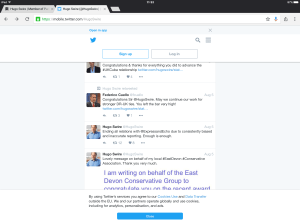
Hugo doing another Trump! Refuses to engage with Express and Echo

Donald Trump has banned several newspapers from his presidential campaign. Our own dear Hugo – after copying him with Twitter spats with other MPs see earlier posts – has now copied him again, this time severing all ties with the well-respected local Express and Echo newspaper – again announcing it on Twitter on 5 August:

image

(“Severing all ties with Express and Echo newspaper due to consistently biased and inaccurate reporting. Enough is enough”)

It seems that he is highly sensitive to criticism these days (again like Trump) and is dealing only with those newspapers which give him favourable column inches.

It cannot be too long before we hear in one of those rare visits to a Sidmouth shop (almost certainly Waitrose) those (in)famous words “Do you know who I am?”

Yes, indeed we do, indeed we do.

Conservatives come last at South Hams District Council by-election

John Birch – Lib Dem 812 votes
Alan White – Green 499 votes
Alex Mockridge – Ind 391 votes
Andrew Barrand – Con 137 votes

Election results in East Devon … amongst the slowest – unless you read the “Conservative Home” website!

There were eleven district, borough or county council by-elections throughout the country yesterday. According to the Twitter account “Britain Elects”, Honiton was ninth out of the eleven to declare and, as of this moment, after ten declarations, the only result awaited is Exmouth Littleham.

Yet the ” Conservative Home” website is already showing it as a Conservative Hold:

image

Is our Electoral Returning Officer, EDDC CEO Mark Williams, resourcing the counts in East Devon appropriately?

Buying votes by political donation

Published in full because Owl found it impossible to decide which paragraph to cut.

“We may be told donors do not influence policy, but anywhere else our setup would be seen as corruption
Is this a democracy or is it a plutocracy? Between people and power is a filter through which decisions are made, a filter made of money. In the European referendum, remain won 46% of the money given and lent to the two sides (£20.4m) and 48% of the vote; leave won 54% of the money and 52% of the vote. This fearful symmetry should worry anyone who values democracy. Did the vote follow the money? Had the spending been the other way round, would the result have reflected that? These should not be questions you need to ask in a democracy.

If spending has no impact, no one told the people running the campaigns: both sides worked furiously at raising funds, sometimes from gruesome people. The top donor was the stockbroker Peter Hargreaves, who gave £3.2m to Leave.eu. He explained his enthusiasm for leaving the EU thus: “It would be the biggest stimulus to get our butts in gear that we have ever had … We will get out there and we will be become incredibly successful because we will be insecure again. And insecurity is fantastic.”

No one voted for such people, yet they are granted power over our lives. It is partly because the political system is widely perceived to be on sale that people have become so alienated. Paradoxically, political alienation appears to have boosted the leave vote. The leave campaign thrived on the public disgust generated by the system that helped it to win.

If politics in Britain no longer serves the people, our funding system has a lot to do with it. While in most other European nations, political parties and campaigns are largely financed by the state, in Britain they are largely funded by millionaires, corporations and trade unions. Most people are not fools, and they rightly perceive that meaningful choices are being made in private, without democratic consent. Where there is meaning, there is no choice; where there is choice, there is no meaning.

Politicians insist that donors have no influence on policy, but you would have to be daft to believe it. The fear of losing money is a constant anxiety, and consciously or subconsciously people with an instinct for self-preservation will adapt their policies to suit those most likely to fund them. Nor does it matter whether policies follow the money or money follows the policies: those whose proposals appeal to the purse-holders will find it easier to raise funds.

Sometimes the relationship appears to be immediate. Before the last general election, 27 of the 59 richest hedge fund managers in Britain sponsored the Conservatives. Perhaps these donations had nothing to do with the special exemption from stamp duty on stock market transactions the chancellor granted to hedge funds, depriving the public sector of about £145m a year. But that doesn’t seem likely.

At the Conservatives’ annual Black and White Ball, you get the access you pay for: £5,000 buys you the company of a junior minister; £15,000, a cabinet minister. Politicians insist that there’s no relationship between donations and appointments to the House of Lords, but a study at Oxford University found that the probability of this being true is “approximately equivalent to entering the national lottery and winning the jackpot five times in a row”.

We might not have had a say in the choice of the new prime minister, but I bet there was a lively conversation between Conservative MPs and their major funders.

Among the many reasons for the crisis in the Labour party is the desertion of its large private donors. One of them, the corporate lawyer Ian Rosenblatt, complains: “I don’t think Jeremy Corbyn or anyone around him is remotely interested in whether people like me support the party or not.” Why should the leader of the Labour party have to worry about the support of one person ahead of the votes of millions?

The former Labour adviser Ayesha Hazarika urged Corbyn to overcome his scruples: “Meeting rich people and asking for money is not exactly part of the brand that has been so successful among his party faithful. But … sometimes you just have to suck it up and do things you don’t like.”

Under our current system she might be right, not least because the Conservatives have cut Labour’s other sources of funding: trade union fees and public money. But what an indictment of the system that is. During the five years before the last election, 41% of the private donations made to political parties came from just 76 people. This is what plutocracy looks like.

Stand back from this system and marvel at what we have come to accept. If we saw it anywhere else, we would immediately recognise it as corruption. Why should parties have to grovel to oligarchs to win elections? Or, for that matter, trade unions?

The political system should be owned by everyone, not by a subset. But the corruption at its heart has become so normalised that we can scarcely see it.

Two-fifths of British political donations made by just 76 people
Here is one way in which we could reform our politics. Each party would be allowed to charge the same fee for membership – a modest amount, perhaps £20. The state would then match this money, at a fixed ratio. And that would be it. There would be no other funding for political parties. The system would be simple, transparent and entirely dependent on the enthusiasm politicians could generate. They would have a powerful incentive to burst their bubbles and promote people’s re-engagement with politics. The funding of referendums would be even simpler: the state would provide an equal amount for each side.

The commonest argument against such arrangements is that we can’t afford them. Really? We can’t afford, say, £50m for a general election, but we can afford the crises caused by the corruption of politics? We could afford the financial crisis, which arose from politicians’ unwillingness to regulate their paymasters. We can afford the costs of Brexit, which might have been bought by a handful of millionaires.

Those who urged us to leave the EU promised that we would take back control. Well, this is where it should begin.”

A fully linked version of this article can be found at Monbiot.com

http://www.theguardian.com/commentisfree/2016/jul/13/billionaires-bought-brexit-controlling-britains-political-system?CMP=Share_iOSApp_Other

Honiton hustings for district council includes East Devon Alliance candidate


“Honiton residents will have the chance to quiz candidates for a district council seat in Honiton’s St Michael’s ward.

The opportunity comes off the back of Cllr David Foster’s sudden resignation.

Three candidates – all currently serving on Honiton Town Council – are set to attend a hustings at Honiton Methodist Hall, on Friday, July 15, from 2pm.

They are

Ashley Alder (UKIP),
Henry Brown (Labour) and
John Taylor (Independent East Devon Alliance)

June Brown, chair of Honiton Senior Voice, said: “We have been approached to hold a hustings because we have a proven track record over many years and because people want more information about candidates who present themselves.

“The district council controls many services and it is only right electors get the chance to meet and question those who wish to serve them as councillors. We are very pleased that with one exception the candidates have agreed to come along.”

For more information about Senior Voice and what the organisation does, visit http://www.devonseniorvoice

http://www.midweekherald.co.uk/news/hustings_to_quiz_next_district_councillor_for_honiton_1_4607829

MPs election expenses – not forgotten by Democratic Audit

Probably not good news for Police and Crime Commissioner Hernandez!

With all the constitutional chaos following the EU referendum result,
it’s easy to forget that up to 30 MPs are still being investigated for
breaking election spending limits by twenty police forces across the
country. But we’re still on the case!

Last week we hosted a meeting of politicians and campaigners to talk
about two things:

How can we bring MPs who have broken the rules to justice?
How can we fix the broken election expenses system?

Our friendly legal experts had some good news – there are legal options
to pursue MPs who have broken election spending limits even if the
police aren’t already investigating them! The allegations that the
police are already investigating could just be the tip of the iceberg in
this election expenses scandal.

It shouldn’t take a crack team of investigative journalists to keep our
elections fair and protect democracy. One big obstacle in the way of
holding MPs to account is that election expenses aren’t publicly
available. The only way you can access them is by going down to your
local council offices. We are working behind the scenes to change this
in time for the next general election (whenever that may be!) We will be
talking to the Electoral Commission to put pressure on local councils to
make this vital information available online.

With Brexit and Chilcot dominating the news, the election expenses
scandal could drop off the radar. We won’t let that happen.

Best wishes,

Alexandra Runswick
Director, Unlock Democracy

Will the demand for ” sovreignty” mean an end to secondary legislation?

This was published by the Daily Telegraph a few days ago, and now Brexit is a reality it should be read with new eyes:

“Perhaps the most powerfully held aspiration for Brexiteers is to restore UK parliamentary sovereignty: in the words of Michael Gove, to “take back control” and, of John Redwood, for Britain to “be a democracy again .

But what would this “taking back control” mean in practice? Brexiteers imply that while EU legislation is “imposed”, Westminster parliamentarians control non-EU law-making through active debates and votes.

Except they don’t, because for voters what impacts on their lives most is not primary legislation – Bills – on which parliamentarians can vote, but the meaningful detail of the Bills, which Whitehall civil servants and ministers increasingly choose to hide in secondary legislation (sometimes called delegated legislation of Statutory Instruments – SIs).

The scale of this was estimated for the Lords by former minister Baroness Andrews:

80 per cent of the laws as they impact on individuals are transported through statutory instruments, whether that is welfare benefits, food safety, planning requirements or competition across the NHS…”

Essentially Whitehall civil servants and ministers are defining important laws as “secondary legislation” in order to subvert the ability of parliament to choose whether to pass or not to pass laws.

Brexit is no guarantee of British control of its own destiny or of parliamentary sovereignty because our parliament is not in control.

SIs are rarely debated, and historic Westminster procedure means they cannot be amended. The idea that parliament meaningfully votes to “pass” them is no more real than the idea that the Queen gets to decide the content of the Queens Speech.

The problem is not new. An official Parliamentary report published in 2011 found that the last time the House of Commons rejected a SI was in 1979; it appears from the Hansard record that the rejection of this SI may have been a mistake.

The House of Lords, despite a 1994 resolution affirming its ‘unfettered freedom to vote on any subordinate legislation’, has voted down secondary legislation on only three occasions in the last half-century.

That one reason why the Lords’ hard line on the tax credits SIs in October 2015 caused such consternation in government and David Cameron to appoint Lord Strathclyde to review Lords powers and recommend further action.

The erosion of parliamentary sovereignty by the growing use of secondary legislation and “Henry VIII clauses” (which give ministers powers to change primary legislation through Statutory Instruments and thereby bypass the need for parliamentary votes) to reduce the parliamentary accountability of ministers and Whitehall civil servants was dubbed “The New Despotism” in a book by Lord Hewart of Bury, Lord Chief Justice of England and former Attorney General, published as long ago as 1929.

This would not change outside the EU. The problem was just as real before Britain joined the European Community.

Labour MP Willie Hamilton told parliament in the 1971 European Community accession debate:

“A great deal goes on even now under our own eyes that we do not know about… some 2,000 Statutory Instruments, which have legislative effect, go through this House every year and only a handful of them are debated. This is already government by default. In that sense this House, voluntarily and negligently, has surrendered a large part of its sovereignty to the Executive…. Much play has been made of the decision-making by the bureaucrats in Brussels. Things are not as simple as that. What about our own faceless bureaucrats in Whitehall? What part does this House play now in making policy decisions and in framing legislation? We have none at all. Everybody is consulted except us. Therefore, let us not pretend there will be any serious derogation there when we get into Europe.”

Some Brexiteers, notably Douglas Carswell, have a track-record of championing democratic accountability in Britain’s Westminster parliament. But they are the exceptions. Most are happy to indulge a Westminster parliamentary processes and rules more akin to Mornington Crescent than to cricket. Westminster “parliamentary sovereignty” would be no more certain of “returning control” to British voters, than a sovereign British space programme would be of sending a union-jack adorned rocket to Mars and getting it back in one piece.

That is nothing to do with the EU – if voters do back Brexit to “take back control” they could find themselves holding a political pudding whose democratic promise has been significantly over-egged.

http://www.telegraph.co.uk/news/2016/06/19/brexit-wont-return-power-to-mps-in-parliament-because-parliament/

“EU Referendum: “East Devon to be one of the last districts to declare results”

East Devon will be one of the last local areas in the UK to return their EU referendum result. The district will return their verdict at 5am on Friday morning.

Residents in Exeter, however, won’t have to wait as long. The city’s verdict is expected to be revealed at 3am.

South Hams are set to announce theirs 3.30am, Teignbridge at 4.30am, West Devon at 5am, Plymouth at 5am and Torridge between 4am and 6am.

http://www.exeterexpressandecho.co.uk/eu-referendum-east-devon-to-be-one-of-the-last-to-declare-result/story-29436536-detail/story.html

Exeter has many more voters than East Devon, so has Plymouth.

Explain.

Former editor of “The Independent” thinks party politics is dead and democracy is broken

“So here is the checklist: Conservative Party: split; Labour Party: in disarray; Liberal Democrats: severe losses.

That isn’t the end of it. There is another serious development running in parallel: the decline in people’s trust in their political leaders. Which is cause, and which is consequence, it is impossible to say.

What is certain, however, is that the systematic, shameless spinning and fear-mongering of the Remain and Leave campaigns has further reduced the respect in which our aged political system is held.

The truth is that the party system – a part of our everyday lives since Labour formed its first government in 1924 – is tottering and will soon collapse. …

… I hope myself that the ‘new’ would have three characteristics. First, the political process would be more consultative than it is at present. To this end I would favour a further expansion of the work of the parliamentary select committees. These are the bodies that have recently held Mike Ashley of Sports Direct and Philip Green, the former owner of BHS, to account. They should hold hearings in regional centres as well as in the Palace of Westminster.

Second, MPs should be subject to term limits, which would mean that they could not stand for re-election to the House of Commons more than, say, twice. This would prevent the creation of a political class. Politics would no longer be a lifetime career but a public duty.

And third, citizens who have done something with their lives other than politics should be willing to stand for Parliament knowing that with term limits, it would not be a job for life.”

http://www.independent.co.uk/news/uk/politics/the-founding-editor-of-the-independent-thinks-democracy-is-broken-and-he-wants-to-know-what-you-a7096311.html

Political spending US-style

Remember £15,000 for a jar of Hugo Swire’s honey in 2014:
http://www.telegraph.co.uk/finance/comment/citydiary/10944187/City-Diary-After-dinner-auction-could-turn-into-a-honey-trap-for-the-Tories.html

and Hugo’s remarks about people on benefits at the auction he chaired in 2015:
http://www.telegraph.co.uk/finance/comment/citydiary/10944187/City-Diary-After-dinner-auction-could-turn-into-a-honey-trap-for-the-Tories.html

Owl, having read below about how Donald Trump manages his election expenses, wonders how much of the battle bus expenses ended up back in donors pockets.

“Donald Trump loves to brag about his wealth. But as he heads into the general election in November, his campaign’s bank account is almost empty (for a presidential candidate) — he has just $1.3 million on hand, nearly 40 times less than presumptive Democratic nominee Hillary Clinton.

And a lot of the money the Trump campaign has spent is going directly back to Donald Trump. In May, according to Federal Election Commission filings, Trump spent about $1 million of his campaign’s funds on products and services from business he owns, including:

$423,372 to rent out Mar-a-Lago, his Palm Beach club
$349,540 to Tag Air, his fleet of private jets
$29,715 to rent out the Trump International Golf Club
$35,845 to rent out the Trump National Golf Club
$72,800 in rent on Trump Tower

Earlier this year, the Trump campaign spent thousands to stay at Trump hotels, eat at Trump restaurants, and serve Trump bottled water at their events. The Associated Press calculated that, in all, $6 million of Trump campaign money has gone back to the Trump Organization.

Campaigns are required to pay the fair market value for the goods and services they purchase, even if they’re paying a company owned by the candidate. (Otherwise, Trump’s companies could give him a big advantage by allowing him to use facilities for free, while Clinton, who is not a real estate magnate, has to pay for venues where she holds her events.) Trump, naturally, wants to host events at properties he owns.

Since Trump’s campaign funds still mostly come from a loan from the candidate himself, a lot of this spending is just passing Trump’s money around. But as the campaign goes on and Trump seeks out more donations, some of the money from his supporters will end up flowing right back to him.”

http://www.vox.com/2016/6/21/11988298/trump-campaign-spending-trump

Two more Independent groups in the south-west

Plymouth Independents:

A group of independently minded people who have their own individual ideas, attitudes
and personalities.

“The object of the Party is to have a central point for the “Lone Voices” who regularly stand in local elections to gather, get advice and plan strategies for PLYMOUTH.

We want ORDINARY people to join us and get involved with local Democracy, we are not being told what to do by some remote CENTRAL OFFICE, our Central Office is the City and its residents.

Not all of us will agree, not all of us will even get on! But, and it’s a big but, we will ALL work for the City.”

http://www.pisw.uk/

and

North Somerset First Independents

We believe that the current administration within North Somerset Council is not democratic or transparent due to its majority stronghold. We want to break down this stronghold to make it a fairer and more balanced democratic council. We aim to reinvigorate local politics and believe localism is the key to this. But above all we want to renew your trust within local politics.”

http://www.northsomersetfirstindependents.org.uk/FAQs

Voting deadline extended to midnight Thursday

The deadline for registering to vote in the EU referendum has been extended, the government has said.

https://www.gov.uk/register-to-vote

Cabinet Office minister Matt Hancock said the government would legislate to extend the cut-off until midnight on Thursday.

It follows a computer glitch which left some people unable to sign up before the original midnight Tuesday deadline.

The Electoral Commission urged people to sign up until the end of Thursday in order to vote on 23 June.

PLEASE do not leave it till the last-minute – do it NOW! With your national insurance number to hand (it is usually on payslips) it will take less than five minutes.

EVERY VOTE WILL COUNT IT IS SO CLOSE.

Rome favouring Independent for Mayor

“Italy’s anti-establishment Five Star Movement (5SM) took a large lead in the first round of voting for the mayor of Rome, according to exit polls published on Sunday, in a possible blow to prime minister Matteo Renzi.

Some 13 million people, or a quarter of the adult population, were eligible to vote for mayors in around 1,300 towns and cities, with attention focused firmly on a handful of major centres, including the capital.

Victory in Rome would be a huge breakthrough for anti-establishment 5SM, which was founded in 2009 by comedian Beppe Grillo and has grown to be Italy’s second largest party.

A victory by the populist party in the capital’s mayoral election is considered to be a key marker of whether the 5SM could eventually challenge Mr Renzi for leadership of the whole country.”

http://nr.news-republic.com/Web/ArticleWeb.aspx?regionid=4&articleid=65928995

The democratic deficit – from the top down

Replace Parliament with EDDC and Executive with Cabinet [and backbenchers with Independents] and you have a dead-ringer for local politics too!

“Scrutiny of the executive

The prime minister’s active participation in parliamentary proceedings is a key mechanism for ensuring the accountability of the executive, but they have been less and less present in the Commons since the time of Thatcher and Blair. David Cameron’s attendances are limited to a 30 minute question time (PMQs) once a week when Parliament is sitting, occasional speeches in major debates, and periodic public meetings with the chairs of Select Committees in the new Liaison Committee.

More encouraging is recent research is showing that backbenchers used PMQs in 1997-2008 as a key public venue, with backbenchers often leading the agenda and breaking new issues that later grew to prominence. The current Leader of the Opposition, Jeremy Corbyn, has also routinely been using PMQs to ask questions sent in on email by the public, somewhat changing the tone of the session.

The ‘payroll vote’

Parliament’s independence vis-a-vis the executive has long been qualified by strong partisan loyalties amongst almost all MPs, who (after all) have spent many years working within parties before becoming MPs. The members of the government’s frontbench are expected to always vote with the executive, as are Parliamentary Private Secretaries (who are pseudo-ministers) The last official data in 2010 showed approximately 140 MPs affected. Unofficial estimates of the size of the payroll vote suggest that it was equivalent to well over a third of government MPs, by 2013. Given the smallish number of Conservative MPs in the 2015 Parliament the ratio will still be high. When Commons seats fall to 600, the prominence of the payroll vote will increase, unless government roles for MPs are cut back.

Dissent by backbench MPs

The coalition period marked not just a period of record dissenting votes by backbenchers against their party line, but also the extension of this behaviour to larger and more consequential issues. The cleavages inside the Conservative party between pro and anti-EU MPs are exceptionally deep. During the summer of 2016 the Cameron government backed off several controversial legislative proposals, and proposed an exceptionally anodyne set of bills in the Queen’s Speech, apparently to avoid straining party loyalties further in the aftermath of the Brexit referendum. The rise of serial backbench dissenter Jeremy Corbyn to be Labour leader has also created a serious gulf between his team and many of the Parliamentary Labour Party, which may reduce the cohesion of the main opposition party’s voting.

Conclusion

Public confidence in Parliament was very badly damaged by the expenses scandals of 2009, and trust in the House of Commons remains at a low ebb, despite some worthwhile but modest reforms in the interim, especially making Select Committees more effective in scrutinizing government. The Commons remains a potent focus for national debate, but that would be true of any legislature in most mature liberal democracies. There is no evidence that the UK legislature is especially effective or well-regarded, as its advocates often claim.

Five years of Coalition government 2010-15 (almost automatically) somewhat reduced executive predominance over Parliament. But it did not break traditions of strong executive control over the Commons. Tory divisions over the EU (plus the artificial exclusion of UKIP from Commons representation) have perpetuated backbench unrest after 2015. But these ameliorations of party discipline may still be termpoary. Structural reforms to make the Commons a more effective legislature, and to modernise ritualistic behaviours and processes, are still urgently needed.”

http://www.democraticaudit.com/?p=22396

Hernandez update

“Adrian Sanders

Torbay Election Expenses Update and New Questions

According to the Devon & Cornwall Constabulary all matters in relation to the expenses returns from the General Election 2015 that relate to our newly elected Police and Crime Commissioner Alison Hernandez have been referred to the Independent Police Complaints Commission. They in turn have referred the matter as a “managed” investigation to West Mercia Police. They now hold responsibility for the ongoing investigation in order to provide the complete and clear separation between Devon & Cornwall Police and the elected PCC.

On 19th May the Police were successful at magistrates court in extending the time limit on prosecutions for a further year in relation to all the MPs and their Agents in Devon & Cornwall.

Investigations will begin into:

Whether the expense of bringing activists to Torbay to campaign for Kevin Foster should have been declared locally or nationally?

Whether the cost of the mention of the battle bus locally in relation to canvass cards should have been fully declared on the General Election return and not apportioned to local council candidates and the Mayoral campaign?

Whether the omission of said battle bus canvass cards from council candidate expense returns bring council candidates and their agent under investigation, or whether this was an attempt by the General Election Agent to pass off costs onto others without their knowledge?

Where other costs of the battle bus should have been declared?

Whether the expense of direct-mail shots naming the constituency as one where people should vote Conservative were a local expense given there was only one Conservative Candidate in the constituency whom they could be asking people to vote for, or whether it was correctly omitted from the return?

These are probably the main issues but now there are some more and one is very serious indeed.

Thanks to a right-wing blogger I’ve had to check my own expense return. Following a complaint from someone based on the blogger’s allegations into my own return the police quite rightly have had a good look.

The Devon & Cornwall police (who should have passed the complaint to another force in my opinion, after all which Police & Crime Commissioner could my Agent or I complain to if dissatisfied with their conduct!) acted on the complaint and requesting copies of election materials from the original suppliers.

Having inspected my expense return and my literature this was their conclusion:

“Initial enquires with regards to these allegations have not provided evidence to support the allegation therefore no further police action will be taken at this time. This includes any consideration of an application to extend time limits for such alleged offences.”

The New Questions for the Tories

In having to look again at my returns I came across an item correctly declared by myself that I had previously overlooked in relation to the Conservative return. I properly declared an amount for telephone canvassing. No such costs are recorded on the Conservative election expense return.

While checking the Conservative return for a declaration of those costs I then noticed something else. It is the date entered under “Date you became the candidate”.

The date is usually the date of the dissolution of Parliament that was Monday 30th March 2015 but Alison and Kevin have put it down as 10/4/14 – over a year early – on their Short Campaign Return and 10/4/15 on their Long Campaign Return.

This is probably a clerical error the candidate and agent will wish to report to the Electoral Commission if they haven’t already done so before investigations begin in earnest.

It does however raise yet another question and that is when exactly did the Conservative Candidate become the Candidate? This is very important as the limited expense limits of the Short Campaign kick in from the date declared and a false declaration is a criminal offence.

This is what the rules say for the Short Campaign:

“The earliest date you can officially become a candidate is the day that the UK Parliament is dissolved. Parliament is scheduled to be dissolved on 30 March 2015. You will become a candidate on this date if you or others have already announced your intention to stand. If your intention to stand has not been announced by the day of the dissolution of Parliament, you will officially become a candidate on the earlier of the date you or another person announce your intention to stand, or the date when you are nominated.”

The key is “You will become a candidate on this date (30th March) if you or others have already announced your intention to stand. “

A chat with the Electoral Commission on this point may also be necessary given the literature and campaign materials that were distributed by the Tories between the 30 March and 10th April in the Torbay Constituency.

For the record I declared I became the candidate on the 30th March 2015, the day of dissolution.”