Well, that’s it: PegasusLife wins Knowle appeal

“An application to create a 113-home retirement community at East Devon District Council’s current HQ has been allowed on appeal by the Planning Inspector.

PegasusLife lodged an appeal following the scheme’s refusal in December 2016.

A public inquiry was held over five days in November 2017.

The new development will be classed C2, which means Sidmouth will miss out on thousands of pounds’ worth of contributions towards affordable housing.

Read reactions in Friday’s Sidmouth Herald.”

http://www.sidmouthherald.co.uk/news/developer-wins-appeal-for-113-home-retirement-community-at-knowle-1-5365209

“Secretary of State forecasts increase in number of unitary authorities”

Might Devon unitisation take place soon AFTER EDDC moves to its new luxury HQ?

“The Secretary of State for Housing, Communities and Local Government says he expects the number of unitary authorities in England to be higher in five years’ time.

Sajid Javid’s comments came in response to a question from former Cabinet colleague Patrick McLoughlin, who noted that both Scotland and Wales “are totally served by unitary local authorities”.

Sajid Javid 146x219The Secretary of State responded: “I can tell him that 60% of English people are served by unitary authorities, and I expect the number to be higher in five years’ time, given the views of many local people about unitary authorities and our commitment to consider unitarisation whenever requested.”

In November 2017 Javid said he was ‘minded to’ back the Future Dorset plans, which involve the replacement of the nine local authorities in the council with two unitaries.

Under this model, one ‘urban’ unitary would be created through the merger of Bournemouth, Poole and Christchurch. The other ‘rural’ unitary would be established from East Dorset, North Dorset, Purbeck, West Dorset and Weymouth & Portland. The county council would cease to exist.

However, councillors at Christchurch agreed this month to write to the Secretary of State to set out their vision of an alternative to the proposed shake-up. The council also approved an initial budget of £15,000 to take legal advice “and if necessary initiate legal proceedings to protect the interests of Christchurch Borough Council and its residents”.

Though not involving the establishment of unitary authorities, the Secretary of State said in December that he was ‘minded to’ back the merger of Taunton Deane Borough Council and West Somerset District Council, and the merger of Forest Heath District Council and St Edmundsbury Borough Council into single district councils.”

http://localgovernmentlawyer.co.uk/index.php

““CAMPAIGNERS REVEAL CASH-STRAPPED KENT NHS TRUST PAID MILLIONS TO A PRIVATE COMPANY TO FIND SAVINGS”

Dame Ruth Carnell is also leading Devon’s STP after her appointment os chief of the “Success Regime” on which her consultanct company worked prior to her appointment.

PRESS RELEAE:

“Two local Kent campaigners claim they had to mount a year-long investigation, involving numerous Freedom of Information (FOI) requests and a meeting with top NHS executives, in order to confirm that a small private consultancy firm had been paid over £6 million of local NHS funds to find cuts and “efficiency savings” in Kent.

Diane Langford and Julie Wassmer say they became concerned when they saw Dame Ruth Carnall, a former NHS executive who heads the private consultancy, Carnall Farrar, had been made Independent Chair of the Programme Board of the local Sustainability & Transformation Plan (STP) – one of 44 regional bodies put in place by NHS England to implement cuts and “savings” within the NHS.(1)

Author and campaigner, Julie Wassmer says “I raised concerns with former Canterbury MP, Julian Brazier, at a public (CHEK) meeting last March, questioning how Dame Ruth could possibly claim ‘independence’ when her own company was set to profit from the contract. At the same time, I was aware that my colleague, Diane Langford, had already been coming up against a wall of obfuscation in trying to discover how much that contract was worth and who was actually making the payments.”

Ms Langford, a writer and former Hansard transcriber says: “I actually submitted my first Freedom of Information request in December 2016, then dozens more to all eight Clinical Commissioning Groups (CCGs) in Kent and Medway as well as to Kent County Council (KCC) and NHS England in order to try to establish who was paying Carnall Farrar. As each respondent has up to 20 days to reply, it was an extremely time-consuming process and all the bodies denied having paid the firm though KCC had disclosed that the money came from ‘the NHS.’”

A complaint to the FOI Ombudsman against Maidstone and Tunbridge Wells NHS Trust was triggered when no reply was received within 20 days.

Eventually the campaigners found that millions of NHS money had been paid to Carnall Farrar by Maidstone and Tunbridge Wells NHS Trust, of which Glenn Douglas was then CEO. Wassmer then obtained a meeting last month, at which the campaigners discussed with Douglas (now – CEO of the Kent and Medway Sustainability and Transformation Partnership) and Michael Ridgwell (its Programme Director) the huge sums that had been paid to Carnall Farrar and why they were not appearing on the Trust’s usual spending records for payments of £25k and over.

“Ironically,’ says Wassmer, “this was on 7th December, just before the local NHS was about to implode with the pressure of Christmas and New Year emergencies. Michael Ridgwell was unable to produce an exact figure of how much had been paid to Carnall Farrar, but suggested the sum of £2.2M. I then explained that with the help of research organisation, Spinwatch,(2) we had actually confirmed that a figure of £6,051,199 had been paid to September 2017 (3) – though only just over half of it had been logged in the Trust’s spending records, with no record of any significant spending on Carnall Farrar before June 2017 – and no trace of the remaining millions. At the meeting Glenn Douglas explained to us that as the STP is not an “organisation” it is not obliged to publish its payments, but Michael Ridgwell then agreed to publish the full expenditure on the Trust’s website and has since done so. These records show that Carnall Farrar has been paid well over half a million pounds a month since September last year, although it’s not known whether this money is on top of the £6m it has already charged the local NHS.“

The campaigners insist it is crucial to challenge the lack of clarity, transparency, and accountability surrounding such huge payments. Even more so as the government now seeks to introduce new bodies – Accountable Care Organisations – that could see billions of pounds of the NHS budget handed to commercial companies.

“This is public money,” says Wassmer, “NHS funds being diverted away from services and into the pockets of private consultancies. We know that over £6 million, and possibly more, has been paid from the local NHS budget to this one consultancy for barely 18 months’ work on the local STP. How much more is going to management consultants across the whole of the UK? It’s almost impossible to hold the system to account and I fear it will only be worse with the impending introduction of so-called Accountable Care Organisations (4). Paying millions to private companies, like Carnall Farrar to find damaging cuts within an underfunded service is not only senseless – it’s immoral.”

Diane Langford agrees: “This lack of transparency conceals not only the sums involved, but the role consultancies like Carnall Farrar play in axing services. At our meeting on 7th December, we mentioned that Dame Ruth Carnall had appeared in a 2011 list compiled by the Sunday Telegraph of the highest paid NHS “fat cats” – earning an annual salary of over £200,000 at that time.(5) Glenn Douglas was on the same list, and while he admitted he was still earning in excess of £200,000 a year, the point is that as an NHS member of staff he can be held duly accountable for his work, in a way that private companies like Carnall Farrar cannot.”

Dr Coral Jones, GP, vice -chair of Doctors in Unite and member of Keep our NHS Public commented: “As the campaigners Diane Langford and Julie Wassmer have uncovered, over £6 million has been paid to a single consultancy company run by a former director of NHS London to tell the Kent and Medway CCGs how to cut services. Downgrading of services at QEQM hospital in Margate, as proposed by Carnall Farrar, will put lives at risk. Patients in Thanet and all those in East Kent living miles away from Ashford will be at risk of death, or avoidable disability, after a review of Kent and Medway urgent stroke services plans to concentrate hospital treatment for strokes in three sites across Kent and Medway. There is no discussion of alternatives apart from the concentration of services in three hospitals, and none on how to avoid the poor outcomes for patients when treatment is delayed due to travel times. The use of management consultancy companies is widespread in the NHS. Their reports, costing many millions of pounds, all follow the same formula of cuts, re-configurations and concentration of services. On Saturday 27th January at 10.30 am there will be a community conference (6) at Queens Rd, Baptist Church, Broadstairs CT10 1NU to oppose downgrading of local NHS services and I urge everyone concerned about the NHS in Kent & Medway to come along.” ENDS

Source: http://www.spinwatch.org

“NHS protest march to be held in Exeter City Centre”

“Organisers say everyone concerned about their health service across Devon is welcome

Hundreds are expected to join a protest march through Exeter city centre to protest at hospital closures across the county.

The Save Our Hospitals Campaign is holding a march in the city on Saturday February 3 which is open to anyone who has concerns about the reorganisation taking place across Devon where four hospitals have already closed while beds have been closed at several more.

Spokesman for the group Mike Dallimore from Brixham where the minor injuries unit has been closed, cited the closure of hospitals at Dartmouth, Bovey Tracey and Ashburton and beds at Paignton Hospital.

He said the group feared Devon would ultimately be left with only two hospitals in Plymouth and Exeter.

It comes as Foreign Secretary Boris Johnson was understood to be pushing for an extra £100m a week for th NHS in England after Brexit.

The group organised a protest march in Totnes last month which hit the headlines when a mock coffin was left outside the office of Totnes MP Sarah Wollaston covered in posters saying ‘cuts cost lives’ with the figure 120,000 ‘ unnecessary’ deaths.

The protest will start at Bedford Square in Exeter at 11am and possibly march through the city centre, said Mr Dallimore.”

http://www.devonlive.com/news/devon-news/nhs-protest-march-held-exeter-1104504

“The ‘temporary’ closure of birth services will now last nine months, and possibly longer, in Honiton and Okehampton”

“The ‘temporary’ suspension of birth services in Honiton and Okehampton is set to continue due to ongoing staff sickness and high patient demand in Exeter.

Today the Royal Devon & Exeter Hospital has announced the two centres will be closed for a further three months – which means they will have been closed for nine months.

When the centres closed in July 2017, it was said at the time the suspension of the services was expected to last for three months.

The latest suspension means women will still not be able to give birth at either site. The suspension will be reviewed again in April.

The RD&E says that although good progress has been made to recruit staff into vacancies within the wider maternity service, ongoing staff sickness and high patient demand in the acute unit in Exeter means it has not yet been able to reach acceptable staffing levels in either centre.

All antenatal and postnatal clinics, midwifery support and home birth services at Honiton and Okehampton are unaffected and running as normal.

Zita Martinez, head of midwifery, said: “We are sorry for this continued suspension in inpatient services and understand it will be disappointing for women who had hoped to birth at Honiton or Okehampton.

“Patient safety remains our top priority and we are continuing to work hard to resolve this as soon as possible.”

Honiton and Okehampton Birth Centres are open for clinics and midwife care and support 8am to 8pm, seven days a week. Outside of these hours women should call the RD&E main maternity triage service on 01392 406616.”

http://www.devonlive.com/news/devon-news/temporary-closure-birth-services-now-1102388

“We’ll live longer but suffer more ill-health by 2035, says study”

Owl says: Couple this with news today that child health care in England lags behind that of Wales and Scotland:

http://www.bbc.co.uk/news/health-42746982

the result of which is likely to be MORE ill-health in later life, we have an perfect storm of ill-health about to descend on us.

“The number of older people who have at least four different medical conditions is set to double by 2035, in a trend that will put huge extra strain on the NHS, researchers warn.

Diseases such as cancer, diabetes, dementia and depression will become far more common as more and more over-65s develop them in their later years, a study at Newcastle University published on Tuesday found.

Health fears over boys as young as 13 using steroids for ‘good looks’
One in three of those diagnosed with four long-term conditions will have dementia, depression or some form of cognitive impairment, according to academics in the university’s Institute for Ageing.

They predict that over the next 20 years there will be “a massive expansion in the number of people suffering from multiple diseases, known as multi-morbidity”.

Those years will see a 179.4% increase in the number of people of pension age being diagnosed with cancer, a 118% rise in those who have diabetes and a big jump, too, in cases of arthritis.

“In the population over the age of 85 years all diseases, apart from dementia and depression, will more than double in absolute numbers between 2015 and 2035”, say the researchers.

The trend will mean that men and women will suffer from four or more diseases for two-thirds of the extra life expectancy that people can look forward to gaining by 2035 – another 3.6 years for men and 2.9 years for women – the authors estimate.

“These findings have enormous implications for how we should consider the structure and resources for the NHS in the future,” said Carol Jagger, professor of epidemiology of ageing at the institute, who led the study.

“Multi-morbidity increases the likelihood of hospital admission and a longer stay, along with a higher rate of readmission, and these factors will continue to contribute to crisis in the NHS”.

A large part of the increase in the number of people with four or more medical problems will come from an expected sharp rise in coming years in the number of people living until at least 85, which Jeremy Hunt, the health secretary, has warned will increase the NHS’s workload.

Jagger and her team also identified another age group whose health outlook is also very gloomy.

“More worryingly, our model shows that future young-old adults, aged 65 to 74 years, are more likely to have two or three diseases than in the past. This is due to their higher prevalence of obesity and physical inactivity, which are risk factors for multiple diseases,” added Jagger.

The research, part of the MODEM project, has been jointly funded by the Economic and Social Research Council and the NHS’s research arm, the National Institute for Health Research.

Caroline Abrahams, the charity director at Age UK, said: “This research absolutely underlines the importance of getting our health and care services right for older people. The increase in longevity over recent years has been a major achievement, but it also means we need to shift our focus to helping people to stay as well and independent as possible for as long as possible.

“As we get older, our health and care needs tend to overlap and become more complex. A more compassionate and intelligent approach to caring for older people must be a priority for us all.”

A spokesperson for NHS England said: “This study is further evidence of the need to integrate care, in the way the NHS is now beginning to do, so as to better support the growing number of older people with multiple health problems.”

https://www.theguardian.com/society/2018/jan/23/well-live-longer-but-suffer-more-ill-health-by-2035-says-study

“Tory government could let Virgin Trains run more rail lines despite East Coast ‘bailout’ “

“Tory ministers could let Virgin Trains take control of more rail lines despite a huge row over the firm receiving a “bailout”.

Transport Secretary Chris Grayling refused to rule out further franchises, despite confessing the firm “made a major mistake” and there will be less money than forecast for the taxpayer.

He faced calls to quit last month when he let Virgin Trains East Coast, a partnership between Stagecoach and Sir Richard Branson’s empire, walk away from its franchise three years early. The firm is expected to pay the government hundreds of millions of pounds less than the £3.3bn it originally promised to 2023.

Labour branded this a bailout, a word Mr Grayling has repreatedly rejected.

Grilled by MPs today, Mr Grayling finally admitted there “won’t be as much” profit to the taxpayer “as had been forecast”. He added he was “not at all” happy with the current situation, adding: “This is a franchise that we clearly have not got right, the company hasn’t got right, it’s hugely frustrating.” But he repeatedly refused to guarantee the firm won’t be granted future rail franchises. He said the firm had not defaulted on the East Coast contract and was running a “good service”.

He told the Commons Transport Committee: “I have to do what is lawful as well as what is desirable. “I’m also constantly under attack from various politicians saying there are too many foreign companies in our rail network. This happens to be a British company in our rail network. “It may have made a major mistake here – do we want to exclude it permanently from all participation in the rail network?”

Mr Grayling insisted he does not want “companies to abuse the system and milk it for money”, and promised: “There’s no question of handing anybody a bung… They will be held to every last inch of that contract.”

But he admitted there will be less money to the public purse than forecast. He told MPs: “The taxpayer continues to make a premium out of this, will make a premium out of this in all circumstances going forward – taking a substantial slice of the operating profit.

“The money that’s been committed through the franchise period doesn’t just disappear in a puff of smoke. “But it’s certainly the case there isn’t as much of it as had been forecast.”

https://www.mirror.co.uk/news/politics/tory-government-could-virgin-trains-11896936

“Orphan” academy school still wIting for new sponsor after 2 years

“Two years ago, Rose Hill primary on the outskirts of Oxford was branded a failing school. Ranked “inadequate” by the schools watchdog Ofsted, it was placed in special measures and staff and parents were told an academy trust would be brought in to turn around the school’s fortunes.

Two years on – and two education secretaries later – the school is still waiting.

When the Guardian visited in January 2016, morale was at rock bottom. The Ofsted report had been so devastatingly negative that the headteacher, Sue Vermes, and her team said they felt “criminalised” by the experience. A compulsory academy order was made and Vermes and her colleagues waited for their new masters to move in. Then – nothing.

Rose Hill, which serves a disadvantaged community far from Oxford’s dreaming spires, has become what is known as an “orphan” school. It is yet to be adopted by a sponsor. Though a local academy trust has shown an interest, a deal is yet to be secured. As the new education secretary, Damian Hinds, gets to grips with his brief, this small school is a reminder of the challenges the government’s academies programme faces.

“You feel unwanted,” says Vermes, sitting in her drab office. “With the day-to-day running of the school, it doesn’t have much impact. But long term, where are we going? I’ve given up trying to explain it to parents.”

Rose Hill is not alone. Estimates suggest there are around 60 orphan schools in England waiting to be taken over by a sponsor.

The government claims its academies policy – which takes schools out of local authority control and puts them in the hands of an academy trust, making them directly accountable to the Department for Education (DfE) – enables it to intervene swiftly when a school is in trouble. However, Rose Hill and others like it show this is not always a straightforward process.

And it has an impact on the children, too. After Rose Hill’s inadequate rating, one pupil asked Vermes: “If this is an inadequate school, does that mean I’m an inadequate child?” The longer the uncertainty continues, the less appealing the school looks to future pupils and their families, hence numbers drop and so does income.

The school building, which was crying out for repairs when we last visited, is just as bleak two years on. There is mould on the ceiling, the toilets smell, the paintwork is chipped, the classrooms are overheated and stuffy and the shabby corridors are chilly and unwelcoming.

It was due to be demolished and rebuilt under the last Labour government – the plans were drawn up and published in the local newspaper. When the coalition government took over in 2010, the funding disappeared overnight and Rose Hill has been struggling to keep up appearances ever since.

Since the Guardian’s last visit, the local authority has spent £200,000 on patching up the roof and replacing some windows; the DfE has set aside £1.4m for a new sponsor to spend on further repairs. But Vermes thinks a total rebuild is needed, which would cost £9m. “This is not a building that says to the children and their families that their education is crucial. It’s just saying to them, you are not worth the investment,” she says.

The building will be an ongoing issue for any sponsor. In addition, staffing costs are high: 35 different languages are spoken at the school, a third of the children have special educational needs and around half of them live in poverty. Vermes says the pressures on vulnerable families have increased as austerity continues to bite. There are two local food banks, which are well used, but some children are not getting enough to eat.

The children’s centre at the school has closed like all Oxfordshire’s children’s centres – so problems are not being picked up at an early stage. Pupils who need to attend a special school cannot always find one because of a shortage of places, so Rose Hill keeps them on roll with additional support staff.

MPs call for overhaul in oversight of England’s academy school chains
After the academy order was made, Vermes was asked to quit – but she refused. “It’s the wrong culture. It’s like football managers,” she says. She has worked as a teacher in Oxfordshire since 1985 and has taken just three days of sick leave in that time.

Last October, Ofsted returned to Rose Hill and found it much improved. The school was taken out of special measures and rated “requires improvement”, but in three categories was ranked “good”. Yet still the school is stranded without a sponsor.

More than half of all secondary schools in England are now run as academies, along with a fifth of primaries. On 17 January, MPs on parliament’s education committee called on the government to overhaul the oversight of academy chains after a string of high-profile failures.

Vermes is optimistic there will be a positive outcome for Rose Hill, hoping that the local academy chain she favours will take the school on, but the journey to this point has been long and bruising. It is, she says, a good example of the chaos of government policy surrounding academisation.

“I also think we are a symbol of the current punitive attitude towards children and families in poverty: ‘You’re poor, so your education is less important, and you can certainly put up with a substandard building,’” she says.

The Department for Education was unable to say how many “orphan” schools there currently are in England. A DfE spokesman said: “We have been working hard to achieve a positive solution for Rose Hill Primary school and to address the most urgent needs which will make the building fit for purpose.
“We are still in negotiations with River Learning Trust, which is supporting the school, and continue to work with the local authority, which remains responsible for maintaining the buildings and site at Rose Hill.”‎

https://www.theguardian.com/education/2018/jan/22/rose-hill-primary-oxford-an-orphan-school-at-the-sharp-end-of-academisation

“Inequality gap widens as 42 people hold same wealth as 3.7bn poorest”

“The development charity Oxfam has called for action to tackle the growing gap between rich and poor as it launched a new report showing that 42 people hold as much wealth as the 3.7 billion who make up the poorest half of the world’s population.

In a report published on Monday to coincide with the gathering of some of the world’s richest people at the World Economic Forum in Davos, Oxfam said billionaires had been created at a record rate of one every two days over the past 12 months, at a time when the bottom 50% of the world’s population had seen no increase in wealth. It added that 82% of the global wealth generated in 2017 went to the most wealthy 1%.

The charity said it was “unacceptable and unsustainable” for a tiny minority to accumulate so much wealth while hundreds of millions of people struggled on poverty pay. It called on world leaders to turn rhetoric about inequality into policies to tackle tax evasion and boost the pay of workers. …”

https://www.theguardian.com/inequality/2018/jan/22/inequality-gap-widens-as-42-people-hold-same-wealth-as-37bn-poorest

“All public service contracting ‘should be paused’ “

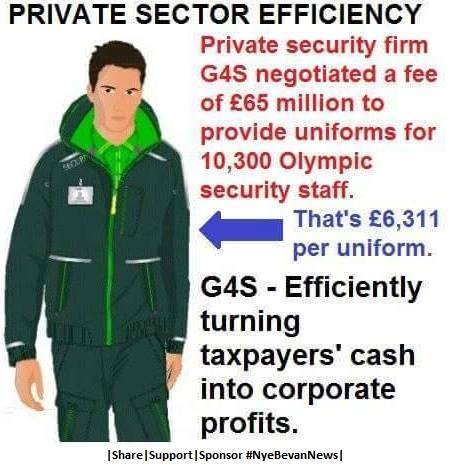
“The Smith Institute has called on the government to end what it called a “‘love in’ with outsourcing and PFI”, after the fiasco of the Carillion collapse.

A report Out of Contract said there should be an immediate pause in all public service contracting followed by a review of existing deals, which were valued in all at around £100bn a year

Authors John Tizard, a former senior executive at Capita, and David Walker, a former director at the Audit Commission, argued that public delivery should again be the norm in government, policing, the NHS and other services and pointed to a trend for local government, the devolved administrations and some NHS trusts to take services back under direct control.

A new regulator should scrutinise public contracting, they proposed, including how much directors are paid as well as staff employment and conditions and union recognition.

The report said there was a lack of data on outsourcing and PFI deals and a ‘Domesday Book’ listing these was needed urgently.

The authors of the report directly cautioned Labour – the Smith Institute is named after the late party leader John Smith – that any review of outsourcing, following the party’s criticism of the concept, needed an evidence base.

Shadow cabinet secretary Jon Trickett said: “Outsourcing and PFI are failed dogmatic experiments.

“Marketisation of public services was sold to us as efficient, with competition ensuring a good deal for the taxpayer and service users. It is clear that this is not the case.”

Tizard and Walker wrote a blog for PF on the report last week. “

http://www.publicfinance.co.uk/news/2018/01/all-public-service-contracting-should-be-paused1

Up to 1 million elderly people starving and lonely say MPs

“As many as a million older people are starving in their homes through loneliness according to MPs who have called on ministers to redirect funds into schemes such as lunch clubs.

Isolation from relatives and friends is a bigger cause of malnutrition in the elderly than poverty, they say, and the winter fuel allowance should be means-tested to free money for meals on wheels and lunch clubs.

Supermarkets should have “slow checkout lanes” so that older people can get enough to eat by shopping without rushing, the all-party parliamentary group on hunger recommends.

It reports cases where people have gone without meals for weeks after losing a partner or wasted away over many months because they had no one to help them cook. Others have gone hungry because they could not get to the shops. Some have been banned from supermarkets for falling over.

Social care services have said that while they will help frail elderly people eat, it is outside their scope to ensure there is food in the house, according to evidence gathered by the MPs.

Frank Field, chairman of the group, said: “Beneath the radar there are malnourished older people in this country spending two or three months withering away in their own homes, with some entering hospital weighing five and a half stone with an infection, or following a fall, which keeps them there for several torturous days, if not weeks.”

Theresa May said that loneliness was the “sad reality of modern life” as she appointed Britain’s first minister for loneliness last week. Tracey Crouch promised a strategy to deal with isolation and Mr Field said that his findings should be the “first report on her desk”.

About 1.3 million over-65s are thought to be malnourished but the MPs called for a more up-to-date estimate. Today’s report argues that pensioner poverty had fallen and few used food banks so the main reason was social. Mr Field said he was surprised to find that “for some of those who become malnourished it may be economic but there is also growing isolation, losing their friends because they’ve died and losing their partner.” Such people often end up in hospital and the House of Commons library estimates that malnutrition costs the NHS £12 billion a year.

A crumbling elderly care system has been cited as one of the main reasons for hospital pressures and Simon Stevens, the head of NHS England, has previously suggested scrapping perks such as free bus passes to pay for social care.

The MPs say that £100 million could be raised to feed the elderly by stopping the winter fuel allowance for higher-rate taxpayers.

Dianne Jeffrey, chairwoman of Age UK and of the Malnutrition Task Force, an independent group of experts, said it was a “shocking reality” of modern Britain that malnourished older people were “hidden in plain sight”.

Only 29,000 people receive meals on wheels, down from 155,000 a decade ago. A handful of Sainsbury’s and Tesco shops have “slow shopping” times when checkouts are devoted to those who want to shop without feeling hurried.

A government spokeswoman said: “We know better diagnosis and detection is key, which is why we continue to train all health staff to spot the early warning signs of malnutrition so effective treatment can be put into place.”

Source: The Times, today (pay wall)

Is Jeremy Hunt an NHS troll?

“Jeremy Hunt’s latest tweet will have the majority of Britain asking whether the widely-hated Health Secretary is just uncompromisingly incompetent, or whether he’s actively trolling the entire country.

The tweet is so inexplicably inept that it will have the entirety of Britain asking if Hunt is sticking two fingers up at every single doctor and nurse across the country, whilst simultaneously mocking the Prime Minister, who was too weak to sack him during her botched reshuffle, and who ended up giving the provably disastrous Health Secretary even more responsibility instead despite his many, many catastrophic failures.

The Tory Health Secretary just tweeted an NHS rota, in his words, as an example of a ‘really clever use of technology’ that NHS staff in Ipswich are using to ‘ensure safe staffing levels are maintained throughout the day.’

It seems Jeremy Hunt and his team either failed to actually look at what the rota was saying, or they just think dangerously low staffing levels are absolutely fine and definitely not a massive risk to patient safety. Let’s take a closer look at that rota:

Yes, like probably everybody else with even the faintest idea of what different colours mean on a rota, you’ve probably already guessed the problem: RED MEANS BAD!

Every red box on the rota Hunt tweeted means that staffing levels during that particular time of day, and on the corresponding ward, are considered at high risk due to understaffing.

For instance, on the early shift, the rota appears to show there are only two wards in the entire hospital that have adequate staff numbers and therefore a low risk level, whilst a staggering 11 wards have an inadequate number of nurses leading to these wards being labelled ‘high risk’.

It would appear that Hunt either wants to normalise this type of chronic and dangerously risky understaffing, or he simply hasn’t got a clue what the hell he’s doing.

[The article continues with some response tweets pointing this out]

And just remember, the person running the country just gave this man – a man whose professional history is littered with a catalogue of disastrous failures, missed targets and literal deaths as a result of his incredibly obvious incompetence – the task of ‘improving’ social care in Britain as well.

How people can actually justify voting for these people really is beyond me.”

https://evolvepolitics.com/jeremy-hunts-latest-tweet-is-so-outrageously-incompetent-people-think-hes-actually-trolling-nhs-staff/

Nurse explains why she has left a beloved profession

“An ”exhausted and despairing ” nurse has written an open letter explaining why she’s quit the NHS – and won’t return until changes are made.

The medic explains why she became a nurse, what she saw, how the NHS is struggling, how she felt after each twelve-hour day and why she’s quit. She also asks the public to be patient and not to blame staff after she read online comments made about doctors and nurses.

She says she was ‘inspired’ to join the medical profession but ”something has changed within the NHS” The nurse says ”…beds have been lost, smaller hospitals have been closed, mental health services have been starved of funding and jobs cut, funding has been cut year on year”.

She adds that ”the numbers of acutely unwell patients coming into the emergency departments is increasing but the services and facilities available to us is declining.”

The nurse says hospitals have ‘no space’ and ”no extra staff to help with the extra work load”. She adds: ”The demand is so much on so few that you are in a position that you are just trying to keep people alive and prevent harm.” She says they have no time to support patients or families and they have no time to offer emotional support and comfort.

She writes: ”You live with a chronic guilt as you cannot provide the care that you want to give every individual, basic tasks like helping someone wash or eat just cannot be done and it pains me to admit that there have been times I have not been able to help someone.”

The anonymous nurse says staff have no time for loo or food breaks and the workload ”has an effect on your own physical and mental health”. She added: Only at the end of your twelve-hour shift when your other nursing colleges take over for the next shift are you able to sit down and do your paper work, meaning having to stay an extra hour or two late (unpaid), you go home exhausted, despairing and listing all the things you haven’t done. You go to bed, wake up and do it all over again.

”The NHS should be the envy of the world but it has been treated so poorly that even with all the will and dedication of all staff involved it is struggling to provide even basic care.”

The letter was written by the nurse to her local paper the Plymouth Herald.”

http://www.devonlive.com/news/devon-news/despairing-devon-nurse-writes-brutally-1097603

Cost of fly-tipping in East Devon

“Figures attained through a Freedom of Information request show that East Devon District Council (EDDC) has been forced to fork out an estimated £41,552 clearing up dumped waste across its patch.

In Sidmouth, 110 reported cases of fly-tipping were dealt with by council workers between 2015 and 2017. Last year, 44 reports of fly-tipping in Sidmouth were made to the council – compared to 21 in 2016. In 2015, 45 incidents were reported – the highest total in the last three years.

The figures place Sidmouth fourth in the overall standings of towns hit hardest by fly-tippers.

Exmouth took the lion’s share between 2015 and 2017 – with 223 reported cases. It has cost an estimated £12,488 of taxpayer cash so EDDC can deal with the incidents.

Honiton was the second highest, with 134 cases reported – costing an estimated £7,504 to clean up.

Axminster had 113 incidents reported, with the council spending an estimated £6,328 there to deal with the waste.

The figures reveal that, on average, fly-tippers are costing taxpayers around £13,500 per year.

In Ottery St Mary, there were 83 reported cases of fly-tipping between 2015 and 2017. EDDC spent an estimated £4,648 clearing up the waste.

A council spokeswoman said the costs provided to the Herald were based on estimated figures used on Waste Data Flow – the national system that councils use to record fly-tip data.

She added: “In reality this figure is lower than the actual cost to EDDC as it is designed more for urban councils than rural ones.

“It is not possible to get an accurate cost to EDDC due to the huge diversity in size and type of fly-tip, so the costs stated are estimates only.”

Sidmouth Town Council chairman Ian McKenzie-Edwards said: “I personally am not aware of a serious fly-tipping problem within the Sid Valley.

“I can accept that it occurs in the more remote reaches of East Devon. Are we not blessed with a state-of-the-art recycling centre? This should provide no excuse whatsoever for fly-tipping!”

“Alienated voters ‘don’t feel Brexit will help them retake control’ over decision making”

“The vast majority of British people feel they have little if any control over decisions that affect their lives and the future of the country, a new study has found.

Voters increasingly feel decision making has been taken out of their hands and is being wielded by a remote clique of politicians at national level, it found.

The report, by one of the country’s most senior civil servants, found growing anger over the fact that people do not feel they are being listened to and that their views are frequently ignored.

Lord Kerslake cited the Grenfell fire tragedy as a damning example of what can happen when politicians ignore the demands of people on the ground.

Lord Kerslake told The Telegraph: “We are one of the most over centralised countries in Europe and there is a growing gap between those who are governed and those who govern.

“The terrible tragedy of Grenfell Tower might possibly have been avoided if one of the richest boroughs in the country had listened more to its poorest residents.

“Power can no longer be viewed as belonging to decision-makers a the centre to be ‘given away’. We must find a radical new way to involve people from every community, every street and every home across the country in the decisions that affect them.”

http://www.telegraph.co.uk/news/2018/01/21/alienated-voters-dont-feel-brexit-will-help-retake-control-decision/

“Crown representatives” are directors of other companies and Tory donors

“Labour has warned that the crown representatives who are supposed to police public sector suppliers such as the failed construction company Carillion face potential conflicts of interest, as its own research showed that several hold external directorships and one was a Tory donor.

A dossier produced by the party showed that the former admiral Sir Robert Walmsley, who is responsible to the taxpayer for monitoring the outsourcing multinational Serco, also sits on the board as senior independent director of two defence contractors, Ultra Electronics and Cohort plc.

Daniel Green, the crown representative for the energy sector, is a Conservative donor who has given £330,000 to the party and £15,000 to Theresa May’s successful leadership campaign in 2016. His profile on the LinkedIn network says he is the chief executive of a private equity firm, Liquid Business.

Jon Trickett, the shadow minister for the Cabinet Office, said such relationships amounted to “an astonishing conflict of interest and yet other example of the chumocracy”. Some of the crown representatives, he added “turn out to be people who actually work for companies that have contracts with the government”.

The crown representative system was introduced under the coalition in 2011. They are supposed to work across government on a part-time basis to act as a focal point for key companies or groups of companies who supply the public sector. When a company is in trouble, or deemed high risk, a crown representative is supposed to work with that company to develop an improvement plan.

The system has come into acute focus after Carillion’s liquidation. Julie Scattergood, the crown representative responsible for Carillion, retired last summer and was not replaced until autumn – by then the company had delivered profit warnings in July and September.

Sean Collins, the crown representative for Vodafone and the telecoms infrastructure provider Arqiva, is a non-executive director at JT Group, providing telecoms expertise in the Channel Islands. William Priest, the representative for technology services companies IBM and DXC, is a non-executive director at Connexin, a wireless broadband company.

Carillion collapsed a week ago leaving 28,000 staff facing uncertain futures as the government and private sector companies scrambled to take on its contracts. It had a £900m deficit in its pension fund at the time of collapse and it is unclear if employee pensions can be paid out in full.

The chief secretary to the Treasury, Liz Truss, said on Sunday that the government did not know how much the closure would cost the taxpayer. When Truss was asked on ITV’s Peston on Sunday if it would cost “hundreds of millions”, she said: “Well, it will be a significant amount of money, it’s been a serious issue.”

A government white paper designed to give regulators greater powers to block or place conditions on takeovers that are deemed to put pension schemes at risk is also being drawn up for publication in March.

The Cabinet Office did not respond to a request for comment.”

https://www.theguardian.com/business/2018/jan/21/conflict-of-interests-rampant-in-firms-such-as-carillion-warns-labour

Next meeting of DCC Health Scrutiny meeting: SOHS suggests action

SOHS suggests the following action following receipt of a letter from Martin Shaw Independent East Devon Alliance Cllr for Seaton and Colyton.

“SOHS:

Please email the councillors on the Devon Adult Care Scrutiny Committee insisting that they discuss this and vote to stop implementation due on 1 April.

sara.randalljohnson@devon.gov.uk
nick.way@devon.gov.uk
hilary.ackland@devon.gov.uk
john.berry@devon.gov.uk
paul.crabb@devon.gov.uk
rufus.gilbert@devon.gov.uk
brian.greenslade@devon.gov.uk
ron.peart@devon.gov.uk
sylvia.russell@devon.gov.uk
philip.sanders@devon.gov.uk
richard.scott@devon.gov.uk
jeff.trail@devon.gov.uk
phil.twiss@devon.gov.uk
carol.whitton@devon.gov.uk
claire.wright@devon.gov.uk
jeremy.yabsley@devon.gov.uk
pdiviani@eastdevon.gov.uk

“Devon’s two Clinical Commissioning Groups (CCGs) are pushing ahead with far-reaching, highly controversial changes to the NHS in the County from 1st April – without alerting the public or even the public watchdog, the Health and Adult Care Scrutiny Committee at Devon County Council.

“The changes will turn the Sustainability and Transformation Plan – which itself grew out of the misnamed ‘Success Regime’ which closed our community hospital beds – into a more permanent Devon Accountable Care System. The first phase, in the first part of the financial year 2017-18, will develop integrated delivery systems, with a single ‘strategic commissioner’ for the whole county.

However the real concern is the next phase, which will lead to the establishment of Accountable Care Organisations. These will lead to services being permanently financially constrained, limiting NHS patients’ options for non-acute conditions, and pushing better-off patients even more towards private practice.

“Large chunks of our NHS will be contracted out for long periods, probably to private providers. The ‘toolkit’ for this fundamental change talks about ensuring ‘that there are alternative providers available in the event of provider failure’. In the aftermath of Carillion, do we really want most of our NHS contracted out to private firms?

“Devon’s public are not being consulted about this change – unlike in Cornwall where the Council has launched a public consultation – and there is no reason to believe that they want a privatised, two-tier health system.
“Devon’s CCGs have pushed the change through without publicity, and it is only because I have put it on the agenda that Health Scrutiny will have a chance to discuss in advance of April 1st. I have written a 7-page paper for the Committee outlining what we know about the ACS and posing eight questions which they should ask about it.”

Remember “the mixed economy”? Is “the left” the new centre?

A comment on an Observer article:

“When I was a lad we had a thing called the “mixed economy”. Remember that, the “mixed economy”? It was a litmus test of political reasonableness – if you didn’t believe in the mixed economy you were a Communist, if you did you were a socialist (or else you might just be a Tory).

Even Hugh Gaitskell and Harold Wilson and Anthony Crosland and Denis Healey believed in the mixed economy.

The mixed economy was a safety net. If there was important stuff that the market economy couldn’t deliver, the public sector would do it. If some things seemed too important to be exposed to the risk of market failure, there could be public provision. If neither of those things applied the market could have it.

The Labour Party’s new slogan “No-one left behind” sums it up beautifully for me. We can’t control what the global economy may throw at us, but we can at least agree to stick together and pool our resources.

What we urgently need to face up to is that there IS no mixed economy any more, it is all market-driven. The idea that the government somehow controls it all is fraudulent.

WE don’t build houses, the private sector does, occasionally. Local councils used to have Direct Labour Organisations that actually built houses, but not any more. WE don’t generate electricity any more – we have a system for bribing the private sector to do it. Our water supplies are all controlled from abroad. Our schools system is being franchised out. We taught the world how to build railways, but now we don’t own ours. Accidentally we had to take part of the railway network back into public control, and the results were embarrassingly good.

Of course there are still islands of “backwardness” – the National Health Service, especially the NHS in Wales and Scotland. The BBC, bits of the Post Office. But they are being “modernised” and “streamlined” and “reformed”, don’t you worry. What the Tories can’t loot directly, they disrupt and undermine and demoralise.

So much has been taken away from us. Or … we have GIVEN so much away. Which way you choose to see that is really important – are we powerless or not?

So we cannot afford to let the party and the country move any further to the right, because they already moved too far to the right. If we move to the left we will still probably be to the right of where we used to be. Many people still remember what things used to be like in this country and are receptive to that type of argument.

If we have to be called revolutionaries just because we want a mixed economy, then so be it.”

https://www.theguardian.com/politics/2018/jan/21/capitalism-new-crisis-can-private-sector-be-trusted-carillion-privatisation?CMP=Share_iOSApp_Other

Top construction companies not accepting fixed-price PFI deals

The new NHS Accountable Care Organisations are relying on fixed-price PFI contracts for their savings.

“Bosses of top construction and outsourcing companies have warned ministers they will no longer accept fixed-price PFI deals after the collapse of Carillion.

The threat is a blow to the government’s £600bn infrastructure programme, which is already struggling to attract bidders. Last week the National Audit Office said there was little evidence that private finance initiative deals offered value for money for taxpayers.

Carillion plunged into insolvency last week with just £29m cash in the bank. Its threadbare finances were undone by failings on a string of PFI contracts, which left it unable to access hundreds of millions of pounds.

Balfour Beatty, Britain’s biggest construction company, has been moving away from fixed-price PFI contracts, which leave the winning bidders vulnerable to big losses if the projects encounter unexpected problems. The £2bn company is emerging from a disastrous spell of contract problems, which led to seven profit warnings.

Galliford Try — Carillion and Balfour Beatty’s partner on the Aberdeen bypass PFI contract — is also refusing to consider new fixed-price deals.

Rupert Soames, chief executive of the outsourcing giant Serco, said contractors would refuse to bid if too much risk were piled on them.

“Government would say, ‘You signed the bloody contract.’ But it’s not in anyone’s interest if you consistently get suppliers making huge losses. That’s no way to encourage a vibrant market. Both sides need to learn lessons from this,” said Soames, whose company’s government contracts include running prisons.

Balfour Beatty said in a report: “We need to move away from the position where fixed-price contracts, risk transfer, lowest-cost tendering and adversarial relationships are the norm.”

Carillion’s crisis was exposed in July when it admitted that contracts to build the bypass, Birmingham’s Midland Metropolitan Hospital and the Royal Liverpool Hospital were to blame for a large chunk of an £845m writedown. All three deals were public-private contracts, which left Carillion to foot the bill for cost overruns. There were unexpected problems in Aberdeen and Liverpool.

Despite this, the government wants contractors to bear all the risk on two huge PFI projects: a £1.6bn tunnel to bypass Stonehenge in Wiltshire and the £1bn Silvertown tunnel in east London.

Stephen Rawlinson of the analyst Applied Value, said: “The government has become more and more of a bully and transferred risk that the private sector cannot cope with.”

● Richard Adam, Carillion’s former finance chief, has quit the board of the warship designer BMT. Adam, 60, oversaw a huge expansion in debt at Carillion before his departure at the end of 2016. He joined BMT only eight months ago. He has recently left the boards of the developer Countryside, estate agent Countrywide and transport company First Group.”

Source: Sunday Times (pay wall)