Not quite in his mate George Osborne’s league but getting there …
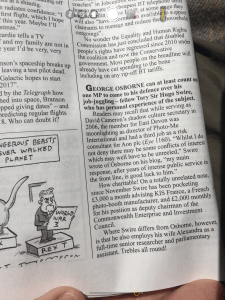
see:
https://www.hugoswire.org.uk/news/blog-greed-george-osborne
for the more gory details of this story.

Not quite in his mate George Osborne’s league but getting there …
see:
https://www.hugoswire.org.uk/news/blog-greed-george-osborne
for the more gory details of this story.
“Conservative MPs accused of breaking election spending rules at the last election face the possibility of being prosecuted by the Crown while they are in the middle of fighting their re-election campaigns at this year’s general election.
14 police forces have sent files to the Crown Prosecution Service relating to the Tory 2015 ‘battle bus’ scheme, which it has been alleged led to Tory candidates breaking strict spending limits on elections.
The CPS is currently reviewing the evidence and considering whether to charge the MPs with breaking the election spending limits, which are put in place to prevent those with wealthy backers from gaining an unfair advantage during general elections.
A spokesperson for the CPS confirmed to The Independent on Tuesday evening that any charges would have to be made before the date of the general election, which Theresa May wants to hold on 8 June subject to a vote in Parliament tomorrow.
This means the CPS’s announcement must by law fall while the MPs are campaigning for re-election, before 8 June.
No charges have yet been made against any MP. All 14 police forces who sent files to the CPS last year applied for a 12 month extension to the prosecution deadline, which would have otherwise elapsed last summer.
Channel 4 News reported on Tuesday evening that the CPS is considering prosecution against over 30 individuals with regards to 2015 election expenses.
As a result, a decision has to be made by the CPS by late May or early June, meaning that any charges will land during at least the long election campaign period, and possibly even the short campaign.
Police forces who have sent files to the CPS relating to the spending allegations include Avon & Somerset, Cumbria, Derbyshire, Devon & Cornwall, Gloucestershire, Greater Manchester, Lincolnshire, the Metropolitan, Northamptonshire, Nottinghamshire and West Yorkshire.
Two dozen Conservatives are understood to be under investigation over claims that they did not include battle bus spending in their local campaign returns. The Electoral Commission is also investigating the allegations in parallel to the police.
The allegations centre on whether spending on hotels for visiting activists and certain campaign material was incorrectly registered as national spending rather than locally – potentially illegitimately taking advantage of a higher spending ceiling.
A Conservative spokesman said: “We are cooperating with the ongoing investigations.”
There have been suggestions that other parties may have failed to register similar spending in their local areas too.
In theory election results in individual seats could be declared invalid if laws are found to have been broken, though this is not an automatic process.
In recent weeks some Conservative MPs have hit out at party officials who they say have dodged blame for the fiasco at the expense of MPs’ reputation.
“Theresa May has announced a snap election on 8 June 2017. But as the country prepares for another election campaign, it’s important to remember that MPs in her party are being investigated for election fraud for the 2015 general election. And given the mainstream media’s reluctance to report the issue, we need to ensure it is kept firmly on the agenda.
Allegations of fraud
12 police forces have submitted files to the Crown Prosecution Service (CPS) over allegations that up to 20 MPs and/or their agents broke election spending limits in the 2015 election. The CPS is deciding whether charges should be brought. And a decision is expected soon – and is likely to come during the election campaign.
The allegations centre around the ‘battle bus’ campaign, and associated expenses such as hotel rooms. Many argue that the campaign promoted prospective local MPs in key seats. Under election law, any expenditure which promotes a local candidate should be covered locally. But the ‘battle bus’ and associated costs were declared nationally. Each constituency has a fixed amount of money it can spend locally. And including the ‘battle bus’ expenditure would have meant many candidates overspent.
Additionally, the Election Commission fined the Conservatives £70,000 for multiple breaches in connection to election spending during the 2015 campaign.
And there’s more
But it isn’t just the “battle bus” campaigns where the Conservatives have been accused of fraud. As The Canary previously reported, there are questions over how the party used social media and, particularly, Facebook, to target voters.
And a report by the London School of Economics has also warned [pdf] that Facebook targeting opens the door to electoral fraud:
The ability to target specific people within a particular geographic area gives parties the opportunity to focus their attention on marginal voters within marginal constituencies. This means, in practice, that parties can direct significant effort – and therefore spending – at a small number of crucial seats. Yet, though the social media spending may be targeted directly at those constituencies, and at particular voters within those constituencies, the spending can currently be defined as national, for which limits are set far higher than for constituency spending.
Implications
Theresa May might think she is avoiding difficult byelections if charges are brought in any of the constituencies. But she is equally taking a huge risk. There is a possibility that she will be running an election campaign while MPs are facing fraud charges. And then there’s the question of whether those MPs and their agents will run in this election.
Either way, the British public get to choose whether they want to vote for a party being investigated for fraud; and a party that’s already been fined £70,000 for election expenses breaches. But in order to do so, it is essential we do not allow the issue to be swept under the table.”
If so, Tories or UKIP will undoubtedly satisfy you.
However, if you are equally (or more) concerned about the underfunding of the NHS, school, adult social care and child services, non-existent affordable housing, then that will not be the party for you.
Think carefully. Brexit will go ahead however you vote, underfunding of local services (and the constant financing of vanity projects) will continue if you vote Conservative and they form a majority government.
What to do if you value local services and an MP who will (a) be here and (b) fight these cuts is: in a safe or marginal seat which a Conservative might win – vote for whoever is most likely to come second, except UKIP, whose local policies veer between the very vague and the crazy – in Somerset a UKIP county candidate believes all problems in the NHS are caused by having too many women doctors and he has not been contradicted or thrown out by their national party.
In East Devon this is certainly local Independent Claire Wright ( presuming she stands again); in Honiton and Tiverton it is, perhaps surprisingly, Labour, though much depends on who else stands there in June.
You really do have one chance this year to make local issues count.
We are in the difficult situation in that neither of our MPs – Swire and Parish – have homes in the constituencies they represent. Swire has his second home in Mid-Devon and Parish has his farm in Somerset.
We must assume that Swire’s main home is in London, as he travels widely for his extra jobs and his wife works for him at the Houses of Parliament where he pays her a salary of £35,000 (Parish also employs his wife to work for him there as a “junior secretary” on around £20,000).
Can an MP truly understand the needs of his or her constituency if he or she does not live there?
Should living in the constituency be a requirement of the job (though Swire says it isn’t a job, making it sound in his case as more of a hobby)?
Should the home in the constituency be automatically assessed for their expenses as their main home? This would mean that MPs would be more likely to rent in London – which would not only give them a better appreciation of the cost of living in the city but might also make it more likely that they would spend more time in their constituencies.
Should they have to put in minimum hours IN their constituencies? NOT having half a dozen quick photo opportunities on Fridays when Parliament doesn’t sit and they get away early for their weekend breaks.
Should they have to attend a minimum number of surgeries per month/year to qualify for their salaries and jobs?
Should they have zero-hours contracts? No work for the constituency, no MPs pay?
Of course, if we had a truly local MP such as Claire Wright – born, raised and living in the constituency, steeped in the day to day concerns such as local hospitals, education and social care and with a daughter at school here – it wouldn’t be such a problem.
“Swire, Sir Hugo (East Devon)
1. Employment and earnings
From 9 November 2016, Adviser to KIS France, a manufacturer of photo booths and mini labs. Address: 7 Rue Jean Pierre Timbaud, 38130 Echirolles, France. I expect to be paid £3,000 every month until further notice. Hours: 8 hrs per month. I consulted ACoBA about this appointment. (Registered 16 November 2016)
From 15 November 2016, Deputy Chairman of the Commonwealth Enterprise and Investment Council. Address: Marlborough House, Pall Mall, London SW1Y 5HX. I expect to be paid £2,000 every month until further notice. Hours: 10 hrs per month. I consulted ACoBA about this appointment. (Registered 16 November 2016)
4. Visits outside the UK
Name of donor: Ministry of Foreign Affairs, Government of Bahrain Address of donor: P.O. Box 547, Government Road, Manama, Kingdom of Bahrain
Estimate of the probable value (or amount of any donation): Flights, accommodation, food and transport with a total value of £3,550 Destination of visit: Bahrain
Dates of visit: 8-12 December 2016
Purpose of visit: Attendance at the IISS Manama Dialogue
(Registered 23 December 2016)
Name of donor: (1) Professor Magdy Ishak; (2) Egyptian Ministry of Foreign
Affairs
Address of donor: (1) private; (2) Nile Corniche, Boulaq, Cairo Governate, Egypt
Estimate of the probable value (or amount of any donation): (1) Flights to a value of £1,386; (2) accommodation, food and transport to a value of £596
Destination of visit: Egypt
Dates of visit: 16-20 March 2017
Purpose of visit: Parliamentary fact finding.
(Registered 03 April 2017)”
page 406
“Tesco will see the business rates bill for its biggest stores fall by £105m over the next five years, highlighting another anomaly created by the controversial tax.
Earlier this year, the government came under pressure to take action on business rates after a revaluation of property in Britain hit independent shopkeepers hard in parts of the country where property prices had surged.
In Southwold, the coastal town’s property boom forced rateable values up by 152%, with some shop owner’s saying the hike threatened the viability of their business. Meanwhile, it emerged that online retailers such as Amazon, Shop Direct and Asos were enjoying tax cuts after the bills for their distribution centres declined.
MPs on the communities and local government committee will question the communities secretary, Sajid Javid, about the revaluation on Wednesday. Javid has already promised to “level the playing field” between online retailers and high street shops, and the committee chairman, Clive Betts, said he would press for a timetable for a review.
“There is a fundamental problem in the way valuations for business rates are done and that needs to be looked at,” said Betts. “High street shops seem to pay more than a similar unit out-of-town. That doesn’t feel right when there is a public and political view that high streets need some form of protection. There’s also an imbalance between property-based businesses and online sellers”
The Tesco store analysis by the business rates specialists CVS calculated that the bill for its largest stores in England and Wales would fall by £13m this year alone, from £450m to £437m.
“Over the next five years, allowing for transitional relief which limits how quickly bills can rise and fall … CVS projects Tesco will save £105.32m in rates under the revaluation for its largest stores,” said its chief executive, Mark Rigby. “In comparison, across England and Wales small shops have seen their rateable values, used to determine bills, increase by 8.5% whilst pubs have seen a 14.36% hike.
Tesco has 3,400 UK stores. The CVS figures is based on official data on its 563 largest shops, which are classed as superstores. The analysis estimates that the supermarket’s rateable value has fallen by 8.6% to £825.78m compared with 2010. It follows a 2015 writedown of the value Tesco’s property portfolio by £4.7bn.
Tesco said the 2017 revaluation would not alter its status as one of the UK’s largest ratepayers and called for urgent reform of the system, which many business leaders agree is not fit for purpose.
“Tesco is one of the UK’s largest ratepayers, paying almost £700m in rates in 2016-2017, and the 2017 revaluation will not alter that trend,” said a spokesman. “Tesco has a significant physical presence across high streets and town centres, and fixed costs such as business rates are placing huge pressure on our operations. The current rates system is unsustainable and needs urgent reform.”
“Controversially sold off by Southwark Council, the estate once homed 3000 people before being knocked down in 2011.
Now part of the regenerated estate, South Gardens in Elephant Park is said to have sold 51 properties all to overseas investors.
The company developing it, Lend Lease, began selling their properties abroad in Singapore before a single flat was available to British buyers.
…
Southwark Council spent £44m clearing people from the estate and will be given just £50m from Lend Lease.
It had been valued at more than £100m that figure.
It was revealed that just 82 of the new flats would be sold at an affordable rate, with the average value £790,000 to £1,500,000.
Every flat in new London estate ‘has been sold to foreign investors’
“A ‘business-case’ for the NHS has now been set, and its the biggest NHS Sell-Off event Ever!
If anyone is in any doubt as to the sheer scale of the privatisation of our NHS, look no further than the Health and Care Conference announced for June.
The conference 28-29 June 2017 at ExCeL London, brings together all STP leads, health trust and CCG chief executives and other delegates from the private sector claims the event is” Europe’s largest integrated health and social care event, building relationships between commissioners, providers and suppliers”.
Their brochure states “IT’S THE ONLY PLATFORM FOR BUILDING RELATIONSHIPS BETWEEN COMMISSIONERS, PROVIDERS AND SUPPLIERS. IT’S ALSO THE LARGEST GATHERING OF STP LEADERS EVER ASSEMBLED. AND LET’S FACE IT, AS THEY’LL BE LOOKING FOR YOU AT HEALTH AND CARE, CAN YOU AFFORD TO NOT SEE 5,500 CUSTOMERS YOU HAVEN’T MET YET.
The objective of the expo conference is to accelerate ‘Transformation’ of the NHS by introducing delegates to hundreds of private healthcare sector companies along with other STP leads.
To anyone wishing to retain a universal healthcare system, the Health and Care conference is a shameful collection of people openly betraying the principles of the NHS. Such events would have been taboo 20 years ago, but now the SALE OF OUR NHS is openly broadcast and in public. There’s even a ‘transformation’ awards event for those who so far have managed to cut NHS services and transform them in line with private healthcare sector values.
It’s a no holds barred event with Labour and Lib Dem politicians thrown in for good measure…
Here’s a brief list of those hosting some of the events with many sessions openly ‘sponsored’ by private companies..
Opening and Welcome to Health+Care 2017
Chair: Dame Ruth Carnall,
Managing Partner, Carnall Farar Ltd [and lead officer for Devon CCG]
Cross-Party Debate: NHS and Social Care Funding – is it time to ask the public?
Jonathan Ashworth MP, Labour Shadow Secretary of State for Health
And another Labour Peer…
■ Delivering the £5bn operational productivity challenge
Patrick Carter, Lord Carter of Coles, founded Westminster Health Care Ltd in1985 which he built into a leading health care provider which he sold in 1999. The Labour peer is a private investor and director of public and private companies in the fields of insurance, healthcare and information technology.
Local Authority Trading Company – The benefits and opportunities and challenges
Alison Waller, Managing Director, Tricuro Limited
■ Improving quality with creative leadership
Chris Gage, Managing Director, Ladder to the Moon
Dr Al Mulley, Managing Director for Global HealthCare Delivery Science, The Dartmouth Institute
Dr Rupert Dunbar-Rees, Founder and CEO, Outcomes Based Healthcare [research company]
Antony Tiernan, Director of Engagement and Communication, New Care Models Programme – Five Year Forward View
James Sanderson, Director of Personalisation and Choice, NHS England
Sir Bruce Keogh, Medical Director, NHS England
Professor Matthew Cripps, National Director, NHS RightCare
Jacob West, National Care Model Lead – Acute Care Collaboration and Primary and Acute Care
Systems (PACS), New Care Models Programme
The Rt Hon Stephen Dorrell, Chair, NHS Confederation and former Secretary of State for Health
Matthew Swindells, National Director: Operations and Information, NHS England
GP Regulation: Professor Steve Field, Chief Inspector of General Practice, CQC
Challenges facing the NHS provider sector: Chris Hopson, Chief Executive, NHS Providers
Dominique Kent, Chief Operating Officer, The Good Care Group Ltd”
http://mavericksunite.blogspot.co.uk/2017/04/the-biggest-nhs-sell-off-event-ever.html
So now BOTH our MPs are constantly out of our constituency: one (Swire) swanning around the Middle East and one (Parish) desperately crossing the country trying to reassure farmers all will be well post-Brexit. Oh, and he also lives outside the constituency – just like Swire. Oh, lucky East Devon.
“A HIGH-ranking government official heard just vital farming and the food and drinks industry were to the county’s economy.
And a pledge that Cumbria’s twin breadwinners would not be left behind post-Brexit was made to a round-table discussion in Carlisle involving local farmers and members of the agri-business industry.
As chairman of the Environment, Food and Rural Affairs (EFRA) select committee, Neil Parish said he would now be fighting tooth and nail to get the best possible settlement for Cumbria’s and Britain’s agricultural and food and drink industries in the Brexit negotiations.
The meeting, held in the Boardroom at Harrison & Hetherington’s Borderway Mart, Rosehill, was instigated by Carlisle MP, John Stevenson.
Afterwards, Mr Parish said the EU was a vital market for British agriculture and food and drink exports.
And, he added, farming was the bedroom (SIC!) of the UK’s food and drink industry, worth £108 billion to the economy and providing jobs for 3.9 million people.
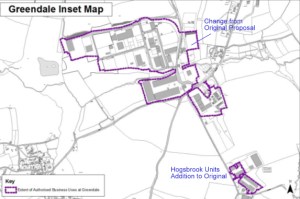
Residents of Woodbury – if you don’t want Greendale Business Park in your back gardens – act NOW!
Here is the necessary information for action:


Woodbury Salterton Residents Association
This reference needs to be attached to all correspondence
APP/01105/C/16/3165341
Representations must be received by 2 May
“At the same time as residents have been asked to comment on an “Employment Zone Boundary” at Greendale Business Park, an “Enforcement Appeal” has been submitted by the owners of Greendale regarding a requirement to remove approximately 3.5Ha of industrial development which have been built without planning permission over the last 2 years.
The Woodbury Salterton Residents Association support East Devon District Council serving a breach of Planning Control. Therefore the Association are asking all Residents to respond to the Planning Inspector by 2nd May.
The details of the appeal are:
Planning Consultation Appeal
Appeal by FWS Carter and Sons
Greendale Business Park Woodbury Salterton EX5 1EW
The appeal arises from the serving of an Enforcement Notice in respect of the unauthorised development which has taken place on the land on the Eastern Boundary at Greendale Business Park.
The breach of planning control
Without planning permission, the construction of four compounds, by the levelling of the land, the laying of hard surfaces using concrete and scalping, enclosing with security fencing, gates, cctv cameras and lighting. The construction of two buildings and the associated use of the land to store a portacabin type temporary building, cubicle, shipping containers, mobile park homes, caravans and other associated items.
The Council considered it expedient to issue the Notice having regard to the provisions of the Development Plan and to other material planning considerations.
Reasons for issuing the Notice
It appears to the Council that the above breach of planning control has occurred within the last four years.
The development, by virtue of its scale and extension beyond the built form of Greendale Business Park and outside of any recognised development boundary, is within the open countryside where new development is strictly controlled. The development represents a sprawling development in the countryside in conflict with the special approach to accommodate industrial development within defined settlements as identified within the Local Plan.
The development also has the potential to impact on the amenity of occupiers of nearby dwellings by virtue of noise and potentially light pollution and potential unacceptable visual impact on the landscape.
The proposal is therefore contrary to the provisions of Strategy 7 (Development in the Countryside), Policy E4 (Rural Diversification), Policy E5 (Small Scale Economic Development in Rural Areas), Policy E7 (Extensions to Existing Employment Sites), Policy D1(Design and Local Distinctiveness), Policy EN14 (Control of Pollution), Policy D2 (Landscape Requirements) and Policy D3 (Trees on Development Sites) of the adopted East Devon Local Plan and guidance within the National Planning Policy Framework.
The requirements of the Notice are to –
1. Permanently remove from the land the concrete hardstanding, foundations and associated drainage works from the compounds 39, 48A and 47
2. Permanently cease the use of the land as compounds and for use of storage of mobile park homes, caravans, shipping containers, portacabin type buildings and storage of associated items.
3. Permanently remove from the land all fencing from the perimeters of and within compounds 39, 48A, 47 and 11.
4. Permanently remove from the land all gates from the perimeters of and within compounds 39, 48A, 47 and 11.
5. Permanently remove from the land all CCTV cameras and supporting ancillary equipment from within compounds 39, 48A, 47 and 11.
6. Permanently remove from the land all light fittings and cabling from compounds 39, 48A, 47 and 11.
7. Permanently remove from the land the two permanent buildings sited within compound 39.
8. Permanently remove from the temporary buildings including the shipping containers.
9. Permanently remove from the land the cubicle.
10. Permanently remove from the land the mobile Park Homes, caravans and associated items.
11 Replace the topsoil in compounds 39, 48A and 47 to a depth of 20cm and reseed with an agricultural grass mix which shall be retained and maintained in perpetuity.
12 Permanently remove to an authorised place of disposal, all materials associated with compliance with steps 1, 3, 4, 5, 6, 7, 8, 9 & 10.
The time for compliance is within six months of the Notice taking effect.
The appellant grounds of appeal.
(a) That planning permission should be granted for what is alleged in the notice, and;
(f) The steps required to comply with the requirements of the notice are excessive and lesser steps would overcome the objection.
Important
There are 2 Consultations ongoing at present at Greendale Business Park.
1. Consultation on a definitive Employment Boundary.
2. Planning Appeal consultation regarding a removal of an enforcement
If you wish to make comments in respect of the appeal, you can do so on
the Planning Portal at https://acp.planninginspectorate.gov.uk or by
emailing teame1@pins.gsi.gov.uk .
Or send three copies to
The Planning Inspectorate Room 3E. Temple Quay
House 2. The Square. Bristol BS1 6PN”
Extracts from two letters in the Business supplement of The Sunday Times:
“… councillors think they know the property market but they don’t have a clue. They now plan to build a new Town Hall (in Tunbridge Wells]. This is an enormous ‘folie de grandeur’ that will leave taxpayers on the hook.
Tunbridge Wells has a town hall, but it has been allowed to fall into disrepair. Was this part of the plan?”
and
“… in Dover, the town clerk and the mayor have set up a charitable company, LoveDover Regeneration, using £350,000 of taxpayers’ money for property development.
Although it is a charitable company, under normal rules this means the directors own the company, hence the company owns any property it buys, not the council. Further, the £350,000 is equal to almost 50% of Dover Town Council’s annual income.
The money has been justified as it comes from the reserves, but surely the idea of passing large sums of money to a body over which Dover Town Council has no control, for property development or any other use, is not acceptable.”
The big question is ‘what is the chance of Pegasus winning an appeal?’
Probably not that great:
The application is for more than a hundred units when the Local Plan allocation is for fifty.
The application does not include any affordable.
The application is opposed by Sidmouth Town Council and a large and vociferous group of local residents.
Most importantly, the Planning Consultants at the time of the provisional sale to Pegasus foresaw that the application would be refused. So did the Planning Team, who miraculously changed their minds when the application came forward. Both EDDC and Pegasus were warned in advance that the Development Management Committee could not approve the application. Remember: this information came into the public domain as a result of the successful Freedom of Information request.
If the application goes to inquiry, as seems likely, then we, and EDDC, will have to wait for 24 months with little confidence that the appeal will be successful.
Then comes the situation of ‘what happens next?’ Well, we know the answer because Grant Thornton have helpfully predicted four scenarios, all of which will lead to receipts well below the price currently agreed with Pegasus.
The whole process would have to begin again, against a backdrop of a planning appeal refusal. New tender, new negotiation, new design, new application, and perhaps even another refusal.
Eventually an application will succeed, and a sale result, but we could easily be four years down the road, and at a substantially reduced price in possibly a very different property market.
An interesting remark in an article about millionaire former Cabinet Minister Cecil Parkinson (a favourite of Mrs Thatcher) where his former secretary and lover bemoans the financial plight of her disabled daughter, his acknowledged child, who was given minimal support during his lifetime:
“Cecil spent much of his time setting up offshore funds in the Bahamas and elsewhere,’ she says ‘He used to keep all relevant papers in the House of Commons as the Inland Revenue couldn’t raid it because it is considered a Royal Palace.”
Wonder how many current MPs (so many, many of whom are millionaires) have their dirty linen stored in their filing cabinets in Parliament?
It is interesting that all scenarios put to the Scrutiny, Audit and Governance and Overview Committee take no account of depreciation on the Honiton HQ.
The committees might want to request the attendance of internal and current external auditors KPMG at their joint meeting, as the relocation finance paper was, for some reason, compiled by former external auditors Grant Thornton.
Click to access 180417-a-and-g-and-s-and-overview-agenda-combined.pdf
page 10

“George Osborne is close to earning £1m for making speeches since being sacked as chancellor. His latest entry on the MPs’ register of interests shows he is set to be paid more than £150,000 for talks delivered last month.
He had already declared expected earnings of £786,450 for a series of speeches since losing his cabinet job when Theresa May took office.
The latest update shows he is set to receive a payment of £51,842 for a speech to the New York University in Abu Dhabi on 4 March. A further £51,754 is expected from the Hungarian central bank for two speeches, on 1 and 2 March, while £51,540 is expected from asset management firm Insight Investment for a speech on 17 March. These sums take his earnings from speeches up to £941,586.
As well as the speech income, Osborne is set to earn £650,000 a year working as an adviser to the US asset management fund, the BlackRock Investment Institute.
The register shows Osborne expects to be paid £162,500 a quarter for 12 days working as an “adviser on the global economy” and £120,000 this year to be a Kissinger fellow at the McCain Institute in Washington DC.
Osborne is yet to take up his most eye-catching appointment, as editor of the London Evening Standard, so details of his earnings from the role have not been entered in the register.
Despite his other interests, he has vowed to continue as MP for Tatton – a job which pays £74,000.”
Swire much admires his pal having so many irons in the fire. Here are a few comments on George’s jobs from his recent blog post:
“The reality is that in all George’s Osborne’s positions he is being employed as a figure head rather than the man that gets his hands dirty. …
Sometimes we just can’t win! I remember the days when George Osborne (who had never had a job outside politics) was accused of being a member of the political class, a ‘professional politician’ who had no understanding of the real world because he only operated in the Westminster bubble. Ironically now he is a mere backbencher he is being criticized for going out to work! …
If an MP uses his time efficiently he has plenty of room for other interests. I, for example, have some paid outside interests but I’m also Chairman of the Conservative Middle East Council (CMEC) and Deputy Chairman of the Commonwealth Enterprise and Investment Council (CWEIC); both these posts keep my interest in foreign affairs active and enable me to ask informed questions to the executive on foreign matters. …
I fear much of the uproar surrounding Mr Osborne’s new jobs tells us more about salary envy than anything else, and that is not a good basis for an argument. …”
While this article concentrates on coastal towns in the north of England, the research findings are applicable to many other coastal towns, more than one of which could be said to be in East Devon.
“Doctors in deprived coastal towns in the north and east of England are prescribing almost twice as many antidepressants as those in the rest of the country, analysis of prescription data shows.
Blackpool, Sunderland and East Lindsey, in Skegness, fill the top three spots for the most prescriptions out of England’s 326 districts.
Psychologists said the findings were consistent with links between deprivation and depression, anxiety and other mental health problems. But they added that seaside towns faced a particular set of difficulties that could give rise to mental health issues. …
Dr Jay Watts, a consultant clinical psychologist, said there were established problems with seaside towns that could affect the mental health of their residents. Blackpool, for example, has the lowest life expectancy for men in the country, and last year topped the list for alcohol-related hospital admissions, she said.
“You’ve got high deprivation, high crime, low life expectancy, loads of alcohol problems,” she said. “Also all of these places tend to be, to a certain extent, ghost towns.
“Because of the destruction of local economies by the cheapening of foreign travel, that we’ve known has been happening since the 1960s onwards, one tends to be environmentally surrounded with the ghosts of a better time.”
Peter Kinderman, president of the British Psychological Society and professor of clinical psychology at the University of Liverpool, said the findings were consistent with established theories on what causes depression, anxiety and other mental health problems.
“You’ve got lack of opportunity, lack of a sense of meaning and purpose in life,” he said. “You’ve got the financial consequences on families, consequent pressure on relationships; a toxic mix of how social and economic factors can put pressure on our mental health and psychological wellbeing.”
Pressure on local authorities and civic organisations trying to operate without a well-functioning economy meant there was a lack of services that could help people with mental health problems, he said.
“Incidentally, I don’t blame the GPs or the psychiatrists. What the hell else have they got to offer people?”
” … Parishes collect just 1.7% of the £26bn raised through council tax overall, so even eye-watering percentages are peanuts compared with the budgets of bigger councils. The average precept in 2016/17 was £54.15 (just over £1 a week), the average rise 6%.
I was part of a group that set up a parish council in Queen’s Park, north-west London, a few years ago, and for the past year have chaired our council. Our neighbourhood of 12,000 people is still the only civil parish in the capital. Residents will see their precept rise by 4.5% this month – under 20p a month on the average bill – but this increase has enabled the community council to provide a grant to our youth centre, which lost all its Westminster City council funding last year.
Did we set up a parish council to plug such gaps? No. Youth services ought to be statutory, and council tax bills for Queen’s Park residents in band E properties are now £46 higher than elsewhere in our borough. The fact that cuts are forcing parish councils to step into shoes vacated by bigger councils is cause for regret, even rage.
But there is an upside. Precept income has also provided additional funds for our neighbourhood park, where a wildlife area locked for years is now open. We have held on to our summer festival and November fireworks, and are working with partners on a jobs advice project. Our parish council can’t fill all the holes created by cuts to frontline services since 2010. But it is better than nothing.
There is another role for parish councils. The world is widely acknowledged to be in a phase of “democratic recession” – a phrase coined by political scientist Larry Diamond – with the hopes of the Arab spring a distant memory and authoritarians on the rise from Turkey to the US. But at the grassroots level, in much of Britain, there is little to retreat from. Most people find the idea of putting themselves up for election to anything utterly foreign. Even the school curriculum is largely empty of politics. However, parishes – if promoted in imaginative ways, as they have been in places such as Frome, Somerset – can provide new ways into local democracy for people who might never get involved in party politics. Indeed, about half of England’s 10,000 parish councils are not party political.
I am not proposing parish councils as a cure-all. There are issues with any form of voluntarism: time is money, and only some people can afford to give it away (parish councillors’ allowances are tiny, and many are retired). But in our divided and individualistic society, the pooling of resources by people who want to do things together should be supported. Civil parishes offer a model of local organisation that is progressive because it is democratic. And if you believe in public spaces such as playgrounds, libraries and sports pitches, there is no better place to make the argument for them than on the ground.”
https://www.theguardian.com/commentisfree/2017/apr/13/parish-councils-unlikely-urban-safety-net
“The roots of Toshiba’s admission this week that it has serious doubts over its “ability to continue as a going concern” can be found near two small US towns.
It is the four reactors being built for nuclear power stations outside Waynesboro, in Georgia, and Jenkinsville, South Carolina, by the company’s US subsidiary Westinghouse that have left the Japanese corporation facing an annual loss of £7.37bn.
Construction work on the units has run hugely over budget and over schedule, casting a shadow over two of the biggest new nuclear power station projects in the US for years.
Events came to a head last month when Westinghouse was forced to file for bankruptcy protection to limit Toshiba’s losses.
Experts said the delays and cost problems were due to America’s lack of recent experience in building atomic power plants.
“I don’t think it is necessarily because of an inherent issue of US skills but rather the lack of practice,” said Richard Nephew, a professor at the Centre on Global Energy Policy, Columbia University. “There simply have not been as many new reactor builds in the US and this has reduced the overall pool of skilled labor, no question.”
The absence of a mass production supply chain, due to the small number of the Westinghouse-designed reactors being built, played a part too, he added. Regulatory issues had also delayed construction. …
Richard Morningstar, chairman of the Global Energy Centre at the international affairs thinktank Atlantic Council, said: “What is happening to Westinghouse and Toshiba only emphasises the need to double down on research on new, safe, nuclear technologies, such as small modular reactors. If we do not do so in the US, leadership will be ceded to other countries.” …
One such aspiring atomic leader is the UK, where the government wants to build a new generation of nuclear power stations to help satisfy the country’s power needs for decades to come.
But there are obvious parallels between the two countries on the issues of recent experience and supply chains. The UK has not completed a new nuclear power station since Sizewell B on the Suffolk coast started generating power in 1995.
EDF, the French state-owned company which has started pouring concrete at Hinkley Point in Somerset, where it plans to have two reactors operational by 2025, maintains it has had plenty of recent practice.
The EPR reactor design for Hinkley is the same as that for the reactors it is building in Finland, and at Flamanville, in France, though both of those are running late and over budget.
The other new nuclear projects proposed around the UK, all by foreign companies, look less certain and all are still years from construction starting in earnest.
Toshiba said this week it would consider selling its shares in the consortium behind another plant planned at Moorside, in Cumbria, which would utilise three of the same AP1000 Westinghouse reactors being built for the two crisis-hit US plants.
The South Korean power company Kepco last month expressed an interest in buying into the project, and the business secretary , Greg Clark, went to South Korea last week for talks on collaboration on nuclear power. …
Justin Bowden, GMB national secretary, said: “The big moral of the story is what on earth we are doing as a country, leaving our fundamental energy requirements to foreign companies or foreign governments?”
While the government has argued that it has plans in place to keep the lights on if new nuclear projects do not materialise, others said the deepening crisis at Toshiba this week showed the need for ministers to consider a new energy policy.
“It’s time to come up with a new plan A,” said Paul Dorfman, of the Energy Institute, at University College London, who believes the Moorside project is dead. “It’s time for a viable strategy that talks about grid upgrades, solar, energy efficiency, and energy management.”
A report published on Thursday highlighted another alternative: a U-turn on the Conservative party’s manifesto commitment to block new onshore windfarms. Analysis for the trade body Scottish Renewables suggested wind turbines on land had become so cheap they could be built for little or no subsidy, compared to the lucrative contract awarded to EDF for Hinkley.
But the prospect of a rethink by the government on wind power looks about as likely as new nuclear power stations being built on time.”
https://www.theguardian.com/business/2017/apr/14/toshiba-us-nuclear-problems-uk-cautionary-tale
A pessimistic but hard-to-argue-with view of “democracy” as it stands. Note this is NOT about the Conservative Party, it embraces every government – New Labour, Coalition, Conservative – since 1997.
“Since 1997, simple parliamentary majorities have been used to radically alter the constitutional make-up of the UK. Devolution and the creation of the Supreme Court have transformed the country’s institutions. Nat le Roux argues that this is evidence of a growing imbalance of power. The executive can change the institutions of state at will – often for politically-motivated, short-term gain. The extent of the democratic mandate has been exaggerated, as the Coalition government shows.
There is a very widespread view in Britain that our political culture is dysfunctional. According to the survey carried out for the Hansard Society’s 2013 Audit of Political Engagement, two out of three citizens believe that the present system of governing Britain is in need of significant improvement. When asked how this might best be achieved, a large majority of respondents favoured action to increase the transparency of politics and the popular accountability of elected representatives.
It is easy to see why many people believe that a disjunction between citizens and elected politicians is the primary problem in an increasingly dysfunctional, and disrespected, political system. However this is at best a partial diagnosis. In reality, British politics are considerably more transparent than a generation ago: proceedings in parliament are televised, it is much easier to access many types of government information, and the public and private activities of the political elite are subject to relentless media scrutiny. From the perspective of the ordinary citizen, Westminster culture may appear introverted and opaque, but this is an inadequate explanation for the current malaise felt towards British politics and government.
Less evident to outsiders, but equally debilitating, is the growing and dangerous imbalance of power between the institutions of the state itself. Lord Hailsham coined the term elective dictatorship in 1976, and it is a more accurate description of the political landscape today than was the case forty years ago.
Two developments have taken us further down that road. The first is the increasing unwillingness of the executive to respect the independent authority of the judiciary, the civil service, local government and parliament itself. The second is the willingness of governments, especially after 1997, to introduce fundamental constitutional changes, many of them effectively irreversible. Perversely, it is the over-representation of democratic legitimacy as the dominant contemporary political virtue which arguably bears a large measure of responsibility for our current predicament. …
The reality of the democratic mandate
It is often argued by the proponents of executive supremacy that a government effectively enjoys a direct democratic mandate because most voters in general elections believe they are voting for a party manifesto and a prime minister at the same time as selecting a constituency MP. Political history suggests that this argument is a very weak one. Two of the last four prime ministers were installed by their parties between general elections, and this has always been an entirely normal route to No 10. Voters in 2010 did not choose to have a Conservative/Lib Dem coalition government (under the current electoral system there is no mechanism which would have allowed them to express such a preference). Many of the policies of that government were foreshadowed in the election manifesto of only one of the coalition partners, and some policies were in neither. The coalition’s policy platform was the coalition agreement, negotiated by the party leaders after the 2010 election and never endorsed by the electorate.
If democratic legitimacy implies substantial popular endorsement, then the democratic mandate of recent British governments rests on weak foundations. In the 2005 general election, Labour secured an absolute majority of parliamentary seats but only 35.2 per cent of the national vote. The turnout was 61.4 per cent of registered electors. Thus the Labour government which was in power between 2005 and 2010 enjoyed the active endorsement of less than one in four potential electors. …
The sovereignty of Parliament
The reality of party politics, in Britain as in other mature democracies, is that a government’s ability to sustain a majority is not based on an ability to convince legislators by reasoned argument of the merits of particular proposals.
Although backbench revolts are more frequent than a generation ago, nearly all divisions are along party lines. Bills are introduced and passed into law irrespective of their objective merit because, tout court, the government commands a majority in the House. Most MPs, most of the time, support their own party leadership for a combination of principled and self-interested reasons.
Despite the Wright reforms of 2010, it is government rather than the Commons itself which largely determines the Parliamentary timetable and enjoys a near-monopolistic control of legislative processes. At best, party loyalty severely muffles effective legislative constraint on executive action, except in those rare cases where a backbench rebellion is large enough to overturn the government’s majority. None of this is especially surprising or – arguably – objectionable in itself: that is how parliamentary democracies work. However, given the realities of parliamentary behaviour, government claims to an untrammelled and generalised authority may ring rather hollow.
…
Drifting towards instability?
A pessimist could easily believe that we are drifting towards institutional instability. Governments have become increasingly willing to alter very long-standing constitutional settlements for reasons which often appear short-term and politically self- interested. It seems likely that, even if the Scots vote No, the independence referendum will accelerate the breakup of the United Kingdom. A serious clash between government and the senior judges over the extent of the courts’ powers of judicial review seems increasingly likely. The constitutional position of the civil service is being challenged by the current government in a way which would have been unthinkable a generation ago. Government ministers are increasingly bold in asserting their democratic mandate – or rather an over-representation of it – to trump all opposition. All of this is taking place against a background of the general breakdown of public confidence in the political elite. Not so long ago, Britain was widely admired across much of the world as a model of strong constitutional democracy. It is hard to believe that is the case today.”

