Swire: enormously missed by the Maldives

Swire’s Twitter account:

https://mobile.twitter.com/HugoSwire

is full of grateful thanks from many countries for his ministrations at the Foreign Office.

By far the most coming from the Maldives, which appears desolate at its loss, not salved by already having a new UK government representative in place, probably Sir Alan Duncan, MP who took Swire’s place.

Still, that country has about 350,000 inhabitants whereas East Devon has only about 136,000 so taking care of East Devon should be much easier and much less commuting time from Mid-Devon.

Was the new wine and candles photo at the top of the Twitter account taken during one of his visits to the Maldives, perhaps? It looks much too exotic to be Sidmouth – though climate change may well see Sidmouth transformed into a tropical climate quite soon!

EDDC: cost of officer time – selective monitoring and double standards for the Standards Committee

Isn’t it interesting that, in just about every area of EDDC’s work, the cost of officer time is not included. Take the Knowle relocation – officer time is NEVER costed. Take planning applications and the production of the Local Plan – officer time is NEVER costed.

Yet, when it comes to monitoring the behaviour of councillors, somehow officer time can be costed. Why? Because EDDC wants to subtly suggest that it costs an awful lot of money and really people should not be wasting their precious time as most complaints are dismissed by the Monitoring Officer anyway!

“The annual cost for assessing Monitoring Officer type complaints remains at approximately £40,000, which has been calculated based on an estimate of officers’ time spent assessing, investigating and administering complaints as part of their job role. Officers dealing with the Code of Conduct complaints process are:
Monitoring Officer; Deputy Monitoring Officer, PA to Monitoring Officer, Democratic Services Officer, statutory Independent Person role (of which EDDC has used two on an alternate basis) and Investigating Officer when required.”

Click to access 190716standardscttecombinedagenda.pdf

Has Hugo Swire semi-retired now he is a backbench MP?

This was the photograph that used to grace his Twitter account when he was a Foreign Office Minister:

hugo1

and this is the photograph that he replaced it with when he was sacked from his ministerial job:

Hugo2

From ministerial leather armchair to wine and candles somewhere that just doesn’t look at all like East Devon – what a difference a day makes!

Though, perhaps, when the carnival is really over, THIS might be the reality:

Claire Wright and MP Hugo Swire with protesters at Ottery St Mary hospital on Saturday Ref sho 21-16SH 4964. Picture: Simon Horn.

Claire Wright and MP Hugo Swire with protesters at Ottery St Mary hospital on Saturday Ref sho 21-16SH 4964. Picture: Simon Horn.

Advice for the new Communities Minister on Devolution

So many instututions are now seeing what is wrong with devolution deals – but does the newly-constituted government care? Does it have the time or the will to care? Great words on inequality and a government that failed to understand ordinary people from Mrs May but will actions follow?

But the final sentence below on “networks and influence” is chilling, and just about negates the rest of the advice and may be pointing another, more worrying, way.

” … Grasp the democratic opportunity of devolution. With mayoral elections due next spring in the devolution deal areas, a more devolved system of governance will soon have new faces and voices, which will contribute to a shift in the political centre of gravity away from Westminster.

Yet democratic engagement through devolution should not begin and end with mayors. The speed of the process has created little space for democratic innovation to accompany reform, but there is an opportunity now for a richer democratic discussion, already being led by councillors, to take place. The next phase should be much more directly shaped by local people who need to feel more connected to the tangible opportunities reform can bring – open policymaking, citizens juries and using digital tools to reach people in new ways.

Above all, the new secretary of state shouldn’t think of devolution as giving power away, but as enhancing his own ability to get results. We live in an age that respects networks, not hierarchies. Some of the shocks convulsing through the institutions of Westminster and Brussels are the effects of this. The traditional clunking levers of Whitehall machinery struggle for impact in a complex, interdependent world. So use devolution as an opportunity to create a different model of governance – where influence and relationships are prime.

We look forward to seeing where Javid takes devolution next.”

http://www.publicfinance.co.uk/opinion/2016/07/five-priorities-new-communities-and-local-government-secretary

EDDC: “OAP’s battle over safety alarm bill”

Seems EDDC only likes competitive pricing when it suits them!

“The 78-year-old, who does not want to be identified, is campaigning against district council sheltered accommodation tenants being forced to pay up to £30 a month for unwanted home alarm and safety systems, writes Becca Gliddon.

The pensioner’s daughter said OAPs were being ‘bullied’ into paying for an unwelcome medical and support system.

She said the family had been fighting the council for a year to abolish the charge and compulsory service; her mum says she had been originally told the service was free.

The family’s fight echoes a Budleigh Salterton pensioner’s plea, recently shot down by East Devon District Council (EDDC), when the 91-year-old asked to source a cheaper, private option.

The Budleigh woman said the £676 annual council charge would force her to choose the unwanted alarm over heating her home.

The Exmouth grandmother says other sheltered accommodation tenants want the Home Safeguard Services scheme scrapped, but are too afraid to speak out for fear of reprisals by the council.

So she is fighting to choose her own home safety and alarm service.

She claims cheaper options are available.

EDDC said the alarm service and support system was an ‘integral part’ of its sheltered housing offer. It said it was ‘determined’ to keep it running.

The council said it had a hardship fund for people unable to pay, warned it would ‘seek possession’ as a ‘last resort’ for non-payment and would discuss other options available with tenants who thought the service unnecessary – including ‘helping tenants find more suitable accommodation’, adding sheltered housing was for ‘residents who are in need of our support services’.

The Exmouth pensioner, who has a personal SOS phone system linked to her daughter in Exmouth, said: “It should be possible to for me to be given the opportunity to supply my own service and protection. I feel I could do it at a fraction of the cost.”

http://www.exmouthjournal.co.uk/news/oap_s_battle_over_safety_alarm_bill_1_4619222

Brexit: where now for Devon and Cornwall businesses?

Devon and Cornwall Business Council:

… “1) DEVOLUTION. This process may be very welcome to the business community (or it may not). There has been inadequate consultation for us to know what the implications might be. Either way it will create a period of uncertainty. We cannot afford to risk this whilst so many critical matters are up in the air. I propose that we ask for, at least, a 12 month moratorium whilst clarity is restored. Then we need a proper period of consultation knowing what we then know. Devolution has the potential to provide significant opportunities for devolved administrations to determine their own future when it comes to skills, transport, investment and development, but this agenda needs to be developed collaboratively with the private sector standing shoulder to shoulder with Government.

2) EUROPEAN MARKETS. More than 50% of South West trade is with near Europe. There have been some bold statements that 90% of trading opportunities will be outside the EU in the next 10-15 years. Many, however, of our investors are based in Europe – IMERYS, EDF Energy, Sibelco, Princes Yachts, Plymouth Gin, Barden Corporation to name but a few. Decisions are made in European capitals which affect a large number of our jobs and future growth prospects. We need to ensure that the existing investments are maintained and that we will feature in future investment decisions – access to the Single Market is vital. UK Trade and Industry (UKTI) department officials are already fully stretched (inadequate funding currently, with an increasing workload), we need to establish our own business trade ambassadors to ensure direct contacts are maintained and developed. From this base we can then begin to start creating a forward order book for whatever new trade agreements might emerge. This will also allow a programme to be developed to enable access into new global markets.

3) INFRASTRUCTURE. The South West has for too long been the Cinderella of the UK in terms of infrastructure investment. We have clearly supported plans for future spending on road, rail, air, marine and broadband projects. We must now directly lobby for these, acting as a single voice and ensuring that our South West MPs are lobbied to also speak with one voice. What, however, will make this happen is a demonstration that investment in infrastructure will result in direct business investment. We need to clearly demonstrate what we will contribute in return.

4) PLAY TO OUR STRENGTHS. Some of our most successful business sectors should be the subject of focussed programmes for ambitious expansion – food and drink, tourism and e-health are good examples of where the South West has specialist skills. Add to these; marine / maritime technology, aerospace / space, advanced engineering, digital and creative economy. Designed and co-ordinated tasks forces could achieve spectacular results in these areas of the economy.

5) GOVERNANCE/REGULATION. The system of regulation has been often complained about as a barrier to business growth – red tape, EU regulations or Gold plating from Whitehall? Staffing levels at regulators have been cut making the problems more acute. The establishment of voluntary codes and working partnerships led by trade bodies and self-regulated by them (with rewards for best practise) could greatly improve the current confrontational systems which have become entrenched – particularly in areas such as planning and environmental health.

6) PRODUCTIVITY. We have routinely lagged behind the average UK productivity levels (between 15-20% lower than UK average for Devon and Cornwall1). There are many drivers of productivity; investment, innovation, skills, enterprise and competition. This problem can be partly addressed by self-help. Simple work based systems can achieve significant improvements to outputs (and profits). These include Lean Production techniques. Training for all staff on digital skills and improvements to work/life balance (flexible working hours) which can reduce lost time off through stress / illness.

7) YOUNG BUSINESS. The Business Community has a collective responsibility to re-engage with the next generation to ensure we have attracted the huge talents of our young people. Business support can start by involvement as a Governor at Primary School all the way through to being a voluntary mentor for new start businesses. There are also great opportunities for assisting with work experience. The SW is blessed with some exceptional people with invaluable skills and experience. This should be high on the business agenda.

8) INNOVATION/SKILLS. We are proud of our Universities and Further Education Colleges. They deliver with national and international standards. The ground breaking research they produce is helping to change things around the world. We complain about a lack of relevant skills; however, do we fully engage with these institutions? Do we share with them our future business plans so that skill sets can be anticipated? Do we share with them our challenges in order to co-develop innovative solutions? Do we respond to their outreach work which can tackle production/system deficiencies? The answer is we could all do better. New partnerships should be formed as a priority. In part focusing on achieving young people with relevant skills (matched to growth sectors) through apprenticeships which, have the potential to greatly reduce our reliability on skilled labour from outside the UK, EU or otherwise.

9) URBAN/RURAL. For too long we have allowed ourselves to get sucked into Whitehall speak on the growth of Cities. Seen from the Whitehall bubble this is the best place to concentrate investment decisions. What we are missing by not forging strong urban/rural partnerships represents one of the greatest untapped opportunities for the growth of our economy – natural energy, local food production, health and well-being, water quality, flood/climate change management are all on our doorstep. DCBC will spearhead a rolling programme of partnership opportunities.

10) FUNDNG. The expectation that Government cash will still arrive as before is fool’s gold. Austerity will get worse before it gets better. Business will become even more important in the funding of growth opportunities. This could include matched funding with Devolved Authorities and perhaps taking advantage of cheap Government borrowing. We must set out our investment priorities more clearly and take these to our key stakeholders in the public sector for early discussions in order that improved delivery be achieved.”

http://www.dcbc.co.uk/news/brexit-where-next-business-community-10-point-recovery-plan#

Back bench – influence or toe the party line?

A correspondent below has raised the question as to why, if Swire as a commom-or-garden back bench MP would be ineffective, should an Independent MP not be just as ineffective.

Good question.

It is Swire himself who told us that he was MORE effective on our behalf as a Minister as, though he maintained that he could not speak for us in Parliament, as a Minister he said had direct access to other Ministers instead. The mover and shaker could easily have quiet words with other movers and shakers.

And now he has one major difference compared to an independent MP – having to follow the Whip of someone in his party who sacked him and whose leadership, it appears from his tweet, does not inspire him. HE sees it as relegation (albeit with his mates).

Not the case for Independents – free to speak, free to act, as they say.

He could, of course, become an Independent and free himself from his shackles!

Swire: jumped or pushed? Depends on your source!

Swire’s Twitter account gives the impression he jumped (see post below) but Daily Mail (so it MUST be true!) says he was pushed:

“The Prime Minister continued her ‘posh boy purge’ by removing Old Etonian Hugo Swire as a Foreign Office Minister. He responded by tweeting a cartoon image of Bugs Bunny saying: ‘That’s all, folks.’

Mr Swire lost his job shortly after using Twitter to liken sacked allies of David Cameron to condemned prisoners sent to the guillotine during the French Revolution.

He said: ‘Not a good time to be a Cameroon. The tumbrils are rolling again!’
Mrs May also sacked public-school educated Ed Vaizey, who was Arts Minister”

http://www.dailymail.co.uk/news/article-3693766/Brutal-sacks-Gove-ally-New-Prime-Minister-s-ruthless-reshuffle-continues-Dominic-Raab-loses-Justice-Minister-role.html

Swire was very briefly Private Parliamentary Secretary to Theresa May when she was Conservative Party Chairman in 2003. Perhaps it was an experience one or both of them did not want to repeat.

Everything changes, nothing changes

“New International Trade Secretary Liam Fox celebrated his government comeback at a Commons champagne party attended by the friend and former associate linked to his previous Cabinet downfall.

Dr Fox and Adam Werritty were among a noisy group who downed eight bottles of bubbly on the Commons terrace, with at least one cork being popped into the River Thames. The event took place within an hour of Dr Fox, 54, being given a key Brexit role in Theresa May’s new Cabinet. His friends queued up to give him congratulatory slaps on the back as he drank £29-a-bottle House of Commons champagne.

The impromptu party, hosted by Commons Deputy Speaker and fellow Tory MP Eleanor Laing, a longstanding friend of Dr Fox and his wife Jesme, was attended by about 20 people. They got through eight bottles over a couple of hours. Mrs Fox was not present.

Dr Fox was forced to resign as Defence Secretary in October 2011 in a row over his dealings with Mr Werritty. The lobbyist did not have security clearance but accompanied Dr Fox on at least 18 foreign business trips.

The resignation came after a week of revelations about Dr Fox’s relationship with Werritty, including disclosures that the friend’s activities were funded by firms and individuals that potentially stood to benefit from government decisions.

At the time, Werritty falsely described himself as one of Dr Fox’s official aides and handed out business cards bearing the Commons portcullis logo. He also took a number of solo trips reportedly with the aim of fostering closer ties between Right-wing politicians in Britain and the United States.

In his resignation letter to the then Prime Minister David Cameron, Dr Fox said he had ‘mistakenly allowed the distinction between my personal interest and my Government activities to become blurred’.

Mr Werritty, 37, best man at Dr Fox’s 2005 wedding, moved into Dr Fox’s spare room in London after graduating from university. Werritty now lives in a flat in Dolphin Square, Pimlico – a mile from the Commons – where many MPs have apartments.

An inquiry cleared Dr Fox of benefiting financially from his links with Werritty.

An MP who saw Dr Fox’s champagne party said: ‘It seemed a bit over the top to celebrate so loudly in full view of members of the public on Westminster Bridge.’

Dr Fox said last night: ‘Adam and his wife were invited by Eleanor.’ He added: ‘My friends are my friends and I’m very loyal to them.’

http://www.dailymail.co.uk/news/article-3693749/Fox-celebrates-bubbly-old-pal-New-Trade-Secretary-attends-party-ex-associate-linked-previous-downfall.html

Swire: jumping before being pushed? Hello constituency MP!

So, farewell Hugo Swire, Minister of State at the Foreign and Commonwealth Office, hello Hugo Swire, common-or-garden backbench MP. It should be noted that, since becoming an MP, Swire has spent most of his time in some government post or other and has never really experienced life as a back bench MP with little or no power or influence.

No excuses now for not speaking up on behalf of East Devon! And SO much less international work for his £35,000+ per annum P.A (his wife Sasha). True, it will mean commuting from his home in Mid-Devon but at least that will still be on expenses.

“Hugo Swire said he was retiring from his role as a foreign minister hours after likening sacked allies of David Cameron to condemned prisoners sent to the guillotine during the French revolution.

He tweeted yesterday: “Not a good time to be a Cameroon. The tumbrils are rolling again!”

Tumbrils were carts used to carry prisoners to the guillotine during the revolution.

On Saturday, he tweeted a photo of the famous Looney Tunes cartoon sign-off “that’s all folks!” and said: “I am retiring to the backbenches to join my friends. It’s been an honour and a privilege to have served as a minister in the government since 2010.”

http://www.theguardian.com/politics/2016/jul/15/more-heads-roll-in-next-round-of-theresa-may-ruthless-reshuffle

Aren’t we lucky …

East Devon street trading consultation

http://www.exeterexpressandecho.co.uk/east-devon-street-trader-consultation-deadline-looming/story-29519491-detail/story.html

What you need to know:

The more street traders, the more income for East Devon.

Charge council tax on unbuilt homes says Lords Committee

“The [House of Lords] Economic Affairs Committee in its report “Building more homes” has strongly recommended that the Government must lift its target by 50% and build 300,000 homes each year to tackle the housing crisis. It also suggests that Local authorities and housing associations must be freed to build substantial numbers of homes for rent and for sale.

Key findings

In their report, “Building more homes”, published today, the cross-party House of Lords Economic Affairs Committee criticises the Government’s housing policy for:

Setting a new homes target which will fail to meet the demand for new homes or moderate the rate of house price increases.

Restricting local authorities’ access to funding to build more social housing.

Creating uncertainty in the already dysfunctional housing market by frequent changes to tax rules and subsidies for house purchases, reductions in social rents, and the extension of the Right to Buy. All of these changes reduce the supply of homes for those who need low cost rental accommodation.
A narrow focus on home ownership which neglects those who rent their home.

Conclusions

The Committee makes wide-ranging recommendations to address the housing crisis, including:

Restraints on local authority borrowing should be lifted. Local authorities should be free to borrow to fund social housebuilding as they are other building programmes. This would enable local authorities to resume their historic role as one of the major builders of new homes, particularly social housing.

The current historically low cost of borrowing means local authorities could make a large contribution to building the houses we need for the future. Further, the new Prime Minister has announced that the Government will abandon their fiscal target. This paves the way to increase local authority borrowing powers.

Council tax should be charged on development that is not completed quickly. The Government’s reliance on private developers to meet its target of new homes is misguided. The private sector housebuilding market is oligopolistic with the eight largest builders building 50% of new homes. Their business model is to restrict the volume of housebuilding to maximise their profit margin. To address this the Committee recommend that local authorities are granted the power to levy council tax on developments that are not completed within a set time period.

Maximise the use of public land. The Government must take decisive steps to build on the very substantial holdings of surplus publicly owned land. The Committee recommends that a senior Cabinet minister must be given overall responsibility for identifying and coordinating the release of public land for housing, with a particular focus on providing low cost homes. The National Infrastructure Commission should oversee this process.

Local authorities should be given the power to increase planning fees. Local authorities should be able to set and vary planning fees to help fund a more efficient planning system and the upper cap on these charges should be much higher than the current limit. …”

http://www.publications.parliament.uk/pa/ld201617/ldselect/ldeconaf/20/20.pdf

Swire: between a rock and a hard place this weekend

Junior ministerial appointments such as Swire’s will probably be sorted out next week.

What an awful long weekend it will be for him, worrying about whether he will be left to try to keep Boris under control or demoted to ordinary constituency MP.

Or perhaps Mrs May might have some other post in mind for him – back to Northern Ireland or Culture, Media and Sport – under some younger, grammar-school-educated boss.

It’s a hard life.

Something for Leadsom and Parish to chew on

“… In Defra’s case, the National Audit Office found that £65.8m of penalties were imposed by the European Commission over failure to properly administer Common Agricultural Policy payments. Of these penalties, most (£38.6m) related to the Single Payment Scheme, with £13.3m from Rural Development, £9.9m in cross compliance penalties and £4.0m from other schemes.

One particular problem the department has is ensuring the details submitted by farmers are kept up-to-date. Where there is a mismatch in information, Defra withholds a proportion of the payment. More than £25m in outstanding payments is estimated to be owing.

Auditor general Amyas Morse said: “The department continues to struggle with managing the complex CAP scheme in a way that ensures accurate, timely payments to farmers. As a result, it has incurred EU penalties of £65.8m related to the CAP scheme in 2015-16, and estimates that it owes 13,000 farmers a total of at least £25.3m.

“Exit from the European Union will not, in the short term, reduce these penalties. The department therefore needs to ensure its strategy for tackling these challenges is effective.”

A Defra spokeswoman said: “We are taking action to tackle the causes of disallowance and are making a significant investment in our mapping data. This will be used to better administer CAP payments.”

http://www.publicfinance.co.uk/news/2016/07/defra-and-mod-accounts-qualified

With new agriculture Minister Mrs Leadstrom on record as having said that UK farmers should not be relying on EU payments, Farmer Parish may be in for a bit of a tough time as piggy-in-the-middle.

Jo Cox, MP

Jo Cox’s funeral took place today.

Her husband’s message:

“Jo would ask us not to fight hate with hate but draw together to drain the swamp that extremism breeds in. Thinking of all victims of hatred today”

Jo’s fund is just £15,000 short of its £1.5 milion target for three charities she supported: Royal Voluntary Service, Hope Not Hate and The White Helmets, each of which will get one-third of the funds raised.

It would be a fitting tribute to her to see that target achieved today.

https://www.gofundme.com/jocox

West Hill: new parish council boundary “compromise”

Independence day as West Hill splits

11:01 15 July 2016 Eleanor Pipe
Proposed new West Hill parish council boundary
Compromise reached over divisive boundary issue

“West Hill looks set to form its own parish council after a contentious bid to gain independence was given the green light.

A long and acrimonious battle came to an end on Wednesday (July 13) when members of East Devon District Council’s (EDDC) cabinet voted in favour of the village breaking away from the governance of Ottery.

The bid was launched by the West Hill Parish Campaign Group (WHPCG), which argued the community has its own identity.

During the consultation process, a bitter row broke out over the proposed boundary.

Speaking at Wednesday’s meeting, WHPCG chairman Margaret Hall said: “Our primary objective has always been to establish a parish council for West Hill. We know we have overwhelming support for this from residents of West Hill. We are disappointed by the boundary, however, we do recognise the need for compromise. We do look forward to working positively with all our neighbouring councils in the future.”

The compromised boundary option means the new parish will be far smaller than the current West Hill ward, but it does incorporate some households in Higher Metcombe, who strongly objected to being included in the Ottery ward.

Mayor Glyn Dobson – not speaking on behalf of the town council – said: “I will be sorry to see West Hill go, because the parish of Ottery will lose approximately 25 per cent of its precept. However, if it’s the will of the majority of West Hill residents, I respect that.”

District councillor Peter Faithfull said the issue should be postponed entirely – as the level of acrimony did not allow for constructive debate. However, Councillor Phil Twiss argued there is a clear case for West Hill forming its own parish council.

EDDC needs to issue a final go-ahead before the proposal will come into legal effect on April, 1, 2017. The first elections could be held in May 2017.”

http://www.sidmouthherald.co.uk/news/independence_day_as_west_hill_splits_1_4617573

Judge quashes out-of-town planning permission for discount store

Wonder how this applies to out-of-town industrial developments?

Mr Justice Ouseley has quashed planning permission for an Aldi store in Mansfield after finding a series of errors in the way in which the planning authority processed the application.

Mansfield District Council had given permission to developer Regal Sherwood Oaks for a food store of 1,925 square metres at Sherwood Oaks Business Park, for which the intended occupier was Aldi.

Developer Aldergate Properties challenged this citing an adverse impact on its development in the town centre contrary to the sequential test in planning policy designed to protect town centre retailing from out-of-town rivals.

Aldergate argued that the council erred in its approach to the sequential test, imposed a condition personal to Aldi without considering relevant planning policy objections to this and failed to consider whether the proposal accorded with the development plan.

In his judgment, Ouseley J said Mansfield had misinterpreted the National Planing Policy Framework as the necessary sequential test has not been carried out and a material factor has not been taken into account.

He also did not accept that the planning committee would have been aware of guidance on personal conditions “in the absence of specific evidence to that effect.

“This is not just because this is not a very common point, but also because the evidence produced by the district council did not show that their training had covered this particular aspect of conditions, and nothing more was forthcoming despite requests.”

He also found the council had misinterpreted its development plan.”

http://localgovernmentlawyer.co.uk/index.php?option=com_content&view=article&id=27743%3Ajudge-quashes-planning-permission-over-interpretation-errors-&catid=63&Itemid=31

Sharp fall in house building and maintenance

“A sharp fall in housebuilding ahead of the EU referendum dragged down the construction sector in May as firms mothballed projects and delayed new work. Housing construction tumbled 3.2% during the month after edging down 0.1% in April, the biggest drop since February 2014.

Earlier this week the UK’s biggest housebuilder, Barratt, said it could reduce the rate at which it builds new homes as the company prepares for a possible slowdown following Britain’s vote to leave the EU.

The impact of an underperforming housebuilding sector on the broader industry was to drag down output by 2.1% on the previous month and by almost 2% on the previous year. Housing output has now fallen in every month this year apart from February, and things could slow further after the 23 June Brexit vote.

The latest figures from the Royal Institution of Chartered Surveyors, published earlier this week, found that buyer interest and expectations of future sales withered in the post-referendum period. Government cuts to local authority spending were also to blame for a fall in repairs and maintenance activity, highlighting the need for Theresa May’s new infrastructure ministry to boost growth.

Local authority spending on repairs and maintenance has declined sharply in real terms since the middle of 2014, mainly in response to cuts to council budgets.

In May, construction firms reported a fall in new work and repairs and maintenance by 2.6% and 1.4%, respectively. “The fall in May 2016, taken together with the strength of April’s figures, continues a longer trend of broadly flat output growth since the start of 2015,” the ONS said. “Within all new work, there were decreases in all work types, except infrastructure. The main contribution to the decrease came from private new housing.”

Chris Williamson, chief economist at financial data provider Markit, said the drop in construction output adds to “what’s looking like an ugly run of data for the sector”. “It looks like there’s worse to come; possibly much worse. Markit/CIPS PMI survey data recorded the steepest contraction of construction activity for seven years in June as projects were put on hold in the lead up to the EU referendum. Housing and commercial construction were especially badly affected,” he said.

http://www.theguardian.com/business/2016/jul/15/sharp-fall-in-uk-housebuilding-drags-down-construction-sector?CMP=Share_iOSApp_Other

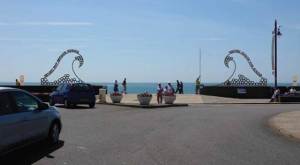
The Seaton Seaside “chickens”

image

Much furore about a new sculpture erected on Seaton seafront a few days ago as part of its Jurassic Coast arts interpretation. Many people have remarked that it looks like two chickens heads, with some even saying that the noise of the wind passing through the sculpture even sounds like chickens clucking!

The saga began long ago in 2014 when the controversial sculpture was first mooted, when, in September 2014, then Mayor, Tony Woodman and Councillor Val Christmas voted against the project, which was carried by a majority of Seaton Town Council:

http://www.viewfrompublishing.co.uk/news_view/33584/21/1/seaton-oppositiongrows-to-proposed-jurassic

A photograph of the sculpture was published in the Midweek Herald on 8 April 2015:

http://www.midweekherald.co.uk/news/controversial_waves_sculptures_get_the_go_ahead_1_4025621

where it was reported that a survey of 200 people asked if they liked the design overwhelmingly approved of it.

The two newspaper reports seem not to have been seen by many people in Seaton who have taken to social media to violently disagree about the merits of the artwork.