“NHS underfunding blamed for maternity ward closures”

“Underfunding in the NHS has been blamed for a sharp increase in maternity wards temporarily closing to new admissions since 2014.

Data obtained by Labour under the Freedom of Information Act showed that in 2016 there were 382 occasions when units have closed doors, a 70% increase in incidents between 2014 and 2016. Some units have closed more than once.

The figures released today showed across England there were 225 closures in 2014, 375 in 2015, rising to almost 400 last year.

Information from the 96 hospital trusts – out of 136 – that responded to the FOI request indicated nearly half of England’s maternity wards, 42 (44%), were affected by the closures, some of which lasted more than 24 hours.

Ten trusts had to shut temporarily on more than ten separate occasions each.

Jonathan Ashworth, Labour’s shadow secretary of state for health, said: “These findings show the devastating impact which Tory underfunding is having for mothers and children across the country.

“It is staggering that almost half of maternity units in England had to close to new mothers at some point in 2016.”

Sean O’Sullivan, head of health and social policy at The Royal College of Midwives (RCM), said trusts were right to close wards when not doing so risked compromising safety of the service but stressed that persistent and regular closures were a sign of an underlying problem around capacity and staffing levels that needed “immediate attention”.

He added: “The RCM has warned time and time again that persistent understaffing does compromise safety and it’s about time the government listened to those best place to advise.”

According to a report from February, the RCM states the health service has a shortage of 3,500 midwives with over a third soon approaching retirement age.

A spokesman for the Department for Health, said: “Temporary closures in NHS maternity units are well rehearsed safety measures which we expect trusts to use to safely manage peaks in admissions.

“To use these figures as an indication of safe staffing issues, particularly when a number of them could have been for a matter of hours, is misleading because maternity services are unable to plan the exact time and place of birth for all women in their care.”

The government says the NHS now employees an extra 2,000 midwives since May 2010 and another 6,500 are currently in training.”

http://www.publicfinance.co.uk/news/2017/08/nhs-underfunding-blamed-maternity-ward-closures

Speak truth to power – or watch chickens coming home to roost

Guardian letters

• Rather predictably, following James Munby’s “blood on our hands” outburst, the NHS “identified a bed” for the suicidal 17-year-old, leaving him to claim, probably correctly, that NHS England would not have acted “as effectively or speedily” without his “outspoken warnings” (Judge’s plea as suicidal teenager is found refuge, 8 August). With new crises being highlighted almost daily, the latest being the closure of maternity wards, and pregnant women being “pushed from pillar to post”, Munby’s example should be followed (Maternity wards closed 400 times as shortage of beds and staff grows, 8 August).

At a time when the “austerity chickens” are coming home to roost, and Labour protests are not always getting the media attention they deserve, he cannot be the only dignitary to be appalled by the current situation. Is it not incumbent upon all judges, archbishops, lords, and even some “celebrities”, to make their voices heard? If the “brand” is indeed to be “reinvented”, royals also could be doing more than “championing mental-health charities” (The royals, a brand reinvented by the millennial generation, 5 August).”

https://www.theguardian.com/business/2017/aug/08/britains-young-suffer-as-austerity-continues-to-take-its-toll

Exmouth Regeneration: computer says “no”!

Dear Dr MacAllister

Thank you for your request for information. Please find the response to your query below.

Please clarify who was awarded the contract to market the site for the second time and when the agent began the process of remarketing the site
The requested information is not held – we have not progressed the re-marketing of this site.

How many developers were contacted with brochures or other marketing materials in respect of the second marketing of the Queens Drive site?
The requested information is not held – we have not progressed the re-marketing of this site

What has been, or will be, the process for the selection of the preferred bidder?
The requested information is not held – this process has not commenced

How many organisations have, to date, submitted a bid to develop the site and what are there names?
No information held – we have not progressed the re-marketing of this site

What is the timeline with regards to choosing a preferred developer
Timescales are as published online http://eastdevon.gov.uk/regeneration-pro… although there has been some slippage.

Please provide minutes of meetings and correspondence between the council, the marketing agent and prospective and submitted bidders
The requested information is not held – we have not progressed the re-marketing of this site

Please provide evidence and explanation of the logic of pursuing vacant possession as a means ro entice a developer and please explain the process of decision making
The requested information is not held – we have not progressed the re-marketing of this site and so minutes, emails and other communications are not held. Please also note that we are not required to provide commentary or explanation in order to comply with our obligations under Freedom of Information legislation – our responsibility is to provide copies of information held only.

I hope this information is helpful but, if you feel dissatisfied with the way we have responded to your request, please contact our Monitoring Officer, Mr Henry Gordon Lennox, to request an internal review [email address]

You may also approach the Information Commissioner for advice at http://www.ico.org.uk

Regards

https://www.whatdotheyknow.com/request/selection_of_developer_for_the_q?nocache=incoming-1019239#incoming-1019239

East Devon: not the best place to have babies?

Honiton, Tiverton and Okehampton maternity units are to close, with services centralised on Exeter.

Let’s, say, take Hawkchurch:

Hawkchurch to Honiton – 15 miles, 25 minutes to Honiton
Hawkchurch to Exeter – 33 miles, 53 minutes to Exeter

Source: AA route planner, miles rounded

28 extra minutes – ON A GOOD DAY – to hospital with a maternity emergency.

That’s if you have a car with an available driver – or an ambulance – sitting outside your home when an emergency begins. A very unlikely scenario. And it assumes a clear road and good conditions – not night-time rain or snow, or a blocked country road.

Under this government, maternity units are understaffed and under pressure. It’s shameful that pregnant women are being turned away due to staff shortages, and shortages of beds and cots in maternity units.”

https://www.theguardian.com/society/2017/aug/08/nhs-maternity-wards-england-forced-closures-labour

Hello, Mr Parish, hello.

Hospital closures: “Repulsive party political puppet show” and “Bow your heads in shame”

Two letters in View from … titles – pulling no punches

Rockbeare Parish Council objects to further expansion of Cranbrook

“… Cranbrook town council’s own planning committee objection to the application last month. And now Rockbeare parish council has voted to object to the application.

The objection says that it infringes on the emerging Rockbeare Neighbourhood Plan but also is premature, does not address the issues around congestion at the M5 junction 29 junction, the density of houses is too high, and the location of the all-weather pitch, the play areas, and the gypsy sites are in the wrong place.

Jacqui Peskett, locum parish clerk to the council says: “The application infringes on the emerging neighbourhood plan as the green wedge between Rockbeare and Cranbrook is intended to include the whole area to the east and north of Parsons Lane and that any development of the area to the west of the country park as proposed would potentially cause flooding in Rockbeare village.

“The proposal is premature, since there is still no overall development plan for Cranbrook, now promised for over three years, so issuing any more development permissions may seriously prejudice the proper development of a Cranbrook masterplan.

“The proposal does nothing to address the capacity of the M5/J29 which is already reaching overload at peak times.

“The developers have not learned the lessons of the first phase of development as the density of 45 homes/hectare is too high.

“The proposals makes no provision for healthcare and would exacerbate the already inadequate education provision in the area by adding a further primary school when the capacity of the secondary provision in Cranbrook is already at the limit.”

The objections also has concerns that the location of the all-weather pitch, the play areas, and the gypsy sites are in the wrong place.

But neighbouring Broadclyst parish council decided after a lengthy meeting that they have no comment to make on the reserved matters application.

Cranbrook town council had objected on the grounds that the green wedge between towns would be too narrow, the density of housing was too high and the location of the gypsy sites were in the wrong place.

Since the build of the new town in East Devon began in 2010, 3,500 homes, a railway station, St Martin’s Primary School, play facilities, the neighbourhood centre, local shops, the education campus, the Cranbrook Farm pub, while construction of buildings in the town centre and the sports pitches are underway, while plans for the ecology park in the town have also been submitted.

The application for the southern expansion for Cranbrook would see the town get an additional 1,200 homes, but also a petrol station, a residential care home, employment land, a new primary school, and an all-weather sports facility. …”

[For detailed information see original article]

http://www.devonlive.com/rockbeare-parish-council-object-to-cranbrook-expansion-plans/story-30472214-detail/story.html

Baker Estates – developer of the moment at EDDC?

For the ‘reserved matters’ decision on the first phase of their latest estate at Gittisham (outline approval was granted against local opposition in 2014, before the Local Plan was adopted), EDDC’s Development Management Committee was supplemented by rarely-seen EDDC big-wigs. Development Officer, Chris Rose, who normally presents applications to the committee, was joined by EDDC’s Solicitor, Henry Gordon Lennox, and Development Manager, Ed Freeman, to counter the objections of a single representative of Gittisham Parish Council even though ward member, Independent Susie Bond, voiced her reservations.

New-kid-on-the-block Bakers was ably supported by Councillor Phil Twiss, Cabinet Member for Economy, who said that ‘£50 million’ would be generated for the local economy by the development. Bakers’ Tom Hammond was seen to give Councillor Twiss a cheerful wave as he left the meeting.

The Parish Council and Councillor Bond were both concerned about three 3-storey blocks of flats, built at the highest point on the site, which will tower over 2-storey houses built lower down. These blocks, of course, will house the ‘affordable’ dwellings which Bakers are (so far) obliged to build (though as with many local developments these days this is subject to change if they find the condition too onerous at a later stage), and so they have been shoe-horned into the smallest possible space, leaving more room for the profit-earning properties for sale on the open market.

The local representatives felt that the blocks were out of keeping with the setting – a feeling that other members appeared to share. However most seemed swayed into allowing the development – with only Independent Matt Coppell and the two Liberal Democrat members voting against.

Bakers say that they now have a ‘track record’ in East Devon. However, as far as we know, they have only two other approved developments in the district, both in Seaton – at Barnards Hill Lane (not yet commenced) and at Rowan Drive – where residents are said to be complaining to EDDC on an almost daily basis about alleged breaches of planning conditions by Bakers’ builders.

Gittisham, keep your eyes on this development.

Why “growth” is almost impossible in East Devon

Our Local Enterprise Partnership trumpets “growth, growth, we must have growth to prosper” and EDDC chose the highest growth figures to ensure its Local Plan got LOTS of housing. But they both seem to have forgotten something that their bible, the Daily Telegraph, now points out:

Britain’s productivity crisis risks getting worse because the population is ageing steadily, leaving relatively fewer younger, more dynamic workers who typically innovate more.

Unless drastic action is taken to boost skills and creativity, or to increase the number of young workers, then growth will struggle to pick up, according to new economic research published in the journal of the National Institute of Economic and Social Research.

“The share of young workers impacts the innovation process positively and, as a result, a change in the demographic profile that skews the distribution of the population to the right [older], leads to a decline in innovation activity,” said the paper, written by Yunus Aksoy, Henrique Basso and Ron Smith. …

To avert a sustained slowdown they recommend that governments should look at ways to make the dwindling proportion of young people more productive.

“Unless there are drastic changes most OECD countries will need to devise new policies to foster medium-run economic growth in an environment with ageing population, perhaps by increasing investment in human capital,” the researchers believe.

Alternative options are also available, but some may be less politically palatable – for instance, encouraging greater flows of migrants of working age into the country.

“Demographics are not destiny and our conclusions assume that there will not be major changes in rates of immigration, labour force participation, fertility or longevity,” the economists said.”

http://www.telegraph.co.uk/business/2017/08/07/ageing-population-make-productivity-crisis-worse/

Land barons

Owl attempted to shorten this post but couldn’t find anything that could be cut out.

“In October last year, Tony Gallagher threw his friend David Cameron a 50th birthday party at Sarsden House, his 17th-century mansion near Chipping Norton, Oxfordshire. He served a dinner of roast beef and lamb, cooked on his Aga, to a private gathering of 23 people.

At the same time, Gallagher was also quietly planning to sell the company that he had built up over three decades, accumulating land, gaining planning permission, and auctioning it off at vast profit.

After reportedly holding talks with the Pears family, the Wellcome Trust and Berkeley Homes, Gallagher Estates was sold to housing association L&Q in January. It netted the entrepreneur a £250m payday, propelling him into 152nd place in The Sunday Times Rich List, with an overall fortune estimated at £850m.

Such is the life of the modern-day land baron. A group of private companies, largely unknown to the public, have carved out a lucrative niche locating and snapping up land across the UK.

Operating in the murky world of “strategic land” promotion, these firms prepare sites for development by doing the time-consuming work of gaining planning permission. It is then sold on “shovel-ready” to housebuilders. These companies don’t ever build homes, but work within the labyrinthine planning system, taking advantage of its weaknesses and loopholes.

It’s a modern-day gold rush: the magazine Farmers’ Weekly is filled with adverts for companies offering to prepare agricultural land for building; Gladman Developments, a land promoter, offers its services on a “no win, no fee” basis to lure landowners interested in selling up, claiming a success rate of 90pc. The reason for this is the sheer profit that can be made by obtaining planning permission on a strategic site of land.

According to Simon Hodson, head of residential land at JLL, while an average acre of agricultural land may sell for £5,000 to £10,000, land with planning permission for residential development is normally worth £1m-4m per acre, depending on its location and the amount of infrastructure and preparation needed before building.

These companies will then take a cut of 10-30pc of the sale value, depending on the size of the site. This means that the murky underbelly of the land market is highly profitable: in the year ending March 31 2016, Gladman made a pre-tax profit of £11.6m, while Gallagher’s was £79m in the year to June 30 2016. The company was bought for £505m, which included land to build 42,500 new homes.

The companies keep a low profile, and so do their bosses. Gallagher quietly donated £110,000 to the Conservative party last year, while Gladman has also built his firm up over decades, selling his family home to invest in his first tracts of land.

The way they operate and the nature of the land market means it is difficult to know the scale of this opaque world.

When promoting land, these companies will seldom purchase it upfront, but instead either pay the owner an option for exclusive rights, or promise the money once it is sold, with the landowner retaining the land and being actively involved in the sale process.

The options don’t need to be registered anywhere, and they are not obliged to detail their deals in their results. A search through a database created by Freedom of Information requests of land ownership by campaigner Guy Shrubsole reveals that Gladman owns just 304 acres, but it says it produces sites for 10,000 homes per year, a far higher amount. Gallagher owns just 714 acres according to this database. Such is the opaque nature of these land deals that mythology swirls around the industry: one – unproven, and very likely untrue – claim is that 90pc of green belt has long-term speculative options in place, in case the Government of the day changes its policy on building on it.

The true size of the industry is almost impossible to find out. There are around eight big companies, and many more smaller ones, quietly preparing land around the country, though largely outside London.

Figures from Savills suggest that land promoters and investors currently control around 20pc of land due to be put through planning, enough for 153,400 homes. This is compared to housebuilders which own just 7.7pc of land at this stage in development. This disparity is caused partly by the fact that these promoters work on a much longer-term basis, picking up options on land for development in 15 or even 20 years. A site for 10,000 homes that Gallagher developed in Northstowe, Cambridgeshire, was acquired in 1998, and then finally sold to housebuilders last year.

A source in one of the large housebuilders says that it buys one third of its plots from these land promoters, although this figure varies. Some housebuilders have substantial land banks that they take through the planning system itself, such as Taylor Wimpey and Persimmon.

Much of the success comes from navigating the planning system. Land promoters track down underfunded local authorities that have not yet set out a local plan for housing in the next 15 years, or a programme for building in the next five years in its National Planning Policy Framework. Enter a land promotion company, which finds sites in these areas where the council is likely to say yes.

David Gladman, co-founder of the eponymous company, told the High Court last July: “We normally only target local authorities whose planning is in relative disarray and … either have no up-to-date local plan or, temporarily, they do not have a five-year supply of consented building plots.” Just 41pc of local authorities have a five-year plan for housing supply, according to Savills. If a local authority doesn’t have that in place, it means as long as a planning application meets certain criteria it will be approved.

Gladman employs a team of more than 50 town planners to develop these sites. Companies searching for land use aerial photography, maps, data and agents to find the sites, often simply knocking on doors to ask landowners if they want to sell up.

Are these businesses a nefarious force? They are “an instrumental part of delivering housing,” says Hodson, and help accelerate the amount of land ready to be built on. Last year, 293,127 homes were granted planning permission, according to the Home Builders Federation, a record high. By preparing large sites for development, like Gallagher does, it’s easier to create a combination of residential and commercial property, parcelling off areas to experts in that field.

But by charging a premium for a clean site that’s ready to be built on, it forces developers to increase house prices to recoup the high outlay on land, while cutting the viability of building affordable homes. “Land promoters deliberately pump the cost of land higher and higher, then reap the rewards when they sell it,” says Catharine Banks, policy officer at Shelter.

While housebuilders have recently been accused of “land banking” by Government, hoarding land with planning permission that could be built on, the same could be levelled at these businesses. Research by Shelter last month found that almost a third of sites that have been approved to have homes built on have not been completed within the last five years. Gladman, however, claims it doesn’t hang on to land and offers it for sale within a couple of months of gaining planning as, under the option system, it only makes money when it is sold.

“The land market is inefficient and fragmented,” says Tom Aubrey, from the Centre for Progressive Capitalism, who argues that these land promoters are a natural product of its dysfunction and lack of transparency.

He likens the model of these businesses to private equity firms, as an agile, speculative force. “It’s a bit like airlines before the internet was set up: it was difficult to know who had the best price because of the asymmetry of information.”

The Government has signalled it wants to open up the land market, making data on land and who owns it more accessible. According to Shelter’s Banks, this “would be a small but very powerful change, which could help the country build the homes we so desperately need.”

https://digitaledition.telegraph.co.uk/editions/edition_nkuOf_2017-08-06/data/361464/index.html

Harm must be “fairly substantial” to stop development contrary to Local Plan officers think

“Officers are sensing that the Inspectorate are taking a more positive approach to development and the economic benefits that it brings. Whilst historically a refusal of development contrary to a local plan policy that caused some harm would be likely to be dismissed on appeal, it appears now that the harm needs to be fairly substantial to override some economic benefit. In effect there is a more pro-development agenda being pursued by the Planning Inspectorate. This is something that we need to learn from. In addition, there is perceived to be less consistency in the decisions coming out of the Inspectorate.”

Click to access 070817-combined-dmc-agenda-compressed.pdf

Page 14

Exmouth Regeneration Board notes* – not all going to plan**

*They can’t be called minutes as it can only make recommendations not take decisions

** Assuming there is a plan

Click to access 130717-notes.pdf

Highlights

Catering contract marketed with no water or electricity but this will be “overcome” with containers!

“JL reported that a three year temporary catering provision had been marketed and received a lot of interest, with returns expected by 21 July 2017. It was unrealistic to expect anything to be operating on the site this summer season, but it could be a year round offer. The successful tender would be decided on the price/quality offer. The visitor survey had provided evidence for demand for the type of offer at Orcombe Point.

There was an issue with no direct water or electricity services on site, although it was possible that these could be overcome.

It was likely that the provision would be in the form of a containerised structure. The planning conditions were fairly light, including the need to clad any structure to be in keeping with the environment.”

EDDC might “invest” in the Magnolia Centre:

“Members noted that there was the need to look at the retail plan for the town centre. However, it was acknowledged that there was a problem with the disparate ownership of property throughout the town centre, and whether EDDC should consider investing some of its reserves in the purchase of land, such as Magnolia Centre.”

No lease agreed with Grenadier:

“The development agreement and lease had not yet been completed with Grenadier, although it was hoped that points could be finalised with the legal times the following week. It was hoped that an application would come in September.”

Chancellor blocks curb on high-stakes gambling – tax revenue more important

“Chancellor of the Exchequer Philip Hammond has blocked government attempts to curb high-stakes gambling machines commonly found in betting shops in order to preserve tax revenues, the Daily Mail newspaper reported on Saturday.

Britain’s ministry for culture, media and sports, which regulates the gambling industry, launched a consultation in October into the maximum wagers that should be allowed on gambling machines, including those known as fixed-odds betting terminals.

These machines currently allow gamblers to bet as much as 100 pounds ($130) every 20 seconds in electronic versions of casino games like roulette, and some British lawmakers have called for this to be reduced to 2 pounds.

The Daily Mail cited a government source as saying Britain’s finance ministry feared this would be “financially crippling” for tax revenues, and separately said Hammond had acted to ensure a clampdown on maximum gambling stakes was shelved. …”

http://feeds.reuters.com/~r/reuters/UKDomesticNews/~3/eywHCmJcdcU/uk-britain-gambling-idUKKBN1AL0DP

Left or centre? NHS or arms sales? New definitions

Our MP frequently visits the Middle East at the same time as our arms salesmen in his capacity as Chairman of the Conservative Middle East Council.

Indeed, in South America, when he was a Minister, he was alleged to have been an arms dealer himself:

https://www.vice.com/en_uk/article/9bgdme/a-british-defence-minister-acted-as-an-arms-dealer-to-colombia-849

Here he talks about his attitude towards selling arms to Saudi Arabia:

https://www.hugoswire.org.uk/sale-arms-saudi-arabia-0

“… Each application is considered on a case-by-case basis against the Consolidated EU and National Arms Export Licensing Criteria, taking into account the precise nature of the equipment and the identity and track record of the recipient. The Government has consistently said it does not, and will not, issue licences where it judges that the proposed export would provoke or prolong internal conflicts, or where there is a clear risk it might be used to facilitate internal repression or be used aggressively against another country. I have always fully supported this stance.

Saudi Arabia has publicly stated that it is investigating reports of alleged violations of International Humanitarian Law. This is an important process and the UK is fully behind thorough investigations into all allegations of violations of International Law. Finding a political solution to the conflict in Yemen is the best way to bring long-term stability and peace talks are a top priority.”

and a couple of other articles for balance:

http://www.independent.co.uk/voices/saudi-arabia-arms-sales-yemen-war-uk-government-us-donald-trump-obama-aid-a7643066.html

“Since the conflict began two years ago in March 2015, the US and UK have together transferred more than US$5 billion worth of arms to Saudi Arabia which is leading the military coalition in Yemen. This is more than 10 times the estimated US$450 million that the US State Department and the UK’s Department for International Development have spent or budgeted to spend in aid to Yemen over the past two years. …

Weapons supplied in the past by states such as the UK and USA have been used to commit gross violations and helped to precipitate a humanitarian catastrophe. These governments have continued to authorize such arms transfers at the same time as providing aid to alleviate the very crisis they have helped to create. Yemeni civilians continue to pay the price of these brazenly hypocritical arms supplies.” …”

http://www.independent.co.uk/news/world/saudi-arabia-yemen-uk-bombs-sold-arms-deal-used-unlawful-attacks-claims-a7776071.html

“… Conservatives are being pushed to make public a report, commissioned by former Prime Minister David Cameron, that investigates whether Saudi Arabia funds terrorist groups. Foreign Secretary Boris Johnson said the report was confidential, and Ms Rudd said the report was “never meant to be seen”.”

EDDC external legal fees – over £800,000 over 4 years

“Costs of using external law firms and barristers

Date submitted: 7 July 2017

Summary of request

I would like to know the amount of money the council spent on the services of external law firms and barristers in the last years (year ending March 31 2017). If this is not possible within the restrictions of the Freedom of Information Act, one year of data will suffice.

Summary of response

2013/14 Legal fees including barristers £285,075.61
2014/15 Legal fees including barristers £353,060.78
2015/16 Legal fees including barristers £79,053.34
2016/17 Legal fees including barristers £107,390.74”

http://eastdevon.gov.uk/access-to-information/freedom-of-information/freedom-of-information-published-requests/

[Total: £824,580.47]

More on Swire saving services at Royal Brompton Hospital, London

Owl says: hypocrisy isn’t a strong enough word!

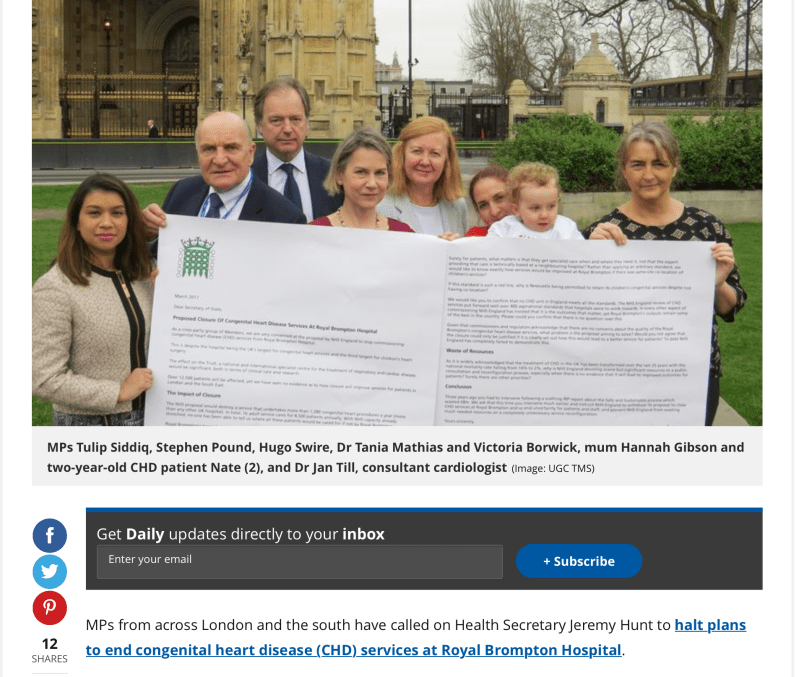
” … Yesterday, 21 MPs [including Swire] issued a letter to Secretary of State for Health Jeremy Hunt MP calling for him to block plans to decommission congenital heart disease (CHD) services at the Trust.

Eight of the MPs joined Dr Jan Till, consultant paediatric electrophysiologist and co-director of children’s services, and Hannah Gibson, mother of a child being treated for CHD at the Trust, in parliament yesterday with a giant reprint of the letter to help raise awareness of the issue.

The letter was sent as more than a thousand patients, staff and supporters prepare to join a demonstration against the plans on Saturday 18 March, organised by three charities that support the Trust and its patients.

The letter outlines how NHS England’s plans are not based on evidence, will destroy some of the world’s leading research teams, will cost the NHS millions of pounds, and will not just affect CHD services but a range of other heart and lung services too.

In the letter, MPs call on Jeremy Hunt to intervene to halt the proposals, as he did the last time Royal Brompton’s CHD services were under threat during the now notorious ‘Safe and Sustainable’ review in 2013.

The letter concludes by adding “Would you not agree that the closure could only be justified if it is clearly set out how this would lead to a better service for patients? To date NHS England has completely failed to demonstrate this”.

Victoria Borwick MP, who signed the letter, said: “MPs have come together from across the political divide to support Royal Brompton, showing that this is not a party political issue. This is a matter of simple common sense. Royal Brompton Hospital offers world leading services as one of the biggest and best heart disease hospitals and is also renowned for its cystic fibrosis care. It is entirely wrong to put this in jeopardy.”

http://www.rbht.nhs.uk/about/news-events/mps-call-on-jeremy-hunt-to-block-nhs-england-plans-for-royal-brompton-services/

Thanks, Mr Swire – at least we know what your priorities are.

As your second home is in mid-Devon, not East Devon, will you be fighting for community hospitals there? Though, of course, community hospitals ARE remaining in your bit of East Devon but now removed from Ottery St Mary, Honiton, Axminster and Seaton – so no worries for you on that score. That’s Parish’s problem. Though as he has HIS second home in Somerset – and successfully campaigned for HIS local district hospital to stay open there – maybe he’s not too worried either.

Swire pitches in to save a hospital – in London!

Yep – that’s our MP … described as one of a number of MPs from “across London and the south”.

Main home is in Chelsea perhaps – and you never know when you might need a good hospital on your doorstep.

Swire on May

“… Theresa May. I’m not denying there are issues around her leadership. But her vilification is damaging our prospects as a nation. There is no knight-in-shining-armour statesman or woman waiting in the wings to replace her. For now, we need to reconcile ourselves to practical governing as the Brexit process grinds on. She may have her faults but she is also dutiful and she is diligent and she deserves our support during these difficult negotiations.”

https://www.hugoswire.org.uk/news/summer-recess

What a damning condemnation of current Tories: “we don’t have anyone better so put up and shut up”!

And “Dutiful and diligent” – sounds like an end of term report on a pupil who hasn’t achieved anything but her teacher is desperately trying to say something positive!