Foreign money raised house prices 20% over 15 years

“House prices in Britain have soared by around 20 per cent in the past 15 years due to an influx of foreign money, according to a new study.
The research by King’s College London showed the average price is around £215,000 but would have been about £174,000 without the investment from overseas.

University researchers said the cash has also had a ‘trickle down’ effect to less expensive properties.

Money from abroad has impacted house prices mostly in the South East and major cities in the north, such as Liverpool, Leeds and Manchester.
But researchers warned there was no evidence the increase in foreign investment lead to an increase in housing building or in the share of vacant homes. …”

http://www.dailymail.co.uk/news/article-5543887/House-prices-rise-20-cent-15-years-pushed-influx-foreign-money.html

Our Local Enterprise Partnership’s favourite project ringing alarm bells

Not what our nuclear-linked LEP board members want to hear:

“The UK nuclear regulator has raised concerns with EDF Energy over management failings that it warns could affect safety at the Hinkley Point C power station if left unaddressed, official documents reveal.

Britain’s chief nuclear inspector identified several shortcomings in the way the French firm is managing the supply chain for the £20bn plant it is building in Somerset.

Though not serious enough alone to raise regulatory issues, together they “may indicate a broader deficiency” in the way the company is run, concluded Mark Foy, chief inspector at the Office for Nuclear Regulation (ONR).

In October and November 2017, a team of 11 inspectors led by Foy visited the Hinkley site, EDF facilities in Bristol and Paris, and a French factory making parts for the plant.

The visits were triggered by the regulator’s concerns that EDF did not have sufficient oversight of the Creusot nuclear forge in France, where records have been found to be falsified.

A summary of the inspections, published by the ONR earlier this month, judged EDF’s supply chain management to be improving but below standard in some areas.

The full reports, released to the Guardian under freedom of information rules, paint a critical picture. They show that:

The ONR was concerned that EDF’s internal oversight and governance had not identified the shortcomings at the forge

Stuart Crook, Hinkley Point C managing director, admitted that EDF, not the ONR, should have spotted those shortcomings first

a lack of resources meant EDF did not undertake an internal audit of its quality control processes during 2017. Foy said this was “disappointing” as it might have picked up problems

On safety, the report said that: “Throughout this … inspection, themes have emerged that relate to both improvements in NNB GenCo’s [the EDF subsidiary building Hinkley] processes and to shortfalls in management system arrangements that, if unresolved, have the potential to affect safety.”

EDF’s own assessment of how it managed Hinkley’s supply chain had discovered shortfalls that could affect safety, the regulator found. The ONR also felt that the company’s plan for improving its self-assessment process was inadequate.

Moreover, they said that it was not clear who at EDF was managing quality control on the supply chain.

Interviews with EDF’s contractors for the Hinkley project, which include civil engineering groups Kier BAM and Bylor, also found that EDF had not done enough to pass on information about the failings at the Creusot forge to its suppliers.

However, the regulator said it was confident the company could make improvements ahead of the next key regulatory milestone for the power station, in August 2018. Overall, EDF was found to be operating within the UK’s exacting nuclear regulations.

“Current arrangements for the control of quality are judged, through ONR’s wider regulatory activities, to be appropriate at present,” said Foy.

Experts said the inspection’s conclusions were significant, as nuclear regulation language is usually restrained.

Paul Dorfman, of the Energy Institute at University College London, said: “Looking at this report with a practiced eye, you can see that the UK regulators are worried, and things aren’t necessarily going to get any better.

“In all things nuclear, safety is absolutely paramount. The fact that the UK nuclear regulator says that these problems could affect safety is very significant.”

EDF said it was already implementing improvement measures where required ahead of an increase in construction activity at the site. The company was also completing the outstanding internal quality assurance programme.

A spokesperson said: “The chief nuclear inspector’s report recognises that the current quality control arrangements for Hinkley Point C are appropriate.”

There are about 3,500 people working on the site at the moment, a number that is expected to peak at around 6,000 in 18 months, when construction is due to be at full throttle.

The power station should provide around 7% of the UK’s electricity and is due to switch on in 2025, though EDF has warned the project may run 15 months over schedule.”

https://www.theguardian.com/uk-news/2018/mar/25/nuclear-watchdog-raises-hinkley-point-c-concerns

Should Randall-Johnson remain chair of the DCC Health and Social Care Scrutiny Committee (or even be a councillor at all?)

We all know our problems with Randall-Johnson as Chair of DCC’s Health and Social Care Scrutiny Committee (or, if not, we should). Here are just a few of many Owl posts on this councillor and her behaviour as its Chair:

https://eastdevonwatch.org/2017/08/12/conduct-of-health-committee-members-investigated-by-devon-council-diviani-and-randall-johnson-heavily-criticised-for-behaviour/

https://eastdevonwatch.org/2017/06/24/claire-wrights-report-on-the-disgraceful-dcc-nhs-meeting-and-its-disgraceful-chairing-by-sarah-randall-johnson/

https://eastdevonwatch.org/2017/08/31/councillor-calls-for-randall-johnson-resignation/

NOW, it seems, she was EXTREMELY reluctant to allow the CCG’s Sustainability and Transformation Plans to be a standing item on her committee’s agenda and inly the intervention of a “committee adviser” led to this being agreed. See Claire Wright’s blog for details:

http://www.claire-wright.org/index.php/post/sustainability_and_transformation_cuts_plan_agreed_to_be_an_item_on_every_h

“… Essentially, the NHS in Devon is looking at a £500m overspend by 2020 unless major cuts and centralisation of services take place.

It is absolutely vital that the committee keeps a very close eye on what cuts are to be made and how this is affecting patients. We are their only ears and eyes on this.

When I made this proposal yesterday – that we receive a detailed report at each committee meeting. Chair, Sara Randall Johnson appeared to be reluctant to introduce such a standing item, given all the other issues that needed to be examined.

I could not see her point of view at all. Surely, this is the most important issue facing Devon’s patients today?

Committee adviser, Anthony Farnsworth suggested that councillors have sight of the CCG’s own financial reports relating to the STP on a regular basis and this was a legitimate area of scrutiny. …

This was agreed.

Here’s the webcast – https://devoncc.public-i.tv/core/portal/webcast_interactive/318671

What is this woman’s problem? Is it simply that she knee-jerks a “no” on any and every proposal from Independent Claire Wright” – putting personalities before what is best for Devon, its healthcare and its scrutiny? We know she has problems with Ms Wright’s forthright defence of our NHS against cuts and privatisation (though the problem seems to stem from further back when the then Leader of East Devon District Council was ousted from her seat by the likeable, knowledgeable and planning policies aware winning candidate – Claire Wright).

Or is it even more dangerous than that? Putting HER personal political beliefs and ideology above those of others – including moderate DCC Tory councillors – and forcing them on others by whatever means she has at her disposal?

Questions, so many questions, and so few answers.

Help-to-buy: now the crunch comes (for some)

Help-to-buy gave interest-free loans of 20% of new house value (40% in London) for 5 years. After that, loan repayment (currently 1.75%) kicks in. That 20% or 40% of home value is still owned by the government and any increase in the home’s value results in increased charges at the year 5 point. Early adopters of this scheme are now reaching this 5 year point. The government’s loan repayments will be in addition to mortgage payments and will rise with the cost of living (and at the same time many mortgage rates may rise if or when the bank rate increases).

Some buyers who have seen big gains in property value may be able to trade up and pay off the loan, but anyone who has seen static value or even a fall (many new houses were over-priced) will be in trouble.

Those whose homes have not increased in value face “a ticking time bomb” according to the think-tank Resolution Foundation.

Wonder how Cranbrook residents who took advantage of the scheme feel now?

And was this consequence foreseen by government or borrowers?

Weasel words on affordable housing from the government’s minister

Sajid Javid faces battle over 4% affordable homes in Sainsbury’s scheme

“The housing secretary, Sajid Javid, is facing a legal challenge after he approved a 700-home housing scheme by the supermarket chain Sainsbury’s, which includes just 4% affordable housing.

The 29-storey development in Ilford, east London, will be built in a borough that has a stated policy that 50% of all new homes should be affordable. It estimates it needs an extra 15,000 affordable homes in the next 15 years, but Javid backed a scheme with just 27 affordable homes. The rest are expected to be sold for about £400,000 for a two bedroom flat.

The London mayor, Sadiq Khan, branded the approval “outrageous” and said 4% was a “disgraceful” contribution. Labour’s shadow housing secretary, John Healey, said it was “a clear case of ministers backing private developer profit over the homes that local people need”.

A local residents group Ilford Noise is now preparing to request a judicial review of the decision after Javid accepted Sainsbury’s claim that the scheme would not be viable with any more affordable units. Javid’s report concluded: “There is no good reason to dispute the agreed conclusions of the financial experts.”

The decision came just weeks after Javid gave a speech insisting it is “totally unacceptable” for developers to claim they cannot afford to meet affordable housing promises.

He said: “It cheats communities of much-needed housing and infrastructure and gives new development a bad name.”

But in this case, where Sainsbury’s never promised more than 4%, he has allowed the developer to hugely undershoot the local target. …”

https://www.theguardian.com/society/2018/mar/23/sajid-javid-faces-battle-over-4-affordable-homes-in-sainsburys-scheme

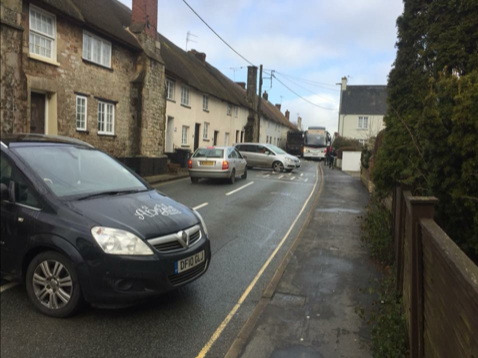
Could Sidford cope with a new industrial site? A 75 minute traffic gridlock says not!

The idea of an industrial complex in Sidford has not died – it could return at any minute.  This was the situation when two large vehicles met on one of the narrowest parts of the road  – vehicles were trapped for more than an hour … imagine if there had been a medical emergency or fire during that time …

Sidmouth DCC councillor Stuart Hughes has responsibility for transport issues in Devon.

A picture is worth a thousand words …

Another day, another council HQ sale mess

Owl says: what is it about councils and HQ relocation that seems it ALWAYS goes pear shaped!!!

“Active Urban Property Group (AUPG) wants to build 100 homes at Suffolk Coastal District Council’s (SCDC) former Melton Hill offices in Woodbridge, sparking residents opposition.

The Ipswich firm won the council contract to redevelop the site in 2016 and its application for the homes was given provisional approval by SCDC’s planning committee in October 2017.

But it needed to satisfy conditions – including affordable housing – before councillors would grant full planning permission.

Since then, nothing has come before the planning committee and critics said the project had stalled, leaving the future of an important site in doubt. …

The proposals had already generated hundreds of objections, many criticising the design of the buildings, which have been described as “cheese wedges”. Public scrutiny has been heightened due to the site’s prominent location and its role in SCDC’s accommodation plan.

The plan, which saw the council move to new £3.9million headquarters in Riduna Park, Melton, in 2016, is hoped to save the taxpayer £8m over 20 years through cheaper running costs.

Although SCDC insists it is still on course to make the savings, the council cannot finalise the sale of Melton Hill until planning permission is granted.

It is understood affordable housing is the main issue to be resolved. AUPG had entered a partnership with Flagship Homes, one of Suffolk’s largest providers of social housing, but the agreement was dissolved in August 2017.

Councillors familiar with the deal claim Flagship’s involvement influenced SCDC’s choice of developer, due to its reputation and financial position. They say Flagship’s withdrawal as a partner in the scheme should have led SCDC to question how AUPG could deliver the project alone.

David Hughes, a director with AUPG, said the partnership’s dissolution was due to a “change in personnel” at Flagship and he expected the planning application to go before the planning committee on April 19.

He insisted the affordable housing would be delivered and said its plans were submitted to the council’s planning department “before Christmas”.

Flagship Homes managing director Tony Tann has not commented on the partnership ending but said Flagship was still involved and “would be pleased to procure the affordable homes”.

He said Flagship was awaiting a response from AUPG regarding its offer.

Much of the criticism of AUPG’s proposals has focused on the difference between its designs and those in a masterplan, released in April 2016.

While the first plans were for 68 homes, retaining two older buildings and the Drummer Boy statue, AUPG’s revisions released last June were for 100 homes and to remove the older buildings.

People at a consultation event last year expressed “shock” at the “radically different” plans, which were “completely unsympathetic” to the surroundings. …”

http://www.eadt.co.uk/news/concern-over-active-urban-property-group-s-homes-plan-for-suffolk-coastal-district-council-s-melton-hill-headquarters-1-5440596

“The Case for Public Consultation Hearings”

In its latest Briefing Paper, the Institute argues the case for Public Consultation Hearings. In the recommended format, organisations undertaking a consultation will provide the opportunity for selected consultees to appear before decision-makers and give their evidence and their viewpoint – a little like Parliamentary Select Committees.

It is not a new idea, but there are important reasons why the time is right to consider these forms of dialogue:

People are heartily fed up with perfunctory, tick-in-the box forms of dialogue, especially simplistic online surveys with questions like ‘Do you agree with us that we should revise the regulations …. Blah blah.? ‘ Serious stakeholders want a better level of debate that considers issues properly. Public hearings can help.

We have to tackle what can be described on the week of Stephen Hawkins’ death) as the consultation ‘black hole’ It is where respondents make a submission or reply to a consultation but have no idea what happens to their views. Does anyone read them? Are they considered? If so, by whom. It is as if responses disappear down a black home never to reappear. Public hearings are one way to demonstrate that consultors listen!

All the emphasis is now on digital dialogues, and they have many fine features that encourage participation by large numbers who might not have responded using traditional methods. Public hearings can be a welcome antidote to the de-personalisation of electronic media – where real people can be seen to sit down and discuss evidence. Video-streaming can make this visible and transparent to far wider audiences, and be living proof that consultation is really taking place.

The Briefing Paper looks at the role of evidence in public debate, and the need for participants in consultations to evidence their claims and assertions. It then presents the arguments in favour of public hearings, and explores whether they might work in the context of public consultations. For existing public engagement practitioners, the most valuable section may well be on the practicalities of organising a programme of hearings and the challenges that might need to be overcome.

Our conclusion is that where there is a considerable amount of public interest, or where the subject-matter is deeply controversial, they will help convince sceptical communities that decision-makers care enough to explore the issues openly and in public. There is even a case for holding events like this well before a consultation is launched. A pre-consultation exploration of key issues and an opportunity for stakeholder to spell out what they would like to see considered might be a first-rate way of involving the public. Used in this way, hearings can even form part of a co-production approach.

Make your own mind up by reading the latest ‘Briefing Paper 35’ which you can view here if you are member. Alternatively contact Rebecca Wright to request a copy if you are not a member, or would like Institute Associates to help prepare a programme of Public Consultation Hearings for your own organisation.”

https://www.consultationinstitute.org/tackling-the-black-hole-of-consultation/

“Struggling Tory council paid acting boss more than £1,000 a day”

“Tory-controlled Northamptonshire county council, which declared itself effectively bankrupt last month, paid its acting chief executive more than £1,000 a day, it has emerged.

Damon Lawrenson had been interim chief executive at the council since November, having previously acted as temporary finance director at the council since October 2016. Lawrenson left the council this week “by mutual consent”.

Northamptonshire was heavily criticised in a recent government inspector’s report, which identified deep-rooted management and governance failures over the past four years as the prime cause of its financial problems.

The report highlighted what it called the council’s “sloppy” approach to financial management and lack of realism in business planning. It called for a clear-out of the existing leadership in order to restore stability to the council.

A freedom of information (FOI) request by the GMB union revealed that the council paid out £371,000 to DDL Consultancy, owned by Lawrenson, during 2016-17 and 2017-18. His company had earlier been paid a further £540,000 between 2008 and 2011, when he had stints as assistant chief executive and commercial director.

The local government secretary, Sajid Javid, is considering the report’s recommendation that the county be run by a team of Whitehall-appointed commissioners until it can be scrapped, along with seven local district councils, and replaced by two new smaller unitary authorities.

The council, which recently warned that its overstretched adults social care services were “on the verge of being unsafe” issued a section 114 notice in February, signalling that its finances were unsustainable. It banned non-urgent spending, and pushed through £40m of cuts plans, including the closure of 21 out of 36 libraries.

A GMB official, Rachelle Wilkins, said: “For Northamptonshire county council to splurge almost £1m on consultancy while people are losing their jobs and services are being cut is a real kick in the teeth.”

A spokesman for Northamptonshire county council said: “Salaries reflect responsibilities associated with the posts, many of which require highly-qualified, professional staff, while being mindful of the necessity of providing value for money.

“It must be noted that about £560k was incurred in the three years between 2008/09 and 2010/11. Additionally, as a contractor Damon is not eligible for sick pay, holiday pay or pension contributions.” …

https://www.theguardian.com/society/2018/mar/23/struggling-northamptonshire-county-council-paid-acting-boss-more-than-1000-a-day

Helpers needed to drive forward Honiton’s neighbourhood plan

“Honiton Town Council and existing members of a steering group have been working together to formulate the town’s Neighbourhood Plan, a document which will enable residents to have a say on its future development.

A council spokesman said: “The aim is to work as a community to develop a plan which reflects the aspirations we all have for the future of Honiton.

“However, we now need a Chairperson and additional members of the Steering Group to lead and deliver the project for the benefit of the community.
“We are looking for a chairperson who is a collaborative leader, an effective communicator with project management experience who has the willingness, enthusiasm and time to devote to the whole project.”

No experience or qualifications are required, although anyone with knowledge of project management, town planning, community engagement and consultation and report writing will be warmly welcomed.

Additional information about the role of Chairperson and the Steering Group, including a person specification and job description, is available on request

Those interested in joining to help steer the group can contact deputy town clerk Heloise Marlow DeputyClerk@honiton.gov.uk

http://www.midweekherald.co.uk/news/chair-needed-to-help-complete-honiton-s-neighbourhood-plan-1-5445942

“Survey reveals another section 114 notice [council insolvency] expected within a year”

Some councils are taking on riskier investments with consequent higher returns to maximise income – risky indeed in the current uncertain financial climate. As with those councils that bought (non-local) shopping centres as investments … which will need very savvy auditors to monitor …

“Three quarters of senior finance officers expect at least one other council to issue a section 114 notice in the next 12 months, according to a Room151 survey.

Last month, Northamptonshire County Council’s director of finance issued a 114 notice imposing immediate spending controls on the authority.

Room151’s Local Government Finance & Treasury Current Affairs Survey, sponsored by investment manager CCLA, found that more than half of respondents expect one or two more notices in the next year.

Presenting the findings to Room151’s LATIF north conference in Manchester this week, John Kelly, client director at CCLA, said that a further 20% expect between three and five further section 114s, with 3.5% expecting between five and 10.

However, when asked about their own council, 56% of treasury officers said they were either confident, or very confident, of financial sustainability.

Kelly said this result “doesn’t suggest there is any panic or any need to get unduly worried at present”.
Elsewhere in the research, 36% of those surveyed said that they had begun to invest in higher yielding instruments, due to the current funding squeeze, compared to 30% who said there had been no impact. …”

http://www.room151.co.uk/treasury/survey-reveals-another-section-114-notice-expected-within-a-year/

Campaign group forces further consideration of “integrated care” in Devon

Save Our Hospital Services scored a major victory today when after its demonstrations (including another one today):

Emails, public speaking and media onslaught led to the DCC Health Scrutiny Committee refusing to agree to the commencement of the secretive and undemocratic imposition of an “Integrated Care System” (accelerating privatisation of health and social care) being forced on the county from 1 April 2018 (probably not coincidentally April Fool’s Day).

Well done SOHS!

BUT remember we are in the national local government election period and it may well be that, once this has passed, the Tory enthusiasts for this privatisation by the back door may well rediscover their taste for it!

Vanity projects and housing: no punches pulled in Cornwall!

22 MAR 2018 — This is not about a Stadium for Cornwall, but about mass housing at Chiverton in the middle of a huge traffic jam.

Council tax payers are already paying some 35% of their taxes to cover interest payments to the banks and a massive pension pot deficit, without subsidising another several million £££ build and running costs for this white elephant.

The whole stadium and conference centre has been poorly costed (£14m?? Really? Add another £20-£30m to that; who’s dubious figures have they used? Have any councillors actually seen the fully costed plans?), whilst the running costs of storing raw sewerage and then transporting this through a busy western corridor into Truro, to Newham, will, with other running costs, mean tax payers are looking at another £10m annual bill – we cannot see Dickie Evans’ Pirates, Truro College, Better or especially not Truro City FC (with its 200 fans), forking out this sort of money to run this poorly planned stadium; so tax payers will pay for the shortfall for another 10 years or more, despite 95% of the population never benefitting from this ludicrous project.

Developers and retailers have already abandoned this “golden opportunity” because of the potential huge costs involved, and Phil Mason has publicly said the Truro western corridor is a “mistake”, whilst Threemilestone, Tregavethan & Penstraze residents are very angry at this smog-induced mess; but somehow, oracle John Betty has it all planned out, and with his magic wand, has convinced many cabinet members that it all adds up…

We ask, adds up for whom? Inox? Patrons at the Chiverton Arms? Or just him and his [] mates? Easy to make promises when you waltz into town on a wage higher than the Prime Ministers’, then disappear into the Bristol fog, but who’s going to foot the bill for all this, now and for years to come? And that’s after another 5.1% Council Tax increase this year alone.

This leads us to think that this part-time council officer is a one-man menace to Cornwall’s residents, worse still than Phil Mason…

Adam Paynter – Leader of the Council – obviously can’t handle the heat, as he’s off skiing in Australia, so will John Betty “convince” his remaining colleagues on Wednesday 28th March that his pet project at Langarth is value for money… for ALL of us? Probably, if we allow it.

EXTRAORDINARY CABINET MEETING AT CORNWALL COUNCIL
(which includes Stadium for Cornwall) 28th March 2018 at 10.0am

QUESTIONS TO BE SUBMITTED BEFORE 12 NOON TOMORROW (FRIDAY)

To – cabinet@cornwall.gov.uk

Report here:
https://democracy.cornwall.gov.uk/documents/s108991/Stadium for Cornwall Report.pdf

A reminder about housing stats in Cornwall, to counter some of the nonsense peddled by several officers, and swallowed hook, line and sinker by the more gullible councillor element, ie. Dwelly and Eathorne-Gibbons:
https://cornwalldevelopersparadise.wordpress.com

Also:
“Cornwall Council has had a cleansing of the database and since 26th February. They now have 6,500 people on the register. They have said:

“We did have 19,000 people on it. As of yesterday (26th Feb), we now have 6,500 people on it. We are expecting the figure to go up, but not to the level it was before. We have carried out a cleansing of the database. We have tidied up the connection criteria and looked at whether to allow people to stay on the database if they’ve turned down housing.”

So who’s the 52,500 new homes for, let alone the additional ones which John Betty and Kate Kennally are trying to tag onto this figure?

Note that the regional inspector, Simon Emerson, who forced through the council’s 47,500 new homes plan (and then added another 5,000 to accommodate second homes), has since retired and is now acting as consultant… to the developers. And so the cycle of moral bankruptcy and [] is complete…

Letter from one Truronian to counter the [comments]Councillor Dwelly seems to have swallowed:

“Dear Mr Dwelly,

Thank you for your reply. I was surprised to learn that the Council has been carrying out “large surveys” of the origin of the residents of new housing, as I have not heard of this research before. I assume that it has not made such evidence public, despite requests by people for evidence to back up assertions that most new housing goes to local residents. I would be very grateful if you could direct me to the evidence of these surveys so that we could evaluate the methodology and better understand whether in-migrants are predominantly buying/renting new or old properties. In the meantime, I remain unconvinced by your statement that 80% of new housing goes to local people. They simply can’t afford most of these properties. With Cornwall’s population increasing by 4 – 5,000 each year, and natural change being negative, that increase has to be from in-migration. Mr Mason tried making similar assertions back in 2015, but was swiftly de-bunked in this piece: https://cornwalldevelopersparadise.wordpress.com/2015/02/21/new-housing-and-migrants-some-evidence/ The article refers to a study of residents of new estates, carried out in 1987 and conducted by the then County Council and the Districts. It found that 44% of households had moved directly to Cornwall from outside, and another 11% moved to the new properties via a short stay in other rented or owner-occupied housing. Those findings are clearly at odds with the planners’ claims that, these days, only 20% of new housing goes to in-migrants, given that current net in-migration rates are running at a similar level.

As you say, it matters not whether I am an incomer or not, so I am surprised you should raise the subject. And I would be grateful if you would refrain from using the acronym NIMBY. It is emotive, has a sneering tone that is unwelcome in rational debate, and suggests prejudicial stereotyping on your part.

I have heard various figures banded about concerning the amount of developed land, anything between 3% to 12%. In any case, the point is that green fields are being consumed at an alarming rate and being replaced by concrete – Cornwall is being subjected to a creeping urbanisation. Whether viewed from air or land, the cumulative effect of hyper-development is to continue to diminish Cornwall’s rurality and all the special qualities that it comprises. Even the Council’s own reports state that biodiversity is falling as not just housing, but vast industrial estates and roads, chop up the integrity of the countryside. What is very clear from an aeroplane is that Cornwall is a small, finite territory. However, our future is infinite, which is why true sustainability is an issue which desperately needs to be addressed in a serious way.

I would suggest that you are amongst a minority of councillors if you feel that the Local Plan figures are “too low”. What is clear, however, is that you do not value the rural dimension that Cornwall is fast losing and that you have no concerns about the loss of tranquility, ancient fields and woodlands; that you are unconcerned about rising levels of traffic, congestion and air pollution, and about the pervading ugliness of so much development that bears no relation to its surroundings. These are the things that opponents of the Council’s hyper-development culture are so shocked, horrified and angry about. Cornwall has been subjected to excessive development for decades now but that has not solved the housing issues you mention. All that has happened is that the population continues to grow and our precious heritage obliterated in order to feed developer profits. I would suggest that the issue is more one of tenureship and ‘affordability’ rather than actual lack of housing.

Regards”

Councillor Timothy Dwelly from Breage, who “represents” Penzance East, has yet to respond.

Another councillor was told:
Sent: 15 March 2018 09:19
Subject: Re Stadium for Cornwall to Cabinet on 28 March

Further to our phone call yesterday, I have asked Democratic Services for further information.

They have advised that, until the vote takes place at Cabinet, it cannot be known how the recommendation will be submitted to Council as, at this stage, there is no way of knowing who will vote for, against or abstain. The agenda pack for Cabinet will be published next Tuesday, 20 March 2018, and this will contain the report (with the recommendations) and any supporting appendices.

As for time, this will be down to the Leader, as Chairman of Cabinet, and the Chairman of Council for Full Council. There are no set timings for Cabinet and Full Council agendas.

There will also be an All Member Briefing on 11 April 2018 concerning the Stadium.

I hope that the above is helpful and please let me know if I can be of further help.

Kind regards”

But according to Eathorne-Gibbons, millions of our taxes are very “modest sums”; some might say “it ain’t your money, Eathorne!”

GOOD AND CAREFUL MANAGEMENT INDEED!

VERY FAVOURABLE FINANCIAL POSITION INDEED!

AT LEAST WE KNOW WHERE HE STANDS.

Mrs Harding is the clerk at Kenwyn Parish Council which is the parish most affected by the Langarth lunacy.

Dear Mrs Harding

Thank you for your correspondence.

I do not support your position.

A Stadium for Cornwall will bring considerable benefits to Cornwall.

The sum likely to be involved from Cornwall Council is very modest in relation to the Council’s very favourable financial position which is the result of good and careful management by members and officers.

When the matter comes to Cabinet I shall support it.

Regards.

Mike Eathorne-Gibbons
Cabinet Member- Customers
Councillor- Ladock, St Clement & St Erme

So much for listening to all the arguments and debates before deciding how to vote on this costly white elephant!!

Why not also write to some of the cabinet members involved, just to remind them which planet they’re living on and whose money they’re playing hard and fast with …”

https://www.change.org/p/11894170/u/22539901

Our LEP enthuses about one of its big achievements

Millions of pounds given to the LEP, and the best grant story they can come up with is:

https://www.heartofswgrowthhub.co.uk/devon-business-refurbishes-premises-thanks-growth-hub-11-support/

If that is the best they can do, their hugely ambitious growth targets are going to be even more difficult than we previously thought.

Swire: Maldives, Saudi Arabia, the Commonwealth – SO,SO busy!

Future of the Commonwealth – [Philip Davies in the Chair] (21 Mar 2018)
https://www.theyworkforyou.com/whall/?id=2018-03-21a.163.0&s=speaker%3A11265#g165.5

Hugo Swire: Does my hon. Friend agree that another reason to be optimistic is that the incoming President of South Africa was a major figure within the Commonwealth family? He believes in the Commonwealth, he gets it, he is coming to London and hopefully he will make South Africa a far bigger player in the Commonwealth family than has hitherto been the case.

Future of the Commonwealth – [Philip Davies in the Chair] (21 Mar 2018)
https://www.theyworkforyou.com/whall/?id=2018-03-21a.163.0&s=speaker%3A11265#g179.0

Hugo Swire: I draw attention to my entry in the Register of Members’
Financial Interests as deputy chairman of the Commonwealth Enterprise and Investment Council. I want to join in the congratulations to my hon.
Friend the Member for Gloucester (Richard Graham). My old friend is a stalwart proponent of all things Commonwealth. It is very good that we have Commonwealth debates from time to time….”

“Councils face ‘almost impossible struggle’ to fund social care””

“Revenue from council tax and business rates in England will not keep pace with a growing social care need – and the funding gap will significantly increase, the Institute for Fiscal Studies warned today.

Even if council tax revenues increased by 4.5% a year, adult social care spending is likely to amount to half of all revenue from local taxes by 2035, the IFS has predicted.

There is “no easy way to square the circle”, the think-tank recognised in its report Adult social care funding: a local or national responsibility?, “without backtracking on reforms to local government finance and reintroducing general grant funding”.

Grant funding from government is planned to end by 2020, and councils will be expected to rely on council tax and business rates for most of their revenue.

If councils meet their social care costs through local tax revenues “the amount left over for other services – including children’s services, housing, economic development, bin collection – would fall in real terms (by 0.3% a year, on average)”, the IFS warned in the report, funded by the Health Foundation charity.

One in 10 councils are to see their share of the population aged 75 and over increase by 6 percentage points or more over the next 20 years, the IFS noted.

Potential solutions all have drawbacks, the report suggested.

These include a ring-fenced top-up grant from government but this could lead to councils cutting back on how much of their own money is allocated to these services.

If government fully funded social care, this would “remove over one-third of what councils currently spend from local control, reducing residents’ say in local spending decisions”, the report stated.

Polly Simpson, research economist at the IFS, said: “The government has to decide whether it thinks adult social care is ultimately a local responsibility, where councils can offer different levels of service, or a national responsibility with common standards across England.

“If it opts for the latter, it cannot expect a consistent service to be funded by councils’ revenues, which are increasingly linked to local capacity to generate council tax and business rates revenues.”

David Phillips, associate director at IFS, suggested the government could “decide to keep and, over time, increase the general grant funding for councils that it currently plans to abolish in 2020”.

He added: “More radically, it could devolve revenues from other more buoyant taxes, such as income tax, to councils to help fund local services.” …
http://www.publicfinance.co.uk/news/2018/03/councils-face-almost-impossible-struggle-fund-social-care

Hunt fires warning shots about social care

“Jeremy Hunt has promised an upcoming green paper will “jump start” a debate with the public about how social care should be funded in the future.

Speaking to an audience of social care workers on Tuesday, the health secretary recognised the “economics of the publicly funded social care market are highly fragile” and said care models needed to “transform and evolve”.

He said: “We will therefore look at how the government can prime innovation in the market, develop the evidence for new models and services, and encourage new models of care provision to expand at scale.”

Hunt outlined seven key principles the government is considering as it draws up its social care green paper, due to be released before the summer.

He added: “We must make sure there is a long-term financially sustainable approach to funding the whole system.”

He added that this would “take time” but “must not be an excuse to put off necessary reforms”.

“Nor must it delay the debate we need to have with the public about where the funding for social care in the future should come from – so the green paper will jump-start that debate,” Hunt promised.

He also said he would look at making paying for social care fairer and less dependent on the “lottery of which illness” a person gets.

He explained the green paper would look at giving people greater control over the care they received, announcing he would consult on personal health budgets. …”

http://www.publicfinance.co.uk/news/2018/03/hunt-vows-social-care-green-paper-will-spark-funding-debate

“Manchester council to publish files used to bypass affordable housing quotas”

“Manchester city council has voted to make public the secret documents used by developers to bypass affordable housing quotas.

Analysis by the Guardian earlier this month showed that developers behind almost 15,000 new homes given the green light by the council’s planning committee in the past two years all managed to avoid including any affordable housing in their developments.

In many cases, developers submitted confidential viability assessments to successfully argue that their projects would not go ahead if they were to offer even one flat for affordable rent or sale. Just 65 of the 14,667 units analysed by the Guardian made any concessions to affordability, being pitched as shared ownership properties.

Over the past year councillors on Manchester city council’s planning committee have become increasingly frustrated that they are being asked to approve huge new developments – some containing 1,500 market-rate, luxury apartments – without being able to scrutinise the viability assessments.

‘We said it wasn’t acceptable’: how Bristol is standing up to developers
On Wednesday councillors voted to require viability assessments for developments of more than 15 units where less than 20% of the development is affordable housing as part of the planning process and for these to be public.

After the unanimous vote, all information submitted for the documents (including commercially sensitive information) will also now be made available to members of the planning committee and other relevant members of the council in advance of determination of the planning decision.

The motion read: “This council notes that developers have often used viability assessments to avoid their obligations to provide affordable housing and where this happens, it can damage public confidence in the planning process. Labour councils in Greenwich, Bristol and Lambeth have improved transparency by making their viability assessments public. “This council believes that the developers who make money from building in our city have an obligation to make a fair contribution to providing affordable housing.”

Last November Bristol became the latest city to force developers to be transparent by publishing viability assessments. Bristol’s mayor, Marvin Rees, believes that it sends a signal to developers: “We’re a great city to do business in – but we want the right kind of money.”

https://www.theguardian.com/cities/2018/mar/21/manchester-council-to-publish-files-used-to-bypass-affordable-housing-quotas

DEFRA not fit for purpose on countryside policies and issues

“The UK government is failing rural communities and the natural environment, a report says.

The Lords Select Committee document says there should be radical change in how the countryside is looked after.

It recommends stripping the environment department Defra of its power to regulate on rural affairs, and reforming the Countryside Code.
The Lords said Defra had focused too much on farming and agriculture, rather than other aspects of rural life.

The report describes a “consistent failure, over a number of years, to prioritise the ‘rural affairs’ element” of the remit of the Department for Environment, Food and Rural Affairs (Defra).

All this, it says, has had a “profound negative impact … to the cost of us all”.

The Select Committee on the Natural Environment and Rural Communities (NERC) Act 2006 recommends that responsibility for rural affairs should transfer to the Ministry of Housing, Communities, and Local Government.

According to the report, the body responsible for conserving the natural environment and promoting public access to the land, Natural England (NE), has been “hollowed out” and is now largely ineffective.

The report’s chairman, Lord Cameron of Dillington, said: “The last major research was done by the Commission for Social Mobility last year, and it said some of the worst spots for deprivation and intergenerational poverty exists in rural England.

“That it’s as bad as if not worse than our inner cities. We feel they have been neglected by government, that Defra is not doing a good job and that changes need to be made.”

Budgets slashed

Severe budget cuts and the abolition of the Rural Communities Policy Unit means that NE no longer has the budget or power to effectively and independently regulate government policy. It also means that not enough is being done to promote responsible access to the countryside.
Taking advice from the National Farmers Union, it says that the Countryside Code should be re-launched, so more people are aware of how to properly enjoy rural areas. …”

http://www.bbc.co.uk/news/science-environment-43475030