
In addition there is a parliamentary inquiry into STPs which is taking submissions NOW until Tuesday 9 May 2017- full details here:
Category Archives: Accountability
NHS (Property Services) threatens GPs with closure
Coming soon to a GPs surgery near you. Not if it is coming but when it is coming. Well, all that “care at home money” has to come from somewhere so why not the GPs – who will be caring for you at home. Anyone see the flaw here? Owl wonders: will it be possible to get shares in NHS Property Services – it’s booming! It will obviously moving into housing development on those empty sites – can we taxpayers cash in? No? That’s not fair is it.
“Dozens of GP surgeries across the country are threatened with closure after the NHS increased its property service charges by up to 1,000%.
Hundreds of surgeries that rent premises from the NHS have been hit by the increased charges. Practices say they may have to close or else cut back on nurses and doctors. Some surgeries that have refused to pay the invoices have been sent letters threatening legal action and the use of debt collection agencies. The demands are being made by NHS Property Services (NHSPS).
NHSPS is a limited company owned by the Department of Health. It is headed by Elaine Hewitt, a former BT executive, who was paid more than £265,000 in 2015-16, including a bonus of more than £65,000. The organisation, which has a £3.5bn property portfolio and covers about 10% of the NHS estate in England, took over the property management of about 1,400 GP practices when primary care trusts were abolished in 2013.
Practices facing demands of up to £100,000 in extra maintenance costs complain that the charges are unfair and unjustified. They also say that some of the figures have been miscalculated.
“We can’t pass on these costs to the customer — the only way for us to sustain ourselves is to cut services,” said Gaurav Gupta, a GP who is part of a British Medical Association team disputing the charges, formed after doctors started disputing the increased fees; it is overseen by the British Medical Association (BMA), the doctors’ union.
“This is an NHS body trying to run NHS practices out of business. It’s complete madness — it should never have got to this stage.”
NHSPS says it has increased what were traditionally low service charges to reflect more accurately the maintenance costs at practices. GP practices have their rents reimbursed by the NHS, but pay service charges out of their own budgets.
GPs say the increases have been introduced too fast and many of the charges have been “plucked out of the air”.
Among the hardest hit is Shepperton Medical Practice in Surrey, which is facing about a 1,000% rise. It has been billed an extra £100,000 in backdated service charges, more than 11 times last year’s costs, with another £100,000 charge to follow next year.
The surgery said it might be forced to close if the bill was not reduced.
“They’ve increased the service charges out of all proportion to what they’re actually providing,” said Simon Bellamy, a GP at Shepperton. “They appear to have stuck a finger in the air and come up with a sum, basically. If we have to pay all of that money then the practice won’t be viable — we won’t be able to provide the service any longer.”
Bellamy added that 19 of the 48 practices in his area were facing similar charges from NHSPS. NHSPS said the bill sent to Shepperton was incorrect and it was meeting the GPs to discuss the fees.
Kent Mullis, 70, from Leigh-on-Sea in Essex, is a patient who has been campaigning against the charges. His local practice, Valkyrie Surgery, closed one of its premises in September, partly blaming the NHSPS which had increased its bill by thousands of pounds.
NHSPS now says the figures were incorrect, according to the practice.
Mullis said the charges were disgraceful. “I can’t understand why one part of the NHS is ripping off another part of the NHS,” he said.
Evergreen Practice in Bracknell, Berkshire, had service charges increased by 320% from £14,976 in 2015-16 to £62,916 this financial year. This included annual management fees which rose from £1,127 to £43,000.
Prash Nelli, a GP at Evergreen, said: “If this carries on we will have to shut down. And I don’t think other practices can survive either.”
Faversham Medical Practice in Kent says its service charge bill rose from £15,000 in 2014-15 to £60,000 in 2015-16 and then to £80,000 in 2016-17.
These included an increase in maintenance fees from £2,600 two years ago to £40,991 this year and an increase in electricity and gas charges from £5,000 to £12,000 over the same period.
Ian Hume, head of GP premises for the BMA, said: “NHSPS needs to reconsider urgently any charges it intends to levy if these are going to threaten the ability of that practice to deliver patient care.”
Surgeries standing up to their NHS landlord may face legal action. NHSPS threatened one GP surgery with “immediate referral to an external debt recovery agency” and “possible commencement of legal proceedings” if it did not pay up in seven days.
“This is a national issue affecting almost every GP practice which occupies NHSPS property,” said Victoria Armstrong, a partner at Sintons Law, a Newcastle-based firm helping practices to dispute the bills. “There is no real basis in most cases for the increased charges. Our advice is: don’t pay the increase. It would financially cripple practices.”
She said one practice with four partner GPs had received a backdated demand for £100,000. Some GPs had been sent the wrong invoices, while others had been charged extra for gardening and cleaning already covered by their rent.
NHSPS says it is increasing the service charges to reflect maintenance costs more accurately but is keen to address GPs’ concerns. It said: “We have been getting better information about the space our customers actually occupy and this is one reason why some are seeing costs increase and others reduce.
“We want to explain any increases fully and make our bills more understandable. We know we’ve got some way to go on this but we are making improvements. Every penny we generate is reinvested back into the NHS.”
Source: Sunday Times (paywall)
Dirty money in UK elections – Electoral Commission has no teeth to prevent it
“An urgent review of “weak and helpless” electoral laws is being demanded by a group of leading academics who say that uncontrolled “dark money” poses a threat to the fundamental principles of British democracy.
A working group set up by the London School of Economics warns that new technology has disrupted British politics to such an extent that current laws are unable to ensure a free and fair election or control the influence of money in politics.
Damian Tambini, director of the media policy project at the LSE, who heads the group made up of leading experts in the field, said that new forms of online campaigning had not only changed the ways that political parties target voters, but crucially had also altered the ability of big money interests to manipulate political debate. “There is a real danger we are heading down the US route where whoever spends the most money is most likely to win. That’s why we’ve always controlled spending in this country. But these controls are no longer working.”
Its policy brief published on Saturday concludes that current laws can no longer ensure the fundamental principle of a “level playing field”, or guard against foreign influence, and that parliament urgently needs to review UK electoral law.
It comes as questions continue to be asked about spending during the referendum campaign. In an interview published in Sunday’s Observer New Review, Arron Banks, the founder of the Leave.eu campaign, says: “We were just cleverer than the regulators and the politicians. Of course we were.”
The Electoral Commission is investigating whether work that the data analytics firm Cambridge Analytica may have done for Leave.eu constitutes an undeclared donation from an impermissible foreign donor. Cambridge Analytica is majority owned by the hedge fund billionaire Robert Mercer, who bankrolled Donald Trump. Filings from the White House disclosed on Friday that Steve Bannon, Donald Trump’s strategy chief, was paid $125,333 by the firm last year.
Asked whether he was worried about the Electoral Commission’s investigation into Leave.eu, Banks said: “I don’t give a monkey’s about the Electoral Commission.”
Banks also claimed that Vote Leave “cheated” to get around campaign financing rules by donating money to third party campaigns. “They cheated! They gave 650 grand to a student. Come on! They absolutely, 100% cheated.”
A spokesman for Vote Leave responded: “The Electoral Commission gave us a clean bill of health.”
Privately, the commission admitted that the only penalties it was allowed to impose by law offered no deterrent to political parties, particularly in a one-off referendum. In addition, the LSE found that loopholes in electoral law mean that spending by political parties during the referendum was almost entirely unregulated or even recorded. The real cost of the campaign – building databases to target voters via social media – occurred almost entirely outside the period regulated by law.
Tambini said: “We don’t have a system that is working any more. In this country, we have had laws to control spending by political campaigns but online campaigning has changed everything and none of the existing laws cover it. The ability to throw around large amounts of cash is almost completely uncontrolled. The key costs in campaigning – building the databases – is happening during the period when campaign spending is not regulated at all.
“There is a real danger that public trust in the democratic process will be lost. There is real potential for foreign influence. We have now the ability to manipulate public opinion on a level we have never seen before. And the current framework is weak and helpless.”
The Electoral Commission has not yet made any public statement but privately it said: “We did have this environment that guaranteed a level playing field. But with the shift online that has all changed. We won’t be able to limit the power of money in elections, that’s what we’re very concerned about.”
Tambini said: “It is urgent. There could be a wholesale loss of trust in the process as the result of a scandal or swinging of an election. Though some would argue that has already happened. There has to be a principle of transparency. The public needs to know where the money is coming from. And we don’t.”
Martin Moore, director of the Centre for the Study of Media, Communication and Power, at King’s College London, said the machinery of campaigning had changed so rapidly, the law has had no chance to catch up. “The first election where digital made a difference was in 2008. And now it’s where pretty much all the spending is. It has been a shift that has happened in less than 10 years. What we’re seeing is exactly the same sort of disruption that we’ve seen in news and music and other industries.
“That is exactly what is happening in politics. The problem is that if you disrupt politics, you are also disrupting the democratic process and you are creating a very dangerous or volatile situation.”
In addition, the Electoral Commission said privately that it did not have the resources to monitor campaigns in real time. “It’s just not practical. There is some proactive stuff that we can do but we simply don’t have the resources.” The only action it can take is once the campaign is over and then the only penalties are fines which “campaigns can simply cost into their spends”.
https://www.theguardian.com/politics/2017/apr/01/dark-money-threat-to-uk-elections-integrity
Ottery Hospital’s “red line” led by DCC Councillor Claire Wright
Holding the Red Line at Ottery Hospital

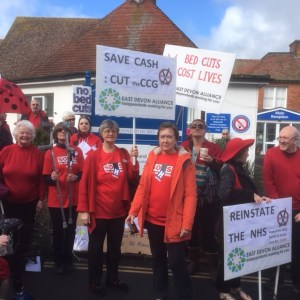
“Ottery St Mary people (and from wider afield turned out in force this afternoon to hold the Red Line against any further risk to our hospital and its very building.
We were one of 13 such events across Devon – all residents involved are fighting for their own local hospitals.
Thank you to around 150 determined people who turned up in the pouring rain.
Ottery Hospital lost its general medical beds in 2015 and the stroke unit will transfer to the RD&E imminently.
The message from the CCG was that it would become a health hub. Then it was it “could” become a health hub, nowadays there are little or no assurances from the CCG as to the hospital’s future.
And the wolf is peering in the window…. NHS Property Services has acquired the building for free (and 11 others across Eastern Devon) and is charging commercial rent to a cash-strapped local NHS, who previously owned it!
I am personally disappointed that we were asked to move twice by staff (presumably acting from orders on high) on the basis we were causing an obstruction. Yet I had already cleared our event with Ottery’s senior GP, Dr Simon Kerr who was quite happy about us being there.
Of course we would have moved if a car or ambulance had arrived. One vehicle did during the course of the 45 minutes or so we were present and people moved accordingly.
I felt sorry for police community support officer, Maria Clapp who was having to enforce us moving around as many people, understandably, were not happy about it!
Aside from these frustrating interruptions and my speech getting soggy in the rain and then getting stuck to my foot, it was a great event and thoroughly enjoyable.
I was using my brand new megaphone, which was great fun!
The thing that always happens at these sort of protest events is that a sense of solidarity, energy, shared purpose and iron is created. NO ONE will take any more services away from Ottery Hospital, NOR will it be sold off to the highest bidder by NHS Property Services.
I think we all went away feeling absolutely determined that we will do everything we can to prevent this from happening.
Thank you to EDDC Cllr Peter Faithfull for these excellent photos and thank you to retired Ottery GP, Dr Graham Ward, who urged people to come forward with ideas for the use of the building into the future.
Here’s the call to action at the end of my speech…
1. Write to Hugo Swire MP asking that he takes up Ottery’s case with the CCG and the govt
2. Write to local newspapers – letter for publication to Ottery Herald and Pulmans View From
3. Write to CCG – Chair is Tim Burke
4. Write to chair of DCC health and wellbeing scrutiny cttee after May elections
5. IMPORTANT POINT – Make all your letters public by sending to local press for publication!
Ottery Hospital is OURS. While the beds have gone for now. I live in hope that one day that common sense will prevail and they will be returned one day.”
Until that day we must fight to retain our hospital.”
http://www.claire-wright.org/index.php/post/holding_the_red_line_at_ottery_hospital
Anyone want to check Alison Hernandez expense forms for 2015 MP election?
Here they are:
BBC reports red line protests – in a downbeat sort of way
Honiton’s red line

Sidmouth “red line” Save our Hospitals pics – Tory councillors conspicuous by their absence
Spot the Independent East Devon Alliance councillors: easy
Spot Tory councillors – impossible!

Exmouth Regeneration “Business Forum” (2) – the rules!
“The voting membership of the Board may invite additional non-voting members as detailed above to join the Board as they deem appropriate. The may also remove non-voting members from the Board as they deem appropriate.
Eligibility for non-voting membership of the Board will be subject to a protocol that ensures that members are fit and proper persons eg covering matters of criminal record, bankruptcy, not being subject to planning enforcement etc.
To assist the Board they may invite any individuals with particular expertise (including other elected Members) and/or representatives of organisations to attend.
Officers of the District Council, County Council and the Exmouth Town Clerk will attend in an advisory capacity only. The District Council will provide the secretariat service for the Board.”
Click to access combinedcabagenda050417publicversion.pdf
“Fit and proper persons” … fit for what and proper for what?
Exmouth Regeneration Board: an East Devon Business Forum clone?
“Board Structure
Voting Members
EDDC Portfolio Holder for Economy (who shall be the Chair)
EDDC Portfolio Holder for Sustainable Homes and Communities (Vice Chair)
EDDC Exmouth Champion
EDDC Tourism Champion
2 x Devon County Councillor (one who shall represent Exmouth)
2 x Exmouth Town Councillor
And then one representative from each of;
Clinton Devon Estates
Exmouth Chamber of Commerce
Exmouth Licensed Victuallers Association
Exmouth Community Organisations Liaison Panel
Exe Estuary Partnership representative
Non-Voting Members
Alderman Tim Wood
And then one representative from each of;
Neighbourhood Plan Steering Group representative
Leisure East Devon representative
Exmouth tourism business (eg holiday accommodation)
Food and drink business (eg restaurateur)
Exmouth landowner
Exmouth commercial developer”
Click to access combinedcabagenda050417publicversion.pdf
page 89
SO reminiscent of the East Devon Business Forum!!!
And why Clinton Devon Estates when EDDC bought out their restrictive covenant on the site? What exactly is their interest?
Why a licensed victualler – don’t we have enough of them at EDDC already!
Alderman Tim Woods – don’t go there, Owl. So reminiscent of … no, no, no do NOT go there!
All the usual suspects, many of whom have, or will have, vested interests in the final outcome. No-one with REAL scrutiny teeth.
Peter Halse as Chairman!!!
Same old … same old … same Old Boys …
Another £225,000 demanded to fund £9 million relocation cost
Owl says: no austerity cuts for our councillors – and, no, this is NOT an April Fool joke – unfortunately.
“The Deputy Chief Executive – Development, Regeneration and Partnerships is delegated authority, in consultation with the Office Accommodation Executive Group, to commence works and deliver the new HQ building.
A budget is agreed of £8,692,000 to provide a new HQ building at Honiton Heathpark, which when added to the approved Exmouth Town Hall refurbishment budget of £1,669,000 gives a total gross budget of £10,361,000.
If Cabinet agrees that it wishes to relocate to a new HQ in Honiton then Cabinet is asked whether it wishes to recommend approval of a further sum of £225,000 to fund the addition of a direct access road to the new HQ building past the East Devon Business Centre This is a more direct approach to the building rather than bringing traffic through the Heathpark business park south of the building and does not affect the conclusions in this report in relation to viability and ranking of options for the sale of the Knowle site.”
This is what our NHS taxes pay for … and trying to bamboozle us with
“NHS managers diagnosed with a rampant case of jargon
The NHS is riddled with jargon and gobbledygook and may even be using impenetrable language on purpose to hide plans from the public, the Plain English Campaign has warned.
“Sustainability and transformation plans” (STPs) that divide England into 44 “footprints” and make promises such as “system-wide quality improvements” as a consequence of “shared understanding of all the interrelated issues” was one example highlighted by the campaign. Steve Jenner, its spokesman, said: “If you use impenetrable language it means the public has no clue what is going on. I can’t help thinking that suits the NHS sometimes.
“What this jargon is describing is very important. It should be articulated very clearly. We expect doctors to clearly explain themselves. It should be the same for the NHS management.”
Health service bosses have been told to draw up STPs for their areas to show how they can save money and improve services. Many of the plans involve hospital or service closures and have drawn widespread opposition. But despite the importance of STPs, some officials have started referring to them as “sticky toffee puddings”, the BBC reported.
The campaign said that jargon terms were “an inevitable sign of trouble” and that references to “reconfiguring” were “suitably vague enough to hide all manner of potential changes”.
It added: “We all know what it means when think tank representatives and planners talk above, over and behind the backs of those whose lives they are meddling with.
“Simply put, it’s to keep those that might have concerns and justifiable complaints out of a debate. In this case, that’s completely unacceptable.”
Last year, NHS England ordered hospitals to stop referring to being at “red alert” or “black alert” as a result of winter pressures.
Instead, hospitals that were so busy that they had to cancel non-emergency operations, call in extra staff and divert ambulances — previously a black alert — were at “operational pressures escalation level four”.
The level down — formerly a red alert — is now “operational pressures escalation level three”.
Source: Times (paywall)
Complete list of school funding cuts in Devon – Exmouth Community College worst hit in whole county
13th police force sends electoral fraud information to Crown Prosecution Service
“Another police force has sent a file on alleged Tory election fraud to prosecutors, it was revealed today.
The Crown Prosecution Service confirmed that it had received a file from West Midlands Police – the 13th police to do so in recent weeks.”
http://www.mirror.co.uk/news/politics/west-midlands-police-become-13th-10111188
“… That is the sort of thing which can not only destroy a government in the eyes of voters, it can wreck the party’s long-term standing too. Any serious prediction about the future has to factor in the possibility that there will be an even more destructive swamping with sleaze stories of Theresa May’s government than happened to John Major. That not only helped bring down a Prime Minister, it helped ensure his party failed to win an overall majority at the next four general elections in a row.
The odds of this happening are certainly a good way short of certain. But they are also far higher than the zero which so many pieces of coverage about how high the Conservatives are riding imply. … “
http://www.markpack.org.uk/148939/west-midlands-police-conservative-election-expenses/
But you can be almost certain that no action will be taken until after the county council elections …
Time to sort out your placards for Saturday’s hospital red lines!

Swire and Parish: do you have yours ready?
A warning for “Greater Exeter” as London council backs out of 3- council agreement due to lack of transparency and conflicts of interest
“The high-profile Tri-borough shared service arrangements are to set to come to an end with Westminster City Council and the Royal Borough of Kensington and Chelsea deciding to serve notice.
Westminster and Kensington & Chelsea said they had “reluctantly” taken the decision “in the face of uncertainty caused by.… Hammersmith & Fulham appearing to make alternative in-house plans without any formal engagement with the other two local authority partners about key services”.
The two authorities claimed this was causing anxiety to shared staff and placing potential risks to the joint services for vulnerable people in each borough.
In response the Leader of Hammersmith & Fulham, Cllr Stephen Cowan, said the council had had concerns about the value of Tri-borough and conflicts of interest.
Westminster and Kensington & Chelsea’s decisions will terminate the shared staffing arrangements in respect of Tri-borough Children’s Services, Tri-borough Adult Social Care and Tri-borough Public Health Services.
According to a paper on the Westminster website, the decision was urgent “because the tri-borough agreements require a year’s notice to terminate the shared arrangements; and ideally any new arrangements need to be in place before the next financial year beginning April 2018; and as soon as possible so that staff can be clearer about their future options”.
Westminster and Kensington & Chelsea said they were determined to continue to work together. They also maintained that the Tri-borough project, which was established in June 2011, had improved services and realised £43m in savings.
The two authorities stressed that Tri-borough’s legal agreements “set out that with any termination of the arrangements all parties are obliged to minimise disruption to delivery of services and to staff during the period of notice”. They called for a joint project team with Hammersmith & Fulham to oversee the transition.
The Leader of Westminster City Council, Cllr Nickie Aiken, said: “We would not have chosen to end the Tri-borough arrangements which we believe have been a great success. When it was established in 2011 it was quite rightly lauded as an innovation in local authority service delivery.
“However, both the Leader of Kensington and Chelsea and I feel we are unable to continue with tri-borough when we have a partner that we do not believe is committed to it as we are and appears to be making their own plans to leave, without any formal discussions. We can’t have that uncertainty for staff and these vital services which is why, with much regret, we have taken the very reluctant decision to terminate the joint arrangements for children’s services, adult social care and public health.”
Cllr Aiken added: “We are confident that the future remains stable and positive for the continued sharing of services between Westminster and Kensington and Chelsea and our door remains firmly open should Hammersmith & Fulham wish to come and discuss a review of the current arrangements and find alternative ways of working together.”
Hammersmith & Fulham’s Cowan said: “We’ve had concerns for some time about the value of the ‘Tri-borough’, its lack of transparency and its built-in conflicts of interest.
“In our last two budgets, Hammersmith & Fulham Council found £31m in savings but the ‘Tri-borough’ contributed no more than £200,000 of that, less than 1%.”
Cllr Cowan claimed that problems with Tri-borough contracts had cost Hammersmith & Fulham more than £5m, including a contract for special needs transport that he argued had put its disabled children at risk.
He added that “senior Tri-borough officers have had to balance Hammersmith & Fulham’s determination to keep Charing Cross Hospital open with Westminster and Kensington & Chelsea’s support for closing it.”
Cllr Cowan said: “Triggering withdrawal is evidently a long-planned move by the two councils. I look forward to having sensible discussions with them about how we can all move on in the best way for our residents.”
“NHS bosses ‘spent half of extra Autumn Statement cash on outside services’ “
“About half of a £2bn cash boost from the 2014 Autumn Statement for frontline health services in England was spent outside the NHS, research has found.
The Health Foundation analysis for the Financial Times showed £901m was spent on buying services from private and non-NHS providers in 2015/16.
It said £800m was spent buying the same kind of care from NHS trusts.
The government said it showed the NHS was “making clinical judgments about delivering high-quality care.
Ex-chancellor George Osborne said in his final Autumn Statement before the 2015 general election that the money for NHS England was a “down payment” on a plan drawn up by NHS bosses, which called for an extra £8bn a year above inflation by 2020.
‘Diverted’ patients
The Health Foundation report also found that £1 in every £8 of local commissioner’s budgets in England is spent on care provided by non-NHS organisations.
Anita Charlesworth, director of research and economics at the Health Foundation, said: “Rising demand for emergency care meant that NHS providers haven’t had the capacity to deliver planned care and patients had to be diverted outside the NHS.
“NHS hospitals were left squeezed by sharply rising drug and staff costs with little additional funding.
“The result was big deficits that had to be covered by raids on investment budgets.”
She said the NHS had to “urgently” consider how to ensure additional funds reach NHS providers.
“The health service needs to plan better for emergency demand, fund emergency care fairly and make sure it gets the best possible price for care provided outside the NHS,” she said.
The Department of Health said it spends less than 10% of its budget on independent providers.
A spokesman said: “This report simply shows the NHS is making clinical judgments about delivering high-quality care for patients.
“The truth is that for many years the independent sector has made a contribution to helping the NHS meet demand, now amounting to less than eight pence in every pound the NHS spends.”
Surprise! Government says one thing and does exactly the opposite – this time rural pharmacies
“Ministers are planning to allow hundreds of rural chemists to close across the country despite repeated assurances to MPs this would not happen, The Telegraph can disclose.
In private letters to Theresa May, last August Philip Hammond and Jeremy Hunt warned that pharmacies would have to close because of the cut in a subsidy worth hundreds of millions of pounds a year to the hard-pressed pharmacies.
The Cabinet ministers’ warnings appear to be at odds with ministers’ repeated public claims in Parliament and in official documents that no closures are likely.
They also appear to confirm that Mrs May is concerned about the plans and had to seek reassurances from Mr Hammond, the Chancellor, and Mr Hunt, the Health secretary.
Campaigners said the letters amounted to a “smoking gun” which laid bare the Government’s indifference to saving rural pharmacies. …
… According to letters disclosed in a High Court challenge to the plans, and seen by The Telegraph, Mr Hammond and Mr Hunt warned that the cut will result in the closure of pharmacies.
Mr Hunt told Mrs May on August 2 the cut would mean that “500-900 pharmacies will close”, in a letter that was copied to Mr Hammond.
Mr Hunt said: “We cannot know exactly how individual pharmacies will be affected by the funding reductions and there is a risk that some pharmacies may close as a result of these changes, although this has never been our objective.”
Mr Hammond went further in a second letter on August 11, telling Mrs May he supported the subsidy cut to what he described as an “inefficient and over-subsidised market” to move chemists “away away from the traditional bricks-and-mortar business model”.
He told the Prime Minister: “Longer-term I would like the community pharmacy market to follow trends we have witnessed in other retail markets.
“This might include a shift away from the traditional bricks-and-mortar business model towards scaled-up, innovative supply solutions employing digital technology, where Government expenditure is minimised.”
The Government announced revised plans in October that increased the number of chemists that can access a special fund from 900 to 1,300, only half as many as the up to 900 that Mr Hunt expected to close.
Weeks later Pharmacies minister David Mowat told MPs three times that no closures were likely. He told MPs on October 17: “We do not believe that community pharmacies will necessarily close as a result of these cuts.”
The department’s own impact assessment was based on a scenario “a scenario where no pharmacy closes” as a result of the cut.
Labour’s shadow health secretary Jonathan Ashworth said Mr Hunt should explain to MPs “why he was saying one thing to the Prime Minister while Mr Mowat was telling the House of Commons something different”.
He said: “Someone in Government needs to get a grip and clarify the future of these hundreds of community pharmacies, the staff who work in them, and the patients who depend upon their services.” …”
Transparency for developer viability appraisals must be published
Owl says: EDDC makes it seem that THEY decided these appraisals should be made public – but government directives, fights with the Information Commissioner and case-law have meant that they really have no option on this!
“Confidentiality
6.28 There is a strong public interest in financial viability appraisals being made available for scrutiny when relied upon to secure planning permission and, for this reason, the council will make this information publicly available.
We consider that transparency is extremely important and the public benefit of publishing all aspects of a viability appraisal will generally outweigh any potential commercial harm to the applicant.
If an applicant feels that some or all of the information should be kept confidential, then it will be necessary for the applicant to show how disclosure of that information would cause specific harm (in this context this means that ‘it is more probable than not that some harm would be caused’ – it will not be sufficient to say it might cause harm) to a legitimate economic interest.
Applicants will need to identify to the Council what the economic interest is and how specific harm would be caused to it when the viability information is provided. This view will be taken into account, and balanced against the wider public interest in disclosure, when the council makes its decision about the publication of the viability appraisal.
Click to access 290317-combined-strategic-planning-agenda-compressed.pdf
page 107
Another broken Tory manifesto promise: starter homes
“The Tories have quietly ditched their manifesto pledge to build 200,000 starter homes.
The party promised to build the homes five times in their 2015 manifesto.
The manifesto promised the Tories, if elected, would “build 200,000 new Starter Homes – 20% below the market price, for first time buyers under 40.”
Later it pledged they would: “Build more homes that people can afford, including 200,000 new Starter Homes exclusively for first-time buyers under 40.”
It went on to say that at the 200,000 figure was a “clear objective” and was at the “heart” of the party’s housing plan.”
Now THAT’S how you do spin!

