“Windsor council calls for removal of homeless people before royal wedding”

“The leader of the Royal Borough of Windsor and Maidenhead – home to Windsor Castle, Eton College and Ascot racecourse – has demanded police use legal powers to clear the area of homeless people before the royal wedding in May.

Simon Dudley, the council’s Conservative leader, wrote to Thames Valley police this week seeking action against “aggressive begging and intimidation” and “bags and detritus” accumulating on the streets.

The letter, seen by the Guardian, follows a series of tweets sent by Dudley while on a skiing holiday in Wyoming over Christmas, in which he referred to “an epidemic of rough sleeping and vagrancy in Windsor” and said “residents have had enough of this exploitation of residents and 6 million tourists pa [per annum]”.

He tweeted that he would write to Thames Valley police “asking them to focus on dealing with this before the #RoyalWedding”. …”

https://www.theguardian.com/society/2018/jan/03/windsor-council-calls-removal-homeless-people-before-royal-wedding

“Tories drop two flagship housing policies from key strategy document”

“Two of the Conservatives’ flagship housing policies have been dropped from a key government document, raising questions about the future of the plans.

The new “single departmental plan” published by the Department for Communities and Local Government (DCLG) does not include a single reference to Starter Homes, which form a central plank of the Government’s commitment to increase home ownership, or of the planned extension of Right to Buy.

…In the latest version, five specific pledges to boost home ownership, including delivering Starter Homes and the extension of Right to Buy, have been downgraded to a single-line promise to “increase home ownership through schemes including Help to Buy”.

… Furthermore, a specific commitment to “increasing home ownership” has been absorbed into the broader aim of fixing “the broken housing market”.

… Ministers had promised to build 200,000 of them by 2020 but The Independent revealed last month that not a single Starter Home has yet been built. This led to officials admitting the policy remained an “ambition” – but have now removed all mention of it from DCLG’s housing objectives.

The previous iteration of the departmental plan included a clear commitment to the policy. It said: “We are delivering a major boost to affordable home ownership with Starter Homes and extending Right to Buy to housing association tenants.”

It reiterated a pledge to build 200,000 Starter Homes, including 30,000 on brownfield land – former industrial sites earmarked for development.

Labour said the omissions in the new document showed the Government had “given up” on helping first-time buyers.

John Healey, the party’s Shadow Housing Secretary, said: “With home ownership at a 30-year low and the number of younger homeowners in free fall, the Government has now given up on first-time buyers.

“We need much more affordable housing for younger people looking to buy their first home but ministers have erased new housing for first-time buyers from the Communities Department’s official objectives. …”

http://www.independent.co.uk/news/uk/politics/government-housing-policy-starter-homes-right-to-buy-housing-association-sajid-javid-tories-a8119266.html

Obscene Persimmon bonuses – add nearly £41,000 to cost of each house

Guardian Letters:

What do management bonuses mean to the average customer? Persimmon’s CEO will receive a bonus of £110m. Senior staff bonuses will exceed £500m. Persimmon builds approximately 15,000 houses a year. Arguably, therefore, the CEO’s bonus adds at least £7,333 to the price of a house and the senior staff bonuses add £33,333. It is unlikely that the customer would think it money well spent.”
Martin Jeffree

AND

“Surely the housebuilding company Persimmon can now afford to run its own help-to-buy scheme.”
David Simpson

“Theresa May Says Just Because Children Are Homeless It Does Not Mean They Live On The Street”

Theresa May has defended the government’s record on homelessness by arguing that just because there are thousands of homeless children it does not necessarily mean they have to sleep on the streets.

Labour MP Rosena Allin-Khan said 2,500 children would wake up homeless in Wandsworth, south London, on Christmas Day. “When will this austerity driven government say enough is enough and put an and end to this tragedy?” she said during prime minister’s questions on Wednesday. …

… This morning the Commons Public Accounts Committee accused the government of being “unacceptably complacent” after an investigation revealed as many as 9,100 people are sleeping rough on the streets of the UK every night.

More than 78,000 households, including over 120,000 children, are classed as homeless and housed in often substandard temporary accommodation.

According to evidence gathered by the cross-party committee, the average rough sleeper dies before the age of 50, and children in long-term temporary accommodation miss far more schooling than their peers.

Homelessness has been steadily rising since 2010, with the number of households in temporary accommodation skyrocketing by more than 60%.

Since March 2011, the number of people who sleep rough has risen by 134%. …”

http://www.huffingtonpost.co.uk/entry/theresa-may-says-just-because-children-are-homeless-it-does-not-mean-they-are-living-on-the-street_uk_5a3a5b1fe4b0b0e5a79e872f

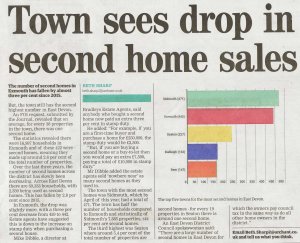
Exmouth sees drop in second home sales

“The number of second homes in Exmouth has fallen by almost three per cent since 2015. But, the town still has the second highest number in East Devon.

An FOI request, submitted by the Journal, revealed that on average, for every 38 properties in the town, there was one second home.

The statistics revealed there were 16,987 households in Exmouth and of these 422 were second homes, meaning they made up around 2.6 per cent of the total number of properties.

Over the last three years, the number of second homes across the district has slowly been decreasing. Across East Devon there are 69,333 households, with 2,339 being used as second homes. This has fallen by 2.8 per cent since 2015.

In Exmouth, the drop was slightly more, with a three per cent decrease from 459 to 442. Estate agents have suggested this is down to the increase on stamp duty when purchasing a second house. Mike Dibble, a director Bradleys Estate Agents, said anybody who bought a second home now paid an extra three per cent in stamp duty. He added: “For example, if you are a first-time buyer and purchase a home for £250,000, the stamp duty would be £2,500.
“But, if you are buying a second home or a buy-to-let then you would pay an extra £7,500, paying a total of £10,000 in stamp duty”.

Mr Dibble added the estate agents sold ‘nowhere near’ as many second homes as they used to.

The town with the most second homes was Sidmouth, which by April of this year, had a total of 471. The town has half the number of households compared to Exmouth and statistically, of Sidmouth’s 7,885 properties, six per cent are second homes.

The third highest was Seaton where around 5.4 per cent of the total number of properties are second homes – for every 19 properties in Seaton there is around one second home.

An East Devon District Council spokeswoman said: “There are a large number of second homes in East Devon for which the owners pay council tax in the same way as do all other home owners in the district.”

Source:
Journal 14 December 2017

The original article:

“London Mayor refuses permission for major scheme over loss of affordable homes”

Well, what do you know, developers don’t have to get their own way – at least in London!

“The Mayor of London has refused permission for an estate regeneration project in Barnet which he said would result in the net loss of 257 affordable homes.

Sadiq Khan described the scheme as “a classic example of how not to do estate regeneration”.

His decision related to a scheme to redevelop the Grahame Park estate in Colindale. This included plans to demolish 692 homes currently available at social rent and replace them with 435.

The planning application was approved by Barnet Council last month.
The Mayor said he had told the council it must replace the lost affordable homes.

The application was also deemed unacceptable because it failed to provide a minimum of £840,000 to deliver additional bus capacity and suitable alternatives to private car use.

Khan said: “I fully support improving social housing on this estate and across the capital, but this scheme falls far short of what I expect of London boroughs.

“As I have made clear in my new London Plan, estate regeneration projects must replace homes which are based on social rent levels on a like-for-like basis. Londoners so urgently need more high-quality housing, not less, which makes this scheme completely unacceptable in its current form.

“I have asked Barnet Council to work constructively with the applicant on alternative plans with greater density, which do not result in the net loss of affordable homes. Given its recent record in this area, I hope the council recognises the need to replace what would be lost at Grahame Park.”
A Barnet Council spokesperson said: “We are clearly disappointed by this decision. We will now be reviewing this with our development partner to agree the next steps.”

http://localgovernmentlawyer.co.uk/index.php?option=com_content&view=article&id=33637%3Alondon-mayor-refuses-permission-for-major-scheme-over-loss-of-affordable-homes&catid=62&Itemid=30

“Second-home owners face 500% tax rise in the Yorkshire Dales”

“Second-home owners in the Yorkshire Dales could see council tax on their properties rise five-fold after a landmark vote.

Members of the Yorkshire Dales National Park Authority have backed an initiative designed to “halt and then reverse” the decline in numbers of young people in the region.

The move follows concern from residents that the number of second homes has contributed to younger people leaving the area, schools closing and a loss of services, thus creating “hollowed out communities”.

There are about 1,500 second homes in the Dales, representing more than 10 per cent of the total housing stock. Last night members of the park authority voted by 12 votes to nine in favour of working with local councils to develop a specific proposal on second homes.

A figure of at least five times the present rate of council tax has been mooted for second-home owners, equating to an annual tax bill of £8,500 for a band D property. The proposals would not apply to holiday lets.

The national park’s constituent local authorities will consider the proposals in the new year. If they all back the scheme a fully developed proposition to attract more young people and families will be put to central government.

Carl Lis, chairman of the park authority, said that the verdict “demonstrates that we are not prepared to sit idly by and watch Dales communities slow decline”.

He said that while unemployment in the national park “barely exists”, employers “cannot afford to pay the sort of wages you need to buy a home in the Dales” because their prices have been so inflated by the second-homes market.

“A lot of effort is going in to getting new affordable homes built, but it is being cancelled out by the number of homes going into second-home ownership. Any initiative to attract and retain families in the park which did not at least try to address the negative impacts of second homes would be like ignoring the elephant in the room.”

He added that he recognised that the proposals were controversial and that second-home owners did help to contribute to the local economy, but said that permanent residents would contribute much more.

Richard Foster, a member of the park authority and leader of Craven district council, went public with the second-homes proposal last month. He said: “I hope we might have pricked the social consciences of those who leave their properties in the Dales empty for most of the year, but our central concern is not about them, it is about the viability of local communities.”

Yvonne Peacock, another member of the park authority, said: “A few years ago there were 70 children on the roll of the school in Bainbridge where I live — now the number is 25. There are simply too many second homes.”

Source: The Times (pay wall)

“Tenants lose out after landlord pressure halves UK home insulation cap”

“Tenants face missing out on energy bill savings after the government caved in to landlords’ demands by lowering a cap on the costs they face to upgrade Britain’s draughtiest homes.

Landlords must improve the energy efficiency of F- and G-rated homes from next April under new regulations designed to protect vulnerable tenants and cut carbon emissions.

But on Tuesday the government said the costs of the upgrade would be capped at £2,500, half what officials had originally told buy-to-let landlords to expect. The total energy bill savings is put at £337m.

The government’s own assessment warned that the lower cap means only 139,200 households in England and Wales will benefit from better insulation by April 2020. That is 121,000 fewer than if the cap was at £5,000.

Campaigners and industry groups said the change left ministers’ ambitions of tackling fuel poverty in tatters.

“This could leave a gaping hole in the government’s plans to meet its own fuel poverty targets,” said Richard Twinn, policy adviser at the UK Green Building Council.

The Association for Conservation of Energy said the government had “missed a big opportunity” to improve the efficiency of thousands of homes.

Officials said the lower cap was necessary to protect owners by ensuring “that landlords of F and G rated private rented properties are not faced with an excessive cost burden”.

The government also said the changes were necessary because landlords’ access to finance for energy-saving measures had become harder since the policy was first proposed.

One green energy charity accused Theresa May of putting landlords’ interests ahead of tenants. Max Wakefield, a campaigner at 10:10 Climate Action, said: “The prime minister claims to be prioritising controlling domestic energy costs, but in reality policy is being designed to suit landlords. …”

“Hundreds of thousands of renters will now be left wondering when, if ever, they can expect to live in a decent home.”

But the National Landlords Association was not happy either, calling the proposal a “complete farce”. It said there was a risk landlords who still could not afford the upgrades would leave properties empty and unimproved. …”

https://www.theguardian.com/money/2017/dec/19/tenants-lose-out-landlord-pressure-halves-uk-home-insulation-cap

“Should we tax housebuilders more heavily than other companies?”

Owl says:

Would it happen? Could it happen? In your dreams!

Housebuilders are amongst the biggest donors to the Tory party and David Cameron let them write their own rules within days of becoming PM. Theresa May has talked about fairness in housing but has done NOTHING.

“Much of housebuilders’ success is the result of state policy.

I’ve never been a fan of windfall taxes, but I am feeling a bit more of one this week.

We have written in the magazine frequently about how much we hate the government’s Help to Buy scheme because of the way it exacerbates the original problem – high house prices. It’s a bad fiscal policy piled on a bad monetary policy.

More recently, we have raged about the effect of this on the housebuilders: for years they have been making verging on obscene amounts of money out of exploiting the scheme. They have also been paying much of that money out to their executives, thanks to badly constructed compensation schemes.

You can try and explain or justify this as much as you like but the truth is that one of the worst effects of Help to Buy has been a whopping transfer of wealth from the taxpayer to the top men at house building firms. There is evidence aplenty of this .

Look to the news this weekend that the chairman of one of the UK’s biggest building firms, Persimmon, has resigned over his role in creating one of the most repulsive bonus schemes of all time, one which is set to pay its top three executives £200m and another 137 managers around another £600m. None of these people started the business. None of them risked their own capital.

Half of Persimmon sales are backed by Help to Buy. When Help to Buy was launched, Persimmon’s market capitalisation was £2.5bn; now it is over £8bn.

There’s a lot to say here about bonus structures and executive pay (see many blogposts past). But there is something else to say about companies whose success is the result of state policy. If the government has been the main driver behind a firm’s profits, is the Treasury perhaps entitled to more than the standard rate of tax on those profits?

Or, to look at it from another direction, does the firm in question have a higher level of social obligation than other companies – in this case, perhaps, to be obliged to build more social housing than usual – or, given the dismal quality of UK new-build housing, to just build better housing than usual?”

https://moneyweek.com/should-we-tax-housebuilders-more-heavily-than-other-companies/

“£500,000 to get your first flat: A quarter of London homes bought by first-time buyers ‘worth half a million or more’ “

Remember, the “Help to Buy” scheme drops 20% of the purchase price of properties up to £600,000 into developers’ pockets and the government has just put an extra £10 billion into this scheme from other hoysing budgets.

The Help to Buy: Equity Loan can be used to purchase a new build property up to the value of £600,000, with a maximum equity loan of £120,000 (20%). In London, applicants are able to claim an equity loan up to 40% of the purchase price.

https://www.gov.uk/government/news/10-billion-new-funding-for-help-to-buy-equity-loan

“A record number of first time buyers must find at least £500,000 to get a foothold on the housing ladder in London, new research reveals today.

The dramatic surge in property values in the capital over the past decade is forcing young Londoners to raise vast sums that would have been unimaginable to their parents, it shows.

So far this year an unprecedented 25.9 per cent of the homes bought by debut buyers in London have been at or above the half a million pound mark, according to analysis of mortgage lending by agents Savills.

… The data, from trade body Finance UK, also shows that no mortgages at all were advanced to first time buyers for homes in the £125,000 to £175,000 bracket during the third quarter. It was the first time on record that this more affordable segment of the market has dried up altogether. …”

https://www.standard.co.uk/news/london/500000-to-get-your-first-flat-a-quarter-of-london-homes-bought-by-firsttime-buyers-worth-half-a-a3720361.html

How to stop developers using the “viability assessment” loophole to avoid building affordable housing

Excellent report on the current disgraceful situation and what needs to be done about it. Part of the conclusion of the 38 page report of November 2017 which should be required reading for all council planning officers:

“… On its own, Section 106 will never meet the country’s need for new affordable housing supply. But the current use and abuse of viability assessments means that we are getting less affordable housing out of private developments than we were before and during the crash, and certainly less than we could.

Flexibility in the viability system has driven down affordable housing provision at the expense of land price inflation, essentially making development more expensive.

By amending the National Planning Policy Framework and National Planning Practice Guidance to close the viability loophole, we can maximise developer contributions to affordable housing, with knock-on positive effects for overall housing supply, build out rates and community support for new housing.

The government is already consulting on the changes needed to turn affordable housing policies into cast iron pledges. It is now vital that they follow through on these plans.”

Click to access 2017.11.01_Slipping_through_the_loophole.pdf

PegasusLife’s second attempt to demolish New Forest heritage property thwarted

Just one note: where PegasusLife bemoans the fact that they are being prevented from building “housing for older people” it should in Owl’s opinion read: “housing for very, very rich old people”.

A grudging offer of 15 “affordable homes” in the second application should be seen for what it is – an attempt to get their own way by any possible means with as little outlay as possible. Owl imagines – as is usual in these circumstances – that there would eventually be a “viability assessment” that rendered the affordable homes “uneconomic” after construction of the non-affordable properties was well underway.

As an aside: isn’t it time these so-called “viability assessments” were banned by the government and developers forced to sink or swim on their original costings? Imagine buying a house and, just before exchange of contracts, the buyer says: “Sorry, I’ve done a viability assessment of my (unchanged or even improved ) finances and you will have to accept a cut of 30% of the agreed price – and the seller being forced to accept!

“Sir Arthur Conan Doyle’s only surviving building has been saved by a campaign run by heritage experts.

The legendary author is best known for creating the world’s most famous fictional detective Sherlock Holmes, but Conan Doyle also designed houses and even a golf course.

After the fiction writer stayed at the Lyndhurst Park Hotel in March 1912, he sketched designs for a third storey extension and redesigned the front of the building.

The hotel sits in the heart of the pretty New Forest, Hants, just miles from his home, and though it has been vacant since 2014 the building is considered ‘highly historically significant’ thanks to his designs.

A controversial application to demolish the property and replace it with flats and affordable homes threatened the site and heritage charity The Victorian Society stepped in to criticise the plans.

Conan Doyle was a regular at the hotel in the late 19th and early 20th century.

The building was originally built as an early 19th century mansion known as ‘Glasshayes House’ but was transformed into a hotel in 1895.

Conan Doyle, who lived in the New Forest’s Brook, was a regular at the hotel in the late 19th century and early 20th century.

By the autumn of 1912 it was given a major face-lift based on ideas submitted by the world famous writer after he visited with his family earlier that year.

He designed the entire third floor extension as well as the new facade and it is his only surviving building.

Property developers PegasusLife have now submitted two applications to bulldoze the site, with both being rejected.

Their first application to build 74 homes for the elderly was declined in December 2016, and their latest attempt to create 75 new houses has also been turned down.

The new application included plans to replace the hotel with 75 flats and 15 affordable homes.

In a report on the bid, the New Forest National Park Authority ‘little consideration’ had been given by the developers to the ‘very cramped’ development.

It said: ‘Little consideration has been given to integrating the affordable housing element within the scene as a whole.

‘It demonstrates a very cramped form of development set around a courtyard dominated by parking with little in the way of amenity space.’

Despite its historic significance, the building is unlisted and therefore unprotected. Conservationists The Victorian Society say it is of ‘paramount importance’ it is saved.

The fact that Glasshayes House is thought to be the last remaining building designed by Arthur Conan Doyle makes it unique, and therefore highly historically significant and certainly worthy of reassessment.

‘In addition, no justification has been submitted to support its complete demolition.’

Speaking when the application was made, Tom Taylor, from The Victorian Society, said: ‘It is now of paramount importance that the building be reconsidered for listing, as that would offer it valuable protection against demolition and insensitive redevelopment.

A spokesman added: [Conan Doyle’s] ambitious redesign transformed the building into what you see today, the building as it currently stands is a near perfect expression of Doyle’s plans.

‘Time is swiftly running out for Glasshayes House, and the risk that it may be lost forever to be replaced with a run-of-the-mill block of flats is becoming ever more real.’

In the planning application by property developers PegasusLife, it said the building is a heritage asset of ‘minor significance’.

PegasusLife planning director Guy Flintoft said the company was ‘disappointed’ with the decision to reject a second application to redevelop Lyndhurst Park Hotel.

He said: ‘We are disappointed with the National Park Authority’s decision.
‘The rejected application included 15 affordable homes, which we would have delivered with our partners at Sovereign Housing Association, a respected provider working in the area.

‘It is disheartening that the provision of housing for older people is so often disregarded.

‘It is disappointing that this amendment to our application has been largely ignored by campaigners – despite being raised by locals as a key reason for the original refusal earlier this year.

‘We will now take some time to consider our next steps.’ “

http://www.dailymail.co.uk/news/article-5180321/Sir-Arthur-Conan-Doyles-surviving-building-saved.html

“Families with stable jobs at risk of homelessness in Britain, report finds”

Homelessness is now a serious risk for working families with stable jobs who cannot find somewhere affordable to live after being evicted by private-sector landlords seeking higher rents, the local government ombudsman has warned.

Michael King said nurses, taxi drivers, hospitality staff and council workers were among those assisted by his office after being made homeless and placed in often squalid and unsafe temporary accommodation by local authorities.

“People are coming to us not because they have a ‘life crisis’ or a drug and alcohol problem, but because they are losing what they thought was a stable private-sector tenancy, being evicted and then being priced out of the [rental] market,” he said.

King said the common perception that homelessness was about people with chaotic lives who slept rough no longer held true. “Increasingly, [homeless people] are normal families who would not have expected to be in this situation,” he said.

The ombudsman’s report came as the latest quarterly homelessness statistics showed another year-on-year rise in the number of households classed as homeless. There are 79,150 homeless households in temporary housing, including 6,400 in bed and breakfast accommodation.

Homelessness of all kinds has increased for six consecutive years in England, prompting a highly critical National Audit Office report in September that said social security cuts and ministers’ failure to get a grip on a “visibly growing problem” was costing the taxpayer £1bn a year.

The homelessness charity Crisis said: “As social housing declines, welfare cuts bite and private renting costs soar, people who were less likely to become homeless in the past are now being pushed further to the brink of losing their homes.”

The ombudsman investigates individual complaints about public services and registered social care providers, and fines councils thousands of pounds when complaints are upheld. In 2016-17, the ombudsman received 450 complaints about council homelessness services, with 70% of those investigated upheld.

King was particularly critical of local authorities he had investigated that rehoused homeless families in damp, filthy and dangerous temporary homes. “You do not have to look to Victorian fiction to see totally Dickensian housing conditions,” he said.

“Dreadful” cases of homeless families being put up in substandard accommodation landed on his desk every week, he said. Examples include:

A couple with two young children who spent 26 weeks in a single room in a B&B. Although they reported that the shower did not work and the room was infested with cockroaches, the council failed to ensure repairs were made.

A mother whose baby had type 1 diabetes was placed in a dirty and unhygienic B&B room without access to cooking facilities. The baby contracted an infection and ended up in hospital. The hospital blamed the housing, saying the mother was unable to properly feed her baby.

A disabled single parent with four children was put up in B&B accommodation for nearly two and a half years after her benefits were capped. The council ignored letters from medical professionals outlining concerns that living in the property was affecting the family’s health.

Some councils routinely flouted homelessness law, with many placing homeless families with children in B&B rooms for longer than the legal six-week limit, a practice that had a “devastating impact” on many tenants’ lives, King said. The situation had deteriorated in the four years since the ombudsman last examined it. …”

Housing Viennese-style

Vienna effortlessly tops the world’s most liveable city surveys, and for good reason. Its citizens – 1.8 million at the last count – enjoy affordable public transport, abundant greenery and rents UK citizens could only dream of. In fact, acccommodation in Vienna is plentiful and cheap, making it one of the most affordable places to live.

In this compact city, dominated by four- and five-storey, walk-up mansion blocks, tenants have been known to snag flats with palace views, free heating and Alps mineral water on tap. More than 80% of residents rent, and two-thirds of Viennese citizens live in municipal or publicly subsidised housing.

Eight out of ten flats built in the city today are financed by Vienna’s housing subsidy scheme. This quality and range helps push down rental prices, meaning low-paid workers can afford to live in the Austrian capital, even in the city centre. They often live centrally and enjoy its cheap amenities, short commutes and, thanks to a sound economy, jobs – even when renting on the partially regulated private market. …

…Vienna spends more than €570m a year on subsidising, constructing and preserving public housing despite having a population nearly eight times smaller than the UK capital. Annual government funding for affordable housing in London, with a population of around 8.7m, is only around £500m, less than half the amount spent in 2009/10 and London’s mayor, Sadiq Khan, says this needs to increase to 2.7bn a year to prevent the housing crisis from getting worse. Vienna also wants to do more, last year committing to increasing annual housing production by 30% in order to meet demand.

… “It’s been so very important to be close to my working place and that is possible in Vienna (especially after the night shift),” says Hammer.

“Tenancy regulations are so important for living sanely, so, yes, I’m a big fan of rent controls and of Vienna. If I had to spend 79% of my income [on rent, like in London] then I think I’d have to leave Vienna because that’s insanely expensive,” she says.”

https://www.theguardian.com/society/2017/dec/12/vienna-housing-policy-uk-rent-controls

“Human rights commission to launch its own Grenfell fire inquiry”

Britain’s human rights watchdog is to launch an inquiry into the Grenfell Tower fire that will examine whether the government and the Royal Borough of Kensington and Chelsea failed in their duties to protect life and provide safe housing.

The dramatic intervention by the independent Equality and Human Rights Commission, which has the potential to draw damning conclusions about the role of the state, could foreshadow the official inquiry, ordered by Theresa May and chaired by retired judge Sir Martin Moore-Bick, which has been criticised for excluding social housing policy from its remit. The commission’s recommendations are due to be published in April, considerably earlier than the official inquiry’s full findings.

The commission’s chair, David Isaac, said the EHRC, whose application to become a core participant in the official inquiry was rejected, had decided to launch its own inquiry amid concerns that key questions – including the extent to which the state has “a duty to protect its citizens”– were being neglected. While acknowledging that the move might be seen as “controversial” in some quarters, he defended the commission’s decision to become involved.

Six months on, Grenfell Tower fire survivors are left demanding answers
“We are the UK’s national human rights body and we have a statutory duty to promote equality and human rights,” Isaac said in an interview with the Observer. “We think the human rights dimension to Grenfell Tower is absolutely fundamental and is currently overlooked. Grenfell for most people in this country, particularly in the way the government has reacted, is a pretty defining moment in terms of how inequality is perceived.”

He recalled his reaction to the tragic events of 14 June. “Like everybody else, it was shock, horror, distress. I think it was a national moment that defined how certain parts of society experience the state’s public provision of housing and also how the state responds. We need to learn from what’s happened with Grenfell, look at it in the context of our human rights obligations, and think about how we can improve. There are loads of lessons to be learned.”

Last week it emerged that four out of every five families who were made homeless in the fire are still looking for new housing, with almost half of them likely to spend Christmas in emergency accommodation.

The EHRC inquiry, which will involve a panel of legal experts, will pay particular attention to the UK’s obligations to the tower’s residents under the Human Rights Act and international law. At a time when some want the act scrapped, the inquiry’s actions could be viewed as provocative.

“Human rights are for everybody,” Isaac said. “This is political and I know there is a view among some politicians, but also among society more generally, that human rights only protect extremists and terrorists but that isn’t the case at all. I always talk about Hillsborough as a really good example of where the Human Rights Act and the human rights lens has been used effectively to ensure justice prevailed.”

In a statement to be published on its website tomorrow, explaining its decision to launch what it refers to as its “project”, the EHRC will say: “The Grenfell Tower fire caused catastrophic loss of life for which the state may have been responsible. More than 70 people died in homes managed by the state. They should have been safe and they were not. The people who died and others affected by the fire come from diverse backgrounds. They include children, elderly people, disabled people and migrants. …

… The commission’s decision to examine the Grenfell Tower fire reflects a more muscular approach to addressing human rights and equality issues. Recently it has brought a number of high-profile legal actions and launched several major inquiries, such as that into the gender pay gap.

Isaac said: “We are a more confident organisation and this is a good example of us being that – holding the government to account by doing what only we can do. It might be perceived to be controversial but I believe that’s our role.””

https://www.theguardian.com/uk-news/2017/dec/09/human-rights-commission-to-launch-own-grenfell-fire-inquiry

“The Guardian view on social housing: time to fight for affordable rents”

“ …On Friday the specialist journal Inside Housing published research that showed a new and significant factor behind the sharp rise in the numbers relying on emergency support.

The right to buy, first introduced in 1980, already abandoned in Scotland and soon in Wales, was successfully reinvigorated in England by David Cameron five years ago. It has been a boon to the buy-to-let market and a curse on councils that find themselves renting them back at hugely inflated cost.

Soaring house values have turned what should be a place to live into a golden asset. Former council properties have been snapped up by private landlords. In the most prosperous areas, up to 70% of former council homes are now privately let. Private rents out of London average over £200 a week while council rents are nearer £90 a week.

Councils in England have been sending up emergency flares for more than a year, trying to alert the government to their inability to build enough new homes to replace the ones they have been forced to sell, with predictable consequences.

In the last five years, since right-to-buy discounts were nearly doubled, 54,581 homes were sold and only 12,472 homes were started. Some are built in one authority from receipts of sales in another, compounding local shortages.

Councils have to use part of the receipts from sales to pay off housing debt, and can only keep a third for replacement. They are still banned from borrowing to make up the full cost of buying or building new ones. Between now and 2020, councils also face having to sell off higher-value council homes in order to fund discounts on housing association homes that are due to come in under right-to-buy provisions.

Like so much else that has happened since 2010, social housing policy has not just been damaging but contradictory, fostering the chimera of a property-owning democracy in an age of shrinking social housing stock and rapidly growing demand. The government makes bold promises on new affordable homes to buy. But what’s needed is homes that people can afford to rent.”

https://www.theguardian.com/commentisfree/2017/dec/08/the-guardian-view-on-social-housing-time-to-fight-for-affordable-rents

“Forty percent of homes sold under Right to Buy now in the hands of private landlords, new analysis reveals”

Scotland and Wales stopped these sales – it can be done, no excuses.

“Tens of thousands of council homes sold under the Right to Buy scheme, designed to help low-income families get on the housing ladder, are now being let out by private landlords, new research has revealed.

Just over 40 per cent of properties purchased under the controversial scheme are now being rented out privately – a rise of 7 per cent in the last two years alone.

As a result, properties sold off quickly become significantly more expensive than they were previously. The average private rent in England is £210 per week – more than double the £88 average social rent.

If the current trend continues, more than half of all Right to Buy homes will be rented privately by 2026, according to the research by Inside Housing magazine.

The analysis – based on figures from 111 councils, around two thirds of the total – shows that 180,260 leasehold properties were sold by local authorities since 1980. Of those almost 72,500 are now registered with an “away address”, suggesting they are being rented out privately.

The mass sell-off comes despite council house waiting lists currently standing at more than 10 years in some parts of the country, and a 97 per cent fall in new social homes being built since 2010.

Amid fears over the on-going impact of Right to Buy, the Scottish Government scrapped the policy in Scotland last year and on Tuesday the Welsh government voted to follow suit.

Critics say Right to Buy has led to a staggering loss of social homes because those sold off under the policy are not being replaced. According to Local Government Association analysis, just one new home is built for every five sold.

There are now just 2 million council homes left in Britain – down from 6.5 million when Right to Buy was introduced by Margaret Thatcher in 1980, although a number of factors are behind the fall.

Despite growing concern about the impact of the policy, last year the Conservatives controversially extended Right to Buy to properties owned by housing associations – meaning thousands more low-rent homes are likely to be sold off. …”

http://www.independent.co.uk/news/uk/politics/right-to-buy-homes-sold-private-landlords-latest-figures-rent-a8098126.html

Cranbrook: bad news for E.on? Regulator to investigate district heating networks

Residents of Cranbrook are stuck with E.on for 80 years unless things change as reported by Owl here in February 2017:

https://eastdevonwatch.org/2017/02/05/cranbrooks-district-heating-system-under-fire-no-switching-allowed-and-developers-get-a-cut-for-80-year-contract/

and here in 2016:
https://eastdevonwatch.org/2016/07/28/cranbrook-what-can-happen-when-you-are-tied-to-one-district-heating-energy-supplier/

“The UK’s competition regulator has announced that it is launching a comprehensive study into domestic heat networks to make sure that households are getting a good deal.

Competition and Markets Authority on Thursday said that heat networks – systems that heat multiple homes from one central source – currently supply about half a million UK homes through about 17,000 networks.

Between now and 2030, the number of customers using heat networks is expected to grow significantly to around 20 per cent of all households. But the sector is not currently subject to the same regulation as other forms of energy supply such as mains gas and electricity.

The CMA said that, as a result of that, it’s concerned that many customers, a large proportion of whom live in social housing, may be unable to easily switch suppliers or are locked into very long contracts – some for up to 25 years.

There’s a risk, the regulator said, that they may be paying too much or receiving a poor quality of service.

It said that its study into the networks would examine whether customers are aware of the costs of heat networks both before and after moving into a property and whether heat networks are natural monopolies. It would also look at the prices, service quality and reliability of heat networks.

“Heat networks can play an important role in cutting carbon and keeping down energy bills for customers. However, we have concerns that this sector may not be working as well as it could be for the half a million homes heated by these systems now and the millions that may be connected in the future,” said Andrea Coscelli, chief executive of the CMA.

“That is why we’re taking a closer look at this market to ensure that heat network customers get a good deal on their energy now and in the future.”

The CMA study will be completed within the next 12 months. It said that it would source evidence from a wide range of stakeholders, including heat network builders and operators, other government departments, local authorities, sector regulators and consumer groups.

An interim report updating on the CMA’s progress will be published in six months.

Heating networks can be better for the environment because they deliver lower carbon emissions, which can also result in cost benefits for households.

Because of this, heat networks have become an important part of the Government’s strategy to reduce carbon and cut heating bills.”

http://www.independent.co.uk/news/business/news/uk-domestic-heat-networks-review-competition-markets-authority-review-regulator-a8096396.html

The scandal of child and pensioner poverty

Almost 400,000 more UK children and 300,000 more pensioners plunged into poverty in past four years, new study finds.

Hundreds of thousands of children and older people have been plunged into poverty in the past four years, according to a stark analysis laying bare the challenge to families trying to keep up with the cost of living in Britain.

The research from the Joseph Rowntree Foundation (JRF) found almost 400,000 more children and 300,000 more pensioners in the UK were living in poverty last year compared with 2012-13, the first sustained increases in child and pensioner poverty for 20 years. The foundation warned that decades of progress were at risk of being unravelled amid weak wage growth and rising inflation.

The thinktank urged the government to unfreeze benefits, increase training for adult workers and to embark on a more ambitious house-building programme to provide affordable homes for struggling families. …”

https://www.theguardian.com/society/2017/dec/04/uk-government-warned-over-sharp-rise-children-pensioner-poverty-study