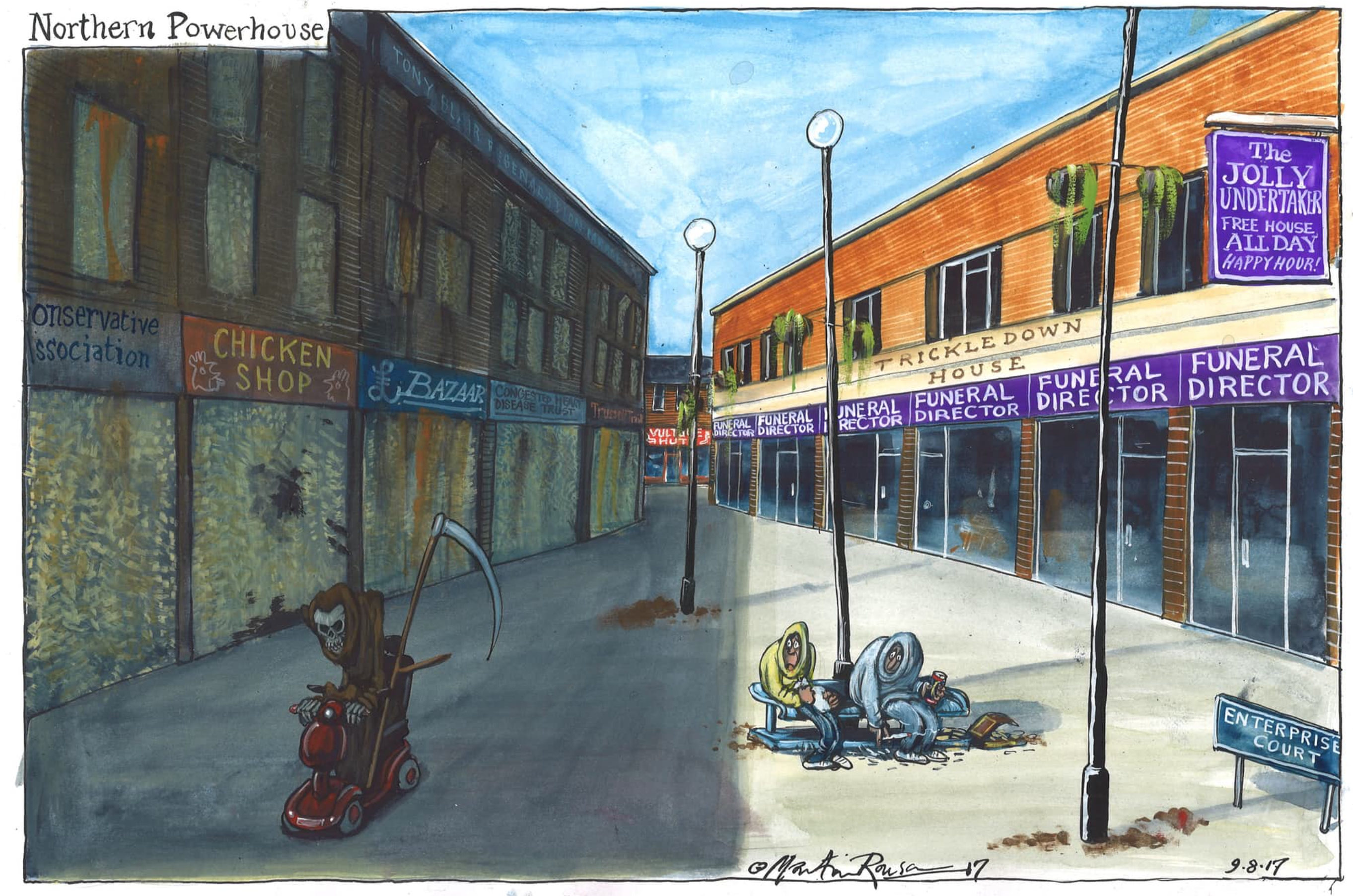
How to fritter away our money or close our hospitals – just because you can

Guardian letters – also has echoes of the DCC “scrutiny” meeting sabotaged by Sarah Randall Johnson and her Tory posse which beat down referral of Seaton and Honiton hospital bed closure to the Secretary of State with their sleight of hand, resulting in the total loss of all their beds in the next two weeks.

“The proposed garden bridge across the Thames was bound to fail as soon as Zac Goldsmith lost to Sadiq Khan, given that the project never had the support of a majority of the 25-member London assembly (Recriminations fly after garden bridge cancelled, 15 August).

The parties opposed to the scheme, with 16 members of the assembly between them, were one seat short of the two-thirds super majority required to stop Boris Johnson and George Osborne frittering the best part of £52m, which had the support of only nine Conservative members.

Ultimately, the origins of this fiasco lies with the Blairite fixation with experimenting with directly elected local potentates, rather than properly constituted English regional assemblies and the single transferable vote for local elections.

David Nowell
New Barnet, Hertfordshire

https://www.theguardian.com/uk-news/2017/aug/16/better-ways-to-spend-the-garden-bridge-cash

RIP Seaton and Honiton community hospitals – RIP some of their patients too?

by Barbara Worsley, Labour MP.

Most people who were rehabilitated in community hospitals will now be hostage to “care at home” and unable to access any other form of care – even residential and nursing homes.

“Seventy thousand older people with complex needs left to fend for themselves: Tory apathy on social care funding could turn a crisis into a catastrophe.

Despite evidence that life expectancy may be stagnating, the century-long rise should be a cause for celebration. However, for too many people – unsure whether they will be able to afford the care they may need or plan for the future – their later years are proving to be a time of fear and uncertainty.

Now we learn there will be insufficient care home places, even if people could afford them: 71,000 more care home beds will be required within eight years – according to a University of Newcastle study – to meet the demands of an ageing population living longer, with complex care needs. But there is little hope that these places will materialise.

Residential and nursing homes are already under unprecedented pressure. By the end of this financial year, £6.3bn will have been cut from social care budgets since 2010, with local authorities facing a £2.3bn care funding gap by 2020. These severe cuts, along with rising costs and problems of retaining and recruiting staff, mean that one in six care homes is now displaying signs of financial stress, and across England residential homes are closing.

And in the coming months, the signs are that things will get worse. The Association of Directors of Adult Social Services has reported that councils will have to cut social care budgets by a further £824m this financial year alone – meaning fewer older people getting the help they need with basic tasks such as washing, dressing and eating.

The Conservatives’ policy of cutting funding and leaving people to fend for themselves is simply not working. It has left us with 1.2 million older people living with unmet care needs, one in 10 facing catastrophic costs, and relatives forced to give up work to look after them. It has also left the Tory “dementia tax” alive and well – more than 70% of people in residential care, who face the highest care costs, have dementia.

If this apathy towards finding a solution for the social care crisis continues, there is a risk not only of insufficient care beds, but of serious care failures.

In Labour’s manifesto, we set out comprehensive plans to tackle the short-term funding gap in social care, promising £1bn this year and £8bn over this parliament to stabilise the sector. But we also recognised the need for a long-term funding solution to meet the needs of an ageing population. As Andrew Dilnot made clear, this must include pooling risks – so that no one is left to face catastrophic costs alone – and raising the means-test threshold, so that no one loses everything they own.

Enough is enough. This government has had ample wake-up calls. Now it must give social care the funding it needs and develop a long-term plan to put the sector on a sustainable footing – so that today’s generation of older people and those to come get the care they need and deserve.”

• Barbara Keeley, Labour MP for Worsley and Eccles South, is shadow minister for social care and mental health

https://www.theguardian.com/commentisfree/2017/aug/17/conservative-solution-unaffordable-care-crisis

“UK needs 71,000 more care home places in eight years, study predicts”

And no community hospitals for any of them who may get ill enough for hospital care before or after entering these homes (should they ever exist) in the eastern part of East Devon, where Seaton and Honiton hospitals close their community beds by the end of August.

Still, Sidmouth millionaire pensioners will be fine in their luxury “assisted care” home at the Knowle when the council moves to its posh new offices in Honiton.

“An extra 71,000 care home spaces are needed in the next eight years to cope with Britain’s soaring demand as people living longer face more health problems, a study has found.

New research predicts there will be an additional 353,000 older people with complex needs by 2025, requiring tens of thousands more beds.

The findings from a team of academics at Newcastle University, published in the Lancet medical journal, revealed that many people over the age of 65 are now living longer but with substantial care needs.

The number of people needing round-the-clock help to feed and dress themselves is predicted to rise by 163,000. For adults over 65 the number of years spent with substantial care needs has doubled between 1991 and 2011. …”

https://www.theguardian.com/society/2017/aug/15/uk-needs-71000-more-care-home-places-in-eight-years-study-predicts

Honiton fighting back on bed cuts

Since this article was written, it has been announced that all Honiton Hospital’s community beds will close on 28 Augusy 2017:

“A BAND of angry residents calling itself Honiton Patients Action Group says it plans to keep hospital beds in Honiton by taking direct action to stop the removal of ward beds and equipment.

The group, consisting of several local patients and their families, say they have become increasingly frustrated at the ‘failure of NEW Devon CCG to listen to the voice of local people and their representatives’.

They claim some end of life patients have already been informed by local GPs that Honiton Hospital will not be available after September and, if they need a local hospital bed, they must be prepared for an out of area transfer to Tiverton, Exmouth or Sidmouth.

A spokesperson for the action group said: “It is quite clear that NEW Devon CCG have never been prepared to fully engage in a sincere dialogue.

“There has been a failure to listen to the voice of local people and our representatives. We believe they decided in advance they would close these beds despite the fullest and proper representations that have been made by locals and their representatives, including MPs, district and town councils. We have tried sitting down and discussing it with them. We have tried large public meetings, marches, deputations and lobbying including the county council. Now we intend to sit down to stop the closure.

“We feel we have been disgracefully let down by the Health Secretary Jeremy Hunt, by Devon County Council and their local representative Cllr Sarah Randall Johnson, and by Cllr Paul Diviani who seems to be representing no one except himself.

“While they prevaricate, the rundown of the wards has begun and it may well be more serious than they are letting on.

“With the closure of the maternity unit and privatisation of the site Honiton Hospital could be scrapped in the near future – this has happened at 45 other hospital sites.

“Meanwhile there is not a scrap of evidence the promised alternative care system is ready or will be effective.

“As patients we will not meekly accept this and at a time of our choosing we plan to take direct action to prevent the removal of beds and equipment and the stripping of wards.

“This will be a peaceful, non-violent, direct action to prevent contractors gaining access to remove the beds and equipment using whatever peaceful methods we can.

“We are also contacting health trade unions to set up a picket line. We shall invite nurses, doctors and local health groups to join in solidarity, along with Neil Parish MP who claimed he would ‘hold feet to the fire’ to stop the closure. Our MP has become very quiet but this is his last chance to show solidarity.

“When we have finalised our plans we hope that local people and families, all of whom could potentially require these beds in future, will join us to keep up the action as long as we can. We need help and support to organise and publicise this if we are to be effective.

“It is the last real chance for Honiton Hospital and our community and we appeal to everyone to search their conscience.

“While we have life and the will to fight ‘They Shall Not Pass’.”

https://www.viewnews.co.uk/honiton-patients-group-promises-direct-action/

East Devon community bed closures to be speeded up – Seaton to close next week, Honiton the week after

From the blog of Claire Wright – did Diviani and Randall-Johnson know this? Do they care?

“I have seen this SO many times.

A threat to hospital beds. Hospital beds close temporarily due to staffing shortages (because understandably staff leave) and then the permanent closures are brought forward.

What I am not reassured on here is how the loss of the existing beds will morph into the new care at home service and the message on staff redeployment is as vague as ever. Last autumn, I was told by the CCG chair, Tim Burke that around double the number of staff will be appointed… the CCG now talks in terms of ‘redeployment’ and ‘recruitment’ of 50 staff, which is difficult to get to the bottom of, given what we have already been told.

What we also still don’t know (because the CCG won’t tell us) is what happens to those hospitals that lose their beds…

Devon County Council’s health scrutiny committee needs to keep a very close eye indeed, on this issue.

The letter below has been sent to Health Scrutiny committee members:

Your Future Care

I am writing to let you know that we are ready to proceed with the changes to improve care for people across Eastern Devon as part ‘Your Future Care’.

These changes are intended to shift the focus of health and care services to keep more people well and independent at home. Part of this shift will be the redeployment and recruitment of over 50 nursing, therapy and support worker roles to enhance the existing community services in each local area. This will enable the reduction in the number of community inpatient beds across the Eastern locality of Devon.

In order to achieve this safely, we will take a phased approach – working closely with staff and partners – to implement the changes as per the following timetable:

• Seaton Community Hospital week commencing 21 August 2017
• Okehampton Community Hospital week commencing 21 August 2017
• Honiton Community Hospital week commencing 28 August 2017
• Exeter Community Hospital week commencing 4 September 2017 (this is the original closure timetable).

The provision of inpatient services at these locations will cease from these dates. All other services at these hospitals will continue as normal. Patients in these areas in medical need of a community inpatient bed will be accommodated at either Tiverton, Sidmouth or Exmouth hospitals, depending on where they live.

It has become apparent over the last couple of weeks that the schedule for the closure of the in-patient beds at Seaton, Okehampton and Honiton would need to be brought forward by a number of weeks due to the increasing pressures on safely staffing the current configuration of seven community inpatient units.

We have been preparing the comprehensive plans for each area since March 2017 and are confident that moving to the new model swiftly is in the best interests for our patients and our staff. For example, our new Community Connect out-of-hospital service, introduced this Spring, has already led to a reduction in demand for community inpatient beds.

Gateway Assurance Process

As you may be aware, part of the implementation process included a clinical assurance panel reviewing the implementation plans against a series of 30 gateway questions. These were developed to provide assurance of the RD&E’s and the wider system’s readiness to switch to the Your Future Care model.

The Gateway Assurance Panel has given its recommendation to proceed. The workforce HR consultation has been completed and staff have been informed of their new roles and working environments. We have also received the approval of the Equality and Quality Impact Assessments, which took place on the 4th August. We can now commence the redeployment of staff into our enhanced community teams and into the remaining community hospital sites. This change will provide extra capacity and resilience to meet the needs of our local population.

Your Future Care is just the beginning of the work needed to move fully to a model of care which proactively averts health crises and promotes independence and wellbeing for our population.

There is still much more to be done and we at the RD&E look forward to continuing this in partnership with you and our local communities.

Yours sincerely,

Adel Jones
Integration Director”

Parish: a farmer very talkative on farm subsidies, not so on NHS

Says a correspondent in Axminster’s View from …

Still wonder where he had his hip replacement done …

Perhaps Neil Parish should be spending less time on widening the A303 and more time on making the A35 safer

Many of us know the disaster that is the Hunter’s Lodge interchange near Axminster and its catalogue of accidents and deaths.

Now there have been three serious accidents on the same road, all near Kilmington.

http://www.devonlive.com/third-crash-in-three-days-on-a35-between-honiton-and-axminster-after-car-and-motorbike-collide/story-30480246-detail/story.html

Swire might also start thinking about his side of the A3052, which has seen two accidents (one fatal) at Four Elms in recent days:

https://eastdevonwatch.org/2017/08/04/tory-councillor-agrees-with-comments-by-independent-councillor-a-first/

Of course, there is no money for road repairs or improvements in East Devon – all money in our area is being poured into roads to Hinkley C, widening the A303 and nationally into shaving off 20 minutes on journeys between London and Birmingham.

Priorities, dear boy, priorities.

Devon County Council councillor responsible for Highways – former Monster Raving Loony Party representative Stuart Hughes:

102 Temple Street
Sidmouth
Devon
EX10 9BJ
01395 578414
stuart.hughes@devon.gov.uk

The money is there – just not here!

Outsourcing kills democracy

“Outsourcing of public services began in the 1980s, a central feature of the drive to roll back what neoliberalism casts as a bureaucratic, inefficient state. Its proponents claimed the involvement of private providers would increase cost-savings and efficiency, and improve responsiveness to the “consumers” of public services. Thirty years later, the value of these contracts is enormous – more than £120bn worth of government business was awarded to private companies between 2011 and 2016, and their number is increasing rapidly. At least 30% of all public outsourcing contracts are with local authorities.

Unlike government, private companies have no duty to provide for any public interest; the laws of the market mean their primary motive must be to maximise returns for shareholders. Questions have been raised about whether corruption or “misuse of public office for private gain” contributed to the Grenfell disaster; but the nature of outsourcing public services means that even the most well-meaning politicians can enter into contracts that result in severe detriment to the public, in both financial and human terms, without any crime having been committed.

The relationship between local councils and companies bidding for contracts is usually highly unequal. Local government funding cuts have caused a reduction in resources dedicated to providing scrutiny and oversight. The Audit Commission, previously responsible for scrutinising local authority contracts, has been abolished. The private companies involved, often huge multinationals, have significant advantage over local authorities in terms of technical knowledge and negotiating experience.

If it’s hard for councillors to evaluate and oversee these contracts it is nigh on impossible for the people using and experiencing services to apply scrutiny to the contracts governing their delivery. “Commercial confidentiality” is frequently cited as a reason for not disclosing the information necessary to assess contract content – and services, when delivered by the private sector, are not subject to the rules on freedom of information that apply to local government.

Attempting to use opportunities promised in legislation when the Audit Commission was abolished, residents in Lambeth, London, recently undertook a “peoples’ audit” of the councils accounts. The resident audit group included highly experienced finance professionals, who spent hundreds of hours chasing information requests and working their way through poor quality data. The published report claims to have identified numerous instances of inadequate governance of contracts, including questionable valuations of council property and land, systematic overcharging and billing for work that wasn’t carried out. The report calculates financial losses that run into millions.

In the London borough of Haringey, council leaders are planning the highest value local government-private sector contract in history. It was never presented in any manifesto on which voters could express their opinions or make their voices heard. The deal involves placing £2bn worth of council homes, property and land into a new “development vehicle” that will demolish and rebuild vast swaths of the area. This new entity will be 50% owned by private company Lendlease, a multinational property company with a turnover of billions of dollars.

Lendlease has form when it comes to contracts with the public sector. Its redevelopment of the Heygate estate in Southwark initially promised 500 social homes, that number reduced to just 82 in the final plan – only 20 have so far been built. It has made millions of pounds from its contracts with Southwark council.

Five years ago the company admitted fraud in government contracts in the US. Three years ago an Australian local government deal resulted in the authority being hundreds of millions of dollars out of pocket. In 2016, the company was named in an investigation into noncompliance with building regulations in Melbourne, Victoria, for using highly flammable cladding on a public hospital construction project, although subsequently Lendlease has offered to replace the cladding in the spring at no charge to the taxpayer, and says test panels were successfully installed in May.

In Haringey, local campaigners have found it almost impossible to examine the content of the Lendlease contract. Senior councillors have ignored the overview and scrutiny committee’s advice against the deal, and campaigners now plan to challenge it via judicial review. Although the councillors responsible for agreeing the deal may no longer be in power come next May’s local elections, its consequences will outlive many political careers. Any future council wanting to reverse the deal will be breaking the terms of the contract, and that is likely to incur financial penalties which will impact heavily on all the borough’s residents. So where is the accountability?

Less than 90 years after the right to vote was extended to all men and women in the UK regardless of wealth, the practice of outsourcing government services to private companies is rendering democracy ineffective, particularly for those most affected. While we could attempt again to insert more transparency and accountability into these opaque agreements, it may just be simpler, and more cost-effective, to return responsibility for government provision where it belongs – back in-house – with the people elected to represent us.”

https://www.theguardian.com/commentisfree/2017/aug/10/outsourcing-killing-local-democracy-britain-stop-it

“Secret NHS land sales” by Tory Government

“A secret “fire sale” of hospital land – including dozens of properties still being used for medical care – is planned to bail out the cash-strapped NHS, new documents show.

The Department of Health has quietly doubled the amount of land it intends to dispose of, triggering accusations of desperate measures to plug a big hole in NHS finances.

Details of more than half of the 1,300 hectares now up for sale have been kept under wraps because of “sensitivity” – raising suspicions that many other sites also have clinical uses.

Today’s analysis, carried out for Labour by the House of Commons Library, went through Department of Health data of land that NHS organisations “have deemed surplus” and eligible for sale.

Of the 543 plots, totaling 1,332 hectares – worth many hundreds of millions of pounds – 117 are currently being used for clinical or medical purposes, Labour said.

However, data on 734 of those hectares, spread over 63 sites, has been held back due to “issues of sensitivity”, the analysis found.

Jonathan Ashworth, Labour’s Shadow Health Secretary, claimed a long-running failure to fund the NHS properly had forced “a blanket sell-off of sites which are currently being used for patient care”.

“Crumbling hospitals are in desperate need of investment for repair and renewal,” Mr Ashworth said.

“But the Government must provide that investment, not strip hospitals of their assets and force them into a fire sale.

“There has been a huge rise in the amount of NHS land available for sale this year, but for more than half of it the Government are keeping the details secret and refusing to fully answer reasonable questions.

“It all adds to the suspicion that ministers are drawing up secret plans for a fire sale of valuable NHS assets to plug the black hole in their finances.”

The criticism comes as Labour launches a major assault on the Prime Minister’s management of the NHS, warning her tenure has seen rising waiting times, cancelled operations and a growing crisis in social care.

However, the Department of Health hit back, insisting only truly unwanted land would be sold – with the cash raised ring-fenced to improve NHS services.

“There will be no ‘fire sale’ of NHS assets, but we continue with our ongoing efforts to help hospitals dispose of land they do not need,” a spokesman said.

“This will provide vital funds for the NHS to spend on patient care and free-up space for much needed homes.”

Ms May’s adoption of the Naylor report triggered criticism during the campaign. Dr Kailash Chand, the former deputy chairman of the British Medical Association, called it “an outline to sell off the NHS”.

The NHS Confederation then urged the Government to step back, calling for the land to be set aside for homes for NHS staff unable to buy on the open market, because of the housing crisis.

It linked the housing shortage to rising NHS vacancies, with 15 per cent of registered nursing jobs unfilled and 12 per cent of positions at GP practices vacant.

The most valuable site on today’s surplus list is the Royal National Orthopaedic Hospital, in Stanmore, London, which has a market value of £38.75m.

Other highly-priced locations include the Ida Darwin Hospital, in Cambridge (£20m), two sites at Broadmoor Hospital, in Berkshire (£16.75m and £11m), the Royal National Hospital for Rheumatic Diseases, in Bath (£10m) and Papworth Hospital, in Cambridgeshire (also £10m).

Meanwhile, Jeremy Corbyn, on a visit to Cornwall, will focus on the condition of the NHS to mark the release of performance data up to the point of the Prime Minister’s first anniversary in No 10.

He will say that, after 11 months, nearly 2.4 million people had waited more than four hours for treatment in casualty departments – or one in 10 patients.

Suspected stroke sufferers faced only a 50-50 chance of getting to a hospital within one hour and about 270,000 people had been added to NHS waiting lists.”

http://www.independent.co.uk/news/uk/politics/nhs-hospital-land-secret-sale-tories-privatisation-sell-off-theresa-may-labour-warning-medical-sites-a7885071.html


Special interest groups (such as blogs) and democracy

Summary of article:

“How should the interest group process operate in a liberal democracy?

• Elected representatives and politicians should recognise a need for continuous dialogue between decision-makers and different sections of the public over detailed policy choices. Procedures for involving interest groups in consultations should cover the full range of stakeholders whose interests are materially affected by policy choices.

• The resources for organising collective voice and action in pressure groups, trade unions, trade associations, non-governmental organisations, charities, community groups and other forms should be readily available. In particular, decision-makers should recognise the legitimacy of collective actions and mobilisations.

• The costs of organising effectively should be low and within reach of any social group or interest. State or philanthropic assistance should be available to ensure that a balanced representation of all affected interests can be achieved in the policy process.

• Decision-makers should recognise inequalities in resources across interest groups, and discount for different levels of ‘organisability’ and resources.

• Policy makers should also re-weight the inputs they receive so as to distinguish between shallow or even ‘fake’ harms being claimed by well-organised groups, and deeper harms potentially being suffered by hard-to-organise groups.

• Other aspects of liberal democratic processes, such as the ‘manifesto doctrine’ that elected governments implement all components of their election programmes, do not over-ride the need to consult and listen in detail to affected groups, and to choose policy options that minimise harms and maximise public legitimacy and consensus support.

• Since policy-makers must sometimes make changes that impose new risks and costs across society, they should in general seek to allocate risks to those groups best able to insure against them.”

The some paragraphs from the article:

“Between elections, a well-organised interest groups process generates a great deal of useful and perhaps more reliable information for policy-makers about preference intensities. By undertaking different levels of collective action along a continuum of participation opportunities, and incurring costs in doing so, ordinary citizens can accurately indicate how strongly they feel about issues to decision-makers.

So sending back a pre-devised public feedback form, writing to an MP, supporting an online petition to the government, or tweeting support for something indicates a low level of commitment. Paying membership fees to an interest group or going to meetings shows more commitment, and gives the group legitimacy and weight with politicians. Going on strike or marching in a demonstration indicates a higher level of commitments still. A well-organised interest group process will allow for a huge variety of ways in which citizens can indicate their views. …

This area of policy-making has been stable for many years, with occasional fringe scandals. Two small changes have taken place recently. The 2014 Lobbying Act introduced an official register of paid lobbyists operating with MPs in Westminster and in touch with Whitehall departments. But this was on a rather restrictive basis, affecting especially paid-for lobbying firms and some groups with developed governmental or parliamentary liaison operations.

The lobbying industry (estimated by some sources to be worth £2bn a year) also remains self-regulated. For a period during the bill’s passage (2013-14), the Cabinet Office proposals seemed to threaten to make academics, universities and a wide range of charities advocating for policy changes register too. But after much criticism this proposal was fought off. However, the legislation is still somewhat controversial – particularly among charities, who complain that it stifles them before election campaigns. …

Nobody now claims that the UK’s interest group process is an equitable one. There are big and powerful lobbies, medium influence groups and no hopers battling against a hostile consensus. Democracy requires that each interest be able to effectively voice their case, and have it heard by policymakers on its merits, so that the group can in some way shape the things that matter most to them. On the whole, the first (voice) criterion is now easily met in Britain. But achieving any form of balanced, deliberative consideration of interests by policymakers remains an uphill struggle. Business dominance is reduced but still strong, despite the shift to cognitive competition and more evidence-based policy-making.”

http://www.democraticaudit.com/2017/08/10/audit-2017-how-democratic-and-effective-is-the-interest-group-process-in-the-uk/

“NHS underfunding blamed for maternity ward closures”

“Underfunding in the NHS has been blamed for a sharp increase in maternity wards temporarily closing to new admissions since 2014.

Data obtained by Labour under the Freedom of Information Act showed that in 2016 there were 382 occasions when units have closed doors, a 70% increase in incidents between 2014 and 2016. Some units have closed more than once.

The figures released today showed across England there were 225 closures in 2014, 375 in 2015, rising to almost 400 last year.

Information from the 96 hospital trusts – out of 136 – that responded to the FOI request indicated nearly half of England’s maternity wards, 42 (44%), were affected by the closures, some of which lasted more than 24 hours.

Ten trusts had to shut temporarily on more than ten separate occasions each.

Jonathan Ashworth, Labour’s shadow secretary of state for health, said: “These findings show the devastating impact which Tory underfunding is having for mothers and children across the country.

“It is staggering that almost half of maternity units in England had to close to new mothers at some point in 2016.”

Sean O’Sullivan, head of health and social policy at The Royal College of Midwives (RCM), said trusts were right to close wards when not doing so risked compromising safety of the service but stressed that persistent and regular closures were a sign of an underlying problem around capacity and staffing levels that needed “immediate attention”.

He added: “The RCM has warned time and time again that persistent understaffing does compromise safety and it’s about time the government listened to those best place to advise.”

According to a report from February, the RCM states the health service has a shortage of 3,500 midwives with over a third soon approaching retirement age.

A spokesman for the Department for Health, said: “Temporary closures in NHS maternity units are well rehearsed safety measures which we expect trusts to use to safely manage peaks in admissions.

“To use these figures as an indication of safe staffing issues, particularly when a number of them could have been for a matter of hours, is misleading because maternity services are unable to plan the exact time and place of birth for all women in their care.”

The government says the NHS now employees an extra 2,000 midwives since May 2010 and another 6,500 are currently in training.”

http://www.publicfinance.co.uk/news/2017/08/nhs-underfunding-blamed-maternity-ward-closures

Speak truth to power – or watch chickens coming home to roost

Guardian letters

• Rather predictably, following James Munby’s “blood on our hands” outburst, the NHS “identified a bed” for the suicidal 17-year-old, leaving him to claim, probably correctly, that NHS England would not have acted “as effectively or speedily” without his “outspoken warnings” (Judge’s plea as suicidal teenager is found refuge, 8 August). With new crises being highlighted almost daily, the latest being the closure of maternity wards, and pregnant women being “pushed from pillar to post”, Munby’s example should be followed (Maternity wards closed 400 times as shortage of beds and staff grows, 8 August).

At a time when the “austerity chickens” are coming home to roost, and Labour protests are not always getting the media attention they deserve, he cannot be the only dignitary to be appalled by the current situation. Is it not incumbent upon all judges, archbishops, lords, and even some “celebrities”, to make their voices heard? If the “brand” is indeed to be “reinvented”, royals also could be doing more than “championing mental-health charities” (The royals, a brand reinvented by the millennial generation, 5 August).”

https://www.theguardian.com/business/2017/aug/08/britains-young-suffer-as-austerity-continues-to-take-its-toll

East Devon: not the best place to have babies?

Honiton, Tiverton and Okehampton maternity units are to close, with services centralised on Exeter.

Let’s, say, take Hawkchurch:

Hawkchurch to Honiton – 15 miles, 25 minutes to Honiton
Hawkchurch to Exeter – 33 miles, 53 minutes to Exeter

Source: AA route planner, miles rounded

28 extra minutes – ON A GOOD DAY – to hospital with a maternity emergency.

That’s if you have a car with an available driver – or an ambulance – sitting outside your home when an emergency begins. A very unlikely scenario. And it assumes a clear road and good conditions – not night-time rain or snow, or a blocked country road.

Under this government, maternity units are understaffed and under pressure. It’s shameful that pregnant women are being turned away due to staff shortages, and shortages of beds and cots in maternity units.”

https://www.theguardian.com/society/2017/aug/08/nhs-maternity-wards-england-forced-closures-labour

Hello, Mr Parish, hello.

Chancellor blocks curb on high-stakes gambling – tax revenue more important

“Chancellor of the Exchequer Philip Hammond has blocked government attempts to curb high-stakes gambling machines commonly found in betting shops in order to preserve tax revenues, the Daily Mail newspaper reported on Saturday.

Britain’s ministry for culture, media and sports, which regulates the gambling industry, launched a consultation in October into the maximum wagers that should be allowed on gambling machines, including those known as fixed-odds betting terminals.

These machines currently allow gamblers to bet as much as 100 pounds ($130) every 20 seconds in electronic versions of casino games like roulette, and some British lawmakers have called for this to be reduced to 2 pounds.

The Daily Mail cited a government source as saying Britain’s finance ministry feared this would be “financially crippling” for tax revenues, and separately said Hammond had acted to ensure a clampdown on maximum gambling stakes was shelved. …”

http://feeds.reuters.com/~r/reuters/UKDomesticNews/~3/eywHCmJcdcU/uk-britain-gambling-idUKKBN1AL0DP

EDDC external legal fees – over £800,000 over 4 years

“Costs of using external law firms and barristers

Date submitted: 7 July 2017

Summary of request

I would like to know the amount of money the council spent on the services of external law firms and barristers in the last years (year ending March 31 2017). If this is not possible within the restrictions of the Freedom of Information Act, one year of data will suffice.

Summary of response

2013/14 Legal fees including barristers £285,075.61
2014/15 Legal fees including barristers £353,060.78
2015/16 Legal fees including barristers £79,053.34
2016/17 Legal fees including barristers £107,390.74”

http://eastdevon.gov.uk/access-to-information/freedom-of-information/freedom-of-information-published-requests/

[Total: £824,580.47]

EDDC leaves elderly tenants marooned – again

No money for better facilities for elderly tenants, olenty of money for luxurious new offices for themselves?

“Fearful residents at a block of sheltered housing flats in Exmouth have spoken of their frustration after being left without a means of getting up or down the stairs – again.

A newly-installed lift at Morgan Court, in Rolle Road, has been broken for the last fortnight and a stairlift has now been removed.

The Journal previously reported in July how ‘trapped’ residents had waited three months for the lifts to be installed.

Elderly and vulnerable tenants with mobility problems living in upstairs flats say they have been unable to leave their homes to go shopping or attend vital doctors’ appointments.

Building owner East Devon District Council (EDDC) has blamed its contractor. A council spokeswoman said: “It would be an understatement to say that we are deeply disappointed in the service provided [by the contractor]. By leaving the flats without a lift and by removing the stairlifts, they have let us down badly by potentially putting our tenants, some of whom are extremely frail and vulnerable, at risk.”

Mary Snell, 84, who lives on the top floor of Morgan Court, needs to take 33 tablets a day and says she frequently needs to get to the doctors.

“It’s very frustrating – I can’t get out or do anything,” she told the Journal.

“They took away the stairlift and I think there were some people who had gone out and couldn’t get back in.”

Another top floor resident, who wanted to remain anonymous, said: “We’ve now been without a lift for 14 days and now they’ve taken the stairlift away, so we’re totally trapped in.”

Another resident, who lives on the first floor, has threatened to write a letter to the Government over the matter, which she fears could result in someone dying.

The woman added: “If there’s a fire it will cause a death. This has been six months now and we still can’t get out of these flats. Morgan Court residents have had enough – this is cruelty, and it has got to stop.

“We just want to get back to normality.”

An EDDC spokeswoman said: “We have been in constant contact with our contractor at all levels to ensure that they immediately rectify the fault with the new lift, which had only just been installed. We anticipate that the lift will be fully operational later today (Wednesday, August 2) as an engineer is replacing a faulty part.

“In the meantime, a team of our officers are continuing to work on site at Morgan Court, as we have been doing so over the last few days, to support residents through this immensely inconvenient situation with any access requirements, temporary housing, support issues and to keep them fully briefed on the situation. We will continue to monitor the lift closely over the next few days, in case any further problems arise.

“For our tenants to be without a lift, or even a stairlift, is simply not acceptable and we are looking into taking further action [against the contractor] for their unsatisfactory installation and poor project management. In the meantime, we apologise to our customers for the inconvenience and distress that the lack of a lift at Morgan Court may have caused them. Our priority is keeping tenants safe and we are working hard to ensure that this situation is not allowed to happen again.”

http://www.exmouthjournal.co.uk/news/morgan-court-residents-trapped-1-5134239

Shortage of care home beds in Devon – except for the rich, of course

Too ill to be cared for at home or in community-bedless Devon? Tough.

But no worries for the rich in their luxurious “assisted living” apartments in places like Pegasus in Sidmouth and Millbrook Village in Exeter!

And even there no use having beds if there are no carers to take care of people post-Brexit.

“Devon and the South West is heading for a major shortfall in care home beds, a leading property expert has warned.

The region will need to create 1,350 beds a year to offset closures and pressures from an ageing population.

Anthony Oldfield, director at property consultancy JLL, which has an office in Exeter, said: “Even before we take into account the impact of bed closures, the care home sector needs to double the delivery of new beds. Demand for private pay stock set to increase across all regions of the UK, not just the wealthy prime markets, as a result of historic house price growth and no change in the threshold for publicly funded care since 2010.

“The election showed what an emotive subject social care and how it is going to be funded can be. But it is essential that the government reaches a sustainable solution as to how social care is to be funded in a way that doesn’t pass the burden to a shrinking working age population.”

JLL estimates that there will be a shortfall of nearly 3,000 care home beds in 2018 based on the current development pipeline and anticipated increase in demand due to growing demographics in the UK.

Just within the South West, the forecasts suggest a need for an extra 15,100 beds by 2026, or roughly 151 beds per year. With just over 1,200 beds lost in the market in 2016, the regional build rate could actually be closer to 1,350 new beds per year in order to offset home closures.

At the same time that demand is rising, the pipeline of planned developments in the South West suggests that just 700 beds will be built during 2018.

With about 77% of all care home beds built before modern quality standards were adopted in 2002, there is an urgent need for new development to meet demand and improve living standards for future care home residents.

Mr Oldfield said that priority should be given to care home provision in planning policy.

“A change of mindset is required that sees the development of care homes as an imperative for society and ensures that applications are resolved in a timely manner and without the frustrations that many operators report. “Attendant to reforms contained in the green paper should perhaps be protection or classification of land allocated to retirement living developments to ensure that the right type of housing is being built in the right locations. This would enable people to extend the period of independent living.”

http://www.devonlive.com/care-home-bed-build-has-to-double-to-offset-major-shortfall/story-30468122-detail/story.html

Budleigh “health hub” advertises for (paying) tenants

“The Budleigh Salterton Community Hospital Health and Wellbeing Hub (Budleigh Salterton Hub) will bring together local residents, the NHS, the voluntary, statutory and business sectors under a common purpose – to improve the quality of health and wellbeing for approx 48,500 people in the Woodbury, Exmouth and Budleigh (WEB) areas, including all the local villages and hamlets.

As a provider of health and wellbeing support, whether it be through fitness, social activities and groups, holistic therapies, mental health guidance, weight management, physiotherapy, healthy eating and lifestyle choices, art therapies, NHS outpatient services, catering, or childcare provision, this is your opportunity to get involved in this new and exciting project, supporting babies and children from early years through to older people.”

https://www.westbank.org.uk/Pages/FAQs/Category/budleigh-hub

Here is the “information pack”:

https://www.westbank.org.uk/Handlers/Download.ashx?IDMF=48d9c97d-1ad5-4ec3-86f5-1aab4f405774

Rooms ( including the kitchen) are from (not at) £15-25 per hour (NHS or private) and it seems from reading the brochure that, as yet, it has no tenants.

The (ir)responsibility of politicians

This long article is about the crisis in prisons. But the last four paragraphs quoted here could be about anything that is the responsibility of politicians:

“Who allowed this systematic irresponsibility? Civil servants could no doubt have been more robust in their advice. But the truth is that Grayling and Gove [and here add names of other ministers] at least did not broach any challenge. Any senior officials that they felt were obstructing their plans or raising awkward questions were edged out. It’s tough to push back when your job is at stake.

No doubt some governors and prison officers could have done more to raise problems and find solutions – but most of them had crises to manage.

The only conclusion I can really draw is that the blame lies with the politicians. They cut prison budgets without having a good understanding of the likely impact, then carried on cutting long after those consequences were clear. They focused on pet projects rather than getting the basics right.

They were supported in doing so from the very top. Cameron and Osborne [and now May and Hammond] made the call that people didn’t much care about the condition of our prisons [hospitals/schools/environment], and if budgets were to be cut this was a place to cut particularly deeply. They ignored signs that the system was creaking, and forgot that changing your justice secretary [or any minister except Hunt where no-one wanted his job] every 18 months is a sure-fire way to create problems. Most important, they forgot that there is no better symbol that government is out of control than riots [bed shortages/failing schools/concrete jungles] within the facilities they are meant to run.”

https://www.theguardian.com/commentisfree/2017/aug/02/prisoners-rioting-serial-ministerial-incompetence-justice-chris-grayling-michael-gove