“GP defends plans to cut hospital beds across eastern Devon” – or does he?

Another example of post-truth journalism, this time from the Sidmouth Herald. Under the above quoted headline, this is what the GP ACTUALLY says:

I share the concern that there won’t be enough provision in the community – that would be my number one concern. We can only reduce beds when we see corresponding change in the community. The timescale will centre on getting the services in place.

“I understand the huge financial pressures within the system, but it’s not in anybody’s interest to do it badly. Getting it wrong will inevitably cost the system a lot more. Moving our services in that direction is the right thing to do and trying to make sure we get the capacity right is very important. It will be a disaster if we do not.”

Dr Mejzner admitted there will always be people who require non-acute hospital care, but argued this could be provided in remaining community hospital beds, or with private sector contracts in nursing and residential homes.

He stressed the importance of responding to the public consultation to inform decision-making and raise issues that might have not been previously considered.

The GP added that if respondents do not agree with any of the four options presented – which each propose bed cuts – it is important that they state why the proposals are wrong in order to help health bosses determine the main concerns and issues.”

http://www.midweekherald.co.uk/news/gp_defends_plans_to_cut_hospital_beds_across_eastern_devon_1_4770586

Does that sound like he defends current bed cuts?

We have no system in place, and very little chance of getting it in place in a largely rural community where the costs will be very high and suitably qualified staff are difficult to find and will become more so with immigration controls.

Diviani votes against Claire Wright DCC motion to re-examine Honiton hospital closure

Reblogged from the site of Claire Wright, indefatiguable independent councillor fighting non-stop on health service cuts.

NOTE: EDDC Tory Leader Paul Diviani sabotaged her effort to “stop the clock” on cuts to re-examine the effects of closing Honiton and Okehampton hospitals.

REPORT FROM CLAIRE WRIGHT, DCC HEALTH SCRUTINY COMMITTEE

“• CCG does not know how many more staff it needs

• No answer (yet) to public health stated assumption that care at home costs the same as care in big hospitals

My proposal at yesterday’s health and wellbeing scrutiny committee meeting to suspend the consultation which proposes to halve the remaining community hospital beds in Eastern Devon, fell by two votes.

There was a packed public gallery. Several members of the public, including Di Fuller, chair of Sidmouth’s patient and public involvement group and Cathy Gardner, EDDC Independent councillor for Sidmouth spoke powerfully, expressing deep concerns about the bed losses.

Di Fuller said the consultation should be rejected as “invalid.”

Cathy Gardner called on the committee to demand more funding from central government.

Councillors, Kevin Ball and James McInnes from Okehampton made strong representations on behalf of the town relating to the hospital being excluded from the consultation.

(I am part of a sub-committee of health scrutiny that meets tomorrow to scope an investigation into the funding formula for Devon’s health services, which many people, including me believe is unfair, despite the government’s claims that Devon receives more funding than its fair share).

Staff from the NEW Devon Clinical Commissioning Group presented to the committee. They were Rob Sainsbury, Jenny McNeill and GPs – Joe Andrews and Simon Kerr.

We were shown a video of patients happy with the hospital at home scheme which operates in Exmouth and Budleigh Salterton only, as evidence that care in people’s homes work.

This to me didn’t seem to be adequate evidence given that hospital at home is limited to Exmouth and Budleigh Salterton, is consultant led and mirrors the kind of care one might expect in a hospital. It is a good service but expensive to run.

This is not what is being proposed for the remainder of Eastern Devon.

The four presenters tried their best to sell us their new model of care. Some of us weren’t convinced.

Cllr Andy Boyd was critical of the plans and other members asked questions about housing and various NHS procedures.

I asked how many more staff they would need to operate their new system. We heard they needed more “therapy staff” and other disciplines, but not how many more of each. We were told that a staff analysis was currently being carried out.

I said I was surprised that this information was not known, halfway through the consultation, with an expected figure of savings at around £5-£6m. How can the CCG be confident that the new system will save money when basic information is not known, such as how many staff are required?

Under the previous agenda item I had turned to page three of the October 2015 public health acuity audit – a document used by the CCG to back up its case for shutting beds, where it states as an assumption: “Caring for a patient in an acute care setting is either more expensive than, or at least as expensive as, caring for a patient in alternative setting, including at home.”

I asked for a reaction to this statement. Angela Pedder, Success Regime chief, said she would get back to me about it.

It is surprising that in a document the CCG is using to back up its case, where they say caring for people at home will save money, it states that this care costs the same as acute care (such as the care provided at the RD&E for example).

I raised the issue of Devon County Council’s adult social care budget being £5m overspent and how this overspend will need to be brought back to zero by April 2017. This will surely have a potentially significant impact on any NHS care that is provided in people’s homes.

But Rob Sainsbury said that social care packages could be organised in a different way to support care in people’s homes.

I said that earlier NHS (incorrect) statements about a third of community hospital beds not being used has now morphed into third of bed space not being used. If this is the case surely it is due to previous community hospital bed cuts over the years!

And the other CCG claim relating to Eastern Devon having far more beds than other parts of the county is surely because they have been cut in other parts of the county!

According to a public health audit from last year, there are 94 per cent bed occupancy levels in Eastern Devon. They are far from being half empty.

Finally, I raised the issue of a government watchdog – the Independent Reconfiguration Panel – that examined the Torrington Hospital case for bed losses. It stated in its response that communities must feel they have a genuine opportunity to influence the outcome of a consultation.

I proposed that the consultation be suspended while the CCG included both Honiton and Okehampton in the options to retain beds.

The proposal was seconded by Brian Greenslade but unfortunately was lost 5-7.

Instead, chair, Richard Westlake asked for urgent talks between the CCG and Honiton and Okehampton communities.

In other news, two motions calling for more funding to Devon’s NHS and for the Success Regime to be paused, were agreed by the committee and will go before full council in December.

To view the webcast see – https://devoncc.public-i.tv/core/portal/webcast_interactive/244717

To comment on the consultation email: d-ccg.yourfuturecare@nhs.net
The deadline is 6 January.

http://www.claire-wright.org/index.php/post/proposal_to_suspend_plans_to_cut_71_east_devon_community_hospital_beds_fail

NHS: How to profit when excrement hitting the air conditioning

The NHS’ new “Success Regime” aims to put a firm brake on health spending, but it’s proving to be a bonanza for consultants on lucrative contracts who oversee the process. And some of these consultants are former senior NHS managers who received generous payoffs when their jobs disappeared as a result of the Tories’ top-down reorganisation of the health service in 2012.

There were a few wry smiles, therefore, at Monday evening’s public “consultation” in Sidmouth to discuss closing the town’s community hospital beds, when Dame Ruth Carnall, chair of the “Success Regime” which is monitoring these cuts, bemoaned the disastrous “fragmentary” effects of the 2012 Health and Social Care Act.

She may not like it, but as chief executive of NHS London which was abolished by the Act, she received a payoff in 2013 which included a £2.2 million pension pot.

Then with another former NHS executive she created consultants Carnall Farrar Ltd who were chosen by NEW Devon CCG to advise them on how to save money before she was appointed “Independent Chair” of the “Success Regime”. Rumours suggest this will net her several hundred thousands of pounds in fees!

See
https://nhsreality.wordpress.com/…/nhs-executives-rehired-as-consultants-after-payoff

Webcast link for this afternoon’s Devon County Council Health Scrutiny Committee

https://devoncc.public-i.tv/core/portal/home

Devolution: centrally-driven, centrally led, locally worthless

A report of a meeting of local Green Party and Devon United groups in south Devon:

“DEMOCRACY – LOCAL:

The meeting in Kingsbridge last week demonstrated, through the participation of a small, engaged and knowledgeable group, that the topic of Devolution has yet to excite a broader segment of the local population.

The group present, largely drawn from Totnes and Dartington with a majority representing the Open Democracy group, Devon United, engaged in a serious and considered debate of the merits and limitations of the present Devon County Council devolution prospectus.

The discussion was greatly facilitated by a thoughtful and grounding presentation from Professor Chris Balch who was able to set the present proposals in a broader historical and geographic context as well as highlighting some of the conclusions from his research on the role of the Local Enterprise Partnerships (LEPs).

The group, which included County and District Councillors from Green, LibDem and Tory parties, worked towards a conclusion which suggested action on two fronts:

1. The Constitutional Question – at some stage, if the present proposals are supported by Government in the Autumn statement, Devon and Somerset County Councils are bound to consult their resident populations more directly on their intention to create a Combined Authority for Devon and Somerset to incorporate the interests of County and District Councils and Unitary Authorities.

This consultation exercise is unlikely to lead to a local referendum, but there will be an opportunity, probably in the Spring 2017, for a concerted campaign by progressive parties and independent groups to express concerns about the formation of another tier of local Government and one which seeks to combine two Counties for the convenience of an unelected LEP.

As Julian Brazil so clearly stated in his opposition to this proposal, the Combined Authority would be directly in support of the highly problematic nuclear power station, Hinkley Point C as well a significant defence industries unidentified within an Aerospace label, both located in Somerset.
SDGP members are encouraged to join with Devon United and other progressive groups to mount an effective campaign of education and mobilisation once the consultation is announced.

The Economic Prospectus

– it is clear that DCC has no intention of consulting on the content of the Devolution Prospectus.

As Chris Balch pointed out, this is essentially aimed at meeting central Government’s requirements for economic growth through ‘high value added’ industrial sectors. The whole basis of the highly optimistic outcomes of the prospectus in terms of jobs and wages is assumed through growth of large scale enterprise in Exeter and Plymouth, in Data Analytics and Marine Industries respectively, and significant growth in housing.

The group agreed that an ‘alternative prospectus’, based on a broader understanding of the economy of the County and on progressive values and concerns could provide the basis for an election campaign by Green parties across Devon along with Independents and other progressive candidates.
At present a small group of Green party members from across Devon is working on such a prospectus and Robert Vint, for the LibDems, proposed that a broader alliance might engage with this work recognising established topics with democratic legitimacy.

Subsequent to the meeting Alan White and Georgina Allen, initiator of Devon United, have published a set of ideas on the South Devon Watch facebook page.

Common themes to emerge so far include:
Affordable Housing
Renewable Energy
Farming, fishing and food
Support for Micro- small and medium sized enterprises
Health and social services to recognise the population and geography of the County.

As one would expect from the Green Party’s core values, each of these topics combines economic with social and environmental implications, and that has to be emphasised in the alternative prospectus.

While there were a number of points of view expressed in the meeting towards differing geographical areas that might constitute an effective location for devolution of fiscal responsibilities and services, it was unanimously recognised that England is, by far the European country with the most centralised form of government. As the present proposals for devolution really do not address this issue, with primary negotiations clearly being with Government on their terms, the alternative prospectus also need to consider how we would intend to engage the relevant population in a discussion that could affect their lives far into the future.

The group at the meeting responded to a number of questions suggested by the notion of ‘Resilient Community’ fundamentally based on the recognition of identity with Place and People as the foundation for local politics. It was clear from the attendance at the meeting and many of the comments made that a politics based on Place and People needs to be rebalanced with the present politics based on party positions and power.

Members are encouraged to engage in the development of campaign strategy and support through attending relevant meetings and engaging in the growing discussion on social media.”

Report on health cuts public meeting in Seaton

“On the heels of yesterday’s successful meeting with nearly 300 people in Seaton Town Hall (I was too busy speaking and listening to take a picture!), Independent County Councillor Claire Wright has now linked to the CCG’s Sustainability and Transformation Plan from September which sets out the need for cuts, including, she says:

100s of more bed cuts to acute hospitals such as the RD&E

cuts to stroke, A&E, paediatrics, maternity, breast services, ENT, radiology, heart surgery and vascular surgery

Claire says, ‘It is more important than ever that our MPs back Sarah Wollaston and ask for more funding in the chancellor’s Autumn Statement.’ This is the point that Seaton Town Council also identified and which I put to Neil Parish MP yesterday. Parish accepted the point and said he will work for ‘more resources’, collaborating with Wollaston.

In response to a question from Paul Arnott of Colyton, former Chair of East Devon Alliance, Parish indicated that he would be prepared to vote against the Government on the Autumn Statement (23 Nov.) if there was no more funding for the NHS in Devon. Watch this space!

A troubling thing from yesterday’s meeting – Parish specifically asked Rebecca Harriott, CCG Chief Officer, if more funding would mean the community beds cuts would be reviewed: she refused to give that assurance.”

https://seatonmatters.org/

RD and E on collision course with “Success Regime”

R D and E has recently taken over responsibility for the local community hospitals where the “Success Regime” plans to cut half the beds.

It seems that RD and E is totally out of synch with the “Success Regime” and is refusing to close beds BEFORE adequate social care provision is in place – well done R D and E!

Increasing patient demand on RD&E shown by 23 consecutive red alert days”

http://www.exeterexpressandecho.co.uk/increasing-patient-demand-on-rd-e-shown-by-23-consecutive-red-alert-days/story-29863017-detail/story.html

RD&E pledge not to remove community hospital beds until it is safe”

http://www.exeterexpressandecho.co.uk/rd-e-pledge-not-to-remove-community-hospital-beds-until-it-is-safe/story-29862481-detail/story.html

People in glass houses would be well advised not to throw stones

An EDDC district councillor recently talking about NHS bed cuts:

The CCG uses inaccurate logic and biased consultation questions, therefore it’s not a real consultation – it’s an act of manipulation.”

An independent councillor? No – true blue Honiton Tory councillor Mike Allen,

Come on, Mike – you’ve been a Tory councillor at EDDC for years – surely you shouldn’t start complaining about these tactics now!

Biased questions – go to any regeneration area or anywhere Section 106 funds are being discussed: “You can have this or that”, “But we want the other!”, “Well, you can’t have it – it’s not on the form and we don’t want it.”

Real consultation? Name one EDDC consultation that didn’t have people up in arms.

Manipulation includes bending with the wind … remember the good old days when you were Chair of the Local Plan panel and refused to let the Ottery (independent) councillor speak about his ward on a crucial part of the plan? Biased? Maybe, maybe not – though Owl recalls you were rapped on the knuckles for that one.

Remember the good old East Devon Business Forum meetings that you attended?

Oh, and you can’t have inaccurate logic – it’s either logical or it isn’t.

Time to wake up and smell the … well, it certainly isn’t coffee.

Exmouth overspend and its worrying ramifications

See agenda item 16 – pages 81 – 91 of papers for next Cabinet meeting on 9 November:

Of particular note:

· The budget estimate rising from £1.5m to £3.12m

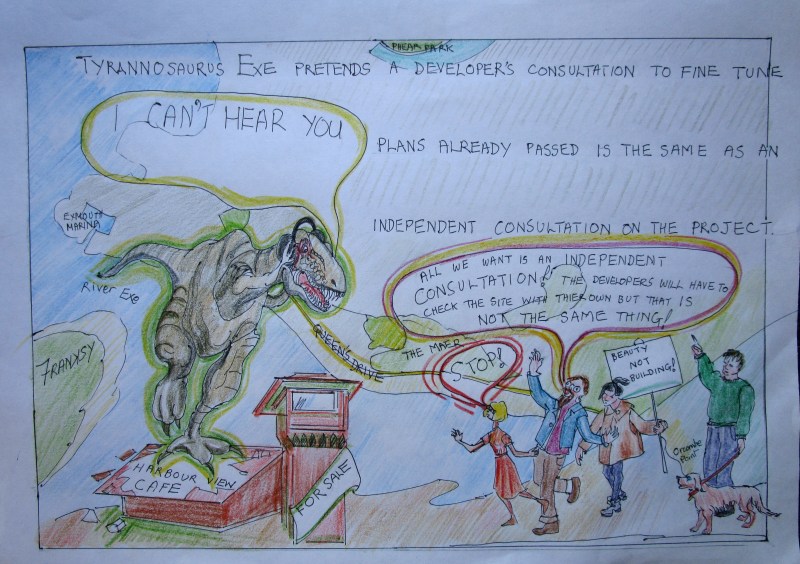
· As per 2.1 and 2.2 – a planning application for phases 2 and 3 is being submitted, as a ‘technical exercise’ to sustain the planning application (as the outline would be due to expire). [Is this allowed?]

· As quoted on page 84 ‘The planning authority will seek responses from the public to the planning application but the Council itself is not proposing to go beyond this with additional consultation for this technical exercise’.

· Consultation is then mentioned as coming after the technical exercise, in language used to imply consultation will be thorough (despite missing the important issue of consultation needing to happen before decisions are made!).

· Having told the tenants of the Harbour View (in a public meeting) that the Harbour View will be considered a separate application, and framing it to sound altruistic and caring of them, they now state that the Regeneration board has considered marketing the Harbour View site BEFORE the rest of the site in recognition of its value!”

… Loads more in there, makes awful reading.

Click to access 091116combinedcabagenda-sm.pdf

Honiton NHS bed closure “consultation” meeting 10 November 2016

Beehive

10.00 – 12.30

Please register to guarantee your place.
Call 01392 356 084 or email d-ccg.YourFutureCare@nhs.net.

For more details see:
https://www.eastdevonalliance.org.uk/event/nhs-future-care-consultation-beehive-honiton/

Honiton is to be left with no beds at all in current plans, so it is hard to see what the town is being consulted about.

So far, EDDC top brass have issued watered-down, anodyne statements about the situation, so you might want to quiz your Tory district councillors BEFORE this meeting.

Public toilets next for the chop in East Devon asks EDA councillor?

“Fears have been voiced for Sidmouth’s free public toilets as district bosses review their £800,000 cost in a bid to balance the books.

East Devon District Council (EDDC) is taking stock of its conveniences and is looking into paid access at some ‘key’ sites, leasing some to businesses and ‘innovative’ ways of reducing the cost of providing its StreetScene service.

Also on the cards is ‘rationalising’ its provision, but the authority insists that no decision has yet been made and residents will be consulted. Any changes are at least two years away, says the council.

Councillor Cathy Gardner, ward member for Sidmouth Town, said the result will be taxpayers paying more for less – and warned the authority will soon run out of ways to cut costs.

“A town like Sidmouth needs free public toilets,” she said. “An elderly population and lots of visitors with children need them, otherwise we have an increase in urination in public places.

“As well as cutting services that we’ve had as a mark of civilisation since the Victorian era, we will be paying more in council tax and getting less.

“This is what austerity means at a local level. It really does affect everyone and I doubt whether things will ever be put back.

“Once an asset is sold, it’s gone – never to be returned – and how do you balance the books next time?”

An EDDC spokeswoman said: “The council recognises that public toilet provision is a very important service for our residents and visitors – however, it is not a statutory service and we provide it because we know how much it is valued.

“As part of the council plan, we need to look at ways of operating services differently in order to help meet our budget deficit of £2.6million.

“We spend around £800,000 per annum on our toilets, so we need to assess them responsibly for quality, level of provision in any given area and possible options for different ways of operating.

“However, we would like to stress that no decisions have yet been made – it is far too early and is still a work in progress.”

The spokeswoman said the provision is being reviewed and the options will be discussed by EDDC’s asset management forum and cabinet. She added: “As and when proposals come forward, there will be full engagement, including consultation, with all interested parties.

“We anticipate that any changes would not come into place for at least two years.”

http://www.eastdevonalliance.org.uk/cathy-gardner/20161027/sidmouth-herald-concern-public-toilets-across-east-devon/

Consultation: gypsy and traveller policy

Consultation ends 15 November 2016 – apart from 30 pitches in Cranbrook, it appears that other sites will be shoe-horned into planning applications where EDDC can see the possibility of suitable sites.

So that could be anywhere else in the district – some plan!

http://eastdevon.gov.uk/news/2016/10/council-consults-on-gypsy-and-traveller-supplementary-planning-document-spd/

Implicit admission that LEP is mothballed and its Single Economic Plan was not effective and new consultation needed

QUESTION FROM COUNCILLOR VINT
Re: HOTSW and Economic Development Consultation

When drafting the economic development elements of the Heart Of The South West Devolution Prospectus how were the primary employment, housing and social needs of the region identified, and how were residents and small businesses consulted to help identify these needs?”

REPLY BY COUNCILLOR HART

“On the 19th September 2016, I gave a presentation at a Member Development Session on Devolution which is available on the Councils website at

Devolution

The presentation is clear in setting out the next steps for the partnership.

In respect of further engagement with key stakeholders in the development of our joint economic priorities; this will be undertaken through the development of a Productivity Plan. This plan will replace the current Single Economic Plan developed by the Local Enterprise Partnership and is an opportunity for all local authority partners and stakeholders to fully engage in developing proposals that will deliver greater prosperity across the Heart of the South West.

The Partnership is starting work on this in Autumn and will be engaging with groups through to Spring. Members will have the opportunity to consider the draft Productivity Plan before final approval.”

This presentation also set out a timetable for formal public and stakeholder consultation starting in the early New Year on the creation of a Combined Authority and a draft deal with Government.

At this meeting I did, however, emphasise that this timetable is subject to Government formally engaging with the Partnership.

I can confirm that the Partnership is not actively engaged in formal negotiations with Government and therefore this timeline will be amended.

The Partnership is clear that it will only go to formal public consultation when it has an offer from Government for the public and stakeholders to consider. I will, of course, continue to keep Members updated on progress with Devolution.

http://democracy.devon.gov.uk/mgConvert2PDF

A tale of two AONBs

A gas-fired power station has been proposed for the East Devon village of Hawkchurch on the East Devon- West Dorset border NEAR an AONB (Area of outstanding Natural Beauty) in Dorset. It was not put out to consultation to the local community.

West Dorset MP Oliver Letwin says of it:

This development will have an impact on the West Dorset AONB.

“I do not believe it is appropriate, or in line with national planning policy, for industrial installations to be located in ways that have such impact on landscape of national importance. I hope, therefore, that this application will be refused.”

Councillor tries to extend consultation period on ‘power station’

In East Devon, an industrial site is being planned WITHIN the AONB at Sidford – after it had been agreed that it would not be allowed in the Local Plan but slipped in because officers did not offer up evidence to a Planning Inspector to remove it.

The local MP, Hugo Swire, has said …

… absolutely nothing at all.

Take control …

“Take control” are two of the most potent words in our language that have come to mean just one thing in the weeks since the Brexit vote.

But the desire for more control over our lives is not the exclusive preserve of Leave voters – and nor can it or should it be confined to the issue of immigration.

Our polling shows that people from all backgrounds and with every kind of belief now feel they have lost control over what matters most to them, whether it is the price of a home, the pace of technological change or the poisoning of our planet.

Far from being supporters of the status quo, a clear majority of remain supporters specifically identify big business and corporate elites as having “too much power over their lives”.

By an even bigger margin of 62%, those who voted remain in the referendum say that only a few people in power take all the big decisions, adding that there is not much the average citizen can do about it.

Those decisions now seem further out of reach than ever for millions of people after the party conference season. The government has confirmed its determination to pursue a hard Brexit, even though that risks making matters worse for people who already feel left behind in this economy.

At the same time, many people see opposition parties as being in disarray and deeply divided, leaving some to despair at the prospects for progressive politics ever providing answers, let alone getting the chance to put them into practice.

A storm in our economy and our democracy that has been gathering for decades is now firmly upon us. A torrent of wealth of power is washing away even the fragile footholds people had established in the economy. Many more now face losing control all together in the face of global, technological and climate change.

Yet, even in the midst of all this upheaval, a surge of energy is being generated that can crack open new possibilities for people to take more control right now – not at some distant point in the future.

The New Economics Foundation seeks to give people the tools to take control and change their lives for the better
Today, the New Economics Foundation is setting out ways to shift debate beyond secret negotiations over Brexit in the capitals of Europe, seemingly endless party infighting in Westminster’s opposition, or literal fights in Brussels over whose turn it is next to lead Ukip.

Instead, we are setting out an agenda for people to take control themselves, without having to wait for government to do it for – or to – them.

Our agenda for people draws on real experiences, ranging from those in seaside communities who feel abandoned by the political elite, taxi drivers in London trying to make a living in an Uber-ised economy, small businesses starved of finance, consumers overcharged for energy, and young families hoping for their first home or worried about the cost of childcare.

It seeks to give all of them the tools they need to take control and change their lives for the better. Coastal communities will find ways to revive a clean marine economy which brings together people who care about the environment with those who care about getting decent jobs. We are helping to develop a new taxi app owned and controlled by drivers themselves, from London to Leeds, to give them the chance to share in the vast new digital value being created around us.

The foundation is also drawing up plans to turn the scandal-torn RBS into 130 stakeholder banks that serve local firms rather than expecting them to serve it. We have teamed up with the Switched On London campaign to help communities generate renewable and affordable energy that gives them a real stake in a low-carbon future.

Furthermore, in a project with Citizens UK, we are creating the first maps of vacant public land available for the houses that need to get built. And we are helping parents expand the number of childcare co-operatives so they can not only afford a service fundamental to modern working lives, but also exercise more control over it.

This is not an agenda merely for clicktivists who think change happens on a smartphone screen on the way to a rally. We recognise that the tools people need to take control must be fashioned in partnership with institutions wielding real power, ranging from devolved government, city mayors and forward-looking businesses to trade union and community-led campaigns across the country.

But this is the first time a major thinktank has set itself a bigger ambition than merely influencing ministers or future legislation, or getting included in a political party’s manifesto.

The New Economics Foundation will focus on helping people and communities take control by engaging with new partners – from the Mayor of London and Google DeepMind to the GMB and Citizens UK – to explore new possibilities for change right now.

We are rooted outside the traditional boundaries of politics. We care most about people’s everyday experience. And we will work with communities of all kinds to give them the tools they need to build a better future because there has never been a more urgent need for a new economy than right now.”

http://www.theguardian.com/commentisfree/2016/oct/11/politicians-housing-employment-childcare-control-new-economics-foundation

“Information not held”

Freedom of Information requests to East Devon District Council on the whatdotheyknow website:

“EDDC policy and guidance on conducting public consultations
Response by East Devon District Council to tim todd on 23 March 2016.
Information not held.

Request for information that supports ‘success’ claims made by Cllr Moulding (Premier Inn)
Response by East Devon District Council to tim todd on 29 April 2016.
Information not held.

https://www.whatdotheyknow.com/body/east_devon_district_council

EDDC afraid of democracy or afraid of independent councillors independence (and their skills)?

“Whilst I give my complete backing to Cllrs Dyson and Barratt for their upcoming work on the Port
Royal Scoping Study reference group (Herald, September 16), I would like to question the attitude of the regime that allows the controlling group at EDDC to pick one from three Town ward members.

Surely, if this process is to be truly open and accountable, this selection should have been the responsibility of the ward members themselves? After all, we were elected by residents to work on their behalf to uphold their wishes. It remains to be seen whether any of the important lessons from other EDDC projects (such as the relocation from Knowle and the beach management plan, let alone Seaton and Exmouth regeneration) have really been learnt.

Sidmouth Town Council may nominally be leading this project for now, but, in the long run, most of the land concerned is owned by EDDC and the final say on who buys it and for what use will be theirs. This includes the car parks and the swimming pool as well as the buildings on the seafront.”

Cllr Cathy Gardner
EDDC Sidmouth Town Ward
East Devon Alliance member

http://www.eastdevonalliance.org.uk/cathy-gardner/20161008/sidmouth-herald-i-question-attitude-regime/

Talk at Exeter Uni by Chief Executive of NHS on 21st Century NHS

Simon Stevens:

Creating a 21st Century NHS

Part of the Exeter Lecture Series

Wednesday 2 November 2016, 19.00 – 20.00

Alumni Auditorium, The Forum (Streatham Campus)
Video linked to G10 Lecture Theatre, Truro (Knowledge Spa)
Tea and coffee available on Streatham Campus from 18.30

Register now at Eventbrite (free)

In this talk Simon Stevens, Chief Executive of NHS England, will talk about creating a 21st Century NHS.

Simon is the Chief Executive of NHS England, which leads the NHS’s work nationally to improve health and ensure high quality care for all. He is accountable to Parliament for over £100 billion of annual Health Service funding.

During this lecture you will be able to hear about plans for the NHS and have the opportunity to participate in a short question and answer session with Simon.

The lecture will be hosted by the Provost, Professor Janice Kay, and is open to staff, students and the general public. To register for this event and to read more about Simon please visit the event web page.

Please note: this event will not be recorded, therefore booking is essential if you would like to attend.
Launched in our Diamond Jubilee year, the ‘Exeter Lectures’ will bring high profile speakers from the worlds of academia, business, the arts and civil society to the University to share their thoughts and ideas, provoke discussion, and challenge us to rethink how we understand society.

Contact us: diamondjubilee@exeter.ac.uk