
CORRECTION: The Tory hopeful with 3 homes who says he’s ordinary bloke is NEW HOUSING MINISTER

“DORSET Council is facing a legal battle over plans to build a large housing estate on countryside immortalised in Thomas Hardy novels, after locals complained of its “devastating” impact on rural communities.
The proposals would result in almost 1,000 homes on Vearse Farm in Bridport, the largest ever development permitted on an Area of Outstanding Natural Beauty in England.
But residents now hope to overturn the council’s decision in the courts after raising more than £30,000 through crowdfunding to finance a judicial review.
The challenge is backed by the Campaign to Protect Rural England (CPRE) and the Thomas Hardy Society, whose members described the plans as a “nail in the coffin” of Hardy Country, an area named in honour of the Victorian author.
Outline planning permission was first approved by West Dorset District Council, which has since amalgamated to Dorset Council, in November 2017 but proposals were only finalised in April.
The development, which covers an equivalent of 63 football pitches, would see the population of Bridport increase by an estimated 25 per cent.
But residents objected on the grounds the scale of the housing estate was “inappropriate” and raised fears the surrounding countryside would be spoiled.
A specifically-created campaign group, called ADVEARSE, was created to set up a crowdfunding campaign to raise £34,000 in order to fund a solicitor and barrister to launch a judicial review.
Barry Bates, chairman of the group, said: “If we do not take this action now, nothing further can ever be done to challenge a development of this devastating scale on this site.”
Overlooking the development site is the distinguishable Colmer’s Hill, a beloved landmark in Dorset that is said to be an inspiration for artists and novelists including Hardy, who mentioned it in his 1880 short story Fellow Townsmen.
Dr Tony Fincham, chairman of the Hardy Society, said: “This proposal is just the kind of over-development which irretrievably destroys part of Hardy’s Wessex.
“So often West Dorset (Council) doesn’t realise the value of its very special landscape in both literary and tourism term.
“This plan is just another nail in the coffin of Hardy Country.”
Elizabeth Sims, the widow of eminent violinist Neville Marriner, known as one of world’s greatest conductors, has also put her name to the cause. …
Dorset Council is under pressure to build over 15,000 new homes in west Dorset – one of the worst areas in Britain for affordable housing – by 2036.
The average price of property in the area now stands at £318,000, well beyond the means of most people born and brought up there.
David Walsh, Dorset Council’s head of planning, said: “We are confident in the way the Vearse Farm application was considered.
“As this is a legal process, it would not be appropriate to comment further at this moment in time.”
Owl says: What they won’t donis stop developers from siting (the very little) affordable housing in “ghetto blocks” on the worst parts of their developments (by main roads, poor views, etc) when the housing is supposed to be “mixed” so that doesn’t happen. Why? Because planners don’t check it is happening – turning blind eyes.
“Ministers have pledged to put an end to the use of so-called “poor doors” in housing developments in England.
The separate entrances for social housing tenants living in new builds “stigmatise” and divide them from private residents, the government said.
Communities Secretary James Brokenshire said he had been “appalled” by the examples of segregation he had seen.
Under the new measures, planning guidance is to be toughened in a bid to create more inclusive developments. …”
But since he refused to say this to the previous Tory-led council, Owl will NOT be quoting him and will NOT provide a link to this hypocritical nonsense.
“Toxic developer Persimmon was branded ‘crooks, cowboys and con artists’ as yet another scandal unfolded over its shoddily built homes.
Persimmon was attacked in Parliament after a block of its flats was found to be riddled with damp, causing misery for families.
Robert Halfon, Tory MP for Harlow, said he was horrified by the conditions endured by some of his constituents.
During Prime Minister’s Questions he said: ‘Homes built by Persimmon… are shoddily built with severe damp and crumbling walls. In the eyes of my residents, Persimmon are crooks, cowboys and con artists.’
In response, Prime Minister Theresa May said: ‘We expect all developers to build their homes to a good quality standard.
These are homes that people will be living in for many years and they deserve those standards.’
It is the latest blow for Persimmon as it fights to keep its place on the lucrative Help To Buy loan scheme which uses taxpayer cash to support families trying to get on the property ladder.
Furious ministers threatened to strike the company off a list of developers able to sell properties through Help To Buy if it cannot clean up its act. [Owl: if you expect that to happen … dream on!]
The Daily Mail has previously highlighted a litany of defects found by buyers of Persimmon homes, including leaks, exposed nails, doors that do not close and toilets that flushed boiling water.
Roger Devlin, Persimmon’s chairman, has vowed to repair the FTSE 100 firm’s battered reputation after scandals which also saw it blasted for corporate excess due to an £85million bonus paid to former boss Jeff Fairburn.
A new homes ombudsman is being introduced to tackle problems in the industry.
Labour MP Clive Betts, chairman of the Commons housing select committee, said: ‘The regime needs to be very tough and regulators need to be able to fine developers and force them to pay compensation.
The Government needs to be prepared to ban these companies from Help To Buy. Why should taxpayers fund shoddy workmanship?’ It comes just days after a TV documentary revealed Persimmon homes had up to 295 defects.
The company was accused of censoring critics this month when it shut down complaints about its homes on a Facebook page.
Persimmon has faced persistent criticism. In an industry-wide ratings survey, it has failed to win more than three out of five stars since 2015.
Persimmon said: ‘We have apologised to customers in Harlow, where manufacturing defects with a batch of blocks have created problems with damp.
The block manufacturer has agreed that this is the likely root cause of the issue and have offered their sincere apologies.
‘Persimmon has agreed to pay the mortgage payments, bills, and the temporary accommodation costs for affected residents while the problem is addressed.’
“Pressure is about to return to Persimmon, with a television investigation set to reveal more concerns about the quality of its properties and customer service.
Britain’s New Build Scandal, to be aired tonight on Channel 4 as part of its Dispatches series, will feature an inspection of a new Persimmon home that found 295 faults, 70 per cent of which were so serious that they violated building regulations, including a fire door that did not close, leaking sinks, unsealed showers and faulty waste connections.
Britain’s most profitable housebuilder is responsible for one in seven homes sold via the government-backed Help to Buy mortgage scheme and in February became the first to report an annual profit of more than £1 billion. Based in York and a member of the FTSE 100 index of leading shares, it was embroiled in a pay scandal last year when Jeff Fairburn, 53, chief executive at that time, was awarded £81.6 million under a long-term incentive scheme put together in 2012 and linked to dividends and the share price.
Persimmon apologised to the customers featured in the programme, including two whose home was uninhabitable for three months after buying it. “We fully accept that on too many occasions in the past we have fallen short on customer care and we can and will do better,” it said.
Last month The Times revealed Persimmon had removed complaints about the standard of its homes from Facebook after taking over the administration of a group targeting customers on the social media site.”
Source: Times, pay wall
Inly luxury homeowner retirement properties being built NOT affordable homes for older people with lower incomes:
Owl has been passed a copy of a letter (from the writer) sent to EDDC:
“Dear Sir/Madam – I have recently made several visits to this development (EX8 2JB) with a view to our family buying at least 2 purchases there.
On Wed 10th July at around 1230 I attended to see how work was going on and walked the public footpath through the site.
The public footpath runs SSE from Buckingham Close to the vicinity of Green Farm and is marked on OS maps as a Public Right of Way. The building works are all to the south and west of this boundary path.

There was no statutory notice saying that the pathway was closed nor was an advised diversion promulgated. Both these requirements are, I believe, legal requirements, to advise closure.
There were numerous signs warning about the adjacent building site, but from the safety of the public path I was better able to see the areas of build I was interested in. At no time was I in any danger from works vehicles. I passed several workers going to lunch – none of whom commented on my presence.
When I got to the end of the path/works I was rudely shouted at by an operative in a dumper truck who demanded to know what I was doing. I simply replied I was looking at the works from a public footpath. He became more authoritative and aggressive so I walked away on the way back. He then had the effrontery to demand a worker escort me “off the premises”. This chap showed me lots of notices such as “Do not enter site”, “Report to site office” but nothing regarding the public footpath. I pointed out to him the several small statutory yellow discs displaying “Public footpath”. But all to no avail.
So what is the position about this footpath? Why are there no statutory notices closing it – the developers Taylor Wimpey surely cannot unilaterally close it. Indeed is the footpath legally closed at all?
I would have thought a clear notice one way or the other is required.”
[author’s name and contact details given]

The people of Budleigh Salterton would advise the people of Newton Poppleford not to hold out much hope in acquiring a surgery or anything of benefit to the village. (see East Devon Watch 11 July) They have been down a very similar route with Clinton Devon Estates.
The failure of the BS Neighbourhood Plan to include all the hospital garden as open space, leaving only under a half leased to the new hospital hub left Clinton Devon Estates controlling the other half. A planning application was submitted for the construction of 2 open market dwellings and associated access in its plot. Like Newton Poppleford the estate lodged an appeal against the delay in making a decision by EDDC. However, the Inspector turned down this on appeal concluding that the benefit to the town of building two houses in the garden was outweighed by the negative effect upon the recreational space within this part of Budleigh Salterton.
“In the absence of evidence to indicate that the remaining garden would adequately meet the needs of visitors to the health and well-being hub, in relation to this main issue, the proposal would have a negative effect upon availability of recreational space within this part of Budleigh Salterton, contrary to LP Strategy 6. The proposal would not result in an enhancement of the retained garden and so would not comply with LP Policy RC1.”
So what did CDE do? Did this estate whose motto is
DOING TODAY WHAT IS RIGHT FOR TOMORROW
allow the continued access to this land which cottage hospital patients had enjoyed since 1887?
No, the estate chose to ignore the spirit of the Planning Inspectorate’s decision.
They erected a fence. I am sure many of Owl’s readers have seen the “abomination” (BS Journal Feb. 15 2018) and may have seen children confined to playing in just under a half of the garden.
So those patients living in Newton Poppleford and seeking to consult their GP will have to continue to travel to Ottery St Mary. (Remember that Newton Poppleford is within the Ottery St. Mary practise boundary, not the nearer Sidmouth!) If they rely on public transport there is no direct bus route, patients have to travel into Exeter and out again, a distance of around 23 miles with a round trip time of at least 2hrs 30 mins. (and don’t ask about the cost)!
“Developers planning on building two flats each smaller than a London taxi have been given permission by the local council.
The two ‘studio’ flats – one 90sq ft and the other 97sq ft – are planned for a disused building in Purley, south London, and were given the green light by Croydon council last year under permitted development rules.
Just two thirds of the size of most parking spaces, the cramped properties are part of plans for the building which also includes a 240sq ft two-bedroom ground floor apartment.
The building’s owner, Andrew Weinstein, has other plans for a 300sq ft three-bedroom space and a 280sq ft two-bedroom apartment on the first floor, but building work is yet to start.
Rules in London state studio flats must be at least 400sq ft, according to Mail Online.
The two flats have been described as the smallest allowed under the rules.
Julia Park, head of housing research for architects Levitt Bernstein, described the properties as “ridiculously small” with very little light.
Developers do not face the usual scrutiny under permitted development rights, with no size restrictions on flats and few ways of councils turning down applications, the Times reported.
Landlords have been accused of ‘disregarding basic human needs’ by ‘exploiting planning loopholes’.
It comes another scheme to convert a warehouse in Barnet, north London, into a 107-flat block with 56 not having an outwards facing window, sparked outrage with locals.
Complaints flooded in against the plans submitted by the Cowell Group, with locals saying the cramped spaces could lead to mental health problems for those living there.
The Barnet Society, made up of residents, said it was “a cynical exploitation of planning loopholes — compounded by disregard for basic human needs”.
The plans, by Adrian Levy and Nicholas Cowell and rival developer Dandi Living, show that even the apartments with an outwards-facing window only have one, with some sharing corridors with a row of offices.
Ali Reza Ravenshad from Dandi Living claimed his company was not going to build the tiny flats and was “playing the planning game”.
Mr Weinstein did not reply to requests for comment from the Times or MailOnline.
The Cowell Group and Dandi Living said they “take great pride in their track record for delivering high end, aesthetic and affordable housing”.
https://www.mirror.co.uk/news/uk-news/permission-granted-ridiculous-flats-smaller-18195135
Clinton Devon Estates … again … not doing its reputation any good.
“Clinton Devon Estates (CDE) says it was unable to find a tenant for the practice which was promised as part of a 40-home development at King Alfred Way. Instead it applied to build two further homes on the land.
On June 11 East Devon District Council (EDDC) deferred its decision for 90 days to allow time for talks between CDE and Newton Poppleford and Harpford Parish Council.
The parish has now shown an interest in renting the surgery and wants to enter into talks.
CDE has instead lodged an appeal against the delay in the decision.
The surgery was part of discussions when a 40-home development was granted permission. At the time district councillor Val Ranger said she felt 40 new homes, next to an area of outstanding natural beauty, was a high price to pay for a new surgery.
Coleridge Medical Centre was originally due to take over the new practice but withdrew its support after NHS funding fell through.
CDE has now refused to meet the parish council and said it was because of the delays already caused, current NHS aims to centralise services and the extra cost involved if the surgery is built after the bulk of the development is finished in 2020.
When asked if it would consider withdrawing its appeal, Clinton Devon Estates said in a statement: “A new GP surgery in Newton Poppleford is no longer viable without a commitment from the NHS to operate it. With the submission of an appeal, the opportunity for formal discussions between CDE and the parish council is now closed until a determination has been made by a planning inspector.”
The developer said Coleridge Medical Centre confirmed in June that its plans to consolidate services within a larger site rather than at branch sites was unchanged. It understood that their plans were to deliver services with the Beacon Surgery, Sidmouth.
When asked if it would be open to talks about the possibility of the parish council taking on the surgery, a Coleridge Medical Centre spokesman said: “We and Devon Clinical Commissioning Group are always open to discussions with our local partners.
“We will continue to provide the existing single-handed doctor service at Newton Poppleford for two mornings a week for the foreseeable future.
“We remain committed to securing high quality and accessible GP services for the people of Newton Poppleford and any proposals about how to best provide this in the long-term must take into account a number of factors including cost, workforce and sustainable modern ways of providing care.”
Brandy Head is a promontory about 1½ miles SSE of Otterton.
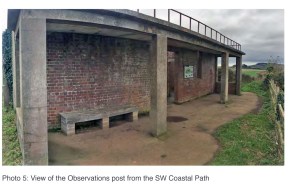
In 1940 the RAF opened a gunnery research range here for ground attack fighters. An observation post was built on Brandy Head with blast walls at the rear and a viewing balcony looking seaward. Targets were floated offshore and aircraft such as Typhoons, Hurricanes and Spitfires from 10 Group RAF would fly from Exeter to test turret mounted guns, wing-mounted cannons and later rockets by flying over the observation post to attack the targets anchored at sea.
The utilitarian observation post still stands as a shell, having lost its roof, alongside the Coastal Path only yards from the cliff edge. It is often used by walkers as a place for a coffee break.
The new tenant farmer at Stantyways Farm has recently submitted a planning application 19/0883 to convert the observation post to holiday accommodation.

This raises an interesting debate: is this an example of imaginative re-purposing of a derelict land mark which will ensure its future; should the observation post be left alone to stand as a simple epitaph; or is it the start of a new camping site to rival Ladram Bay and Devon Cliffs on either side?
Owl has noted this passage from the Design and Access Statement supporting the application:
“Clinton Devon Estates have offered Mr and Mrs Walker their support and have stated:
“Clinton Devon Estates recently let Stantyway Farm to Mr and Mrs Walker, we are encouraged by their plans to farm organically and sustainably. Their tender included a wish to convert the lookout into visitor accommodation to make the most of the South West Coast path tourism and we support this diversification and use of the redundant building.
It is essential that the eco-sustainability side is expressed and access is by foot.”
Owl personally just wouldn’t perch overnight that close to the cliff edge!
Perhaps it also needs Listed Building or Heritage Building status?
“The prospect of local authorities being able to increase their fees for managing planning applications has been raised by housing and communities secretary James Brokenshire, as part of a long-awaited Accelerated Planning Green Paper.
With many departments relying on temporary staff from overseas and university courses closing through lack of demand, the shortage of local authority planners and under-resourcing of departments has been an acute problem for some time.
Planning Delivery Grant was introduced in 2003, linked to a 13-week target for decisions. For the next five years, £110m a year was allocated in grants. In the same period, £4.8m was spent on student bursaries to increase the number of qualified planners. Fee increases of 25% and 23% were introduced in 2005 and 2008.
But the problem, which was highlighted by the Public Accounts Committee in 2008 continued, hampering the Government’s ability to deliver changes to the National Planning Policy Framework, designed to boost housing supply.
Mr Brokenshire’s announcement has been widely welcomed. Some stakeholders, including the Royal Town Planning Institute, have been calling for English local authorities to be allowed to raise fees to cover the entire administrative cost of the planning application function.
The construction sector would be less than happy with such an approach, particularly small builders who have complained that the increased planning fees already imposed don’t seem to have speeded things up.
Richard Blyth, RTPI Head of Policy and Research, commented: “We are delighted to see that Mr Brokenshire has taken note of our proposals. We have been talking to our members and will be contributing to the forthcoming Accelerated Planning Green Paper. We look forward to working with the Government on its proposals.”
Martin Tett, Local Government Association’s Housing spokesman, said that council tax payers were currently subsidising planning application administration to the tune of £200m a year.
He commented: “It is good that the Government recognises our call for council planning departments to be given greater resources if they are to ensure applications are processed as efficiently and effectively as possible. Councils need to be able to set their own planning fees.”
Announcing the proposals at the CIEH’s annual housing conference in Manchester, Mr Brokenshire said: “The planning system is not a barrier to housebuilding – with councils approving nine in 10 applications, and the majority processed quickly while hundreds of thousands of homes have been given planning permission but are yet to be built.”
He said that the green paper would look at creating “greater capacity and capability within local planning authorities, stronger plan-making, better performance management and procedural improvements, including in the process of granting planning permissions.”
Currently, he said, only half of the annual £1bn spent on local authority planning functions was covered by fee income. The green paper would launch pilots of new approaches to meeting the costs of planning.
Councils would be expected “to demonstrate measurable improvements within their performance – not just in terms of speed, but very firmly also in terms of quality”.
Other Brokenshire announcements:
Government may appoint a new homes ombudsman to deal with shoddy standards in new-build
Consultation on redress for purchasers of new build homes
Ground rents on new leases reduced to zero, preventing leaseholders being charged exorbitant fees, and the sale of leasehold houses will be banned
Nineteen new garden villages delivering 73,000 new homes. They will include a facility for people with dementia at St George’s Barracks in Rutland
Proposals to make it easier for renters to transfer deposits between landlords when moving
Rogue landlord database could be accessed by tenants
Half of the £2bn of long term funding to 2028-29 for housing associations will go to London
Planning process for families wishing to extend their properties to be improved.”
“The chief executive of Persimmon has refused to deny that the housebuilder paid to take control of a Facebook group dedicated to complaints about the company before shutting it down,
The Times revealed last week that Persimmon had acquired the administration rights to the “Persimmon Homes Unhappy Customers” group, which had almost 14,000 members. It subsequently shut down the group, deleting years’ of customer posts sharing problems with their homes.
Outraged group members have speculated on other Facebook groups dedicated to complaints that the housebuilder “paid off” the administrator of the group, whose identity is not public.
Facebook does not allow the sale of administrative rights to groups created by users so a payment would have been a breach of the website’s rules.
Dave Jenkinson, chief executive of Persimmon, confirmed yesterday that it had acquired the administration rights to the group but would not say whether it had paid for them. “That’s a private agreement between us and the administrator and that’s not something I am prepared to discuss,” he said.
The FTSE 100-listed builder, which is based in York, has a market capitalisation of more than £6 billion. In February it became the first British housebuilder to report an annual profit of more than £1 billion. It sold 16,449 homes last year, about half of which went to first-time buyers using the Help to Buy scheme, which is designed to boost home ownership. Since Help to Buy was introduced Persimmon’s profit per house has almost tripled, from £22,114 in 2012 to £60,219 in 2018.
The move to shut down the Facebook group has produced claims from customers that it is trying to censor criticism of the company, which is working to improve its build quality and customer service after criticism by ministers.
James Allan, 23, a planning officer at East Lothian council who has complained about problems at his one-bedroom Persimmon flat in Edinburgh, said: “They are taking away the voices of people who have had issues. It’s good to see the experiences of others so you know that you are not alone.”
Mr Jenkinson, 51, said Persimmon had been monitoring the group for several months to address customer issues as they arose in posts. However, he said that in the past few weeks activity on the page had become “much more aggressive” and there were “signs of bullying behaviour” towards staff. He also said the company had found, when checking users against its customer database, that most complainants were not Persimmon customers; some were friends of customers, tradesmen or from other organisations. “We’ve done this for our customers, we’ve done this for the right reasons,” he said.
In a trading update, the builder said that revenue in the first half of the year had fallen as a result of selling fewer homes because it was focusing more on customer satisfaction. It sold 7,584 homes in the six months to the end of June, down from 8,072 in the same period last year. Revenue fell by 4.4 per cent to £1.75 billion. The average selling price rose to £216,950 from £215,813. The housebuilder said that it expected its operating margin for the full year to remain stable at a hefty 30.8 per cent.
Persimmon has announced measures to improve its customer satisfaction levels and build quality since The Times revealed in February that the government was reviewing its access to the Help to Buy scheme from 2021 as a result of allegations of poor standards. It is to allow buyers to retain 1.5 per cent of the value of their purchase until faults are fixed. Buyers of new-build homes who report snags within a week of receiving the keys to their property will be able to withhold a portion of the purchase price until any faults are resolved.
Its customer satisfaction rating has improved in recent months, it said. Mr Jenkinson said: “Persimmon is listening carefully to all stakeholders and making the changes needed to position the business for the future, while maintaining a robust trading performance.”
Last night the shares closed down 23½p, or 1.2 per cent, at £19.64.”
Source Te Times, pay wall
The Times today is doing a heart-rending expose of modern slums, slum landlords and the links between these landlirds and donations to the Tory party.
There is a heart-breaking story of one such young mother living with her sick and asthmatic 6 year-old young son in the most appalling conditions in a flat in Croydon – placed there by Waltham Forest council, which is 20 miles away. They pay £800 per month for her to exist there – one cannot say “live”. Conditions worthy of the very worst Victorian slums.
In a second article, the newspaper looks further into the types of properties and their landlords and the loopholes that allow them to benefit from these apalling places. They find:
“The developers have exploited a change in planning rules to convert offices into hundreds of flats without any minimum size requirements, prompting claims from experts that they are building “some of the worst homes in Britain” and the “slums of the future”.
Flats costing £800 a month are as small as 14 square meters (150 sq ft), barely bigger than the size of a typical parking space.
Families are living on industrial estates and alongside busy roads, with some residents claiming that mould, noise and anti-social behaviour inside the buildings are damaging their health.”
They then go on to turn the spotlight on three such landlords:
“ Caridon, a property group founded by Mario Carrozzo, receives at least £8 million in housing benefit payments to house hundreds of tenants in flats as small as one-third of the minimum size which would be required under the planning regime;
Joel Weider, the owner of a double glazing company, has converted office space in Leicester, Aylesbury and south London, including flats branded a “hell-hole” by an MP;
A third developer, Anwar Ansari, a former eye surgeon, rents small studio, one and two-bed flats to tenants, including a former office block which has been cited for fire safety breaches.
A change in permitted development rights introduced in 2013 means that developers do not have to adhere to normal planning standards when converting offices into residential housing.”
A further article goes on to look at how much money these “developers” are raking in:
“Caridon
Mario Carrozzo’s sprawling Surrey mansion was once owned by a Premier League footballer and boasts a tennis court, indoor swimming pool and cinema. The £6 million home has three sitting rooms, a gym, spa and games room with bar. It is a far cry from the tiny flats his property empire is built on.
Caridon Group flats are among the smallest in the country, with some measuring 14 square metres (150sq ft). Three of these flats would fit into Mr Carrozzo’s cinema room.
The conversions include Token House in Croydon, where the smallest flats are 15sq m (160sq ft). In one, a sofa and bed fill the flat. The rent is almost £800 a month. “I can open my fridge and make a cup of tea or answer the door while I’m still lying in my bed,” one tenant said. …
Joel Weider
Located in a south London industrial estate with lorries passing near by, a former office building has become home to dozens of people including families. Many of those living in Connect House’s 86 flats, some of which are only 14sq m (150sq ft), have belongings piled up in suitcases and boxes because of a lack of space. Residents have reported breathing problems and rashes which they claim have been caused by damp and mould. The smell of cannabis fills the corridors. A bag with traces of a white powder lies discarded.
The developer behind it is Joel Weider, the owner of a double glazing company who bought the property for £3.1 million in 2015. …
AA Homes
AA Homes and Housing is owned by a Labour donor, Anwar Ansari, 59, and has property holdings worth more than £170 million. Dr Ansari trained in London as an eye surgeon but is now a full-time developer.
AA Homes and Housing is behind at least five big office-to-residential conversions and rents mainly to private tenants. The flats are generally larger than those created by Caridon and Mr Weider but are often still below space guidelines set out by the government.
The company owns a five-storey former NatWest office building in Croydon. A previous owner had sought permission to convert it into 34 flats but Dr Ansari squeezed in an extra 20. In 2017, the fire service issued an enforcement notice over safety concerns including a locked fire escape, poor ventilation and defective fire doors. The company was also fined £20,000 for failing to secure a landlord licence for 36 of the building’s privately rented flats. It is contesting all of these findings.
Dr Ansari and his wife Hina live in a sprawling estate near Caterham, Surrey. …”
£77,000 profit per house, adding £30,000-plus to the cost of a new home, poor quality builds, CEO laughing all the way to the bank with his multi-million bonuses – what could possibly go wrong? Answer: nothing goes wrongfor Persimmon, because this government doesn’t just turn a blind eye, it actively encourages this behaviour by putting developers in the planning driving seat (in chauffeur-driven cars)!
“Over half of properties sold by housebuilder Persimmon in the first six months of this year went to first-time buyers, the group’s trading update reveals.
The group sold 3,082 homes to first-time buyers, representing 52 per cent of all private sales for the period.
Speaking to This is Money, a spokesman for Persimmon said ‘around 50 per cent’ of these first-time buyers used Help to Buy schemes to complete their purchase.
While the proportion of purchases being made via Help to Buy adds weight to criticisms that housebuilders are being propped up by the Government schemes, they appear to have done little to help to Persimmon’s overall performance in the first half of the year….
… Persimmon scored the worst figures of all the major house builders in a recent Home Builders Federation new homes survey.
The firm launched a review of its house quality and customer care functions in April. …”

“A homeowner plagued with issues in his new-build house said his family was left unsafe when the developer withheld a report condemning the roof.
Joe Tompkinson also said Linden Homes “reneged” on a promise to pay expenses if they moved out during repair work.
He said more than 400 different faults had been identified since his family moved into the house in Abbey Farm in Swindon in December 2017.
Linden has pledged to “attend to any issues” at the property.
Mr Tompkinson claimed he and his family had suffered a catalogue of “extremely poor and negligent” workmanship and botched repairs – including unbolted banisters, sinking bathroom floors, micro-cracks, subsidence and missing brickwork.
Shortly after they moved in, the couple were alerted to problems with the roof when a tile fell off, causing £3,000 of damage to Mrs Tompkinson’s car, and tiles were found to be secured with duct tape.
Mr Tompkinson said in December an independent survey condemned the “unsafe” roof because the majority of tiles were incorrectly secured and soffits built too low.
The father of three said he only discovered this information through a subject access request.
He claimed the “dishonest and obstructive” firm would not release the report or provide a copy to the National House Building Council (NHBC). …
It [Linden Homes] admitted there was “an unusually high number of reported issues” on the development, which has seen more than 40 other homeowners detail problems.
“New-build “affordable” homes are standing empty after nearly a dozen housing associations rejected them for being too small.
The five properties were deemed to be lacking the square footage required to meet “modern standards of social housing.”
Developer Monument Two Ltd is currently building 42 homes at Derby’s former Calder Aluminium site in Repton Road, reports DerbyshireLive.
South Derbyshire District Counciil signed off on the scheme in 2010 but it has not yet been completed.
Now the firm has told the council that the affordable homes built on the site have been seen as too small by 11 housing associations that were offered them.
The housing associations also said that there were not enough affordable homes on the site – with just five built due to the cost of developing the site.
Of the five homes, two are three-bed homes and three are two-bed homes.
The council says that the square footage of the homes does not meet modern standards of social housing – which have been upgraded since 2010 when the homes were approved. …”
https://www.walesonline.co.uk/news/uk-news/developer-built-new-homes-small-16515537
Owl says: time to stimulate sales with price drops, perhaps? Bringing that profit-per-house at Persimmon down from £77,000 to, say, £27,000 would certainly bring a lot of buyers in! Of course, then there would be no masdive director bonuses, so guess that’s a non-starter (home).
“Britain’s construction sector suffered as “sharp drop in momentum” last month, says data firm Markit.
In a very worrying healthcheck on the construction sector, Markit has found that business activity and incoming new work both fell at the fastest pace for just over 10 years.
Housebuilding, commercial construction and big civil engineering work all contracted during the month — a bad sign for the whole construction sector.
Builders across the country blamed “risk aversion among clients in response to heightened political and economic uncertainty.”
That suggests people are simply unwilling to take risks while they don’t know how the Brexit crisis will be resolved.
This has dragged the IHS Markit/CIPS UK Construction Total Activity Index down to just 43.1 in June, down sharply from 48.6 in May. Any reading below 50 shows a contraction, and this shows the steepest reduction in overall construction output since April 2009.” …
UK builders also reported that new orders dropped at the fastest rate in over 10 years, while demand for construction products and materials fell at the sharpest pace since the start of 2010.”
 East Devon Watch