“New “affordable” housing in Devon is anything but, investigation reveals”

“Most new “affordable” housing in Devon is anything but, a major new DevonLive investigation has revealed.

Affordable housing is an umbrella term used by the government to describe lower-rent properties that are available to eligible households unable to afford the full market rate.

This includes both traditional social rent housing – which is similar to what most people know of as council housing – and “affordable rent” housing, which was first introduced in 2011/12.

Social rent is based on a formula that combines local wages and local property values, and typically sees rents set at around 50 per cent of private rents in the same area.

“Affordable rent”, however, is capped at 80 per cent of the full market rate – meaning that in many areas it will still be out of the reach of people on low incomes. …

… Some local areas see “affordable rent” housing dominate more than others. In Mid Devon, South Hams, Teignbridge and West Devon, 100 per cent of new affordable housing was “affordable rent” rather than social rent last year.

Meanwhile, in East Devon the figure stood at 97 per cent, in Torridge at 67 per cent, and in both North Devon and Exeter at just 13 per cent.
In Plymouth the figure also stood at 100 per cent, while in Torbay they made up 58 per cent of the total.

In comparison, the national average saw 81 per cent of new affordable housing built or acquired across England in 2017/18 classed as “affordable rent” rather than social rent.

The most common type of affordable housing found in Devon is general needs properties managed by private registered providers, such as housing associations.

These cost an estimated £86 a week on average for a social rent property, compared to £121 a week for an “affordable rent” property – meaning “affordable rent” in Devon is typically 42 per cent higher, or £1,854 more a year. Private renters in Devon pay an estimated £150 a week, on average.

Kate Henderson chief executive of the National Housing Federation said: “In 2010, the government stopped funding social housing altogether, and announced it would only fund homes for “affordable rent” instead.

“This left housing associations in a really difficult position where they had to choose between building homes for “affordable rent” or building nothing.

“In the face of a dire housing shortage, many housing associations chose to build affordable rented homes, but continued to argue that social housing shouldn’t be neglected.

“While affordable rents do work for some people, there are many more who desperately need social housing.

“In 2017, the government announced some new money for social housing for the first time in seven years, but this is nowhere near enough.”

https://www.devonlive.com/news/property/new-affordable-housing-devon-anything-2543061

“Knowlegate”: Del-Boy and the Trotters spring to mind – but just the fools (no horses that we know of)

“East Devon District Council’s senior management team have been rebuked by scrutiny councillors after failing to consider the public perception over the sell-off of assets from their former Knowle HQ.

The council this week completed its move from its former Sidmouth home at the Knowle, to Exmouth town hall and the new Honiton Heathpark HQ, and as part of the move, they had to find homes for various items that are unsuitable for its new building.

But a furore erupted just before Christmas when it was first revealed that council staff and members, but not the general public, were given the chance to bid on various items, and then when an email was leaked claiming a councillor managed to buy a large mahogany dining table and 20 chairs for £50 at the internal staff auction, instead of allowing it to be publicly auctioned for the best possible price.

A council spokesman had said that this leaked information was totally incorrect with the bid being for £400 and only including some of the chairs, and that the bid was withdrawn when Exmouth Town Council, who initially declined the offer of the table originally, changed their view just before Christmas and are now expected to take ownership of the table.

Cllr Ian Thomas, Leader of East Devon District Council, had previously said in a statement: “Our council relocation team has been working with professional auctioneers, Sidmouth Town Museum, charities and clearance specialists, to value and dispose of a wide range of items from our old East Devon District Council offices at The Knowle in Sidmouth.

“As part of this process, we offered our staff and elected members the chance to bid for items that may be of sentimental interest or practical use, but are of negligible commercial value.

“The value of items to be disposed were identified based on the view of experienced professionals. They included the large table from the Members area, which attracted little professional interest with one valuer estimate of just £50.

“All proceeds from this sale and those raised from other sales will go to the Chairman’s Civic Fund, to be donated to nominated charities.”

East Devon District Council’s scrutiny committee considered the disposal of the contents of the Knowle at their meeting last Thursday.

Richard Cohen, the Deputy Chief Executive, produced a report that outlined the process of disposal of items from the Knowle prior to handover to PegasusLife for demolition.

He said: “As part of that process and prior to the handover of the old office buildings to the developer, the council needs to clear the buildings. In total there are just over 2,600 separate items in the Knowle.

“The vast majority of these are office furniture: desks, chairs, cabinets etc of varying ages, condition and size. There are also a number of particular items of varying antiquity and value: these involve both furnishings and fixture and fittings. From a perspective of bulk disposal the estimated total weight of all these items is 45 metric tonnes.”

He outlined that Sidmouth Museum and Sidmouth Town Council were both interested in re-home various items, multiple local auction houses were invited in to look over items but that the majority of items were not of interest to them, and that for remaining items an opportunity was offered for council staff and members to bid for items whether for practical or aesthetic reasons.

He said: “These were items that had been attributed little or no sale value by the various professional auctioneers and ranged from standard office furniture items to cupboards, upholstered furnishings, tables, curtains for example. This element of the disposal process involves around seventy separate items and is likely to raise of the order of £2,000 for the Chairman’s chosen charities.”

Mr Cohen added that groups such as Action East Devon, Green Furniture Aid and Hospicare who are all either networked with voluntary groups or can sell furniture via charity outlets were asked whether they had an interest in some of the for the more generic items such desks, chairs and tables, but the response has been largely muted.

Town and parish councils will also be contacted asking them whether they have an interest in any items with the requirement that they transport said items away themselves, he added.

But councillors said that contrary to what Mr Cohen said, a full list of the items for disposal had not been circulated to them.

Scrutiny committee chairman Cllr Roger Giles said: “There has not been a list that we have seen so could someone produce a list that will be circulated very soon.” He also asked wat do town and parish councils know about the process, as the answer he had heard from them is nothing.

Cllr Cathy Gardner added: “Why was the full explanation of the process not circulated to members before we were given the chance to bid for items? The reason there was a furore around the subject as the offer of sale of items internally was offered in isolation and the lack of communication meant there was a lack of understanding of the wider process that this sat.”

Her recommendation, which the scrutiny committee backed unanimously, was that they remind the senior management team of the council to always consider the public perception of actions taken, particularly when it is involves public assets, and the disposal of public assets.

https://www.devonlive.com/news/devon-news/council-management-team-rebuked-over-2545040

K’ching! 3 bids in for Sidmouth seafron Drill Hall

“East Devon District Council has received three ‘interesting and diverse’ bids for the site following the consultation period, which ended on Friday, February 4.

A core group made up of Sidmouth and East Devon town and district councillors are now considering the bids, working with property agent JLL which has managed the marketing.

A council spokesman said at the moment the details of the bids must remain confidential and recommendations will be made for East Devon District Council’s cabinet for approval at a later date. …”

https://www.sidmouthherald.co.uk/news/final-bids-to-be-considered-to-transform-sidmouth-drill-hall-1-5891620

” ‘Major shake-up of public audit needed’ “

“A “radical overhaul” of public service audit is needed to give the public confidence over how its money is spent, according to recommendations from a think-tank.

Increasing financial pressures and people’s dissatisfaction with public services means now is the time for a shake-up of audit for central and local government, the authors of a report for the Smith Institute said.

Tax is likely to increase in the future as a result of demographic pressure on areas such as health and social care, and these can only be justified if the public is “confident” its money is being well spent, authors John Tizard and David Walker told the report launch yesterday.

“Fiscal pressure is likely to rise in the short run, depending on the nature of Brexit. It will certainly grow in the long run, as public spending accommodates demographic change: an older population will demand more health and social care and other services,” Spending fairly, spending well said.

It called for the creation of two new government bodies and more responsibilities given to the National Audit Office to improve public audit.

The NAO would take over audit responsibilities for the NHS and local government, the report suggested.

Authors audit commentator Tizard and David Walker, former head of communications at the Audit Commission, urged for the creation of a Public Interest Appraisal Unit, which would evaluate value for money before spending decisions are made. The NAO assesses government spending decisions after they have been made.

They also said the government should set up an Office of the three Es – equity, efficiency and effectiveness. This body would be responsible for looking at which groups benefit and which groups lose out on certain spending decisions. …”

https://www.publicfinance.co.uk/news/2019/02/major-shake-public-audit-needed

Sidbury, Sidford and snow – a lethal combination for the A375

Developers take heed!

Last weekend, a car slid off the road into the dip alongside the bend in central Sidbury, smashing its windscreen and narrowly missing a row of lowlying cottages.

Radio Devon travel news announced (2nd February) that the Sidford-Sidbury Road (A375) was turning into a skating rink.

Radio Devon travel news announced A375 was closed due to burst water main.

Imagine of that car had been a lorry …..

Bats (and Batmen and Batwomen) in East Budleigh – today’s development

Owl hears that, somewhat surprisingly, EDDC’s Development Management Committee voted to defer the bat habitat decision.

It also appears that yesterday’s activity in and around the barn, reported by Owl here:

https://eastdevonwatch.org/2019/02/11/bats-in-east-budleigh-barn-cleared-24-hours-before-eddc-planning-committee-meets-to-decide-their-fate/

has been reported to the Police who have allocated a crime number to it.

Here is how it has bedn reported in the local newspaper:

“Campaigners fighting the proposed demolition of a known bat habitat in East Budleigh have been given ‘breathing space’.


Image: Archant, Daniel Wilkins

More than 20 members of a conservation group gathered outside Exmouth Town Hall this morning (Tuesday, February 12) ahead of a crucial meeting to decide the fate of an East Budleigh barn known to be home to rare and protected bats.

East Devon District Council’s development management committee decided to defer their decision pending additional information from Natural England about wildlife mitigation on the site.

Landowner Clinton Devon Estates (CDE) is looking to knock down the barn and build a new dwelling on the site and has offered to build a separate ‘bat barn’ on the plot as mitigation.

Speaking after the meeting, Karen Alexander-Clarke, secretary of the East Budleigh Parish Conservation Group told The Journal this decision gives them ‘breathing space’ in their fight to protect the bats’ home.

The Pound, in East Budleigh, which is subject to a planning application to demolish a barn which is thought to be home to species of rare bats.

She also said they would be writing to Natural England to lobby them and ‘emphasise that there are councillors that feel as strongly as we do’.

Speaking at the meeting, councillor Brian Bailey also raised concerns over whether the bats would take to their new home.
He said: “The bats, I feel, have been served poorly because there is no guarantee what so ever that the bats will survive the demolition or would accept their new home.”

Cllr Geoff Jung said: “This is one house and one family that is going to benefit and how many bats and other wildlife are going to benefit?”

An independent ecology report commissioned by the council recommended that the mitigation being offered by CDE be accepted.

Cllr Mark Williamson said he did not feel confident that, if they refused the application and CDE appealed, the Planning Inspectorate would back their original decision.

He said: “As we do frequently, we would look to our statutory consultees to guide us.

“Natural England is giving quite detailed guidance and they recommend the planning authority follow advice from the ecologist.”

Councillors voted in favour of deferring the application pending information from Natural England on the suitability of the proposed ‘bat barn’.”

https://www.exmouthjournal.co.uk/news/east-budleigh-bat-barn-demolition-plan-deferred-1-5889261

One (Tory) councillor nearly sabotaged a highways safety project in Otterton

Honestly, EDDC Tories will stop at nothing to try to stop Claire Wright …. even if they cut off their own noses to spite their faces!

EDDC Councillor Tom Wright thinks he knows better than Otterton residents. Perhaps residents angry at his intervention should ensure they DON’T tick HIS box in local elections on 2 May!

Blog of Claire Wright.

“Otterton Parish Council has agreed to part fund a 20mph limit through the village, at a packed and testy meeting last night.

[This is the road being discussed below]

The agreement was made, despite a Conservative councillor selected to stand for Otterton in the East Devon District Council May election suggesting repeatedly during the meeting that the 20mph limit was a waste of time.

This did not go down with residents who made it clear they disagreed with him.

The vast majority of the village of Otterton wants a 20mph limit. I have carried out a consultation, had a public meeting and made a case based on the policy requirements.

Also backing the proposal is the Otterton Primary School headteacher.

And the parish council wrote to Devon County Council highways officers last year to support the case.

I have worked towards this over the past year or so, but despite meeting virtually all the policy requirements, the scheme fell recently as there has not been a speed related death in the village. A traffic accident resulting in a death, yes. But not a speed related death.

This very silly rule will hopefully be overturned thanks to a new government report which a Devon County Council highways task group is currently working on. This very much emphasises a ‘can do’ approach to 20mph limits as they are beneficial in slowing traffic and

Despite having no jurisdiction over Otterton – neither a resident nor a councillor representing the village, EDDC Conservative, Tom Wright continued to pour cold water all over the plans for the revised speed limit and claimed it was a waste of money.

At one point he even accused me of blogging that I would fund the entire project myself.

I replied that this was never the intention, as the upper limit cost would use up half my entire locality budget!

I also said it was quite wrong for him to be trying to undermine my work and the wishes of the vast majority of residents of Otterton.

Nevertheless Cllr Tom Wright, backed up by two managers attending from Ladram Bay, attacked me several times for this.

The Ladram Bay managers were on the warpath because I had asked them to fund a third of the scheme, given that a significant proportion of traffic travels to Ladram Bay. Local traffic surveys have confirmed this.

Otterton Parish Council Chairman, John Fudge received a statement from Ladram Bay about an hour before last night’s meeting which he read out.

It has taken about six months for the company to produce a response following my initial approaches to them, which they ignored.

The parish council clearly had reservations about the cost and the implications on the precept so I increased my offer to half funding the scheme. This will be decided at a later date, assuming the scheme finally gets approval.

Here’s the letter:

Dear Otterton Parish

Regarding the proposed introduction of an 20mph speed limit and the request of Councillor Claire Wright for Ladram Bay to part fund.

All the present information leads to the ineffectiveness of such an initiative, during a meeting in 2018 that was held in Otterton, with the Parish Council and the Highways Authority, it was communicated by Highways that a 20mph scheme without any relevant traffic calming measures would have absolutely no effect on speed reduction. This is also backed up by the latest government research study (Nov 2018) that confirms “no significant safety outcome in terms of collisions or casualties have come following the implementation of a 20mph zone” Unfortunately no scheme can legislate against the mindless minority who unfortunately drive recklessly.

Should Devon County Council support and approve such a scheme, or come up with a different scheme with proven results, then we will certainly consider funding part of the project in conjunction with other businesses in Otterton, if approached by the Parish Council.

Please can it be noted that we, like many residents, are vexed that Councillor Claire Wright has reneged on her promise at the public meeting January 2018 to fund the scheme in it’s entirety.

Ladram Bay Holiday Park

Thank you to Otterton Parish Council for agreeing to contribute to the costs of the scheme, should it be approved. We now await the results of the Devon County Council taskgroup, which should report its findings back in the next few weeks.”

http://www.claire-wright.org/index.php/post/otterton_parish_council_agrees_to_part_fund_20mph_limit_at_ill_tempered_mee

Should Seaton’s disgraced ex-Mayor still be Chair of the town’s Lib Dems?

Given that Councillor Burrows (Seaton Town and East Devon district) was forced to resign his post as Seaton Mayor and is subject of at least one complaint to EDDC’s Monitoring Officer:

https://eastdevonwatch.org/2019/01/11/seaton-disgraced-ex-mayor-peter-burrows-town-council-responds-names-names/

should he still be Chair of the Seaton branch of the Lib Dems?

And he might consider amending his puff-job for himself on his “invitation only” Seaton Views Facebook page (from which he excludes or bans many people who do not share his views) where he says:

“… Peter is currently the Chairman of Seaton & District Liberal Democrats with Lewis Ragbourn secretary and Ron Farlow treasurer. The Liberal Democrats in Seaton are the only party that campaigns and informs residents outside of elections.”

Owl thinks that East Devon Alliance is constantly campaigning and informing residents of the whole of East Devon, AND Seaton in particular, with its high-profile Devon County Councillor Martin Shaw, who is campaigning and working tirelessly for Seaton and Colyton – particularly over issues of the NHS and Highways issues in that area.

Save Clyst St Mary – update

“Following the message that we received asking us to remove our banner from the fence backing onto A3052, I thought that I should write to you to let you know we are still here and continuing the fight for sustainable development in Clyst St Mary. There has been numerous items in the press regarding development in and around Exeter known as the ‘Greater Exeter Strategic Plan (G.E.S.P)’ and I have attached a copy of our latest press release which might help to explain matters a little more.

Over five years ago when we formed the Save Clyst St Mary Campaign we never expected to have received so much overwhelming support, for so many years. It really goes to show how uniting the different areas of the village can lead to a continued great outcome for everyone.

If you know someone who wants to get involved either just as a member or actively helping please let me know.”

PRESS RELEASE

“Village Life -v- Future Development

Many people favour living in a picturesque, rural village nestled in surrounding countryside with only the amenities of a village shop, post office, school, pub, hall and church. Clyst St Mary is a village where some historic areas have barely changed since late-medieval times but the settlement has expanded and progressed to incorporate the demands of the 21st century.

It is often described as a rural idyll, offering a different lifestyle than that experienced in the nearby urban City of Exeter. The old village is portrayed as charming and rustic but new contemporary designs show a progressive quality that coexists with the more traditional standards of the settlement. It remains unpretentious but with a modern, caring and vibrant neighbourhood.

This community has recently embraced considerable, sustainable housing development with the building of almost 100 new residences (a substantial quantity for a modest-sized village) to support East Devon Local Plan growth policies to 2031. However, the Local Plan also includes a further 150 dwellings allocated on brownfield land at Winslade Park awaiting planning approval, which totals approximately 250 new homes. Although it is appreciated that people need somewhere to live, such high numbers in one village go beyond growth recommendations in the Local, Villages and Neighbourhood Plans.

Crucially, there are also fears that proposals in the Draft Greater Exeter Strategic Plan (GESP) for substantial future development along the A3052 around Westpoint at Clyst St Mary will sound the death knell for this historic Devon village, with the creation of, perhaps, another new town similar to Cranbrook or building a large suburb of Exeter or a sizeable extension to the existing settlement, all of which could result in the destruction of the village identity.

The entire GESP area incorporates Exeter City, Teignbridge, Mid Devon and East Devon with a vision for the provision of new homes, jobs and infrastructure for existing and future generations while protecting and enhancing the environment. Ideally, each area would share growth, avoiding one locality being burdened by substantial, unsustainable over-development.

However, concerns are not alleviated by recent comments made by East Devon planners declaring that some communities will be detrimentally impacted by proposed GESP large scale growth recommendations, e.g. ‘…in most cases growth would have to be quite substantial to make it viable to deliver the required services and facilities to make the settlement suitably sustainable for growth and in the process could harm the character of the village and the existing community.’

http://eastdevon.gov.uk/media/2581497/040918strategicplanningcombinedagenda.pdf – (Strategic Planning Committee report – 4th September 2018, page 24, Item 9.1).

Furthermore, at the full Council meeting in October 2018 in answer to a question as to why East Devon is taking a disproportionate share of development (58% more than Exeter, 53% more than Teignbridge and nearly three times that of Mid Devon according to independent analysis conducted by CPRE), a local politician replied: “Because we have the land and we are good at it.”

Exeter City Council has just unveiled their 20-year vision for the city, which includes 12,000 new homes, cultural centres, ‘a garden bridge’ across the Exe and the creation of a comprehensive cycle and pedestrian network to tackle traffic congestion.

However, with a target of 53,200 homes proposed for the Greater Exeter areas and the propulsion for substantial business growth, surely the communities within East Devon should equally have sight of the development proposals for their localities? For example, the present Exeter Sowton Park and Ride site appears to show future development – so where will the new replacement Park and Ride facilities be located to serve Exeter?

To date, representatives from East Devon local authority, business communities and growth partnerships have maintained exclusivity regarding the proposals for the GESP large allocation sites offered by landowners for future major development. Will there be a general release to the public of this restricted information before the Local Elections in May 2019? The electorate may be reluctant to vote for expansive commercial and housing proposals that would destroy or detrimentally alter their community.

Consequently, it might be thought unwise to acquaint the populace at this time with extensive GESP growth recommendations for fear that they would be judged undesirable. Although, there will, of course, be statutory public consultation on such vast development proposals under GESP but not until after the Local Elections!

In reality, Clyst St Mary’s portrayal as an idealised village is not entirely accurate and the images below bear testimony to the daily traffic congestion which reaches unacceptable levels, where the A376 and A3052 converge at the bottleneck that is the Clyst St Mary roundabout.

At present, large volumes of HGVs serving the extensive business expansions at Hill Barton and Greendale Industrial Estates, together with huge tractors and trailers importing and exporting to an ever-increasing sized anaerobic digester, thunder through the village! Coupled with significant large levels of commuter and tourist traffic they create safety issues for residents (especially young children) accessing the village primary school, shop, village hall and play park via the toucan crossing on the A3052. Regrettably, the pedestrian footbridge is unsuitable for many users and is generally in a state of disrepair!

Only last year a resident sustained serious injuries crossing the A3052 in the village after being knocked down by a speeding car during daylight hours! Fortunately, there appears to be current medium-sized road improvements planned around the Clyst St Mary roundabout and Junction 30 of the M5 in the near future.

However, it is considered that the crucial, major road network advancement necessary in this area at present and for any future development expansion may not be forthcoming in the current uncertain and fragile financial climate. It is unacceptable for developers to build sizeable residential and business developments that access a substandard, mediocre road network. There is gridlock with the present peak time traffic let alone any future requirements. Planning cycle tracks and park and ride facilities are positive approaches but may be inadequate ‘band-aid solutions’ that will not sufficiently tackle the root causes.”

[Pictures with press release not shown here]

Bats in East Budleigh: barn cleared 24 hours before EDDC planning committee meets to decide their fate

Over the past two weeks there has been much activity on the Pound and within the barn. Last week one set of the double doors were removed.

Today, the barn is being emptied of its contents.

When challenged on the activity, members of the East Budleigh Parish Conservation and Wildlife Protection Group were told Clinton Devon Estates had instructed the workers to get the barn cleared.

This planning application is on the agenda for tomorrow’s Development Management Committee, where it is supposedly being decided.

Although set for approval with conditions, it is very worrying that any activity around or within the barn has disturbed or destroyed any wildlife present in advance of a planning decision.

As it has been a very mild winter thus far, it is entirely possible that much of the Pound’s wildlife will not have left.

Nothing should be being done until permission is granted and license issued by Natural England.

it makes the group wonder if the gossip mongers were right all along, in saying this application is a ‘done deal’?

Not a party person? Become an independent councillor

Fed up with “same old” ways of doing things in East Devon? Fed up with political party coming before people? Want to do something about it?

A good start would be to attend the East Devon Alliance AGM on

Saturday 23 February 2019
11 am
Dissenters Hall, Sidmouth

(on the corner of All Saints Road at the top of Sidmouth High Street, EX10 8ER – opposite Tesco Metro)

You can talk to current EDA councillors and, if you are interested in making a difference in YOUR community, they will tell you how EDA can provide help, advice and support.

No whip, no toeing a party line, no party politics – just a group of independent-minded people working together for the benefit of everyone in East Devon.

Or, if you want to discuss this now, contact
secretaryeda@yahoo.com

Do things the 21st century way, not the 19th century way!

“Heart of the South West, our Local Enterprise Partnership, gets its first school report and it’s not good”

Local David Daniel, a former senior government strategist, who has done much work on the East Devon economy, Heart of the South West Local Enterprise Partnership (HotSWLEP) statistics and forecasts and county growth figures (and presented these to EDDC and Devon County Council) has provided this analysis of the current “achievements” of HotSWLEP.

It must be recalled that HotSWLEP is sucking up vast amounts of money that in the past would have gone direct to local authorities and its board members (apart from a few councillors) have vested interests in housing development, the nuclear industry, commercial banking and Hinkley C recruitment.

Here is the report:

“As a result of the 2017 Mary Ney review of Local Enterprise Partnership (LEP) Governance, a newly formed Joint Scrutiny Committee is to scrutinise Heart of the South West’s (HotSW) annual performance review. This will take place on

Thursday, 14 February, in County Hall at 2.15.

There will, however, be no opportunity for public engagement or speaking and this Scrutiny Committee is not politically balanced but appointed by the very councils that agreed HotSW’s strategy in the first place.

Credit where credit’s due, this is progress! Remember, HotSW was appointed by the Government to act as our “devolution body in waiting” in 2011. It didn’t publish minutes of any meetings in the public domain until 2015. Yet it had already agreed a growth deal with the Government on our behalf the year before, 2014.

It has since published wildly ambitious strategy papers culminating with its Productivity Strategy in late 2017 aimed at doubling our local economy first in 18 years, later revised to 20 years, through transformational growth in the “Golden Opportunity” economic sectors of: Aerospace; Marine; Nuclear; Data Analytics and Healthcare. Economic growth comes from increasing the labour force and/or increasing productivity.

Demographically, the population is set to grow 0.8% p.a. but it is an ageing one and the growth of those of employable age will only be a fifth of this at 0.16% p.a. HotSW intends to “limit growth” in employment to 0.8% per annum and concentrate on raising productivity way above the national average. But even this “limited” growth in employment is five times the trend and will need substantial inward migration.

When this strategy was written, productivity in the HotSW area ranked 7th worst in England. An Office of National Statistics (ONS) report last week said: “The lowest labour productivity in 2016 was in Cornwall and Isles of Scilly. Other largely rural LEPs with relatively low labour productivity included Heart of the South West, Greater Lincolnshire, and The Marches”. The ONS now places HotSW lower at 4th worst, 18% below UK average.

We now have the opportunity to lift the lid and peer into how successful HotSW has been in meeting the targets it agreed, by reading the HotSW annual performance review for 2017, commissioned from Ash Futures.

Investment

HotSW has secured a total of some £245M to date from central government funds, though, when assessed on a per head basis, HoSW has actually received one of the lower allocations across the LEP network. These funds are supposed to be matched by funding from other sources.

LEPs have to be business-chaired and business-led and it was intended that LEPs would unlock private investment. However, the bulk of this matched funding is forecast to come from public bodies including 17% from local authorities. Only 23% will come from the private sector. In regard to this the report says: “Our consultations have also highlighted that the strategic plan is not perceived as having had any significant influence over private sector investment plans.”

Only seven of the 56 funded projects are yet complete in spending terms and so the bulk of the benefits are yet to come. Though this needs to be read in the context of a continuous stream of past funding previously distributed through Regional Development Agencies.

Of these projects, 30 are designed to create conditions for growth e.g. transport and digital infrastructure; 17 are designed to capitalise on distinctive assets in expected high growth sectors such as low-carbon and nuclear energy, marine, big data and photonics; and seven on maximising productivity and growth such as opening up employment space.

Several stakeholders feel that rural areas have been ‘overlooked’ by LEP investments and much of this due to this original identification of urban-based transformational opportunities. However, this should not come as a surprise given the composition of the original HotSW board which was dominated by individuals from a construction/development; defence/nuclear or big education background.

Here are some examples of the sort of projects submitted in the bid proposals:

£13 million to provide Hinkley C infrastructure and £55 million of pump priming to provide Hinkley housing;

a Nuclear Training College;

and one of the deals agreed includes £13.7 million loan funding to three developers to accelerate home building at: Frome, Brixham, Exeter and Highbridge. (You may ask why developers need such funding).

Much is made of the “Golden Opportunity” offered by Hinkley C. This is not the first nuclear power station to be built on the site. Hinkley A was constructed between 1957 and 1965 and Hinkley B between 1967 and 1976. So there should be plenty of historical evidence of the short and long-term economic benefits of such developments. Where are they or are they too insignificant to be found? It is no longer obvious that this is a growth industry.

Economic Measures and Growth

Lack of progress in making any significant changes to our economy are best illustrated by two direct quotes from the review:

“…….the review of economic data leads to the overall conclusion that the HoSW economy, at best, continues to track the ‘baseline’ growth scenario. That is, there is no firm evidence that it is achieving either ‘strong’ or ‘transformational’ growth as aspired to in the Strategic Economic Plan.” [Baseline – continuing to fall behind UK average; Strong – keeping pace with UK average; Transformational – faster than UK average]

“The plan outcome measures and objectives in the current economic environment do not currently look achievable, certainly in the short-term. Some of this is outside of the LEP partnership’s control (with more muted conditions nationally). However, the fact that many of the Strategic Plan outcome measures are expressed in relative terms does means that even if significant absolute improvements have been made to the HoSW economy, they may still never meet their outcome measures given that other areas will grow more quickly, notably London and South East. It is our view that some of the outcome targets, particularly those associated with the ‘transformational’ target, now look very aspirational in their nature.”

The only areas on track appear to be in the delivery of broadband coverage and in housing development density (development rates against existing stock).

Conclusion

For an unelected body that made a pitch to Government eight years ago that it could transform the local economy, including, initially, delivering health and transport, this below average performance from unlocking investment to falling productivity surely can only be seen as a failure?

The review catalogues the “critical issues” (excuses) for shortfalls: the economic context has changed; the expected ‘freedom and flexibilities’ have subsequently been rolled-back by Government; parameters [strings] have been tied around what could be funded; HoSW is a relatively new ‘construct’ and does not naturally represent a functional economic, or political, area as found elsewhere in the UK.

But that’s life. Any worthwhile strategic plan needs have been developed to be robust against a set of likely future scenarios. The “critical issues” listed above shouldn’t have come as surprise and the sensitivity of the plan to these sorts of “issues”, some use the term risks, should have been examined and reported. Another essential component, given the extreme uncertainty of how to improve productivity, should have been the development of a set of metrics and a feedback mechanism. So it is heartening to see that the reviewers make this recommendation:

“Currently, there is no ‘feedback loop’ back to the Strategic Investment Panel to develop its understanding of ‘what has worked well, and what not’ with investments made. Whilst we recognise that many projects are still at an early stage of development, we feel this is a missed opportunity. A better understanding of how investments have developed would lead to better long-term decision-making.”

On the basis of this review, is HotSW delivering value for money (our money)?

SOURCES:

Joint Scrutiny Agenda and Ash Futures Review reports pack:
https://democracy.devon.gov.uk/documents/g3570/Public%20reports%20pack%2014th-Feb-2019%2014.15%20Heart%20of%20the%20South%20West%20HotSW%20Local%20Enterprise%20Partnersh.pdf?T=10

Office for National Statistics latest productivity data:
https://www.ons.gov.uk/employmentandlabourmarket/peopleinwork/labourproductivity/articles/regionalandsubregionalproductivityintheuk/february2018#results-for-local-enterprise-partnerships-and-city-regions

HotSW Productivity Strategy:

Click to access HeartoftheSouthWestProductivityStrategy.pdf

HotSW Strategic Economic Plan

Click to access Non-tech-summary-FINAL.pdf

Oh noooooo…..”£20m investment fund to be set up so East Devon can buy property and raise cash to balance budget”

Owl says: THAT COST-NEUTRAL MOVE TO HONITON SEEMS TO HAVE COST AN AWFUL LOT!

Owl can see it now …. and it isn’t nice …

“East Devon District Council is set to join the growing number of councils who are investing in property to help balance its budget.

The cabinet have recommended to full council that up to £20m be allocated to an investment fund, either from existing resources or funding from the Public Works Loan Board.

The money would then be drawn down and invested as and when required and would be expected to give the council a net return of £450,000 a year.

East Devon District Council is set to join the growing number of councils who are investing in property to help balance its budget.

The cabinet have recommended to full council that up to £20m be allocated to an investment fund, either from existing resources or funding from the Public Works Loan Board.

The money would then be drawn down and invested as and when required and would be expected to give the council a net return of £450,000 a year.

Any decision on investment of more than £5m would have to be made by the council, but delegated authority to the Deputy Chief Executive in consultation with Leader, Portfolio Holder for Asset Management, Portfolio Holder for Finance and Portfolio Holder for Economy would be given for anything less than that.

Tim Child, Senior Manager – Property & Estates, told the cabinet on Wednesday night that the Commercial Investment Framework was a strategy to help deliver income that would be gleaned from land and property and that the overview committee had supported the principle of it.

He added: “This is a method tried and tested by other authorities. Some have done this and others are trialling it. The model we are set to go with reflects the low risk appetite for East Devon and some of the investments will be within East Devon.”

Chief Executive Mark Williams added: “As the new council prepares for the 2020/21 budget and the £2m funding gap and a 13 per cent reduction in our budget, we will have to do something and a lot of engagement with the public around it. As part of that engagement, I dare say public will say what are you doing to protect the services, and one of those things is to engage in low risk activity to try and generate some income by investing in property.”

Cllr Philip Skinner, portfolio holder for the economy, said that he was very supportive of the idea and was the kind of work the council needed to do. He said: “I look at Torbay, and they are known as a basket case, but they have put together a fantastic financial team and have made some phenomenal investments up and down the country.

“They are doing a really good job, and want to make investments in our patch, so we need to make sure we get there first, as there is a speed that you need to move at in the commercial world as good deals don’t last long as other people recognise that there are good deals.

“We need to make these investments to ensure we can find a way to cover the funding gap we will be facing. We need to wake up and smell the coffee on this. I am very supportive of this and this is the kind of work we need to be doing.”

Among the investments Torbay Council has made includes purchasing a bakery in Bodmin from Proper Cornish Ltd for £3m, with a council spokesperson saying that investment in properties from Cornwall to Kent will raise an estimated £2.8m and that they need to generate more income to fund local services due to budget cuts.

Cllr Mike Allen added: “This strategy is very important. The amounts are small compared to other authorities who are borrowing up to £100m, but this is a prudent way of filling the black hole gap we have in the revenue income.”

Leader of the council, Cllr Ian Thomas, added that the council was taking a very professional approach to an area that they historically haven’t covered very well.

Concerns though about the strategy were raised by Cllr Roger Giles, who said that he would have thought that people generally would want the council to borrow money to provide services for residents and to borrow to provide additional housing for the less well-off residents.

He said that property investment brings with it the potential for significant risk if things go wrong and there were concerns about the public perception of making these investments, particularly if they are outside of East Devon.

Concerns though about the strategy were raised by Cllr Roger Giles, who said that he would have thought that people generally would want the council to borrow money to provide services for residents and to borrow to provide additional housing for the less well-off residents.

He said that property investment brings with it the potential for significant risk if things go wrong and there were concerns about the public perception of making these investments, particularly if they are outside of East Devon.

The cabinet agreed with the overview and scrutiny recommendation hat there should be a Council Tax increase of £5 a year made on an Band D council tax property, taking the meaning the average tax payer will be charged £141.78 a year for 2019/20.

They also agreed to recommend that a vacant post within the Economy Portfolio at a cost of £25,000 be reinstated. The deletion of this vacant post in the draft budget was agreed by the Strategic Management Team as a saving in line with Transformation Strategy “Fit for Purpose” imperative as they believed the saving could be made through efficiencies and would not impact the service, but the cabinet disagreed and said that it would help free up the economy and planning teams from their current pressures.”

https://www.devonlive.com/news/devon-news/20m-investment-fund-set-up-2525158

Guess which council is very picky where it (sort of) recruits new councillors?

Teignbridge District Council is actively promoting new councillor candidates via numerous events throughout the district.

When challenged, EDDC it seems is not – choosing instead to send CEO (and supposedly neutral civil servant) Mark Williams to selected events, only upon invitation. Like trueblue Budleigh Salterton.

It’s almost like they don’t want any new candidates signing up – thus allow the incumbents to romp back home without a contest thus maintaining (their trueblue) status quo…

Odd that …..

And maybe time to check that electoral roll again.

We don’t want to find ourselves with 6,000+ too few voters again do we, Mr Williams.

As Private Eye might say: Shom mistake shurely …

Greater Exeter Strategic Plan – Exeter leaks its “vision”*

“But not yet in East Devon until July 2019 (see below). It seems East Devon is the only council keeping ALL its plans secret until after the 2 May 2019 district council elections.

Fishy? You bet!

Anyway, here’s what we currently know:
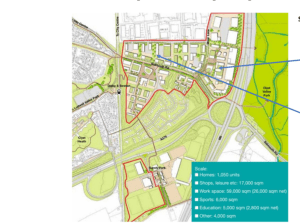
Interesting proposals for changes to Sidmouth Road and Junction 30 of the M5. The Motorway Services and Sowton Park and Ride being developed as a “Mixed Neighbourhood” (see image above).

The Governments require the Greater Exeter Housing target to be 53,200 new homes over the next 20 years. That is for the combined area governed by East Devon, Teignbridge, Mid Devon and Exeter.

Exeter’s housing ambitions

Karime Hassan, chief executive and growth director of Exeter City Council revealed this week a proposal for 12,000 new homes in the City of Exeter over the next 20 years. His vision of “Liveable Exeter”, for delivering a transformational housing programme for Exeter from 2020 to 2040. involves the creation of 8 new neighbourhoods.

Exeter’s published Vision

Red Cow Village (St David’s) – 664 homes in new neighbourhood, including new work space, on both sides of the railway around St David’s Station.

Water Lane (close to Exe Valley Park) – 1,567 homes. A space for expanding leisure attractions near the quay, with low traffic or car-free development with attractive cycle and walking connections.

Marsh Barton – 5,544 homes in a new neighbourhood. It will remain an important employment and retail area, but with the integration of living and working, to make better use of riverside location. Development linked to the new proposed train station. Creation of new types of work space, including light industrial, workshops, office and shared work space.

East Gate (Heavitree Road) – 962 new homes, an enhanced approach to the city centre from the east, reduced traffic on Heavitree Road and a greater provision for public transport, walking and cycling. New places to live close to the city centre will exist alongside existing neighbourhoods.

West Gate (Western Way) – 617 new homes, opening up access to the river and canal from the city centre, a new cultural destination, an expanded and connected park at the heart of the city, a “Green Bridge” promoting active travel across the river.

South Gate (Holloway Street/South Street linked via Topsham Road) – 300 new homes, establishing an improved link between the city centre and the historic quayside, with a greater emphasis on the wall, city gates and Southernhay.

North Gate (North Street) – 308 new homes, a new approach to the city from St David’s, uncovering the medieval city wall.
Sandy Gate (land off Sandygate roundabout) – 1,050 new homes in a new sustainable and well-connected mixed-use neighbourhood, bridging the city and the new and existing neighbourhoods to the east, providing recreational, cultural and entertainment space where Exeter meets the proposed Clyst Valley Park.

Mid Devon’s published ambitions.

Mid Devon’s Local Plan is almost complete with a Planning Inspectors hearing due in the next few weeks to consult on their final draft.

Culm Valley on the South side of the M5 opposite Cullumpton create a new community of up to 5,000, with a new Motorway junction and railway Station.

Junction 27. A landmark project for a leisure and tourism development involving Tim Smit from the Edan Project
Tiverton Eastern Urban Extension will cover 153ha, to the east of Tiverton.

Teignbridge future ambitions.

Teignbridge has just started a review of their Local Plan and therefore their plans are in the infancy.

Brownfield Their preferred option to develop brownfield land for development however, the required number of homes the government require Teignbridge to build, is not possible to meet the housing needs from brownfield land only. Therefore, open countryside will need to be considered for development to meet the housing needs.

Garden village is being considered with the new settlement proposal to be between 1500-10,000 homes.

So – What are East Devon’s Ambitions?

Hard to say.

Although the other 3 Authorities are keeping their residents well informed on their sections of the GESP proposals, East Devon has been an almost total blackout! There has been a Local Plan in place since 2016 with most of new development being built in an area known as the West End. That is an area close to Exeter’s border plus the new Town of Cranbrook.

At East Devon District Council Strategic Planning Committee on Tuesday 29th January it was hoped that Agenda item 12 would be able to explain more on the Greater Exeter Strategic Plan strategy and provide councillors some clarity on the East Devon Local Plan, plus the East Devon Villages Plan only agreed last year which most councillors only learned the previous week, would be jettisoned and replaced with a brand new East Devon Local Plan by 2023.

Local Plan to be replaced

At the meeting last week, the Head of Planning Ed Freeman explained that the present Local Plan was in 2 parts, with the section on Policies would require total re-writing because the Policies would be “substantially superseded” by the emerging GESP Policies. He also explained that the Villages Plan policies, will be merged into the new Local Plan.

Tory Councillor Philip Skinner who along with Tory Councillor Paul Diviani who are the only 2 East Devon`s elected representatives on the GESP “steering group committee” along with 2 elected members from the 3 other Authorities gave only a few hints on some of the latest thoughts for the GESP Strategy for East Devon.

Higher Density Housing for Exeter proposed for GESP

Regarding a question on Housing, he explained that it had been decided by the steering group, that each authority had a certain quota of dwellings proposed and it was not correct that if one Authority was unable to provide the housing numbers, other Authorities were required to build extra dwellings to offset the shortfall. He also explained that Exeter City Council had to return to the drawing board to enable extra dwelling numbers through “much higher density” within the confines of the City.

East Devon will take on most of the Industrial and commercial development for the GESP

Councillor Skinner also told the meeting regarding business development that he aimed to “Get the best for East Devon” and explained that to “Our strength and Exeter’s demise, they do not have the capacity, but we do!” and claimed most of the commercial and industrial development “will be in our patch”

After 2 years of joint secret meetings.

Exeter’s residents know what to expect with “Liveable Exeter”, Teignbridge residents are being told that their local plan is being re-assessed and are having public consultations, and Mid Devon residents have been through their public consultations and an agreed local plan about to be approved.

However, the residents of East Devon only know that their local plan is now being superseded by a new plan with substantial more housing and more industrial, commercial and business development.

All will be revealed in July 2019 after the District Council Elections. Who will you trust to steer East Devon through the next few years of obtaining the most appropriate and suitable Planning Policies. Leave it to the Tory Councillors who have kept everyone in the dark?

Or choose an Independent who are the major opposition for East Devon?

“More than 165k social homes lost in six years, says CIH”

“The number of social rent homes in England has plummeted by 165,697 in just six years, analysis by a trade body has found.

As many as 199,000 of social rent homes will have been lost between 2012 and 2020, according to analysis of government data by the Chartered Institute of Housing released yesterday.

The housing trade body estimated 140,828 council homes and 57,869 housing association properties will be lost by 2020.

Terrie Alafat, chief executive of CIH, said: “For many people on lower incomes, the only truly affordable option is social rent.

“It is simply unacceptable that we are losing so many of our most affordable homes at a time when more and more people are in need.”

The loss was mainly due to homes sold through right to buy but also demolitions and properties being converted to ‘affordable rent’, the CIH said.

Alafat added: “Government investment is still heavily skewed towards the private market.”

The CIH analysis found 79% of the central housing budget up to 2020-21 is directed towards private housing, with just 21% going to affordable housing.

“Rebalancing this budget could make a big difference – it is vital that the government supports councils and housing associations to build more homes for social rent,” Alafat said.

She added that CIH supports the principle of helping tenants move into home ownership but said “it cannot be at the expense of other people in need”.

Since 2010 funding for social rent, which tends to be around 30-40% cheaper than market rent, has been cut and funding has instead gone towards homes for ‘affordable rent’, which can be up to 80% of market rents.

CIH said the projection of 199,000 homes is lower than previous estimates because the government has made several “positive announcements” including funding for housing associations, lifting the HRA borrowing cap and abandoning plans to force councils to sell their most valuable empty homes to pay for an extension of right to buy.

Minister for housing Kit Malthouse said: “Providing quality and fair social housing is a priority for this government – evidenced by the fact we have delivered over 400,000 affordable homes since 2010.

“And by abolishing the borrowing cap, we’re also giving councils extra freedom to build the social homes their communities need and expect.”

https://www.publicfinance.co.uk/news/2019/02/more-165k-social-homes-lost-six-years-says-cih

Will Exeter take the pressure off East Devon with 12,000 new homes?

Owl says: unlikely!

“Plans for 12,000 new houses in Exeter will be unveiled today as the city expands over the next two decades.

The biggest house-building project will be in Marsh Barton, where more than 5,000 new homes are planned.

Thousands of others will be built in Sandy Gate, East Gate and Red Cow village.

Other schemes are also in the pipeline, including a new bridge over the Exe, cultural spaces and new schools.”

https://www.bbc.co.uk/news/live/uk-england-devon-47030319

Sidford Business Park – appeal lodged

“We have today received the news that most people living locally didn’t want to hear. Namely, that the applicants who submitted a planning application to build a business park on agricultural land in an AONB, have now submitted an appeal against the decision taken last October by the District Council to oppose their application.

This clearly is very disappointing and speaks volumes about the attitude of the applicants to the wishes of those who live locally. After all, the Town Council, the District Council and 1,400 local residents who signed our petition all oppose the proposed business park.

We are determined to immediately take steps to raise funds to allow the Campaign to represent the views of local residents at the planning appeal hearing that will now have to be held. Our next email will set out how we intend to raise the funds to do this.

However, in the meantime we would again remind you of our timely ceilidh fundraising event which is being held on Saturday 23 February in Sidford Social Hall, Byes Lane, Sidford, starting at 7.30 pm. Tickets cost £5.00 and can be obtained by emailing us or from the Rising Sun in Sidford, the Red Lion in Sidbury or Paragon Books in Sidmouth.

It’s more imperative than ever to support us!

This is what we have today issued as a press release –

The Campaign is disappointed but determined to fight on!
The news that the applicants have lodged an appeal, whilst not unexpected, is nonetheless a massive disappointment, particularly for local residents who have overwhelmingly made their views known about this unwanted and unnecessary business park.

The fact that the applicants are going to an appeal when the District and Town Councils and so many local residents have all said that they are against the proposed business park shows how little the applicants care about the local area and its people.

The Say NO Campaign is absolutely determined to support the District Council and its rejection of the planning application at the appeal. But to do this we need to engage professional representatives to forcefully make our case against the business park development. This will take a significant sum of money that we must raise from our supporters. We will now be publicising how people can donate directly into our recently opened bank account, as well as continuing to accept cash donations.

Sadly, our fundraising ceilidh on the evening of 23 February at Sidford Social Hall cannot be timelier. If anyone wants to support the Campaign financially, or in any other way, we would invite them to contact us at

nosidfordbusinesspark@yahoo.com.

Just about everyone puts the boot into the government on local authority funding

“The UK government is “in denial” over the sustainability of local government finances, a group of MPs has warned.

Councils are overspending on social care, reducing key services, relying on reserves and resorting to generating income from alternative sources, the Public Accounts Committee has claimed – adding that the government’s insistence that the sector is in fact sustainable is “extremely troubling”.

A PAC report, published today, noted that local authorities in England have seen their core funding from central government slashed by nearly 50% since 2010/11.

It added that such cuts have coincided with increasing demand for services such as housing – the number of homeless people in the UK has risen by one-third in the past eight years – adding that increased demand for social care means councils have had to cut spending in other areas. Spending on services outside of social care has fallen by 32.6% between 2010/11 and 2016/17, it stated.

The report added that, despite these figures, the Ministry of Housing, Communities and Local Government insists the sector remains sustainable.

“The government is in denial about the perilous state of local finances. It insists the sector is sustainable yet is unwilling or unable to back up this claim,” said Meg Hillier, chair of the PAC.

“Flimsy assertions have no place in financial planning. The fact that government has bailed out councils with short-term fixes should be evidence enough that all is far from well.

“Government needs to get real, listen fully to concerns of local government and take a hard look at the real impact funding reductions have on local services. And then it needs to plan properly for the long-term,” she added.

The cross-party group of MPs added that it was “deeply dismayed” that MHCLG views the financial sustainability of local authorities solely in terms of a “small set of statutory services”, such as social care, rather than the full range of services local people need.

“It is extremely troubling that the government views the financial sustainability of councils solely in terms of statutory services, rather than the full range of services local people need and can reasonably expect councils to provide,” Hillier said.

Overall local authority spending on services fell by 19.2% in real terms between 2010/11 and 2016/17, which the PAC says has pushed the MHCLG into using short-term cash injections, such as the £1.4bn allocated in the 2018 Budget.

Permanent secretary at MHCLG, Melanie Dawes, told the PAC in November: “We believe the sector as a whole is sustainable if the amount of resources available to it can deliver the statutory services that it is required to deliver.”

The report recommended that MHCLG should work with local authorities to collect evidence on the impact on service users of providing funding through one-off funding boosts as opposed to long-term funding arrangements.

In the 2019/20 local government finance settlement communities secretary James Brokenshire said that core spending power would increase from £45.1bn in 2018-19 to £46.4bn in 2019-20 – a cash increase of 2.8%.

“This year’s settlement paves the way for a fairer, more self-sufficient and resilient future for local government. That is why local authorities will have more control over the money they raise and a real terms increase in their core spending power,” he said.

The Local Government Association recently warned that discretionary services are under threat due to cuts to central government funding.

Further reaction to the report:

Rob Whiteman, CIPFA chief executvie, said: “It is widely accepted that the current funding model for local authorities is no longer viable, and without bold policy solutions vital public services will continue to be eroded in order to balance the budget.

“We should all share the concern that if current trends are allowed to continue, it will be some of the most vulnerable in society who will be missing out on services and experiencing worsening outcomes as a result.”

Richard Watts, chair of the Local Government Association’s resources board, said: “We agree with the Committee that the financial sustainability of local government cannot be defined by the ability of councils to just provide statutory duties.

“Pressures continue to grow in children’s services, adult social care, and efforts to tackle homelessness, and this is leaving increasingly less money for councils to fund other discretionary services, such as the maintenance of parks, certain bus services, cultural activities and council tax support for those in financial difficulty.”

Andrew Gwynne, shadow communities and local government secretary, said: “Nine of the ten most deprived councils in the country have seen cuts of almost three times the national average.

“And when you cut vital support services in such areas, social problems grow – and demand for those services only becomes greater.”

https://www.publicfinance.co.uk/news/2019/02/local-government-finances-unsustainable-mps-warn