Increased Parking Charges – Extraordinary Scrutiny Meeting Thursday, October 24, from 6pm, at Blackdown House

“Last month, East Devon District Council’s cabinet agreed to launch a consultation process on increasing the hourly tariff in nine car parks from £1 to £1.20.

If approved, the following car parks would be affected: Lace Walk (Honiton), West Street (Axminster), Orchard (Seaton), Central (Beer), Ham East, Ham West, Roxburgh and Mill Street (Sidmouth), Rolle Mews (Budleigh Salterton), London Inn, Imperial Road and Queen’s Drive (Exmouth).

The district council says the proposals would allow ‘more efficient management’ of the car parks and encourage motorists to use the less popular facilities.

The decision has been called into scrutiny by councillor Mike Howe.

Scrutiny has the right to request any decision made by the cabinet or a portfolio holder be discussed by them, with a view to make recommendations, prior it being implemented.

The scrutiny meeting will take place on Thursday, October 24, from 6pm, at Blackdown House, in Honiton.”

https://www.exmouthjournal.co.uk/news/extraordinary-scrutiny-meeting-called-to-discuss-parking-1-6323425

Exmouth developer wants to build private houses before affordable ones …

Yeah, right … and then somehow the houses don’t get sold (maybe because people don’t know where the affordable houses will go if ever they are built) and then the affordables disapear … and then all high-cost housing gets built … and then suddenly they all sell …

Developer behind 36-home Exmouth scheme asks for more time to deliver last affordable dwellings – so it can sell private properties

Councillor whose group enabled Sidford Business Park now wants traffic cuts!

EDDC’s Hypocrite of the Year Award should go to Tory councillor Stuart Hughes, whose Tory group when it was in power sneaked in permission for Sidford Business Park to be included in the Local Plan at the last minute. Now he is “trying” to get a vehicle weight restriction in the village!

In 2018 he said it was pointless trying to stop the development on Highways grounds:

https://eastdevonwatch.org/2018/11/19/calls-for-removal-of-sidford-business-park-site-in-local-plan-are-unrealistic-says-highways-boss-stuart-hughes/

Background from 2016 when he and his fellow councillors acted positively and some might say disingenuously to support the business park in Sidford:

https://eastdevonwatch.org/2016/02/05/could-councillor-stuart-hughes-have-done-more-for-sidford-fields/

Rumour has it that Councillor Hughes is spending much less time in his area these days so try to catch him when you see him if you want to give him your opinion!

Local Enterprise Partnership “scrutiny” laid bare (and a chance to see for the scrutiny not working for yourself)

Comment as post:

“Heart of the South West (HotSW) Joint Scrutiny Committee

meets on

Thursday October 17
at County Hall 2.15 pm

(public may attend but not speak) to consider, amongst other things, a review of its own scrutiny performance and how it could be improved. This Joint Scrutiny Committee is the nearest thing we have to democratic oversight of our Local Enterprise Partnership (LEP), HoTSW. Judge how good it is for yourselves. The Joint Committee comprises 17 councillors drawn from just nine of the 17 odd Devon and Somerset local and unitary authorities. Political proportionality only applies to the four nominees from each of the two County Councils.

https://democracy.devon.gov.uk/documents/g3572/Public%20reports%20pack%2017th-Oct-2019%2014.15%20Heart%20of%20the%20South%20West%20HotSW%20Local%20Enterprise%20Partnersh.pdf?T=10

FIRST A RECAP & SOME SCENE SETTING.

In 2010 the government started approving bids from self-selecting, business led, Local Enterprise Partnerships. LEPs were encouraged to make ambitious plans to run their local economies and bid for central government growth development funds, effectively kick starting English Devolution. HotSW is the selected LEP covering Devon and Somerset. By 2014 HotSW had agreed, in secret and with no scrutiny, a growth strategy with government. Nothing was openly published until 2015. This growth strategy is built around doubling the local economy in 20 years (3.53% annual growth rate) by increasing productivity and population growth. The targets are wildly unrealistic and therefore undeliverable.

This government devolution experiment has come in for severe criticism from the Public Accounts Committee (PAC) (e.g. 2016): “It is alarming that LEPs are not meeting basic standards of governance and transparency, such as disclosing conflicts of interest to the public….LEPs are led by the private sector, and stakeholders have raised concerns that they are dominated by vested interests that do not properly represent their business communities.”

As a result, the Department for Communities and Local Government commissioned a “Review of Local Enterprise Partnership Governance and Transparency”, Led by Mary Ney. This review made 17 recommendations (2017) to improve governance, accountability and scrutiny of LEPs. Although the Department accepted these recommendations, they adopted a “light touch” approach, leaving LEPs and Local Authorities to work out the details for themselves.

Not surprisingly the PAC concluded this year (June 2019):

“We welcome the improvements to LEP governance and transparency since we last examined these issues, but there is still a long way to go for all LEPs to reach the rigorous standards we expect. We remain concerned that LEP boards are not yet representative of their local areas and business communities and that local scrutiny and accountability arrangements are not strong enough considering the significant sums of public funding that LEPs manage.”

NOW TO THE HOTSW SCRUTINY REVIEW ITSELF.

First thing to note is that of the 17 members of this Joint Scrutiny Committee, only eleven attended the very first scrutiny meeting last November. This attendance dropped to ten in February and then to just five in June, with Devon County Councillor R Bloxham for Broadsclyst, being amongst the absentees. This is the bare minimum for a quorum. This scrutiny committee has all the appearance of being in crisis. Perhaps members feel out of their depth scrutinising regional economic issues? Perhaps members feel inhibited from diving deep where all past HoTSW decisions have been rubber stamped? Maybe they have been warned not to undermine the LEP for fear of losing central funds? Could HotSW be confusing them with detail (oldest administrative trick in the book)? There is a plea for shorter presentations up for discussion.

Scrutiny Committee Members have canvassed views from other County and Unitary Authorities to try to understand their Scrutiny arrangements for LEPs, and have concluded that the HotSW arrangements are “more developed than in many authorities”. “Current arrangements are having some impact but have further to go.” A report proposes some changes to strengthen the transparency and quality of scrutiny (e.g. to adopt the Devon County practice for public participation, web casting, public attendance and speaking) and minor tinkering with the Terms of Reference to allow them to be more pro-active.

For discussion is this list of how to judge their Scrutiny success over the next year, with only three meetings to do it in:

1. Positive and impactful relationship between Scrutiny and the LEP, evidenced by change or amendments to policy or decisions.
2. Being cited in advance of priorities, decisions and strategy arising for the LEP
3. Clarity on the Chair of the Board and LEP’s ambitions and how Scrutiny can add value particularly to investment strategy.
4. Representing the ambition and concerns of the South-West’s residents
5. Demonstrable contribution to productivity and growth by the LEP
6. Increasing democracy in regional government
7. Scrutiny to build a culture of learning and improvement, taking account of best practice nationally

THERE IS NO SHORTAGE OF THINGS TO SCRUTINISE.

At the February 2019 meeting the annual HotSW performance review, commissioned from Ash Futures, was presented to this Scrutiny Committee. It gave an early view of progress already faltering.

https://democracy.devon.gov.uk/documents/g3570/Public%20reports%20pack%2014th-Feb-2019%2014.15%20Heart%20of%20the%20South%20West%20HotSW%20Local%20Enterprise%20Partnersh.pdf?T=10

“…….the review of economic data leads to the overall conclusion that the HoSW economy, at best, continues to track the ‘baseline’ growth scenario. That is, there is no firm evidence that it is achieving either ‘strong’ or ‘transformational’ growth as aspired to in the Strategic Economic Plan.” [Baseline – continuing to fall behind UK average].

“The plan outcome measures and objectives in the current economic environment do not currently look achievable, certainly in the short-term. …..It is our view that some of the outcome targets, particularly those associated with the ‘transformational’ target, now look very aspirational in their nature.”

“Currently, there is no ‘feedback loop’ back to the Strategic Investment Panel to develop its understanding of ‘what has worked well, and what not’ with investments made….. A better understanding of how investments have developed would lead to better long-term decision-making.”

Following that, the LEPs covering Cornwall, Devon and Somerset had an opportunity to submit evidence at the beginning of August to the Treasury Committee Inquiry into regional imbalances in the UK economy:

The preface to the evidence reads: “We have put forward two submissions; one on behalf of Cornwall Council and Cornwall and the Isles of Scilly Local Enterprise Partnership and another on behalf of the Heart of the South West Joint Committee and the HotSW Local Enterprise Partnership representing Devon, Plymouth, Somerset and Torbay.”

“We are submitting this joint letter as being neighbouring areas we have similar policy asks which the committee might find helpful to have highlighted as well as the nuances that are described in our two responses. There is no clear definition of what constitutes a region and we believe these two documents provide detailed insight into the complexity of this subject.”

Cornwall then followed this introduction with a detailed response for their part of the region comprising 4,342 words and four graphs but the detailed HotSW response was left blank. My understanding is that Local Authorities decided/were instructed to feed inputs to HotSW, stand back and let HotSW take the lead. Unfortunately, any County inputs have got “lost in the post” and the only organisation that took the time, trouble and effort to answer questions raised in the Inquiry terms of reference from the perspective of Devon’s economy was the East Devon Alliance.

http://data.parliament.uk/writtenevidence/committeeevidence.svc/evidencedocument/treasury-committee/regional-imbalances-in-the-uk/written/103800.html

WHY DOES THIS MATTER?

Philip Aldrick, economics editor The Times, summarised why the Treasury will become more interested in regional funding in an article he wrote in 2018:

“….One theory doing the rounds is that the Treasury wants to know if its business support schemes are working. A crunch is coming. England’s 39 local enterprise partnerships [now reduced to 38- one went rogue], designed to boost growth, are funded largely with EU grants. For 2014 to 2020, they secured €6.51 billion of European Structural and Investment funds. Of that, €2.5 billion was allocated to “enhancing the competitiveness of small and medium enterprises”, about a tenth of which went to less developed regions.”

“After Brexit, now formally delayed until 2021 after yesterday’s transition deal, the money will no longer make the round trip via Brussels. It will come directly from Westminster, bringing with it more political accountability. If the money is not driving productivity, which it patently isn’t, the Treasury may decide the financial medicine could be administered more effectively.”

And the PAC in the 2019 report (referred to above) picks up the same theme:

“Despite spending up to £12 billion of taxpayers’ money [between 2015/16 and 2020/21], the Department has no real understanding of the impact which the Local Growth Fund has had on local economic growth. The Department chose not to set quantifiable objectives for Growth Deals. Its assertion that every £1 of local growth funding could generate £4.81 in benefits is an unsubstantiated estimate. Despite receiving quarterly performance data from LEPs, the Department has not used this to build up an understanding of the impact that local growth funding has had nationally, nor has it measured what value for money LEPs have delivered so far.”

Spending vast sums of tax payers’ money without strong scrutiny and without demonstrable value for money isn’t going to continue. Treasury watchers will be familiar with their scepticism over future plans that lack realism. Ambition not only has to be deliverable but be seen to be delivered.”

DevonLive’s best misleading headline yet! “Cranbrook will get its town centre within years”


NOT the design – just a warning!

The headline appears above an article which suggests that Cranbrook developers will now get away with financing “one multi-use building” (cheap) instead of the larger number of (more expensive) single-use buildings they were supposed to construct!

The part of the article not reproduced is the second half where DCC councillors (including former EDDC Leader Sarah Randall-Johnson) desperately try to pretend this is good news.

“… The multi-purpose building would provide flexible space for children’s, youth, adult and library services with potential use for public health and highways services, as well as space for the town council.

The trigger point for the provision of the children’s centre facilities– 2,000 home occupations – has been met which means the Cranbrook consortium of developers have to construct the children’s centre facilities no later than June 10, 2021.

The existing planning agreement also requires them to provide town council offices in the town centre by June 2021, and youth facilities and a library when the 3,450 home is occupied, currently expected to be in 2025.

Devon County Council’s cabinet on Wednesday morning though unanimously agreed to try and renegotiate the agreement so that the multi-purpose building can be built, and subject to funding, should be complete within the next two years.

It would be built on land that is supposed to be the town centre, but currently remains an empty green space.

Cllr Rufus Gilbert, cabinet member for economy and skills, said that bringing forward the delivery of the library and the youth services would provide the town with the services that it needed. He added negotiations were still ongoing, but he enthusiastically welcomed the move, saying: ”
“The existing agreement is for these key services – the library, youth and a children’s centre facilities – to be built over the next two to six years.

“But as the town is continuing to grow, especially noting the high proportion of families with young children and need for additional support, we must bring them forward.

“We believe that our proposed integrated community facilities building in Cranbrook’s town centre is the best way to provide these required facilities.

“It would allow residents to benefit sooner, and give us greater control over the design and delivery of the facilities.” …”

https://www.devonlive.com/news/devon-news/cranbrook-town-centre-within-years-3414376

EDDC: Greater Exeter Strategic Plan update – delayed to at earliest April 2023

Highlights:

The Heart of the South West devolution bid highlights a number of challenges facing the LEP area which planning has a key role in addressing. These are:

 Comparative productivity is 29th out of 39 LEP areas
 An aging workforce and major skills shortages reported
 Our performance remains low on key productivity measures: wages, innovation, inward investment exports and global trade
 Disproportionate growth in our older population is placing unsustainable burdens on our services
 Strategic infrastructure has good coverage, but is incomplete
 Insufficient capacity of the road network and motorway junctions
 Uncompetitive travel times to London and the south east
 Incidents and extreme weather threatens transport resilience
 Housing supply not keeping up with demand
 Threats to National Parks and Areas of Outstanding Natural Beauty

Page 5: revised timetable pushes back a GESP agreement to not earlier than April 2022. HOWEVER, this is almost certainly a spelling error, as on page 11 this is contradicted:

Once adopted it will supersede specified strategic parts of the East Devon Local Plan, Exeter Core Strategy, Exeter Local Plan, Mid Devon Local Plan (once adopted), Teignbridge Local Plan Parts 1 and 2 and any other Development Plan Documents as necessary. The preparation timetable is as follows:
 Site Options and Draft Policies – June 2020
 Draft Plan – November 2020
 Publication (Proposed Submission) – February 2022
 Submission – July 2022
 Examination – September 2022
Adpotion : April 2023
(not April 2022)

Page 8: The Greater Exeter Strategic Plan will cover the local planning authority areas of East Devon, Exeter, Mid Devon and Teignbridge (i.e. those Councils’ administrative areas excluding Dartmoor National Park). It will be prepared jointly by those four local planning authorities with the support of Devon County Council under Section 28 of the Planning and Compulsory Purchase Act. It will:

• set an overall vision and strategy for the area in the context of national and other high level policy and in particular climate emergency declarations and the NPPF;
• contain policies and proposals for strategic and cross boundary issues where these are best dealt with at a larger-than-local scale;
• set the overall amount of growth for the period 2020 – 2040;
• promote the Liveable Exeter vision by allocating urban regeneration sites in the city;
• implement the overall vision and strategy by allocating strategic sites of 500 or more
homes which may include urban extensions and new settlements ;
• provide districts’ local plans with targets for non-strategic development

EDDC response to Jurassic National Park: sit back and do nothing

“Resolve to await the Governments response to the recommendations; and note that the Chilterns, the Cotswolds and the Dorset and East Devon AONBs are potential candidates for future designation as National Parks.”

Click to access 4Protected%20Landscape%20Report.pdf

EDDC resigned/sacked councillor attempts to change constitution over parking price rises

Nice to see the non-Independent Group councillors of different parties and no party flexing their collective muscle!

“Councillor Paul Millar has tabled a motion for the next full council meeting, calling for car park strategy to be added to the list of 12 areas of policy the full council has the final say over – taking decisions out of the cabinet’s hands.

The cabinet, made up of nine councillors from the ruling Independent Group, has agreed to put parking charge changes out to a public consultation.

The proposals include raising the hourly rate in some East Devon car parks from £1 to £1.20 and introducing pay-and-display to previously free car parks.

According to the council’s constitution, cabinet can make decisions on parking changes without consulting full council.

Cllr Millar’s motion, which has been ratified by the chief executive, would force cabinet to make a recommendation to full council instead.

In an email seen by this title, Cllr Millar writes: “I believe this amendment is a vital safeguard to ensure the leader does not rush ahead with a consultation on a policy the vast majority of members do not support.

“It would be a waste exercise, and a waste of taxpayers’ money.

“I believe we must ensure that democracy is served.”

In response, East Devon leader Ben Ingham said: “With most notice of motions, unless I have put them forward or supported submission, I like to hear the debate in full before deciding.

“In the past, I have found keeping a motion simple is best.

“We shall see.”

Following the cabinet’s decision to launch a consultation, the proposals were called in by EDDC’s scrutiny committee which decided to set up a forum to consider car parking tariffs in East Devon.

Cllr Millar, an Independent councillor who is no longer part of the ruling Independent Group, is concerned that cabinet will press ahead with the consultation before the parking forum reports back with its findings.

The motion to change the constitution, set to be discussed at the full council meeting on Wednesday, October 23, has received cross party support having been seconded by Liberal Democrat Eileen Wragg.

Two other Lib Dem councillors and one Conservative have backed the motion.

Eight of the Independent East Devon Alliance councillors, including leader Paul Arnott, are listed as supporters.”

https://www.midweekherald.co.uk/news/east-devon-constitution-amendment-tabled-1-6314614

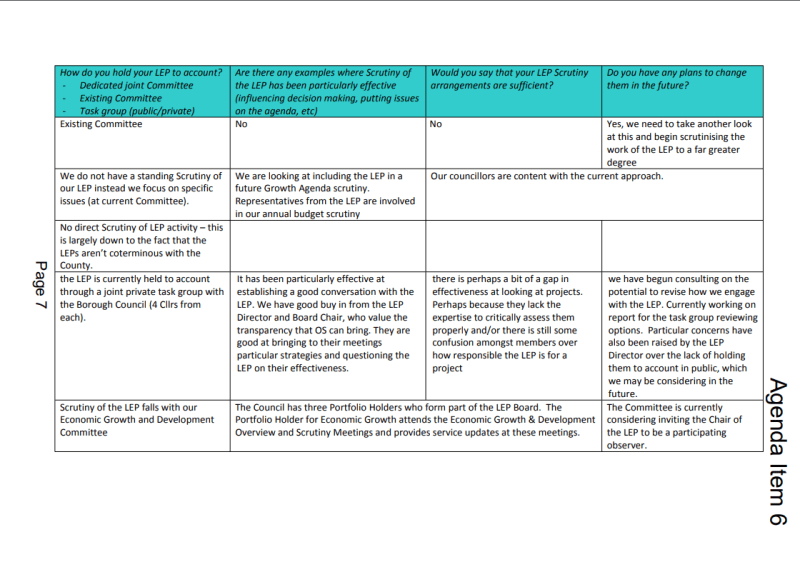
Councils scrutinising our Local Enterprise Partnership? In your dreams!

HEART OF THE SOUTH WEST (HOTSW) LOCAL ENTERPRISE PARTNERSHIP (LEP) JOINT SCRUTINY COMMITTEE

Thursday, 17th October, 2019

A meeting of the Heart of the South West (HotSW) Local Enterprise Partnership (LEP) Joint Scrutiny Committee is to be held on the above date, at 2.15 pm

Here is the agenda for the scrutiny committee (and the minutes of the previous one):

https://democracy.devon.gov.uk/documents/g3572/Public%20reports%20pack%2017th-Oct-2019%2014.15%20Heart%20of%20the%20South%20West%20HotSW%20Local%20Enterprise%20Partnersh.pdf?T=10

and here is a chart which accompanies Agenda item 6:

Joint Scrutiny LEP Review (Pages 5 – 16)

from which it can be extrapolated that scrutiny …. needs tightening? … beset by lack of co-operation? … unsatisfactory? … non-existent? … utterly ineffective, pointless and dangerously ineffective stewardship of OUR money?

Take your pick?

Sale of Knowle site to PegasusLife – final numbers in

You decide whether it represents value for money (and maybe take some developer costs with big pinches of salt):

District council reveals how much developer will pay for former Sidmouth HQ – with new retirement community ‘set to be worth £50m’

“Seaside residents earn £1,600 less than people inland”

“Workers living in seaside areas are likely to earn on average £1,600 less per year than those living inland, BBC News analysis has found.

The research also found two-thirds of coastal areas had seen a real terms fall in wages since 2010.

The All Parliamentary Group for Coastal Communities said the findings showed seaside towns were “being left behind”.
But the government said its £200m Coastal Communities Fund was changing lives.

This week BBC News is profiling what life is like in seaside communities across the country as part of the Coastal Britain project.

The most deprived places in England are found by the sea, according to government figures…..

The issue of low pay affects coastal communities across the whole country.

BBC News has analysed income data collected by the Office for National Statistics for 632 parliamentary constituencies in Great Britain. Taking into account full and part time workers the analysis found:

In coastal constituencies, the typical (median) worker in 2018 earned £22,104 before tax

That was £1,681 less than the typical worker in a non-coastal area, who earned £23,785 before tax

When inflation was taken into account annual wages fell in two-thirds of constituencies between 2010 and 2018, a “real terms” decrease

The coastal constituencies of Wirral West and Weston-Super-Mare have seen real terms wages fall by around 25% since 2010

Mike Hill MP, chair of the all Parliamentary Group for Coastal Communities, said “for a long time coastal communities have felt forgotten”.

“Many of these areas have lost industries like shipbuilding that once provided thousands of well paid jobs,” he said.

“There’s research that shows that without major changes, by 2030 places like my own constituency of Hartlepool could see lots of young people leave coastal areas, which underlines why we need the right investment to protect the long term future of our coastal towns.”

At its party conference in September, Labour promised to build 37 offshore wind farms, which it claimed would generate more than 60,000 new well paid jobs in coastal areas. …”

https://www.bbc.co.uk/news/uk-england-49890749

“East Devon leader responds after call for him to resign”

Might more councillors who rushed into “The Independent Group” which Ben Ingham was so very keen to lead, be regretting their choice? If so, interesting times. As Owl has already pointed out, if all other non-Tory and non-TIG councillors came together (Independent, East Devon Alliance, Green and Lub Dem) they would be the majority group …

“East Devon leader Ben Ingham said he will not be ‘stepping aside’ after a former cabinet member called for him to resign.

Writing for this title, Councillor Paul Millar said Cllr Ingham has ‘failed to deliver a workable policy let alone the change people were asking for’.

In response, Cllr Ingham said he will not be stepping down ‘just yet’ and the ruling Independent Group are focused on delivering on its policies ‘including a balanced budget for next year’.

Cllr Millar said: “I call on Ben to do the right thing and step aside to allow someone more in touch with the reality of people’s lives to lead the council.”

In response, Cllr Ingham said: “I won’t be stepping aside just yet.

“There is so much to do and the Independent Group is eager to put our priorities into action.

“This includes preparing a balanced budget for next year.”

https://www.exmouthjournal.co.uk/news/ben-ingham-response-to-resignation-call-1-6311778

Allegations about Clyst St Mary anaerobic digester on Inside Out tonight

“Jemma Woodman investigates the green credentials of farm-based power production …”

Tonight BBC1 7.30 pm

Apparently, breaking agreements and not-so-green …

Surprise, surprise … yet again the Carters of Greendale involved! Yet another headache for Environment Portfolio holder Geoff Jung and Leader Ben Ingham.

Just one of many posts by East Devon Watch on this subject:
https://eastdevonwatch.org/2018/07/13/investigation-launched-at-greendale-business-park-by-the-environment-agency/

“Devolution white paper announcement accompanied by hint on unitary push”

So, Blackdown House could be a super-white elephant … worth less than Knowle, even at the Knowle’s knock-down price!

“Local areas could get more powers and cash from central government – but face government pressure to adopt unitary models, following this week’s Conservative Party conference.

Speaking this week at the conference in Manchester, chancellor Sajid Javid announced that the government was rebooting its devolution drive, promising a new white paper on the issue.

He said the move would give “more local areas more local powers to drive investments in the infrastructure and services they know they need”.

The English devolution white paper will set out how further powers and funding would be devolved across England, the Treasury said in a statement.

Director of the Northern Powerhouse Partnership, Henri Murison, welcomed the announcement, “particularly if it extends to taking more control of existing local spending from Whitehall, as well as retaining taxes raised locally and allowing areas to capture the additional revenues their investments generate.”

He said that passing investment directly to mayors and combined authorities was the best way of funding local transport services. …”

Devolution white paper announcement accompanied by hint on unitary push

Friends of the Earth climate emergency local authority league table

Highest: Wiltshire 92%
Lowest Spelthorne, Pendle, Ribble Valley 42%

Exeter 80%
Dorset 80%
East Devon 72%
Mid-Devon 72%
Torridge 68%

“This league table provides a perfomance score for every local authority in England and Wales (see notes on methodology at end of document).

All local authorities, even the best performing, need to do much more if climate catastrophe is to be averted. The government needs to provide them with the powers and resources to do so, and it needs to do much more itself. All local authorities should adopt an ambitious local climate action plan . And they should join with Friends of the Earth and others in urging more government action. Each local authority should declare a climate emergency as a sign of political intent.”

Click to access League_table_England_Wales.pdf

Big changes for PegasusLife – maybe Knowle won’t be retirement homes …

“Property developers PegasusLife, Anthology and Renaissance Retirement have announced that the three companies will merge to create Lifestory, a housebuilder that will cater to every rung on the property ladder, from starter to retirement homes.

Lifestory will operate across three regions, creating developments under all three of the existing brands through local teams. PegasusLife Group CEO, Mark Dickinson, becomes Lifestory’s CEO with three regional Managing Directors reporting to him.

The South and South West region will be led by Marc Evans, currently Chief Operating Officer at PegasusLife Group; the North and Midlands by Mike Gill, currently Regional Development Director at PegasusLife Group; and the London and South East region by Steve Bangs, currently Managing Director at Anthology.

Lifestory will be backed and funded by Oaktree Capital Management, current majority owner of both Anthology and the PegasusLife Group.

Focusing on the full spectrum of property development, the three regions will build homes tailored to first time buyers through to older customers looking to downsize.

Mark Dickinson, Lifestory CEO said: “We have created Lifestory to bring together three strong customer facing brands that will deliver on our goal to transform customer experience when buying a new home, whatever stage of life our customers are at.

“This is an exciting new venture for Anthology, PegasusLife and Renaissance Retirement as each company brings a range of strengths to the combined business, but at the core is a commitment to providing outstanding customer experience.

“Our customers’ shared aspirations for quality homes and quality of life is at the centre of our business model, with their stories and lives at the heart of our ethos and approach.

“The combined regional companies have been rebranded Lifestory, however we will continue to trade to our customers through our sub-brands. This flexible approach allows us to address the needs of different customers and communities across the country.

“The collective portfolio currently amounts to some 50 projects and with the launch of Lifestory, we have ambitious growth plans to double this within a three-year period. Our refreshed and united approach sets us in a strong and unique position to successfully achieve these targets.”

Three developers merge to create new housebuilder Lifestory

EDDC Leader on car park charges … basically now a complete muddle

Leader Ben Ingham’s statement – a masterclass on how to make a bad decision worse – a rushed, piecemeal temporary fix that suits no-one and has no clear outcome.

“East Devon Scrutiny committee to set up a Task and Finish Forum to consider the ongoing future of the council’s car parks

At a meeting of East Devon District Council’s Cabinet on Wednesday 2 October, councillors discussed a report detailing proposed changes to car parking charges in East Devon and resolved to take the following steps:

That statutory advertisement and consultation procedures are actioned with a view to changing car park charges from £1 to £1.20 per hour in high demand car parks (including the London Inn, Imperial Road and Queens Drive car parks in Exmouth).

The 20p per hour increase for the high demand car parks is a rounded down inflation based increase from 2010.

To implement a 12 month trial of free coach parking in Seaton Jurassic coach park and a promotional tariff of £2 all day parking in the Canaan Way and Brook Street car parks in Ottery St. Mary

The Cabinet decision was subsequently debated at a meeting on Thursday 3 October by the council’s Scrutiny committee, which has resolved to set up a Task and Finish Forum (TAFF).

This will consider a range of matters with regard to the ongoing and future management and operation of the Council’s car parks.

There is a possibility that the Cabinet decision will also be called-in to the Scrutiny Committee but we will not know this until later next week.”

https://exmouth.nub.news/n/leader-of-east-devon-district-council-issues-statement-regarding-car-parking-tariffs

Car park charges and whelk stalls – a councillor comments

From the blog of East Devon Alliance Sidmouth Rural Councillor John Loudoun, who comments:

  • “I attended last evening’s District Council Cabinet meeting to join 23 other Councillors in voicing our opposition to the proposed increases in parching fees at some car parks and changes to the number of publicly available spaces at others.
  • In particular I was concerned about the proposals as they will detrimentally affect the car parks in Sidbury and Temple Street, as well as the Ham East, Ham West, Roxburgh and Mill Street car parks.
  • The meeting ended up in a farce as the Cabinet carried out a Dutch auction when it came to trying to agree by how much it would increase the parking fees. It was no way to run a whelk stall!”

“Last evening the District Council’s Cabinet met to consider a much-trailed report on changes to car parking arrangements and fees across East Devon. Those of us who are not Cabinet members, about 48 of us, are able to attend and make comments on any of the issues under consideration.

In total 24 non-Cabinet District Councillors spoke on this issue. Because there were so many of us wanting to speak, we were restricted to only two minutes to say what we wanted to.

Before any of us spoke we heard from two members of the public, one of who was James McClean who owns Sidmouth Pets in Temple street who made an impassioned set of arguments as to why the Temple Street car park should not be changed from a free car park to a pay and display one. James is collecting signatures, so please pop in and sign his petition.

I spoke out against the proposal to increase the price of parking in Sidmouth’s Ham East, Ham West, Roxburgh and Mill Street car parks. The proposal is to encourage drivers to use the Manor Road car park instead as it will remain at the current fee.

Not only might an increase, of, as proposed 50% mean that less people use our car parks, but this could lead to less people shopping in Sidmouth. Sidmouth and its traders don’t need this as the shops across Sidmouth and other local high streets are struggling.

It could also mean that drivers might decide to use the private car park opposite the Bedford Hotel as its closer to the town centre than the Manor Road car park is.

I also spoke against the proposal to turn Sidbury’s small free car park to one where only permit holders or residents who have paid for a reserved space can park there. This is a ridiculous proposal! The car park is well used every day and also during many evenings.

It is used to visit our two shops, our Church our Village Hall, our Parish Rooms and Sidbury Primary School. Without our free car park visitors to all of these venues would be forced to clog up Ridgeway, park on the A375 making access through the village even more difficult, or park in other parts of the village where residents will be hugely inconvenienced.

Sidbury’s car park is also used by many who live in the centre of the village and who either don’t have either off road parking spaces or have space outside or nearer to their homes.

After all of the 24 non-Cabinet members had spoken the Cabinet then debated the proposals. Oh dear! This turned into a complete farce as different Cabinet members proposed various amendments to the proposals and the Leader, Ben Ingham, who was chairing the meeting, totally failed to keep control of the discussions and in so doing added to what was already a confusing Cabinet debate.

After what seemed to be forever, the Cabinet, although not by a unanimous vote supported a set of slightly amended proposals keeping the intent to increase parking fees, although by not quite as much, in all the various car parks identified. The Cabinet settled on a 20% increase in these car parks after the Leader had in effect carried out a Dutch auction with numbers appearing to be plucked out of the air.

This was no way to make decisions which include increasing parking fees. Instead of pulling the report and reviewing it in light of the total opposition of the 24 Councillors who spoke against the proposals we ended up with a set of Cabinet decisions taken through a bidding process.

This matter will not end here. The Cabinet Minutes which will record last evening’s decisions on car parking will be presented to Full Council on 23 October. Councillor’s will have the opportunity to challenge the Minute and even vote against it, thus rescinding the decisions made by Cabinet.

Members of the public too can attend the Full Council and put across their points of view on this and any other matter.

Alternatively, a Motion could come from a Councillor which calls for the car parking proposals to be scrapped. This is set to run for a while longer!

If you are interested in reading the full proposals that were discussed last evening at Cabinet follow this link –

Click to access Car%20Parking%20Tariff%20Review%20-%20Careful%20Choices.pdf

“Town Hall Rich List 2017-18”

“In 2017-18:

There were at least 2,441 council employees who received total remuneration in excess of £100,000. That’s 135 more than in 2016-17.

607 council employees earned over £150,000.

A total of 28 local authority employees received remuneration in excess of a quarter of a million pounds in 2017-18.

The local authority with the greatest number of employees receiving remuneration in excess of £100,000 was Essex council with 55 employees in total earning over this amount. Essex also had the highest number of employees earning over £150,000 at 13.

The TaxPayers’ Alliance (TPA) presents the Twelfth Town Hall Rich List, the only comprehensive list of its kind, with council-by-council breakdown.

Praised in the past by politicians from across different political parties, it is the go-to guide for local government executive pay deals. It details the full remuneration and many of the names of all local council employees whose remuneration exceeds £100,000.

Many senior managers at local authorities have performed well in tough financial times. There are many reports of residents seeing no difference in the services they receive despite the necessary savings being made. However, the Town Hall Rich List also showcases the executives who have overseen failing departments, or received bumper pay-offs after poor performance in the job.

The research is a vital tool for taxpayers wanting to judge which authorities are delivering the best value for money.”

Full report here:

https://d3n8a8pro7vhmx.cloudfront.net/taxpayersalliance/pages/16524/attachments/original/1555592082/Town_Hall_Rich_List_2019.pdf?1555592082

Data – alphabetical by council:
https://d3n8a8pro7vhmx.cloudfront.net/taxpayersalliance/pages/16524/attachments/original/1555590752/Town_Hall_Rich_List_2019.xlsx?1555590752

Cranbrook: one multi-purpose DCC building triggered – maybe, if money available

But no plans for anything else.

“If all goes to plan the community facilities building will include a flexible space for children’s, youth, adult and library services with potential use for public health and highways services, as well as town council working space.

The building could be completed within two years, if funding is secured.

The trigger point for the provision of the children’s centre facilities – 2,000 homes being occupied – has been met which means the Cranbrook consortium of developers have to construct the children’s centre facilities no later than June 10, 2021.

The existing planning agreement also requires them to provide town council offices in the town centre by June 2021, and youth facilities and a library when the 3,450th home is occupied, currently expected to be in 2025.

But council officers are recommending the agreements be renegotiated so that a multi-purpose building can be built.

Nearly 2,000 homes in the new town are currently occupied and while the town has a primary school, an allthrough school, a multi-purpose building with GP surgery space and a train station, the only building that has been provided in the town centre is a the pub Cranberry Farm.

Other facilities such as additional town centre shops and a food store are commercially led and will likely only come when there are more people living in the town. There are no fixed timescales for when it may happen. …”

https://www.midweekherald.co.uk/news/tow-centre-community-building-plan-at-cranbrook-revealed-1-6302771