More new homes built on flood plains than off them

“New houses are being built in England’s highest-risk flood areas at almost twice the rate of housing outside flood plains, according to figures which a Government adviser warned showed the country was “storing up problems for the future”.

Housing stock in areas where flooding is likely at least once every 30 years has grown at a rate of 1.2 per cent per year since 2011, according to analysis by the Committee on Climate Change (CCC). By contrast, housing outside of flood plains – in areas with less than a 1-in-1,000 year chance of flooding – increased by an average 0.7 per cent a year over the same period.

Lord Krebs, head of the CCC’s adaptation sub-committee, said: “We are building faster in the flood plain than anywhere else.

“If the planning system is going to allow people to carry on building in the flood plain, we have to be aware we are storing up problems for the future because flooding is going to get more frequent.

“So you are locked into cycle of building and having to defend, and then having to build bigger defences because the flood risk has increased.”
On current trends up to 20,000 houses are likely to be built this year in flood risk areas.

Lord Krebs said he expected about 4,500 of these to be medium or high risk areas, where flooding is expected at least once every century.
Many of these are being built with the Environment Agency (EA)’s approval because they are behind existing flood defences, which the agency judges provide adequate protection, he said.

But such protection may not be adequate in future, with defences already being overtopped in recent weeks by “unprecedented” floods. “Today’s unprecedented may be tomorrow’s norm,” he warned.

Thousands of other homes in at-risk areas may be being built without the EA’s oversight because they are in small developments of less than 10 houses, he said.

Lord Krebs warned the continued spread of concrete and paving tiles over gardens and other green spaces was worsening the risk of flooding because it prevented water draining.

Farmers and grouse shooting estates had also increased the risk for urban areas by draining peat bogs on surrounding uplands, which used to provide a natural “sponge” for rainfall.

Senior EA officials have been among thousands of social media users to share a photograph in recent days showing flood waters lapping around a sign marking a development site with permission for 39 new homes, near Whalley in Lancashire.

But documents reveal the EA did not object when consulted by council planners on three applications for the development.
In two cases it made no comment, while in one case it said it had “no objection in principle”, only proposing conditions of sustainable drainage for the new homes.

The agency did raise concerns about an earlier plan that extended into the official flood risk zone, but waved through a tweaked plan that would see houses built immediately abutting the flood zone.

Photos appear to show that flood waters in recent days have extended at least to the edge of the proposed development site.

When the Telegraph attempted to contact the applicant for the development, his wife claimed the picture was “misleading” because the proposed houses were not to be built right by the sign, and were not due to be built “on what the Ribble Valley says is the flood plain”.

She would not confirm whether the flood waters had however extended into the area designated for development.

Ministers on Tuesday announced a further £50 million funding for local authorities to help support households and businesses affected by this weekend’s floods.

http://www.telegraph.co.uk/news/earth/flooding/12073672/Housebuilding-rates-higher-on-flood-plains-as-UK-stores-up-problems-for-future.html

Developments on flood plans: responsibility of local authorities

“Scientists have linked the recent weeks of flooding to climate change while the prime minister and Liz Truss, the environment minister, appear to have acknowledged that view, with both speaking of “unprecedented” weather conditions.

Even so, one new home in every 14 built in 2013-14 — the most recent year for which data are available — was constructed on land that has a significant chance of flooding, either from a river or the sea, according to FT analysis of official figures.

As 138,000 homes were built in total, this suggests that 9,700 properties were built on floodplains, with housing built on more than 90 hectares of land that is at risk of inundation.

The methodology changed in 2013-14 but earlier data indicate a fairly constant level of construction on floodplains, at about 7 per cent of total housebuilding.

John Healey, Labour’s shadow housing minister, called on the Conservatives to “make sure planning policy keeps up” with climate change. Despite the UK’s housing shortage government planning should take the increasing risk of flooding into account when deciding where homes should be built, he said.
A government spokeswoman said it had “put in place strong safeguards to stop inappropriate development in areas at risk of flooding”.

The final decision on whether to grant permission for construction on floodplains lay with local councils, which receive advice from the Environment Agency, she added.

After weeks of heavy rain from winter storms Desmond and Eva, KPMG, the professional services firm, said the total economic impact on the region could be £5.8bn. KPMG said its figure included £2.6bn-£3.3bn of losses and £2bn needed to boost flood defences.

The government was facing further pressure after the Federation of Small Businesses said about 75,000 smaller businesses at risk of flooding had found it difficult to find flood insurance and 50,000 had been refused cover nationally.

The FSB said it would be pressing the government to reverse their exclusion from the government’s flood programme, Flood Re, which guarantees affordable insurance.”

http://www.ft.com/cms/s/0/bfa49cb0-acbf-11e5-b955-1a1d298b6250.html#axzz3vigeuAqw

Flooding – a Taunton solution

A comment on the Guardian website:

“I live near Taunton Somerset and the local Council are on a flood plain crusade-If they see a flood plain, they build on it. Their defence is 1 in 50 year risk or 1 in a 100 year risk, and this bares [sic] no relationship to what is happening. They also like using attenuation storage, but imagine when we have sustained rainfall, what are they going to do? Yes you have guessed right-release all the attenuation water storage at the same time into River Tone-exactly!

They in my opinion don’t care about traffic congestion, traffic pollution, over development and are destroying what was a beautiful market town. They ought to be ashamed!”

Development on flood plains

… Earlier this year, the Chancellor announced a flagship housing scheme which saw 20 brownfield sites around the country designated as new ‘housing zones’, with local councils given access to money and experts to expedite the building process.

Greenpeace UK researchers used details obtained through Freedom of Information requests to plot the location of these housing zones, and cross-referenced this with flood risk maps from the Environment Agency.

They found around nine of the 20 zones, comprising a total of 9,000 planned new homes, are in areas now identified as being partially or fully at risk from flooding. Under the terms of a new government flood-insurance scheme soon to be implemented, these properties would be excluded from cover.

This would leave homeowners reliant on commercial insurers who may choose not to insure homes built in flood zones, or do so at prohibitively expensive rates.

A spokesperson for Flood Re confirmed to Greenpeace that ‘properties built from 2009 onwards’ in flood-risk areas are still excluded from the government scheme, adding: “It would be irresponsible to incentivise developers to build in such areas simply because those properties could have their insured flood risk ceded to Flood Re.”

Greenpeace UK also obtained new figures showing that the number of people employed by the Environment Agency to work on Flood and Coastal Erosion Risk Management fell by 230 – a 5% cut – in the last three years. The agency plays a key role advising councils on flood risk.

Greenpeace UK chief scientist Dr Doug Parr said: “The current flood emergency isn’t even over yet, and the government is already storing up the next one. Rushing to build thousands of new homes in flood-risk areas whilst at the same time cutting flood protection staff is a recipe for disaster.

“David Cameron’s lofty rhetoric at the UN climate summit is helpful, but if he’s serious about protecting Britain from the impacts of climate change, these words need to translate into climate-savvy policies on the ground.

“When it comes to energy, flood defences, and other big infrastructure projects, we need the government’s hands to start following what the government’s mouth is saying rather than acting of their own accord.”

http://www.westernmorningnews.co.uk/Half-area-earmarked-fast-track-housing/story-28340599-detail/story.html

Flood defences: time for a rethink?

“… On Monday, experts called for new measures to be implemented –such as raising new buildings a metre above ground – to help cope with global warming-induced flooding.

Prof David Balmforth, a former president of the Institution of Civil Engineers, said that conventional defences, such as the barriers that line the river Greta in Keswick, had to be supplemented with more innovative methods.

We tend to design defences to a particular standard, to give an annual probability against flooding, which might be, say, a one-in-100- or one-in-200-year chance of the defence being overtopped,” he said.

“That would be a typical sort of figure that would be used. The question that now remains is: were the events that we’ve now seen in recent days so excessive that it’s reasonable to expect them to overtop defences?

Suggesting ways of coping with future deluges, Balmforth cited work that was done in Nepal. He said: “They have regulated minimum threshold levels about a metre above surrounding ground for any new major development, whether or not it’s in a flood risk area.”

http://www.theguardian.com/uk-news/2015/dec/07/britain-flood-defences-storm-desmond-fit-for-purpose

” One in a hundred/ two hundred years” floods

What would have happened if Storm Desmond had chosen East Devon for its landing, with all its rivers and estuaries?

What the Environment Agency DOESN’T tell you is that the phrase ” one in a hundred or two hundred year event” does NOT mean such floods will ONLY happen once in a hundred or two hundred years: they mean 5 or 10 times in a thousand years – which could be five or ten years in a row! However, if we do get 10 years in a row and we query them when it happens in year 11 – they will tell us it is an acceptable statistical variation, etc. etc.

Plus the EA uses PAST events to work out what to do where the past is no guide whatsoever to the future.

In any case, with climate changes going haywire and El Nino playing up more than usual, it is all pretty meaningless.

What CAN you do? DON’T BUILD ON FLOOD PLAINS – the clue is in the name! And perhaps even extend the said floodplains!

Lack of cohesive coastal climate change policies leave people and infrastructure vulnerable

… “The team conclude that the mixture of decentralised and privatised management of services like rail is “not geared towards” addressing the impact of climate change. They add this will only be made worse if the Conservative Government continues to pay too little attention to the threat posed by climate change.

“Given the fact that the current UK government policy is not oriented towards prioritising climate change adaption and providing local authorities with more resources, this lack of action is not likely to change in the future,” continues Dr den Uyl.

“And given that this decentralised, privatised setting around infrastructure and coastal management applies to other areas in the UK, these areas may face similar challenges.”

http://www.westernmorningnews.co.uk/Lack-planning-leaves-coastal-services-vulnerable/story-27715996-detail/story.html

This is how you do coastal protection Councillor Moulding

http://www.midweekherald.co.uk/news/top_accolade_for_coastal_scheme_1_4162706

Compare with this “progress”:

http://www.sidmouthherald.co.uk/news/progress_in_sidmouth_s_coastal_defence_project_1_4162256

Eat your hearts out Pennington Point residents.

A masterclass on how to turn bad news into no news into good news

To read this EDDC spin you would assume that the project on Sidmouth coastal defences has gone fantastically well. In reality it has dragged on, and on, and on. And reading between the lines, that is exactly how it will continue.

A particular masterpiece of spin that has us laughing out loud is this from Andrew Moulding:

It is tremendously exciting to have reached the fourth stage of this long and technically challenging coastal defence project – we are now only a short step away from being in a position where we can actually start to produce the BMP itself and provide a detailed plan for the short, medium and long-term management of the beach and cliffs.”

http://www.sidmouthherald.co.uk/news/progress_in_sidmouth_s_coastal_defence_project_1_4162256

A short step away from STARTING!

Oh, and they forget to mention that, with 25-40% cuts in government spending, the chances of anything happening are slim.

Contrast this with Lyme Regis where a £20m four-phase scheme was completed in one year in 2014 which consisted of a 390m (1,200ft) stretch of sea wall should last 50 years and will safeguard nearly 500 homes and access to the town.

http://www.bbc.co.uk/news/uk-england-dorset-28898711

Feniton, tanks, the stump and ex-Councillor Brown – oh, and voting!

The latest blog post of Independent Councillor Susie Bond:

It’s been a fascinating run up to the 2015 election.

I’ve enjoyed dropping off my leaflets to the houses in Feniton, Gittisham and Buckerell and chatting to those who were at home and had time to talk to me. People are really engaged with this election and want to talk about national issues as much as local ones … and there was a lot of interest in the ‘rise of the Independents’, as one resident described it.

There were several recurring themes which were of concern to everyone in my ward … planning inevitably being at the top of the list.

On the stump, Question 1:

What about the attenuation tanks?

This is a continuing issue in Feniton, where developer Wainhomes eventually succumbed to pressure from me, the Parish Council, EDDC and the media, and provided the attenuation tanks which were required of them following the planning inquiry in 2012. However, the Parish Council is not happy with the system the developer was forced to install and has grave concerns that the tanks will fail. This is an unresolved issue and a great worry to those who live ‘downstream’ of the site.

There is quite reasonably very little faith in developers and the promises they make to sweeten the offer of concreting over precious sites. Residents still bemoan the loss of the tennis courts which were such a feature of life in Feniton before the developer of the existing Acland Park site bulldozed them in pursuit of profit. Promises were made that they would be reinstated, but the tennis courts never reappeared.

On the stump, Question 2:

Whatever happened to the Graham Brown affair?

The police investigation into former Councillor Graham Brown was closed with no action taken in 2014 as there was insufficient evidence to take the case forward. End of story.

My concern is not with the individual, but what process allowed anyone whose main source of income was building and development to be put in a position of such authority (he was for some time Chairman of the Local Development Framework panel, the committee set up to steer the Council towards adoption of a Local Plan, identifying possible sites for development and deciding on strategic allocations for development within the district), and who must have found it extremely difficult not to confuse the two roles. I have called on a number of occasions for an internal inquiry at EDDC to look into the lapse in decision-making which allowed this to happen. Each time I posed the question, I was met with the response that the matter was in the hands of the police and therefore any internal investigation would be inappropriate.

At the full Council meeting in February, and given that the police investigation had concluded, I asked the question again.

I was surprised on this occasion when my request for an internal inquiry was met with the minimal response, ‘Why?’, with no further explanation. In other words, whether the former councillor was charged with any misdemeanour or not, EDDC never had any intention of conducting a full internal inquiry.

Something to think about for the next council.

On the stump, Question 3:

What is the East Devon Alliance?

There was lots of interest on the doorstep in this umbrella organisation formed to support independent candidates.

It’s a lonely business being an Independent.

I chose to stand as an Independent in 2013 so that I was not constrained by party politics which, to my mind, should have no business in local government. But standing alone means that you don’t have the backup of the party machine to write your leaflet for you and even pay for it to be printed, as well as the advice of those who have been councillors before.

Had it existed at that time, I would have welcomed the help and advice of the East Devon Alliance to steer me through the minefield of the election process. Two years on and EDA candidates have the support of their leader, Cllr Ben Ingham, whose 25 years of experience is invaluable to those who don’t know how the system works. Their excellent website (http://www.eastdevonalliance.org.uk/) has given the candidates an on-line profile and their YouTube videos have reached a wide audience.

Once elected, every ‘Independent EDA’ candidate will work hard in their ward and represent that ward at Council. No Party Whip to ‘encourage’ them to vote in a particular way and no question of being lambasted by senior party figures if they fail to conform.

Final thoughts

Don’t forget to voteBut whatever the issues and whatever hue your politics, the main thing is to make your voice heard and Remember To Vote. The turnout at elections has fallen steadily from an all-time high of 83% in 1950 to just 65% in 2010, reflecting disillusionment and mistrust of party politics.

If you want to change the status quo, Thursday 7 May is the day to make a difference!

https://susiebond.wordpress.com/2015/05/02/on-the-stump/

Campaigners given second chance to challenge developer in court on drainage/flooding issues

Good news for Feniton?

http://www.localgovernmentlawyer.co.uk/index.php?option=com_content&view=article&id=22736:campaigners-get-appeal-judge-to-reinstate-ground-of-challenge-in-housing-battle&catid=63&Itemid=31

‘Peoples’ Voice on Planning’ event has support from all but one Party!

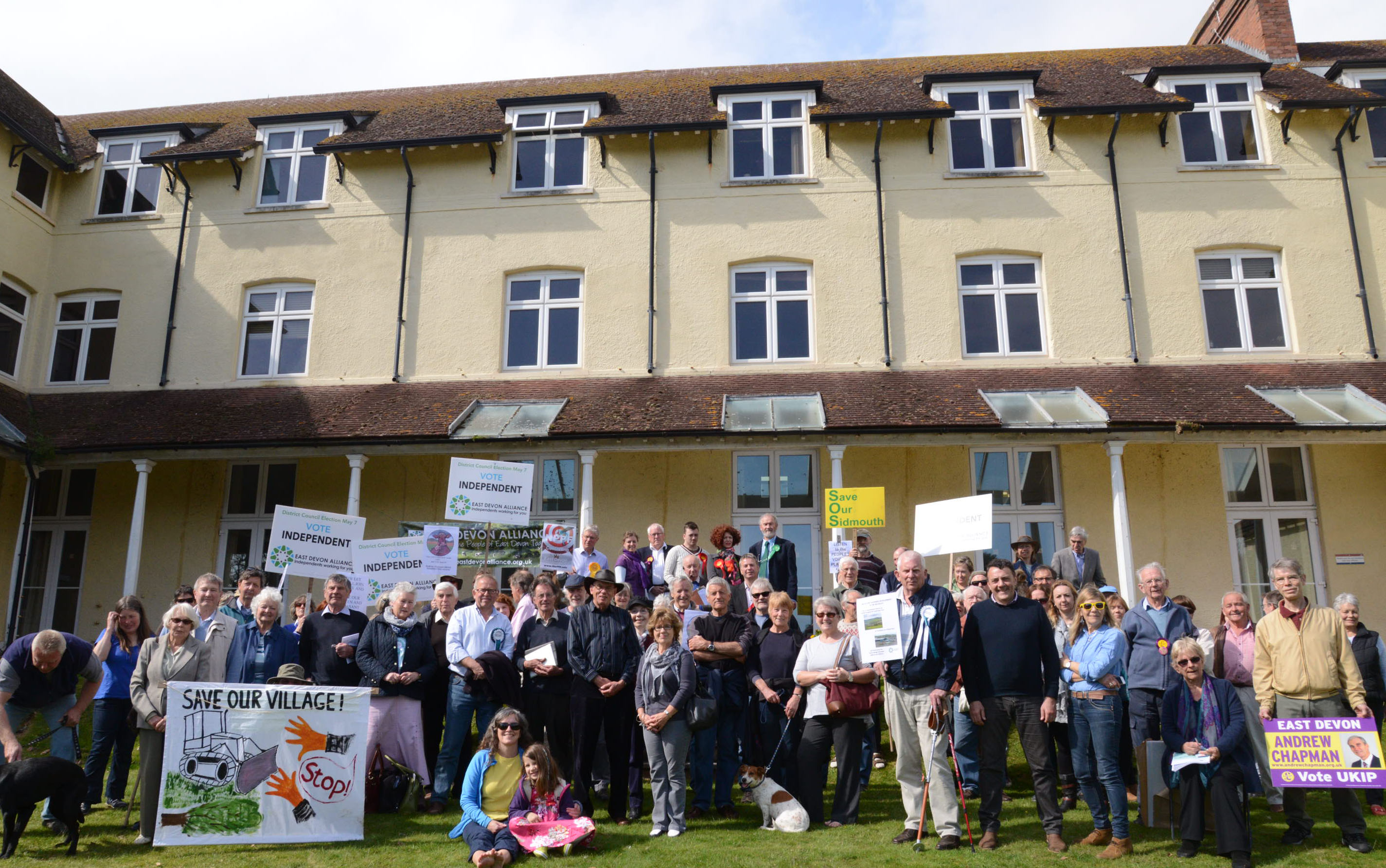
CoVoP crowd
About a hundred people from various parts of East Devon gathered on the lawn terraces at Knowle on Sunday afternoon 12th April to listen to speeches from parliamentary candidates and others about the national planning set-up.

The event was part of a nationwide Day of Action called for by Community Voice on Planning (Covop) and was organised by Covop trustees and Vision Group for Sidmouth.

Parliamentary candidates representing all parties, except the Conservatives ( from both the Honiton and Tiverton and the Devon East constituencies) gave their views on the national planning system and in particular the National Planning Policy Framework (NPPF).

All of them promised reforms, mostly involving prioritising brownfield developments, protecting the countryside and building more affordable homes for local people. Conservative candidates were unable to attend and failed to respond to requests to send a written statement.

The first speaker was ex-judge Ian McKintosh, of East Devon Alliance and Covop. After reviewing the situation nationally and locally, he argued that local communities were being ignored in favour of developers.

Caroline Kolek, Labour candidate for Honiton and Tiverton, claimed that Labour would stop land-banking and prioritise brownfield sites. She shared her slot with Henry Brown, district councillor candidate for St Paul’s ward, Honiton,who made the case for more affordables for local young people.

Paul Edwards of the Green party and candidate for Tiverton and Honiton, said the countryside was our greatest resource and should be protected.

John Kelly, standing in for Andrew Chapman, UKIP parliamentary candidate for Devon East, who was indisposed, argued that the planning crisis was caused by EU regulations.

Stuart Mole, Liberal-Democrat candidate for Devon East, contended that the reforms recommended by the recent Communities and Local Government committtee should be immediately instated, for instance the proposal that all planning permissions be counted towards the 5-year land supply.

Claire Wright, Independent candidate for Devon East, put the blame for the massive increase in inappropriate development squarely on the government’s deregulation of the planning system and on the Local Council’s developer-bias and failure to produce a Local Plan.

Robert Crick, for Vision group of Sidmouth, read a litany of some of the inappropriate developments approved in the district in the past three years together with statistics provided by the Campaign for the Protection of Rural England. These included the prospect of about a thousand houses a year in East Devon until 2031.

A Covop petition, to be presented to the new government, was handed out along with a short guide to the planning system and suggested reforms. The petition is available online at https://you.38degrees.org.uk/p/covop2015

No massive business park for Sid Valley after all!

See http://saveoursidmouth.com/2015/03/26/proposed-sidford-business-park-removed-from-local-plan/

Flood prevention cuts “a false economy” say MPs

http://www.westernmorningnews.co.uk/Flood-defence-repair-cuts-false-economy-say-MPs/story-26224557-detail/story.html

Sidmouth’s flood risk “plan” gets “council approval”

Except it isn’t a plan – it is a currently preferred option. And it hardly merits approval as there is as yet no money to fund it.

[Sidmouth DCC Councillor Stuart Hughes] said: “Future plans depend on what, if any, scheme can be promoted with a robust business case and justified cost benefit for national funding.

“Additional partnership funding will also need to be sourced.”

Can unfunded, aspirational ideas really be plans – or are they election “promises”?

http://www.devon24.co.uk/news/sidmouth_s_flood_risk_plan_gets_council_approval_1_3990483

Can EDDC be serious, with revised Local Plan?

One example here: http://saveoursidmouth.com/2015/03/16/what-eddcs-revised-local-plan-specifies-for-the-sid-valley/

Reminder: National Day of Action event at Knowle (12 April)

Details here: April 21 National Day of Action CoVoP Poster

The Knowle event is being organised by two East Devon Alliance members, Ian McKintosh and Mike Temple, who have joined the National Community Voice On Planning (CoVoP) as trustees.

CoVoP is constantly working for reforms in the National Planning Policy Framework (NPPF), as this latest message shows:

‘Two letters from our members have appeared in the Telegraph this week – both were edited to remove references to CoVoP National Day of Action (12 April), but both expressed the key message that the Government is not listening to communities on planning. References to the 5 year plan supply have also been removed. The full text for both letters is here: letters to the Telegraph

Another member has written to Messers Betts, Pickles and Lewis expressing similar frustration.
“Dear Honourable Members
The NPPF is NOT working for local communities!
Further to the recent press release by the Communities & Local Government Select Committee on the operation of the NPPF I would like to draw your attention to further evidence that the NPPF is not protecting important local landscapes from inappropriate development and that Planning Officers appear to be ignoring sustainable planning principles outlined in the NPPF.
South Lakeland District Council (SLDC) planning officers regularly emphasise the ‘presumption in favour of development’ to their Planning Committee while failing to mention that all planning applications (even those for allocated sites in a Local Plan), must comply with core planning principles in the NPPF. These are outlined the NPPF (219 paragraphs) which also states (several times) that these sustainable planning principles are ‘material considerations’ when assessing planning applications.
At an SLDC Planning Committee meeting last December (attended by six out of 17 members), a planning application for a prime green field site, in the middle of Grange-over-Sands’ Conservation Areas, was granted. Committee members did not bother to discuss major infrastructure problems (drainage and roads), or the likely adverse impact on the town’s tourist economy. These problems had been raised at the meeting by local residents and Town Council representatives who also drew attention to the relevant paragraphs in the NPPF. No wonder people are losing faith in local planning procedures. This feels like a District Council dictatorship; not a local democracy.
We believe that District Councils are being ‘threatened’ with appeal cases by developers that they claim will be resolved in favour of granting planning permission. Also, we have evidence that our planning officers are also being pressurised into putting planning applications before the Planning Committee, due to perceived time constraints, even when the developer has not provided all the evidence needed to support their application such as an adequate flood risk assessment that considers the potential for flooding elsewhere.
We need more homes in areas where there are good employment prospects and good public transport links. We do not need them in areas with poor employment prospects, poor public transport links and inadequate infrastructure or where they will become second homes and have an adverse impact on Conservation Areas that are important to the local tourist economy.
I realise that you cannot do anything about specific issues raised above but I hope that the next Parliament will rectify some of the problems highlighted as a matter of urgency!
At the moment many of us do not know who to vote for at the next election because none of the main political parties have robust proposals for dealing with these serious planning inadequacies.
Yours sincerely”

We need to shout more loudly! Please demonstrate your frustration on 12 April.

Best wishes
Julie

Chairman of CoVoP
admin@covop.org

Community Voice on Planning
A National Alliance to provide communities with an effective voice on planning
http://www.covop.org’