Obscene Persimmon bonuses – add nearly £41,000 to cost of each house

Guardian Letters:

What do management bonuses mean to the average customer? Persimmon’s CEO will receive a bonus of £110m. Senior staff bonuses will exceed £500m. Persimmon builds approximately 15,000 houses a year. Arguably, therefore, the CEO’s bonus adds at least £7,333 to the price of a house and the senior staff bonuses add £33,333. It is unlikely that the customer would think it money well spent.”
Martin Jeffree

AND

“Surely the housebuilding company Persimmon can now afford to run its own help-to-buy scheme.”
David Simpson

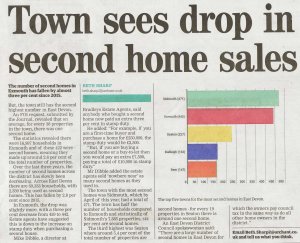
Exmouth sees drop in second home sales

“The number of second homes in Exmouth has fallen by almost three per cent since 2015. But, the town still has the second highest number in East Devon.

An FOI request, submitted by the Journal, revealed that on average, for every 38 properties in the town, there was one second home.

The statistics revealed there were 16,987 households in Exmouth and of these 422 were second homes, meaning they made up around 2.6 per cent of the total number of properties.

Over the last three years, the number of second homes across the district has slowly been decreasing. Across East Devon there are 69,333 households, with 2,339 being used as second homes. This has fallen by 2.8 per cent since 2015.

In Exmouth, the drop was slightly more, with a three per cent decrease from 459 to 442. Estate agents have suggested this is down to the increase on stamp duty when purchasing a second house. Mike Dibble, a director Bradleys Estate Agents, said anybody who bought a second home now paid an extra three per cent in stamp duty. He added: “For example, if you are a first-time buyer and purchase a home for £250,000, the stamp duty would be £2,500.
“But, if you are buying a second home or a buy-to-let then you would pay an extra £7,500, paying a total of £10,000 in stamp duty”.

Mr Dibble added the estate agents sold ‘nowhere near’ as many second homes as they used to.

The town with the most second homes was Sidmouth, which by April of this year, had a total of 471. The town has half the number of households compared to Exmouth and statistically, of Sidmouth’s 7,885 properties, six per cent are second homes.

The third highest was Seaton where around 5.4 per cent of the total number of properties are second homes – for every 19 properties in Seaton there is around one second home.

An East Devon District Council spokeswoman said: “There are a large number of second homes in East Devon for which the owners pay council tax in the same way as do all other home owners in the district.”

Source:
Journal 14 December 2017

The original article:

“Tenants lose out after landlord pressure halves UK home insulation cap”

“Tenants face missing out on energy bill savings after the government caved in to landlords’ demands by lowering a cap on the costs they face to upgrade Britain’s draughtiest homes.

Landlords must improve the energy efficiency of F- and G-rated homes from next April under new regulations designed to protect vulnerable tenants and cut carbon emissions.

But on Tuesday the government said the costs of the upgrade would be capped at £2,500, half what officials had originally told buy-to-let landlords to expect. The total energy bill savings is put at £337m.

The government’s own assessment warned that the lower cap means only 139,200 households in England and Wales will benefit from better insulation by April 2020. That is 121,000 fewer than if the cap was at £5,000.

Campaigners and industry groups said the change left ministers’ ambitions of tackling fuel poverty in tatters.

“This could leave a gaping hole in the government’s plans to meet its own fuel poverty targets,” said Richard Twinn, policy adviser at the UK Green Building Council.

The Association for Conservation of Energy said the government had “missed a big opportunity” to improve the efficiency of thousands of homes.

Officials said the lower cap was necessary to protect owners by ensuring “that landlords of F and G rated private rented properties are not faced with an excessive cost burden”.

The government also said the changes were necessary because landlords’ access to finance for energy-saving measures had become harder since the policy was first proposed.

One green energy charity accused Theresa May of putting landlords’ interests ahead of tenants. Max Wakefield, a campaigner at 10:10 Climate Action, said: “The prime minister claims to be prioritising controlling domestic energy costs, but in reality policy is being designed to suit landlords. …”

“Hundreds of thousands of renters will now be left wondering when, if ever, they can expect to live in a decent home.”

But the National Landlords Association was not happy either, calling the proposal a “complete farce”. It said there was a risk landlords who still could not afford the upgrades would leave properties empty and unimproved. …”

https://www.theguardian.com/money/2017/dec/19/tenants-lose-out-landlord-pressure-halves-uk-home-insulation-cap

“Should we tax housebuilders more heavily than other companies?”

Owl says:

Would it happen? Could it happen? In your dreams!

Housebuilders are amongst the biggest donors to the Tory party and David Cameron let them write their own rules within days of becoming PM. Theresa May has talked about fairness in housing but has done NOTHING.

“Much of housebuilders’ success is the result of state policy.

I’ve never been a fan of windfall taxes, but I am feeling a bit more of one this week.

We have written in the magazine frequently about how much we hate the government’s Help to Buy scheme because of the way it exacerbates the original problem – high house prices. It’s a bad fiscal policy piled on a bad monetary policy.

More recently, we have raged about the effect of this on the housebuilders: for years they have been making verging on obscene amounts of money out of exploiting the scheme. They have also been paying much of that money out to their executives, thanks to badly constructed compensation schemes.

You can try and explain or justify this as much as you like but the truth is that one of the worst effects of Help to Buy has been a whopping transfer of wealth from the taxpayer to the top men at house building firms. There is evidence aplenty of this .

Look to the news this weekend that the chairman of one of the UK’s biggest building firms, Persimmon, has resigned over his role in creating one of the most repulsive bonus schemes of all time, one which is set to pay its top three executives £200m and another 137 managers around another £600m. None of these people started the business. None of them risked their own capital.

Half of Persimmon sales are backed by Help to Buy. When Help to Buy was launched, Persimmon’s market capitalisation was £2.5bn; now it is over £8bn.

There’s a lot to say here about bonus structures and executive pay (see many blogposts past). But there is something else to say about companies whose success is the result of state policy. If the government has been the main driver behind a firm’s profits, is the Treasury perhaps entitled to more than the standard rate of tax on those profits?

Or, to look at it from another direction, does the firm in question have a higher level of social obligation than other companies – in this case, perhaps, to be obliged to build more social housing than usual – or, given the dismal quality of UK new-build housing, to just build better housing than usual?”

https://moneyweek.com/should-we-tax-housebuilders-more-heavily-than-other-companies/

No Devon or Cornwall area in top 50 places to live – and only one in Dorset

Only one area in the south-west: Purbeck, Dorset. None in Devon or Cornwall.

Red flag ,..

http://www.mirror.co.uk/news/uk-news/dentists-jeremy-hunts-constituency-refuse-11712710

Isn’t 7 years in power long enough to stop blaming previous government for housing situation?

David Cameron came to power with the Lib Dems in May 2010 and began the “austerity” policy. One of the first things he did was arrange for developers to rewrite planning policies in their favour. Yet Theresa May still prefers to blame Labour for her housing disasters!

“The sombre shadow of the Grenfell Tower disaster hung over Prime Minister’s questions.

The six month anniversary of the tragedy was noted by Theresa May and Jeremy Corbyn, with the Labour leader saying it had shone a “light on the neglect of working class communities.”

The Labour then used all six of his questions to shine a forensic light on the Government’s record on housing.

Mr Corbyn struck a dignified, almost sorrowful tone as he listed how homelessness has risen by 50% under the Tories and rough sleeping has doubled.

“Will the Prime Minister pledge that 2018 will be the year when homelessness starts to go down?” he asked.

Theresa May ignored the question.

The Labour leader tried again. And again.

Would the Prime Minister ensure all rented homes are fit for human habitation?

Would she ensure no children would spend next Christmas in temporary accommodation?

Would the Prime Minister bring in a three-year rent cap?

You could tell Mrs May was uncomfortable as she went into full automaton mode, regurgitating her “I’m perfectly clear” and “we are clear” lines without actually saying anything of substance or even providing an answer.

The Prime Minister was stronger in her last couple of responses but she was forced to rely on the previous Labour government’s record to defend her own administration’s failure on housing.

Voters may have lingering gripes about what Tony Blair and Gordon Brown achieved but they will also know it is now seven years since they were in power.

May’s use of statistics was not so much brazen as shameful. At one point she claimed “statutory homelessness peaked under the Labour government and is down by over 50% since then.”

Yes, it peaked in 2003 but then fell every year until Labour left government in 2010. It is now rising again.

Corbyn could not resist ramping up the volume for his final question where he accused the Tories of putting the interests of private speculators and rogue landlords ahead of tenants.

Though clips of these attacks tend to play well with the faithful, he was at his most effective when asking quiet, penetrating questions.

It was not a walkover for the Labour leader but it was a return to form after an indifferent couple of weeks.

SCORE Jeremy Corbyn 2 Theresa May 1”

http://www.mirror.co.uk/news/politics/who-won-pmqs-jeremy-corbyn-11686939

The Times: “Builders shun brownfield sites” [what a surprise!]

Are we surprised? Oh, come on – of course not. And interesting that a council, for example, might spend, say, £10 million on a new HQ, but not have the “resources” to identify all suitable brownfield sites for housing in their district!

Parts of the countryside are being needlessly sacrificed to build homes because thousands of small plots of previously developed land are being overlooked by councils, a study has found.

Sites with room for almost 200,000 homes are missing from official registers of brownfield, according to research by the Campaign to Protect Rural England (CPRE). These include former builders’ yards, disused warehouses and blocks of garages no longer used for parking.

The government says that it has a “brownfield first” policy when identifying land for more homes. To help to achieve this it has ordered all councils in England to publish registers by the end of this month of brownfield land suitable for development.

The CPRE examined 43 of the registers already published and found that only 4 per cent of the brownfield land they identified was on small sites that could accommodate up to ten homes.

In the budget last month the government announced that it wanted councils to identify enough small sites to provide 20 per cent of the new homes needed.

Philip Hammond, the chancellor, also said that the government would “ensure that our brownfield and scarce urban land is used as efficiently as possible”.

The CPRE found that if councils met the 20 per cent target on small brownfield sites, an additional 189,000 homes could be built in England.

It asked a sample of local authorities how they identified land for their brownfield registers and found that they “routinely disregarded small brownfield sites”.

Councils overlooked the sites even though they usually had infrastructure in place, such as rail and road links and schools and hospitals, which were less likely to be available for greenfield sites.

The reasons given by councils for not listing small brownfield sites included that they lacked the resources to identify them and that housebuilders did not favour them because of the perception that the planning system was too burdensome for small plots.

The CPRE said that the failure to identify small brownfield sites was resulting in councils allocating land for development in the green belt, the protected land around 14 cities.

It has called on the government to amend official guidance to ensure that councils identified all the available brownfield sites in their areas.

Rebecca Pullinger, CPRE’s planning campaigner, said: “Up and down the country tens of thousands of small brownfield sites are not included in brownfield land registers and their housing development potential missed.

“The current system of collecting this data must be improved if we are to unlock the potential of brownfield and stop developers finding an excuse to build on greenfield areas.”

In October Sajid Javid, the communities secretary, said on The Andrew Marr Show on BBC One: “I don’t believe that we need to focus on the green belt, there is lots of brownfield land, and brownfield first has been a policy of ours for a while.”

Source: The Times (pay wall)

Grenfell Tower resident blogged that fire would be result of council’s deliberate neglect – local media refused to take up the story

Local media knew about this for YEARS but refused to take it up or investigate, leaving a lone Grenfell Tower blogger to document the unfolding disaster. One so-called “local” journalist was actually filing copy from Dorset!

“[Edward] Daffarn [a social worker who had lived in Grenfell Tower for 15 years] is understandably emotional when reflecting on the last few months, but more than that he is angry. Angry with the way he feels Grenfell residents were treated by the Kensington and Chelsea Tenant Management Organisation – the people who were entrusted to maintain the estate and keep its residents safe. Angry with the Royal Borough of Kensington and Chelsea Council, which was meant to scrutinise the KCTMO. Angry with a society which didn’t seem to care about people like him – people who live on housing estates – until it was too late.

“The reality is if you’re on a housing estate it’s indifference and neglect, two words that sum up everything about the way we were treated,” he says. “They weren’t interested in providing housing services, keeping us safe, maintaining the estate. They were just interested in themselves.”
It wasn’t for us to tell the council what they should be doing we were just trying to raise an alarm.

Edward Daffarn, Grenfell Action Group blog

Daffarn and fellow Grenfell resident Francis O’Connor had been blogging on behalf of the Grenfell Action Group since 2012. They wrote about issues that concerned their tight-knit community – air pollution, the closure of the local public library, and their fears that corners were being cut during the refurbishment of the tower.

“We wanted to record for history how a community on a housing estate in the fifth richest country in the world could be ignored, neglected, treated with indifference. We never thought we could make change. We just wanted to record what was happening,” he says.

Daffarn and O’Connor shared a theory that Kensington and Chelsea – a London borough more widely known for its museums, designer shops and flower shows – actually wanted its council estates to go into decline, so that the residents would leave and expensive flats could be built in this sought-after location. For this they were described as fantasists.

“We weren’t fantasists,” he says, visibly hurt. “We were trying to raise genuine concerns about how our community was being run down.”

The natural consequence, he concluded, would be loss of life. Which is why on 20 November 2016, frustrated and desperate, Edward wrote the blog post KCTMO – Playing with fire!

“It is a truly terrifying thought but the Grenfell Action Group firmly believe that only a catastrophic event will expose the ineptitude and incompetence of our landlord.”

A few months earlier a fire had ripped through five floors of a tower block in Shepherd’s Bush, just down the road. Edward was worried that if a fire broke out in his tower block residents wouldn’t know what to do. They had been given no proper fire safety instructions from the KCTMO. There were no instructions on individual floors on how residents should act in the event of a fire, there was only a recent newsletter saying residents should remain in their flats – advice which in the case of the Shepherd’s Bush fire would have led to fatalities.

There’s a lot of abusive behaviour evidenced forensically about what was happening to our community, but it wasn’t sexy so it never got picked up.

In March 2017 the KCTMO installed fire safety instruction notices in the entrance hallway to Grenfell Tower and outside the lifts on every floor of the building, again urging residents to “stay put” unless the fire was “in or affecting your flat”.

It wasn’t the first time the Grenfell blog’s authors had raised concerns about fire safety.

Before the blog began, when a school was built on the only green space the residents had, they wrote to the borough pointing out that access for fire and emergency vehicles had been compromised.

Later they blogged about the blocking of a fire exit with mattresses during the refurbishment and the power surges in 2013 that manifested in flickering lights, computers and stereos blowing up, and entire rooms filling with smoke. These continued for three weeks, Daffarn says.

“We were tenants we weren’t fire safety specialists but we were switched on enough to feel this was important and it was not being dealt with on our estate and that’s why we were blogging. It wasn’t for us to tell the council what they should be doing., We were just trying to raise an alarm.”

An alarm that went unanswered. The November 2016 blog post represented the last moment at which something might have been done to avert the disaster which followed six months later. But why didn’t anyone heed or investigate Daffarn’s claims?

Hidden within the story of the Grenfell blog is another story of the decline of local media. There simply was no local press on the ground in the borough of Kensington and Chelsea scrutinising the authorities and helping to amplify the voice of people like Edward Daffarn.

The last time he had the attention of a local journalist was in 2014 when Camilla Horrox, the reporter for the Kensington and Chelsea Chronicle ran front page stories about Grenfell residents’ concerns regarding the possible presence of asbestos on the site of the new school and about the power surges.

She had met Daffarn several times, and had been concerned about KCTMO’s dealings with the residents of the properties it managed.

But when the newspaper was closed down later that year Horrox was made redundant and all her Grenfell articles disappeared from the web. The Kensington and Chelsea Chronicle was incorporated into a website that reports on 29 west London districts.

Horrox’s replacement was expected to report on three boroughs – Kensington and Chelsea, Westminster and Hammersmith and Fulham – while based in Surrey, an hour’s drive away.

Some residents of the borough might have been under the mistaken impression that they did have a local newspaper. In 2015 a free paper, The Kensington and Chelsea News, was established to fill the gap left by the closing of the Chronicle.

But when I tracked down its reporter he explained that he was the sole reporter working on the paper, and on two other local newspapers – his salary was £500 a week and he did almost all his reporting from home in Dorset, 150 miles away. He made it to the borough only twice in two-and-a-half years, and the one story he ever published about Grenfell was from a council press release about the installation of the new cladding.

Though he always searched for a “good front page splash” for each of the three editions, he also made sure to find two pages of royal stories and two pages of entertainment stories.

Edward Daffarn didn’t take his concerns to the media in November 2016 because he no longer thought anyone would listen. But the blog was out there for everyone to see, he points out, if only they had been looking.

“We’d been blogging for three or four years and you go back over that time there’s a lot of abusive behaviour evidenced forensically about what was happening to our community, but it wasn’t sexy so it never got picked up.”
For Edward, what was going on at Grenfell wasn’t just a local story, but a national one. A story about invisible people in a society that cared more about celebrity and wealth than its most vulnerable residents.

Close to tears, he admonishes the nation’s journalists.

“If you look back now our whole community of North Kensington, the policy that the local authority was taking every public space and privatising it, that that could be missed by the BBC, by Channel Four, by these wider news agencies… The question should be for you, why did you miss it?
“Why aren’t our lives important enough for you?”

http://www.bbc.co.uk/news/stories-42072477

“Tory stamp duty cut could cost first-time buyers twice as much as they save, leading think tank says”

“… Because this is a permanent reduction in stamp duty for first-time buyers, it will actually increase the price of properties by twice the size of the tax cut,” the think tank said. “As such prospective first-time buyers’ net costs will actually increase not decrease.

“In reality, a first-time buyer purchasing an average priced property would experience a £3,200 price increase to offset the £1,600 tax cut.”

Those buying cheaper properties, however, are likely to save more in stamp duty than the extra they have to pay in inflated house prices, it added. The stamp duty cut also means that more of a buyer’s savings can go towards a deposit, enabling more to afford a home.” …

http://www.independent.co.uk/news/uk/politics/stamp-duty-cut-latest-budget-saving-twice-more-save-buyers-resolution-foundation-philip-hammond-a8072601.html

How many council houses equals a new headquarters?

The £10 million being spent on the new EDDC HQ could pay for 80 new council houses in our district.

Yes, EDDC will say it will SAVE money.

BUT if EDDC had properly maintained Knowle over the last 10+ years as it should have, they would not have needed to move.

“Councils are on course to spend more than £1bn on commercial property this year, investing more in shopping centres, country clubs, hotels, offices and other assets than in building council houses, figures show.

Town halls in England and Wales spent £758m buying up commercial property in the first eight months of this year, according to property market data from Savills, but are only building 1,730 council houses a year, government figures for 2016-17 show.

The £1bn councils are on track to spend could produce more than 8,000 new council homes, an expert estimate suggests. Earlier this year, Downing Street indicated that amount could deliver 12,500 homes.

While no nationwide figure is available for the total cost to the taxpayer of council houses built in 2016-17, expert estimates putting the cost per property at up to £125,000 would suggest local authorities spent in the region of £250m. …”

https://www.theguardian.com/society/2017/nov/17/councils-commercial-property-spend-council-housing-housebuilding

“Rogue landlords enjoy an easy ride as councils fail to prosecute”

“Councils across Britain have been accused of letting rogue landlords off the hook, after new figures revealed that most have failed to secure a single prosecution.

Almost six in 10 councils had not prosecuted any landlords in the last year, with more than 80% prosecuting fewer than five.

The figures, released under the Freedom of Information Act, have prompted suggestions that private renters face a “postcode lottery” when it comes to having their rights upheld.

It comes with councils complaining that the unprecedented budget pressures they are facing mean that they are struggling to cope.

Nearly 30% said they had carried out fewer than 100 inspections in their area in the last year. It has led to calls for councils to be handed more power and resources to tackle the problem.

More than 180 councils responded to a survey on inspections of private rented housing and prosecutions.

The London borough of Newham stood out, having prosecuted 331 landlords. The council has a mandatory licensing scheme for landlords, which it is currently waiting for the government to renew.

Brent council was next with 65 prosecutions, followed by Waltham Forest with 58, Doncaster with 49, Barking and Dagenham with 35, and Wirral with 29. However, most reported that they had not secured any. …”

https://www.theguardian.com/society/2017/oct/28/rogue-landlords-enjoy-an-easy-ride-as-councils-fail-to-prosecute

And just as interest rates are predicted to rise – Javid says government should borrow to build houses!

Owl says: suddenly when Tories see that lack of suitable housing = losing Tory votes, NOW it’s ok to borrow!

And who will the borrowed money go to – developers!

“The government should borrow money to fund the building of hundreds of thousands of new homes, a cabinet minister says.

Communities Secretary Sajid Javid said taking advantage of record-low interest rates “can be the right thing if done sensibly”.

Housing charity Shelter said his comments suggested the government was “going in the right direction”.

Labour said spending on new affordable homes had been “slashed” since 2010.
It comes as Mr Javid launched an eight-week review of housing, in which he has called on the industry to offer solutions to the home-buying and selling process. …

… Asked about the change in tone from the Tories’ previous approach to borrowing, Mr Javid said a distinction should be drawn between “vitally important” deficit reduction and “investing for the future” in housing and infrastructure.

“So for example… you borrow more to invest in the infrastructure that leads to more housing – take advantage of some of the record-low interest rates that we have. I think we should absolutely be considering that,” he said.” …

business

Old? Sick? Mentally ill? Disabled? Vulnerable? We’re cutting your benefits

“Plans to cap housing benefit for thousands of mentally ill, elderly and other vulnerable people in supported housing are to be re-examined after protests by MPs and charities.

The rethink, expected within weeks, also follows evidence from the National Housing Federation, which found that 85% of schemes to build new supported and sheltered homes for vulnerable people have been shelved by housing associations because of fears that the new funding system will make them unsustainable.

The move comes amid suggestions that ministers may cut the six-week waiting time for universal credit payments after an outcry from Tory MPs.

More than 700,000 people in supported housing usually have the accommodation element of their costs met entirely through housing benefit. But under plans announced by the government in 2015, and due to be introduced from next year, these payments would be capped in the same way as for people renting in the private sector.

As accommodation costs are higher in supported housing, because of the extra services and communal spaces provided, charities and others critics say the proposed system would leave residents facing big potential shortfalls. This is despite ministers saying that they could get help from special funds run by local authorities.

The plans have caused an outcry, with charities warning the system would be bureaucratic, unworkable and would leave people facing uncertainty and worry about whether they could afford to remain.

Supported housing provides a secure, safe place for the most vulnerable, the majority of whom are older people or those with long-term disabilities, as well as the mentally ill, people with disabilities, those at risk of homelessness and women fleeing domestic violence. An inquiry, by the communities and local government and work and pension committees in parliament, called for an urgent rethink, saying: “In particular, we have been concerned by reports of providers choosing to postpone or cancel investment decisions, as well as increased levels of anxiety among vulnerable tenants who fear they may no longer have the guarantee of a home for life.”

The communities secretary, Sajid Javid, told a recent session of the communities and local government committee the report had been “very helpful” and he expected to announce a decision soon that would show ministers had listened. Pressure for a climbdown is mounting before an opposition day debate on supported housing that will take place on Wednesday.

On Monday the charity Rethink Mental Illness will publish a report showing people with the highest needs, and the highest costs, are likely to suffer the biggest shortfalls in rent.

The charity says this will be most evident in parts of the country where rents are cheapest and therefore housing benefit payments will be lowest. Research has shown the cap will mean housing benefit will only cover about two-thirds of accommodation costs in some parts of the country. …”

https://www.theguardian.com/society/2017/oct/21/government-uturn-expected-on-housing-benefit-cap-after-protests

What is the view of independent councillors at the Local Government Association?

“Dear colleagues,

It has been good to see so many of you this month at our Group Party conferences and at the National Conference of Children and Adult Services. We also ran the first module of the Next Generation leadership course. All this adds skills and knowledge to the many talents of our [Independent] members and enables us to discuss issues and craft better solutions. The regional meetings also start shortly in every area, so we shall soon be at a place nearer you to hear your views first hand. Thank you to those who made it to the recent information and development seminar on campaigning, either in person or online in the webinar.

English councils have taken a reduction of £16m in Government Grant funding from income tax, only partly offset by the 50 per cent retention of local business rates. 166 councils will be expected to pay the Government instead, further centralising money and power, exactly contrary to the agreed direction. The LGA is working hard on this in their Budget submission. 97 per cent of councils signed up to the four year agreement, but on the promise that 100 per cent of the business rates would be retained in local government, now a broken promise. If you are one of the 166 councils, have you passed a motion to seek a better deal? Please let us know.

It leaves us short of funds to run services and makes it hard to support more people with increased housing. We have called long and hard for powers and funds to build the houses people can afford. It is bizarre that councils can borrow to build a swimming pool or a hotel, but not for much needed housing, regardless of a sound business case.

Instead of lifting this cap, Theresa May has announced a £2bn fund for social and/or “affordable” housing. If you rely on the media it is unclear whether this is intended for affordable or social housing. For example, the Sky News headline refers to affordable housing while the Guardian headline refers to social housing. Whichever it is for, it is only available to some councils and then only through a bidding process, ratheru than just giving us the funds. Her calculation of 5,000 homes a year, is based on an £80,000 subsidy per dwelling, but in areas of greatest demand, where she says she wants to direct the funding, that will fall woefully short. In its budget submission, the Chartered Institute of Housing recommended an extra £1.5bn every year to build 28,000 homes.

Sadly, although genuine funds are always welcome, the fund announced by the PM will not tackle the problem. We cannot plug the housing gap while the “right to buy” continues to drain our resources. In many councils, these have almost doubled this year, each sale taking two thirds of the value out of the public purse and into central government and private hands. We have to start to limit these expensive donations to what we can afford.

We cannot flood the market to bring house prices down while demand is unrestricted. Anyone in the world can buy here, and they do. Like a foreign holiday home, the first sale brings money into the community, but after that sales are often passed from one absent owner to another and sometimes left empty – more a place to house funds, rather than people.

We cannot make housing affordable while rents spiral without restraint and “affordable” is not linked to income, but to 80 per cent of commercial value. Many people will obviously continue to struggle. A housing rent statement is expected to confirm the move back to a maximum of 1 per cent above the consumer price index.

Meanwhile, homelessness is rising. I visited EMMAUS which provides an en suite room, regular meals, a community and a job for 720 homeless people. But it uses Housing Benefit that is about to be swallowed up in Universal Credit, an issue colleagues and I have raised at all levels. Our Vice President, Lord Victor Adebowale, CE of Turning Point was on Twitter this week supporting the work of community enterprise.

Greg Clarke, one the most thoughtful of our Ministers, responded brilliantly to my question recently, pointing out that growth could be an empty target if it did not provide balanced communities with work and housing to match.

However, DCLG has a consultation out now about increasing the pressure on councils to give permissions for housing, regardless of local ability to provide jobs, services, infrastructure such as roads and schools, and regardless of land availability without damage to the environment. Our Group’s Deputy Chairman, Rachel Eburne, is on the LGA board for the Environment, Economy, Housing and Transport. She pointed out that the cross party board was unanimous in its objection to the centralised steamroller approach.

The LGA has sought powers to prevent land-banking that prevents houses being built, while councils are required to compensate by giving ever more permissions, making a mockery of a planning system which is prevented from planning ahead. DCLG has not chosen to put any pressure on the developers to get on with it, despite our calls to give councils the ability to step in. Also the viability studies remain obscure and enable developers to reject the much-needed contributions to affordable housing or infrastructure. We cannot just look at housing on its own. It must be linked to economics, environment, and sustainability.

Leader of the Independent Group
Vice Chair of the Local Government Association
Lincolnshire County Councillor and North Kesteven District Councillor”

The Red Tape Initiative – West Dorset MP and pal of Swire’s new, er, initiative

Does anyone else find this declaration of interest by Oliver Letwin, West Dorset MP, oldxEtonian pal of Swire and Cameron, champion of privatisation of anything and everything, but particularly the NHS, somewhat worrying?

Remember Letwin has been the centre of several controversies and foot in mouth incidents as well as authoring, with John Redwood (1988) “Britain’s Biggest Enterprise – ideas for radical reform of the NHS”.

https://en.m.wikipedia.org/wiki/Oliver_Letwin#Controversies

He is now, as of April 2017, the founder and Chairman of the Red Tape Initiative, which he describes in his Parliamentary Declaration of interest:

https://publications.parliament.uk/pa/cm/cmregmem/170502/letwin_oliver.htm

as:

“From 19 April 2017, Chair (unpaid) of the Management Board of the Red Tape Initiative; a cross-party think tank established to identify regulatory changes that can be made by political consensus speedily after Brexit. (Registered 19 April 2017)”

https://redtapeinitiative.org.uk

which is made up of:

“Leading Conservative, Labour and Liberal Democrat politicians [who] have agreed to join the Advisory Board, alongside other distinguished people entirely independent from any political party.

The CBI, BCC, IOD and FSB are working with the RTI to construct groups of experts from a range of industries – as well as representatives of environmental and other NGOs – who can help us identify changes that could quickly be made in specific areas of EU regulation, with immediate benefits for jobs and businesses in the UK and with no adverse effects on our ecology or our society. We will be consulting relevant trade unions – via the TUC – on the proposals that emerge, in order to ensure that they are acceptable to employees as well as employers.”

Unfortunately, there is no list of the Management Board or of people, other than Letwin, who make up this group, other than someone called Nick Tyrone, whose blog can be found here:

https://nicktyrone.com

who had had a couple of relatively short tenures as leader of think tanks Radix and CentreForum, and who seems to work from a Centre in Westminster Kingsway College according to the postcode on the RTI website, but we do know its first three priorities:

The first three areas that the RTI will address are:

1) the construction of housing

2) the construction of infrastructure

3) training and apprenticeships”

Ah – developers and zero-hours employers? Oh, Owl is SO excited!

Government and developers creating NIMBYs

“The biggest housebuilders are creating growing numbers of nimbys by trampling over communities and building ugly, unaffordable homes, the head of a homelessness charity has warned.

Polly Neate, the chief executive of Shelter, said that developers were putting profits before people and ignoring concerns about the quality and price of new homes.

She blamed the builders for “a huge loss of public faith in our housebuilding system” and called for reforms to planning laws to put people’s needs before corporate profits. “Even when communities create detailed plans for housing developments, these developers brush them aside and build unattractive, unaffordable homes,” she said. “This means many [people] choose to oppose new homes rather than go through a long planning process, only to be ignored in the end.”

The three biggest housebuilders, Persimmon, Taylor Wimpey and Barratt Developments, completed more than 46,000 homes last year and shared revenues of more than £11 billion. They made profits of £2.2 billion.

“The government needs to bring in a new way of building homes which listens to local people to build the high quality and genuinely affordable homes they need, along with schools, parks and other amenities,” Ms Neate said. “We once had a proud tradition of housebuilding in this country, as seen in our popular postwar new towns and garden cities, and it is now critical this is revived for the 21st century.”

Her comments came after a survey of more than 3,500 people found that only 13 per cent felt that developers listened to them. Almost 60 per cent said that they would be more inclined to support the building of new homes if they were listened to more keenly. The southeast had the highest proportion of nimbys, at 38 per cent, while the West Midlands had the lowest at 23 per cent.

The Times revealed last month that a consortium of housebuilders behind a new garden town in Devon had watered down its strict design code. The Sherford development on the outskirts of Plymouth was designed by the Prince of Wales’s architects to prove that his model village of Poundbury in Dorset could work on a larger scale.

The Prince’s Foundation for Building Community said that the builders, Bovis Homes, Linden Homes and Taylor Wimpey, used arcane planning laws to renege on their commitments to quality. Ben Bolgar, the foundation’s director, said they were determined to build a “normal, rubbish housing estate” instead. The consortium said the quality of the homes would not be affected.

Stewart Baseley, chairman of the Home Builders Federation, an industry body, insisted that his members “work closely with councils and residents to ensure the homes being built are what communities need”.

“Housebuilders have dramatically increased output to provide desperately needed homes,” he added. “Constructive debate is needed to develop policies that allow more homes to be built as opposed to baseless claims.”

Source: The Times (pay wall)

Lung cancer rates among non-smokers doubles – ? pollution

It rather fits in with ex-Vice-President and environmental campaigner Al Gore’s description of the skies above us as “vast outdoor open sewers”.

“Lung cancer rates among non-smokers have doubled over the past decade amid concerns that high levels of air pollution lie behind the rise, a study shows.

The number of lung cancer deaths among people who have never smoked will overtake deaths from smoking- related cancer within a decade if the trend continues, according to the UK’s largest cancer surgery centre.

Researchers worry that this shift would make the condition, which is the deadliest form of cancer, even harder to diagnose and treat in time. There are 46,400 new cases and 36,000 associated deaths in Britain each year, and only one in 20 patients survives for more than ten years.

Lung cancer has overwhelmingly been linked to cigarettes, which caused about nine out of ten cases. As smoking rates have fallen to a record low, however, specialists at the Royal Brompton Hospital and Harefield NHS Trust in London have seen a substantial increase in the number of operations they are performing on non-smokers.

Other researchers said they had yet to see any sign of the trend, and there is little rigorous national data on whether lung cancer patients ever smoked. However, a similar rise was recently identified by three big hospitals in America. Eric Lim, a consultant thoracic surgeon, said he was confident that his team had identified a new and troubling phenomenon.

Between 2008 and 2014 the number of lung cancer patients treated at the centre remained constant at about 310 a year, but the proportion of people who had never smoked climbed steadily from 13 to 28 per cent, rising from fewer than 50 never-smokers to nearly 100 a year, 67 per cent of whom were women.

Mr Lim said that the reasons for this change were unclear but air pollution was a strong candidate. The International Agency for Research on Cancer has classified fine particles such as soot as a carcinogen, and Cancer Research UK estimates that pollution accounts for 3,500 cases of lung cancer each year. Another possible explanation is better detection of tumours through scans for other diseases.

Mr Lim said the rise of lung cancer in people who had never smoked could lead to a higher death rate because it was harder for doctors to spot the disease early without the red flag of a cigarette habit. Even now only 21 per cent of cases are diagnosed by GPs, compared with the 35 per cent that are discovered at accident and emergency wards.

The Royal Brompton group plans to launch the first clinical trials of a “liquid biopsy” blood test next year that could catch fragments of DNA shed by lung cancer months or years before the most serious symptoms appeared.

Some experts argue that the study, which involved 2,170 patients and is published in the European Journal of Cancer, is too small to be truly reliable.

Stephen Spiro, a former head of respiratory medicine at University College Hospital and an honorary adviser to the British Lung Foundation, said: “There is no good evidence that lung cancer is becoming commoner in never-smokers.” He added: “Lung cancer will become more frequent in never-smokers as a proportion, as smoking cancers begin to decline.”

Mr Lim stood by his findings, saying that Britain was not good enough at monitoring lung cancer rates to have spotted the trend.”

Source: The Times, pay wall

“Cranbrook expansion plans for 1,200 new homes opposed by Cranbrook town council”

“Cranbrook town council voted on Monday night to object to plans for the southern expansion of the new town. Two new applications for the southern expansion of Cranbrook have been submitted to East Devon District Council for the outline planning permission for 27.2 hectares of residential development, 9.2 hectares of employment development, a new primary school, a local community centre, and sport pitches and tennis courts as part of a sports hub.

The plans includes 1,200 new homes, a new primary school, a sports hub, a petrol station, and a site for travellers and were a revision of plans that had been outlined in 2015 but had been deferred while the Cranbrook Development Plan Document was being finalised.

The revised plans would see a reduction of 350 homes, a reduction in employment space by 5,000 square meters to 35,000 square meters, enhanced sports and play areas with all-weather facilities, floodlighting, changing facilities and children’s play, community uses as well as the possibility of gypsy and traveller pitches as an alternative to employment land.

But concerns by the council’s planning committee were raised about the fact that the proposals added land for housing on the eastern edge of the original proposals between Parsons Lane and the Country Park boundary immediately opposite the existing homes in Post Coach Way which front the B3174, and they requested further clarification on the gypsy and/or traveller allocation being provided.

The committee said: “Broadly the planning proposals being considered are in line with East Devon District Council’s Local Plan 2013-2031, which precludes development within the Neighbourhood Plan areas of the surrounding villages. By reducing the application to 1,200 homes, the proposals maintain an acceptable density per hectare and respect the Neighbourhood Plan areas of the two immediate parish neighbours.

“The Committee considered that density of 45 dwellings per hectare as acceptable and reiterated that parking issues associated with that level of density were well recorded.

“The Committee felt that the applications ignored previous pledges about the green wedge contained within East Devon District Council’s Local Plan 2013-2031. Councillors were anxious to preserve the green wedge between Cranbrook and Rockbeare and considered the proposed wedge too narrow.

The proposal added land for housing on the eastern edge of the original proposals between Parsons Lane and the Country Park boundary immediately opposite the existing homes in Post Coach Way which front the B3174 which may raise concerns about visual impact from the village of Rockbeare.

“The inclusion of the “gypsy and traveller pitches” required clarification.The Town Council always maintained a position that it is acceptable for Cranbrook to accommodate a proportionate and reasonable number of pitches particularly to provide permanent homes for gypsy and/or traveller families and this provision should be within the allocation of affordable homes within the scheme.

“The indicative site was, however, shown as an alternative to employment land and had close proximity to the airport. This site was not suitable for settled gypsy or traveller families to be located because of its proximity to the airport and the Committee felt that a possible transition site should be located nearer the main arterial routes and the M5 and not in a residential area

“The Committee also reiterated that there was a need to separate between sites for each group and, traditionally both genuine gypsy and genuine traveller families were not usually content to share sites with new age or caravan travellers.”

They resolved to object to the planning applications.

Since the build of the new town in East Devon began in 2010, 3,500 homes, a railway station, St Martin’s Primary School, play facilities, the neighbourhood centre, local shops, the education campus, the Cranbrook Farm pub, while construction of buildings in the town centre and the sports pitches are underway, while plans for the ecology park in the town have also been submitted.

The application for the southern expansion for Cranbrook would see the town get an additional 1,200 homes, but also a petrol station, a residential care home, employment land, a new primary school, and an all-weather sports facility.”

http://www.devonlive.com/cranbrook-expansion-plans-opposed-by-cranbrook-town-council/story-30445666-detail/story.html

Austerity and the poor

Letter in today’s Guardian:

“• Deborah Orr (Opinion, 30 June) is unfortunately absolutely right in all she says about the Grenfell catastrophe. A contempt has developed for health and safety considerations and they are considered a pathetic nanny-state approach.

This, coupled with the worship of cost-cutting at the expense of humanity, has caused this tragedy.

Even though I understood that terrible things were happening in the name of austerity I must admit I still thought we lived in a country that used regulation to require housing to be built or altered so as to offer adequate fire protection. Not if you live in social housing it seems. Could that be any more shameful?

Linda Maughan
Hartlepool”

“Why do England’s high-rises keep failing fire tests?”

“… Undermining the building regulations

The first thing to know is that local officials no longer run all building inspections. England has a so-called “Approved Inspector” regime.

Contractors must no longer wait for a local authority official to check their work. Instead, they may hire people to check their construction processes meet the required standards. There is no single regulator – or arm of government – directly upholding standards.

Second, the most important requirement in the building regulations is to build a safe building. So long as you do that, the fine print of the rules does not much matter too much. That is why, when inspectors sign off sites, they do not feel the need to work directly from the government’s own guidelines. And the guidelines set out by government are rather old, and cannot specify everything in all circumstances.

That has left a gap into which esteemed sector bodies have stepped. Their umbrella organisation – the Building Control Alliance (BCA) – has issued advice about how to get a building signed off as compliant without using the type of materials specified in the government guidelines.

And it is the case that, in the event of some prosecutions or a civil case, breaching the government’s guidance would count as a serious strike against a builder. But it would also be the case that following widely accepted professional practise and BCA guidance may also constitute a defence in a suit for negligence and grounds for mitigation in a criminal prosecution.

The problem is that this BCA guidance does not just suggest ways of making new technology fit the old rules. It introduces loopholes. The net effect of the sector bodies’ guidance is to set weaker standards than the government’s rulebook. …”

http://www.bbc.co.uk/news/uk-40418266