Britain lags behind the rest of Europe with fire regulation

Thousands of buildings across Britain have been fitted with external cladding similar to the kind implicated in the unprecedented spread of the Grenfell Tower fire.

The public sector alone has spent £553 million on contracts to wrap such insulation round the outside of buildings including homes, schools, hospitals and leisure centres.

In the absence of any central record of which buildings have been fitted with cladding, or which type of insulation materials have been used, the government yesterday launched an emergency review of 4,000 tower blocks owned by councils and housing associations in England.

European safety campaigners said that despite repeated lobbying Britain lagged behind many other countries in allowing potentially combustible materials to be used on building façades.

As EU officials discussed the repercussions of the blaze, Fire Safe Europe, which lobbies to raise the profile of fire safety, said Britain was among a number of countries that needed to improve building regulations and testing regimes in relation to cladding materials.”

Source: Times ( firewall)

Woman of the people?

Credit: Ragged trousered philanderer Facebook page

and:

“... Asked if she had misread the public anger, she replied: “What I have done since this incident took place is, first of all, ensure that the public services had the support they need in order to be able to do the job they were doing in the immediate aftermath.

Pressed again on whether she had failed to understand the public’s anger, May said: “This was a terrible tragedy that took place. People have lost their lives and others have lost everything, all their possessions, their home and everything. What we are doing is putting in place the support that will help them.

“But it is a terrible tragedy. I have heard horrifying stories from the fire brigade, from police and from victims themselves who were in that tower but also from other local residents, some of whom of course have not been able to go back to their homes either.

“What I’m now absolutely focused on is ensuring that we get that support on the ground.

“Government is making money available, we are ensuring we are going to get to the bottom of what happened, we will ensure that people are rehoused, but we need to make sure that that actually happens. …

Asked how residents in other high rise blocks would be able to sleep at night, May said: “The government is doing everything in its power to ensure that people are safe. We have identified those buildings and now and over the weekend people are going in and inspecting those buildings.”

The prime minister’s performance prompted scorn on social media – including from once-friendly media outlets such as the Daily Mail, which panned her interview online under the headline “Maybot malfunction”. …”

https://www.theguardian.com/uk-news/2017/jun/17/theresa-may-avoids-questions-on-personal-response-to-grenfell-disaster

One law for the rich, no laws for the poor

“… In February this year, ministers posted on a government website details of their ‘anti-red tape’ agenda on new-build properties.

In a separate report fire safety inspections, the Conservatives said, had been reduced for some companies from six hours to just 45 minutes.

The move, titled Cutting Red Tape, was part of the Tory plans to abolish a ‘health and safety’ culture that they claimed was hurting money-making businesses. …

Former Prime Minister David Cameron promised to abolish the ‘albatross’ of ‘over regulation’.

… Businesses with good records have had fire safety inspections reduced from six hours to 45 minutes, allowing managers to quickly get back to their day job.’

… The group describe their purpose as working ‘with business, for business’.

The reference to the 2013 slashing of fire regulation for new-builds had previously been ‘welcomed‘ by the Chief Fire Officers Association.

However, a cabinet committee was still in operation before the General Election, called the Economy And Industry Strategy (Reducing Regulation).”

Government ministers ‘congratulated themselves’ for cutting fire regulations

Austerity, inequality and deaths: Robert Peston tells it as it is

“… there is horror that the government never made it obligatory for the fire safety standards that apply to new buildings to be enforced at older blocks – that such improvements are only recommended, not obligatory.

But such lax or light touch regulation only becomes fatal in a system – such as we have – designed to drive down costs and save money, not to put the safety of people first.

It is a system in which those working for all the interconnected bodies that made the refurbishment decisions and gave the wrong safety advice to tenants are able to say – as if that makes it alright – “we followed the rules”.
It is a system in which identifying anyone who can be proved to be ultimately responsible for what happened may be impossible.

And as we saw in the banks before the financial crisis, when people can take reckless decisions safe in the knowledge they can’t be held to account, reckless decisions get taken.

The horrific corollary of a faceless, irresponsible system of public-housing governance is that many of the poor and vulnerable people who died in the fire are not even being given the respect of formal identification as victims – because they live on the fringes of the state, and the authorities seem unable to be confident they even existed, let alone that they have died.

There is a social contract between those of us lucky enough to have voices that are heard and those who don’t that we should not put them in harms way. Grenfell seems the most grotesque breach of that contract in my lifetime. It shames us all.”

Robert Peston, Facebook page

“New Tory DWP minister claimed he had ‘experience’ of zero-hour contracts – as a £250-an-hour BARRISTER”

“A Tory who said he had ‘experience’ of zero-hour contracts as a £250-an-hour BARRISTER has landed a job in the welfare department.

Guy Opperman made the astonishing comment in a House of Commons debate in 2013 when quizzed on the perils of insecure work.

Theresa May has now promoted the MP to a junior role in the Department for Work and Pensions (DWP) in her reshuffle.

As pensions and financial inclusion minister, his job will include steering the Tory manifesto pledge to slash winter fuel payments for all but the poorest pensioners.

Mr Opperman made the remark during a debate on zero-hour contracts in October 2013.

He said: “As a barrister, I spent two and a half years without a contract.

“With respect, I therefore suggest I do have some experience of that, with no contract whatsoever.”

He argued MPs should only be against “inequitable and exploitative zero-hours contracts”, not try to ban the type of work outright.

The register of MPs’ interests says Mr Opperman was normally paid between £100 and £250 an hour for his work as a barrister, before he joined the House of Commons in 2010.

The number of zero hour contracts has soared in recent years and stands at more than 900,000.”

http://www.mirror.co.uk/news/politics/new-tory-dwp-minister-claimed-10630960

“Fury as Theresa May promotes MP who said people use foodbanks because of their ‘choices’ in life”

“There was anger tonight after Theresa May promoted an MP who said people use foodbanks because of their ‘choices’ in life.

John Glen is now in government despite his “astonishing” comments – and at one point was even lined up as minister for foodbanks.

The government told trade website Civil Society News yesterday that Mr Glen would be minister for civil society, overseeing charities.

But that was later retracted and he was confirmed as minister for heritage, arts and tourism, part of the same department.

Even so, Mr Glen has come under fire for remarks blaming foodbank use on “the chaotic nature of lives of some people.”

Source: Daily Mirror

No money trees in Devon – or are there?

“Workers in the South West are £1,500 a year worse off in real terms than they were before the financial crash, according to new figures published by the TUC.

The analysis shows that real wages in the region are 6.7 per cent lower, on average, than they were in 2008. …

One in three jobs created in the South West since 2011 have been in insecure work, according to the figures. The TUC estimates that 281,223 people now work in insecure jobs in the region. That represents one in 10 workers in the South West.

TUC General Secretary Frances O’Grady said: “Workers in the South West are £1,500 a year worse off than before the crash.

“This region badly needs a pay rise. It’s nearly ten years since the financial crisis, and working people are still suffering. Politicians have to explain to voters how they’ll create decent jobs that people can actually live on.

“And there needs to be recognition of the damage pay restrictions in the public sector are having. Hard-working nurses shouldn’t have to use food banks to get by.”

http://www.devonlive.com/figures-reveal-devon-workers-are-1-500-a-year-worse-off-than-in-2008/story-30369615-detail/story.html

AND YET:

“The head of a publicly funded body tasked with boosting prosperity in Devon and Somerset has been awarded a 26 per cent pay rise.

Chris Garcia will now earn £115,000 a year for his role as chief executive of the Heart of the South West Local Enterprise Partnership.

The controversial proposal was approved by the LEP board at a meeting in Tiverton on Tuesday, January 17.

Devon County Council had signalled that its representative on the board, Councillor Andrew Leadbetter, would vote against the proposed pay award in light of “the tight financial times in which we live”.

http://www.devonlive.com/figures-reveal-devon-workers-are-1-500-a-year-worse-off-than-in-2008/story-30369615-detail/story.html

“Loads of Britain’s 100 richest people have donated more than £19 million to the Tories and nobody’s at all surprised”

“Some 35 of the richest 100 people in Britain have given £19 million to the Tories, it was revealed today.

More than a third of the Sunday Times Rich List, published today, are Conservative donors, according to a Labour party analysis.

The wealthy backers, who include property moguls, financiers and retail CEOs, have a combined net worth of more than £123 million. …”

http://www.mirror.co.uk/news/politics/loads-britains-100-richest-people-10375139

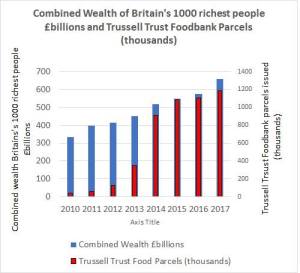
Food banks: an interesting statistic

To which one can add this:

“Britain’s has more billionaires than ever, as the super-rich reap the benefits of a “Brexit boom”, according to this year’s Sunday Times Rich List.

There are now 134 billionaires based in the UK, 14 more than the previous highest total. Fifteen years ago, there were 21. …”

https://www.theguardian.com/business/2017/may/07/brexit-boom-creates-record-number-of-uk-billionaires-sunday-times-rich-list

Council neighbourhood services – a thing of the past

“English councils’ spending on neighbourhood services, such as bins, planning, potholes and leisure, has fallen by more than £3bn in the past five years, research has found.

A report, published by the benchmarking group, the Association for Public Service Excellence (Apse), says the huge cuts to funding and the wide variations between authorities in funding services were “changing the very nature of local government.”

The reductions amount to a dismantling of universal services that are the most high-profile, core functions of local government, the report says. “These services need defending in their own right as part of wider defence of local government as a whole.”

The most deprived council areas have seen the biggest falls in spending in these services – up to 22% on average over five years among the most deprived fifth of authorities, compared with just 5% among the wealthiest, research shows.

Hundreds of children’s playgrounds in England close due to cuts
The poorest areas had an especially sharp spending fall in, for example, food and water safety inspection, road safety and school crossings, community centres and services aimed at cutting crime – such as CCTV – and support for local bus services.

There were wide variations across the country, with some councils cutting neighbourhood services by 40% while others have increased these budgets by 20%.

The cuts to neighbourhood services have taken place against a backdrop of unprecedented cuts in local government spending as a share of the economy. In 2010-11, it accounted for 8.4% of the economy, falling to 6.7% by 2015-16. By 2020-21, it will be down to 5.7%, a 60-year low, the report says.

Although much of the political focus of local government cuts has been on social care services, the impact on neighbourhood services, which include highways and transport, cultural services, environmental services and planning, has been far greater, the report says.

Spending on neighbourhood services in England fell £3.1bn, or 13%, between 2010-11 and 2015-16 at a time when social care spending increased by £2.3bn.

“Neighbourhood services should be on an equal footing to other public services and not viewed as a painless option for more cuts in local spending,” the report says. …”

https://www.theguardian.com/society/2017/apr/25/spending-on-council-services-in-england-fell-3bn-in-past-five-years-study-bin-collections-local-government

Swire gets £5000 per month from “other earnings” including £3000/month for 8 hours work being an adviser to a French photo booth manufacturer

“Swire, Sir Hugo (East Devon)

1. Employment and earnings

From 9 November 2016, Adviser to KIS France, a manufacturer of photo booths and mini labs. Address: 7 Rue Jean Pierre Timbaud, 38130 Echirolles, France. I expect to be paid £3,000 every month until further notice. Hours: 8 hrs per month. I consulted ACoBA about this appointment. (Registered 16 November 2016)

From 15 November 2016, Deputy Chairman of the Commonwealth Enterprise and Investment Council. Address: Marlborough House, Pall Mall, London SW1Y 5HX. I expect to be paid £2,000 every month until further notice. Hours: 10 hrs per month. I consulted ACoBA about this appointment. (Registered 16 November 2016)

4. Visits outside the UK

Name of donor: Ministry of Foreign Affairs, Government of Bahrain Address of donor: P.O. Box 547, Government Road, Manama, Kingdom of Bahrain
Estimate of the probable value (or amount of any donation): Flights, accommodation, food and transport with a total value of £3,550 Destination of visit: Bahrain
Dates of visit: 8-12 December 2016
Purpose of visit: Attendance at the IISS Manama Dialogue
(Registered 23 December 2016)

Name of donor: (1) Professor Magdy Ishak; (2) Egyptian Ministry of Foreign
Affairs
Address of donor: (1) private; (2) Nile Corniche, Boulaq, Cairo Governate, Egypt
Estimate of the probable value (or amount of any donation): (1) Flights to a value of £1,386; (2) accommodation, food and transport to a value of £596
Destination of visit: Egypt
Dates of visit: 16-20 March 2017
Purpose of visit: Parliamentary fact finding.
(Registered 03 April 2017)”

Click to access 170410.pdf

page 406

Cranbrook Town Council: ex- councillors give reasons for leaving

Having their hands tied on many matters
Inability to influence matters affecting Cranbrook residents
Frustration that information was not shared with all councillors
Not open, transparent or inclusive

The page detailing the current council’s response to these allegations is in the current e-edition of the Cranbrook Herald on page 4 here:


What SHOULD super-Mayors (and LEPs) be doing?

This is what a think tank believes Mayors (and by extension Local Enterprise Partnerships) SHOULD be tackling.

Can anyone see any of these issues being given attention in our Devon and Somerset super-mayoral area?

… Mayors are due to be elected in May in Greater Manchester, the West Midlands, Tees Valley, Liverpool City Region, Cambridgeshire/ Peterborough and West of England, the latter an area based around Bristol.

The IPPR said its evidence base showed mayors should deliver inclusive growth by using their transport policy to prioritise poor neighbourhoods, establishing development corporations and championing the living wage and higher employment standards.

They could improve infrastructure by integrating land use planning and working with central government on housing investment and seek to embed health in all public policy.

The IPPR also urged mayors to set up companies to pilot ‘invest-to-save’ models in employment support, and to collaborate with councils to tackle homelessness….”

http://localgovernmentlawyer.co.uk/index.php?option=com_content&view=article&id=30775%3Athink-tank-urges-new-mayors-to-make-full-use-of-powers&catid=59&

“Greater Exeter Strategic Plan”: are we already shafted?

Time is running out to comment on the “Greater Exeter Strategic Plan” initial consultation on “Issues”. Comments must be in by

10 April 2017

and the document is here:

https://www.gesp.org.uk/consultations/issues/

and the full (12 page) document is here:

Click to access Greater-Exeter-Strategic-Plan-proof-v14.pdf

Owl thinks that there is precious little in the document that points either to a strategy or a plan! There are, however, many issues not covered such as:

– inequality ( how are the “just managing”, the “barely managing” and the “not managing at all going to access Greater Exeter’s resources (housing, transport, infrastructure, environment, health care, education) none of which is geared to them – only to the “managing very nicely thank you and ready to trade up to a bigger property or luxury retirement village” group

– the effect of Brexit, labour and skills shortages on the much-vaunted “economic growth”

– landbanking and housing supply – how they undermine all strategic planning projects

Owl also thinks this “plan” is shutting the door well after several horses have bolted, as already in the pipeline are massive developments planned to circle the city:

– west of Exeter: the 5,000-plus houses planned for “Culm Village” (Mid Devon)
– north/east of Exeter: the more than doubling in size of Cranbrook (East Devon) and the connected developments at Tithebarn Green, Pinn Brook Pinhoe and Monkerton (East Devon and Exeter City)
– south of Exeter: the massive development of Alphington and similar plans for doubling the size of Newton Abbott
– not to mention city developments such as St James’s Park and the thousands of student units in the city centre
– Local Enterprise Partnership plans to build extra houses just about everywhere else

Can anyone tell Owl which bits of “Greater Exeter” are left to consult on?

Inequality in rural communities

Councillor Phil Twiss is in charge of rolling out broadband to areas in East Devon that have low or no broadband speeds. EDDC opted out of a Devon-wide project, preferring to choose its own way of doing things. Contact Councillor Twiss if you are unhappy about broadband provision in your area:

Email: ptwiss@eastdevon.gov.uk
Telephone: 01404 891327
Address: Swallowcliff, Beacon, Honiton, EX14 4TT

“Almost 10 million people in the UK live in areas of England defined as rural. They are – on average – 5.3 years older than their counterparts in urban areas, with settlements in sparse areas tending to have the highest proportion of their populations amongst the older age groups, the report said.

The outward migration of young people and inward migration of older people, who tend to have greater health and social care needs, as well as poorer public transport links, are having a “significant impact” on people’s daily lives and access to services, it concluded.

Eighty per cent of rural residents live within four kilometres of a GP surgery, compared with 98 per cent of the urban population, while only 55 per cent of rural households compared to 97 per cent of urban households are within eight kilometres of a hospital, the study found.

Crucially, a combination of the older demographic and the unavailability of high-speed broadband has led to a growing digital gap between urban and rural areas, which is enhancing loneliness among the elderly and preventing people from benefiting from important developments and innovations in access to health-related services, the report went on.

There is a growing social and economic gap between those who are connected and those who are not – the ‘digitally excluded’ — with 13 per cent of the adult UK population (6.4 million) never having used the Internet, and 18 per cent saying that they do not have Internet access at home.

“Rural social networks are breaking down with a consequent increase in social isolation and loneliness, especially among older people,” the report states.

“The fact that social isolation influences health outcomes in its own right suggests that this and the emotional and mental wellbeing of people in rural areas is an important and hitherto neglected area in the promotion of public health.” …

… We need to be more observant of how dependent that older population in rural areas is, and the pockets of isolation and deprivation that you get are there, and they’re very often hidden because it all looks like a nice rural ideal.”

The report also states that the level of poverty in certain rural areas was also a serious problem that was frequently overlooked, with almost one in seven (15 per cent) rural households living in relative poverty after housing costs are taken into account.”

A lack of affordable housing in some areas is now extending to those on average incomes, not just people on lower incomes, leading to people — generally of the younger generation — moving out to urban areas and increasing concerns about the sustainability of rural communities.”

http://www.independent.co.uk/news/uk/home-news/rural-communities-countryside-public-health-england-local-government-association-neglected-digital-a7636521.html

“Big Society” a big failure says Parliamentary Committee: £1 billion plus wasted

Owl says: Vanity projects – imagine how much we could spend on necessities if they were all abandoned! Hinkley C, HS2, the Big Society, EDDC relocation, Exmouth “regeneration”, Devon and Somerset devolution …!

“A publicly funded £1bn “big society” project set up by former prime minister David Cameron to restore values of responsibility and discipline among young people has been criticised by MPs for lax spending controls and poor management.

The Commons public accounts committee (PAC) said the National Citizen Service (NCS) trust lacked appropriate governance arrangements, could not justify its high costs, and was unable to prove whether its courses had any long-term impact on youngsters.

Meg Hillier MP, chair of the PAC, said: “We urge the trust and central government to review fundamentally the way NCS is delivered and its benefits measured before more public money is committed in the programme’s next commissioning round.”

MPs said that the scheme – which has received £600m in government funding since 2011 and stands to get another £900m investment over the next two years – should be “fundamentally reviewed” by ministers.

Hillier said although there was some evidence the scheme had a short-term positive impact on participants this did not in itself justify the high level of public spending on the programme, nor demonstrate that it would deliver the proposed benefits.

The PAC report criticised the trust for refusing to disclose directors’ salaries, and accused it of a “lack of discipline” after failing to recover £10m paid to providers for unfilled places. It concluded that it was unclear whether the trust management had the necessary skills and experience to run the scheme. …”

https://www.theguardian.com/society/2017/mar/14/national-citizens-service-justify-costs–commons-committee-cameron

It’s best to live in Surrey if you want favours from the government

“Philip Hammond was among a series of Conservative MPs who lobbied on behalf of Surrey county council in a row over social care funding, correspondence released under freedom of information laws has shown, reviving claims the council received a special deal from ministers.

Hours after Theresa May insisted at prime minister’s questions that Surrey had enjoyed no preferential treatment, one of the released letters and emails showed the chancellor had spoken to the communities secretary, Sajid Javid, on the council’s behalf.

Hammond, who represents the Surrey constituency of Runnymede and Weybridge, wrote to the council’s deputy leader, Peter Martin, in September to sympathise about funding difficulties, saying he would “take this up with Sajid Javid”.

The correspondence shows that another Surrey MP, Jonathan Lord, wrote to the council in November saying he had discussed the issue with Javid and “he’s doing something for us”.

In an email to the council’s leader David Hodge and fellow Surrey Tory MPs in January, Lord suggested Javid might have “£40m hidden under the departmental sofa” for the council, and suggested other councils’ budgets could be trimmed to help.

The correspondence, released following a freedom of information request from the BBC, follows a long and public standoff between by the Conservative-run council and Javid’s department over what Hodge said was a funding gap to pay for social care.

Hodge promised to hold a referendum of Surrey residents on imposing a 15% rise in council tax to make up the shortfall. However, last month this was called off at the last moment.

Leaked text messages passed to Labour last month prompted Jeremy Corbyn to accuse May at prime minister’s questions of buying off Surrey with a special deal, something she denied.

Following the release of a recording in which Hodge told fellow Surrey Conservatives about a “gentleman’s agreement” with ministers, Corbyn reiterated the accusation at PMQs on Wednesday. May again denied Surrey had received special treatment.

The new documents show a concerted lobbying effort by Surrey MPs, among them Hammond. Other Surrey MPs to lobby for the council included Chris Grayling, the transport secretary, Michael Gove, Crispin Blunt and Dominic Raab, the correspondence showed.

It also highlights the extent of anger felt by Hodge over the funding issue. In one letter, he accuses Javid of “some seriously muddled thinking”, and warns of the political consequences if an agreement is not reached. “We will see the largest Conservative group in the country pitted against a Conservative government, and we will be blunt about where we think the blame lies,” he warned.

Writing to Hodge, Hammond had said: “I recognise the challenges you are facing in Surrey, and the apparently harsh treatment that the funding formula delivers, and I will take this up with Sajid Javid.”

An email from Lord in November suggested Javid and Hammond were seeking to help the council. “I have spoken to Sajid J, and he says he’s doing something for us,” Lord wrote. “Won’t be drawn on exactly what. Says that Philip H is being supportive and will be signing off on things for us.”

But a subsequent email from Lord in January said he was “extremely unimpressed” Javid had not “come up with the goods”.

He wrote: “If Saj was imprudent enough to not have £40m hidden under the departmental sofa just for this sort of emergency/problem/‘outlier’ emerging from his department’s draft settlement, then I assume, if he is a man of his word, that he must have done his best to put a strong case to the Trreasury

“If all his local government settlement money is really allocated, if the Treasury is refusing to help out, and if he can’t find a pot of money for the ‘missing’ learning disability grants, then Saj still has the option of adjusting all the other council settlements down very slightly in order to accommodate the £31m needed for Surrey – and I think he should be encouraged to do this.”

The shadow communities secretary, Teresa Pearce, said May should “come clean” over the deal. “Despite Theresa May’s claims to the contrary, this is more evidence of the Tories’ secret deal with the leadership of Surrey county council,” she said.

“We need full disclosure of the terms of the deal and reassurance that all councils will be treated the same way, not just the lucky few the Tories favour.”

However, a government spokesman said the discussions were nothing exceptional.

“As we have repeatedly made clear, there was no special deal for Surrey county council and they will not receive any extra funding that would not otherwise be provided or offered to other councils. To imply the opposite is simply untrue,” he said.

Javid’s department discussed funding settlements “with councils across the country, of all types and all political parties”, he added. “This happens every year, involves councils making representations to the government, and has always been the process.”

https://www.theguardian.com/society/2017/mar/08/philip-hammond-among-mps-lobbying-for-surrey-county-council-in-funding-row

How does ex-Chancellor Osborne manage …?

“George Osborne has declared a salary of £650,000 a year for working just four days a month at BlackRock, the world’s biggest fund management firm, as well as almost £800,000 for speeches to financiers.”

https://www.theguardian.com/politics/2017/mar/08/george-osborne-to-be-paid-650000-for-working-one-day-a-week-blackrock-salary

He REALLY needs that MP’s salary …

Business rates row intensifies

“Ministers try to defuse business rates row

Philip Hammond, the chancellor, is examining ways of making the scheme fairer after widespread outrage at the first rates overhaul in seven years, which will come into effect in April.

Small businesses face huge increases while some of the biggest companies in Britain — including Amazon and large supermarkets — will benefit from rate cuts on some of their properties.

The chancellor will be looking at ways of ensuring things can be done a little fairer
Senior government sources insisted they would stick with the revaluation but conceded that more might need to be done to ease the pain.

Hammond is understood to be examining ways of preventing a “cliff edge” increase after business groups signed a letter demanding changes. But he is reluctant to pour more money into a fund to help those worst hit.

A senior government source said: “The chancellor has paid very close attention to the way this has played out over the last week. If you take money for this, it comes away from other things. The system has been fixed to ensure there are far more winners than losers.

“However, the chancellor is attuned to this and will be looking at ways of ensuring that things can be done a little fairer”. He will want to prevent “heavy-handed” implementation of the revaluation so as to ensure “the system never has a cliff edge like this ever again”.

The shift came as Grant Shapps, the former local government minister, said ministers should “quietly drop” the planned revaluation. He said he was “concerned” that the changes “may undo progress” on reviving Britain’s high streets. “Might be better not to revaluate BizRates,” he tweeted, adding that he would “need convincing transition plans will help”.

Shapps’s intervention came as the chief executive of Sainsbury’s waded into the row, calling for “fundamental reforms”. Mike Coupe described the current setup as “archaic” and called for a “level playing field”. He said: “The way it currently stands, there is an advantage for those without bricks-and-mortar operations so there’s a strong case for a level playing field in business rates and taxation generally.”

The Sunday Times has established that large supermarkets are to benefit from business rate cuts of up to 25% on their out-of-town stores while nearby struggling high streets are to be “hammered”.

Reporters analysed the top 20 towns being hit by the biggest rise in business rates, compared with the changes in rates at the local out-of-town supermarket.

Thirteen out of the 20 supermarkets were set for business rate cuts, five were having no changes and two faced higher rates.

Traders in Southwold, Suffolk, say the “rateable value” of their properties — which is used to calculate business rates — has risen by 177%. By contrast the nearest Tesco superstore — a 30-minute drive away in Lowestoft — has had its rateable value cut by 7%.

Rebecca Bishop, owner of the Two Magpies Bakery, who is facing an increase in her rates from £2,000 to £11,883, said: “The government is encouraging the growth of online retailing and out- of-town shopping and killing the high street.”

The fall in business rates for supermarkets in the 20 towns worst hit by the increases — including Cobham in Surrey, Padstow in Cornwall and Crowthorne in Berkshire — is reflected across the country.

The Valuation Office Agency is updating the rateable value of business properties on April 1 this year. The last time they were all valued was in 2010.

The rates rises have triggered a political storm with more than 500,000 traders facing increases.

The annual rates are calculated by multiplying the rateable value by a figure set by the government, which is up to 47.9p for 2017-18. There is also transitional relief to limit the sudden changes in bills.

Supermarkets are enjoying a rates cut because the rental values of their out-of-town stores has fallen.

Analysis by CVS, a business rates specialist, has found that the rateable values for 2,172 supermarkets in 2017 is £2.76bn compared with £2.93bn in 2010. The average superstore will see its rateable value fall by 5.9% or £79,368.

Sainbury’s said this weekend, however, that it expected its rates bill to rise from £483m to £500m.

CVS said it would “stick in the throat” of many small businesses trying to keep their “heads above water” while the warehouses of large online retailers such as Amazon and various superstores were getting business rates cuts.

It added that the government had said in 2015 that it would conduct a structural review of business rates but this was never delivered.

Mark Rigby, chief executive of CVS, said: “April will serve a hammer blow to small shops and the consideration should now be to ensure that they are in fact paying fair and accurate rates.”

The Department for Communities and Local Government said most businesses will either not see their rates rise, or will enjoy a fall.

It added that 520,000 ratepayers will see their bills increase, 920,000 will see them drop and 420,000 will see no change.”

Sunday Times, 19th Feb 17 (paywall)