The Great EDDC Section 106 Scandal of 2016 – and probably earlier years

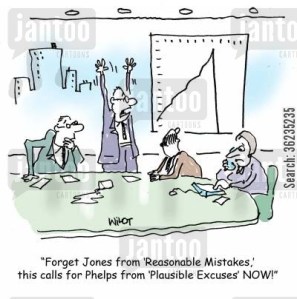
Forget Jones from Reasonable Mistakes, this calls for Phelps from Plausible Excuses NOW!

OWL’S SUMMARY:  EDDC HAS NO EFFECTIVE MONITORING OF SECTION 106 PAYMENTS DUE AND OFTEN RELIES ON DEVELOPERS TO TELL THEM WHAT THEY OWE TO THE COUNCIL.  THIS IS NOT JUST A PROBLEM FOR THIS FINANCIAL YEAR BUT, ACCORDING TO EXTERNAL AUDITORS, COULD HAVE HAPPENED IN PAST YEARS TOO.

Due to the explosive nature of the report detailed below, it is hardly surprising that the Audit and Governance Committee is meeting in the afternoon on 17 November 2016 at 2 pm, while most people have to be at work.  Had it been held in the evening there might well have been some seriously embarrassing problems for the committee.  As it is, even the afternoon session is likely to throw up some VERY tough questions.

Only recently added to the EDDC Audit and Governance Committee agenda papers is this little nugget of a report – it is only 21 brief pages and deserves very focused reading.  The report is as per the link below:

KPMG: Management of s106 contributions

and boy, what interesting reading it makes!

It seems that a local elector complained to EDDC’s external auditors – KPMG, new to the job this year – that it appeared that management of Section 106 payments (the money due from developers) was, in Owl’s lay-owl opinion, not fit for purpose – as reported in recent East Devon Watch postings:

HERE and HERE

The elector concerned alleged serious mismanagement of the listing, monitoring and collection of Section 106 money – the payments due from developers as part of their requirement to mitigate any problems that the development might cause and for the provision of green, open and play spaces within and around their developments.  This was as a result of a Freedom of Information request to which EDDC responded that it did not have the information the elector required.

BEAR IN MIND THAT DETAILED BELOW ARE SUMS FOR THE LAST FINANCIAL YEAR ONLY AND THE EXTERNAL AUDITOR DID NOT EXAMINE PREVIOUS YEARS.

After a very light-touch investigation by the new auditors KPMG (which simply sampled various agreements in this financial year only rather than forensically analysing them all over a period of several years), they found:

     “As at 31 March 2016 the Council had £5.8 million of s106 contributions held on its Balance Sheet.  During the 2015/16 financial year it accounted for £1.9 million of s106 receipts.
      We found that at the Balance Sheet date there was a gross amount of £636,000 in s106 contributions due to the Council where it had not identified that conditions had been met which triggered liability for payment from the relevant developer.
     No invoices had been raised seeking payment and consequently this amount had not been included in the 2015/16 financial statements, meaning the accounts were understated.
      When other audit findings are taken into account there was a net understatement of £227,000 in the Council’s financial statements. This is because our financial statements audit work had separately identified that the Council had incorrectly accounted for an amount totalling £409,000 for a different s106 agreement which actually related to another body.
     Whilst we have not exercised formal audit powers in response to the objection, our work has indicated that the issues raised by the objector are correct and we have upheld the objection.”

Here are the external auditors findings FOR THIS YEAR ONLY in more detail:

“Our evaluation of the processes has identified the following control weaknesses.
1. An absence of summarised financial information to facilitate the monitoring of s106 contributions
The Council currently has no summarised monitoring document which shows the value of all s106 contributions outstanding at any one point, with the trigger which would lead the contribution to be payable and, if the contribution is liable to be paid, the current status of the collection process. In addition to this the Council does not currently have the information in a format which is consistent with s106 contribution triggers so it cannot determine if triggers have been met.
2. Lack of challenge or enforcement of the Cranbrook developers’ legal obligation to provide information
From our understanding there is no challenge or enforcement of the developers’ legal obligation to provide the Council with details of the number of dwellings constructed, sold and occupied, instead only information on completions is supplied. In addition this information should be received quarterly but our testing suggests that it is received on an ad hoc and untimely
basis.
3. Understanding of financial and accounting implications of triggers being met and the communication between Planningand Finance over this
It has been found that at present there is a gap in the understanding of the financial and accounting implications of a contribution trigger being met within Planning, due to an oversight in communication between Finance and Planning over the treatment.  When contributions become virtually certain to be received, but are not invoiced for practical or commercial reasons, they should be recognised as accrued income.  At current however, given this gap in understanding in the planning team, the Council’s Finance team only accounts for s106 contributions when the cash has been received or an invoice has been raised. This has led to the financial accounts having an incomplete accrued income balance on the Statement of Financial Position.
In addition to the evaluation of the s106 processes and controls, we performed testing to enable us to quantify the potential misstatement as a result of the control weaknesses found in the system.
We focused this testing on s106 agreements associated with the Cranbrook development, as these agreements (individually and in total) represented the major value of all agreements in place. We requested a listing to be prepared of all s106 contributions that the Council has in place at the Cranbrook site and found that there were nine contributions that had been triggered and are due to the Council. It was also found that there was a tenth contribution where it was uncertain if the trigger point had been met and the financial value of the contribution, this is therefore not included within the misstatement below. The contributions ranged from £5,000 to £200,000 in value individually, see page 12 for further details.
It was found that the planning Officer was aware of the individual cases, but not the aggregate position of the un-invoiced amounts. None of the contributions had been invoiced or accrued in the financial statements but as noted previously, there is no evidence of financial loss and the misstatement is one of accounting treatment. If the total value of this misstatement was recognised in the Council’s accounts,the Grants in Advance balance would increase by £636,000, as documented below.
It is noted however that this is the gross misstatement as a result of the weaknesses in the system and that our final accounts audit procedures had already identified a misstatement that overstated the Grants in Advance balance by £409,000. This was because the Council had incorrectly accounted for a s106 contribution due from a developer but payable to another body, rather than the Council itself.

Consequently, when concluding effect of these misstatements on our audit opinion, we were able view the impact at 31 March 2016 as a net understatement to the balances is £227,000.  This was reflected in our reporting to the Council’s Audit & Governance Committee in September 2016.

Whilst neither the gross or net misstatement were considered individually material to the financial statements, they are nevertheless significant sums. Given the weaknesses identified in the Council’s controls, it is possible that understatements of a similar scale or even larger could be apparent at any point in time.”
 

The real rationale for bed cuts? And where is the evidence?

Upgraded comment from Paul F to previous post:

“Behind these proposals is an organisation desperate to cut costs. The “Success” in the title of the “Success Regime” is success in cutting spending in Devon to meet the NHS budget – it is not about successful healthcare for people, it is all about saving money.

They talk about “efficiency savings” rather than “cost cutting” and the difference is vitally important. “Efficiency savings” are when you can provide the same level of care for less money by being more efficient, whilst “cost cutting” is when you reduce your costs by reducing the quality of care.

The underlying principle of their proposals is that home-based care is as good medically but can be provided at a fraction of the cost.

On top of the reduction in hospital beds that would result from home care, they claim that beds are already under-utilised and that even more beds can be cut if we can cut bed blocking (so that social care support is available for patients who need it so that they can leave hospital).

All these make sense if the evidence is there to back them up, but these claims need to be independently analysed and verified. Additionally there is the inevitable fight about where the cuts in beds will be made, and questions about whether the replacement home care and social services will be in place and fully ready before the cuts in beds are made.

Like Claire, I set out to see whether the written evidence actually supports these proposals or whether the evidence has been fudged.

The Home Care proposal is based on pilots already undertaken in North Devon – and on formal reports that have been written following these pilots. When reading analyses like these, I want to see them take the data, ideally using objective measures of health improvement (such as mobility resulting from physio on some standardised scale) though subjective surveys of patients also have a value, and then summarise the good and bad points and only then draw conclusions about whether the pilot should be extended to the whole of the CCG area.

Unfortunately the reports are lacking in objective medical assessments of home care vs. hospital care, relying almost exclusively on subjective patient surveys of home care and without comparative subjective patient surveys of hospital care.

Even more worrying is that the reports seem to have been written in the wrong direction, starting with an objective in mind (i.e. a decision to roll home care out across Devon) and then selecting data to support this case (i.e. they give lots of individual survey comments about how good home care is but gloss over the negative comments).

The analysis is also deficient in highlighting potential down-sides to their proposals (for example increased difficulties for patients and visitors who do need hospital care to travel to the now much more distant hospitals) or the risks that might be inherent in these changes of approach (i.e. availability of immediate help from hospital nurses cf. planned visits from home carers, ability to handle emergency complications that need hospital facilities which are not available when people are being treated at home).

The reports do not give proposals for improving availability for social care for people who should be leaving hospital, because that is not funded by the NHS and so outside their control, but nevertheless they are going to cut those beds.

I guess they see this as a one-off issue, because once they have implemented home care, the people won’t be blocking hospital beds because they won’t actually be in hospital. Of course, that doesn’t deal with either this one-off issue of people who are in the beds when they are cut, or the resulting long-term issue of people now being treated at home who start to need social care in the same way that they would if they had been in hospital – but their thinking is presumably that at least these people are not blocking their beds.

The bottom line on home care is that it may well be as good or even better (for certain types of patients and conditions) but the evidence is insufficient to show this, and there are no guidelines set to ensure that the new approach is only chosen for patients who will benefit and not be at risk from home care.

BUT, suppose we assume that there is solid evidence that home care really works – the next issue is where to cut these beds.

The issue with the CCG approach is that they are looking simply at financial numbers, and not at the impact it may have on the ability of patients or visitors to get too and from hospitals which may now by 30-50 miles further away.

For example, the beds in Ottery St Mary [Axminster] and Budleigh Salterton hospitals are already gone, the beds in Honiton hospital are going in every option currently put forward by the CCG, and yet one of the options proposed also eliminates the beds in Sidmouth hospital. That would mean that ALL the community beds in central East Devon will be gone. How can this be right?”

Finally, we also need to be careful about use of terminology – whether to call it “over spending” or “under funding”.

We need to be realistic that if we decided to treat every medical condition, however minor, using the best possible drugs, however expensive, NHS costs would probably be unaffordable.

The reality is that NHS care has to be prioritised, with some treatments rationed or unavailable. So the issue is whether this prioritisation is undertaken nationally to set the national budget with regions spending what is needed to achieve this standard of care, or whether you continue as at present and fund each region individually (with inevitable inequalities in funding because demographics e.g. an older than average population or population growth due to massive house building or new towns are not properly factored in) and allow them to do the best with the funds they are given, which inevitably results in variations of care which get called postcode lotteries – and these regional variations in medical care (postcode lotteries) are likely to increase when you use local “Success Regimes” to cut costs (oops sorry – make efficiency savings) in individual regions rather than deal with matching treatments to budget at a national level.

(Disclosure: I have been told by my own doctor, for instance, that I can’t have a treatment I might need because it is not available in Devon, but if I lived in Gloucestershire – the nearest available location – I could have it. Fortunately not life threatening – just somewhat detrimental to my quality of life.)

“Jeremy Hunt tells NHS bosses who are rationing care not to make ‘easy’ choices”

Jeremy Hunt has accused local health chiefs who are rationing treatments after running out of money of making “easy” choices.

The Health Secretary dismissed recent controversies – involving hip and knee replacements, eye surgery and fertility treatment – insisting it was perfectly possible to both “improve care and make efficiencies”.

The comment came as Mr Hunt came close to admitting that Theresa May had told him the NHS will receive no extra money in this Parliament.

The NHS had been given all the money it asked for – admitting it was only enough to “get going” on a restructuring plan.

Meanwhile, the Commons Health Select Committee was also told that funding-per-head in England will actually be cut in 2018-19.

The committee heard evidence from both Mr Hunt and Simon Stevens, the chief executive of NHS England, amid growing concern about a gathering storm in the health service.

The National Audit Office has warned that, without proper funding and tough efficiencies, “the result will be some combination of worse services, fewer staff, deficits, and restrictions on new treatments”

In recent months, there have been protests that patients are waiting up to 15 months for cataract surgery, that IVF treatment is being axed in many areas, and similar controversies about orthopaedic care.

Sarah Wollaston, the committee’s Conservative chairman, pointed out to Mr Hunt that there were “numerous examples of rationing”, adding: “This is happening on a widespread scale.”

But the Health Secretary said: “I don’t accept that, in order to make those efficiency savings, you have to make changes that will have an impact negatively on patient care

“There is of course an easy way to make savings – which is to reduce the availability of care for patients

“But there is a harder way, but the right way, which is to find ways that improve care and improve efficiency at the same time.”

Mr Hunt insisted the Department of Health did not allow rationing that made care worse for patients, telling the committee: “We step in.”

Last month, Mr Stevens warned that much of a promised extra £10 billion each year for the NHS has been “back-ended to 2020”, which made tough choices inevitable in the intervening years.

It was only in 2016-17 that the NHS was getting “broadly what we asked for” – which meant that, between 2017 and 2020, the Government was providing less cash than requested.

Yet ministers had repeatedly dismissed warnings of a crisis on the basis that the NHS had been “given the money it asked for” – and that the cash injection was “frontloaded”.

Today, Mr Hunt changed tack, acknowledging the NHS had only been given the cash “they said they needed to get going” – to “kick-start” the five-year transformation plan.

Emphasising the hard years ahead, Mr Stevens said there would be “negative per person funding” – a per capita cut – in the financial year 2018-19.

At the weekend, it was reported that Theresa May insisted there would be no extra cash for the NHS in next month’s Autumn Statement.

Asked if that was correct, Mr Hunt replied: “It was a private meeting.”

http://www.independent.co.uk/news/uk/politics/jeremy-hunt-tells-nhs-bosses-who-are-rationing-care-not-to-make-easy-choices-a7368306.html

Remember, both our MPs voted for these NHS cuts

Copied in full, too important to precis.

Expect trouble. On Tuesday, health secretary Jeremy Hunt and NHS England head Simon Stevens appear before the Commons health committee. Sarah Wollaston, GP and chair, has already said she wants no one quoting the mythical “£10bn extra” the government pretends the NHS has received, yet Hunt brazenly used it again on the Today programme.

Thankfully, Stevens is unlikely to indulge in the same delusional fantasies about the state of his service. He already warned the public accounts committee in September of this “incredibly financially challenging period”, and “incredible” is the word he should cleave to. As every trust is forced to produce a financial plan that balances on paper, most – in private – admit these are fairy-tales; Chris Hopson of NHS Providers makes plain these pigs won’t fly. Hunt relies on threats and micro-managing. Just yesterday he put another three debt-ridden trusts into “special measures” to warn others their heads will be on Whitehall spikes. But there’s safety in numbers: he can’t sack them all.

Theresa May has said there is no more money: the NHS must save £22bn by 2020, despite three quarters of trusts being up to their ears in debt and missing waiting targets by miles. If she could cut police costs by 20%, why can’t the NHS, she asks. Because crime has dropped like a stone over recent decades while NHS need heads skywards, with growing numbers of the old, and collapsing social care. She risks a brutal brush with NHS reality before long.

But that’s not all. By Friday all 44 areas have to produce a sustainability and transformation plan (STP), unleashing vehement local protest against any mergers or closures.

After Lansley’s catastrophic 2012 act blew the NHS into myriad competing fragments, this re-reorganisation was meant to repair the damage and glue the fractured parts together again – a good idea. Stevens devised STPs to bind each area into a single unit, combining GPs, mental health and hospital services in one budget as a coherent whole. That might mean amalgamating maternity or A&E departments, rationalising stroke or cardiac care. Good idea, in theory.

But these plans collide with the £22bn “savings”, so how will local people trust the good intentions of these plans? NHS England has rightly taken fright: the Health Service Journal reveals there have been orders requiring each area to send every STP announcement to the headquarters communications team to make sure they “articulate tangible benefits for patients” in language that is “clear and compelling”. But it may take more than “compelling” language to assuage local fears.

Few of these plans have yet been agreed, allowing rumours and fears to fester – and when they do emerge, the government can expect no backing, not even from their own MPs and councillors. Expect every politician, irrespective of party, to dash to join the local “Save Our Hospital” demo. Any who pause to suggest some plans might be good for patients will be mown down in the stampede. Bandwagon campaigners will join every protest, regardless.

A cluster of hospital protesters went to Downing Street and the Commons last week, with petitions about closures from Barnstaple, Dewsbury, Chorley, Huddersfield, Grantham and St Helier. Each has their own circumstance, so it’s well-nigh impossible for local people to know which units should be “saved” and which rightly closed.

Among them were protesters about the Horton hospital in Banbury. At last week’s prime minister’s questions, the Tory MP for North Oxfordshire, Victoria Prentis, asked an impassioned question: “Does the prime minister share my sadness that the majority of Banbury’s babies cannot be delivered, as I was, at the Horton general hospital? Will she join with me to put pressure on the trust to reopen the unit?” The PM replied: “Every effort is being made …”

Horton swears they’ve moved heaven and earth to hire doctors but none would come: there’s a 24% vacancy rate
The Horton maternity unit closed abruptly this month after failing to hire middle-grade doctors, leaving a midwife-led unit. Part of the Oxford University Hospitals, its HR director swears they have moved heaven and earth to hire doctors but none would come: there’s a 24% vacancy rate in the district. The Horton obstetric unit lost its validation for training doctors as too few babies were being born there to qualify, so junior doctors won’t apply. They are still advertising, promising to reopen if they can recruit. Managers spell out the situation in painstaking detail, answering every possible query. But all this is to no avail.

A vociferous local Keep the Horton General campaign gathered 5,000 people to hold hands round the hospital, amid longstanding suspicions that it might be axed despite a plan to rebuild it. Every party supports the protest, with their Tory MP as militant as the rest. She says she doesn’t trust the management: “They make decisions about us without us.” She and the campaigners mistrust whatever they are told.

The Banbury Guardian relishes the story, as the local press always does. “It’s lovely how the community has come together,” Prentis says. Banbury businesses are offering any obstetric doctor recruited free shirts, free beer, cheap accommodation and discounted fees at a local private school. A packed meeting roasted NHS managers about the journey time for mothers in labour to travel to the John Radcliffe in Oxford. Nothing creates such feelgood community cohesion as a local NHS threat.

Talking to both sides, I am inclined to believe the managers’ good faith. But with deeper cuts scheduled for the years to 2020, can anyone know for certain where they might fall? At the Witney byelection, the Horton and other Oxfordshire NHS closures feature prominently. How Tory MPs get away with it beats me: they voted for these NHS cuts.

Watch this pattern repeated around the country as STP plans unfold. “Clear and compelling” language may not be enough when the NHS professionals, even the doctors, struggle to be believed. In the fog of war, with suspicions rife, local people have no way of detecting the good plans from dangerous cuts. As Stevens warned MPs: “Let’s be clear, there are going to be significant challenges, there will be choices, there will be controversies.”

The tragedy is that STPs were a progressive way to reunite NHS community, hospital, GP and social care services. But with no capital for rebuilding and even less for day-to-day spending, they risk wreckage. The cuts dig deep. How long before Simon Stevens decides to walk away?”

http://www.theguardian.com/commentisfree/2016/oct/18/jeremy-hunt-cant-fix-nhs

Midas does turn everything and everyone it touches into gold!

““Property Personality of the Year

Winner: Karime Hassan, chief executive and growth director at Exeter City Council

In his time as chief executive of Exeter City Council, Hassan has earned a great reputation as a man who gets things done. His efforts have ensured that Exeter is well and truly open for business.”

Sponsored by: Midas Group

whose Chairman, Steve Hindley, is Chairman of the Local Enterprise Partnership and:

“Chairman of Midas Group, Steve Hindley CBE DL, has been appointed Chairman of the CBI Construction Council, the first time a leader of a regional/mid market size business has held the post. Here he makes the case for construction as a driver of the local and national economy.

My new role is a significant one because the council represents the entire industry – designers, constructors, supply chain and specialist contractors – as a single point of contact with Government. …

… Exeter is a very good example of this where projects undertaken by Midas Group are worth millions to the local economy. These include new work at Exeter University, the new Atass building on Exeter Business Park for Summerfied Developments, major retail projects for John Lewis Partnership, Waitrose and Morrisons and an extension to the Business Park at Hill Barton”

Property Personality of the Year is NOT listed on the Categories / Nominations Page – so presumably they were not accepting public nominations for this prize and Hassan was nominated by persons unknown.

As stated, ECC was NOT nominated for Local Authority of the Year – this was won by Plymouth City Council (shortlisted: East Devon District Council, Bristol City Council, Somerset County Council)so Owl wonders how its Hassan, CEO scored so highly for his award when his council did not.

and on that win by Plymouth City Council, note:

“Local Authority of the Year
Winner: Plymouth City Council

“Our judges said Plymouth City Council has demonstrated an exceptional and proactive approach to the built environment in the last 12 months. It has an innovative approach to planning infrastructure and housing needs and has a compelling vision for a waterfront city.”

Shortlisted: East Devon District Council, Bristol City Council, Somerset County Council”

We learn on the Plymouth City Council building front:

“Midas recently started work on the landmark £3.6million Performing Arts Centre building at Plymouth University.

It is also leading renovation works at the £12million rejuvenation of North Prospect for Plymouth Community Homes.

Other major contracts in Plymouth include the £5million extension to the Kawasaki Precision Engineering factory in Ernesettle.

It is also building the £5million Frobisher House student digs project, funded by a Jersey-based private equity group, in Ebrington Street.”

http://www.plymouthherald.co.uk/city-construction-sector-s-thriving-says-midas/story-19715564-detail/story.html

Should you not know the story about King Midas yo umight want to reflecton its ending here:

http://www.primaryresources.co.uk/english/kingmidas.htm

Seaton Town Council organises meeting about proposed NHS hospital bed cuts

“As almost everyone in Seaton must now know, the NEW Devon (North, East and West Devon) Clinical Commissioning Group is currently consulting on which few beds should be retained in community hospitals. Although Seaton will keep 24 beds under Options A (the CCG’s preferred option) and C, under options B and D these beds will go to Sidmouth.

Indeed having removed the beds from Ottery St Mary and Axminster hospitals, the CCG now proposes to take all beds from Honiton and Okehampton, leaving only 32 beds in Tiverton, 24 in either Seaton or Sidmouth, and 16 in either Exmouth or Exeter (Whipton), to serve 900,000 people in most of Devon.

The Town Council has expressed its grave concern at the threat to Seaton Hospital and the wider removal of community beds. With Councillor Martin Pigott taking the lead, I and other councillors have met with representatives of the Hospital League of Friends and the GP practices (who have questionnaires available for you to express your views to the CCG).

We will be organising a public meeting, probably on Friday 4th November, with Neil Parish MP – the CCG will be invited to send a representative.

The community hospitals are an essential half-way house, much valued by patients, between the acute beds in the Royal Devon & Exeter Hospital and care in the community. The whole point is to have them local. Taking their beds away will make only a small difference to the CCG’s ballooning deficit – the only thing that will really change it is for the Government to finally put in the extra funding which everyone knows the NHS needs. We need to link up with others in East Devon to make this a common battle.”

https://seatonmatters.org/2016/10/08/save-the-beds-in-seaton-hospital/

“Flatpack Democracy” talk in Exeter

“Many politicians are making decisions to meet their own needs or those of their Party, not the needs of the people they serve”.

Tuesday 25th October 2016, 7.30pm | Exeter, Exeter Castle

This is the opinion of the author of Flatpack Democracy and founder of Independents for Frome, Peter Macfadyen. And he’ll be sharing his vision at the first ever 38 Degrees Live event.

The evening at Exeter Castle will be hosted by award-winning presenter and comedian, Charlie Partridge. It’s free to attend and there’s a cash bar available.

Tickets via Eventbrite

More on that “extra” money for “housing” and its ?(un)intended consequences

“… The £3bn fund will be made up of £1bn in short-term loan funding. This will be used for small builders, custom builders, and innovators, delivering 25,500 homes this parliament. A further £2bn of funding for infrastructure will be used to unlock sites for up to 200,000 homes over the longer term. Of this, £1.15bn is new money.

The action will see the government use surplus public land to build more homes more quickly by encouraging new developers with different models to enter the market, and to support small and medium-sized firms and constructors. This will help to close the housing supply deficit, ministers stated.

In addition, local planning authorities will be able to grant permission in principle on sites suitable for housing-led development, as well as turning abandoned shopping centres into new communities and increasing housing density around transport hubs.

Javid said that the government had made progress in boosting construction, with over 700,000 net additional homes delivered between April 2010 and March 2015, but it was now time to go further.

“We want to ensure everyone has a safe and secure place to live and that means we’ve got to build more homes,” he added.

“It is only by building more houses that we will alleviate the financial burden on those who are struggling to manage.”

Hammond stated there had been a housing shortage in this country for decades, and that the government was determined to tackle it.”

“We’ll use all the tools at our disposal to accelerate housebuilding and ensure that over time, housing becomes more affordable, that is why we are committing £2bn of additional investment towards this.”

http://www.publicfinance.co.uk/news/2016/10/chancellor-pledges-ps3bn-build-25000-homes-2020

So, it’s short-term loans, selling off “public land” that the public will never get back or probably be able to replace, subsidising infrastructure that developers are supposed to pay for, decreasing the number of shopping centres and building little boxes near bus stations and railway stations.

And that’s a PLAN? The small builders will have to pay back the loans, public realm will be flogged off to developer friends at rock- bottom prices, WE pay for infrastructure instead of developers who still charge the same or more for the housing it leads to – AND we won’t be able to shop nearer home OR park our cars near bus stations and railways!

“Greater Exeter” to take over next East Devon Local Plan revision? Will we be top or bottom?

iiiimages


We all know (or do we?) that “Greater Exeter” is now becoming more and more the vehicle of change in East Devon – more than East Devon District Council itself.

What – you DIDN’T KNOW?

Well, hardly surprising as the details (and, as we do know to our cost in East Devon, the devil is in the detail) are being discussed in secret.

Where? “The Greater Exeter Visioning Board”. The usual thing these days – no agendas, no minutes, no records, yet somehow its decisions get rubber-stamped by the EDDC Cabinet – which releases details on a “need to know” basis in which it is deemed that the public and most of East Devon’s District Councillors do not need to know.

This is what is happening in Devon and East Devon these days, folks. Faceless, paperless and secret societies (sorry, working parties, forums, partnerships, whatever) are now where the deals are done – large and small.

You (or they) might say – but we aren’t discussing anything of any great importance. Well, they would say that wouldn’t they. But when everything is secret, there is, of course, only one question to be asked: why?

Just in case you don’t believe Owl, here is a direct quote from the latest papers on the EDDC Scrutiny Committee agenda.

“Undertake a Review of the process for writing the Local Plan in future

There has not been an opportunity due to other workload commitments to consider how a review of this process may be taken forward and with proposals for a joint strategic plan going to members shortly the processes for future plan making may look very different anyway. It is considered that any review should follow decisions about how plan making will be taken forward in future so that any review can consider what can be learnt in the context of informing new processes moving forward whether this be through a Local Plan Review or a Joint Strategic Plan with a more local level plan beneath.”

Click to access 061016-scrutiny-agenda-combined.pdf

Local Plan beneath, Joint Strategic Plan on top – hhhm!

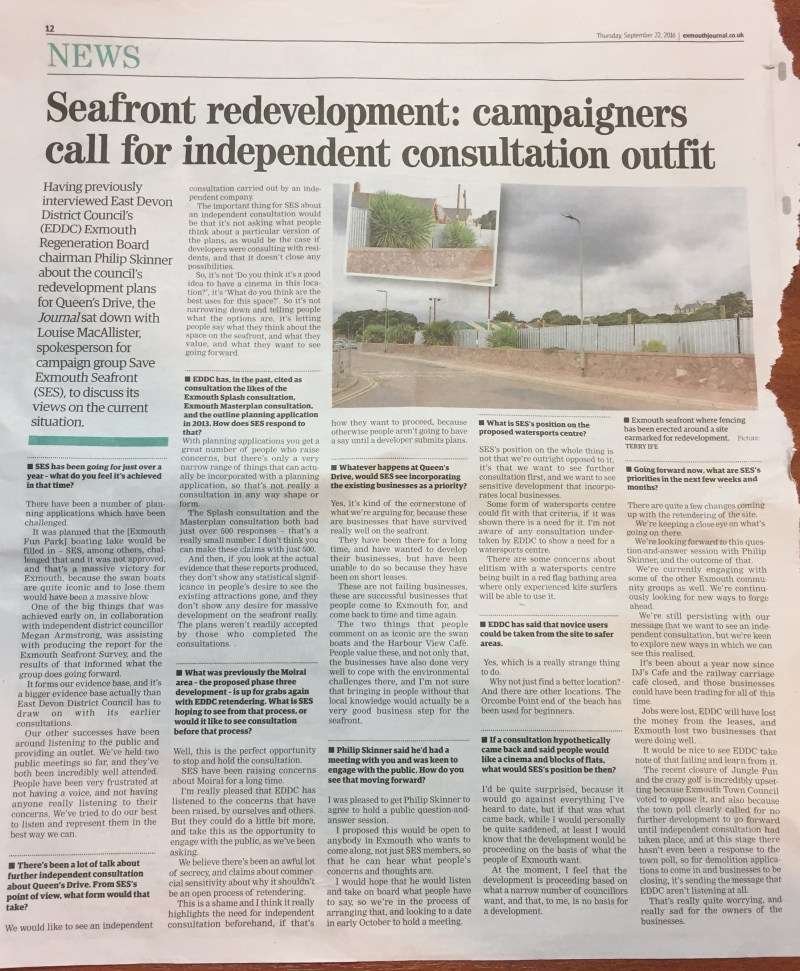
Exmouth seafront regeneration: an alternative view

In this week’s Exmouth Journal an interview with Dr Louise McAllister, spokesperson for Save our Seafront:

img_1304

We won’t be seeing much of Swire in East Devon (what’s new!)

“The Conservative Middle East Council [of which Swire was elected Chairman last week] or CMEC is an organisation which exists to ensure that Conservative MPs and Peers understand the Middle East.

CMEC achieves this through a number of activities. Firstly, it organises delegations of Conservative MPs and Peers to the region. Delegations have visited Israel and the Palestinian Territories, Libya, Egypt, Syria, Bahrain, Saudi Arabia, Iran, Lebanon and Tunisia.

CMEC also organises a number of events in the UK. These include talks by experts in the Houses of Parliament, receptions and lectures.”

https://en.m.wikipedia.org/wiki/Conservative_Middle_East_Council

The planners came to our town

THE PLANNERS CAME TO OUR TOWN

The planners came to our town
To see what they could do
We’ll smack this place around a bit
Who cares about the view?
We’ll knock it down and mess it around
We’ll sound its final knell
We’ll rip the heart right out of the place
And the locals can go to Hell

Hands off, hands off
They must be on Cloud Nine
The planners they can stick their plan
Right where the sun don’t shine

The planners came to our town
To grab the Market Square
There’s nothing much of value
That ever happens there
The market’s so untidy
We can’t see why the fuss
We’ll make it nice and neat and clean
For boring people like us

Hands off, hands off
They must be on Cloud Nine
The planners they can stick their plan
Right where the sun don’t shine

I don’t care what the planners think
Their plan is plain absurd
Its up to every one of us
To give the loonies the bird
We’ll march, petition and protest
With signatures by the load
And if that doesn’t do the trick
We’ll sit down in the road

Hands off, hands off
They must be on Cloud Nine
The planners they can stick their plan
Right where the sun don’t shine

Composed for a Facebook page protesting about inappropriate development in Totnes by Sam Richards, but could be anywhere.

Renewed interest in petition to cease schools monitoring service by Babcock

In May 2016 East Devon Watch reported on a 38 Degrees petition which sought to remove the armament manufacturer Babcock from a contract to monitor attendance in Devon schools:

https://eastdevonwatch.org/2016/05/18/why-is-babcock-the-arms-manufacturer-involved-in-monitoring-school-attendance-in-devon/

The post has been re-read many times in the last few days and the petition has begun to gain more signatures again, which gives the impression that there is perhaps a new disquiet about the 7 year contract.

The £125 million contract was described thus by the company:

https://www.babcockinternational.com/News/Babcock%20awarded%20Devon%20schools%20contract

The 38 Degrees petition:

https://you.38degrees.org.uk/petitions/devon-county-council-get-weapons-manufacturers-out-of-education

made the following claim:

“Babcock International is a weapon manufacturer operating around the globe. They are also contracted by Devon County Council to monitor and produce reports on school attendance.

After ten sessions (five days) of “unauthorised absence” they send this letter threatening a fine of up to £2500 and/or three months in prison.
The letter is sent to hundreds of parents each year, causing disproportionate distress for what, in many cases, is a single case of illness or forgetting to inform the school in time.

Children become worried that their mum or dad might go to prison. Parents worry their children might be taken into care, that they might lose their jobs, businesses, dignity and freedom.

The threat, and potential fine and imprisonment, disproportionately affects single parents and poor people, who are less able to pay a Fixed Penalty Notice within 21 days (after which it doubles).

I have personally supported a single mum who was working full time, raising two children, starting a business and having to comfort her children who thought that Mum was going to prison.

Babcock’s business is in fear, not in children’s education.”

The petition currently stands at nearly 800 signatures.

Exmouth “regeneration”

“Just wanted to share these photos with you. They were found on the fencing of Jungle Fun’s premises about lunch time today.

The messages on these banners are pretty clear. I’d say a resident/some residents are behind this who feel completely ignored and devalued by East Devon District Council, and who also want to share their support and solidarity with the owner and staff of Jungle Fun/Crazy Golf, during this truly heartbreaking time.”

A small selection of the 22 photographs – all available to anyone to share.

imageimage

image

image

image

Continue reading →

Sidford business park: AONB carbuncle

Last night’s meeting of Sidmouth Town Council Planning Committee unanimously recommended refusal of Fords’ revised application to build a business park on the AONB in Sidford, and condemned it as a “cosmetic attempt” to disguise a “carbuncle” which was totally unacceptable to the people of the Sid Valley.

St Peter’s Hall was crowded with members of the public, and many were scathing in their comments on the applicant’s determination to build a development that the inadequate local road system could not cope with.

The recent report from Devon County Highways Officer which found the application acceptable,was met with incredulity. “Not worth the paper it was written on” said one resident because it totally failed to address the traffic bottle-neck in School Street. Another challenged the objectivity of the Traffic Assessment carried out by the applicant’s consultants, and demanded an independent report.

Councillors vied with each other to condemn the applicant’s, “gross error of judgement” in proposing excessively large buildings up to 15 metres high. Chair Cllr Ian Barlow said they would be higher than other buildings in the Valley with the exception of Sidford parish church, and were more appropriate for a distribution centre rather than small units suitable for local businesses. According to Cllr Kelvin Dent it was the “wrong development in the wrong place”.

EDDC Councillor Marianne Rixson claimed revised information about the distribution of bats as misleading, pointing out that, horseshoe bats had been recorded more widely on the site than the applicant’s survey suggested.

Landowner Sir John Cave was criticised for withdrawing his offer of land for a cycle track to be funded by Devon County, so that Fords could then offer to include it in the development as a crude “inducement” for the application to be approved.

While repeating their united opposition to the proposed development, town councillors felt it necessary to recommend strong conditions to be applied if EDDC were to approve the application. They proposed a maximum ridge height of 7 metres, and a maximum area of 100 square metres for any building; there should be no flat roofs; no retail should be allowed. The cycle track should be completed first, and strict precautions should be taken to mitigate noise and light pollution.

Finally several councillors urged residents to mobilise to “defend their homes”, and a meeting of residents is planned on

Monday 12 September at 7.15 p.m.

in Sidford Social Hall, Byes Lane. Doors open at 6.30pm.

FORDS’ BUSINESS PARK PLAN SLATED BY SIDMOUTH TOWN COUNCIL AND PUBLIC.

Cranbrook: why the high turnover of councillors?

From the Cranbrook Town Council website, a comment:

“Should we be worried about the high turnover rate of [Cranbrook] Town Councillors?

The turn over rate coupled with the extremely short period spent as a Councillor, by some, seems to point to some form of real and deep seated problem within the Council.

Generally working out what, or who, the problem is,is not difficult, resolving the problem however can be more difficult, but resolved it must be if the Council is going to be effective.

Just a thought! However resolved it must be!“

Hinkley C”not essential”

Well, maybe not to the country as a whole but our LEP members with their nuclear interests would be devastated with most of their eggs in its basket!

“The Hinkley Point C nuclear power plant is “not essential” for the UK to meet its energy and climate change targets, according to a think tank.

The Energy and Climate Intelligence Unit (ECIU) also said opting for “established” approaches instead would save bill payers £1bn a year in total.EDF Energy, which has agreed to back Hinkley, said the ECIU report did not offer “credible alternatives”. 

The government is due to make a final decision on Hinkley in the autumn. …”

“NHS plans closures and radical cuts to combat growing deficit in health budget”

As if here in East Devon we didn’t already know it – yet our LEP still sees Hinkley C as its main priority in Somerset and Devon- a project that will make a lot of money for many of its members – with mere platitudes about our health services.

“NHS bosses throughout England are quietly drawing up plans for hospital closures, cutbacks and radical changes to the way healthcare is delivered in an attempt to meet spiralling demand and plug the hole in their finances, an investigation by the Guardian and campaign group 38 Degrees has revealed.”