” ‘Perfect storm’ over rural social care costs”

“Rural residents are unfairly penalised when it comes to Improved Better Care Funding, MPs have been told.

The Rural Services Network issued the warning in response to an inquiry by MPs who are examining the long-term future of adult social care.

The Long Term Funding of Adult Social Care Inquiry is being undertaken by the Housing, Communities and Local Government Committee of the House of Commons.

Submitting evidence to the inquiry, the Rural Services Network said the average predominantly urban resident will attract £37.74 per head in Improved Better Care Funding in 2019/20.

This is £8.20 more than rural residents who attract just £29.54 per head.

In 2017/18 Adult Social Care Core Funding is met by Council Tax to the tune of 76% in rural areas compared to just 53% in urban.

The Rural Services Network said there was no relationship between the numbers of people requiring social care and either Council Tax or Business Rates.

Growth in business rates or council tax income is in no way correlated to the service needs of care services, it pointed out.

“It is obvious that the rising costs of caring for the growing elderly population cannot be met by local taxation and must be funded per capita by central government,” said the network.

In rural areas, there are significantly more residents aged 65+, fewer businesses required to pay business rates and Council Tax levels are already much higher than in urban areas.

The network added: “Thus, there is created a ‘perfect storm’ of rising costs and limited income in the rural areas across England.”

Cost pressures in Social Care Services mean county and unitary councils serving rural areas are having to cut other budgets to the detriment of the well-being of rural residents and businesses.

Council tax per head is reflected in the Final Settlement for 2018/19 is £541.46 for Predominantly Rural Areas compared to £450.58 in Predominantly Urban Areas.

“The gap, at circa £91 per head, is inexcusable,” said the network.

There appears to be a conscious policy decision by the government that in rural areas Spending Power will be increasingly funded by council-taxpayers, it added.

In other words, the government appeared content for people in rural areas to pay more council tax from lower incomes and yet receive fewer services than their urban counterparts.

“This is manifestly unreasonable and totally inequitable,” said the network.

The role of preventative services in respect of adult social care was not formally recognised by government and district councils were not funded for public health.

With increasing pressures on district council budgets, there remained uncertainty as to how public health interventions delivered at a local level would be funded in the future.

http://www.rsnonline.org.uk/perfect-storm-over-rural-social-care-costs

“These are the MPs who voted to keep government Windrush documents secret”

… Parish, Neil

… Swire, Hugo

https://inews.co.uk/news/politics/these-are-the-mps-who-voted-to-keep-government-windrush-document-secret/

“Crumbling Britain: how austerity is hollowing out the heart of Tory Somerset”

The article takes the town of Dulverton and charts its decline due to council austerity cuts. Just change Dulverton to any rural area in Devon and you have the same story.

“Richard Eales pulls off his walking shoes and sits back on the sofa in his caravan, where he lives with his wife and their four-year-old son. Wisps of dog hair stick to his khaki polo shirt, which bears the badge: “Exmoor National Park Ranger”. His three dogs, Jet, Star and Sky, settle at his feet.

The 40-year-old father has been living for 17 years on the edge of Dulverton, a remote rural town in west Somerset known as the “gateway to Exmoor”. From managing the native pony herds and deer to grappling with farmers and landowners, Eales says: “It’s not a job; it’s a way of life. You’re always on duty.”Even when opening a tab at the pub, he’s logged as “National Park – Richard”. As he travels around Dulverton’s narrow streets in his mud-splattered Land Rover, the tall and gregarious figure seems to know everyone.

His first child Thomas attended Little Owls, the local nursery, from the “the age of nought”. The nursery opens 8am-6pm Monday to Friday, 49 weeks a year, for children up until the age of four.

But the family might not be here much longer.”Little Owls nursery is facing spending cuts, and Richard’s wife, Rebecca, who works as a dental hygienist, is three months’ pregnant. The nearest alternative nursery would add almost two hours to their daily drive, which would, in effect, stop them working.

Yet Eales and other parents isolated deep in this wooded valley have been told that Little Owls’ hours are likely to be reduced after the next academic year to 9am-3.30pm Monday to Thursday, term-time only, with no provision for under-twos. “We couldn’t afford to live if Bex [my wife] wasn’t working,” Eales says.

The current nursery provision is only continuing until July 2019. It applies for emergency money to keep the hours that it does, which is not deemed sustainable. A Somerset county council spokesperson tells me the nursery “applied for and recently received a grant from the Sustainability Fund and can apply again”​ but that “these grants are to help providers while they look for ways of being sustainable in the long term and we are currently helping the nursery do that”.​

“I look at other families and I can see why they’re claiming [benefits],” Eales sighs. “We’d be far better off money-wise if we moved further away. You stick it for as long as you can, but you get these hurdles chucked in front of you that keep getting bigger.”

Dulverton’s state provision has been rolled back. Its Sure Start children’s centre was “de-designated” (transferred to the local school and stripped of many services) in 2014 – a precursor to this year’s decision to close two-thirds of Sure Start buildings in Somerset.

Recent government figures reveal that more than 500 Sure Start centres – established by the last Labour government in 1998 to provide early years support – have closed throughout the country since 2010, when the Conservatives took office.

The Council insists children’s services will still be available – just no longer run in “expensive and sometimes difficult to reach buildings”, which will instead be taken over by nurseries, schools and others. But that was not the result in Dulverton, which made this change four years ago.

Once a hub of parent clubs and support sessions, Dulverton children’s centre services have been “really reduced”, according to Becky Fry, who has a four-year-old son and one-year-old daughter. She relied on the weekly baby group, health visitors and reading time with her first child. “I don’t know what I would have done without it… I’ve struggled with my second one.” She works for a charity more than a 45-minute drive away from where she lives.

Dulverton’s library, a former green-fronted old ironmongers on the main square, is also under threat – nearly half of Somerset’s libraries face closure as the council consults on making them community- or volunteer-supported instead of council-run, or replacing them with mobile libraries. In the consultation, Dulverton library has a “no change” option, but locals are gloomy about its fate.

The town even lost its only bank two years ago; now a mobile bank stops by every Tuesday for 45 minutes in the late morning.

“By taking all that away, you’re not encouraging any young, working families to live and stay in the area. You’re literally just pushing them out,” says Richard Eales, the park ranger.

The woodland idyll masks widespread deprivation. West Somerset has the worst social mobility in England, performing particularly poorly on services for early years and working-age people. Job opportunities are scarce and public transport poor – the word “bus” provokes bitter laughter from people I meet.

Wages are low but retirees moving in, and holidaymakers with second homes for shooting and fishing on Exmoor, inflate property prices. West Somerset has Britain’s highest percentage of people aged 65 and over, and its population is dwindling.

“We’re not a theme park or just a place for people to retire to,” says the Somerset county councillor for Dulverton, Conservative Frances Nicholson. “Working families should be supported because they will move out.”

Rural deprivation is so great that the government has made west Somerset an “opportunities area”: an area to focus funds on improving outcomes for children.

For residents like Eales, however, it’s already too late. “It almost feels like [living here] you are being pushed beyond the realms of our reach,” he says. “It’s austerity, isn’t it?”

Somerset is solid Tory territory. With the exception of Bath, all its constituencies are held by Conservative MPs – the best-known being Jacob Rees-Mogg (whose six children are unlikely to bear the brunt of Sure Start cuts).

Yet, because of the “Corbyn effect”, west Somerset’s local Labour Party membership has more than tripled in the last two years. “No Labour politicians ever come to this area,” leader Kathrine See tells me. “We’ve got to tackle these communities; we can’t just ignore them. For one, it’s not responsible because that’s not part of the [Labour slogan] ‘For the many’, and two, we need their votes… It’s a poor area for the majority.”

Local Tories also feel neglected by their Westminster counterparts. “I’m just wondering where our society’s going, and what can be done? And are our policymakers really in touch with the grassroots?” asks the chairman of West Somerset Council, Bruce Heywood, who has represented Dulverton since 2011, when I meet him for a coffee outside the grey stone-walled Tantivy Café. To avoid bankruptcy his council is merging with neighbouring Taunton Deane. “It is a chipping away of what has been established over years that causes problems in our environment… when they turn the tap off funding.”

The former mayor of Dulverton and fellow district councillor Nick Thwaites warns that the “slow creep” of austerity – “when the pillars the town depends on are removed one by one” – is difficult to reverse. This is why, he says, “you have to fight each removal as if it is much bigger than it first appears”.

https://www.newstatesman.com/politics/uk/2018/04/crumbling-britain-how-austerity-hollowing-out-heart-tory-somerset

“Care homes fear closure over night shift back pay”

“Two thirds of charities caring for vulnerable adults risk going bust if they are required to pay backdated wages to staff for night shifts, a survey suggests.

The findings come after a tribunal ruled that carers had been historically underpaid for the shifts. …

Only half of local authorities or NHS care commissioning groups that buy care packages for disabled people had agreed to fund sleep-in shifts for care staff at a rate that paid them the national minimum wage per hour.

The survey also found that care providers had decided not to bid for 273 new contracts with councils or NHS bodies as they judged the fees offered would not cover higher staff costs. Fifty-six per cent were considering handing contracts back and 70 per cent wanted to renegotiate contracts. …”

Source: Times (pay wall)

“Tax on pensioners proposed to heal inter-generational divide”

A Robin Hood tax? Owl doubts pensioners in East Devon (quite a few of whom have probably given their kids and grandkids substantially more than £10,000) would agree!

“A £10,000 payment should be given to the young and pensioners taxed more, a new report into inter-generational fairness in the UK suggests.

The research and policy organisation, the Resolution Foundation, says these radical moves are needed to better fund the NHS and maintain social cohesion.

Its chairman, Lord Willetts, said the contract between young and old had “broken down”.

Without action, young people would become “increasingly angry”, he said.

The Resolution Foundation says its goal is to improve outcomes for people on low and modest incomes. ….”

http://www.bbc.co.uk/news/business-44029808

“UK parks save NHS more than £111m a year, study suggests”

And guess what? They are being sold off (as in land appropriated by EDDC for PegasusLife) or kept under the control of developers – as in Cranbrook.

https://www.theguardian.com/uk-news/2018/may/07/uk-parks-save-nhs-111m-year-study-suggests

“Theresa May warned plans to make ‘silver-strivers’ who work in their retirement pay NI are ‘toxic’ “

Somewhat controversial when a large proportion of East Devon’ s voters fall into this category:

https://www.telegraph.co.uk/politics/2018/05/06/theresa-may-warned-plans-make-silver-strivers-work-retirement/

Do you have a damp home? Do you need an affordable home? Contact Councillor Phil Twiss to get your problems sorted!

It seems councillor Twiss is a modern-day superhero – able to help you with just about any problem you might come across.

So, if you live in Honiton, do contact him:

Email: ptwiss@eastdevon.gov.uk
Telephone: 01404 891327
Address: Swallowcliff, Beacon, Honiton, EX14 4TT

http://eastdevon.gov.uk/council-and-democracy/councillors/honiton-st-michaels/phil-twiss/

or at DCC:
Email: phil.twiss@devon.gov.uk

True, he hasn’t so far sorted East Devon’s broadband not-spots, wasn’t able to halt the closure of Honiton Hospital’s community beds or stop Baker Estates from weaselling out of their affordable housing commitments and the ‘fillip’ to Honiton’s jobs and shops when the EDDC HQ moves to Honiton will be at the expense of Sidmouth … but these are just minor hiccoughs … aren’t they?

NHS discriminates against older people … says former old people’s tsar

“The NHS is discriminating against older people, Dame Joan Bakewell has claimed, as she said she had been denied access to a vaccination for shingles and mammograms because of her age.

Dame Joan, the former ‘older people’s tsar’ for the government said she was concerned that the health service was prioritising younger people for preventative treatment and screening.

The 85-year-old broadcaster and Labour peer, said older people would be left to ‘fend for themselves’ unless the NHS realised the value of keeping pensioners healthy.

Speaking on ITV’s Peston on Sunday, Dame Joan said: “Something is going wrong. I went to my local clinic I would like to have a mammogram again and I have been having them all my life, and I stay healthy, and I’ve resolved to stay healthy and they said, no you don’t automatically get called in now.

“Now that also happens to shingles. It’s a very horrible illness and there are now vaccines for people who are old because the risk of shingles increases with age especially if you had chickenpox as a child. And I applied for that. No you aren’t eligible for shingles.

“So what is happening? Is the health service saying, well the old they’ve had their lives we’ve got bigger priorities, it doesn’t matter.

“Given the problems of our finances, we’ll put the money with younger people rather than old, is that what’s happening? In which case the old are going to have to fend for themselves.”

Dame Joan said she was denied the shingles vaccine because she was too old
Dame Joan said she was raising the issue following the recent NHS breast cancer scandal in which 450,000 older women failed to receive screenings, which may have shortened the lives of 270 and led to thousands of missed cancer diagnosis.

Currently women are only offered screening up to the age of 70, because it was felt that by then the harms of over-diagnosis outweight the risk of cancer. However trials are currently underway to find out if it would be beneficial to extend screening to 73.

Older people are also only allowed the shingles vaccine up to the age of 79.

Dame Joan said prevention was extremely important to keep older people healthy and save the NHS money.

“There are more older people and they are very concerned about their health and it would save the health service money if they avoid illness

“Believe me, when you are over 70 (prevention) is very important. And I know that’s true of all my generation. We’re eager to stay fit, we want help in doing it, but we don’t want to fall off the radar. We need to be told about these things.”

Asked by Robert Peston whether it amount to a scandal, Dame Joan said: “Well I’m not sure that it is yet, but I am eager to find out what is happening here, to people who are over 70, over 80, people are living into their 90s.”

https://www.telegraph.co.uk/science/2018/05/06/nhs-discriminates-against-older-people-warns-dame-joan-bakewell/

Austerity and our NHS: in the relegation zone in football terms

Owl says: so, in football terms England has 8 men playing in a game with a full Barcelona premier, super-fit 11-person team. With our 8-person team consisting of six people waiting for hip operations and 2 blocking beds awaiting their home care packages!

“… The stark findings come from a new King’s Fund analysis of health data from 21 countries, collected by the Organisation for Economic Cooperation and Development. They reveal that only Poland has fewer doctors and nurses than the UK, while only Canada, Denmark and Sweden have fewer hospital beds, and that Britain also falls short when it comes to scanners.

“If the 21 countries were a football league then the UK would be in the relegation zone in terms of the resources we put into our healthcare system, as measured by staff, equipment and beds in which to care for patients,” said Siva Anandaciva, the King’s Fund’s chief analyst.

“If you look across all these indicators – beds, staffing, scanners – the UK is consistently below the average in the resources we give the NHS relative to countries such as France and Germany. Overall, the NHS does not have the level of resources it needs to do the job we all expect it to do, given our ageing and growing population, and the OECD data confirms that,” he added.

The report concludes that, given the dramatic differences between Britain and other countries: “A general picture emerges that suggests the NHS is under-resourced.”

The thinktank’s research found that the UK has the third-lowest number of doctors among the 21 nations, with just 2.8 per 1,000 people, barely half the number in Austria, which has 5.1 doctors per 1,000 of population.

Similarly, the UK has the sixth-smallest number of nurses for its population: just 7.9 per 1,000 people – way behind Switzerland, which has the most: 18 nurses, more than twice as many.

With hospital beds, the UK has just 2.6 for every 1,000 people, just over a third of the number in Germany, which has the most – 8.1 beds – and which places the UK 18th overall out of the 21 countries which the OECD gathered figures for. The number of hospital beds in England has halved over the last 30 years and now stands at about 100,000, though the NHS added about 4,000 more as an emergency measure in December, January and February to help it cope with the spike in patient numbers caused by the long, cold winter.”

https://www.theguardian.com/society/2018/may/05/nhs-lowest-level-doctors-nurses-beds-western-world

Dear Local Enterprise Partnership: about that promise to double growth … again

“California has overtaken Britain to become the fifth biggest economy in the world in its own right. …”

as opposed to:

“In comparison, Britain’s growth has slowed to a virtual standstill in the first three months of 2018, hitting just 0.1 per cent in the first quarter.

Chancellor Philip Hammond blamed the sluggish performance on bad weather but the Office for National Statistics said that had been only a minor factor.

A contraction in construction, weak manufacturing growth and a squeeze on consumer spending led to the weakest economic activity in the country for five years.”

https://www.mirror.co.uk/news/uk-news/california-overtakes-britain-become-fifth-12483939

To paraphrase Dorothy in The Wizard of Oz:

“Devon and Somerset ain’t California, Toto”!

DON’T do as I say! Political hypocrisy at its very best!

“Theresa May’s 2004 Question Time Exchange

Question: “Has the government lost control of its immigration policy?”

Theresa May: “Yes I think the government has lost control of its immigration and asylum policy. Frankly I think we see a degree of chaos in what is happening and what is perfectly clear from what has taken place and been admitted by the Government and by Beverley Hughes in particular at the beginning of this week is that we have in this Government Ministers who simply don’t know what is going on in their Department, we have Departments that deny the truth and have to have it dragged out of them.”

David Dimbleby: “What’s the political remedy?”

Theresa May: “I think there are two things. I do think Beverley should resign as Minister on this particular issue. And I find it absolutely extraordinary that she has said in front of the Select Committee and in the House of Commons she blamed officials in her Department for this particular decision having been taken.

“I find it extraordinary that a Minister isn’t willing just to step up to the plate and take responsibility and it seems to me that you don’t have to take a Ministerial job, you don’t have to take the care and the extra pay and so forth. But when you do there is responsibility that has to be taken with it. And I’m actually sick and tired of Government Ministers in this Labour government who simply blame other people when something goes wrong and are not willing to take responsibility for what is happening under this government and their decisions.”

When Hughes said she couldn’t be expected to manage the civil servants in her department, May responded: “But Beverley, you are the minister who is responsible for what happens in your department.”

The Home Office has also been unable to say how many Windrush Britons have been wrongly deported, blaming a mix-up in paperwork.

May has also faced criticism for failing to act sooner after Jeremy Corbyn raised the issue with May at Prime Minister’s Questions a month ago. …”

https://www.huffingtonpost.co.uk/entry/theresa-may-branded-hypocrite-after-old-footage-of-pm-demanding-labour-ministers-resignation-emerges_uk_5ad8a401e4b0e4d0715defe8

Roads: less traffic predicted on poorer roads

Both articles in today’s Times (pay wall)

“Billions of pounds spent upgrading motorways and roads may be a waste of money because traffic levels are expected to fall, ministers have been told.

A study said that people were travelling “less often and less far” by car because of the rise of internet shopping, Netflix and flexible working. …”

and

“The condition of Britain’s roads is turning into a “national emergency”, with rising numbers of cyclists seriously injured and cars damaged.

Research published today by the AA found that almost nine in ten drivers say that roads have deteriorated in the past decade. In the past year the number of motorists describing the state of local roads as “poor” has risen by a quarter.” …

Pays yer money, don”t get yer choice!

“UK in last ditch new nuclear crunch talks as ageing power plants falter”

Remember, Hinkley C is where most of our Local Enterprise Partnership’s money (OUR money) is invested and a good proportion of LEP board members have nuclear or allied-closely-to-nuclear interests. AND renewable energy costs are getting lower and lower.

“Prime Minister Theresa May faces crunch talks over the future of a new nuclear power station on Thursday, as fresh faults reduce the amount of energy Britain’s ageing fleet of reactors can generate.

The Japanese conglomerate behind plans to build a new reactor at the Wylfa nuclear site in Wales is expected to call on the Government to take a direct stake in the new plant, or risk the £27bn project falling through.

The last-ditch talks between Hitachi chairman Hiroaki Nakanishi and the prime minister were scheduled for the same day that fresh cracks in one of the UK’s oldest [EDF-owned] nuclear plants underlined the need for new investment in low-carbon power.

A string of power plants, including the faltering Hunterston nuclear plant, are set to close by 2025.

Hitachi’s 2.9 gigawatt nuclear project could help to fill the gap created by the closures, but the group is not willing to take on the full risk burden without the backing of other private investors and government involvement.

The conglomerate is planning to back away from the project entirely unless the UK agrees to help finance it or take a stake in the plant alongside investments from the Japanese government, according to local media reports.”

https://www.telegraph.co.uk/business/2018/05/03/uk-last-ditch-new-nuclear-crunch-talks-ageing-power-plants-falter/

EDDC Independents lead call for action on local health provision

Owl can’t quite see why Tory Councillor Allen felt the need to table his amendment – perhaps he felt Independent councillors were rather too Independent and therefore needed a dash of Tory policy! Now we just have to hope that new Leader Thomas doesn’t go and do exactly the opposite of what was resolved when he attends to DCC health scrutiny meetings – as Diviani notoriously did last year.

“A motion calling for the community hospitals which have lost beds to be maintained as health hubs, that services and clinics should be moved out of Exeter to local community hospitals and that more outpatient services should be provided in each community hospital was discussed by East Devon District Council at their meeting last week.

Proposing the motion, Cllr Marianne Rixson [EDA, Independent] said that health hubs in local areas need to be supported by the Council.

She added that the need for less travelling and difficult local bus services needed to be taken into consideration and that if place-based care was to be effective then the level of out-patient services need to be increased overall or at least maintained in every town.

She was supported by Cllr Val Ranger [Independent] who added that those people discharged early from hospital, children and elderly living with long-term health conditions should be able to access out-patient services locally in every community.

Councillors voted for an amendment, proposed by Cllr Mike Allen [Conservative], that said that this Council resolves to welcome the proposal of the Devon CCG’s to develop placed-based health care where strong evidence suggested that it would deliver high-quality patient care and sustainable services.

It added: “However, due to lack of supporting clinical evidence and clear future planning, the Council has strongly opposed closure and removal of community hospital beds and hospital-based services throughout East Devon.

“All efforts are made, in consultation with local communities, to ensure the existing estate of community hospitals was retained for health care purposes, where appropriate, the potential development of ‘Health Hubs’ was investigated, and council members received from the Clinical Commissioning Group a review of service changes (bed-based to home/community based care) made during 2017/2018 in East Devon, to include clinical evidence highlighting levels of patient safety and outcomes achieved and an evidence-based forward plan of proposed changes to health services in East Devon, for initial discussion at a future Cabinet.

After the meeting, Cllr Martin Shaw [DCC East Devon Alliance], said that he has written to Cllr Ian Thomas, who is due to become the new leader of the council on May 16, asking for assurances that each of the hospitals which has lost its beds (Axminster, Honiton, Ottery and Seaton), as well as Exmouth and Sidmouth, to be kept open and that a formal public consultation in the affected town and surrounding area should a closure of any community hospital, involving substantial relocation of outpatient services, be proposed.”

https://www.devonlive.com/news/health/closure-removal-hospital-beds-should-1530794

Another safety setback for another EDF nuclear reactor

“A reactor at EDF Energy’s (EDF.PA) Hunterston B nuclear power plant in Scotland will remain offline for additional safety checks after cracks were found in its core, Britain’s Office for Nuclear Regulation (ONR) said. …

“Inspections confirmed the expected presence of new keyway root cracks in the reactor core and also identified these happening at a slightly higher rate than modelled,” EDF Energy said in a statement.

The reactor has been offline since March and was due to come back online this month, but EDF Energy has extended the outage until later this year. …”

https://uk.reuters.com/article/uk-britain-nuclear/cracks-in-scottish-nuclear-reactor-core-prompt-safety-checks-idUKKBN1I40LM

Devon may soon be the only non-unitised county in this part of the South West – but for how long?

So, Somerset is moving towards a unitary authority (see below). Inevitable really, isn’t it.

The new HQ for the already combined Taunton Deane and West Somerset authority is ten minutes walk from Somerset County Hall. Taunton Deane and West Somerset are intending to spend £11 million altering their building to accommodate their merger requirements – when Somerset County Hall has a lot of spare capacity.

Meanwhile EDDC proceeds apace with Blackdown House, their new HQ in Honiton, at a minimum cost of £10m – and an ultimate cost of probably MUCH more than that – without at any factoring into their calculations of the likelihood of a unitary Devon proposal similarly coming forward with the same arguments for big savings.

EDDC’s consultants apparently estimated the open market value of Blackdown House on completion of the building to be £3 million. Given the current economic situation, even that might be optimistic.

So a potential BIG loss looming – with the local taxpayer picking up the bills? And that’s if HQ builder Interserve s

If Somerset goes unitary, that will be Somerset, Cornwall and Wiltshire all unitary and Dorset double unitary. Devon will be an anachronistic exception.

Has Devon County Council leader John Hart anything to tell us?

And Owl bets soon-to-be-ex-Leader Paul Diviani may be very pleased with the timing of his exit!

“£250m spent but no starter homes yet built under flagship fund”

“The government has spent £250m to boost starter home construction without a single property being built so far, it has emerged.

Dominic Raab, the housing minister, made the admission in response to a question from John Healey, the shadow housing secretary, who described the situation as “a betrayal of young Brits looking for help to buy a first home”.

In March 2016 the government announced a £1.2bn fund to help deliver “200,000 quality starter homes by 2020 exclusively for first-time buyers at a 20% discount on market value”. The promise was originally made in the Conservatives’ 2015 election manifesto.

The aim was to use the cash to support the purchase and cleanup of sites to guarantee the construction of starter homes. The policy recognised that the cost of making brownfield sites useable could make some places unviable for development. Ministers believed that targeted interventions could help increase housebuilding at the bottom of the market where the affordability crisis had bitten most deeply and particularly affected millennials.

In January 2017, Gavin Barwell, then housing minister, said the first homes would be built that year after partnership agreements with 30 local authorities.

He said: “This first wave of partnerships shows the strong local interest to build thousands of starter homes on hundreds of brownfield sites in the coming years. One in three councils has expressed an interest to work with us so far.”

However, after Raab confirmed that “£250m of the starter homes land fund has been spent to date”, a spokesman for his department said, adding: “At the moment no specific starter homes have been built yet.”

The government has now placed the operation of the flagship fund under review.

A spokesperson for the Ministry of Housing, Communities and Local Governmen, said: “We have spent £250m buying land to build affordable properties, and work is underway getting them ready for development. It is important we get starter homes right and we aim to introduce regulations on them alongside our new planning policy before building gets underway.” …”

https://www.theguardian.com/society/2018/may/02/250m-spent-but-no-starter-homes-built-under-flagship-fund

Unitisation … today Somerset, tomorrow? Will the (very fat) turkeys vote for Christmas?

“Scrapping Somerset councils ‘may save £28m a year’ ”

“Abolishing all six local authorities in Somerset could save £18m to £28m each year, the county council leader says.

Conservative David Fothergill has asked for work to begin to look at how a unitary arrangement could work.

The plan would see several single-tier authorities – or one – replacing local councils including the county council.

The idea has been met with mixed responses with one councillor saying it would mean getting “turkeys to vote for Christmas”.

Mr Fothergill said: “At a time of unprecedented financial pressures on all councils we are all looking at different ways to be more efficient, make savings and protect the front-line services that our residents value so much.

“I believe that we owe it to our residents to look at this option too.

“I want start the ball rolling on work to establish the benefits and costs of such a change so that we can all make an informed decision as to whether a unitary model is the right way to go.”

News ‘a bombshell’

He said savings from introducing a single-authority would include £500,000 per year by moving from five chief executives to one, and about £1m per year by reducing the number of councillors covering the county by about half from the current 300.

Analysis: Ruth Bradley – BBC Somerset

While it’s relatively unusual for councillors to decide to get rid of their own authorities, it’s not unheard of.

In fact Somerset has been looking to the example of its near-neighbours to see just how it could work here – and how much money it could save.
Wiltshire became a unitary authority in 2007 – the same time as Cornwall – merging four districts and a county council into what is now the biggest local authority in the West of England.

But that was in a different political era, pre-austerity rather than as a reaction to government cuts.

And next year Dorset is due to scrap its nine councils and set up two new unitaries.

Interestingly it has managed to achieve this with near-consensus from all the councils involved – something which Somerset will be keen to emulate, given the fractured nature of the last attempt at this here in 2007.
Buckinghamshire was also signed off by the government earlier this year to go unitary at the same time as Dorset.

Somerset is hoping to have its model in place by the 2021 local elections.

Other savings would come through reducing the number of HR, customer services and finance teams, and reducing the number of IT and utilities contracts and transport costs.

The Conservative leaders of West Somerset and Taunton Deane said they were prepared to discuss the idea, while the Liberal Democrat leader of South Somerset described the news as “a bombshell” and said “none of us [district council leaders] want to go down this route but we have to put the people or Somerset first”.

Independent county councillor, Mike Rigby, said he was pleased with the plan and “had been calling for this for years”.

“It’s going to require some turkeys to vote for Christmas so it’s not in the bag yet, though I suspect the momentum will become irresistible,” he added.
There were protests outside parliament in London in 2007 when the Liberal Democrats made a similar proposal.”

http://www.bbc.co.uk/news/uk-england-somerset-43972967

Lies, damned lies – and election leaflets!

Should you get one of these, feel free to ask a few questions!

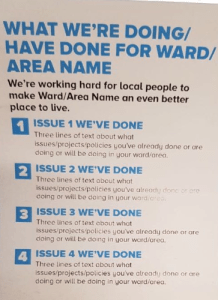
“Conservatives are standing for election in east London on their record of “ISSUES WE’VE DONE” for “AREA NAME”, according to their leaflet.

The leaflet, promoting the Tory candidate for Ilford Town, sets out in blue capitalised letters “WHAT WE’RE DOING/HAVE DONE FOR WARD/AREA NAME”.

Underneath, it lists issues one to four that “we’ve done” for Ilford. In what appears to be an embarrassing copy-and-paste error, the leaflet reads: “Three lines of text about what issues/projects/policies you’ve already done or are doing or will be doing in your ward/area name.”

The latest in a series of leaflet gaffes ahead of the local elections on Thursday, images of the leaflet quickly went viral on social media.”

https://www.huffingtonpost.co.uk/entry/election-leaflet-ilford-conservative_uk_5ae9983de4b022f71a038ce3