“John McDonnell: Spring Statement ‘must help ailing councils’ “

[Many of the councils ehich admit to severe problems are Conservative councils – some in affluent areas]

“John McDonnell has urged the government to ensure that the Spring Statement offers help to local councils that are struggling financially.

Mr McDonnell said: “Tories are bizarrely saying they will pass up an opportunity this month to act.”

He warned that councils in England are facing bankruptcy due to what he called the government’s “failed policy of austerity”.

Chancellor Philip Hammond will deliver the Spring Statement on 13 March.

A recent survey suggested that 80% of England councils feared for their finances.

In his speech in Southampton on Saturday, Mr McDonnell highlighted reported comments by Surrey County Council leader David Hodges – a Conservative – who said the authority faced “the most difficult financial crisis in our history”.

Mr Hodges also reportedly urged the government not to “stand idly by while Rome burns”.

Surrey County Council spans the chancellor’s constituency of Runnymede & Weybridge.

John McDonnell said: “If his own Tory council leader doesn’t trust his main economic policy, why should anyone else in the country?”

Mr McDonnell accused the government of trying to play down the Spring Statement by refusing to publish “any major documents” and moving the statement from its usual slot.

A Treasury spokesman outlined the plans to the Financial Times for the statement which, unlike most recent Budgets and Autumn statements, is being delivered on a Tuesday rather than taking the high profile slot straight after Prime Minister’s Questions on a Wednesday.”

http://www.bbc.co.uk/news/uk-politics-43273843

EDDC, the property consultant and Premier Inns – a worrying menage-a-trois?

From East Devon Alliance Facebook page:

“Look who’s coming to advise our Council: Item 7 on Overview agenda, March 13th.

http://eastdevon.gov.uk/…/130318-overview-agenda-combined.p…
Do we trust these people? Public can attend the meeting”

Anyone recall a few years ago, Tesco was flavour of the month? Now it seems to be Premier Inns.

Oh, and JLL was the company that chose Moirai as the lead developer for the first ill-fated stab at seafront development in Exmouth!

https://eastdevonwatch.org/2016/07/18/exmouth-eddc-backtracks-on-moirai-capital-investments-seafront-development-up-for-grabs-again/

The blurb that goes with this agenda item says:

“Matters for Debate 7 JLL presentation – Commercial Property Investment for Local Authorities JLL is a leading professional services firm that specializes in real estate and investment management. A Fortune 500 company, JLL helps real estate owners, occupiers and investors achieve their business ambitions.

Presenting Team John Kinsey, National Director John Kinsey joined the practice in November 2003 and has over 30 years of experience within the property markets throughout the South West. He has considerable experience in out-of-town leisure and retail developments along with High Street A3 developments. He is the representative for Whitbread Plc for their Premier Inn hotel chain throughout the South West. He has advised a number of local authorities on key project work and regeneration schemes. Simon Bennett, National Director Simon joined Jones Lang LaSalle in October 1995. He has 22 years’ experience within the Investment Department, specialising in the disposal and acquisition of a variety of properties across the whole of the South West. His clients are a wide range of institutional, local authority, property companies and private investors, together with a number of charity clients. Recent clients include CBRE Global Investors, AEW, IO Group, Standard Life and Mayfair Capital. David Roberts, Director A Director in JLL’s Planning and Development Team with a focus on the preparation and implementation of effective estate strategies for a range of public sector clients. David also currently works on a significant number of commercial and residential regeneration projects across the South West. His specialist skills include concept development, masterplanning, options appraisal, viability analysis, due diligence, business planning and estate strategy, implementation strategy, development partner procurement, agency and funding support.

Presentation JLL will be presenting and discussing with the council the recent drive by local authorities to enter into the commercial investment market and how this is being used for both income generation and regeneration projects.

They will present a number of case studies and also discuss case studies where local authorities have used their covenant to enable regeneration and investment opportunities.“

Exmouth’s Wright family receives much-deserved and unique award

From Exmouth’s Save our Seafront Facebook page and Exmouth Journal:

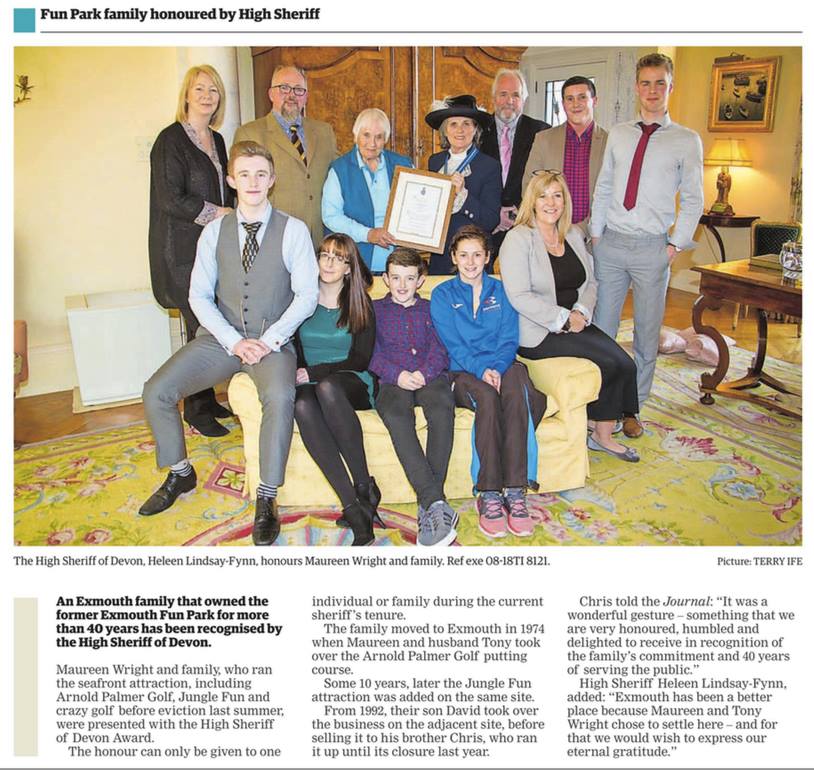
“The High Sheriff of Devon honours Maureen Wright and family, former owners of The Fun Park.

The award was presented to The Wright Family “in recognition of the great and valuable services to the community” and also recognises “the appreciation of the residents and people for activity and contribution in enhancing the life of the community”.

The High Sherriff, Heleen Lindsay-Fynn, can only honour one family or individual during her time in office and chose to present her award to The Wright Family on 21 February 2018.”

Majority of councils fear effect of Brexit

ALL councils, irrespective of who is in control – scary!

https://www.theguardian.com/politics/2018/mar/03/council-leaders-across-uk-believe-brexit-will-hurt-local-economy

Productivity, weather, climate change and – robots!

Our LEP says we can double productivity in Devon and Somerset by 2030. But can we do this given recent weather/climate activity that has apparently already cost Devon £200m?

https://www.devonlive.com/news/business/snow-storm-emma-cost-south-1289777

To recap: the only 2 main roads into and out of Devon (M5 and A303) were both impassable at the same time, the rail service collapsed in Dawlish and London, Exeter airport was closed and rural bus services were all cancelled. Devon came to a standstill. At a time when there were threats to cut gas supplies to larger, non-strategic businesses.

Good quality and quantity infrastructure is essential to get productivity growth, and now the cold weather has – yet again – shown how bad our infrastructure is, and that the current government has under invested – almost certainly because the south-west is generally a set of safe seats – so there is no need to invest – need as defined by political election need not citizen need.

So LEP claims to double productivity would be extremely optimistic / challenging in the best of circumstances, with great infrastructure, but with crumbling infrastructure, struggling under the weight of homes growth, and subject to the vagaries of the weather and lacking in desperately needed investment, there is not a hope of getting anywhere close. And indeed, we might ask, with the woeful infrastructure we currently have, and no investment, should we expect a decline in productivity rather than an increase?

And we have another problem. Productivity = output. so, with robotics does that mean more or less employment – and if less, and no one wants to move here, who are going to live in all these new homes and how will they afford to keep them?

Even Greggs the bakers are now using robots to make sausage rolls and pasties:

https://www.dailystar.co.uk/news/latest-news/685288/Greggs-to-cut-hundreds-of-jobs-sausage-roll-doughnut-robot-UK

Developers and loopholes – go together like a horse and carriage!

Owl says: as millions of pounds meant to be used for affordable homes was returned to the Treasury by the Department of Communities, Local Government and HOUSING, we can only assume this government doesn’t give a stuff about this.

“Property developers have used a legal loophole to halve the number of affordable homes that they are building in the countryside.

A study of more than 150 new housing developments found that confidential viability assessments had been used to cut the number of affordable houses by 48 per cent. The assessments let developers break promises made to get planning permission, if they can show those commitments will eat into profits.

The research, which was commissioned by Shelter, the charity for the homeless, and the Campaign to Protect Rural England (CPRE), found that eight rural councils lost 938 affordable homes after viability studies over the course of a year. “The viability loophole is slashing affordable housing supply in the countryside,” the report said. “The profits of volume housebuilders are rocketing, yet affordable housing provision by the same developers is being undercut on the grounds that it is not profitable enough.”

In one instance in Cornwall, the owners of a disused tin and copper mine promised that 40 per cent of the site’s 99 new homes would be affordable. They cut that commitment to zero with a viability study. The owners then advertised the plot for sale, boasting in the brochure that all of the plots had been approved for “open market housing” without any “liabilities”.

Central Bedfordshire, which was the worst affected of the eight councils in the study, lost 533 affordable homes in the 2015-2016 financial year.

Affordable housing includes homes for social rent, shared ownership and other intermediate tenures. “The term affordable in this context does not necessarily mean that these homes are in fact genuinely affordable to local people,” the report said.

The profits of Britain’s three biggest builders, Barratt Developments, Taylor Wimpey and Persimmon Homes, have quadrupled since 2012 to £2.2 billion a year. Yet they regularly cite financial constraints to reduce the percentage of affordable homes at new developments.

At Sowerby Gateway in North Yorkshire, Taylor Wimpey promised to build 256 affordable homes. A viability study cut that promise to zero. “Too much of our countryside is eaten up for developments that boost profits, but don’t meet local housing needs because of the viability loopholes,” said Crispin Truman, the chief executive of CPRE.

Councils can challenge viability studies but the government has guaranteed big builders at least a 20 per cent profit. If the builders can show that they stand to make less, the government will side with them.

“Developers are using this legal loophole to overpower local communities and are refusing to build the affordable homes they need,” said Polly Neate, the chief executive of Shelter.

Sajid Javid, the communities secretary, has promised to review how “viability is assessed” when he starts a consultation next week to overhaul the planning laws.

Separate research by the Institute for Public Policy Research, a think tank, found that the number of people sleeping rough in rural parts of England increased by 42 per cent from 397 in 2010 to 565 in 2016.

Houses are 26 per cent more expensive in the countryside because of pressure from wealthy retirees and buyers of second homes, but wages in rural areas are 26 per cent lower, which has created an exodus of young families.

Andrew Whitaker, from the Home Builders Federation, an industry body, said local authority targets were always negotiable. “There is a limit as to what can be extracted from development sites before they become unviable and you get no homes of any sort,” he said.”

Source: Times (paywall)

Swire gets about: questions about Burma and – yes, yet again – the Maldives in Parliament!

He really hasn’t accepted that he doesn’t work at the Foreign Office any more, poor dear, has he!

Bet those people who DO have responsibility for these places now get pretty fed up with his “interest”.

Upcoming Business – Commons: Main Chamber 6 Mar 2018

Political situation in the Maldives – Hugo Swire. Adjournment debate

Recent appearances

International Development Committee: Burma Visas 28 Feb 2018

Having seen what has been going on in Rakhine, albeit a few years ago, I can say it is imperative that we continue to assist the Rohingya people in their hour of need. I urge the Minister formally to summon the Burmese ambassador to the Foreign Office to explain how seriously this House takes the fact that the Committee cannot go there to oversee what is the biggest bilateral aid programme in…”

https://www.theyworkforyou.com/calendar/?d=2018-03-06#cal19364

Government gave special treatment to failing private training provider

“The government gave England’s largest commercial further education provider ‘special treatment’ even though its performance was declining, a group of MPs concluded.

A Public Accounts Committee report out today has criticised the government’s continued commitment to its multi-million pound contract with Learndirect.

The report shows that the Education and Skills Funding Agency and its predecessor the Skills Funding Agency gave Learndirect almost £500m in the academic years from 2013-14 to 2016-17.

However, the PAC also notes that the quality of Learndirect’s apprenticeships have been in steady decline – Ofsted gave it a rating of ‘good’ in March 2013 but downgraded this to the lowest possible rating of ‘inadequate’ in March 2017.

Learndirect instigated a legal challenge challenging the ‘inadequate’ rating, which delayed the publication of Ofsted’s inspection report.

The Department for Education would normally cancel an ‘inadequate’ provider’s contract and withdraw funding immediately, but Learndirect warned that this would impact its 75,000 learners.

The government has since said it is ending Learndirect’s contract to provide apprenticeships and adult education.

Learndirect received £121m from central government in 2016-17 and is expected to get another £105m in the current financial year, the PAC pointed out.

PAC chair Meg Hillier said: “It cannot be right that individual contractors should command such large sums of public money regardless of their performance.

“No commercial provider should be allowed to become so essential to the delivery of services that it cannot be allowed to fail.”

She added: “Government has a duty to manage taxpayers’ exposure to risk diligently and we urge it to act on the recommendations set out in our report. … ”

http://www.publicfinance.co.uk/news/2018/03/dfe-gave-inadequate-training-provider-learndirect-special-treatment

Tory donor puts screws on tenants in Grenfell-type block

“A company run by a property tycoon who recently made a five figure donation to the Tories is forcing the residents of a block of flats with flammable cladding foot the bill for safety measures.

The latest party funding figures reveal the Tories pocketed £10,000 from Ashcorn Estates Limited, which is owned by James Tuttiett, a multimillionaire who lives in a £1.6 million farm house which has its own vineyard.

Another of his companies, E&J Estates, has been in the news recently.

It owns an apartment block in Salford which was found to have been constructed with a similar type of cladding to the one used on the Grenfell Tower.

The Guardian reported last month that E&J have told residents that they have to pay the £100,000 cost of interim fire wardens needed to make the building safe until the cladding is replaced.

The company even took legal action to enforce the charge, which one resident said would cost him an extra £235-a-month.

Matthew Crisp told the Manchester Evening News:

“I’m worried this now sets a precedent for us to foot the bill for the cladding too, and that’s devastating, as I don’t know if I’ll be able to continue living in my home.”

Crisp’s fears aren’t unfounded.

Scrapbook revealed in January how residents living in a building owned by a separate millionaire Tory donor were forced to pay the £2 million to replace flammable cladding.

The Government say they are clear that “private sector landlords follow the lead of the social sector and not pass on the costs of essential fire safety works.”

So why do the Tories keep taking their money?”

https://politicalscrapbook.net/2018/03/company-of-tory-donor-forcing-residents-of-flats-with-grenfell-style-cladding-to-pay-for-fire-safety-measures/

“Clean coal” – like “cheap nuclear energy”?

Substitute “nuclear energy” (or perhaps Hinkley C!) to see what can go wrong with flagship, vanity energy projects that ignore renewable power:

https://www.theguardian.com/environment/2018/mar/02/clean-coal-america-kemper-power-plant

“Public at risk from ‘daily cocktail of pollution’ “

We can all do more – but big institutions can do a lot more. AND our councils can lead … sorry could lead if there was the foresight and will. Has our CCG – always thinking of our health (lol) – considered this? You bet not!

“People are being exposed to a daily cocktail of pollution that may be having a significant impact on their health, England’s chief medical officer says.

Prof Dame Sally Davies said the impact of air, light and noise pollution was well recognised in the environment.
But she said its role in terms of health was yet to be fully understood.

Dame Sally added there was enough evidence to suggest action had to be taken. And, in her annual report, she said the NHS could lead the way in cutting pollution levels. She said one in 20 vehicle journeys was linked to the NHS, either from patients or staff travelling.

Seven charts that explain the plastic pollution problem
And making sure services were brought out of hospitals and closer to people’s homes could help reduce that burden.
Dame Sally also pointed to the attempts being made to phase out ambulances run on diesel, a key source of nitrogen dioxide, which is linked to respiratory disease.

And she said the NHS could cut its use of disposable plastics, landfill and incineration. …”

http://www.bbc.co.uk/news/health-43246263

“NHS England treats too many patients as an emergency, watchdog warns”

“The ageing population and other unexplained factors mean hospitals are now treating 5.8 million patients as emergency admissions every year, 24% more than a decade ago, the NAO found. Together they cost the health service £13.7bn, almost a 10th of its budget, and account for 33.59m bed days.

Its hard-hitting report, published on Friday, praises NHS England’s handling of the extra numbers but also criticises its failure to put in place enough services outside of hospitals to keep patients healthier.

The watchdog believes this lack of provision underpins its finding that 24% of emergency admissions are avoidable, implying that £3.43bn a year of NHS funds may be being wasted on people who, with better care, would not have ended up falling ill.

GPs offered cash to refer fewer people to hospital
The NAO said: “The impact on hospitals of rising emergency admissions poses a serious challenge to both the service and financial position of the NHS.”

It acknowledged that hospitals have done well to reduce the overall impact of rising emergency admissions in recent years, in particular by reducing patients’ length of stay and treating more patients as day cases.

But it warned: “[The health service] cannot know if its approach is achieving enduring results until it understands whether reported increases in readmissions are a sign that some people admitted as an emergency are being discharged too soon.

“The NHS also still has too many avoidable admissions and too much unexplained variation. A lot of effort is being made and progress can be seen in some areas, but the challenge of managing emergency admissions is far from being under control.”

The NAO cast serious doubt on whether key government-backed NHS initiatives to keep people out of increasingly overloaded hospitals have proved effective. The NHS’s longstanding policy of reducing its supply of beds has made things even more difficult for hospitals trying to deal with rising emergency admissions, the watchdog added.

The latest NHS data published on Thursday on how health services are coping with winter’s intense pressures shows that 95.3% of hospital beds were occupied last week – more than 10% more than the limit considered necessary for patient safety.

The NAO also voiced concern that the number of emergency admissions varies from 73 to 155 per 1,000 overall admissions in different parts of England, suggesting NHS trusts’ admission policies appear to be inconsistent and possibly wasteful.

NHS organisations and health unions endorsed the NAO’s conclusion that health service leaders’ failure to create and deliver more services in and nearer patients’ homes, despite promises to do so, was a key factor behind the upward trend in admissions.

The number of nurses working in NHS community services fell by 15% between 2010 and 2017, the Royal College of Nursing pointed out.

“People, particularly older people, are not getting the support they need in the community, which leads to more emergency admissions and dangerous levels of bed occupancy when demand is high, as we have seen this winter”, said Donna Kinnair, the RCN’s director of nursing, policy and practice.

Saffron Cordery, the deputy chief executive of NHS Providers, which represents hospitals, said proper community services were “central to the [NHS’s] ambitions” to transform the way it cares for patients. However, she added, efforts to do so had been hampered by underfunding and such care not being seen as a priority.

Prof Keith Willett, NHS England’s medical director for acute care, said: “As the report states, there are 12% fewer A&E patients being admitted than was predicted at the start of the decade, and hospitals, community trusts and GPs trialling new models of care have meaningfully reduced admissions compared with their peers.

“In addition, growth in the cost of managing emergency admissions has been less than a third of the growth in demand.”

https://www.theguardian.com/society/2018/mar/02/nhs-england-too-many-patients-as-emergency-nao-warns

RDE declares crisis

Well, we didn’t see that one coming did we – after more than 200 of our community beds were closed.

How on earth do you “prioritise patients in currently in your care” when emergencies happen and when your next nearest large hospitals are 40-90 miles away and having their own crises?

Here’s an idea: have community hospitals and move dying, improving or rehabilitation patients closer to their homes, freeing up acute beds!

“The severity of today’s weather has resulted in the Royal Devon & Exeter Hospital declaring a status of ‘internal critical incident’.

The warning means that care is being prioritised to patients already in its care, and it is calling on all available staff to come in to work.

Pete Adey, RD&E chief operating officer, said: “Due to the adverse weather conditions the trust, earlier today, declared an internal critical incident. This means we are diverting all available staff and resources to provide care for the patients who are in the hospital and receiving care from our community teams.

“We are asking staff within walking distance of the RD&E’s main Wonford site to come in and provide help if it is safe for them to do so.

“As we expect the weather conditions to continue, our focus for the next 24 hours is to provide urgent and emergency services and to look after the patients already in our care.

“In view of the treacherous driving conditions, patients should only attend their booked appointments if it is safe to do so. Appointments for all of the patients who cannot reach the hospital and those we have needed to postpone in light of the weather conditions will be rescheduled as soon as possible.”

The RD&E advised Honiton Minor Injuries Unit will reopen at 9am tomorrow.

Tiverton and Exmouth MIUs are open as normal at this time but may be subject to change. Regular updates will be provided.

Mr Adey continued: “We sincerely thank the public for their help and support at this challenging time and pay tribute to our staff who are working incredibly hard to keep our essential urgent and emergency services running.”

https://www.devonlive.com/news/devon-news/devon-hospital-declares-internal-critical-1285163

Privatisation: Network Rail assets likely to be sold off to billionaire equity funds

“Private equity firms, including Guy Hands’ Terra Firma, have emerged as contenders to take over Network Rail’s commercial property business, fuelling further dismay over the forced sale of assets to fund the budget shortfall.

The US investment giant Blackstone is understood to be another bidder for the rail property arm, which includes about 5,500 premises across England and Wales and is estimated to be worth £1.2bn.

According to Sky News, about 20 parties are expected to table preliminary bids on Friday, including Telereal Trillium, owned by the billionaire Pears family, and also funds linked to the Wall Street bank Goldman Sachs.

Much of the property is in urban areas under railway arches, and often let to small businesses such as bars, garages and hairdressers. The portfolio generated a large proportion of Network Rail’s total rental income of £293m in 2017. Network Rail has said existing tenants will retain their leases under the new landlords.

The involvement of Guernsey-based Terra Firma was revealed a month after a scathing report from the National Audit Office found the government had lost up to £4.2bn in a previous sell-off to part of Hands’ private equity group. The Ministry of Defence sold 57,400 army homes for military families for £1.66bn in 1997 to Annington Homes, and then rented them, which the public accounts committee chair, Meg Hillier, described as “a rotten deal for taxpayers”.

Terra Firma has also attracted attention for its management of the crisis-hit Four Seasons Health Care, whose care homes look after 17,000 elderly people in the UK and which is seeking a rescuer.

The sale of Network Rail assets, including some depots but no stations, was agreed as a condition of George Osborne (who was then the chancellor) releasing more funds in 2015 to continue promised infrastructure work. Network Rail hoped to raise £1.8bn towards a £2.5bn shortfall. A host of rail upgrades in a five-year plan from 2014-19 were cancelled after the budget for electrifying the Great Western mainline alone overran by approximately £2bn. …”

Unions and campaigners condemned the sale. Mick Cash, general secretary of the RMT union, said: “This is the same old bunch of chancers, speculators and asset strippers queuing up to make another killing at the expense of our public services. These property assets make a decent income for Network Rail and once they are gone they are gone, smashing another gaping hole in the rail infrastructure budget.” …

… Cat Hobbs, of the campaign group We Own It, said: “Railway land belongs to all of us – we don’t want it parcelled up and sold to the highest bidder. This is an asset which generates millions every year, money which should be returned to the public purse not disappear into private profits.”

https://www.theguardian.com/business/2018/mar/01/guy-hands-emerges-as-bidder-in-national-rails-property-sell-off

Bovis pays out £10.5 m to repair sub-standard homes

“Profits at Bovis slumped last year after the housebuilder was forced to spend millions of pounds repairing poorly-built homes and fending off takeover attempts by rivals Galliford Try and Redrow.

The company was criticised after rushing the construction of some properties and offering customers cash to move into unfinished houses, some of which had plumbing and electrical problems.

The scandal has so far forced it to spend £10.5m on repairs, including £3.5m in 2017. Other one-off costs last year included £4m for restructuring and £2.8m on advisory fees as it tried to see off the takeover bids.

The charges dragged down Bovis’s annual pre-tax profits, which fell 26pc to £114m. Revenues dipped 3pc to around £1bn, despite a 7pc hike in its average selling price to £272,000.

The housebuilder’s previous chief executive David Ritchie resigned last January, just days before the quality scandal came to light, after Bovis was forced to issue a profit warning because it had struggled to build as many homes as expected in 2016. …”

https://www.telegraph.co.uk/business/2018/03/01/bovis-profits-slump-35m-payout-botched-homes/

“Accountable Care” – if it walks like a duck …

BMA website link:
What are Accountable Care Organisations (ACOs)?

An ACO brings together a number of providers to take responsibility for the cost and quality of care for a defined population within an agreed budget.

The key feature of an ACO is that there will be a single contract with a single organisation for the majority of health and care services in the area.

The ACO contract holder would be responsible for the provision of services, but may not necessarily deliver all the services itself; it could instead hold sub-contracts with other providers.

This is our artistic impression.

http://999callfornhs.org.uk/nhs-cunning-linguists/4594220738

Danger of Exmouth’s “temporary” attractions

Letter in Exmouth Journal:

“There is very important meeting at the Town Hall on Tuesday 6th March at 10 am.

The future of Queens Drive is at stake. Do not be deceived by the description that the planning application is for 12 months only and is “temporary”.

Our Town Council has been bullied and harassed by EDDC paid officials and members of the Regeneration team to try and force this through using the threat of dereliction if they don’t get their way.

This plan reduces the play and recreation of this area to about a quarter. The bulk of the site is to be cheap food outlets and a big screen and spurious as yet unnamed and untested events. To this end to also force the issue EDDC has signed a contract for some play equipment and hired an events manager without consulting our elected representatives.

This area up to now has been protected by the Masterplan for Play and Recreation. Even in the wonderful, could now say fantastical, plans in Reserved Matters last year there is a huge area put aside for water play and other recreational activities. All this can now be lost forever if this so called “temporary attractions“ application goes through in its current form.

If you care about our Seafront, send someone to this meeting. We must stand up to bullying. We must stand up for democracy and above all we must continue to stand up for our lovely Seafront.

Sally Galsworthy, Exmouth”

The business rate retention scam

“Allowing English councils to retain more of their business rates revenue could lead to damaging shortfalls in funding and drive divisions between different areas, the Institute for Fiscal Studies has warned.

Councils that enjoy the biggest increases in such revenues are unlikely to be those with the biggest spending needs, the think tank said. Levelling the playing field by redistributing the money would address regional disparities but would undermine the goal of encouraging councils to use business rates to boost regional growth.

The government turned the business rates system on its head in 2013 as part of its devolution strategy, when local authorities were allowed to keep half of any real-term growth in revenues or bear half of any real-term fall. Until then, business rates were pooled by central government and distributed back to local authorities as grants.

Five years ago, the ambition was for councils to keep 100 per cent of the change from 2019. That has been revised down to 75 per cent from 2020. The idea was to give local authorities an incentive to boost their revenues and local economies by increasing commercial property development or by cutting rates to attract more business.

The IFS said that the plan may backfire and “lead to divergences in English councils’ funding without promoting growth”. Its analysis of councils’ revenues and spending since 2006 showed that the policy may be flawed.

“The report shows that significant divergences could arise in just a few years under 100 per cent rates retention,” the IFS said. “This is because those councils, which would have seen the biggest increases in their retained business rates revenues, were often not the councils that experienced the biggest increases in their relative spending needs, for example, because their population became older, poorer or sicker.

“It is also not clear that the incentives provided by rates retention will translate into faster economic growth. The report finds no relationship between changes in the councils’ business rates tax bases and local economic growth, or indeed employment or earnings growth, in recent years.”

David Phillips, associate director at the IFS, said: “Areas seeing lots of new developments aren’t guaranteed strong economic growth. And growth doesn’t necessarily rely on large-scale property development.”

Source: The Times (pay wall)

So, how is the “Misconduct in Public Office” consultation going?

Here’s the current state of play:

Click to access cp229_misconduct_in_public_office_summary.pdf

Here’s a summary:

Click to access cp229_misconduct_in_public_office_summary.pdf

Owl says: chances of reform – zero. Why: there is no will for change from a government that has too much to lose from such reforms!