More houses? Maybe not: “UK construction output falls at fastest rate in six years in January”

Construction output suffered its biggest monthly drop in six years, figures for January show, confirming that the sector’s recession drags on into this year.

The Office for National Statistics reported that UK builders’ work volumes fell by 3.4 per cent in the month, the largest month-on-month decline since June 2012.

There were deep drops private commercial construction work on the previous month as well as in private housing, which will concern ministers who are trying to drive up constriction rates.

On a year-on-year basis total construction output fell by 0.5 per cent, worsening from the 0.2 per cent rate of contraction in December.

http://www.independent.co.uk/news/business/news/construction-output-january-ons-builders-a8247086.html

and

“The sector was feeling as flat as a pancake in February with falls in new orders for the second month in a row, and with just a marginal rise in overall activity, as ongoing political and economic uncertainty shouldered the blame,” said Duncan Brock of the Chartered Institute of Procurement & Supply.

Civil engineering activity contracted at its sharpest pace for five months, according to the latest survey.

Housebuilding was also weak again, putting it on track for its weakest three-month performance since the third quarter of 2016. …”

http://www.independent.co.uk/news/business/news/uk-building-construction-february-2018-pmi-purchasing-managers-index-a8236086.html

Independents gaining more and more council seats countrywide

Labour and Conservatives lising to Independents – even in their heartlands and, in one case, on a single issue problem. Take elections held yesterday:

Wollaton West (Nottingham): Labour GAIN from Conservative.
* Farnworth (Bolton): Farnworth & Kearsley First GAIN from Labour.
* Oakham South East (Rutland): Independent GAIN from Conservative.
Rochester West (Medway): Labour GAIN from Conservative.
Northchurch (Dacorum): Liberal Democrat GAIN from Conservative
Droylsden East (Tameside): Labour HOLD
* Petersfield Bell Hill (East Hampshire): Independent GAIN from Conservative
Little Parndon & Hare Street (Harlow): Labour HOLD

* = Independent victories

https://www.politicshome.com/news/uk/politics/opinion/politicshome/93453/update-election-breakdown-08032018

Will East Devon MP Neil Parish will benefit from Exmoor Brexit initiative?

Well, he should, considering he is a former Chair of the Environment, Food and Rural Affairs Select Committee and for his entire career in the European Parliament he was a member of the Committee on Agriculture and Rural Development (from January 2007 to July 2009 he was Chairman of the Committee AND he was appointed Conservative spokesman on agriculture and he was also the delegation’s deputy chief whip) …. and he farms from his family home on Exmoor.

Just a pity the test area isn’t in his Tiverton and Honiton constituency.

BUT what is it about East Devon that BOTH of our MPs choose not to have a home here (Swire’s second home is in Mid-Devon).

Still, on the bright side, at least his main interest isn’t the Middle East and, in particular, the Maldives!

“Exmoor’s farmers have received the backing of Cabinet minister Michael Gove MP.

Backed by the Exmoor Hill Farming Network, conservationists and local public bodies – Exmoor’s Ambition – aims to sustain and enhance Exmoor’s farmed landscapes and communities following the UK’s exit from the EU. …”

https://www.devonlive.com/news/devon-news/exmoors-ambition-becomethe-test-bed-1312397

Street trading in East Devon – when bureaucrats go wild!

Translation: we made what was supposed to be a simpler system MUCH more complicated and now we are frantically paddling under the water while trying to make it simpler again but, being bureaucrats, we are finding this difficult”. Good luck with that.

“… since the introduction of the new system last October, the council says that it has received commented that it can be confusing and inflexible.

… Now though the council has announced they will be reviewing the street trading policy with a view to removing the street trading application fee charge entirely, giving clearer guidance on the activities that do and don’t require consent, a less detailed application form with less supporting information required and a more streamlined procedure for processing the application. …

… Cllr Steve Hall, the chairman of the licensing and enforcement committee, said: “Having listened to our customers, the council has identified the need to make refinements to ensure that it delivers in the way which was intended.”

https://www.devonlive.com/news/devon-news/street-trading-rules-changed-too-1317267

Warning light for our LEP council partner’s finances (Somerset)

Owl wonders how our Local Enterprise Partnership will function with (at least) one partner council “showing financial stress” – and the lead partner which provides most of the administrative services to the LEP … and have some of those “fallen useable reserves” (fallen 60% in five years) “fallen” to the LEP – possibly even towards Hinckley C support?

As we do not get to see LEP accounts, we will never know.

“Three Conservative-run counties have been added to the list of those showing signs of financial stress because of funding cuts.

Somerset, Norfolk and Lancashire county councils are exhibiting some of the warning signs demonstrated by Northamptonshire county council before it declared itself effectively bankrupt last month, according to the Bureau of Investigative Journalism.

The three join the Tory-run Surrey county council, which is facing a £100 million shortfall, as the counties in the deepest financial crises. The National Audit Office has found that one in ten councils could run out of money in the next three years. County councils have been hit hard by cuts to local government funding since 2010 and social care costs are rising.

Somerset, Norfolk and Lancashire’s usable reserves — effectively rainy day funds — have all fallen substantially in recent years, the bureau’s research found. Somerset’s usable reserves have fallen by 60 per cent in the past five years, Norfolk’s have halved and Lancashire’s have fallen by 48 per cent.

All three show further signs of financial difficulty. In Somerset the council overspent on children’s and adult’s social services in each of the past three years and its budget this year projects a £14.6 million overspend on children’s services, the largest in the country. Last month it announced plans to close two-thirds of its children’s centres.

In Norfolk the council has spent more than it budgeted for in each of the past three years, the bureau found, although the council disputed the claim it had been overspending and insisted its budgeting was “robust and prudent”.

Lancashire has overspent on children’s and adult social services in each of the past three years, and its funding gap is £97 million in the coming financial year.

A spokesman for Somerset said that the findings “overstate the position and don’t take account of our considerable contingency funds or the plans we have in place to make savings”. A Norfolk spokesman said the research was “scaremongering” and that the council had recently “set a balanced budget for 2018-19”. Angie Ridgwell, Lancashire’s chief executive, said: “There may be sufficient funds within the transitional reserve to support the identified budget gap in 2018-19 and 2019-20. However, further savings will need to be made.”

Source: The Times (paywall)

[Somerset county council has announced plans to close two thirds of its children’s centres in a bid to save cash]

Conservative Middle East Council (and Swire) come in for some stick

Owl has no understanding of Middle East politics whatsoever, flying only over East Devon, but well-known journalist Peter Oborne (see below for credentials) does have such an understanding and has quite a lot to say about Hugo Swire, the Conservative Middle East Council and its donors in this fascinating article:

http://www.middleeasteye.net/columns/why-uk-conservative-party-ignoring-palestine-cmec-focus-on-gulf-bahrain-uae-saudi-libya-israel-1824625298

Wiki: “Oborne is an associate editor of The Spectator and former chief political commentator of The Daily Telegraph, from which he resigned in early 2015. He is author of

The Rise of Political Lying and
The Triumph of the Political Class, and,
with Frances Weaver, the pamphlet Guilty Men.

He writes a political column for the Daily Mail and Middle East Eye. He sat as a Commissioner for the Citizens Commission on Islam, Participation and Public Life. He won the Press Awards Columnist of the Year in 2012 and again in 2016.

Oborne is known for his acerbic commentary on the hypocrisy and apparent mendacity of contemporary politicians. …

https://en.m.wikipedia.org/wiki/Peter_Oborne

EDDC has second-highest number of complaints about councillors and staff in Devon

North Devon Council recorded the most complaints at 87, with Exeter City Council recording the least with just two.

https://www.devonlive.com/news/devon-news/revealed-330-complaints-made-devon-1309919

“Westminster councillor resigns after receiving nearly 900 gifts and hospitality packages in six years”

Owl says: what is happening to Westminster council’s Monitoring Officer, Leader and Standards Committee? Nothing, so far.

And NO-ONE should be Chair of a Planning Committee for SEVENTEEN years!

“The deputy leader of Westminster city council has stepped down after it was revealed he had received nearly 900 gifts and hospitality packages over six years.

Robert Davis, a Tory councillor, was the chair of the borough’s planning committee until last year.

He has stepped aside as deputy leader and cabinet member for business, culture and heritage as an independent QC investigates his conduct.

Councillor Robert Davis has referred himself to the City Council’s monitoring officer and has decided to stand aside as Deputy Leader and Cabinet Member for Business, Culture and Heritage while the investigation is undertaken,” said Nickie Allen, the leader of Westminster City Council.

“Our residents need reassurance that the planning process is not only impartial, but is seen to be impartial,” she said, adding she had “asked the council’s chief executive to look at all aspects of the decision-making process to ensure planning is, and is seen as, an independent and impartial process.”

The Guardian revealed Mr Davis had received gifts and hospitality invitations 893 times over the last six years, which frequently came from property developers who were seeking planning permission.

Gifts and hospitality packages worth more than £25 must be declared and some of the items and invitations received by Mr Davis exceeded the figure.

The Cambridge graduate is the longest serving member of the council, having been elected in 1982. He was voted Conservative councillor of the year in 2014 and given an MBE in 2015 for his service to local and government planning.

“I think it’s important to recognise Robert Davis remains a candidate for the May election,” Adam Hug, leader of the Labour Group, told The Independent. “He remains a councillor.

“This move has been described as standing aside, with a clear view that if no legal wrongdoing is found he may return to his post. As he remains a candidate it is clear that the Tories believe what is known and not disputed is acceptable for them.”

He added: “Westminster Tories knew this was going on, did nothing for decades, and it is clear that unless legal wrongdoing is found, he may return to his post.”

In a statement, Mr Davis said: “Due to the ongoing interest and wrongful assertions regarding my time as chairman of planning I have decided to step aside from my roles as deputy leader and cabinet member for business, culture and heritage whilst the council investigates.

“In 17 years as chairman of planning committees which granted hundreds of applications and resulted in the council receiving substantial sums for affordable housing, public realm and other public amenity, I have at all times acted with the independence and probity required by my role.

“My desire to rigorously declare all meetings and hospitably, regardless of its nature, underpins this transparency and independence. It is trite to confirm that within these 17 years, I have got to know many of the developers and associated professionals who work in the city and help to develop Westminster into one of the most important economic centres in the country and home to over 280,000 people. Any suggestion or implication that I have done anything other than to further the interests of the city and its residents are baseless and strenuously denied.”

http://www.independent.co.uk/news/uk/politics/westminster-councillor-robert-davis-gifts-hospitality-bribery-investigation-corruption-planning-a8245626.html

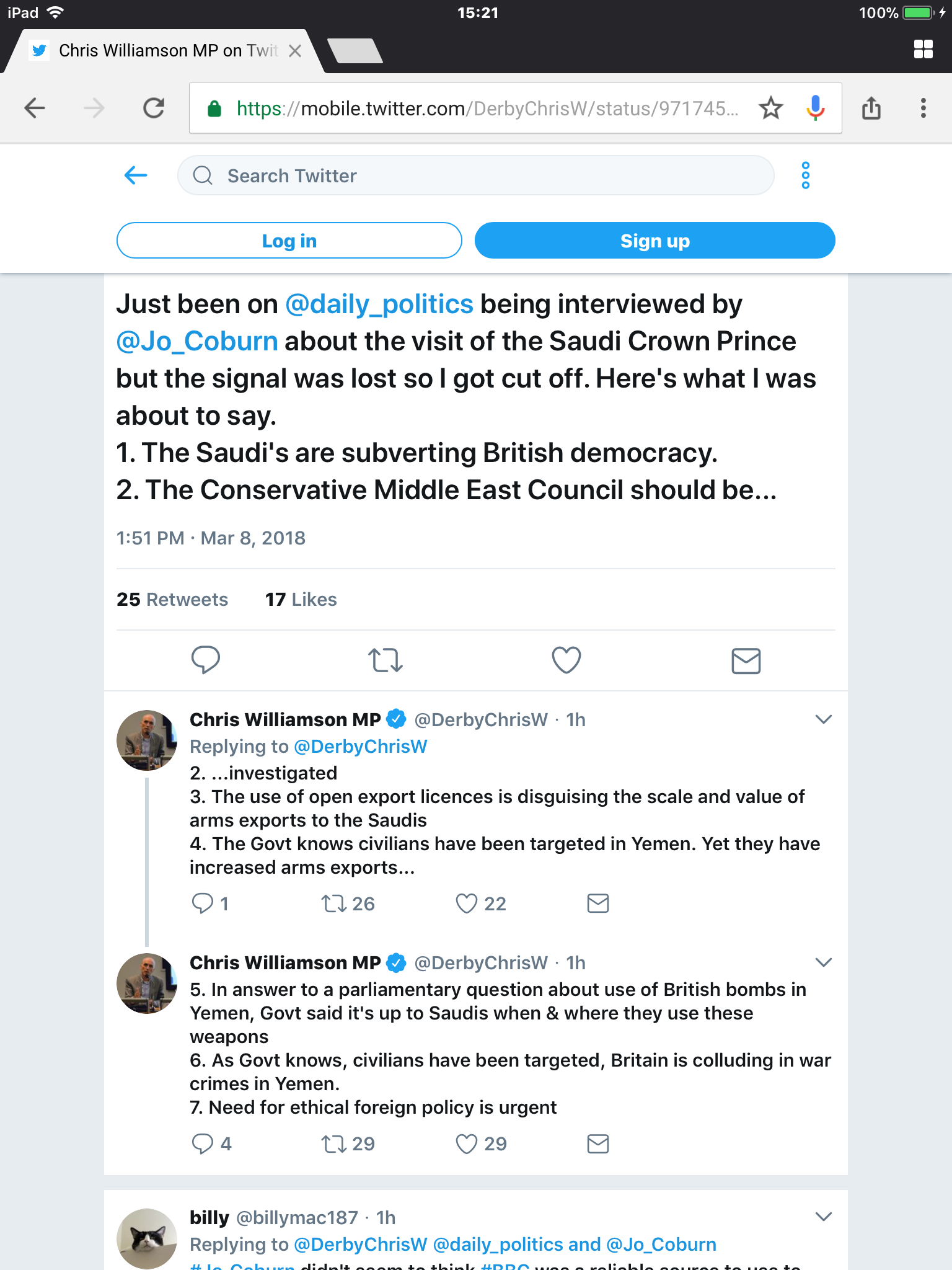
Labour MP calls for investigation into Swire’s Conservative Middle East Council

Image: Saudi Crown Prince’s UK visit PR

Swire retains a massive interest in the Middle East via his chairmanship of the Conservative Middle East Council. He visits many Middle East Countries and is often around at the same time as British arms companies, and hosts many visits and seminars as well as hosting Middle Eastern potentates and politicians in the UK. We have reported on the group’s controversial funders (see below). Now a Labour MP has called for an inquiry into the group. He is particularly concerned about UK arms sales to Saudi Arabia being used in their war with Yemen:

Swire still can’t let go of his old Foreign Office job and The Maldives

One has to feel sorry for poor old Swire. Once upon a time he swanned round the Middle East as a Foreign Office Minister. Now, he STILL swans around the area as Chairman of the Cobservative Middle East Council (salary £2,000 per month plus expenses) with its ties to somewhat controversial donors:

https://eastdevonwatch.org/2018/02/12/swires-conservative-middle-east-committee-accused-of-bias-towards-gulf-arab-states/

Swire succeeded in getting a special adjournment debate about the country in which he took an inordinate amount of interest when he was a Minister of State at the Foreign Office. And during this debate he spoke very knowledgeably about its tourism situation:

“The Maldives economy remains a tourism driven economy in that it contributes more than 25% of the country’s GDP. While the tourism sector supplies more than 70% of the foreign exchange earnings to the country, one third of the Government revenue is generated from this sector. Tourism is also known as the leading employment generator in the country. In 2016, tourism contributed 36.4% to the Government revenue. But as a result of the current situation, the Maldives is facing financial ruin, with the tourism industry estimated to be losing $20 million a day since the start of the state of emergency. If the trend continues, it will lead to unemployment and dissatisfaction, to my way of thinking both active recruiting sergeants for radicalisation, and with our tourists spread out over 115 square miles in 105 resorts it is almost impossible to guarantee their safety.”

But it seems that the current Minister of State at the Foreign Office is rather fed up of his predecessor’s continuing interference in his area:

“I am grateful to my right hon. Friend Sir Hugo Swire for securing this debate. During his time as one of my predecessors in the office I currently hold, he was tireless in his efforts to improve the political and human rights situation for all the people of the Maldives. I pay great tribute to him for his continued commitment to this cause and share his disappointment and alarm at the recent deterioration in the political outlook in the Maldives”

https://www.theyworkforyou.com/debates/?id=2018-03-06b.277.3&s=speaker%3A11265#g279.

The human cost of austerity cuts

“One in ten councils faces running out of money in the next three years after exhausting its reserves to pay the dramatically rising cost of social care, the government’s financial watchdog has concluded.

The National Audit Office (NAO) warned that many councils were on the verge of insolvency having had their central government funding cut by almost 50 per cent in eight years. It found that authorities’ financial positions had “worsened markedly” since they were last audited in 2014, with two thirds of councils with social care responsibilities dipping into their reserves last year. The report also revealed that government cuts had led councils to:

• Reduce the number of households having their bins collected each week by 33 per cent since 2011;

• Cut the number of food hygiene checks on cafés and restaurants by 40.9 per cent;

• Make savings of £1.6 billion by closing Sure Start centres and services for young people.

In addition, bus route subsidies have been cut by 48 per cent, 10 per cent of libraries have been shut and 67 per cent fewer health and safety enforcement notices are being handed out.

The NAO found that despite these cuts, councils were still unable to balance their books because of the increased demand for social care combined with cost pressures such as the new national minimum wage. It said that the estimated number of people aged over 65 in need of care had increased by 14.3 per cent. Social care accounts for 54.4 per cent of local authorities’ total service spending, up from 45.3 per cent in 2010-11.

As a result, 66 per cent of local authorities with social care responsibilities drew on their reserves last year. The NAO said that at the current rate of deficit 10 per cent of councils would have exhausted their reserves by 2020.

Last month Northamptonshire county council had to impose strict in-year spending controls after effectively going bankrupt. The Timesrevealed that Surrey, Britain’s richest county, is facing a £100 million cash crisis. Councils are not legally allowed to run up deficits and so they would be forced to cut services to ensure they remained solvent. Many of the councils affected are in solid Conservative areas. Surrey, for example, is a county represented at Westminster by seven government ministers.

Amyas Morse, head of the NAO, said that while the government had given local councils several “short-term cash injections” this funding had only been available for adult social care and uncertainty remained over the long-term financial plan for the sector.

Meg Hillier, chairwoman of the Commons public accounts committee, said funding cuts had led to “stark choices” about which services local authorities continue to provide. “Many councils are raiding their rainy day funds to pay for social care, and we have seen Northamptonshire reach the brink of financial failure,” she said.

A government spokesman said councils needs and resources were being reviewed and a real-terms increase had been provided over the next two years.”

Source: Times (pay wall)

Who will be working where with the new EDDC HQ

Freedom of Information request 19 February 2018. EDDC seems to be increasing staff during austerity.

“Total number of employees working for EDDC
513 – data as at 28 February 2018.

How many currently working remotely or ‘on the move’ are:

A) based in Exmouth Town Hall -79
B) based in Sidmouth – 280
154 are based elsewhere across the district including THG, Manor Pavilion, Cranbrook, StreetScene depots, parks and gardens, Lymebourne House, Business Centre, Camperdown or may be mobile touching down at both ETH and Knowle.

How will this situation change once the new office opens in Honiton (number):

It remains to be seen exactly but I would expect the majority of the 280 to relocate to Honiton but I will be consulting with all individuals and where there are people who potentially live in Exmouth who can work more sensibly from Exmouth we may make adjustments.”

http://eastdevon.gov.uk/access-to-information/freedom-of-information/freedom-of-information-published-requests/

Blackill Engineering Extension – is this an excuse to drive a new industrial site into the heart of the Pebblebed Heaths?

These days most large developers pay for pre-application advice before submitting a planning application. A recent Freedom of Information request has uncovered the advice that was offered to someone (name redacted) seeking such advice on proposed business units at Blackhill Quarry, Woodbury in early October 2017.

Specifically this proposal was for the erection of AN ADDITIONAL industrial building to support the existing business, Blackhill Engineering, being operated form the site together with the erection of FIVE ADDITIONAL industrial buildings for use by other businesses.

In summary the advice given was that this would not comply with the protective policies that cover this sensitive site. A much stronger employment benefit case regarding the expansion of the existing business to justify a departure from these policies would be needed. The five speculative industrial buildings would not justify a policy departure.

On 20 December 2017, within three months of this advice, planning application 17/3022/MOUT was submitted for outline application seeking approval of access for construction of up to 3251 sqm (35,000 sq ft) of B2 (general industrial) floor space with access, parking and associated infrastructure.

The accompanying justification reads:

“There is considerable and clearly identified need for the existing business at Blackhill Engineering to expand as a result of that business having grown considerably over recent years and with its existing premises now at full capacity. The provision of additional facilities on the application site would allow the company to continue its expansion and so deliver additional economic and employment benefits to the local area…. With the winding down of the existing quarry use of the site, there is a short and fortuitous window of opportunity in which to address BESL’s growth requirements with the reuse of an area of former minerals processing site….It is a crucial part of both local and national employment strategy to protect existing businesses and to encourage their expansion. If approved, the scheme would allow the existing business not to only remain at the site but also to expand. The resulting investment will enable a substantial increase in the provision of highly skilled jobs in the area, increased training opportunities for apprentices and added value to the local economy. Furthermore, the expansion of the Blackhill Engineering will help reinforce the vitality of its parent organisation…”

So, is this application all about the needs of Blackhill Engineering to expand, having already designed flood defence gates for New York City Hospital, worked for the European Space Agency and the pier at Hinkley Point, which in October seemed to require only one building; or more about Clinton Devon Estates trying to generate rent from a new industrial park? Restoration provides no income.

For those interested here is the detailed pre-application advice, given on an informal basis and without prejudice, in about half the words:

“The extant planning permission on the site requires a restoration and aftercare scheme to be implemented following cessation of the quarrying operations. As part of this condition, alternative schemes (subject to planning permission) can be considered but two policies are of particular relevance:

East Devon Local Plan- Strategy 7 – Development in the Countryside.

This strategy states that development in the countryside “will only be permitted where it is in accordance with a specific Local or Neighbourhood Plan policy that explicitly permits such development”. In this instance, there is no local or neighbourhood plan which would permit the proposal and, therefore, it is considered that it would not comply with Strategy 7.

East Devon Local Plan- Policy E5 – Small scale Economic Development in Rural Areas.

This policy states that the expansion of existing businesses designed to provide jobs for local people will be permitted where

1. it involves the conversion of existing buildings. Or

2. if new buildings are involved, it is on previously developed land. Or

3. if on a greenfield site, shall be well related in scale and form and in sustainability terms to the village and surrounding areas.

In this instance, the Local Planning Authority recognise the previously developed nature of the site, however, in the ‘Glossary of Terms’ section of the Local Plan (which echoes those contained in the National Planning Policy Framework) previously developed land specifically excludes land that has been developed for minerals extraction or waste disposal by landfill purposes where provision for restoration has been made through development control procedures.

Accordingly, the land would be considered as greenfield.
In terms of Policy E5, as the site would not be well related in sustainability terms to Woodbury or surrounding areas, the proposal would be contrary to policy.

However, if sufficient justification can be made in terms of the needs of the existing business being operated from the site to expand into an additional building, then the economic benefits may outweigh the environmental harm, of the unsustainable location as a departure from the Local Plan.

For this purpose, an economic benefits statement would need to be submitted as part of an application.

The five speculative units being located in an unsustainable location would not be acceptable.”

If you are a man, live long in Newton Poppleford!

The top five areas for life expectancy
For men:

Warfield Harvest Ride, Berkshire (90.3 years)
Fleet North (89.7 years)
Easton, Norfolk (89.6 years)
Newton Poppleford and Harpford, Devon (89.4years)
Salcey, Northampton (89.3 years)

http://www.dailymail.co.uk/news/article-5472373/Figures-life-expectancy-rates-Britain-ward-ward.html

“Tories seek to block move to reveal donations to DUP in EU referendum”

Imagine if this was Corbyn paying off the Lib Dems with £1 billion and then agreeing to keep all Lib Dem referendum donations secret – what would the Conservative Party be saying and doing?

“Ministers will whip Conservative MPs to block a move to reveal donations to the DUP during the EU referendum, which Labour has said is “doing the party’s dirty work”.

The government is set to help the Northern Irish party conceal details of past political donations, including a highly controversial sum given during the referendum, despite a 2014 law that extended party transparency rules to Northern Ireland.

The rules on transparency were to bring Northern Ireland into line with the rest of the UK, which first introduced in legislation in 2014 with the wide understanding it would be applied from that year.

However, the government has since said the transparency rules will apply from 1 July 2017, which would mean donations during the EU referendum in 2016 will not be made public.

The shadow Northern Ireland secretary, Owen Smith, said it was outrageous that the government would not backdate the donations rules.

“All parties in Northern Ireland apart from the DUP support the government’s previous promise to publish. There is simply no excuse to not publish the donations,” he said.

“The Tories must explain why they are doing the DUP’s dirty work by helping them avoid publishing the source of the funds received in the EU referendum. Those funds played a significant part in the referendum campaign across the UK and the public have a right to know precisely where that money came from.”

Serious questions remain over the DUP’s spending on the EU referendum in June 2016 – including a £435,000 donation from a group called the Constitutional Research Council (CRC), chaired by Richard Cook, a former vice-chairman of the Scottish Conservatives and Unionist party.

The DUP spent more than £280,000 of that money on a wraparound advertisement in the London-based Metro newspaper, which is not distributed in Northern Ireland.

On Monday night, the government attempted to enact the transparency rules in the legislation via statutory instrument, a process which allows the provisions of an act of parliament to come into force or be altered without parliament having to debate them.

However, after objections by Labour at the last-minute nature of the SI, the measure will now be put to a vote on Wednesday, where the party will attempt to get the law backdated to its introduction in 2014. Conservative MPs are under a three-line whip to oppose.

A Labour source said: “The government tried to pull a fast one and got their minister to sit down early so they could vote on the SIs last night rather than deferred on Wednesday. We stopped it but it’s very unusual and shows the nervousness on this, especially the NI political donations.”

https://www.theguardian.com/politics/2018/mar/07/tories-seek-to-block-move-to-reveal-donations-to-dup-in-eu-referendum

“How Bristol is standing up to developers”

East Devon developers do not disclose their viability agreements – EDDC thinks they should remain confidential because they contain “commercially sensitive information” yet Bristol disagrees and publishes theirs.

Baker Estates in Honiton have been allowed to reduce the number of affordable properties, using such a confidential document.

“Last autumn, campaigners scored an unprecedented victory. The target was “viability assessments”: dossiers produced by housing developers to justify the amount of affordable housing – or lack thereof – in their developments, and which are frequently used during the construction process to shrug off previous commitments.

“Developers were saying, ‘We can’t afford to put 30-40% affordable housing in here,’ to make the profits they are legally entitled to,” says Louise Herbert, spokesperson for Bristol-born tenants union Acorn. “But all of their numbers – how much they projected to sell the houses for, how much they bought the land for – were redacted.”

Acorn, along with the Bristol Cable media co-operative, campaigned for the full release of these files. Following a public outcry, the council voted to make the viability assessments public.

Now, Herbert says, the public can examine these assessments themselves, and make sure that more affordable housing is built in their areas.

In response, Andrew Whitaker, planning director at the Home Builders Federation (HBF), argues that those without formal training “may feel that the figures set out in such assessments are ‘too high’ or ‘too low’ and make representations and decisions accordingly, rather than based on the evidence.”

For now, it’s too soon to tell if publishing the viability assessments has achieved change in Bristol. But it’s a small step that could point the way for cities such as London, where viability assessments remain pervasive, or Manchester, where in contravention of the city’s own guidelines, none of the nearly 15,000 planned new developments have any provision for affordable housing.

Bristol’s mayor, Marvin Rees, believes that it sends a signal to developers: “We’re a great city to do business in – but we want the right kind of money.”

Councillor Paul Smith agrees. “Housing can’t be left to the market if you want to meet the housing needs of the whole city,” he says. “There are 500 families in temporary accommodation, 100 people sleeping rough on the streets, huge numbers who are inadequately housed, and people living in poor-quality, high-rent accommodation.”…

https://www.theguardian.com/cities/2018/mar/07/bristol-housing-developers-affordable-property

McCarthy & Stone demands exemption from ground rent charges

“The market leader in developing retirement homes has urged the government to exempt it from plans to reduce ground rents on new long leases to zero.

McCarthy & Stone used a trading update for the first half of its year to say that it was working in a state of uncertainty and wanted “swift clarification” on the new rules.

Last summer the government said that it would ban the sale of new houses on a leasehold basis and was setting all ground rents on long leases to zero, including on newly built flats.

McCarthy & Stone, which controls 70 per cent of the retirement housing market, specialises in flats and sells most of them leasehold, with the freehold sold to private companies. It argues that this allows it to afford more land to build more homes for the elderly.

The ground rent charged by the private investors starts at about £450 per year and rises in line with the retail prices index every 15 years. Last year McCarthy & Stone made 4 per cent of its revenue, about £27 million, by selling freeholds to investors.

Clive Fenton, chief executive, said: “We believe that there is a strong case for a very specific exemption for the retirement housebuilding sector and we are seeking swift clarification.

“Until this is received, we continue planning to mitigate the potential impact on the business, including maintaining discipline around our cash position and adopting a more measured approach to securing land.” First-half revenue is expected to be broadly flat from the previous year at £240 million.”

Source: Times (pay wall)

“Planners back REDUCTION of affordable homes in Honiton”

“… Councillors voted by 13 votes to one on Tuesday afternoon to allow the application, but not until Cllr Jenny Bond asked the committee to remember the 26 affordable homes and the families who would miss out when voting on it.

She had earlier added: “We have lived and breathed this application for many years through gritted teeth but this is disappointing as there is a real need for affordable housing in Honiton and Gittisham. The current offer is 90 affordable with £500,000 offsite, which equates to four houses, so the net loss is 26 families in desperate need of an affordable house who have to wait.

“With my heart I would recommend refusal and vote against it, but my head says that we have to vote with the recommendation and not waste public money on appeal. But to lose 26 affordable houses is unforgivable.”

Cllr David Barratt said: “I will propose approval as we need to vote with our heads on this one, even though affordable housing is incredibly important.”

The committee was told by development manager for EDDC Chris Rose that the applicants have submitted the request as they believe that current planning policy would support a reduction in the provision of affordable housing down to 25 per cent, if a new planning application were to be submitted.

The planning officers’ report advised that while there is a chance that Baker Estates may not be able to successfully argue 25 per cent affordable housing provision as part of a new planning application, there is an equal chance that such a proposal would be acceptable should an application be submitted and determined on appeal by the Planning Inspectorate.

Graham Hutton, Development Director at Baker Estates had said: “We think that we are making a very fair offer. We have consulted at length with the local ward members, as well as with both Gittisham Parish Council and Honiton Town Council, to make sure that we get this right.

“What is now on the table is a proposal to provide 31 per centaffordable housing, as well as a far better mix of homes and a further £500,000 off-site contribution. This provides the best chance of securing the swift delivery of 90 affordable homes for the local area – it’s worth bearing in mind that fewer than 10 affordable homes have been built in Honiton in the past decade.

“Only by reaching agreement at the local level today is it possible to offer a package this generous, as the costs of appeal or a new application would prohibit it. An agreement today will allow us to continue delivery of the homes and this will make a huge difference to Honiton and Gittisham.”

https://www.devonlive.com/news/devon-news/planners-back-reduction-affordable-homes-1305831

“Law Society criticises proposed government approach to planning conditions”

“The Law Society has expressed concern that the government’s proposed new approach to planning conditions was “overly prescriptive and risked generating more appeals as a result of refusal or non-determination of planning applications”.

The Ministry of Housing, Communities and Local Government’s consultation on draft regulations intended to improve the use of planning conditions ran until 27 February.

It invited comments on draft regulations which create an exemption to the requirement in the Neighbourhood Planning Act 2017 that local planning authorities obtain the written agreement of an applicant before imposing a pre-commencement condition on a grant of planning permission.

In its response Chancery Lane’s Planning & Environmental Law Committee said the generation of more appeals was an outcome that “would defeat the object of the exercise”.

The Committee went on to propose alternative approaches to meet the government’s objectives.

The Committee’s response, which can be downloaded here, was as follows:

Q1: Do you agree that the notice should require the local planning authority to give full reasons for the proposed condition and full reasons for making it a pre-commencement condition?
We agree with the requirement to give reasons for proposed conditions but are concerned that the meaning of “full reasons” is undefined (and is not defined in S100ZA of the 1990 Act) and could thus lead to litigation in the same manner as happened with “summary reasons”.
It may be preferable to apply the recently affirmed standard for reasons in the Dover case(1) – “proper, adequate and intelligible”, also per South Bucks(2) many years before.
(1) Dover District Council v CPRE Kent; CPRE Kent v China Gateway International Ltd [2017] UKSC 79
(2) South Buckinghamshire District Council v Porter (No 2) [2004] 1 WLR 1953

Q2: Do you agree with our proposed definition of “substantive response” set out in draft Regulation 2(6)?
A developer veto without reasons is also unlikely to help achieve government’s goals if it increases the number of non-determinations and thus appeals. Furthermore, the Planning Inspectorate may find it unnecessarily difficult to deal promptly with such appeals if the developer’s reasoning for bringing them is not known at the outset.
We suggest that developers should be expected to give “proper, adequate and intelligible” reasons for refusing a condition, just as planning authorities should do for proposing them.

Q3: Do you agree with our proposal not to give local planning authorities discretion to agree with applicants a longer period than 10 working days to respond to the notice?
We propose that planning authorities should have discretion to allow a longer response time where this facilitates an agreed position during the notice period. Given that a longer notice period can benefit an applicant there shouldn’t be negative consequences from the additional “delay”.
If a limitation is sought, the regulations could emulate recent changes in Environmental Impact Assessment by permitting extension by agreement up to a maximum (90 days for EIA).

Q4: Do you have any other comments on the draft regulations?
While commending their brevity and clarity, we have concerns that the regulations as proposed are overly prescriptive and could lead to unnecessary increases in appeals – thus defeating their original object. We hope that our proposed amendments offer constructive solutions and would be happy to assist the Ministry further.”

http://localgovernmentlawyer.co.uk/index.php?option=com_content&view=article&id=34464%3Alaw-society-criticises-proposed-government-approach-to-planning-conditions&catid=63&Itemid=31

“PM wrong to blame councils for housing crisis but big builders have a case to answer”

Owl says: Couldn’t have put it better than this Tory leader of the Local Government Association!

“Theresa May seems to like giving “major” speeches. She’s delivering them everywhere right now. If she’s not careful she’ll end up with the sort of sore throat that made her speech at the Tory Party conference rather more entertaining than usual last year.

The latest one is on housing, for which the over used adjective “crisis” is for once apt. Cue a telling-off for developers and “nimby” local authorities for failing to “do their duty” to foster the British dream of home-ownership.

It’s a standard, and cheap, tactic of central government to blame others for its own failings, particularly local government.

Some 321,000 new homes were greenlighted in 2016 to 2017. Just 183,000 were actually built. There is a bank of 423,000 homes with planning permission awaiting construction. If there’s something stopping housebuilding it wouldn’t appear to be the planning system.

By the way, Lord Porter is a Conservative.

The figures supplied by his Local Government Association would certainly suggest that there is something to the claim that the big housebuilders have been sitting on land banks with the aim of profiting from rising values.

There are perverse incentives on them not to build, not just through those land values but also because of the fact that a genuine increase in the supply of homes might serve to reduce asking prices and thus the developers’ profits, not the mention the crazy bonuses they have been handing to executives.

The PM, in her speech, railed against the latter, and no wonder given their companies have made huge profits on the back of her Government’s Help to Buy scheme without doing much to increase the supply of homes.

Councils quite like the idea of being given powers to force their hands. Whether the limp measures suggested by the PM would do that is open to question, if they ever reach the statute book. Allowing councils to revoke permissions after two years if a building doesn’t get started feels like a half measure.

We, said, Lord Porter, a council leader and chair of the Local Government Association, are doing our bit and we have the figures to prove it.

Nine out of every 10 planning applications are approved and when the rare refusals are appealed to the Planning Inspectorate nearly three out of every four (73 per cent) of council decisions are upheld.

One thing that would help increase the supply of available homes would be to allow councils to borrow to build so that they could pick up the development slack. It’s a suggestion that has found favour with Communities Secretary Sajid Javid in the past, but not, so far, with his colleagues.

Another might be a windfall tax on developers’ profits, and perhaps on their executives’ bonuses, like the one Labour imposed on bankers, too. They could help to provide desperately needed funding to cash-strapped councils.

They might also prove to be rather popular. But they would be controversial, and require a PM with some gumption to force through. This one prefers to talk and talk and talk, and to moan a bit about local government while she’s doing it. She’ll be needing more cough sweets before too long. The rest of us will be after headache pills and prozac.”

http://www.independent.co.uk/news/business/comment/housing-crisis-theresa-may-councils-builders-construction-a8240516.html