
http://www.bbc.co.uk/news/av/technology-43292047/burger-flipping-robot-begins-first-shift
Author Archives: East Devon Watch
Do you want to tell the government what you think of the National Planning Policy Framework?
Well, you can – until 10 May 2018:
“… Alongside the National Planning Policy Framework consultation documents, we have published for reference the draft planning practice guidance on viability and the housing delivery test measurement rulebook. We will publish additional draft planning practice guidance for reference later this week. …”
https://www.gov.uk/government/consultations/draft-revised-national-planning-policy-framework
Housing minister who attacked NIMBYs is a NIMBY – or maybe a BANANA!
Sajid Javid has attacked councils and NIMBYs for standing in the way of more housing.
Now, it seems Javid is even worse – a BANANA – Build Absolutely Nothing Anywhere Near Anyone!
“…1) Just months before his re-election in 2015, Javid slammed plans from his local Tory Council, Redditch Borough, to build 2,800 new homes. He said:
“…..I wish to re-emphasise my concern that land within Redditch Borough is fully utilised before any consideration is given to expanding the area’s housing need into Bromsgrove Green Belt as a neighbouring district.”
Ah, the green belt, of course. Javid is a man of principle, let us not forget.
2) In June 2016, Javid slammed his local council’s plans to build 1,300 houses in Perryfields:
“While I understand this land was designated for housing, there is significant concern about the implications such a large-scale development would have on local infrastructure, facilities and environment.”
Aaaah, it all makes sense now: Javid cares about providing sustainable housing. Makes perfect sense:
3) In 2012, Javid backed another campaign against plans to build 175 homes in the Worcestershire village of Hagley. At the time, he said:
“People aren’t against it just for the sake of being against the development, it’s can the local infrastructure cope?”
Hmm, a theme seems to be emerging. Surely Javid was again rallying to defend the green belt, no? Well, no. The council head of planning Ruth Bamford responded to Javid’s NIMBYism by pointing out: “If it didn’t go here it would most likely go on greenbelt because there isn’t much land around Bromsgrove district that can take new housing.”
Slippery Javid just keeps on passing the buck #NIMBYpamby.”
The myth of affordable homes
“Some of the UK’s biggest cities are allowing developers to plan huge new residential developments containing little or no affordable housing, a Guardian Cities investigation has found.
In Manchester, none of the 14,667 homes in big developments granted planning permission in the last two years are set to be “affordable”, planning documents show – in direct contravention of its own rules, and leading to worries that London’s affordable housing crisis is spreading.
In Sheffield – where house prices grew faster last year than in any other UK city, according to property portal Zoopla – just 97 homes out of 6,943 (1.4%) approved by planners in 2016 and 2017 met the government’s affordable definition. That says homes must either be offered for social rent (often known as council housing), or rented at no more than 80% of the local market rate.
In Nottingham, where the council aims for 20% of new housing to be affordable, just 3.8% of units given the green light by council planners meet the definition, Guardian research found. …
One major way developers get past planners is by filing confidential “viability” appraisals. These assessments, which often take place once significant work on the development has already been done, frequently conclude that, if the developer were forced to include any affordable flats, their schemes would be insufficiently profitable.
Research by the housing charity Shelter in November found that where viability assessments were used, new housing sites achieved just 7% affordable housing.
Liberal Democrat councillor John Leech, the one-man opposition to the Labour-run council in Manchester, has demanded the council publish these appraisals so that they can be scrutinised.
Last year, Bristol council decided to force housing developers to do so. Guardian figures show that in the last two years just 6.77% of new developments in the city will be affordable. …
Other cities are far more strict with developers. In Cardiff, 24% of the homes granted planning approval in 2016 and 2017 met the affordable definition.
Leeds council routinely forces developers to include at least 5% affordable units in any large development. Some 2,011 affordable homes have been built in Leeds since 2012 – 510 of which were in the private sector, agreed as part of agreements with big developers. …”
“May wrong to blame housing crisis on councils, says LGA”
“… The truth is that councils are currently approving nine in 10 planning applications, which shows that the planning system is working well and is not a barrier to building,” Porter said.
“Nearly three-quarters (73%) of planning refusals are upheld on appeal, vindicating councils’ original decisions. It is completely wrong, therefore, to suggest the country’s failure to build the housing it desperately needs is down to councils.”
He said the government proposal to put independent inspectors in place where councils were seen to be blocking housing development was “unhelpful and misguided”.”
New Knowle owners will benefit from £750,000 taxpayer-funded flood prevention scheme
“The first phase of the project will include drainage improvements, followed by the installation of a massive water storage tank at Knowle.
Funding to the tune of £750,000 has now been secured after a 2013 report found that Sidmouth has a history of flooding, both from rivers and surface water. …
Mr Hughes added: “It is hoped that the surface water drainage improvements can be delivered during 2018/19 and storage at the Knowle – which will be subject to landowner agreement and planning approval – to be created in the latter stages of 2019/20. …”
How do you solve the housing crisis? With great difficulty given vested interests
Matt Ridley:
“Sajid Javid, the housing secretary, is right — and brave — to go on the warpath about Britain’s housing crisis in his new national planning framework, to be launched today. Britain’s housing costs are absurdly high by international standards: eight times average earnings in England, fifteen in London. A mortgage deposit that might have taken a few years to earn in the early 1990s can now take somebody decades to earn. Average rents in Britain are almost 50 per cent higher than average rents in Germany, France and crowded Holland.
Britain really is an outlier in this respect. Knightsbridge has overtaken Monaco in rental levels. Wealthy, crowded Switzerland has falling house prices and lower rents than Britain. Over recent decades, most things people buy have become more affordable — food, clothing, communication — and the cost of building a house has come down too. Yet the price you pay for it in Britain, either as a buyer or a tenant, has gone up and up.
Speculation exacerbates the problem. British people, and foreign investors here, borrow money to invest in housing on the generally valid assumption it will rise in value. This distorts our economy, diverting funds from more productive investments and exacerbating labour shortages in expensive places such as London and Cambridge.
The fastest take-off in house prices relative to earnings has been in the past two decades, when cheap money has further fuelled the house-price spiral, rewarding the haves at the expense of the have-nots. The high cost of housing is by far the biggest contributor to inequality. The reason people have to turn to food banks is not because of high food prices, but because of high housing costs. It is a rich irony that the Attlee government’s Town and Country Planning Act 1947 is probably as responsible as anything for the continuing prosperity of most dukes.
Yet seeking out profiteers misses the point. At the root of the problem is supply and demand. Britain restricts the supply of housing through its planning system far more tightly than other countries. That keeps prices going up, enabling developers, landlords and speculative buyers to make gains. We are building not much more than half as many houses each year as France, despite a faster population growth rate, and a quarter as many as Japan.
So why is British planning so restrictive? Until 1947 Britain regulated housebuilding in most cities the same way other countries did: by telling people what they could build, rather than whether they could build. As Nicholas Boys Smith, director of Create Streets, told a recent conference at the Legatum Institute, in the centuries following the Great Fire of 1666 “there was a series of pieces of legislation that set down very tight parameters: ratio of street width to street height, the fire treatment of windows etc. That is how most of Europe still manages planning. They have not taken away your right to build a building.”
Britain switched to deregulating what you could build, but nationalised whether you could build, by adopting a system of government planning in which permission to build was determined by officials responding to their own estimate of “need”. This brought great uncertainty to the system, because planning permission now depended on the whims of planners, the actions of rivals and the representations of objectors. Today local plans are often years out of date, if they exist at all, and are vast, unwieldy documents, opaque to ordinary citizens and subject to endless legal challenge and revision.
This makes Britain both far more subject to centralised command and control, and far more dominated by big corporations than other countries. It is a good example of how socialism and crony capitalism go hand in hand. Barriers to entry erected by planning play into the hands of large companies and make it hard for small, innovative competitors to take them on. In turn, this leads developers to produce unimaginative, repetitive designs to get the best return on their huge investment in land and permission.
Getting planning permission to build houses in Britain requires you to spend big sums on consultants, lawyers, lobbyists and PR experts, as you wear down the councils’ planning teams and their ever-growing lists of questions over several years. Not that the two sides in such debates are really antagonists: it is more like a symbiosis, a dance in which both sides benefit, because the fees to be earned by everybody from ecologists to economists are rich. And that is because at the end of the process the reward can be huge: a hundredfold uplift or more in the value of a field that gets turned into housing.
As a property owner, I have experience of this system and, I freely admit, a vested interest in it. I should be arguing for it, rather than against. However frustrating planning authorities can be, the rewards they bring to property owners can be large, either through upward pressure on prices and rents by their restrictions on permissions, or through uplifts in the value of land zoned for development.
Our mostly centralised taxes make things worse. In Switzerland, cantons compete for the local taxes that residential property owners pay, encouraging them to agree promptly to building bids, whereas here development brings headaches for local councils in providing infrastructure and services, only partly redressed with “section 106” agreements that make developers pay for schools and roads.
The system also creates opportunities for nimbyism on a greater scale than elsewhere. Opposing new development because it blocks your view, increases congestion on the roads and crowds the doctor’s surgery and local school, is rational everywhere. But it is much easier to organise a protest when the decisions are taken by council officials and the permissions are for big projects, rather than where many small decisions to build are taken by many dispersed owners and builders.
If Sajid Javid is to succeed in revolutionising Britain’s housing market, he must tackle the underlying causes. Rent control, Help to Buy, affordable housing and bearing down on developers’ land banks mostly address the symptoms. Forcing councils to set higher targets for housebuilding is a start, but if he were to succeed in unleashing a building boom across the country sufficient to bring down house prices, he would create a debt crisis among those with negative equity. So it will not be easy to cure Britain’s addiction to property, but he must try.”
Source: The Times (pay wall)
More than 2,000 deaths due to cold snap Ministers were warned about 3 months ago
Fuel poverty – does our CCG take this into account when sending people home with a “care package” – no. And we are the 6th richest country in the world.
“The death toll from Britain’s big freeze could rise to more than 2,000, as it emerged the Met Office had warned ministers a month ago about the cold snap.
The number of people who have died in cold homes in the UK might reach 100 per day this winter, a charity warned in an analysis of Office for National Statistics figures. …
But amid the expected lift in most travel restrictions on Monday, experts have begun to assess the health impacts of the cold snap.
The estimated rise in deaths, compared to a five-year average, comes as thousands face broken down boilers and fuel poverty, preventing them from heating their homes to safe temperatures.
Campaigners claimed that public health officials had been too slow in warning the public – particularly the vulnerable and elderly – of potential health risks so they could protect themselves. …
Peter Smith, director of policy for National Energy Action, said that the weather would likely see an average of as many as 100 people per day perishing in cold homes this winter, compared to a five-year average of 80 people per day.
The total number of cold-home deaths due to the “Beast from the East” cold front is therefore estimated to be more than 2,300.
At least ten deaths have so far been attributed to the cold weather, but the true death toll is likely to take longer to emerge due to the increase in strokes and heart attacks linked to cold weather.
Mr Smith’s analysis is based on ONS data from previous years and a comparable period of cold weather in the winter of 2010-11.
The World Health Organisation estimates that an overall proportion of 30 per cent of excess winter deaths are due to cold homes. … “
May desperately tries to claw back housing votes her government has lost
“Theresa May will hit out at the “perverse incentive” of housing industry bonus structures paying out millions of pounds to chief executives as a result of company profits rather than the number of homes built.
The prime minister will make the comments as she unveils a series of measures, previously outlined in the government’s housing white paper, to rewrite the rules on planning in an attempt to boost the speed of housebuilding and ease prices.
She will call the “national housing crisis” one of the biggest barriers to social mobility and argue that she “cannot bring about the kind of society I want to see” without tackling it.
May, who wants to make housing her number one domestic priority, will say she expects “developers to do their duty to Britain and build the homes our country needs”.
Under the plans:
Local authorities will be able to take into account how quickly a developer builds on a site before issuing future planning permission.
Independent inspectors will be given the power to take over decision-making in local areas if “nimby councils” fail to publish housing plans quickly enough.
Staff working for councils and hospitals will be given priority when public land is sold off.
Homeowners will be able to add two storeys to existing properties.
The prime minister will tell the national planning conference in London that developers must play their part too. “The bonuses paid to the heads of some of our biggest developers are based not on the number of homes they build but on their profits or share price,” she will say.
“In a market where lower supply equals higher prices that creates a perverse incentive, one that does not encourage them to build the homes we need.” [Duh – we told her that in 2010 when developers wrote their own rules]
The comments come after a decision to pay the chief executive of housebuilder Persimmon a £110m bonus was widely criticised, with some describing it as “corporate looting”. Jeff Fairburn collected the first £50m worth of shares on New Year’s Eve, while 140 members of senior staff were also in line for more than £500m, with more than 80 receiving in excess of £1m.
While the government cannot force a change in bonus structures, May will hope to pile pressure on companies. [While taking their donations to the Conservative Party and meeting them privately]
Areas where action can be taken include “allowing councils to take a developer’s previous rate of build-out into account when deciding whether to grant planning permission”, May will say.
May will argue that the aim is to improve affordability so that more people can achieve the dream of home ownership.
“I still vividly remember the first home I shared with my husband, Philip. Not only our pictures on the walls and our books on the shelves, but the security that came from knowing we couldn’t be asked to move on at short notice,” she will say.
But she will admit that in much of the country millions who ought to own cannot do so, and prices are being pushed upwards.
“The result is a vicious circle from which most people can only escape with help from the bank of Mum and Dad. If you’re not lucky enough to have such support, the door to home ownership is all too often locked and barred.”
Polly Neate, the chief executive of the housing charity Shelter, said the planning system was not delivering and welcomed the move, but said the evidence would be in the building figures. “It appears the government is waking up to the scale of our housing emergency and the critical need for action which is urgent and bold,” she said.
Steve Turner from the Home Builders Federation said: “We welcome measures to speed up the planning system and stimulate all parts of the market from starter to retirement homes. The industry has delivered big increases in recent years and is committed to working with government to go further and match supply to need.”
However, the shadow housing secretary argued that May should be embarrassed to be “fronting up these feeble measures first announced a year ago”.
“After eight years of failure on housing it’s clear her government has got no plan to fix the housing crisis,” John Healey said.
One industry expert questioned whether linking planning permissions to former build-out rates was workable. He pointed out that permissions were attached to the location, not a particular developer, and many were held by landowners or promoters who would then sell on the site to a housing company.
May will promise to retain protections for the green belt, saying boundaries can only be changed if every “other reasonable option” for places to build needed homes had been explored. Downing Street pointed out that only 10% of England has been built on and only 13% is covered by green belt. But Mark Littlewood, Director General at the Institute of Economic Affairs said the commitment to the Green belt meant the proposals fell “at the first hurdle”.
“I want to see planning permissions going to people who are actually going to build houses, not just sit on land and watch its value rise. Where councils are allocating sufficient land for the homes people need, our new planning rulebook will stop developers building on large sites that aren’t allocated in the plan – something that’s not fair on residents who agree to a plan only to see it ignored.”
Javid says build more expensive houses to solve housing crisis
So, where houses are expensive MORE expensive even more houses must be built because Javid thinks that will bring prices down! Yet developers will still be allowed to make more than 20% profit on EACH development before affordable housing has to be built.
Just watch for the first developer to blame Brexit for house prices that don’t go down, and watch Letwin’s report on land banking get kicked into the long grass!
Remember this is the man who has just given more than £800m earmarked fo4 affordable housing back to the Treasury.
And it will be COUNCILS which are sanctioned when developers keep land with planning consent bare NOT DEVELOPERS.
Well done, Javid, well done. Your developer donors getting bigger profits and councils being forced to bend to developer will – and still youngsters won’t be able to get on the housing ladder.
“Thousands of new homes are to be approved and council Nimbyism curbed, the housing secretary Sajid Javid tells Tim Shipman.
Up to five new garden towns are to be approved for the corridor between Oxford and Cambridge under government plans to launch a “housing revolution” this week.
In an interview with The Sunday Times, Sajid Javid, the housing secretary, said he would give the go-ahead to at least two new towns in the next few weeks and could push for up to three more. The decision comes after ministers agreed to fund a high-speed rail line and an “expressway” for cars between the two leading university towns.
“Along that corridor there’s an opportunity to build at least four or five garden towns and villages with thousands of homes,” Javid said. The first step will be to establish “new town development corporations” for the chosen sites, which will help developers and town planners to “cut through a lot of the bureaucracy”, he said.
Referring to the creation of Milton Keynes in 1967 and the transformation of London’s Docklands in the 1980s, Javid said: “We haven’t been that ambitious for a long time.”
Now that Theresa May’s latest Brexit speech is behind it, the government will return this week to what Javid calls “our No 1 domestic priority”.
He said: “We have a housing crisis in this country. Average house prices in England are eight times average earnings. In London, where we have the most acute shortage, it is 15 times average earnings. That’s not just the worst we have had in England , it’s the worst of any major developed economy.”
Last year 217,000 homes were built, more than double the total in 2010, but well under the 300,000 a year the government is aiming for by 2025.
This week ministers will change the planning rules to try to kick-start house-building “where it is needed” and turn the heat up on “Nimby councils” who have refused to build what is needed.
Tomorrow Javid will unveil a new version of the National Planning Policy Framework (NPPF), to get councils to give more land for development. “You’ve got to release it where people are demanding more homes,” he said.
The NPPF will contain new national rules determining how many homes councils should be building each year — taking account of local house prices and wages and the number of key workers in the area. Javid is clear that will force many councils to set higher targets.
“It will no longer allow Nimby councils that don’t really want to build the homes that their local community needs to fudge the numbers,” Javid said. “For the first time it will explicitly take into account the market prices. If you are in an area where the unaffordability ratio is much higher you will have to build even more. It will make clear to councils that this number is a minimum, not a maximum.”
Javid will also launch a crackdown on councils who do not meet targets. He said: “The other thing we’ll introduce is the delivery test. If they say we’re going to plan for 300 a year at the moment there is nothing in the system that checks to see they are actually delivering the 300 and that is going to change.”
Councils who fail to step up will be stripped of their right to decide what gets built in their areas, with decisions made by independent planning inspectors instead. “Developers can only apply for planning permission in the areas the council has identified,” he said. “If the protection of that plan is switched off, a developer can apply for planning permission anywhere in your area.
“This is quite a big sanction for every local authority to not just come up with the right number, but once that number is in place, we are going to be breathing down your neck to make sure you are actually delivering on those numbers.”
Javid says that does not mean building on the green belt, “but it does mean that outside of naturally protected land like woodland and green belt they can pretty much roam everywhere outside that”.
The housing secretary has shown he is prepared to intervene after he threatened 15 councils who had failed to draw up any local plan for development.
“The last time York had a plan was 1954,” he said. “There was the chancellor’s district council, Runnymede. They responded positively. It doesn’t matter who you are or who your MP is, if you haven’t got a plan you will be hearing from me. If a council keeps ignoring its responsibility we can take that planning responsibility away from them and give it to someone else.”
The new planning framework will also seek to make local plans more responsive to their populations’ needs. Javid said: “Our nurses, police officers and fire officers want to live as close as possible to where they serve the British public. We want to make it easier it build and take their needs into account.”
In cities he is keen to see more building upwards. New rules will make it easier for homeowners to add two storeys to their houses — and will clear the way for a large number of mansion blocks to be built.
“The density of London is less than half that of Paris. We don’t want London to end up like Hong Kong,” Javid said, but he wants more “mansion blocks, the kind you might see in Kensington and Chelsea”. He said: “It will be quite surprising how easy we want to make it for people who want to build upwards.”
Further proposals to force developers to build more quickly will be revealed next week when the former cabinet minister Oliver Letwin publishes the interim findings of his report into the problem of land banking by developers.
“We need planning permission to turn into homes,” Javid said. “I don’t think Oliver is going to hold back.”
Javid is aware that failure to deliver could cost the Tories the next election. “We need a housing revolution. We have to show the British public that we are doing everything we reasonably can because if we don’t they will turn to the hard-left ideas of [Jeremy] Corbyn. If that means taking on councils, developers and others that’s what we’re going to do.”
Source: Sunday Times (pay wall)
“Housing ministry returns cash to Treasury”
Affordable homes? Pah, who needs them!
“The Ministry of Housing, Communities and Local Government has returned £817m of unspent cash to the Treasury.
According to website Huffington Post, the money includes £329m for the government’s Starter Homes programme, £72m for affordable homes and £52m for estate regeneration.
Labour’s shadow housing secretary, John Healey, said: “If the secretary of state can’t defend his department’s budget from the Treasury he should give the job to someone who can.”
“John McDonnell: Spring Statement ‘must help ailing councils’ “
[Many of the councils ehich admit to severe problems are Conservative councils – some in affluent areas]
“John McDonnell has urged the government to ensure that the Spring Statement offers help to local councils that are struggling financially.
Mr McDonnell said: “Tories are bizarrely saying they will pass up an opportunity this month to act.”
He warned that councils in England are facing bankruptcy due to what he called the government’s “failed policy of austerity”.
Chancellor Philip Hammond will deliver the Spring Statement on 13 March.
A recent survey suggested that 80% of England councils feared for their finances.
In his speech in Southampton on Saturday, Mr McDonnell highlighted reported comments by Surrey County Council leader David Hodges – a Conservative – who said the authority faced “the most difficult financial crisis in our history”.
Mr Hodges also reportedly urged the government not to “stand idly by while Rome burns”.
Surrey County Council spans the chancellor’s constituency of Runnymede & Weybridge.
John McDonnell said: “If his own Tory council leader doesn’t trust his main economic policy, why should anyone else in the country?”
Mr McDonnell accused the government of trying to play down the Spring Statement by refusing to publish “any major documents” and moving the statement from its usual slot.
A Treasury spokesman outlined the plans to the Financial Times for the statement which, unlike most recent Budgets and Autumn statements, is being delivered on a Tuesday rather than taking the high profile slot straight after Prime Minister’s Questions on a Wednesday.”
EDDC, the property consultant and Premier Inns – a worrying menage-a-trois?
From East Devon Alliance Facebook page:
“Look who’s coming to advise our Council: Item 7 on Overview agenda, March 13th.
http://eastdevon.gov.uk/…/130318-overview-agenda-combined.p…
Do we trust these people? Public can attend the meeting”
Anyone recall a few years ago, Tesco was flavour of the month? Now it seems to be Premier Inns.
Oh, and JLL was the company that chose Moirai as the lead developer for the first ill-fated stab at seafront development in Exmouth!
The blurb that goes with this agenda item says:
“Matters for Debate 7 JLL presentation – Commercial Property Investment for Local Authorities JLL is a leading professional services firm that specializes in real estate and investment management. A Fortune 500 company, JLL helps real estate owners, occupiers and investors achieve their business ambitions.
Presenting Team John Kinsey, National Director John Kinsey joined the practice in November 2003 and has over 30 years of experience within the property markets throughout the South West. He has considerable experience in out-of-town leisure and retail developments along with High Street A3 developments. He is the representative for Whitbread Plc for their Premier Inn hotel chain throughout the South West. He has advised a number of local authorities on key project work and regeneration schemes. Simon Bennett, National Director Simon joined Jones Lang LaSalle in October 1995. He has 22 years’ experience within the Investment Department, specialising in the disposal and acquisition of a variety of properties across the whole of the South West. His clients are a wide range of institutional, local authority, property companies and private investors, together with a number of charity clients. Recent clients include CBRE Global Investors, AEW, IO Group, Standard Life and Mayfair Capital. David Roberts, Director A Director in JLL’s Planning and Development Team with a focus on the preparation and implementation of effective estate strategies for a range of public sector clients. David also currently works on a significant number of commercial and residential regeneration projects across the South West. His specialist skills include concept development, masterplanning, options appraisal, viability analysis, due diligence, business planning and estate strategy, implementation strategy, development partner procurement, agency and funding support.
Presentation JLL will be presenting and discussing with the council the recent drive by local authorities to enter into the commercial investment market and how this is being used for both income generation and regeneration projects.
They will present a number of case studies and also discuss case studies where local authorities have used their covenant to enable regeneration and investment opportunities.“
Exmouth’s Wright family receives much-deserved and unique award
From Exmouth’s Save our Seafront Facebook page and Exmouth Journal:
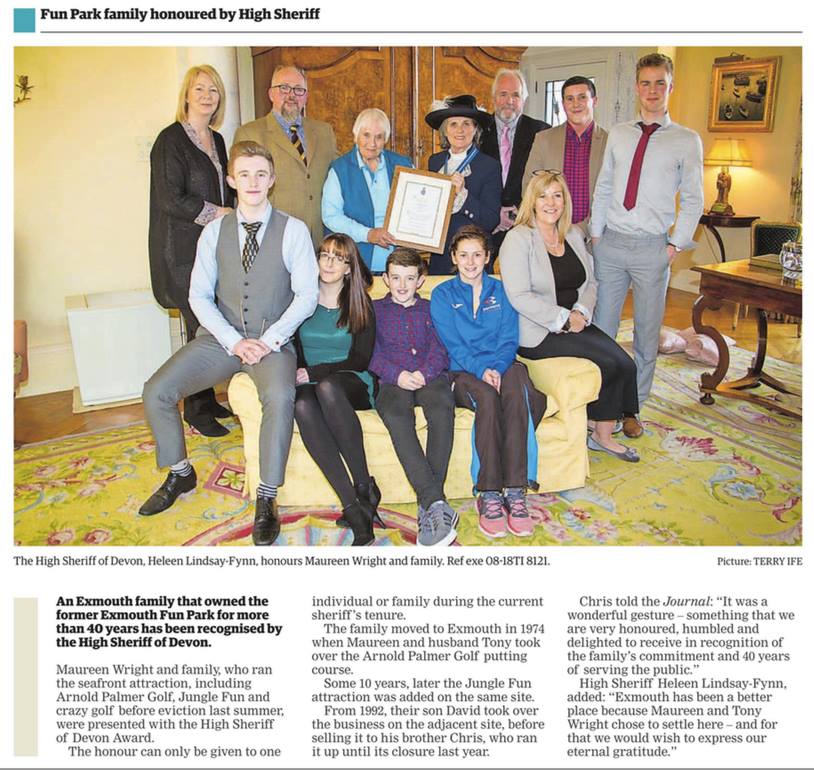
“The High Sheriff of Devon honours Maureen Wright and family, former owners of The Fun Park.
The award was presented to The Wright Family “in recognition of the great and valuable services to the community” and also recognises “the appreciation of the residents and people for activity and contribution in enhancing the life of the community”.
The High Sherriff, Heleen Lindsay-Fynn, can only honour one family or individual during her time in office and chose to present her award to The Wright Family on 21 February 2018.”
Majority of councils fear effect of Brexit
ALL councils, irrespective of who is in control – scary!
Productivity, weather, climate change and – robots!
Our LEP says we can double productivity in Devon and Somerset by 2030. But can we do this given recent weather/climate activity that has apparently already cost Devon £200m?
https://www.devonlive.com/news/business/snow-storm-emma-cost-south-1289777
To recap: the only 2 main roads into and out of Devon (M5 and A303) were both impassable at the same time, the rail service collapsed in Dawlish and London, Exeter airport was closed and rural bus services were all cancelled. Devon came to a standstill. At a time when there were threats to cut gas supplies to larger, non-strategic businesses.
Good quality and quantity infrastructure is essential to get productivity growth, and now the cold weather has – yet again – shown how bad our infrastructure is, and that the current government has under invested – almost certainly because the south-west is generally a set of safe seats – so there is no need to invest – need as defined by political election need not citizen need.
So LEP claims to double productivity would be extremely optimistic / challenging in the best of circumstances, with great infrastructure, but with crumbling infrastructure, struggling under the weight of homes growth, and subject to the vagaries of the weather and lacking in desperately needed investment, there is not a hope of getting anywhere close. And indeed, we might ask, with the woeful infrastructure we currently have, and no investment, should we expect a decline in productivity rather than an increase?
And we have another problem. Productivity = output. so, with robotics does that mean more or less employment – and if less, and no one wants to move here, who are going to live in all these new homes and how will they afford to keep them?
Even Greggs the bakers are now using robots to make sausage rolls and pasties:
Developers and loopholes – go together like a horse and carriage!
Owl says: as millions of pounds meant to be used for affordable homes was returned to the Treasury by the Department of Communities, Local Government and HOUSING, we can only assume this government doesn’t give a stuff about this.
“Property developers have used a legal loophole to halve the number of affordable homes that they are building in the countryside.
A study of more than 150 new housing developments found that confidential viability assessments had been used to cut the number of affordable houses by 48 per cent. The assessments let developers break promises made to get planning permission, if they can show those commitments will eat into profits.
The research, which was commissioned by Shelter, the charity for the homeless, and the Campaign to Protect Rural England (CPRE), found that eight rural councils lost 938 affordable homes after viability studies over the course of a year. “The viability loophole is slashing affordable housing supply in the countryside,” the report said. “The profits of volume housebuilders are rocketing, yet affordable housing provision by the same developers is being undercut on the grounds that it is not profitable enough.”
In one instance in Cornwall, the owners of a disused tin and copper mine promised that 40 per cent of the site’s 99 new homes would be affordable. They cut that commitment to zero with a viability study. The owners then advertised the plot for sale, boasting in the brochure that all of the plots had been approved for “open market housing” without any “liabilities”.
Central Bedfordshire, which was the worst affected of the eight councils in the study, lost 533 affordable homes in the 2015-2016 financial year.
Affordable housing includes homes for social rent, shared ownership and other intermediate tenures. “The term affordable in this context does not necessarily mean that these homes are in fact genuinely affordable to local people,” the report said.
The profits of Britain’s three biggest builders, Barratt Developments, Taylor Wimpey and Persimmon Homes, have quadrupled since 2012 to £2.2 billion a year. Yet they regularly cite financial constraints to reduce the percentage of affordable homes at new developments.
At Sowerby Gateway in North Yorkshire, Taylor Wimpey promised to build 256 affordable homes. A viability study cut that promise to zero. “Too much of our countryside is eaten up for developments that boost profits, but don’t meet local housing needs because of the viability loopholes,” said Crispin Truman, the chief executive of CPRE.
Councils can challenge viability studies but the government has guaranteed big builders at least a 20 per cent profit. If the builders can show that they stand to make less, the government will side with them.
“Developers are using this legal loophole to overpower local communities and are refusing to build the affordable homes they need,” said Polly Neate, the chief executive of Shelter.
Sajid Javid, the communities secretary, has promised to review how “viability is assessed” when he starts a consultation next week to overhaul the planning laws.
Separate research by the Institute for Public Policy Research, a think tank, found that the number of people sleeping rough in rural parts of England increased by 42 per cent from 397 in 2010 to 565 in 2016.
Houses are 26 per cent more expensive in the countryside because of pressure from wealthy retirees and buyers of second homes, but wages in rural areas are 26 per cent lower, which has created an exodus of young families.
Andrew Whitaker, from the Home Builders Federation, an industry body, said local authority targets were always negotiable. “There is a limit as to what can be extracted from development sites before they become unviable and you get no homes of any sort,” he said.”
Source: Times (paywall)
Swire gets about: questions about Burma and – yes, yet again – the Maldives in Parliament!
He really hasn’t accepted that he doesn’t work at the Foreign Office any more, poor dear, has he!
Bet those people who DO have responsibility for these places now get pretty fed up with his “interest”.
“Upcoming Business – Commons: Main Chamber 6 Mar 2018
Political situation in the Maldives – Hugo Swire. Adjournment debate
Recent appearances
International Development Committee: Burma Visas 28 Feb 2018
Having seen what has been going on in Rakhine, albeit a few years ago, I can say it is imperative that we continue to assist the Rohingya people in their hour of need. I urge the Minister formally to summon the Burmese ambassador to the Foreign Office to explain how seriously this House takes the fact that the Committee cannot go there to oversee what is the biggest bilateral aid programme in…”
https://www.theyworkforyou.com/calendar/?d=2018-03-06#cal19364
Government gave special treatment to failing private training provider
“The government gave England’s largest commercial further education provider ‘special treatment’ even though its performance was declining, a group of MPs concluded.
A Public Accounts Committee report out today has criticised the government’s continued commitment to its multi-million pound contract with Learndirect.
The report shows that the Education and Skills Funding Agency and its predecessor the Skills Funding Agency gave Learndirect almost £500m in the academic years from 2013-14 to 2016-17.
However, the PAC also notes that the quality of Learndirect’s apprenticeships have been in steady decline – Ofsted gave it a rating of ‘good’ in March 2013 but downgraded this to the lowest possible rating of ‘inadequate’ in March 2017.
Learndirect instigated a legal challenge challenging the ‘inadequate’ rating, which delayed the publication of Ofsted’s inspection report.
The Department for Education would normally cancel an ‘inadequate’ provider’s contract and withdraw funding immediately, but Learndirect warned that this would impact its 75,000 learners.
The government has since said it is ending Learndirect’s contract to provide apprenticeships and adult education.
Learndirect received £121m from central government in 2016-17 and is expected to get another £105m in the current financial year, the PAC pointed out.
PAC chair Meg Hillier said: “It cannot be right that individual contractors should command such large sums of public money regardless of their performance.
“No commercial provider should be allowed to become so essential to the delivery of services that it cannot be allowed to fail.”
She added: “Government has a duty to manage taxpayers’ exposure to risk diligently and we urge it to act on the recommendations set out in our report. … ”
Tory donor puts screws on tenants in Grenfell-type block
“A company run by a property tycoon who recently made a five figure donation to the Tories is forcing the residents of a block of flats with flammable cladding foot the bill for safety measures.
The latest party funding figures reveal the Tories pocketed £10,000 from Ashcorn Estates Limited, which is owned by James Tuttiett, a multimillionaire who lives in a £1.6 million farm house which has its own vineyard.
Another of his companies, E&J Estates, has been in the news recently.
It owns an apartment block in Salford which was found to have been constructed with a similar type of cladding to the one used on the Grenfell Tower.
The Guardian reported last month that E&J have told residents that they have to pay the £100,000 cost of interim fire wardens needed to make the building safe until the cladding is replaced.
The company even took legal action to enforce the charge, which one resident said would cost him an extra £235-a-month.
Matthew Crisp told the Manchester Evening News:
“I’m worried this now sets a precedent for us to foot the bill for the cladding too, and that’s devastating, as I don’t know if I’ll be able to continue living in my home.”
Crisp’s fears aren’t unfounded.
Scrapbook revealed in January how residents living in a building owned by a separate millionaire Tory donor were forced to pay the £2 million to replace flammable cladding.
The Government say they are clear that “private sector landlords follow the lead of the social sector and not pass on the costs of essential fire safety works.”
So why do the Tories keep taking their money?”

