Over 300 sold and converted to flats and offices at great profit … many sold cheaply … Woodbridge in Suffolk sold for £1.1m expected to be worth £3.8m after conversion. Many bought at auction.
Source: Daily Telegraph business section

Over 300 sold and converted to flats and offices at great profit … many sold cheaply … Woodbridge in Suffolk sold for £1.1m expected to be worth £3.8m after conversion. Many bought at auction.
Source: Daily Telegraph business section
“An application to create a 100-acre quarry on the outskirts of Ottery has once again faced backlash from civic leaders.
Aggregate Industries’ (AI) proposals to extract up to 1.5million tonnes of raised sand and gravel at Straitgate Farm came before Ottery Town Council’s planning committee after the firm submitted further environmental information.
In the additional documents, the developer has suggested a traffic light-controlled cattle crossing on the B3174 to meet the farm’s grazing needs.
The quarry has been earmarked as an approved site, but has not received planning permission.
On Monday, the committee voted again not to support the application.
Councillor Roger Giles said the idea of a cattle crossing was ‘absolutely outrageous’ and ‘atrocious’. He added: “This is a planning application that is very detrimental to Ottery and the surrounding areas and here is an opportunity to express our views once again.
“There are going to be four movements of cattle a day across that road, just below Daisymount, with traffic lights.
“If we weren’t concerned enough about the hundreds of slow-moving vehicles going up and down and across that road, we are now facing the prospect of traffic being stopped for cattle coming across four times a day, 365 days a year.
“I think that is absolutely outrageous and atrocious and I can’t think of anything more damaging and dangerous.”
Cllr Giles reiterated his previous concerns from March, which included traffic, flooding, water supplies, wildlife and landscape issues.
He added: “The town council has very serious concerns about the proposals to have laden lorries exiting the site and turning right across a heavy flow of fast moving traffic and travelling slowly uphill along Exeter Road to Daisymount.
“And we have very serious concerns about the proposals for unladen lorries slowly executing a left turn from the B3174 towards the site with a heavy flow of fast moving traffic coming up behind, speeding downhill from Daisymount.”
Members supported the request to resubmit their previous concerns, as well as adding ‘very strong’ objections to the cattle crossing.
The fate of the application will be decided by Devon County Council.”
Not much in the way of money passing through their hands these days, thanks to former heavy reliance on government handouts and EU money.
Now, forget the “Heart of th South West” LEP and the “Golden Triangle” LEP and look forward to … well leave you to make up your own minds by letting them explain themselves.
But they soldier on, making more invisible clothes for the emperor, bigging up projects that are grinding on, avoiding talk of those that are stuck or being downgraded.
Here’s highlights from their August newsletter where we find an interesting new development.
First of all, the LEPs are all struggling to achieve anything so they are trying to find safety in numbers:
“This message and strong business interest have been taken forward into the Great South West brand. The work is at an early stage and is yet to involve more partners in the region; it is meant to be a flexible concept which partners can use on a project by project basis when it adds real value. Importantly, it aims to give us added weight with Government and other key stakeholders when we need to communicate across a larger geography. The concept has been progressed by the South West Leaders’ Forum and will continue to be developed through partnership and consultation with local authorities, MPs, business and the education sector.”
And so, our LEP will now aim to be part of a conglomerate called – wait for it
THE GREAT SOUTH WEST
to rival the (currently rather dead in the water) “Northern Powerhouse”.
Here’s how they explain it:
“In order to compete with other UK and international regions, ‘Great South West’ aims to bring together a wide range of stakeholders from across the whole of the South West including Local Authorities, LEPs, MPs, Business and Education. It’s being created as a vehicle to promote all that is great about the region and to act as a common banner to communicate a clear focus on the opportunities to deliver prosperity.
With over £100bn of business opportunities, the South West has much to contribute; a dynamic and progressive South West economy can generate the critical success factors needed for a successful national economy.
As a region, the South West is diverse with different priorities covering different geographies. By working together, we will develop strategies and actions to secure enhanced funding and investment creating a prosperous region for all of us.”
AND it even has a brand new web page!
http://greatsouthwest.org.uk/pages/contact-us/94
But don’t worry, the current and former members of our LEP are not neglecting their nuclear interests:
“In response to the Government’s commitment to work on an ‘early sector deal’ with the nuclear industry in the Industrial Strategy, NSW (made up of HotSW, West of England, Dorset and GFirst LEPs together with the private and academic/skills sectors) and its equivalent partners in the North West, have set out an approach to the Nuclear Industry Council to making the UK a global lead for the nuclear industry. …
The approach is an early stage and we will refine this through continued dialogue with Government on an effective nuclear sector deal. NSW believes it’s a major step forward and a testament to its integrity and profile that the North West consortium supported this joint approach.”
Lots and lots of scope for wasting more and more money there!
And last, but very much not least our LEP finally seems to realise that Brexit is upon us! And it has ANOTHER new sub-group:
“The Brexit Resilience and Opportunities Group continues to draw together intelligence to understand the threats of Brexit in our area and maximise any opportunities.
Good information is crucial and the Group is still looking for more businesses to give their views on how their business will be affected by leaving the EU. The more people that respond, the better the results will be in building a meaningful response across all sectors.”
Summary: Heart of the South West LEP quietly morphing into …. drum roll… another iteration of the
South West Regional Development Agency
originally cut off in its bureaucratic prime by – the Conservative Government in 2012:
https://en.m.wikipedia.org/wiki/Regional_development_agency
Newsletter:
http://mailchi.mp/heartofswlep/august-heart-of-the-south-west-lep-newsletter
And still as unaccountable and non-transparent as ever – just BIGGER!
” … On 21st August 2017, Balfour Beatty announced that it had now been awarded that very contract from under Costain’s nose.
Today Costain chief executive Andrew Wyllie said this on the matter: “Costain continues to undertake a number of enabling works contracts at Hinkley Point C. However, the group will cease its involvement in the marine works contract at Hinkley Point C following completion of a further circa £20m of existing obligations, anticipated to be concluded by the end of December 2017. Since Costain announced its initial appointment in October 2013, there was a significant delay in the approval for Hinkley Point C. While Costain has worked closely with EDF through the £40m of early contractor involvement phase to date, it was not possible to reach agreement on the final terms and conditions for the overall completion of the works.”
Mr Wyllie said that the company was still committed to, and involved in, the nuclear sector. “Costain remains involved in the planned UK new nuclear power plants and has started to develop opportunities in the small modular reactors market,” he said. “At Sellafield the Evaporator D contract is near completion and we have fully mobilised our team in support of the Decommissioning Delivery Partnership Framework. We have recently been awarded a major construction and programme management contract for AWE in the development of one of its nuclear facilities.”
http://www.theconstructionindex.co.uk/news/view/costain-explains-loss-of-hinkley-point-contract
and it seems workers at the site prefer to rent cheaply rather than buy in the area – not a sign of confidence:
“… workers on site at Hinkley seemed to be looking to rent as cheaply as possible, with many of them even travelling home on weekends.
… The people working on Hinkley at the moment are mainly construction workers and they are mainly opting to rent rather than buy,” Mr Zorab said.
“This has pushed up prices for buy to let properties but house prices in general have not been affected in a major way yet.”
He said the majority of the people who would be on site in the long term had not arrived yet, and expected a more noticeable increase when they started to arrive in year three of the project.”
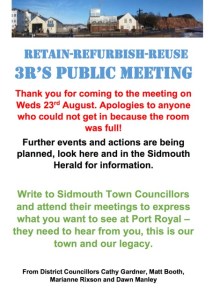
All the presentations, and programme for the meeting, are detailed here:
Slides are here:
Click to access 23-aug-3rs-final-slides.pdf
Report of meeting:
“The five perfectly-pitched short presentations at last night’s Public Meeting were each restricted by Chair, Di Fuller, to not much more than 5 minutes. This maximised the time for questions and comments from the audience packed into Sidmouth’s All Saints’ Church Hall, and ensured ample time for the questions to be answered. There was a clear strength of opinion in the room, that Port Royal regeneration should be carefully conceived as a suitable legacy for the town. Local knowledge from those attending, raised issues such as flood risk and contamination that could disadvantage residential development on this site. Potential loss of existing public parking behind the lifeboat station was also a concern.
Speakers were EDDC Councillors Marianne Rixson (Ward Member Sidmouth-Sidford), Cathy Gardner and Matt Booth (Ward members Sidmouth Town); and local residents Mary-Walden-Till and Jeremy Woodward.
Mary Walden-Till concentrated on The Ham conveyance land.
She told the crowd:
“Under the terms of the Conveyance the land was given to the inhabitants of and visitors to Sidmouth as a place of recreation ‘for ever’. Subject only to ‘reasonable restrictions and regulations in accordance with the law for the time being affecting the use of Public Parks and Pleasure Grounds’.
It was a Trust for which Sidmouth Town Council is now the Trustee, with all the legal responsibilities that entails. Sidmouth Town Councillors act to manage that trust on behalf of the Council. It is a complex legal arrangement but it does not in any way affect the terms of the Conveyance which forms the Governing Document of the Charity.
It was therefore incorrect to allow part of The Ham to be included in the Local Plan area ED03 as being available for redevelopment. The toilet block stands on Ham land, and the Land Registry deed says it is covered by the terms of the Conveyance. I have asked EDDC Councillors to correct the boundary of ED03 but they never even bothered to acknowledge my email.
None of The Ham land is available to be built on or to be used in any way other than for free recreation for all. It can not be used as parking for cars or boats, as that is restricting its use. Using it as car parking was suggested, and thrown out, in the early part of the 20th C. Nothing has changed since then as far as the Conveyance is concerned. And nothing can change with the Conveyance except through our connivance or apathy.
It is in breach of charity law to do anything which adversely affects the rights of a charity’s beneficiaries, and any of those beneficiaries has the right to complain to the Charity Commission. Anyone who has ever been to Sidmouth is covered by the terms of the Conveyance, so there are a large number of people who can demand that the terms are kept.”
The award goes surprise, surprise) to Archant newspapers (Midweek Herald, Exmouth Journal, Sidmouth Journal) for the headline from this EDDC press release:
“Council backs campaign against hate crime”
http://www.exmouthjournal.co.uk/news/council-backs-campaign-against-hate-crime-1-5162356
It isn’t offering money or resources. It isn’t doing ANYTHING AT ALL except issuing a press release backing a Devon and Cornwall Police initiative. No doubt one of those great ideas that come – at a price – from our Police and Crime Commissioner.
Can you imagine the furore if the council DIDN’T back it!
Now that WOULD be a headline!
Ian Hall – Axminster Rural and Axminster DCC
Ian Chubb – Newbridges and Whimple and Blackdown DCC
Tom Wright – Budleigh
John Humphreys – Exmouth Littleham
Andrew Moulding – Axminster Town
http://www.devonlive.com/news/devon-news/dozens-devon-councillors-are-freemasons-342713
That’s a clean sweep for Axminster which must give the boys plenty to talk about at their Lodge(s). And all of them Conservative majority councillors wearing many hats in many posts, both at DCC and EDDC.
And that’s only the ones who declare it!
Why is it a problem? This very old article (1966) is still pertinent today:
“Freemasons who sat on a council’s planning committee have been found guilty of malpractice after a lengthy inquiry by the local-government ombudsman.
The investigation into their activities on the council at Canvey Island, Essex, began after complaints that they had given a fellow lodge member the go-ahead to build a leisure complex. …”
The ombudsman said:
“Freemasonry is generally viewed with suspicion among non-Masons not least because of the secrecy attached to the `craft’ … in my view, knowing that a councillor and a planning applicant are Freemasons and members of the same lodge, members of the public could reasonably think that such a private and exclusive relationship might influence the member when he came to consider the planning application.”
http://www.independent.co.uk/news/in-a-small-town-where-the-tories-and-masons-hold-sway-1312466.html
(where you can also see details of other councils and councillors in Devon).
Though, nowadays, we don’t have a national standards board or a “National Code of Local Government Conduct” – both were abolished by national government some years ago.
Leaving each council to decide on its own standards – hhhmmmmm!
“A county council cabinet that is prepared to force its CEO to take on two jobs which would “significantly reduce checks and balances” and cause her an enormous conflict of interest.
“Lancashire County Council has voted to merge its chief executive and section 151 officer roles, sparking a row about accountability.
At a meeting on Monday, the authority’s Conservative cabinet voted in favour of the unusual move in the teeth of vocal criticism from opposition Labour councillors.
The vote came at the end of a meeting at which current chief executive Jo Turton made a plea to keep both roles separate.
She told the cabinet: “Now plainly I do have a personal interest in this matter, but the report is not about me but about the future shape of the county council.
“I would simply emphasise there are reasons why there are three statutory officer roles and that combining them significantly reduces the checks and balances within the governance structure of this council.”
She added that a survey had confirmed that no other county or similar-sized metropolitan authority has such a combined role.
Turton also said she objected to part of the proposal which would separate children and adult services. Overall, the cabinet argued that the overall restructuring proposals would save £244,000 a year.”
During the meeting, a number of opposition councillors lined up to speak against the proposal. Councillor David Whipp said: “It is quite clear that there is a huge risk of consolidating executive power in the hands of a single person.
“There is a reason why there are checks and balances, why there is a division of responsibility, and that is to ensure that proper consideration is given to initiatives that come forward.
“A chief executive may wish to be very bold and that has to be tempered by a small ‘c’ Conservative officer exercising that section 151 responsibility.”
In tense exchanges with council leader Geoff Driver, Labour group leader Azhar Ali said:
“The question needs to be asked why Kent, Gloucestershire, Surrey, Buckinghamshire, North Yorkshire, Leicestershire – all these big counties which are all conservative controlled – have decided not to undertake that role.
“The answer simply is because it is not viable, not good governance.”
Worries over interim costs
Ali also said that the cost of employing an interim to perform the role of chief executive and section 151 officer – which he said could reach up to £2,000 a day – would wipe out any savings in the first year.
He also questioned whether the council would be able to find anyone capable of taking on the new role.
He said: “There is a small pool of people qualified at this level to undertake this work and that small pool of people is already in employment.
“There is a danger that the way this is being done – and the damage to this authority’s reputation that has already been done by this cabinet and leader – that the number of applicants might be very small.
“Therefore, there’s a risk of no appointments and again you’ll have to resort in part to either asking officers of this council to step up out of those roles which they might not want or resorting to interims. Again there is a cost.”
Responding to the criticism, Driver said: “We are in serious financial difficulties and we need somebody at the top with financial expertise who can advise the county council on both policy and financial matters at the same time.
“If it was felt inappropriate to combine the two roles the law would stop it happening and it doesn’t.”
Practice ‘died out’ in noughties
Speaking to Room151, Rob Whiteman, chief executive of the Chartered Institute of Public Finance and Accountancy, confirmed there is nothing in the rules that prevents the move.
He said: “If what members want from their chief executive is an organisational head of an organisation with strong management and planning and a focus on making the organisation more efficient it can make sense for the roles to be combined.
“If, on the other hand, they are looking for the chief executive to have a focus on regeneration deals and putting together development partnerships, then you are at risk of creating a conflict of interest.”
Whiteman served at London Borough of Barking and Dagenham in a dual chief executive and section 151 role in the early noughties.
At that time, it was not unusual for chief executives to also hold section 151 responsibilities, with Bob Coomber at Southwark, Tony Redmond at Harrow and Richard Harbord at Richmond all performing both roles.
However, the practice has virtually died out since the introduction of the cabinet system into local government in 2000. Last year, Lancashire warned that it faced the prospect of being unable to carry out its statutory duties due to a major structural deficit.
A report commissioned by the council from accountancy firm PwC found that even if the council is successful in meeting all of its cost reduction targets, it will have a cumulative deficit of £398m by 2021.”
http://www.room151.co.uk/resources/lancs-merger-of-s151-and-ceo-roles-sparks-accountability-row/
“We want to hear from current staff and former council staff about the challenges of monitoring air quality at a local level. How hard it is to do? How does it impact on local planning decisions? Could it be done in a better way? What more council councils do to protect environments at a local level? Share your stories.”
30 [plus] questions” that must be asked BEFORE care at home can be implemented:
Pre-implementation
The model of care:
• Does the new model of care align with our overriding ambition to promote independence?
• Is there clinical and operational consensus by place on the functions of the model and configuration of community health and care teams incorporating primary care, personal care providers and the voluntary care sector?
• Is there a short term offer that promotes independence and community resilience?
• Is there a method for identifying people at highest risk based on risk stratification tool?
• Are the needs of people requiring palliative and terminal care identified and planned for?
• Are the needs of people with dementia identified and planned for?
• Is support to care homes and personal care providers, built into the community services specification?
• Is support for carers enhanced through community sector development support in each community?
• Has the health and care role of each part of the system been described?
• Have key performance indicators been identified, and is performance being tracked now to support post implementation evaluation, including impact on primary care and social care?
Workforce:
• Is there a clear understanding of the capacity and gaps in the locality and a baseline agreed for current levels and required levels to meet the expected outputs of the changed model of care?
• Is there a clear understanding of and plan for any changes required in ways of working:
o thinking
o behaviours
o risk tolerance
o promotion of independence, personal goal orientation
• Have the training needs of people undertaking new roles been identified, including ensuring they are able to meet the needs of patients with dementia?
• Do we have detailed knowledge with regards to investment, WTE and skill mix across the locality and a plan for achieving this?
• Are system-wide staff recruitment and retention issues adequately addressed with a comprehensive plan, and where there are known or expected difficulties have innovative staffing models been explored?
Governance, communications and engagement:
• Is there a robust operational managerial model and leadership to support the implementation?
• Has Council member engagement and appropriate scrutiny taken place?
• Is there an oversight and steering group in place and the process for readiness assessment agreed?
• Have providers, commissioners and service users and carers or their representative groups such as Healthwatch agreed a set of key outcome measures and described how these will be recorded and monitored?
• Is there a shared dashboard which describes outcomes, activity and productivity measures and provides evaluation measures?
• Is there an agreed roll out plan for implementation, which has due regard to the operational issues of managing change?
• Is there a comprehensive & joint communications and engagement plan agreed?
• Is there a need for a further Quality or Equality Impact Assessment?
Implementation
• Is there a clinical and operational consensus on the roles of each sector during the implementation phase including acute care, community health and care teams, mental health, primary care, social care, the voluntary care sector and independent sector care providers?
• Is there an implementation plan at individual patient level describing their new pathway, mapping affected patients into new services?
• Are the operational conditions necessary for safe implementation met?
• Have the risks of not implementing the change at this point been described and balanced against any residual risk of doing so?
Post Implementation
• Is there a description of the outcomes for individuals, their carers and communities?
• Are the mechanisms for engagement with staff, users of services and carers in place and any findings being addressed appropriately?
• Is there a process in place for immediate post implementation tracking of service performance including financial impact to all organisations?
• Is longer term performance and impact being tracked for comparison against pre-implementation performance?
• Have we captured user experience as part of the process, and have findings been addressed and recorded to inform the planning of future changes?
• Are there unintended consequences or impacts (e.g. on primary care or social care) which need to be addressed before any further change occurs?
• Is there a clear communication plan for providers and the Public describing the new system and retaining their involvement in community development?”
“British political parties received a record £40m of donations in the three months before the election, with the Conservatives bringing in more than twice as much cash as Labour.
More than half of the money was given to the Conservative party, which raised almost £25m between April and June compared with £9.5m for Labour.
The funding received beat the previous record high for a three-month period, which was set during the runup to the election in 2015, by more than £9m.
The biggest donation to the Conservatives was £1.5m from Anthony Bamford, a Conservative peer and industrialist who also helped fund the Brexit campaign. Labour’s largest sum was from Unite, the trade union, which donated £1.3m.
Other wealthy businessmen who gave more than £1m each to the Tories including John Armitage, a hedge fund manager, John Gore, a musical theatre impresario, and John Griffin, the founder of the Addison Lee taxi firm.
The Liberal Democrats raised about £4.4m, while Ukip managed to get £150,000, the Greens around £175,000, the Women’s Equality party almost £300,000 and Plaid Cymru just £5,300.”
“… Giving the MacTaggart lecture on Wednesday, the journalist [Jon Snow]said: “Amid the demonstrations around the tower after the fire there were cries of: ‘Where were you? Why didn’t you come here before?’
“Why didn’t any of us see the Grenfell action blog? Why didn’t we know? Why didn’t we have contact? Why didn’t we enable the residents of Grenfell Tower – and indeed the other hundreds of towers like it around Britain – to find pathways to talk to us and for us to expose their story?
“In that moment I felt both disconnected and frustrated. I felt on the wrong side of the terrible divide that exists in present-day society and in which we are all in this hall major players. We can accuse the political classes for their failures, and we do. But we are guilty of them ourselves.
“We are too far removed from those who lived their lives in Grenfell and who, across the country, now live on amid the combustible cladding, the lack of sprinklers, the absence of centralised fire alarms and more, revealed by the Grenfell Tower fire.” …”
https://www.theguardian.com/media/2017/aug/23/jon-snow-grenfell-mactaggart-media-diversity
and
… “The Grenfell residents’ story was out there, published online and shocking in its accuracy. It was hidden in plain sight, but we had stopped looking. The disconnect was complete. Our connectivity – life on Google, Facebook, Twitter and more – has so far failed to combat modern society’s widening disconnection. …”
https://www.theguardian.com/commentisfree/2017/aug/23/grenfell-british-media-divide
Better keep fingers crossed that you or your loved ones are not in a similar position to some of the people mentioned here.
But if you are one of the unfortunate ones, remember Paul Diviani (EDDC), Sarah Randall Johnson (DCC), Neil Parish MP, Hugo Swire MP, Minister Jeremy Hunt and Prime Minister Theresa May all put you there. They all have one thing in common: they are Conservative politicians whose decisions led to this situation – and think carefully about whether you would vote for them now or in the future knowing what you know now.
“People who receive care at home have told a health watchdog that a lacklustre service has meant they have had to go two weeks without a shower, eat their dinner at 3.30 in the afternoon and be cared for by workers who can’t make a bed.
The failings highlighted in a report by Healthwatch England drew on the experiences of more than 3,000 people who receive care at home. Other problems described in the document include care workers coming at different times to those scheduled, not having enough time to fulfil all their duties and some missing appointments altogether.
Across England there are more than 8,500 home care providers, collectively helping an estimated 673,000 people with tasks such as washing, cooking, dressing and taking medication. The report suggested that home care was “in a fragile state” and that care packages were being “designed to meet the needs of the service provider rather than the service user”.
One home care user in Redcar and Cleveland said: “Sometimes they give me a shower but they go over their time. Most of the time they haven’t got the time to give me one so I go a couple of weeks without one and that is not right. I feel dirty.”
A woman in her 80s told Healthwatch Bradford her care workers were unable to boil an egg or make the bed, while another said staff needed to be taught “home care common sense”.
A care user in Barnet, north London, said: “I am diabetic and sometimes carers are late or don’t show up and that really affects my medications and insulin administration.”
However, Healthwatch, the health and care consumer champion, stressed that most people had positive things to say about their domiciliary care – with many older people praising the service because it enables them to remain in their own home and to maintain as much independence as possible.
Neil Tester, the deputy director of Healthwatch England, said: “We heard examples of compassionate care from dedicated staff, but people also talked about care that doesn’t meet even basic standards. Given the challenges facing the social care sector, it is more important than ever that people’s voices are heard.”
Izzi Seccombe, the chairwoman of the Local Government Association’s community wellbeing board, said: “This report shows that while most people report that their services are good there is a need to improve services.
“The financial pressure facing services is having an impact and even the very best efforts of councils are not enough to avert the real and growing crisis we are facing in ensuring older people receive the care they deserve.
“The continuing underfunding of adult social care, the significant pressures of an ageing population and the ‘national living wage’ are combining to heap pressure on the home care provider market.”
She added: “This study shows the strain providers are under, and emphasises the urgent need for a long-term, sustainable solution to the social care funding crisis.
“While the £2bn announced in the spring budget for social care was a step in the right direction, it is only one-off funding and social care services still face an annual £2.3bn funding gap by 2020.”
A Department of Health spokesman said: “Everyone deserves access to high-quality care, including those who receive it in their home. This is why we have introduced tougher inspections of care services to drive up standards, provided an additional £2bn for adult social care, and have committed to consult on the future of social care to ensure sustainability in the long term.”
And here is the spin, spin, spin:
“East Devon District Council has confirmed it has signed a deal with Grenadier Estates for new watersports centre in Exmouth.
The watersports centre will be community focused and a not for profit development, and forms an integral part of the council’s plans to regenerate the seafront area, the new centre will be built on a former car park on Queen’s Drive.
As well as offering watersports facilities, a new access ramp will be incorporated within the development allowing easier access to the beach, and will further confirm Exmouth’s place as a leading UK watersports destination, the council say.
Cllr Philip Skinner, the council’s portfolio holder for economy, and chairman of the Exmouth Regeneration Board, said: “I am delighted that we are entering into this agreement with Grenadier Estates. There has been a long-held commitment to have this watersports centre for Exmouth and we are now taking a huge step forward to achieving this ambition.
“The council, through the Exmouth Regeneration Board, has delivered significant improvements for Exmouth over recent years including the new Strand in the town centre, the new Premier Inn and more recently, the re-opening of a brand new Mamhead slipway. The delivery of the first phases of the Queen’s Drive regeneration is now the next step in this exciting journey for Devon’s largest town.” …
http://www.devonlive.com/news/devon-news/deal-signed-developers-new-watersports-369821
There is more in the same vein, but Owl can’t bear to give them more oxygen of publicity.
Owl predicts it will indeed be extraordinary – if it happens!
“East Devon District Council says it is to hold an extraordinary meeting to discuss the future of two Exmouth seafront businesses which are set to close imminently.
The council confirmed its chief executive was considering a request for a meeting to discuss the future of Exmouth Fun Park, set to close next week, and the Harbour View Café, set to close at the end of September.
A spokesperson said: “We will announce shortly when that meeting will be held.”
The sites of those businesses are needed for phase three of EDDC’s proposed three-phase seafront redevelopment plans, but there is currently no developer in place for this phase, and it was revealed last week that the site has not yet been remarketed to developers.
EDDC said last week that sites would be boarded up ‘for a time’, but that temporary attractions could be provided.”
Well, it seems simple to us countryfolk: charge people too much to remove their waste and they will dump it somewhere that is free … But councils no longer work for their electors – they are big businesses that exist for profit and development. Fewer services for more money to spend on vanity projects and unsympathetic regeneration.
“… Official figures from the Department for Environment, Food and Rural Affairs showed councils across England reported 936,090 cases in 2015/16, up 4 per cent on the previous year.
Clearing up all the waste is said to cost councils £49.8million a year, and on-the-spot fines of up to £400 are said to have done little to ease the situation.
Craven, who has fronted Countryfile for more than 25 years, continued: ‘This scourge had been on the decline but now it’s peaking and in some quarters blame is being put on local councils.
‘Because they are strapped for cash, they are charging more to use local rubbish tips and even closing some of them, while at the same time cutting back on household waste collections. …”
http://www.dailymail.co.uk/news/article-4814648/John-Craven-s-despair-fly-tipping-epidemic.html
Guardian letters:
“• Jeremy Hunt’s tweeted dismissal of Hawking’s article (How to solve the NHS crisis – scientifically, 19 August) is revealing: “Stephen Hawking is brilliant physicist but wrong on lack of evidence 4 weekend effect.2015 Fremantle [sic] study most comprehensive ever”.
If Hunt bases policy on a single publication (which no serious observer would do) then he should read it, and he would see Freemantle’s warning: “It is not possible to ascertain the extent to which these excess deaths may be preventable; to assume that they are avoidable would be rash and misleading.”
Freemantle found that patients admitted over the weekend are more seriously ill and more likely to die. Nobody denies that the “weekend effect” exists, but one must not jump to the facile and unsubstantiated conclusion that it reflects quality of care.
Hunt cherrypicks not only the evidence but even the authors’ interpretation.
Dr Richard O’Brien
Highbridge, Somerset
Jeremy Hunt accuses Stephen Hawking of ‘pernicious falsehood’ in NHS row
• Privately provided services, with their bank loan costs, dividend payments and management add-ons, cost far more than state-funded ones. The administration of privatisation, with the consultants, lawyers, accountants, billing agents etc involved in franchising NHS services, also add substantial costs. Hospital PFIs (private finance initiatives) have evidenced the billions that privatisation is costing the NHS and taxpayer.
Yet the government’s and NHS England’s “reconfiguring” of the NHS is using regional accountable care organisations (ACOs) which allow for extended involvement of the private sector in the running and provisioning of NHS services. This not only accepts the continuing financial burden of privatisation to the taxpayer, but allows further costs to that burden.
ACOs, and other NHS England plans such as the move from the family GP practice model to a system of commercially driven super-clinics called multi-speciality community providers, originate from the US’s notoriously costly and flawed healthcare system. The plans have been drawn up by business consultants with extensive US interests like McKinsey and Optum, a subsidiary of US private health provider/private health insurer United Health. NHS England’s CEO Simon Stevens is a former UnitedHealth senior executive.
Professor Hawking’s concerns about the privatisation and Americanisation of the NHS are therefore unsurprising. Removing all the privatisation apparatus from the NHS would allay such concerns, which are shared by many. The savings that this would make would cover the lion’s share of the costs of the extra demands facing the NHS (the ageing population etc) which are blamed for making the NHS “unaffordable”.
John Furse
London
• I am 100% behind Stephen Hawking’s attack on the Tories over the plight of the NHS. As a nurse for the last 40 years, I think that the NHS is by far the best health system in the world and it is only surviving because of the deep commitment of thousands of medical and admin staff to a worthy cause. I know for a fact that after the referendum results, scores of foreign doctors and nurses started to leave our large local hospital, for fear that they would not be allowed the freedom to stay. This has left our hospital grossly understaffed and under tremendous pressure. Others have gone off sick with severe stress after all the extra hours they are expected to put in to care for patients.
The Tories’ recent promise to provide training for thousands of medical students and nurses in a few years’ time is of no use whatsoever. Something drastic is needed now and that is to give the nurses the pay rise that others are getting. With conditions and pay at such an all-time low, how else are they going to recruit any new nurses?
Sue Ingleby
Gloucester
• What wise words from Prof Hawking and what a pathetic response from Jeremy Hunt. Hawking is right to draw attention to the vast amounts of public money going into the coffers of private organisations for services that could be handled better and cheaper in-house. The question of agencies providing nurses to fill gaps is analogous with those providing supply teachers. Previously hospitals relied on their own “banks” to provide cover for absentees, usually drawn from any of their own staff who requested extra shifts. The advantage of employing their known staff is obvious. Schools requiring temporary help could contact their local education authority (now sadly almost defunct) which kept a list of qualified teachers requesting temporary work. No money was exchanged, unlike today where in many cases the agency charges both the professional worker and the employer. How did we allow this to happen?
Ruth Lewis
Potters Bar, Hertfordshire
• Stephen Hawking’s article is so wonderfully simple and beautiful it made me want to cry. How precious the NHS is and how much it means to us. Thanks to him for writing it and to the Guardian for printing it. It should be printed in all the newspapers.
Jenny Bushell
London”

Credit:Steve Carne
“Another MP has resigned from his role at the University of Bath in protest against its vice-chancellor’s £451,000 pay package.
Darren Jones, Labour MP for Bristol North West, became the fourth politician to step down from the university’s court, a statutory body representing the interests of the university stakeholders, in protest over Dame Glynis Breakwell’s pay deal. His resignation on Tuesday afternoon follows those of two Labour colleagues Kerry McCarthy, MP for Bristol East, and David Drew, MP for Stroud,. as well as Andrew Murrison, Conservative MP for South West Wiltshire.
As the mounting resignations prompted former Labour education minister Andrew Adonis to call for Breakwell to stand down, Jones said: “Students in my constituency are paying increasingly high tuition fees, with many families helping their children out with the costs associated with going to university.
“Vice-chancellors pay needs to be set within the context of value for money. And students take on excessive debt to get a good education, not to pay bloated executive pay.”
The issue of pay was raised by Lord Adonis in an article for the Guardian earlier this month.
University vice-chancellors are paid too much, says Lord Adonis
Murrison resigned from the university court last week, saying university bosses were “looking increasingly like a self-serving cartel”.
The series of resignations also puts the squeeze on a government already facing pressure to investigate the high salaries awarded to vice-chancellors, amid mounting accusations that students’ tuition fees are being used to inflate the pay packets of senior management.
McCarthy and Drew said Breakwell’s salary, as well as those of senior staff, could not be justified when students were taking on debts of £60,000 to pay fees.
McCarthy said her resignation was about “sending out a signal”.
She said: “I’ve been concerned for quite some time about the level of vice-chancellors’ pay; it’s the fact it’s now coupled with increasing pressures on students. It’s not just that student fees have gone up to £9,000 a year, but the interest they’re being charged on those has gone up to about 6%.
“And I know that ordinary academic staff who are on pretty modest incomes have generally had their pay held back to a 1% pay rise. We’ve got it at local government level, where you’ve got chief executives that are on several hundred thousand a year, quite a few of their senior officers are on more than the prime minister, and yet you’re holding back pay rises for the bin men.
“I think it sends out a very poor signal to the students if the impression they’re given is they are the ones bearing the financial burden.”
Subsequent to the resignations, Adonis said a pay reduction for Breakwell would not be enough to solve the problem.
“The crisis at the university of Bath can only now be resolved one way, which is by the resignation of the vice-chancellor,” he told the Guardian. “It’s clear that she’s progressively losing the support of her court and council, and for very good reason. Her pay and conduct has been unacceptable.”
The peer has previously called for an inquiry in the House of Lords and criticised the “serious controversy” of salary increases awarded to Breakwell, along with benefits such as “a large house in the historic centre of Bath”, and non-executive directorships she holds.
Jones said on Tuesday that he agreed with Adonis that government should undertake an inquiry into public sector executive pay. “I have therefore resigned from my ex officio position on the court of Bath University as a sign of my support for such a review,” he said.
While Breakwell is top of the salary list, the controversy is not unique to Bath. Vice-chancellors received an average salary package of £277,834 in the last academic year, more than six times the average pay of university staff.
A report released by University and College Union (UCU) in February revealed that 23 British universities had increased the pay packages of their vice-chancellors by 10% or more in 2015-16. Fifty-five universities paid their heads more than £300,000, with 11 vice-chancellors earning more than £400,000 a year.
Breakwell’s package was an 11% rise on the previous year, despite a 1.1% cap on pay for non-managerial staff across the higher education sector.
The Higher Education and Funding council for England (Hefce), the universities charities watchdog, has been asked to examine whether Breakwell’s salary is in line with charitable duties and responsibilities. It has said it would investigate “governance in relation to the remuneration committee of the university”.
Jo Johnson, the universities minister, has told universities that in future they will have to justify exceptionally high salaries.
A University of Bath spokesperson said: “We are providing Hefce with all the information they have requested including in relation to meetings of university court. The university does not intend to comment further on these matters until such time as Hefce have concluded their investigation.”

