Budleigh “health hub” advertises for (paying) tenants

“The Budleigh Salterton Community Hospital Health and Wellbeing Hub (Budleigh Salterton Hub) will bring together local residents, the NHS, the voluntary, statutory and business sectors under a common purpose – to improve the quality of health and wellbeing for approx 48,500 people in the Woodbury, Exmouth and Budleigh (WEB) areas, including all the local villages and hamlets.

As a provider of health and wellbeing support, whether it be through fitness, social activities and groups, holistic therapies, mental health guidance, weight management, physiotherapy, healthy eating and lifestyle choices, art therapies, NHS outpatient services, catering, or childcare provision, this is your opportunity to get involved in this new and exciting project, supporting babies and children from early years through to older people.”

https://www.westbank.org.uk/Pages/FAQs/Category/budleigh-hub

Here is the “information pack”:

https://www.westbank.org.uk/Handlers/Download.ashx?IDMF=48d9c97d-1ad5-4ec3-86f5-1aab4f405774

Rooms ( including the kitchen) are from (not at) £15-25 per hour (NHS or private) and it seems from reading the brochure that, as yet, it has no tenants.

The (ir)responsibility of politicians

This long article is about the crisis in prisons. But the last four paragraphs quoted here could be about anything that is the responsibility of politicians:

“Who allowed this systematic irresponsibility? Civil servants could no doubt have been more robust in their advice. But the truth is that Grayling and Gove [and here add names of other ministers] at least did not broach any challenge. Any senior officials that they felt were obstructing their plans or raising awkward questions were edged out. It’s tough to push back when your job is at stake.

No doubt some governors and prison officers could have done more to raise problems and find solutions – but most of them had crises to manage.

The only conclusion I can really draw is that the blame lies with the politicians. They cut prison budgets without having a good understanding of the likely impact, then carried on cutting long after those consequences were clear. They focused on pet projects rather than getting the basics right.

They were supported in doing so from the very top. Cameron and Osborne [and now May and Hammond] made the call that people didn’t much care about the condition of our prisons [hospitals/schools/environment], and if budgets were to be cut this was a place to cut particularly deeply. They ignored signs that the system was creaking, and forgot that changing your justice secretary [or any minister except Hunt where no-one wanted his job] every 18 months is a sure-fire way to create problems. Most important, they forgot that there is no better symbol that government is out of control than riots [bed shortages/failing schools/concrete jungles] within the facilities they are meant to run.”

https://www.theguardian.com/commentisfree/2017/aug/02/prisoners-rioting-serial-ministerial-incompetence-justice-chris-grayling-michael-gove

Eastern Devon – your new fantasy health care after hospitals closed

“… Dr Sonja Manton, director of strategy for both Devon Clinical Commissioning Groups, said: “The current model of care is not sustainable either clinically or financially, so we have to look at doing something differently.

“We are extremely grateful to the Devon Health Scrutiny Committee members for the time they have put in to reviewing our plans in order to feel assured about the changes we are making. We thank them for their diligence and constructive challenge. Their insight was invaluable.

“We are now ready to move to the next step and start the final preparations of implementation and making the changes we have proposed.”

The Your Future Care proposals, which were subject to a 13-week public consultation that closed earlier this year, set out to move away from the existing bed-based model of care. Instead it focuses on a model of care that proactively averts health crises and promotes independence and wellbeing. By redirecting and reinvesting some existing bed-based resources, community services can be enhanced to support more home-based care by establishing:

Comprehensive Assessment
Single Point of Access
Urgent Community Response

The net result of this new approach will mean a reduction in inpatient beds in community hospitals in the Eastern* locality of Devon and an increase in community-based staff to support Out of Hospital Care.

Deputy Chief Executive/Chief Nurse of the Royal Devon and Exeter NHS Foundation Trust, Em Wilkinson-Brice, said: “The endorsement from the members of the committee coupled with the clinical recommendation to proceed from the assurance panel, will support public confidence that our plans are not only safe but will provide improved care.

“By moving to this model of care, we can help more people to have a better outcome – ensuring that across the whole of Eastern Devon everyone has access to safe, reliable services that promote independence and support people to live their life to the fullest.”

A significant amount of implementation planning including engagement with the workforce, stakeholders and local communities has already been undertaken and now that these two important milestones have been reached, the RD&E will, for the benefit of staff and patients, ensure that the move to provide more care and support in people’s homes is done in a safe and timely manner. In order to achieve this, the RD&E will continue to work closely with staff, partner organisations and communities to take a phased approach to implementation.

Further information specific to each of the four community hospitals will be provided in due course.

*The Eastern locality includes Exeter, East Devon, Mid Devon and parts of West Devon including Okehampton”

http://devonccg.newsweaver.com/GPNewsletter/un6s1ilvrc3qm5yxda10xa?email=true&a=2&p=1797435&t=289800

Hunt secretly visits Devon hospitals – too little too late? Or a privatisation dry run?

” … A Department of Health spokesman said: “Today he [Jeremy Hunt] visited Weston Hospital, Barnstaple Hospital and Exeter Hospital.

“The purpose of these visits was not to do media but to talk to hospital staff and managers about their work and gain insights into the local healthcare system.”

Councillor [Frank] Biederman [DCC Independent, Fremington Rural] sees the visit as more political than practical, he said: “Jeremy Hunt is at North District Hospital today. This tells me they are expecting another election, within 12 months, no other reason he would come to North Devon.”

Frank, with his tongue firmly in his cheek, added: “They should stamp on his foot, really hard and send him to Exeter for treatment.”

The visit comes a couple of months after the results of an Acute Services Review from the Northern Devon Healthcare Trust.

A report issued as a part of the review recommended that North Devon District Hospital, one of those visited by Mr Hunt today, retain its A&E, maternity, paediatrics, neonatal care and emergency stroke services.

Health campaigners from Save Our Hospital Services welcomed the news but are seeking clarification on how theses services will be funded in the future.”

http://www.devonlive.com/jeremy-hunt-tours-devon-hospitals-prompting-general-election-talk/story-30466779-detail/story.html

“What does democracy require of England’s local governments?”

Local governments should engage the wide participation of local citizens in their governance via voting in regular elections, and an open interest group and local consultation process.

Local voting systems should accurately convert parties’ vote shares into seats on councils, and should be open to new parties entering into competition.

As far as possible, consistent with the need for efficient scales of operation, local government areas and institutions should provide an effective expression of local and community identities that are important in civil society (and not just in administrative terms).

Local governments should be genuinely independent centres of decision-making, with sufficient own financial revenues and policy autonomy to be able to make meaningful choices on behalf of their citizens.

Within councils the key decision-makers should be clearly identifiable by the public and media. They should be subject to regular and effective scrutiny from the council members as a whole, and publicly answerable to local citizens and media.

Local governments are typically subject to some supervision on key aspects of their conduct and policies, in England directly by UK government in Whitehall. But they should enjoy a degree of constitutional protection (or ‘entrenchment’) for key roles, and an assurance that cannot simply be abolished, bypassed or fully programmed by their supervisory tier of government.

The principle of subsidiarity says that policy issues that can be effectively handled in decentralised ways should be allocated to the lowest tier of government, closest to citizens.”

http://www.democraticaudit.com/2017/08/02/audit-2017-how-democratic-is-local-government-in-england/

Planning decisions must take air quality into account – so a council falsified the data

NOT the developer, the COUNCIL. Do we need any better evidence that it appears some councils no longer work for us but DO appear to work for (andcan be corrupted by) developers?

Cheshire East is the council that has suspended its CEO, its Financial Officer and Chief Legal Officer for unknown reasons. The CEO formerly worked at Torbay.

http://www.bbc.co.uk/news/uk-england-manchester-39495102

Though, of course, suspension is a neutral act and doesnot imply guilt.

http://www.knutsfordguardian.co.uk/news/15416114.Second_senior_management_suspension_as_Cheshire_East_Council_investigates_misconduct_allegations/

On that air pollution scandal:

“A local authority has admitted its air pollution data was deliberately manipulated for three years to make it look cleaner.

Cheshire East council apologised after serious errors were made in air quality readings from 2012 to 2014.

It is reviewing planning applications amid fears falsified data may have affected decisions in at least five towns. It said it would reveal the full list of sites affected this week.

When considering planning applications councillors have to look at several factors, including whether a development will introduce new sources of air pollution or release large amounts of dust during construction.

Government’s air quality plan branded inadequate by city leaders
“It is clear that these errors are the result of deliberate and systematic manipulation of data from a number of diffusion tubes,” a statement on the council website said.

Sean Hannaby, the director of planning and sustainable development, said: “On behalf of the council I would like to sincerely apologise in respect of these findings, we would like to assure everyone that we have done everything we can to rectify these failings.”

He added: “There are no immediate health protection measures needed as a result of these errors.”

Cheshire East council, like all other authorities, monitors nitrogen dioxide levels on sites throughout the borough as part of work to improve air quality. The information is then submitted to the Department for Environment, Food and Rural Affairs (Defra).

Oliver Hayes, a Friends of the Earth air pollution campaigner, said the fact that the data was falsified was outrageous. He said: “Residents will rightly be wondering what this means for their and their families’ health. The council needs to be fully transparent about how far the numbers were manipulated and what impact this has had on the local area.”

He added: “If this is happening in Cheshire East, where else across the country are pollution figures being lied about? … National and local government need to get serious about dealing with this invisible killer, not just cooking the books and hoping the issue will go away.”

An internal review by council auditors last year found the air quality data submitted was different to the original data from the council’s monitoring equipment. It prompted an external investigation, the results of which were released last week.

The falsified data was from testing stations spread over a wide geographical area, according to the report. It noted: “The air quality team have reviewed their internal processes and procedures to ensure that the risk of data adjustment is minimised. There are now a number of quality control measures in place.”

Cheshire police said officers would review the case to establish if any criminal offences occurred.

A Defra spokesperson said: “We are aware of this issue and understand the local authority is now considering its response to the investigation.”

https://www.theguardian.com/environment/2017/aug/02/cheshire-east-council-admits-falsifying-air-pollution-data

Plymouth says No to new town rules relaxation, South Hams says Yes!

So now what?

“Planners at South Hams District Council have voted in favour of allowing the developers of the new town of Sherford more flexibility in the way they build houses at the site.

A strict set of rules known as the ‘town code’ – affecting things like architectural style, where people park and how streets are laid out, will be replaced with a less rigid set of guiding principles.

Last week Plymouth City Council voted against the changes out of concern that future houses would not be built to high enough design standards.”

http://www.bbc.co.uk/news/live/uk-england-devon-40725650

“Care homes face ‘huge shortfall’ in available beds” and more beds will be needed in hospitals!

“Up to 3,000 elderly people will not be able to get beds in UK care homes by the end of next year, research suggests.

Research commissioned by BBC Radio 4’s You and Yours programme reveals a huge shortfall in the number of beds available.

Increasing demand from an ageing population could see that grow to more than 70,000 beds in nine years’ time.

The Department of Health said local authorities in England had been given an extra £2bn to help fund social care.

But in the past three years one in 20 UK care home beds has closed, and research suggests not enough are being added to fill the gap. …

The research, carried out by property consultants JLL, found that since 2002 an average of 7,000 new care home beds had opened in the UK every year, but by 2026 there would be an additional 14,000 people needing residential care home places per year.

Lead researcher James Kingdom said: “We’re currently building half the number of care home beds every year that we need.”

“There are more people living longer.

“We know that over the course of the next decade there is going to be 2.5 million more over-65s, and as a result that means there is going to be demand for care home beds.

“To fix that, we need to double the rate of delivery”. …

In the past three years, 21,500 care beds have closed in the UK.

People in the care industry worry that as bed capacity decreases and demand increases, there will be more pressure on NHS beds as elderly people are admitted to hospital because they can’t cope at home.

The government estimates this already costs the NHS in England £900m a year.
Pete Calveley, from Barchester Health Care, said it was an increasing feature of the health and social care environment because there was not enough capacity in the community.”

http://www.bbc.co.uk/news/uk-40791919

Alternative vision for Sidmouth’s Port Royal

To see drawings link to the original link at the end of this post.

Sidmouth Town Council and East Devon District Council (EDDC) have released a preliminary idea that shows the lifeboat station, sailing club and other facilities incorporated into a single building that could stand five storeys high.

Graham Cooper’s alternative vision – created in a personal capacity – is to build on what is there, rather than ‘destroy’ Sidmouth’s heritage as a fishing town and block views of the sea.

Mr Cooper, who entered an architecture competition last year to ‘re-imagine’ Port Royal, said: “In everybody’s mind, five storeys is too large. EDDC might say that it’s just an idea, but that’s what it’s put into the public domain as a ‘proposal’. It’s not ‘scaremongering’ to suggest it’s almost like a Trojan horse.

“The consultants are only proposing to include community assets that are already there. It doesn’t add anything, except holiday apartments.

“We want other options. An alternative would be to make incremental changes – to refurbish and repurpose what’s there.

“A lot of people have said there should be a performance area, but we already have the Drill Hall.

“The fishing area is a piece of history. That fishing compound is what eastern town used to be like.

“A big building is a form of cultural cleansing – it’s clearing out the heritage that is there. You shouldn’t destroy things unless you have a better solution.”

Mr Cooper proposed adding a further floor and balcony to the sailing club, with canopies extending over the boat yard and to the east of the Drill Hall linking it to the toilets.

The maximum height would be below that of Trinity Court, the four-storey block adjacent.

Mr Cooper added: “I think the Drill Hall would make a great flexible event space, café and bar, with a gallery in the basement shooting range.

“The top floor added to the sailing club would make a fabulous fish restaurant!”

In response, Sidmouth Town Council and EDDC said in a joint statement: “We are currently consulting on the findings of the independent consultants and we must stress that there are no proposals, no plans and no schemes currently being put forward.

“We are delighted to have so far received 159 responses to the consultation and responses are welcome from the public up to the closing date of Monday, July 31.”

http://www.sidmouthherald.co.uk/news/graham-shares-alternative-vision-for-port-royal-1-5129254

Public land unlocking fund

We could have bought Knowle off ourselves and built affordable housing!

Councils can bid to a new £45m land release fund for site remediation and small-scale infrastructure projects that will help bring sites forward for housing that could not otherwise be developed.

The fund has been launched by the Department for Communities & Local Government in partnership with the One Public Estate programme run by the Cabinet Office and the Local Government Association (LGA), which is separately offering £9m to councils to deliver programmes to make better use of publicly owned land and buildings.

Ministers hope to unlock enough council-owned land for at least 160,000 homes to be built by 2020.

Minister for government resilience and efficiency Caroline Nokes said: “One Public Estate is enabling local authorities to make better use of their land and property and deliver tangible benefits to their communities.”

http://www.publicfinance.co.uk/news/2017/08/government-launches-ps45m-land-release-fund

New nuclear plants in USA axed in situation eerily similar to Hinkley C

“Billions of dollars spent on two new nuclear reactors in South Carolina went up in smoke Monday when the owners nixed plans to finish them after years of delays and cost overruns, dealing a severe blow to the industry’s future.

South Carolina’s state-owned public utility has voted to stop construction on two billion-dollar nuclear reactors. The reactors were set to be among the first new nuclear reactors built in the U.S. in decades, but the vote by Santee Cooper’s board on Monday, July 31, 2017 likely ends their future.

The reactors were set to be among the first built in the U.S. in decades. While the decision will save customers billions in additional costs, customers of the two utilities — Santee Cooper and South Carolina Electric & Gas — may get little to nothing refunded of the billions they’ve already paid for the now-abandoned project.

“I’m disappointed today not just for Santee Cooper and its customers but for our country and the industry as a whole,” said Santee Cooper CEO Lonnie Carter. “If you really believe we need to reduce carbon, this was the way to do it.”

Energy demands are far less than the utility’s pre-Great Recession projections that factored into the initial decision to build.
But Monday’s decision may eventually result in the utility putting a coal-fired unit idled earlier this year back in operation. Another option for supplying power needs in the decades to come include building a natural gas unit.

“Absolutely, this pushes us back to more carbon, whether it’s natural gas or coal,” Carter said.

Santee Cooper’s board said the decision to end construction will save customers an estimated $7 billion. The utility had already spent about $5 billion for its 45 percent share of the project, and completing it would have cost an additional $8 billion, plus $3.4 billion in interest.
“I’m not celebrating,” said Tom Clements of Friends of the Earth, which has questioned the project from the outset. “This is a sad day for South Carolina. So much money has been wasted. Ratepayers are losers any way you take it.”

He said the group will work to “get to the bottom line of how this happened, who’s responsible” and what that means for customers.

Gov. Henry McMaster called for legislators to hold hearings to get customers’ questions answered.

The project has been shrouded in doubt since earlier this year, when primary contractor Westinghouse filed for bankruptcy protection.

The utilities have since determined the project likely wouldn’t have been finished until 2024. Under a timeline adopted in 2012, the first reactor was supposed to be operational earlier this year. Westinghouse hasn’t been forthright since, according to Santee Cooper.

South Carolina Electric & Gas, which owns 55 percent, announced its plans shortly after Santee Cooper’s unanimous vote. SCANA, SCE&G’s parent company, will seek approval from regulators Tuesday about their abandonment plans.
Under the approved Santee Cooper resolution, all work will end within six months. How quickly within that timeframe workers at the site will lose their jobs is uncertain.

About 5,000 people are employed at the site by contractors and subcontractors. SCE&G employs an additional 600 workers for the project, according to the utility.

The utilities announced last week that Westinghouse’s parent company, Toshiba Corp., agreed to jointly pay them $2.2 billion regardless of whether the reactors are ever completed.”

http://www.apnewsarchive.com/2017/Billions-of-dollars-spent-on-two-new-nuclear-reactors-in-South-Carolina-have-gone-up-in-smoke-when-the-owners-nixed-plans-to-build-them-because-of-delays-and-cost-overruns/

Times article: scrap Hinkley C, frack for shale and to hell with carbon reduction

Britain’s energy policy keeps picking losers

by Matt Ridley

The public have paid the price for years of missteps: it’s time to scrap Hinkley Point C and support the shale revolution

Shortly before parliament broke up this month, there was a debate on a Lords select committee report on electricity policy that was remarkable for its hard-hitting conclusions. The speakers, and signatories of the report, included a former Labour chancellor, Tory energy secretary, Tory Scottish secretary, cabinet secretary, ambassador to the European Union and Treasury permanent secretary, as well as a bishop, an economics professor, a Labour media tycoon and a Lib Dem who was shortlisted for governor of the Bank of England.

Genuine heavyweights, in short. They were in general agreement: energy policy is a mess, decarbonisation has been pursued at the expense of affordability and, in particular, the nuclear plant at Hinkley Point C in Somerset is an expensive disaster. Their report came out before the devastating National Audit Office report on Hinkley, which said the government had “locked consumers into a risky and expensive project [and] did not consider sufficiently the risks and costs to the consumer”.

Hinkley is but the worst example of a nationalised energy policy of picking losers. The diesel fiasco is another. The wind industry, with its hefty subsidies paid from the poor to the rich to produce unreliable power, is a third. The biomass mess (high carbon, high cost and environmental damage) is a fourth.

The liberalised energy markets introduced by Nigel Lawson in 1982, embraced by the Blair government and emulated across Europe, delivered both affordability and reliability. But they were abandoned and, in the words of the Lords committee, “a succession of policy interventions has led to the creation of a complex system of subsidies and government contracts at the expense of competition. Nobody has built a power station without some form of government guarantee since 2012.”

All three parties share the blame. Labour’s Climate Change Act of 2008 made Britain the only country with mandatory decarbonisation targets, a crony-capitalist’s dream. The Lib Dems who ran the energy department for five years, Chris Huhne and Ed Davey, negotiated the disastrous Hinkley contract. The Tories reviewed the decision in 2016, by which time it was clear we had managed the unique feat of finding a technology that was untested yet already obsolete. They decided to go ahead anyway, missing the chance to blame the other parties for it. As the energy analyst Peter Atherton put it, the three parties “have managed to design possibly the most expensive programme for delivering nuclear power we could have come up with”.

The chief Lib Dem mistake was to ignore the shale gas and oil revolutions under way in America and assume that fossil fuel prices would rise from already high levels. By 2011, influenced by peak-oil nonsense and lobbied by professors of “sustainability”, the department of energy and climate change was projecting that the oil price would be between $97 and $126 per barrel in 2017. Today it is about $50 a barrel, roughly half the lowest of the 2011 projections. Gas prices were expected to be about 76p per therm by now, whereas they are actually about half that: 37p.

The shale revolution is gathering pace all the time. Britain has very promising shales and could prosper and cut emissions if it joins in, so let us hope the first wells about to be drilled in Lancashire by Cuadrilla, against the determined opposition of wealthy, middle-class protesters, prove successful. (No, I don’t have a commercial interest in shale.)

American industry pays about half as much for its electricity as we do
This forecasting mistake is behind much of the rising cost of Hinkley. In 2015 the whole-life cost of its power was expected to be £14 billion. Now it is £50 billion. Because consumers are on the hook to pay the difference between the wholesale price of electricity and the “strike price” for Hinkley, we must hope that the project is badly delayed, because that way our children will at least spend fewer years paying inflated electricity prices.

These bad forecasts, widely criticised at the time, make all strike prices horribly expensive, for onshore and offshore wind and solar as well. Lib Dem ministers kept saying at the time that subsidies for renewables and Hinkley would protect the consumer against “volatile” gas prices. Yes, they have done so: by guaranteeing high prices. Oh for a little downward volatility!

Britain’s industrial and commercial users now have some of the highest electricity prices in the developed world, which find their way to households in cost of living and a downward pressure on wages. American industry pays about half as much for its electricity as we do, and everyone benefits. Energy prices are not just any consumer price: they determine the prosperity of the entire economy.

It is just possible some new arrangement could be salvaged

Well, no use crying over spilt future money. What are we to do? Here is where it could get interesting. Almost nobody wants Hinkley to go ahead, apart from the contractors who get to build it. EDF and Areva, the French owner and developer, are in trouble over the only two comparable reactors in Europe. The one at Flamanville is still to start working, many years behind schedule. The French unions want Hinkley cancelled. Lord Howell of Guildford, the former energy secretary, wisely pointed out in the Lords that the key player is China, a partner in the project. Rather than cost, the government’s excuse for revisiting Hinkley last year was partly worries about security. This was a silly worry and bad diplomacy. However, it is not clear China wants to go ahead, and subtle negotiation could tease this out. The great prize for China was regulatory approval through Britain’s gold-standard “generic design assessment” process, which could unlock foreign markets and give a green light for a Chinese-built reactor at Bradwell in Essex.

But Lord Howell says the Chinese increasingly realise that the Hinkley design is a dead end, as costs escalate and delays grow. And they know that the future for nuclear power must lie in smaller, modular units, mass-manufactured like cars rather than assembled from scratch like Egyptian pyramids. Their “Nimble Dragon” design could slot into both the Hinkley and Bradwell sites, perhaps beside the larger Hualong design.

Cancellation would cost some £20 billion. But if the initiative comes from Beijing it is just possible that some new arrangement could be salvaged from the certain wreckage of the EDF scheme, without seriously damaging both livelihoods and our relations with China.”

1 in 5 MPs still employ family members – including both our MPs

Swire employs his wife as his researcher on about £35,000 a year, Parish employs his wife at a lower salary as a junior secretary on about £15,000 (but we don’t know how many hours that is for):

“One in five MPs are still using taxpayer-funded expenses to employ members of their family – despite the practice being banned for new Members of Parliament.

Official data shows that, of the 589 MPs who returned to Parliament after the June election, 122 have declared the employment of a relative in the latest Register of Members’ Financial Interests.

Yet under new rules, none of the 61 new MPs elected for the first time on 8 June are allowed to do so.

Alexandra Runswick, the director of campaign group Unlock Democracy, said: “The ban on new MPs employing family members reflects the public’s concerns about nepotism and the potential abuse of public money.

“If MPs employing family members is wrong in principle, then when the MP was first elected is irrelevant.”

Among the MPs who have continued to employ spouses following the June election are several members of the Cabinet, including Tory chairman Sir Patrick McLoughlin, Defence Secretary Sir Michael Fallon and Transport Secretary Chris Grayling.

Several of Jeremy Corbyn ’s top team also employ spouses, including Labour chairman Ian Lavery and shadow international trade secretary Barry Gardiner.

There is no suggestion any of the existing MPs who continue to employ family members have done anything wrong.

Ms Runswick said it was ‘reasonable’ to give MPs’ families time to prepare for a new clampdown – but said a ‘time limit’ was needed on how long the current situation could continue.

“A transitional period is reasonable, particularly as the snap election means that these rules have come into force three years earlier than expected,” she said. …

… Darren Hughes, acting chief executive of the Electoral Reform Society, said it was fair to phase out the practice over the coming years.

“Given the high rate of turnover of both MPs and staff, it is clear that within the next few electoral cycles it will apply to the vast majority of Parliamentary staff,” he said.

“Voters must be able to have confidence that our democracy is resourced in an open and transparent way, so it’s welcome that Parliamentary authorities have taken steps to reform the system.”

http://www.mirror.co.uk/news/politics/one-five-mps-still-using-10907964

Make sure you are registered to vote says EDDC Electoral Registration Officer

And will those who don’t return their forms be canvassed for follow-up? Your guess as good as Owl’s since Mr Williams believes it isn’t necessary to follow up and told a parliamentary committee that phone calls (how you get the phone number is a mystery) will suffice:

http://data.parliament.uk/writtenevidence/committeeevidence.svc/evidencedocument/political-and-constitutional-reform-committee/voter-engagement-in-the-uk/oral/14118.html

“East Devon residents will soon receive a form asking them to check whether the information that appears on the electoral register about their address is correct.

East Devon District Council is asking residents in East Devon to look out for the form in the post and to make sure that they respond as soon as possible.

The aim of the form is to make sure that the electoral register is up to date and to identify any residents who are not registered so that they can be encouraged to do so.

Being registered to vote gives you the right to vote in elections and can also improve your credit rating

Mark Williams, Electoral Registration Officer at East Devon said: “It’s really important that residents respond as soon as possible, so we can make sure we have the right details on the electoral register for every address in East Devon. Simply check the form when it arrives and respond as soon as you can.”

If you’re not currently registered, your name will not appear on the form. However if you decide to apply to register, you will still need to complete the form and then send it back to us. The easiest way to get yourself registered is to go online to apply to register at

http://www.gov.uk/register-to-vote

or we’ll send you information explaining how to do this in the post. You can also provide the information over the telephone.

It’s particularly important that anyone who has moved address recently looks out for the form and checks whether they are registered.

Research by the independent Electoral Commission indicates that recent home movers are far less likely to be registered than those that have lived at the same address for a long time. The research showed that across Great Britain, 94 % of people who have been at their property for more than sixteen years will be registered compared to 40% of people who have lived at an address for less than one year.

Any residents who have any questions can contact the registration team on 01395 517402 or electoralservices@eastdevon.gov.uk”

http://www.devonlive.com/residents-in-east-devon-urged-not-to-miss-important-voter-registration-information-in-the-post/story-30463309-detail/story.html

Report recommends capping cost of all judicial reviews

The protective costs rules in environmental cases should be adapted and extended to all judicial review claims, Lord Justice Jackson has recommended.

In his Review of Civil Litigation Costs: Supplemental Report Fixed Recoverable Costs the judge said: “Whilst those rules were originally introduced to achieve compliance with the Aarhus Convention, they are in principle suitable for judicial review cases in general, all of which are of constitutional importance. Citizens must be able to challenge the executive without facing crushing costs liabilities if they lose.”

A report was written for the judge by Martin Westgate QC of Doughty Street Chambers on how the Aarhus Rules might be developed for general application across the whole landscape of judicial review.

Lord Justice Jackson wrote that government lawyers were “perhaps unsurprisingly….less enamoured of the idea” and had suggested that there was no access to justice problem which needed to be addressed.

His recommendations were based on his conclusions that:
“(i) Even though many JR cases fall into a standard pattern, costs are too variable to permit the introduction of a grid of FRC [fixed recoverable costs].
(ii) CCOs [costs capping orders] are of little practical value, because the procedure for obtaining such orders is too cumbersome and too expensive. The criteria for granting CCOs are unacceptably wide and the outcome of any application must be uncertain. Also, that outcome will not be known until too late in the day.
(iii) There would be merit in extending the Aarhus Rules, suitably amended, to all JR claims. The fact that most JR cases fall into a standard pattern makes it possible to set default figures as caps, even though it is not practicable to draw up a grid of FRC.
(iv)The discipline of costs management should be available in larger JR claims, at the discretion of the court.”

Lord Justice Jackson went on: “I accept that it is both tiresome and expensive for hard pressed public authorities to face (as they do) (a) a stream of unmeritorious claims and (b) and a much smaller number of meritorious claims. The fact that most claims are knocked out at the permission stage is not a complete answer. By then the defendant authorities will often have incurred significant costs in investigating the facts and drafting the acknowledgement of service.

“Despite those unwelcome burdens falling on public authorities, the ready availability of JR proceedings in which public bodies are held to account for their actions and decisions, is a vital part of our democracy. Both JR and a free press are, in their different ways, bulwarks against the misuse of power.”

Under the proposal:

The regime should be available in any case where the claimant is an individual (or an individual who is a representative of a number of natural persons with a similar interest) without legal aid.
The regime should be optional. Any judicial review claimant should be able to opt in.
There must be some form of means testing for those claimants who opt in.
Any investigation of means should be in private and the claimant’s disclosure should be made only to specified individuals within a defined confidentiality ring.
The default figures of £5,000/£10,000 for claimants and £35,000 for defendants should remain, but be subject to three yearly reviews.
Any application to vary those figures should be made by the claimant in the claim form and by the defendant in the acknowledgement of service. Such applications should be dealt with at the permission stage. Such applications should only be entertained later in exceptional circumstances, for example a fundamental change in the case or the discovery of dishonesty in the claimant’s disclosure.
If the claimant’s costs liability is increased above the default figure, they should be permitted to discontinue within 21 days and (if they do) only be liable for adverse costs to the extent of the previous figure.
Lord Justice Jackson argued that the fact that the defendant would not normally be liable for more than £35,000 in costs would protect the public purse against open-ended liability.

“The opportunity to vary the default figures at an early stage provides (a) an additional opportunity for claimants to secure access to justice, as well as (b) an opportunity for defendants to protect the expenditure of taxpayers’ money in litigation brought by wealthy claimants,” he added.
Lord Justice Jackson said the proposals could not be made by rule change alone, and legislation would have to be amended or repealed.

The judge also called for costs management to be introduced, at the discretion of the judge, in ‘heavy’ judicial review claims.
He proposed that in any judicial review case where the costs of a party were likely to exceed £100,000 or the hearing length was likely to exceed two days, the court should have a discretion to make a costs management order at the stage of granting permission.

Lord Justice Jackson rejected the courts being given a discretion to override agreed judicial review budgets.

“Both public authorities and claimants must be assumed to act rationally,” he said. “The defendants have a duty to conserve taxpayers’ money. Claimants and interested parties have their own commercial interests to protect. It would be a waste of scarce judicial time for judges to pore over the details of agreed budgets in JR cases.”

Elsewhere in his report the judge recommended a grid of fixed recoverable costs (FRC) for all fast track cases. Above the fast track, he called for a new ‘intermediate’ track for certain claims up to £100,000 which can be tried in three days or less, with no more than two expert witnesses giving oral evidence on each side. This intermediate track will have streamlined procedures and a grid of FRC.” …

http://localgovernmentlawyer.co.uk/index.php?option=com_content&view=article&id=32046%3Aextend-protective-costs-rules-to-all-judicial-review-claims-lord-justice-jackson&catid=56&Itemid=24

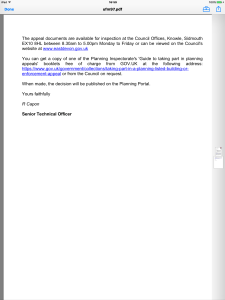
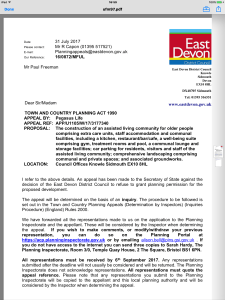
Knowle planning appeal inquiry – objections to Planning Inspector by 6 September

i

“Taxpayers still footing the bill for non-existent ‘ghost’ schools locked into £100m ‘PFI swindle’ “

Imagine how this money could benefit current pupils – and we are powerless to stop these payments:

“Taxpayers will foot a bill of over £100 million over the next two decades for “ghost” schools, as local authorities are held to ransom over outstanding Private Finance Initiative (PFI) contracts.

The Sunday Telegraph has identified schools across the country, built under the Government’s PFI scheme, which closed down just a few years after opening due to declining pupil numbers, poor performance or structural flaws.

But local authorities must continue to pay until the end of the contract – amounting to millions of pounds for empty or demolished buildings.”

http://www.telegraph.co.uk/news/2017/07/29/taxpayers-still-footing-bill-non-existent-ghost-schools-locked/

See your Police and Crime Panel in action – in Plymouth – and how to ask a question

Owl thinks the Police and Crime Commissioner is getting an easy ride when it comes to accountability. And thinks the Police and Crime Panel (which can make recommendations to her but cannot do anything else if she disagrees with them) is getting an even easier ride.

It is very hard for people in East Devon to get to Plymouth, where the panel always meets (time for an Exeter venue?) but for anyone who wants to attend and ask questions of the panel, here is the relevant information:

Devon and Cornwall Police and Crime Panel
Next meeting: Friday 18 August 2017 10.30 am

The agenda will be displayed in the week before the meeting

Proposed venue: Council House (Next to the Civic Centre), Plymouth

How to ask the panel a question

Members of the public can attend panel meetings (except where confidential or exempt information is likely to be discussed) and may ask questions at each meeting (up to two questions per person per meeting and up to 100 words per question) that are relevant to the Panel’s functions.

At the start of each meeting 30 minutes will be allocated to questions asked by members of the public. Responses may be oral or written.

Questions must be put in writing to the Democratic and Member Support Manager at Plymouth City Council at least 5 clear working days before the panel meeting.

Democratic and Member Support Manager
Plymouth City Council
Civic Centre
Plymouth
PL1 2AA
democraticservices@plymouth.gov.uk

Prince Charles gets his own (beautiful?) way with his new south-west town

Owl says: bet this wouldn’t happen in the Republic of East Devon! And wonders if a “zombie town” of which they speak might be on our own doorstep!

Jerome Starkey
http://www.thetimes.co.uk

“Three of Britain’s biggest housebuilders have lost an attempt to change the plans for a garden town designed by Prince Charles’s architects, amid claims that the builders’ proposals would have created a “zombie town”.

The Sherford Valley, on the outskirts of Plymouth, had been earmarked for 5,500 new homes and was designed by the Prince’s Foundation to create an eco-friendly pedestrian community like Poundbury in Dorset.

Bovis Homes, Linden Homes and Taylor Wimpey, which bought the site in 2014, had applied to Plymouth council to water down the design rules and change Prince Charles’s plan so that they could build cheaper homes more quickly.
Councillors said that the move would have created a “zombie town” with “years of planning thrown out of the window” and rejected their application.
The builders had built fewer than 300 of the homes when they applied to amend the town code and master plan.

“Instead of having the highest standard of new homes, we will instead have a rather large housing estate,” Vivien Pengelly, a councillor, said.
The housebuilders said that they were asking for minor changes that would not have affected the quality of homes. However, Ben Bolgar, a director of the Prince’s Foundation, said that they were trying to strip out commitments to quality.

He said that Sherford was designed to prove that Prince Charles’s model village of Poundbury, near Dorchester, could work on a larger scale but that the builders were determined to “build their normal boxes”.

The design code meant that the builders had to produce a range of houses, built from local materials, which were not more than 500m from the shops. Cars had to be parked in hidden courtyards rather than on the street to encourage people to walk.

Mr Bolgar said that the builders’ plans would have transformed Sherford into a “rubbish housing estate”.

Jonny Morris, a councillor, said that he did not want Sherford to end up like the sort of place you would see “in the aftermath of a zombie apocalypse”.

Housing companies applied to ditch a town code drawn up 13 years ago and replace it with a set of “fundamental principles” which they said allowed them greater flexibility over materials and construction methods.

“This is simply far too premature to take such a radical act, disregarding all those measures that allowed permission to be granted in the first place,” Nick Kelly, the deputy lord mayor, said. “We want development but everybody thinks, ‘This is what we’re going to get’, and at the stroke of a pen years of planning and assurances go out of the window.”

Lord Taylor of Goss Moor, who wrote a report in 2015 calling for dozens of new garden villages, said that Sherford had an excellent town plan and was “overwhelmingly supported by the local community” because of its commitment to quality. “The housebuilders knew what they were signing up to. There should really be no question about what will be delivered,” he said.”

Times (paywall)

Seaton DCC Councillor on that shameful DCC Health Scrutiny meeting – and Diviani’s disgraceful behaviour

“Councillor-Sara-Randall-Johnson (from this article):

Why did Devon’s Health and Adult Care Scrutiny Committee block the proposal to refer the closure of our beds to the Secretary of State?

The idea that the Chair, Councillor Sara Randall Johnson (left), was settling an old score with Claire Wright makes a nice story but overlooks the concerted Conservative position. The collusion between Randall Johnson and Rufus Gilbert – who rushed to propose a ‘no referral’ motion before Claire could move her motion to refer – was obvious to all, as was her keenness to persuade her colleagues not to have a recorded vote.

Equally striking, however, is that only one out of 12 Tories on the Committee – Honiton’s Phil Twiss – voted against Gilbert’s motion. The other 7 Tories who voted were all for allowing the beds to be closed; 2 who had reservations abstained; 2 more were (diplomatically?) absent. Whipping is not allowed on Scrutiny committees, but this gives a strong impression of a Tory consensus. Members who were uncertain of their support were unwilling to defy it beyond abstention. Twiss was obviously a special case, as the one committee member whose hospital will lose its beds.

Clearly the Conservative Group on DCC gave their East Devon members the main role in dealing with the Eastern Locality hospital beds issue when in May (with its return to Scrutiny looming) they made Randall Johnson chair and nominated two Exmouth members, Jeff Trail and Richard Scott, as well as Twiss as members of the Health Scrutiny Committee. With East Devon Tory leader, Paul Diviani, representing Devon’s district councils, 5 of its Tory members were from East Devon and only 7 from the other five-sixths of the Tory group.

East Devon Tories on the committee certainly lived up to their role on Tuesday. All except Trail voted, making half of all Tory votes cast on the committee and 3 out of 7 on the pro-CCG side. In contrast, only 4 of the 8 Tories from elsewhere in the county cast a vote on this crucial issue: East Devon’s Tories may have convinced themselves, but not their colleagues.

Paul Diviani spills the beans

With Randall Johnson preoccupied with timekeeping (except when the CCG were speaking), Scott silent and Twiss asking questions, it was left to Diviani to express the Tory rationale. He claimed to speak for Devon district councils as a whole, but has acknowledged that he had consulted none of the others. He was happy to defy his own Council, which has voted to keep hospital beds, and spoke for himself – and East Devon Conservatives.

Diviani’s caustic little speech deserves more attention than it has been given.

He started by saying that those who decide to live in the countryside expect diminished service, and must cut their cloth accordingly in current times – forgetting that many have lived here all their lives, or moved here long before the present Tory government arrived to savage the NHS.

‘Costs will always rise without innovation’, Diviani continued, forgetting that the ‘costs’ of community hospitals are rising particularly because of the Tory innovation which gave them over to NHS Property Services and its ‘market rents’.

‘Local decisions should be made locally’, he averred, overlooking the fact that Sustainability and Transformation Plans, Success Regimes and NHS property sales are all national initiatives forced on the local NHS – while NEW Devon CCG is so unrepresentative even of local doctors that only full-time managers (Sonja Manton and Rob Sainsbury) are allowed to present its case in public while its ‘practitioner’ figurehead, Dr Tim Burke, hides in a corner.

When, however, Diviani warned that ‘attempting to browbeat the Secretary of State to overturn his own policies is counter-intuitive’, he expressed the truth of the situation. The closure of community hospitals results from the determined policies of the Conservative Government. (Referral would have served the purposes of delaying permanent closures, embarrassing the Government and forcing its Independent Reconfiguration Panel to give an assessment of the issue.)

East Devon Tories are the Government’s faithful servants. ‘Don’t trust East Devon Tories’ over the hospitals, I warned during the County elections. How right have I been proved.”

East Devon Tories were central to ditching Seaton and Honiton hospital beds