“Air pollution: Houses on polluted street face demolition”

“Residents on one of the UK’s most polluted roads are set to be given 150% of the value of their homes to knock them down.

Recorded levels of nitrogen dioxide on the A472 at Hafodyrynys were higher than anywhere else apart from central London 2015 and 2016.

These far exceed World Health Organisation guidelines.

Next week, Caerphilly council’s cabinet will be asked to approve plans to purchase the 23 worst-affected homes.

The A472, between Newbridge and Pontypool, suffers pollution from an estimated 21,000 vehicle movements a day.

Life on Wales’ most polluted road – Hafodyrynys, Caerphilly

There have been many proposals for improving air quality, including buying and demolishing the houses and businesses, which would cost about £4.5m.
This was the Welsh Government’s preferred option. …”

https://www.bbc.co.uk/news/uk-wales-48694087

“Ministers reject plans for 1p per garment levy to tackle fast fashion”

Climate crisis – what climate crisis?

“Ministers have rejected recommendations from MPs to clean up the huge environmental impact of fast fashion, which sees 300,000 tonnes of clothing burned or buried in the UK every year.

MPs on the Environmental Audit Committee (EAC) said a charge of 1p for each garment was urgently needed to raise £35m a year for better clothing collection and sorting, a move supported by many in the industry. But the government’s response, published on Tuesday, failed to commit to this, stating only that it could be considered by 2025.

The MPs report, Fixing Fashion, was published in February and revealed that UK shoppers buy more new clothes than any other European country, and roughly twice as many as in Germany and Italy. It also said textile production contributes more emissions to the climate crisis than international aviation and shipping combined, consumes lake-sized volumes of fresh water and creates chemical and microplastic pollution.

The cross-party EAC said there should be a ban on incinerating or landfilling unsold clothes that can be reused or recycled. But the government said: “We believe that positive approaches are required to find outlets for waste textiles rather than simply imposing a landfill ban.”

The MPs also recommended mandatory environmental targets for fashion retailers with a turnover above £36m. However, the government said it would only “encourage the wider industry to take part in [the voluntary] Sustainable Clothing Action Plan (Scap)”. …”

https://www.theguardian.com/fashion/2019/jun/18/ministers-reject-charge-of-1p-an-item-to-clean-up-fast-fashion?

Where does EDDC now stand on climate emergency?

Owl is surprised there isn’t a lead councillor for climate emergency … Oh, wait, the CEO has already made the climate emergency policy himself:

https://eastdevonwatch.org/2019/05/08/eddc-ceo-puts-new-majority-in-their-place-about-climate-crisis-wants-very-slow-change/

Presumably, the job will be for new Councillor Sam Hawkins (Estates and Property Services) and Asset Management Group’s Geoff Pook to sort out between them.

Here is Devon County Council’s pathetic attempt to do something:

https://www.devonlive.com/news/devon-news/campaigners-question-speed-devons-response-2906352

taking the St Francis of Assisi approach – “make me a saint, but not yet”.

It’s going to get very warm EDDC’s new HQ in Honiton – especially in that long, narrow, dark Council Chamber; no opening the french doors in the Members Room next door, with the view out to the gardens and out to sea with a cooling breeze … just the noise from the slip road to the A35 or, if you are really lucky, a view of Aldi or Lidl – or possibly both!

But no worries – the climate cost and real cost of the air-conditioning in summer and heating in winter will not be as high as in the old HQ …..

Citizens Assembly to tackle climate crisis?

“Oxford City Council is to be the first UK local authority to establish a citizens assembly to help address the issue of climate change, and consider the measures that should be taken in Oxford.

The recent Intergovernmental Panel on Climate Change (IPCC) report warned that the current global target of 80% cut in carbon emissions by 2050 is not enough to avert catastrophic temperature change. It said it’s essential that global temperature change is limited to 1.5 degrees Celsius and that rapid, far-reaching and unprecedented changes in all aspects of society are required to ensure this.

Next week the UK’s independent Committee on Climate Change (CCC) will publish its advice to the UK Government on tightening Britain’s carbon reduction targets. This will lead to new minimum requirements for us all.

In January, Oxford City Council members unanimously declared a climate emergency and agreed to create a citizens assembly in Oxford to help consider new carbon targets and additional measures to reduce emissions.

The citizens assembly will involve a randomly-selected representative sample of Oxford residents and will meet in September. It will be the first citizens assembly in the UK created to consider climate change.

The City Council will be commissioning research to develop options and timescales for carbon reduction in areas such as housing and transport, which will be put to the citizens assembly. In addition, it will hear from a range of independent contributors. The citizens assembly’s recommendations will assist the City Council in its final decisions on adoption of carbon abatement measures and targets. …”

https://www.oxford.gov.uk/news/article/1064/oxford_city_council_to_establish_uk_s_first_citizens_assembly_to_address_climate_emergency

“Rewild a quarter of UK to fight climate crisis, campaigners urge”

Rewilding would (according to the Environment Secretary) focus on:

Native woodlands
Salt marshes
Peat bogs
Ponds and lakes
Meadows and grasslands

all of which we have in abundance in East Devon.

Perhaps it is now time to revive the idea of a Jurassic Coast National Park (West Dorset would be an already-enthusiastic partner) which was squashed by the previous council because they feared losing their cosy relationship with housing developers …

And, as part of our climate emergency, make rewilding an integral part of all future neighbourhood, district and Greater Exeter development plans.

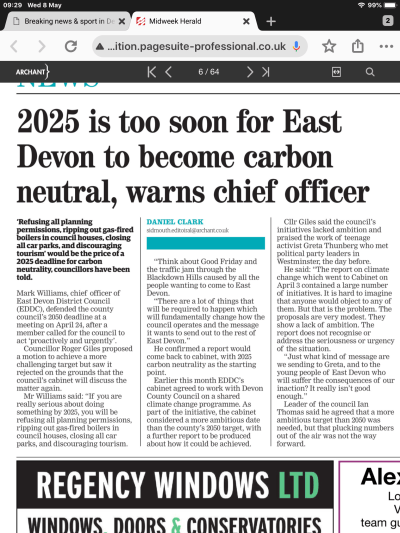
EDDC CEO puts new majority in their place about climate crisis – wants very slow change

Wasn’t aware Williams was in charge ….. print quality of the article is poor but you get the gist – I won’t be rushed …

   the

Don’t buy Comic Relief PLASTIC red noses

Scoop, Facebook post:

“Red noses…

They are plastic and we buy 6-7 million of them each year!!! The worst bit about it is that you pay £1.25 and only 65p of that goes to comic relief. Buy something useful instead I.e a t-shirt or better still avoid the ‘stuff’ and donate the entire £1.25 (and more if you can afford to) by texting or ringing.

Huge amounts of waste and unnecessary paraphernalia. It’s a fab cause but actually the people who will suffer most from climate change are being supported by money which is spent on things that are causing it! Ironic!”

Exeter and Devon County Council debate climate change – EDDC CEO refuses to allow debate

Press release from Transition Exeter below. EDDC CEO Mark Williams has refused a similar request for debate from an independent councillor.

“Green Councillor Chris Musgrave is bringing a motion to Exeter City Council on Tuesday February 26th calling on it to

Declare a ‘Climate Emergency’;

Pledge to make the city of Exeter carbon neutral by 2030 or sooner, taking into account both production and consumption emissions;

Call on Westminster to provide the powers and resources to make the 2030 target possible;

Continue to work with partners across the city and region, including Devon County Council, to deliver this new goal through all relevant strategies and plans;

To support the motion letters to city councillors would be very welcome; and supporters plan to gather outside the Guildhall before the motion is heard, at 5 pm on 26th February.

Devon County Council will also discuss a similar motion on Thursday February 21st.

Our Facebook page shows the {minority of} councillors who have pledged to support the motion. https://www.facebook.com/transition.exeter/ .

Cabinet has recommended changing the motion to aim for 2050. This is not much of an emergency! Please to your county councillor asking them to support the motion with the original target date for being carbon neutral of 2030. They will not be able to do this with their present budget and powers but the motion would be a strong call to Westminster to make realistic action possible!

Find your county councillor here

https://democracy.devon.gov.uk/mgMemberIndex.aspx?bcr=1
The motion is here https://democracy.devon.gov.uk/mgAi.aspx?ID=17450

EDDC: “Relocation cost, No Deal Brexit, electric charging points and climate change motions rejected from being discussed”

Owl says: remember, the Chief executive, Mark Williams, is supposed to be a NEUTRAL civil servant and yet ALL of the refused motions are from ALL the minority groups ONLY……!

“Motions to support recycling, to call for a new property ombudsman to streamline complaints against shoddy builders, and for East Devon to get its fair share of the police precept rise will be discussed at next Wednesday’s full council meeting.

But motions over the full relocation costs of the move from Sidmouth to Honiton, to put electric charging points in all car parks, what to prioritise in a ‘No Deal’ Brexit and on climate change will not be discussed.

Various motions that councillors had put forward for debate at East Devon District Council’s full council meeting on Wednesday, February, were rejected by the council’s chief executive, as either the agenda already provides the opportunity for debate or the wording of the motions were inaccurate.

RELOCATION

Cllr Cathy Gardner had proposed a motion calling for the council to commit to publish an annual ‘summary of accounts’ for the relocation project until break-even is reached as relocation from Sidmouth to Honiton was proposed and predicated on the basis that the project would breakeven within 20 years and deliver cost-savings to the council tax payers of East Devon.

Cllr Gardner said: “Whilst some of this information is already available we feel it is vital for the ongoing costs to be published to show confidence that this project will breakeven. A majority of Councillors voted for relocation on the basis that money would be saved on energy bills. We are left unsure of whether breakeven will ever be proven.”

But an EDDC spokesman said: “The rejected motion contained inaccuracies and omissions that had the potential to mislead councillors and it was also premature. It is however proposed to bring a report to the next meeting of the Cabinet that will summarise the position reached with regard to the sale of the Knowle and the relocation. Cllr Gardner can raise the matters she is concerned about as part of the debate into that report.”

The motion would have called for the accounts to include

energy costs for the Knowle for the past 20 years (for comparison);

energy costs for both Blackdown House and Exmouth Town Hall per year;
the capital receipt for the sale of the Knowle;

a Red Book valuation of Blackdown House as of 1 March 2019;

the full costs for the relocation project since its inception, including: project management; removal, furnishing and equipment;

staff retraining and travel expenses;

new-build costs for Blackdown House; refurbishment costs for Exmouth Town Hall; and any other associated costs.”

CLIMATE CHANGE

Cllr Matthew Booth’s motion had called for the council to recognise that Climate Change and Global Warming are the key issues of our time, to acknowledge the strong concerns of young people in particular the recent walk out of school children and for the council to commit to introducing a policy of carbon measurement and reduction within all aspects of its own activity.

He said: “I personally do not care how we begin to do this, or who does it, but that we act now not wait for some planned strategy in the future.”

An EDDC spokesman said that the issue of climate change emergency is acknowledged to be of critical importance but that it would be appropriate to wait to see what Devon County Council decides. They added: “Currently, however, the County Council is considering its position and will shortly debate the matter. As we are in a two tier area it is appropriate for the District Council to assess the position taken by the upper tier authority and then respond accordingly. The public would expect us to work in partnership with the County Council rather than unilaterally.”

ELECTRIC VEHICLE CHARGING

Cllr Eleanor Rylance had submitted a motion calling for the council to plan for and implement over the next five years a full rolling renovation programme of its car parks estates to fit and bring into operation electrical charging points at every space for domestic cars, and cycle parks with charging points for all types of cycle and that there should be mandatory EV charging points for the parking spaces of every new-built house in East Devon.

She added: “This council should approach the future of electrically-powered domestic vehicles with enthusiasm and proactivity, play a positive role in helping develop the use of electrical and should make this infrastructure, that will be a necessity within the next ten years, available in advance of full electrification of domestic vehicles in 2042.

But an EDDC spokesman said: ““The agenda already provides an opportunity for this issue to be raised so this motion was inappropriate.”

BREXIT

Cllr Rylance had also submitted a motion that said in the event of a No Deal Brexit or a version of Brexit that causes significant disruption, the council should approach this event as a situation of emergency in respect of its most vulnerable residents, dedicating any available human, material and financial resources required to palliate any negative outcomes for these groups, but the motion was rejected.

Talking about all the motions, a council spokesman said: “The council agenda for February contains the most important annual decision, namely the setting of the budget and the approval of the Council Tax for the forthcoming year. The process leading to this meeting has included several meetings where members were encouraged to raise all items of future relevance so these could be assessed as part of our service planning process and for assessment as part of the budget.

“It is unfortunate that some members did not take these opportunities and have chosen instead to submit their proposed motions.

“It is also noted that the wording of the motions was not checked in advance with relevant officers who would have been able to give timely advice as to their wording.”

But motions on the police precept, protection for new home owners and supporting recycling will be discussed.

POLICING

Cllr Tom Wright’s motion says: “In view of the £24 per band D property increase in policing precept, this council urges the Chief Constable to recognise the needs of East Devon when deciding how to allocate extra resources. East Devon residents are the biggest contributors to the police budget in Devon, other than Plymouth. It is only fair that we should get a fair share of the larger cake.”

NEW HOMES

Cllr Douglas Hull’s motion says: “The Government has stated that it would therefore be introducing as a priority a new property ombudsman to streamline complaints against shoddy builders. As a council that not only provides an excellent and highly regarded building control service but also has seen significant levels of new building in its district, we call on the government to fulfil its pledge to provide this much needed remedy for homeowners as a matter of the highest priority.”

RECYCLING

Cllr Peter Burrows’ motion says: “This Council continues to support the fine work done by the EDDC Recycling team in achieving the best results in Devon and to support and encourage local Organisations and voluntary groups who are involved in trying to reduce the amount of single use plastics used in their communities & beaches by making resources and expertise available, where appropriate. The order of priority should be – Reduce, Reuse, Recycle. To actively help promote such activities through the Councils social media platforms.”

The full council meeting will be held at East Devon District Council’s new Honiton Heathpark HQ on February 27 at 6pm.”

https://www.devonlive.com/news/devon-news/relocation-cost-no-deal-brexit-2557565

“Sidmouth sea defences could cost double the £9m expected”

NOT unexpected to Owl! At the moment, decisions on whether to fund are done on a “cost per dwelling saved” and that factors in the value of the dwelling. As costs rise (and possibly house prices level out ot fall) and austerity continues, the less likely DEFRA is to fund projects.

“The current estimated cost of the project is around £9milion over its entire lifespan – around £5.7million is expected to be funded by central government, leaving a funding gap of around £3.3million.

At a recent steering group committee, additional offshore breakwaters were discussed and it was explained again that although the breakwaters may present a more robust solution technically, they would come at almost double the cost.

The cost has been re-examined recently by consultants Royal HaskoningDHV and they have confirmed that the previous costings as part of the Beach Management Plan were correct.

Royal HaskoningDHV also presented some of the more detailed outline design drawings they are now working on, which have been developed with the use of 3D models to help ensure that costs for the volumes of rock and shingle are estimated accurately.

Additional surveys are being carried out along the seafront to help inform the outline design of the splash wall.

The proposals also include improving maintenance access onto East Beach for future recycling and replenishment.

Royal HaskoningDHV’s thorough tests and methodical approach has resulted in a proposal to recharge the beach with a 10 metre flat section at the top, and a suggested increase in the height of the splash wall of up to 0.5 metres from its existing level, with sections of lower height where the beach is less exposed. …”

https://www.sidmouthherald.co.uk/news/sidmouth-sea-defences-could-cost-double-1-5875210

“Developers to be forced to plant more trees amid fears barren developments are being constructed by builders”

Developer definition of trees – two trees which residents have to pay high maintenance charges on
Developer definition of open space – pocket handkerchief, which belongs to them but which residents have to pay for high upkeep costs

“Developers will be forced to demonstrate to planners that they are improving wildlife habitats whenever they build new homes, Michael Gove will say on Sunday.

Under plans that will go out for consultation next week, builders will be required to deliver a ‘biodiversity net gain’ when building new housing or commercial development.

This means that wildlife habitats must be enhanced and left in a measurably better state than they were before development started.

It could also see developers planting more green spaces around new developments. …”

https://www.telegraph.co.uk/politics/2018/12/02/developers-forced-plant-trees-amid-fears-barren-developments/

“Take business park land out of Local Plan say campaigners”

“Campaigners have called for land earmarked for a multi-million pound Sidford business park to be taken out of the Local Plan.

t follows East Devon District Council’s decision to throw out an application to build 8,445sqm of employment floor space on an Area of Outstanding Natural Beauty (AONB).

The proposed development for the Two Bridges site received 255 comments of objection and 111 in support. A campaign group also submitted a petition to the council with 1,400 signatures opposing the plans.

Now campaigners are calling on council bosses to look at removing the area, earmarked for development, out the Local Plan, claiming it should have never been there in their first place.

The Herald understands the application could once again go to appeal following a response from East Devon District Council saying it would not be appropriate to respond to the campaigners’ comments.

An EDDC spokeswoman said: “As we understand that this matter is now going to appeal, it would not be appropriate to make any comments about the status of the Local Plan.

“The campaigners can make their points direct to the Planning Inspector in support of the council’s decision to refuse.”

Councillor Marianne Rixson has spoken out on the reasons why the town should join her rallying call to pressure the authority to look at taking the site out of the Local Plan at the earliest opportunity.

The Local Plan

“When a Government inspector was examining the suitability of the site in 2014, county Highways failed to point out that the roads would not be able to cope with the traffic an industrial estate would bring. Highways only admitted their error in September 2016.

“After the draft Local Plan had been sent to the Inspector for final approval in 2015, district councillors realised they’d made a mistake and voted almost unanimously to try to remove it from the plan but no effort was made to explain to the Inspector the reasons why the site was unsuitable – consequently he had no option but to rule that the site should remain, subject to planning.”

Flooding issues:

“It is on a floodplain and flooding will inevitably get worse with climate change.

“The Two Bridges site is in zones 3A and two flood risk zones – yet another reason why this site is unsuitable.”

Area of Outstanding Natural Beauty (AONB):

“England has 34 AONB all of which are supposed to have the highest rate of protection in law and Government policy.

“We should only build on AONB if there is an overwhelming need for a development. The owners’ plans for a business park were market driven so there isn’t any hard proof. Surely we need to know for sure that there is an overwhelming need for employment space in the Sid Valley before we destroy this AONB?

“I would advocate for the district and town councils to work together to look seriously at how we can attract good quality, well paid jobs into the valley and how we can most effectively locate them without encroaching into the AONB and where there is good transport infrastructure.

“We need to attract good quality, well paid jobs into the area. Surely we can do this without encroaching into the AONB and where there are better road links? Regrettably by mid November Sidmouth will have lost three banks and building societies. Far better to turn these buildings into offices, which would help to keep our town vibrant, rather than build new offices on the outskirts.

Roads:

“Traffic cannot cope on this narrow road as it is due to the bottlenecks and number of HGVs already using the A375 – it will not be able to cope with more.

“Highways now agree this is not suitable for HGVs. “For two lorries to pass you need 6.5 metres. The main access for business park would be School Street which has a pinch point of 4.77 metres. There are several points through Sidbury too where the road is less than 5.5m, including Sidbury Mill and Cotford Bridge.

“Surely there should be a weight restriction on this road?

“According to an FOI submitted by the Say No Sidford Business Park campaigners some 30,000 cars travelled along the road in one off-peak week in April.

“I’d like to call for a weigh restriction on these struggling roads.

Endangered Bats and Japanese knotweed:

“The Two Bridges site is an important wildlife site for species that are protected such as horseshoe bats, otters and dormice.

“Knotweed exterminators have been seen on the site – it takes several years to get rid of.

Light Pollution

“The Norman Lockyer Observatory is both historical and the home to an active amateur astronomical society.

It also has plans to build a £70,000 extension so more experiments can take place than ever before.

“The light from any business park there will have an impact on the night sky, which currently has semi rural dark skies status at Sidford.”

http://www.sidmouthherald.co.uk/news/campaigners-reasons-why-sidford-business-park-land-should-not-be-in-eddc-local-plan-1-5772366

“The UK’s Urban Parks Could Store As Much Carbon As A Tropical Rainforest”

“London’s Hampstead Heath isn’t just a great place to hang out in during the summer, it’s also a vital tool for preventing global warming.

According to a new study by University College London, the UK’s urban forests such as Hampstead Heath can actually store the same amount of carbon as a tropical rainforest.

The remarkable findings will be vital for city planners who are hoping to create the next generation of sustainable cities.

The study was carried out using airborne LiDAR (Light Detection and Ranging) data collected by the UK Environment Agency, combined with ground-based LiDAR measurements.

Together the University was able to generate a map of the carbon stored in an estimated 85,000 trees in the London Borough of Camden.

Using that data they found that green areas such as Hampstead Heath were able to store up to 178 tonnes of carbon per hectare. This is in comparison to the median value for rainforests which can store up to 190 tonnes of carbon per hectare.

“Urban trees are a vital resource for our cities that people walk past every day. We were able to map the size and shape of every tree in Camden, from forests in large parks to individual trees in back gardens.” Explained lead author of the study, Dr. Phil Wilkes….”

https://www.huffingtonpost.co.uk/entry/the-uks-urban-parks-can-store-as-much-carbon-as-the-amazon-rainforest_uk_5b3213a7e4b0b5e692f12d9c?guccounter=1

Rental properties can be very cold – but not icy, icy cold!

Rented properties energy rated F or G (properties are rated A = best, G = worst) have been told to bring their properties “up” to at least an E rating. This could cost landlords up to £1,400 per property.

Surely we should be looking for rented properties to be AT LEAST a Grade C!!!

However, of course the unintended (or is it intended?) consequence is that, landlords will raise rents to cover (or even over-cover) the costs involved.

Renters 1 – Landlords 101!

https://www.mirror.co.uk/money/300000-rented-homes-cheaper-bills-12302246

More than 2,000 deaths due to cold snap Ministers were warned about 3 months ago

Fuel poverty – does our CCG take this into account when sending people home with a “care package” – no. And we are the 6th richest country in the world.

“The death toll from Britain’s big freeze could rise to more than 2,000, as it emerged the Met Office had warned ministers a month ago about the cold snap.

The number of people who have died in cold homes in the UK might reach 100 per day this winter, a charity warned in an analysis of Office for National Statistics figures. …

But amid the expected lift in most travel restrictions on Monday, experts have begun to assess the health impacts of the cold snap.

The estimated rise in deaths, compared to a five-year average, comes as thousands face broken down boilers and fuel poverty, preventing them from heating their homes to safe temperatures.

Campaigners claimed that public health officials had been too slow in warning the public – particularly the vulnerable and elderly – of potential health risks so they could protect themselves. …

Peter Smith, director of policy for National Energy Action, said that the weather would likely see an average of as many as 100 people per day perishing in cold homes this winter, compared to a five-year average of 80 people per day.

The total number of cold-home deaths due to the “Beast from the East” cold front is therefore estimated to be more than 2,300.

At least ten deaths have so far been attributed to the cold weather, but the true death toll is likely to take longer to emerge due to the increase in strokes and heart attacks linked to cold weather.

Mr Smith’s analysis is based on ONS data from previous years and a comparable period of cold weather in the winter of 2010-11.

The World Health Organisation estimates that an overall proportion of 30 per cent of excess winter deaths are due to cold homes. … “

https://www.telegraph.co.uk/news/2018/03/04/uk-weather-big-freeze-death-toll-could-rise-2000-emerges-met/

Productivity, weather, climate change and – robots!

Our LEP says we can double productivity in Devon and Somerset by 2030. But can we do this given recent weather/climate activity that has apparently already cost Devon £200m?

https://www.devonlive.com/news/business/snow-storm-emma-cost-south-1289777

To recap: the only 2 main roads into and out of Devon (M5 and A303) were both impassable at the same time, the rail service collapsed in Dawlish and London, Exeter airport was closed and rural bus services were all cancelled. Devon came to a standstill. At a time when there were threats to cut gas supplies to larger, non-strategic businesses.

Good quality and quantity infrastructure is essential to get productivity growth, and now the cold weather has – yet again – shown how bad our infrastructure is, and that the current government has under invested – almost certainly because the south-west is generally a set of safe seats – so there is no need to invest – need as defined by political election need not citizen need.

So LEP claims to double productivity would be extremely optimistic / challenging in the best of circumstances, with great infrastructure, but with crumbling infrastructure, struggling under the weight of homes growth, and subject to the vagaries of the weather and lacking in desperately needed investment, there is not a hope of getting anywhere close. And indeed, we might ask, with the woeful infrastructure we currently have, and no investment, should we expect a decline in productivity rather than an increase?

And we have another problem. Productivity = output. so, with robotics does that mean more or less employment – and if less, and no one wants to move here, who are going to live in all these new homes and how will they afford to keep them?

Even Greggs the bakers are now using robots to make sausage rolls and pasties:

https://www.dailystar.co.uk/news/latest-news/685288/Greggs-to-cut-hundreds-of-jobs-sausage-roll-doughnut-robot-UK

“Hinkley Point: the ‘dreadful deal’ behind the world’s most expensive power plant”

This is a VERY long article, but well worth reading.

Our LEP is throwing all OUR eggs into this disgraceful basket, decorated with white elephants by French and Chinese companies. But, at least those members of the LEP with nuclear, construction industry and recruitment and training of those servicing our nuclear warheads will be happy!

Just a flavour of the article:

“… But the irony of Hinkley Point C is that by the time it eventually starts working, it may have become obsolete. Nuclear power is facing existential problems around the world, as the cost of renewable energies fall and their popularity grows. “The maths doesn’t work,” says Tom Burke, former environmental policy adviser to BP and visiting professor at both Imperial and University Colleges. “Nuclear simply doesn’t make sense any more.”

The story of Hinkley Point C is that of a chain of decisions, taken by dozens of people over almost four decades, which might have made sense in isolation, but today result in an almost unfathomable scramble of policies and ambitions. Promises have been made and broken, policies have been adopted then dropped then adopted again. The one thing that has been consistent is the projected cost, which has rocketed ever upwards. But if so many people have come to believe that Hinkley Point C is fundamentally flawed, the question remains: how did we get to this point, where billions of pounds have been sunk into a project that seems less and less appealing with every year that passes? …”

…”Andrew Stirling believes that there was a crucial, largely unspoken, reason for the government’s rediscovered passion for nuclear: without a civil nuclear industry, a nation cannot sustain military nuclear capabilities. In other words, no new nuclear power plants would spell the end of Trident. “The only countries in the world that are currently looking at large-scale civil power newbuild programmes are countries that have nuclear submarines, or have an expressed aim of acquiring them,” Stirling told me.

Building nuclear submarines is a ferociously complicated business. It requires the kind of institutional memory and technical expertise that can easily disappear without practice. This, in theory, is where the civil nuclear industry comes in. If new nuclear power plants are being built, then the skills and capacity required by the military will be maintained. “It looks to be the case that the government is knowingly engineering an environment in which electricity consumers cross-subsidise this branch of military security,” Stirling told me. …”

“… Given its commitment to building Hinkley Point C, the government had no choice but to make EDF an offer that was too good to resist. It offered to guarantee EDF a fixed price for each unit of energy produced at Hinkley for its first 35 years of operation. In 2012, the guaranteed price – known as the “strike price” – was set at £92.50 per megawatt hour (Mwh), which would then rise with inflation. (One Mwh is roughly equivalent to the electricity used by around 330 homes in one hour.)

This means that if the wholesale price of electricity across the country falls below £92.50, EDF will receive an extra payment from the consumer as a “top-up” to fill the gap. This will be added to electricity bills around the country – even if you aren’t receiving electricity from Hinkley Point C, you will still be making a payment to EDF. The current wholesale price is around £40 per Mwh. If there had been no inflation since 2012, the consumer would be paying an EDF tax of around £52.50 per Mwh produced at Hinkley. However, because it is linked to inflation, the strike price has already risen since 2012. (The price will be reduced by £3 if EDF develops another new reactor in Sizewell in Suffolk, as it is planning to do.) …”

https://www.theguardian.com/news/2017/dec/21/hinkley-point-c-dreadful-deal-behind-worlds-most-expensive-power-plant

Utility companies move into battery storage, not nuclear

Our Local Enterprise Partnership still puts all OUR eggs in the Hinkley C basket (case).

“Britain’s switch to greener energy will take another significant step forward this week with the opening of an industrial-scale battery site in Sheffield.

E.ON said the facility, which is next to an existing power plant and has the equivalent capacity of half a million phone batteries, marked a milestone in its efforts to develop storage for electricity from windfarms, nuclear reactors and gas power stations.

The plant, housed in four shipping containers, is the type of project hailed by the business secretary, Greg Clark, as crucial to transforming the UK’s energy system and making it greener.

At 10MW, the Blackburn Meadows battery is one of the biggest in Britain so far, but will soon be eclipsed by much larger plants.

Centrica, the parent company of British Gas, is building a 49MW facility on the site of a former power station in Barrow-in-Furness, Cumbria, while EDF Energy is working on one of the same size at its West Burton gas power station in Nottinghamshire.

David Topping, the director of business, heat and power solutions at E.ON, said: “This is a milestone for E.ON in the new energy world and an important recognition of the enormous potential for battery solutions in the UK.”

The utility-scale batteries are being built in response to a request from National Grid, the owner of Britain’s power transmission network, for contracts to help it keep electricity supply and demand in balance, which is posing an increasing challenge for the grid as more intermittent wind and solar comes online. …”

https://www.theguardian.com/environment/2017/oct/09/uk-first-mega-battery-plant-come-online-sheffield-eon-renewable-energy

A test for our LEP: offshore wind power now vastly less expensive than Hinkley C

The Local Enterprise Partnership for Devon and Somerset (Heart of the South West LEP) is investing heavily in Hinkley C nuclear power station in Somerset.

This is not surprising, as many of its members are making money, now and in the future, in providing services and infrastructure for the massively expensive French/Chinese project. Making THEIR money with OUR money – whether the white elephant gets built or not.

Now we hear that the infrastructure costs of offshore wind power have plummeted – making it much more cost-effective than nuclear power, particularly Hinkley C nuclear power:

https://www.theguardian.com/environment/2017/sep/11/huge-boost-renewable-power-offshore-windfarm-costs-fall-record-low

Now, solar energy is operating at zero subsidy and onshore costs for wind power are also falling – and energy storage batteries are also becoming nearer to cost-neutral for homeowners.

So, what is/was our LEP’s Plan B for this eventuality?

Er ….. they don’t need one or want one, because THEIR profits aren’t based on what’s best for us, or what costs least but what’s best for them.