EDDC: Greater Exeter Strategic Plan update – delayed to at earliest April 2023

Highlights:

The Heart of the South West devolution bid highlights a number of challenges facing the LEP area which planning has a key role in addressing. These are:

 Comparative productivity is 29th out of 39 LEP areas
 An aging workforce and major skills shortages reported
 Our performance remains low on key productivity measures: wages, innovation, inward investment exports and global trade
 Disproportionate growth in our older population is placing unsustainable burdens on our services
 Strategic infrastructure has good coverage, but is incomplete
 Insufficient capacity of the road network and motorway junctions
 Uncompetitive travel times to London and the south east
 Incidents and extreme weather threatens transport resilience
 Housing supply not keeping up with demand
 Threats to National Parks and Areas of Outstanding Natural Beauty

Page 5: revised timetable pushes back a GESP agreement to not earlier than April 2022. HOWEVER, this is almost certainly a spelling error, as on page 11 this is contradicted:

Once adopted it will supersede specified strategic parts of the East Devon Local Plan, Exeter Core Strategy, Exeter Local Plan, Mid Devon Local Plan (once adopted), Teignbridge Local Plan Parts 1 and 2 and any other Development Plan Documents as necessary. The preparation timetable is as follows:
 Site Options and Draft Policies – June 2020
 Draft Plan – November 2020
 Publication (Proposed Submission) – February 2022
 Submission – July 2022
 Examination – September 2022
Adpotion : April 2023
(not April 2022)

Page 8: The Greater Exeter Strategic Plan will cover the local planning authority areas of East Devon, Exeter, Mid Devon and Teignbridge (i.e. those Councils’ administrative areas excluding Dartmoor National Park). It will be prepared jointly by those four local planning authorities with the support of Devon County Council under Section 28 of the Planning and Compulsory Purchase Act. It will:

• set an overall vision and strategy for the area in the context of national and other high level policy and in particular climate emergency declarations and the NPPF;
• contain policies and proposals for strategic and cross boundary issues where these are best dealt with at a larger-than-local scale;
• set the overall amount of growth for the period 2020 – 2040;
• promote the Liveable Exeter vision by allocating urban regeneration sites in the city;
• implement the overall vision and strategy by allocating strategic sites of 500 or more
homes which may include urban extensions and new settlements ;
• provide districts’ local plans with targets for non-strategic development

Persimmon in the deep, deep manure yet again on leasehold houses

“Persimmon is heading for a bitter showdown with families who claim the housebuilder mis-sold them homes on toxic leasehold deals.

Hundreds of its customers bought leasehold houses and now claim they are trapped by ratcheting rent bills that have made it impossible to sell.

But the company, which is the UK’s most profitable developer, is playing hardball and has told desperate customers that it ‘does not accept’ their complaints.

Along with other developers, Persimmon has been banned from selling leasehold houses after a public outcry.

Persimmon and others were accused of charging extortionate ground rents, some of which rose dramatically over time, along with a raft of hidden charges.

Leaseholders effectively buy the right to live in a property for an agreed period, rather than ownership of it outright.

However, an inquiry by MPs earlier this year found that many leaseholders did not appear to have fully understood the deal.

In a recent row with Cardiff council, Persimmon was accused of mis-selling leasehold homes. It offered residents the freeholds to their properties at no charge as part of an out-of-court settlement.

Campaigners now argue all its leasehold customers across the country should receive similar compensation.

But in a letter sent to customers and seen by the Mail, the company rejected claims householders were misled.

It claimed staff would have explained the terms of the homes to customers during the sales process, that their solicitor should have advised them about it and that mortgage lenders would have also assessed the property at the time.

A separate survey by the Solicitors Regulation Authority also found one fifth of people sold leasehold properties were not even told the difference between leasehold and freehold homes.

MPs called for an investigation into possible mis-selling. They lambasted solicitors for being too cosy with developers and failing to warn clients about the rip-off deals.

Following their report, the Competition and Markets Authority (CMA) launched a probe.

Sir Gary Streeter, Tory MP for South West Devon, accused the firm of telling ‘blatant’ lies to leaseholders in Plymouth, part of his constituency, during the sales process.

A Persimmon spokesman insisted the decision to ‘gift’ ownership to leaseholders in Cardiff was ‘not to do with the mis-selling of leasehold properties’, adding: ‘We firmly dispute the fact that the customers were not aware the properties were being sold on a leasehold basis.

Any suggestion that the decision by Persimmon to gift the freeholds was in relation to mis-selling of leaseholds is false and misleading.’

‘All customers buying leasehold properties are informed by the sales team at the time of purchase that the properties are leasehold and not freehold.’

‘It feels like we have been tricked’

Grandparents Noelle and Alf Lutton bought their five-bedroom home three years ago for £250,000 – but they have still been asking for problems to be fixed

Noelle and Alf Lutton claim the punitive terms of their leasehold home were not made clear to them by Persimmon.

The grandparents bought their five-bedroom home three years ago for £250,000 – but they have still been asking for problems to be fixed.

In addition, they face having to pay £150 in ground rent every year – a rate that increases every decade – and must fork out so-called ‘permission fees’ of £250 if they want to make even minor changes to the property.

They claim they were never told they would have to pay these charges. Former customer services worker Mrs Lutton, 75, says the couple had always previously lived in freehold properties but were not given that option when buying their current home in Market Deeping, near Peterborough.

Instead, they say a Persimmon sales representative verbally promised they could buy the freehold for ‘a couple of hundred pounds’ two years after the initial sale.

But Persimmon later quoted them a price of £3,750. And although it later reduced this to £500, the company insists they would still have to pay permission fees even if they now acquired the freehold.

‘Had we known then what we know now, we would never have bought the property,’ Mrs Lutton said. ‘We weren’t told about any of the fees we would have to pay. It feels like we have been tricked.’

A Persimmon spokesman said: ‘The details of the ground rent, associated fees and covenants were included within the contract and documentation at the time of purchase.

‘Following completion, Mr and Mrs Lutton raised a number of snagging issues with their property. The last one of these is due to be addressed shortly.’ “

https://www.thisismoney.co.uk/money/news/article-7560423/Housebuilder-Persimmon-fresh-row-toxic-leases.html?ito=rss-flipboard

“First-time buyers using Help to Buy paying 10% more for homes than everyone else”

Catch 22: first-time buyers can buy only new properties; if they could get the discount on ANY property many would save at least 10% – and have none of the poor-quality build issues affecting new properties.

But developers won’t allow that!

“First-time buyers using the Help to Buy scheme in England are paying an average of 10% more than those buying a new home without Government support, figures suggest.

Those who purchased a new-build home in the past year using the scheme paid an average £303,450 each, significantly more than those who bought without Government help.

On average, the premium paid by those using the scheme was 10.3% in the 12 months to September 2019.

That’s according to a report on 41,500 new build properties, which also found huge price disparities between properties sold in London and the rest of the country. …”

https://www.mirror.co.uk/money/first-time-buyers-using-help-20536679

A tale of two anaerobic digesters …

Before tonight’s Inside Out programme on BBC1 about anaerobic digesters in Clyst St Mary, it maybe worth pointing out there are TWO of them – one at Enfield Farm at Clyst St Mary off Oil Mill Lane, owned by the people that own Crealy (the Down family) plus one at Hogsbrook near Greendale owned by the Carters.

To make matters more complicated, both were developed by a company called Greener for Life – until they went into administration and were then run by separate companies but with similar directors as Greener for Life. (Keep up there at the back, keep up!).

It’s the Enfield Farm one that is in the news – basically as it was built with double the capacity as specified at the Planning Application stage. (Note to planners: why was this allowed? Where was the Enforcement Officer?).

To restrict additional tractor movements and travelling far distances to obtain feed it’s not allowed to run at 100per cent (again, note to planners, why was this allowed?).

They are appealing against the planning condition at the moment.

Which begs the question: if I got planning permission to build a 2-bed house but built a 4-bed house instead, would planners have agreed – as long as no-one used the two extra bedrooms and we used only two of our cars on the site rather than the 4 we had there?

“RIBA slams moves to extend permitted development rights”

“The government’s ambition to simplify the country’s planning system will be wrecked by ministers’ determination to persist with extending permitted development rights, the RIBA has warned.

Alongside a number of other housing initiatives announced earlier this week, including plans to change energy regulations and introduce a new housebuilding standard, the housing secretary Robert Jenrick said the government would be looking to reform the planning system, “making it faster and more efficient for everyone, from households to large developers”.

The government wants to allow homes to be built above existing properties and is seeking views on demolishing old commercial buildings for new housing, a move it claimed would revitalise high streets in the process.

An accelerated green paper on planning reforms will be published next month, outlining ministers’ thinking.

But the RIBA president Alan Jones pointed to a “huge contradiction” at the heart of the government’s ambitions and said moves to create “a planning system that works for society would be undermined by the proposal to extend permitted development rights”.

Jones said the RIBA said it would continue to urge the government to reconsider its plans, since these “would only lead to more homes that sidestep vital quality and environmental standards and inhibit any plans to incite a ‘green housing revolution’”.

The architects’ trade body has been a vociferous critic of those developers who used permitted development rights to turn redundant office and commercial space into residential properties, many of which do not meet minimum space standards.

It backed a Children’s Commissioner report, published in August, which the RIBA said provided “further evidence of the damaging effect that current regulations have on people, including families with children, who end up living in these poor-quality homes, often through no choice of their own”.

Other organisations have warned that prolific use of permitted development rights to convert offices and warehousing space into homes would create the “slums of the future”.

The Labour Party has committed to scrapping permitted development rights if it gets into government, while the Royal Town Planning Institute believed such rights “put housing affordability and design quality at risk” and undermined the planning system.

At the Conservative Party conference earliest this week housing minister Esther McVey said the government would tweak the permitted development rights’ regime but ruled out rolling it back.”

https://www.housingtoday.co.uk/news/riba-slams-moves-to-extend-permitted-development-rights/5101950.article?

“Yet another delay in reveal of Exmouth seafront future plans”

“A report on the current position was due to come to tonight’s Cabinet meeting – but there is no sign of it.

September’s East Devon District Council Cabinet meeting saw an urgent item brought forward to dissolve the Exmouth Regeneration Board and replace it with the Exmouth Queen’s Drive Delivery Group.

Although not initially on September’s agenda, it was brought forward at the last minute so that they could meet that month and receive the latest information, with a report to come to the October cabinet meeting outlining the current position and a timetable of next steps.

Explaining why it was adding as an urgent item, Cllr Ben Ingham, leader of the council, said that had they waited until the next meeting, it would have caused a further delay in progressing the plans.

But the cabinet agenda for tonight’s meeting (October 2) does not include any items on the Queen’s Drive project. A council spokesman has said though a public engagement event will take place in November.

They said: “A cabinet report will come forward later on regarding progress and next steps on the delivery of Queen’s Drive Phase 3. A public engagement event will be taking place in November led by Hemingway Design who have been leading on a new vision for the Queen’s Drive site. More information on this will come forward shortly.”

Consultation with the public was undertaken by HemingwayDesign in the summer of 2018 and it was hoped and expected by senior councillors that their report on the options for phase 3 would have been published this summer, but that date has passed.

Phase 1 of the Queen’s Drive project, the realignment of the road and the new car park, was completed in June.

Phase 2, the new watersports centre, is set to open in time for the summer of 2020, and the hoardings have been installed around the new, upcoming watersports development, Sideshore. …”

https://www.devonlive.com/news/devon-news/yet-another-delay-reveal-exmouth-3385751

Cranbrook: one multi-purpose DCC building triggered – maybe, if money available

But no plans for anything else.

“If all goes to plan the community facilities building will include a flexible space for children’s, youth, adult and library services with potential use for public health and highways services, as well as town council working space.

The building could be completed within two years, if funding is secured.

The trigger point for the provision of the children’s centre facilities – 2,000 homes being occupied – has been met which means the Cranbrook consortium of developers have to construct the children’s centre facilities no later than June 10, 2021.

The existing planning agreement also requires them to provide town council offices in the town centre by June 2021, and youth facilities and a library when the 3,450th home is occupied, currently expected to be in 2025.

But council officers are recommending the agreements be renegotiated so that a multi-purpose building can be built.

Nearly 2,000 homes in the new town are currently occupied and while the town has a primary school, an allthrough school, a multi-purpose building with GP surgery space and a train station, the only building that has been provided in the town centre is a the pub Cranberry Farm.

Other facilities such as additional town centre shops and a food store are commercially led and will likely only come when there are more people living in the town. There are no fixed timescales for when it may happen. …”

https://www.midweekherald.co.uk/news/tow-centre-community-building-plan-at-cranbrook-revealed-1-6302771

Devon “new town” runs out of parking spaces

“Sherford bosses have sought to calm a brewing storm over parking arrangements in the town amid claims there’s not enough spaces available for everyone.

Neighbours say it’s a daily ‘nightmare’ trying to find somewhere legitimate to leave their car overnight in the new-build South Hams town.

Some are even being forced to break a town covenant which bars anyone from leaving their cars on the High Street at night because there’s too many cars per household lining the streets, it’s claimed. …”

https://www.plymouthherald.co.uk/news/plymouth-news/sherford-drivers-say-town-run-3377885

Sidford Fields Business Park – Campaign update

“Forgive our silence over recent weeks but please don’t take this to mean that we haven’t been doing anything!
Having received the disappointing news that the Planning Inspector has upheld the appeal for the proposed Business Park a solicitor was engaged and a barrister instructed to obtain a legal opinion on the likelihood of a successful legal challenge to the Inspector’s decision.

We have only very recently received the barrister’s written opinion. Regretfully, the barrister’s opinion whilst incredibly sympathetic to the circumstances that local residents will find themselves in when the Business Park is up and running, concludes his opinion by stating “ … while I can see much to disagree with in the Inspector’s assessment, I do not consider there to be an arguable ground of challenge raising an error of law, and therefore the prospects of success in a section 288 claim – in my view – are low.”

This means that we have no legal avenue to challenge the Inspector’s decision. That said at least one Sidford resident has written to the Secretary of State for Housing, Communities and Local Government asking that the decision be “called in”. In other words, they have asked the Secretary of State to review the decision.

If anyone else would like to do the same then you can email the Secretary of State, Robert Jenner, at Robert.Jenrick.MP@parliament.uk.

There remain concerns of evidence that arose out the Inquiry and the outcome of the inquiry itself. We have been asked what residents can do should they wish to raise their concerns. Should you wish to do so your concerns can be addressed to –

(i) Concerns regarding the Planning Inquiry, its process and/or its outcome are best addressed to the Secretary of State Robert Jenner;

(ii) Concerns regarding the way in which the District Council, its Members and/or its Officers have dealt with the planning applications thus far can be addressed to the Leader of the Council, Councillor Ben Ingham, at BIngham@eastdevon.gov.uk. And/or residents are able to make comments at the start of Full Council meetings, with the next one being held in the evening of 23 October.

District Councillor John Loudoun has raised the matters associated with the meeting held between the Chief Executive and the applicants back in 2016 after the Council had refused the 2016 planning application. He has updated his blog which sets out the issues associated with the meeting based upon information provided by the Council. His blog is at http://johnloudoun4sidmouthruralhome.wordpress.com/.

The applicants, having now obtained outline planning approval as a result of the Inspector’s decision, will need to start to obtain detailed planning approval from the District Council.

This obviously will lead to scrutiny by the Town Council and the district Council and will afford residents opportunities to comment on the details within those applications. As of yet, no applications have been submitted.

It has been suggested that it might be appropriate for residents who are annoyed at the Inspector’s decision to lobby the District Council. We cannot see what this would achieve as it has no ability to alter the Inspector’s decision. Rather, we think that any further lobbies would probably be best considered when future planning applications are under discussion at Town and/or District Council meeetings.

We recognise that many of you are concerned to appreciate all that has happened over recent months and what can/should be done as things move forward. We are therefore trying to organise a public meeting for the evening of either 14 or 15 October. Once we have been able to book a venue, we will let you know the details of the meeting.
Best wishes

Campaign Team”

Another Taylor Wimpey home so badly constructed couple can’t sell it

and Taylor Wimpey won’t buy it back.

https://www.mirror.co.uk/news/uk-news/couples-brand-new-350000-dream-20332525

The curious case of the missing houses

Many council officers are honourable, many are not. Owl had hoped to to write “most officers are honourable, a few are not” but that hasn’t been Owl’s experience, sadly.

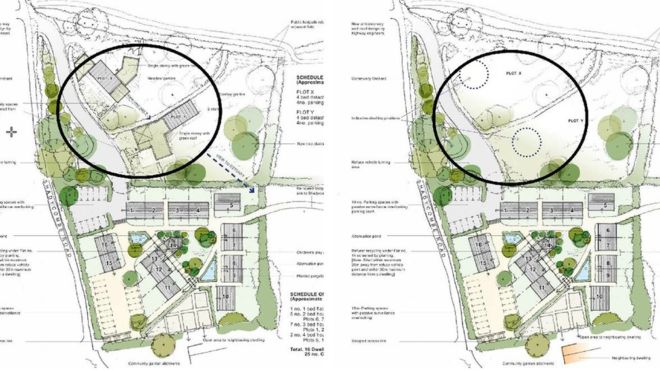
Now, all eyes are on a planning application in Salcombe, for two houses in an exceptionally good location were deleted from plans shown to a “planning workshop” for councillors.

Why? That old chestnut “commercial confidentiallity”.

“A council has been forced to reveal plans for two luxury homes on a beauty spot which were withheld from councillors during a meeting.

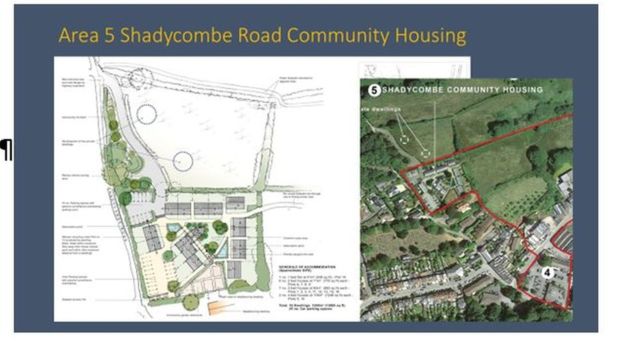
Above: original plan and plan shown to councillors and plans shown to councillors

South Hams District Council in Devon cited “commercial confidentiality” in keeping the Salcombe plans under wraps, but a watchdog rejected that excuse.

Environment group South Hams Society urged “more transparency in planning matters” by the council.

The authority said it “did not want the meeting to be sidetracked”.

Drawings of the homes had formed part of draft plans for the hill-top development off Shadycombe Road in the seaside town.

But a council officer told architects in an email on 11 October last year that “at this point” the scale of the four-bed detached houses should be left out of the plans.

He said the scale “concerns me” and added: “It would be a mistake to present this detail.”

In an email response, the architect sent back revised plans with circles instead of drawings of the houses “without being too prescriptive on their size and design”.

The email:

The revised plans were then put before a planning workshop of councillors and local businesses on 17 October.

The council initially refused South Hams Society’s request to reveal the original plans.

However, it appealed and the Information Commissioner’s Office (ICO) ordered the authority to divulge the omitted details.

In a statement, the council said it had “sought legal advice” and “we were of the view that we were entitled to withhold them”.

“It was clear to us that the plans as they were, would not be recommended for approval by the council.

“We felt that the size of the properties on the plan were inappropriate.”

The workshop had been arranged to talk to key stakeholders about a masterplan for the whole area and we did not want the meeting to be side-tracked by a proposal which we were sure would never come forward in its current state.”

It added it now “fully respects” the demand to release the full plans.”

Above: plans presented to workshop

Didi Alayli, chair of the society, said she hoped the ICO ruling “will lead to real change” in how council planners deal with draft plans.

“The huge profits to be made by landowners and developers in our beautiful area make it all the more important that our planning system is fit for purpose and we are not there yet,” she said.

It is understood landowner Jason Smith, who has not yet responded to a BBC request for comment, has not taken the proposals forward.”

https://www.bbc.co.uk/news/uk-england-devon-49812449

“‘I won’t be buying Redrow again!’ Angry [Dawlish] people put up protest signs in their own gardens”

One of Cranbrook’s big developers:

https://www.devonlive.com/news/devon-news/i-wont-buying-redrow-again-3368923

John Loudon (EDDC Sidmouth Rural councillor on Sidford Business Park planning application

From the blog of John Loudon, East Devon Alliance councillor for Sidmouth Rural.

The Sidford Business Park, Chief Executive, Council Leader & Private Eye
The planning applications to build the Business Park in Sidford have received a great deal of local attention and significant opposition, and I was pleased to be able to recently give evidence at the Inquiry in opposition to the proposed development. I believe that it is the wrong thing in the wrong place. Unfortunately, the Planning Inspector who adjudicated at the Inquiry disagreed and has now given the go ahead for the Business Park.

We are where we are because there have been two planning applications submitted by Tim and Mike Ford, in the name of OG Holdings Retirement Benefits Scheme, to build this Business Park. The first of these applications was submitted in 2016 and rejected by East Devon District Council. The second was then submitted in 2018 and was again rejected by the District Council.

In listening to the evidence at the Inquiry I, and many others, were taken aback to learn a claim arising from the evidence given by a key witness for the Fords, their agent Joseph Marchant, which was repeated by their QC and which wasn’t challenged by the Council.

The claim was set out at paragraph 6.0.1 in Mr Marchant’s written evidence “Subsequent to the refusal of the 2016 application, an approach was made to Members (Councillors) including Councillor Hughes and the CEO (Chief Executive) of EDDC, Mark Williams”.

This is continued in paragraph 6.0.2 of Mr Marchant’s written evidence “We were advised by Mark Williams…. that in his opinion, the applicant (the Fords) may make more advance in progress towards delivery through appealing (the Council’s decision to refuse the 2016 planning application) rather than resubmission”.

This claim was also clearly set out in paragraphs 13 and 14 of the Fords’ QC’s final closing arguments at the Inquiry “After the 2016 application was refused, there was a meeting with Councillor Hughes and the CEO of the Council”. “The CEO advised that the way to progress was to appeal. That is an extraordinary state of affairs”.

In my opinion all of this raised serious questions, not for the first time, about the links between the District Council and developers. It could be construed that the Chief Executive’s actions and advice undermined the authority and responsibilities of not only the Council’s planning officers, but also that of the elected Members, particularly those with responsibility for oversight and decision making on planning applications.

I therefore took this matter up with the Leader of the Council and in doing so I asked him a number of questions about how this meeting, involving the District Council’s Chief Executive and the developers, came about, what was discussed at it and who was present. After a bit of toing and froing I received answers to some of my questions, and as a result I believe that this is what happened –

After the 2016 planning application to build the Business Park was turned down by the District Council Tim Ford contacted the Chief Executive’s PA on Thursday 3 November 2016 seeking a meeting with the Chief Executive. This request appears to have been acted up very quickly as the meeting took place on Tuesday 8 November at 8.30 am in the Chief Executive’s office.

Present at the meeting were the Chief Executive, Mark Williams, Paul Diviani, the then Conservative Leader of the District Council, Councillor Stuart Hughes plus the developers Tim and Mike Ford and their agent Joseph Marchant, the one and the same person who’s witness statement led to this meeting being made public. The reason for the meeting is recorded as “To discuss the Sidford Business Park”.

The District Council is unable to confirm how long this meeting took. In addition, the District Council appears to have no formal, or informal, record of what was discussed or any decisions that were reached.

I find this situation concerning. It is amazing that within 4 working days of requesting a meeting that a developer can hold a meeting involving the Chief Executive and Leader of the Council, the two most senior people within the Council, to discuss a planning application that their Council had refused. I wonder how many members of the public can get that sort of high-level access so quickly?

I am concerned that at this meeting there was no planning officer, legal adviser nor the Council’s Monitoring Officer present. Surely, any discussion about a matter relating to a planning application should have the input of a planning officer. Wouldn’t the Council be best protected by having a legal adviser present? Surely, the Monitoring Officer, who is responsible for the probity of the Council, ought to be in attendance?

There was no record of the meeting’s discussions made on behalf of the Council. I cannot understand why this was so. Surely, it’s important that a record of such a meeting is made and then shared with the planning officers? Surely, a record of the meeting should have been placed with all the other related documents in the planning application file? It’s almost as if no one wanted the meeting to have been known about by anyone else, or otherwise why not keep a record of its discussions?

My role as a campaigner against the Business Park and as a District Councillor pursing this matter has been challenged by the District Council. The Business Park is within my Ward. Local residents within my Ward and within a neighbouring Ward at Sidford have expressed concern at the proposed Business Park and the involvement of the Chief Executive in this matter. It is therefore only right and proper that I have pursued this on their behalf.

Afterall, the Local Government Association’s Guidance for new Councillors 2019/20, which the District Council provided to me upon taking office in May, states at page 7, in the section headed “The Councillor’s role” that –

“A councillor’s primary role is to represent their ward or division and the people who live in it. Councillors provide a bridge between the community and the council. As well as being an advocate for your local residents and signposting them to the right people at the council, you will need to keep them informed about the issues that affect them”.

It goes on to explain that –

“As a local councillor, your residents will expect you to: … know your patch and be aware of any problems … represent their views at council meetings … lead local campaigns on their behalf”.

This guidance was reinforced to Councillors through the training that it provided in May 2019.

I don’t feel comfortable with some aspects of how the District Council has handled this planning application. I don’t feel comfortable about –

how quickly a developer was able to gain swift access to the most senior people in the Council.
that other key Officers weren’t present at the meeting.
that no record of the meeting was made by the Council.
I know for sure that many local residents remain uncomfortable too. As does Private Eye which has picked up on this story on 20 September.”
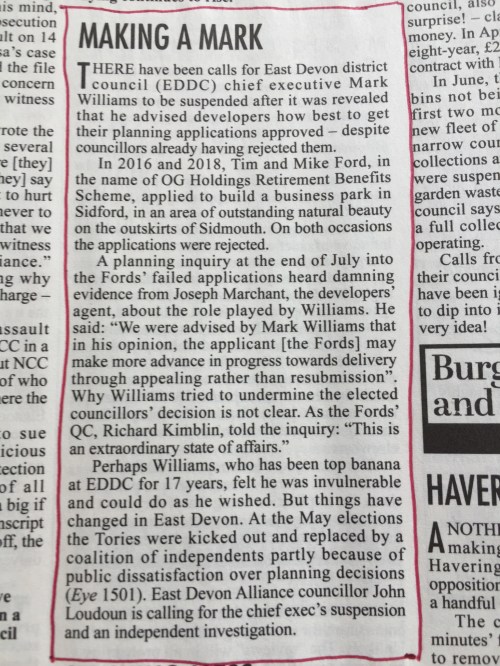
The Sidford Business Park, Chief Executive, Council Leader & Private Eye

“Pre-Application Openness And Transparency”

A useful guide from the South Hams Society on what developers and officers can co-operate on before a planning application goes in and what rights residents have to know what they are doung.

” …You are entitled to ask the district council:

If you suspect that discussion is being held on a proposal for development that hasn’t yet been published as a planning application, you are perfectly entitled to ask the district council, as the planning authority, what it knows about it.

The Environmental Information Regulations of 2004 require public bodies, if asked, to release to the requester, within 20 working days, any information they have on proposals for the land.

There are certain defined circumstances in which they can withhold it but they wouldn’t often apply in the cases in which the ordinary resident would be interested.

The rules cover pre-application discussions and any other less formal enquiries. Your request needn’t be in writing, it can be oral, for instance, by asking a councillor, in or out of a meeting, and the rules would equally apply to a town or parish council as well as to a district council.

Any blanket response such as ‘Pre-Application discussions are confidential’ is misconceived and should be challenged.

Your enquiry can be submitted online through the council’s Freedom of Information portal, citing the Environmental Information Regulations.

Requests are perhaps best framed in relation to an area or place and a time period, without any reference to the parties you think might be involved. For instance “Could I please be informed of any proposal of which the council has become aware in the last year, in the form of a pre-application request or otherwise, for development in the field of which the centre is at SX66805021? Please include the record of any advice the council may have given.”

Make sure your request is acknowledged, and follow it up if you haven’t had a reply within 20 working days.

[A model letter example from South Hams can be found here]:
https://southhamssociety.org/wp-content/uploads/2019/09/SHS-ICO-pre-application-ruling-Councillors-letter-230919.pdf

Click to access fer0829003.pdf

“Build commuter villages near train stations in green belt to solve housing crisis, Government told”

Fortunately, there is no green belt land in East Devon – most is around London – but our AONB could be at further risk – unless, of course, we get our Jurassic Coast National Park!

“A thousand “commuter villages” providing 2.1 million new homes should be built in the green belt near train stations to help solve Britain’s housing crisis, says a leading Government adviser and academic.

LSE professor Paul Cheshire, who has been a Government adviser for over a decade, said building the villages within 10 minutes walk of the 1,035 under-developed rail stations would offer easy and quick commutes to urban jobs while producing as many new houses as have been built in the last 15 years.

It would take commuters just 45 minutes to get to cities where they worked, providing them with environmentally “greener” and shorter journeys than many now face.

The 47,000 hectares of land needed would amount to just 1.8 per cent of the existing green belt in England but would increase the number of homes in Britain by almost 10 per cent.

Professor Cheshire’s report, for the think tank Centre for Cities, also calls for the current restrictions on affordable housing and community infrastructure levies to be replaced by a 20 per cent charge on developers when they sold the houses. …”

https://www.telegraph.co.uk/news/2019/09/21/build-commuter-villages-near-train-stations-green-belt-solve/

“Persimmon faces wave of claims that it mis-sold properties with toxic leaseholds”

“Britain’s most profitable housebuilder faces a flood of claims that it mis-sold toxic leasehold properties.

Persimmon made ‘deliberate misrepresentations’ when selling homes on leases, MPs and families say.

They are calling on the developer, which made a £1.1billion profit last year and handed former boss Jeff Fairburn a bonus of £75million, to surrender full ownership of the properties to compensate buyers said to have been misled.

The demands erupted after Persimmon backed down in a court battle over allegations of mis-selling.

In an out-of-court settlement reached last month with Cardiff council, Persimmon agreed to give leaseholders in the St Edeyrns development outright ownership of their properties as a ‘goodwill gesture’.

The defeat has been seized on by campaigners, who say leaseholders across the UK should get similar compensation.

And it comes as the Competition and Markets Authority (CMA) probes claims that housebuilders may have mis-sold leases.

Katie Kendrick, of the National Leasehold Campaign, said: ‘We are hopeful that the CMA and others can now use this example to build a future mis-selling case on behalf of leaseholders.’

A lease grants the right to live in a property for an agreed period, not ownership of it outright. Leaseholders can face extortionate ground rents and fees to make small changes.

The Cardiff case has led leaseholders in Plymouth and Cheltenham to demand they get similar treatment.

Sir Gary Streeter, Tory MP for South West Devon, has warned Persimmon that he will report it to trading standards, complain to ministers and shame it in Parliament if it does not agree.

Persimmon has so far rejected suggestions it should offer similar deals.

A spokesman last night said of the Cardiff case: ‘We firmly dispute the fact that the customers were not aware the properties were being sold on a leasehold basis.’ “

https://www.thisismoney.co.uk/money/news/article-7487335/Persimmon-faces-wave-claims-mis-sold-properties-toxic-leaseholds.html

PegasusLife removes age restriction on luxury Portishead flats (“not viable” they say)

Seems about the same size as the proposed Sidmouth development at the old EDDC HQ, but without the sea views and parkland location …

“Pegasus Life unveiled proposals to change the use of its recently-completed Marina Gardens project, in Martingale Way, at Portishead Town Council’s meeting on September 11.

The developer completed construction of the 126-home complex – intended for ‘assisted living’ for elderly people – over the summer, but has decided its plans ‘won’t work financially’.

Instead, it will submit an application to North Somerset Council to remove the age restriction to allow the properties to be sold on the open market.

An additional apartment will be created as a result, while 38 will be earmarked for affordable housing schemes.

Emma Webster, Pegasus Life’s head of corporate affairs, said: “As we headed towards the final stages of the development, one of the things we have discovered is quite a lot has gone on.

“In the intervening period (since the application), there have been a number of developments built in North Somerset to address the requirement (for assisted living homes).

“We have taken the decision the application we secured consent for won’t work financially.”

The developer plans to increase parking capacity from 96 to 127 and Ms Webster believes the homes will offer a better ‘quality of life’ for owners.

She also told councillors the firm sees a need for ‘this type of accommodation in Portishead’, and will not be ‘importing people into the area’.

The plans were met with anger from members of the public.

Portishead resident Ken Smith, after hearing Pegasus Life’s presentation, described the development as the ‘worst building in Portishead’.

He continued: “I could probably live with it if you were going to look after old people, but you’ve realised you’re not selling them and you need to make more money by selling to any Tom, Dick and Harry.

“I think you should be ashamed of yourselves.”

Jonathan Mock labelled the building ‘horrific’ in public participation.

“It has all the charm of something from the communist bloc in terms of architecture,” he added.”

https://www.northsomersettimes.co.uk/news/marina-gardens-plans-changed-1-6273316?

Persimmon refuses to correct disgraceful legal foul-up in Plymouth

Well, as Mandy Rice-Davies would have said (look it up millenials): they would, wouldn’t they …

https://www.devonlive.com/news/devon-news/persimmon-homes-responds-over-alleged-3330144

“Help to Buy is not helping housing crisis, warn MPs”

As they say: No sh*t Sherlock!

“A parliamentary committee has slammed the government’s £12 billion Help to Buy scheme for tying up vast sums of money in a policy that has mostly supported homebuyers who could already afford to buy a property while failing to boost the provision of affordable housing or reduce homelessness.

The public accounts committee found that three fifths of buyers who took part in the scheme did not need it to buy a home. It said that the “large sums of money tied up could have been spent in different ways to address a wider set of housing priorities and focus more on those most in need”.

The committee has called on the Ministry of Housing, Communities and Local Government to carry out a full evaluation of the scheme’s value and necessity before a new version of the policy is launched in 2021.

Shares in Britain’s biggest housebuilders, which sell a significant proportion of homes through the scheme, fell this morning on the report. Persimmon lost about 53p, or 2.5 per cent, to £20.48; Taylor Wimpey fell by 4p, or 2.4 per cent to 159p; Barratt Developments slipped 9¼p, or 1.4 per cent, to 641¾p.

Help to Buy was introduced in April 2013 in response to a fall in house sales following the financial crash of 2008, when a tightening of regulations around mortgage lending made it more difficult to buy a property. It was originally intended to run until 2015 but will now last for a decade.

The scheme offers buyers with a deposit of 5 per cent a five-year interest-free loan of up to 20 per cent of the purchase price, or 40 per cent in London. The loan must be repaid in full on the sale of the property, within 25 years, or in line with the buyer’s main mortgage if it extends beyond 25 years.

The current scheme, which runs until March 2021, is not means-tested and is open to first-time buyers and those who have previously owned a property. Buyers can purchase properties valued at up to £600,000. From March 2021, a new scheme which is due to run for two years, will be restricted to first-time buyers and will introduce lower regional caps on the maximum property value, while remaining at £600,000 in London.

Help to Buy has increased housing supply by an estimated 14 per cent. Since it launched, it has supported more than 220,000 home purchases. The government has issued loans with a total value of more than £12.4 billion.

However, the committee warned that the government has allowed the scheme to become a semi-permanent feature of the housing market without thinking through the changes needed to improve the value to be achieved from the scheme. There is also no plan in place to prevent a fall in supply when the scheme ends in 2023.

Research by the committee also found that should house prices fall or interest rates increase, the government could make a substantial loss on the scheme. It warned that homebuyers who have used Help to Buy might not be aware of the financial risks if interest rates change. It also found that buyers who wanted to sell their property soon after purchase might find that they were in negative equity as new-build properties typically cost 15 per cent to 20 per cent more than equivalent “second-hand properties”.

Meg Hillier, Labour MP and chairwoman of the committee, said that the scheme had “increased the supply of new homes and boosted the bottom line of housebuilders.” She added: “It does not help make homes more affordable nor address other pressing housing problems in the sector such as the planning system or homelessness”.

“The scheme exposes both the government and consumers to significant financial risks were house prices or interest rates to change. Better consumer protection needs to be built into similar schemes in the future.”

Source: Times (pay wall)

Trump, Obama, Netflix – and Taylor Wimpey in Cranbrook?

Owl is not just interested in East Devon, oh no. Owl has relatives in the United States and has been known to cast its beady eyes over the pond to see what the owls over there are up to.

Imagine Owl’s surprise when reading about President Trump’s latest spat with ex-President Obama about Obama’s contract with Netflix to see this Google “push” advert pop up:

Now, Owl knows this is a targeted, personalised ad – but who would have expected it to turn up here? And why does Taylor Wimpey think Owl wants one of their little boxes in Cranbrook?

Obviously desperate times for Taylor Wimpey and Cranbrook!