Where are the main badger setts on Exmouth seafront?

Deputy CEO Cohen and Deputy …. whatever, something or other, waffle …. Councillor Moulding were both very, very vague about where the main badger setts (plural) are on Exmouth seafront.

Under the Premier Inn?
Under the Bowling Alley?
Under Exmouth Town Hall?

Owl thinks we should be told!

Brian May’s latest Save the Badger song:

img_1307

EDDC’s Cohen says they will “do the right thing by them” in Exmouth

Source: today’s BBC Spotlight Richard Cohen, Deputy CEO of EDDC and Regeneration supremo, interviewed on Exmouth seafront said that “EDDC will do right by them”.

Unfortunately for us (though fortunately for the badger set under the demolished Crazy Golf area) he meant only the badgers.

Badgers are a protected species whereas human beings are not. Though perhaps someone should check that they don’t come under the Devon gassing orders.

Looks like EDDC got him down there pretty fast after the Moulding omnishambles on Radio Devon earlier – see post below.

Exmouth regeneration: Councillor Andrew Moulding, comedian

img_1306


BBC iPlayer, Radio Devon this morning, Simon Bates

From 1:05:15

After a fair amount of discussion about the badger set found under the Crazy Golf and some local “vox pop’, Independent EDA Councillor Megan Armstrong can be heard at 1:09:53 followed by Tory Councillor Andrew Moulding at 1:10:28.

By 1:14:30, when Moulding has said nothing whatsoever of interest or use, simply regurgitating old, old, information, Simon Bates feels obliged to cut into Moulding’s waffle (and it IS ultra-top-grade waffle) Moulding says “the water sports park will have open spaces in it” (1:15:28). He doesn’t even understand why what he said was so silly!

When Moulding says they have a developer for the water sports development and also HAVE (not had) a preferred developer for the rest of the site, Moirai Capital Ltd, Bates breaks into laughter. He then says really ruefully: “Well, Adrian I think that’s all we are going to get, don’t you?” to which Adrian (the on-site reporter) says, just as ruefully and with a big sigh “”I know …” at which point they both break into peals of laughter!

http://www.bbc.co.uk/programmes/p046w538

Summary: 30 seconds of Independent EDA councillor being totally focused and on point, then roughly 5 minutes of Councillor Moulding saying nothing at all, waffling and being laughed at by two radio presenters!

By Owl’s reckoning that leaves BBC Radio Devon owing Councillor Megan Armstrong 4.5 minutes of air time for right of reply.

Though, to be fair, Moulding said nothing anyone COULD reply to!

EDDC hints at return of Sidford Business Park planning application in future

Owl NEVER knew that delegated decisions could be made this way! And so quickly!

The latest press release sounds like a hint that if the applicant can put in lots of trees to largely camouflage it, hide it and baffle some noise, dig into their pockets for a little bit of traffic management and change the use of some of the buildings to generate slightly less traffic, they will be able to push it through.

Bet their agent is finishing off plan B as Owl writes. Keep those barricades up, Sidford – you may need them sooner than you thought yesterday!

East Devon District Council (EDDC) has this morning shed light on why it refused an outline planning application for a 9.3-acre business park in Sidford.

The decision was made yesterday (Tuesday) at the authority’s weekly planning chairman’s meeting.

In accordance with EDDC’s constitution, as both Councillor David Barratt, the ward member for Sidmouth Rural, and Sidmouth Town Council were opposed to the proposal – and the officer recommendation was also for refusal – the application did not need to be determined by the development management committee (DMC).

“The application was therefore presented by officers at the DMC chairman’s delegation meeting, where the decision was made in consultation with the ward member and DMC vice-chairman Councillor Mike Howe (standing in for the Cllr David Key), an EDDC spokeswoman told the Herald.

“The reasons for the refusal were that the application failed to demonstrate how the developers would achieve the high standards of design and landscaping, which are a requirement for all developments taking place in an Area of Outstanding Natural Beauty. The proposal also did not sufficiently prove that traffic likely to be generated from the proposed mix of uses at the site would not be harmful to highway safety.

“Members attending the delegated session were also not satisfied that any noise impact would be acceptable and were concerned that the application did not show how a cycle route would be put in place. The proposal also failed to include possible junction improvements and did not show how the site would be landscaped to reduce its impact on the surrounding area.

“The applicant has a right to appeal the decision to the Planning Inspectorate within six months, or they may wish to attempt to address the reasons for refusal through the submission of a new planning application.

“It is important to note that the council remains committed to seeing the Sidford Two Bridges site developed for employment purposes – its allocation remains in place and is supported by the Local Plan. All future applications for the site’s development must fulfil the requirements of the Local Plan and should include specific details that justify the extent and mix of proposed employment uses.”

http://www.sidmouthherald.co.uk/news/eddc_sidford_business_park_plan_was_unacceptable_1_4714620

EDDC councillor laughed at on radio when talking about Exmouth and Moirai

Which EDDC councillor got laughed at on air by a BBC presenter this morning for a daft answer to a question about Exmouth seafront regeneration and EDDC’s links with Moirai Capital Investments?

Answer: Councillor Andrew Moulding!

From a correspondent:

Cllr Moulding seemed very flustered when questioned on radio Devon about the opinions of locals and EDDC financial support for the Ocean complex. Ignoring the question entirely, Cllr Moulding proceeded on his own agenda to talk about phase three of the development, leaving the presenters laughing incredulously.

Additionally, Cllr Moulding agreed that people love the openness of the space but that it is okay to develop on that because the watersports centre will include open space! I’m not entirely sure Cllr Moulding actually understands how people value open space?!”

Er, is it open space when you have to pay to use it Councillor Moulding? Owl guesses that, in EDDC la-la-land, where money rules, it probably is!

“Right to know Day”

International Right to Know Day is an annual occasion designed to promote freedom of information worldwide.

In 2016, 250 years since the launch of the world’s first Freedom of Information law in Sweden, the right to request information from public bodies is as important as ever to democracy.

The Information Commissioner:

Acts on Complaints
Works to improve transparency in public sector outsourcing
Provides guidance and helping raise awareness of information rights
Is independent

https://iconewsblog.wordpress.com/2016/09/28/international-right-to-know-day-2016/

and EDDC is one of a handful of councils that the ICO has taken to court (Knowle consultancy secrecy) where the ICO won its case and forced previously secret papers to be published.

The full refusal for Sidford Business Park

[Has Owl said Hip Hip Hurrah, Councillor Marianne Rixson? What the heck, here is another one for her!]

EAST DEVON DISTRICT COUNCIL
Council Offices, Knowle
Sidmouth, Devon EX10 8HL
TOWN AND COUNTRY PLANNING ACT 1990
REFUSAL OF PLANNING PERMISSION

Applicant: Fords And Sons Application No: 16/0669/MOUT
Address: (Mr T Ford)
Alexandria Industrial Estate
Sidmouth
EX10 9HA
Date of Registration:
22 March 2016

Agent: Context Logic Ltd Date of Decision: 27 September 2016
Address: (Mr J Marchant)
Threshers Stone
Church Road
Colaton Raleigh
Sidmouth
EX10 0LH

Proposal: Outline application accompanied by an Environmental Statement (with all matters reserved except access) for the development of up to 22,800sqm of floor space for use classes B1 (Office Light Industry), B2 (General Industry) and B8 (Storage and Distribution) with details of, and associated strategic landscaping for, the access, linking cycleway and footway, and flood improvements/attenuation.

Location: Land Adjacent To Two Bridges
Two Bridges Road
Sidford

The Council hereby refuses permission to carry out the development described in the application and the plans attached thereto for the following reasons:

1. The application has failed to demonstrate how the quantum and mix of development and the parameters for its scale and massing could be incorporated into this rural location whilst reflecting both the local vernacular styles and reinforcing the existing landscape.

Without robust landscape mitigation and an associated design code with adequate detail, the development would:
o result in harm to the landscape;
o make inadequate provision for green infrastructure; and
o fails to work sensitively with local habitats resulting in an over engineered appearance to the regraded stream and proposed flood attenuation ponds.

It is considered that the proposal therefore fails to meet the requirement for the highest design and landscaping standards set out within the policy which allocates the site for employment development and fails to adequately respect the landscape which is designated as an Area of Outstanding Natural Beauty and which should therefore be afforded the highest level of landscape protection. As such the proposal is considered contrary to national guidance and to Strategies 5 (Environment), 26 (Development at Sidmouth), 46 (Landscape Conservation), 48 (Local Distinctiveness in the Built Environment) and Policies D1 (Design and Local Distinctiveness) D2 (Landscape Requirements) EN5 (Wildlife Habitats and Natural features), of the adopted East Devon
Local Plan 2013-2031.

2. The proposed development would use access routes that by reason of their inadequate road width (with unsuitable footway provision) and a potentially unsatisfactory junction, are unsuitable to accommodate the increase in traffic likely to be generated by the currently proposed quantum and split of employment uses. In addition the directional split of traffic generation has also not been justified. As such the proposed development is therefore considered contrary to paragraph 32 of the National Planning
Policy Framework and Strategies 26 (Development at Sidmouth), and Policies TC7 (Adequacy of Road Network and Site Access) of the adopted East Devon Local Plan
2013 – 2031.

3. Insufficient information has been submitted to justify the noise assessment and its findings that are contained within the Environmental Statement. As such it is not
considered possible to accurately understand or assess the likely amenity impact that the development would have on near neighbours or secure appropriate mitigation. As
such the proposal is currently considered contrary to Policies D1 (Design and Local Distinctiveness) and EN14 (Control of Pollution) of the adopted East Devon Local Plan
2013 – 2031.

4. No mechanism has been submitted to secure necessary contributions towards or the management and maintenance of both the hedgerow bounding the proposed cycle route and the surface water attenuation and drainage scheme proposed. In addition there is no mechanism to secure the necessary junction assessment in respect of Sidford Cross which is likely to require an improved signal system and which falls
outside of the identified strategic infrastructure list associated with the adopted CIL charging scheme. As such the proposed development is therefore currently considered
contrary to Strategy 50 (Infrastructure Delivery) and Policies TC7 (Adequacy of Road network and site access), EN22 (Surface run off implications of new development) and
D2 (Landscape requirements) of the adopted East Devon Local Plan 2013 – 2031.

NOTE FOR APPLICANT
Informative:
In accordance with the requirements of Article 35 of the Town and Country Planning (Development Management Procedure) (England) Order 2015 in determining this application, East Devon District Council has worked proactively and positively with the applicant to attempt to resolve the planning concerns the Council has with the application.
However, the applicant was unable to satisfy the key policy tests in the submission and as such the application has been refused.

The plans relating to this application are listed below:
CONTEXT LOGIC General
Correspondence
11.08.16
PETER BRETT General Correspondence
11.08.16

LANDSCAPE/VISUAL IMPACT STMT
General Correspondence
11.08.16
G416B Proposed Combined Plans
11.08.16
G417C Landscaping 11.08.16
H100K Other Plans 11.08.16
G415D Sections 11.08.16
H102A Proposed Site Plan 11.08.16
H103 REV P1 Location Plan 11.08.16
Other Plans 12.08.16
058-001A Landscaping 11.08.16
CIL Form – Additional Information
19.08.16
H101B Other Plans 31.05.16
General Correspondence
31.05.16
Arboriculturist Report 05.05.16
Design and Access Statement
05.05.16
LIGHTING STRATEGY
Additional Information 06.05.16
ENVIRONMENT
AL STM
Additional Information 22.03.16
ENVIRONMENT
AL STM
Additional Information 22.03.16
ENVIRONMENT
AL STM
Additional Information 22.03.16
ENVIRONMENT
AL STM
Additional Information 22.03.16
ENVIRONMENT Additional Information 22.03.16

SIDFORD INDUSTRIAL SITE REFUSED PLANNING PERMISSION

Full report to follow.

But for now, thank Councillor Marianne Rixson for this.

Make no mistake this is NOT sensible or responsible Tories, or even sensible and responsible planning officers (though they HAVE done the right thing). Our Tory councillors should NEVER have been allowed to sneak in to the Local Plan through the back door.

It is definitely NOT thanks to Councillor Stuart Hughes, who watched it walk through that back door and did nothing.

It is totally NOT thanks to Hugo Swire who did – you guessed it – nothing.

The war is NOT won, this is just the first battle of almost certainly many more, with a powerful landowner. But no doubt Councillor Rixon will carry on her fight.

THANK YOU COUNCILLOR RIXSON, EAST DEVON ALLIANCE.

Tourism is expected to have a much higher growth rate than the national economy as a whole. Do our councils and Local Enterprise Partnership reflect this in their local plans or devolution plans? No. Why? You will need to ask them – provided you can drag them all away from their high-end housing development and nuclear industry interests first.

LGA press release 27 September 2016

“New research by the LGA has found that the tourist industry is set to grow by nearly 3% every year over the next decade.

The LGA is urging the Government to keep up the momentum on agreeing devolution proposals to further boost tourism-led growth.

English tourism can soar under devolution, say councils
LGA press release 27 September 2016

English tourism can soar under devolution deals with new figures revealing the tourist industry is set to grow by nearly three per cent every year over the next decade, research by the Local Government Association revealed today.

With tourism emerging as one of the fastest growing industries, the LGA said local areas can use the devolution agenda to turn their cities and counties into thriving tourist hotspots for the growing ‘staycation’ market and overseas visitors.

To mark World Tourism Day, new research commissioned by the LGA shows that domestic tourism is predicted to grow 2.9 per cent every year over the next decade, which is more than the overall economy (2.5 per cent).

It follows latest industry figures which reveal there were 103 million overnight trips in England in 2015, an 11 per cent increase compared to 2014, and an 8 per cent increase in expenditure compared to 2014, with a total spend of £19.6 billion.

Regions which saw the biggest increases in overnight trips include the West Midlands (+22 per cent), Yorkshire (+20 per cent), the South West (+14 per cent) and London (+14 per cent).

Councils are already enjoying huge economic returns on investment in tourism through ambitious projects. They include:

· Plymouth City Council – Plymouth has enjoyed visitor growth of over 28 per cent since 2008 and an increased spend of 23 per cent in turn has helped to increase overall jobs in the sector by 92 per cent to just over 8,000 – 7 per cent of the local economy. The strategy has included being re-branded as ‘Britain’s Ocean City’ in 2013 ahead of the 400th anniversary in 2020 of the Mayflower sailing which is to be celebrated on a globally significant scale

· Staffordshire County Council – adopting a new strategic approach to sport, “Sportshire”, is paying dividends for tourism. Hosting Ironman Staffordshire 70.3 and the UK Corporate Games, both in 2015, attracted 16,000 visitors into the area, creating an economic boost of £5.4 million. Staffordshire secured a three-year contract for the long-distance Ironman triathlon

· Liverpool City Council – to boost the city’s tourism industry, which is worth nearly £4 billion a year, the council is using its borrowing power to provide an upfront capital grant which is repaid by reduced revenue funding, or increased lease charges if it’s a council-owned building. The grant is used for venue refurbishments, resulting in a boost in revenue and visitors, making them more sustainable. To date, The Philharmonic Hall, Royal Court Theatre and Unity Theatre have all benefited.
The LGA is urging the Government to keep up the momentum on agreeing devolution proposals to further boost tourism-led growth. The recently announced Tourism Action Plan is a step in the right direction, but much more could be done to put the levers of growth in the hands of local leaders.

By focusing on improving transport, infrastructure, skills and business support – all central to devolution deals and key to boosting tourism – combined authorities and other similar arrangements can make better, more efficient decisions to maximise tourist revenue.

Crucially, councils and local partners can link these policy levers to enhance the distinctiveness of destinations, including high quality attractions and skilled labour to drive England’s tourist economy and unlock further growth.

With UK residents increasingly holidaying – and spending – at home rather than abroad, this is a trend that devolution deals can exploit. The UK’s tourism deficit – the difference between money spent by UK residents holidaying abroad and money spent in the UK by overseas visitors – has fallen from a peak of over £20 billion in 2008, to under £14 billion in 2014.

Even with this trend, less than 40 per cent of England’s total holiday spend goes on domestic tourism, which offers significant potential growth for devolved powers to target by offering high quality destination experiences that will keep people holidaying at home and persuade international visitors to London to extend their stay to the rest of the country.

Reports of a jump in tourist spending following a softening in the pound post-Brexit further underline the potential of tourism for local economies.

Councils will also be able to keep all locally raised business rates by 2020 which will further incentivise councils to attract and retain businesses in local growth sectors, including tourism.

Cllr Ian Stephens, Chair of the LGA’s Culture, Tourism and Sport Board, said:

“Councils have long recognised, and supported, the value of tourism to local growth, jobs and prosperity, which the devolution agenda should be primed to exploit.

“The tourist economy is one of the UK’s fastest growing economic sectors and councils have the opportunity to align their devolved responsibilities to improve their tourism offer to best showcase their unique identity and heritage, from food and drink and natural landscape to historic buildings and traditional festivals.

“Local areas have already capitalised on recent tourism opportunities and councils can use devolution deals to improve transport, infrastructure, skills and business support, which are crucial levers to maximise the tourist pound and economic growth.

“Decisions about these critical success factors for boosting tourism are best taken at the local level, which devolution deals stand to make possible through combined authorities and similar local governance arrangements.

“The move to full localisation of business rates in 2020 means that it will be even more important for councils to support and attract tourism-related businesses, where this is a local growth priority.

“There is significant growth potential from tourism and our analysis highlights an opportunity for increasing staycations in order to close the UK’s large tourism deficit.

“By creating the wider conditions for the visitor economy to thrive, local communities also benefit from a successful local visitor economy with an increased choice of facilities such as places to eat out, local shops, events and exhibitions, as well as conservation of local heritage and the natural landscape.

“The Government needs to keep up the momentum on agreeing devolution proposals to further boost tourism-led growth and transform local economies.”

Case studies

Plymouth City Council

Plymouth re-branded as ‘Britain’s Ocean City’ in 2013 as part of its first ever Visitor Strategy launched in 2010. With the 400th anniversary of the Mayflower sailing in 2020 the city aims to grow visitors to the city by 20 per cent and spend by 25 per cent up to 2020 in line with a huge ambition to commemorate the anniversary on a globally significant scale.

Since the baseline figures were established in 2008 visitor growth of over 28 per cent and increased spend of 23 per cent in turn has helped to increase overall jobs in the sector by 92 per cent to just over 8,000 – 7 per cent of the local economy. Looking forward to 2020, Plymouth has aligned itself behind the Mayflower plans and has in process unprecedented capital development of over £70 million as well as a major commitment of over £2.25 million revenue from the city council to supporting the project. Projects include a new hotel development, coach hub, re-designed railway station and cruise terminal as well as a £40 million extension by British Land to their Drake Circus development. It is estimated that more than 25 million Americans are descended from the Mayflower pilgrims and Plymouth is working closely with the national partnership to ensure that the UK benefits not just in 2020 but significantly beyond.

Staffordshire County Council

Developing from the City Deal process, Staffordshire County Council has adopted a new strategic approach to sport, “Sportshire”, which is attracting visitors and boosting the local economy through major events and sporting infrastructure.

The main aims were to increase the number of overnight stays and subsequent visitor spend, which are low in comparison to West Midlands counterparts, and attract more high spending visitors. In Year 1 (2015), this was achieved by hosting Ironman Staffordshire 70.3 and the UK Corporate Games. These events attracted 16,000 visitors into the area, creating an economic impact of £5.4 million. Staffordshire secured a three-year contract for the long-distance Ironman triathlon.

Liverpool City Council

Liverpool’s tourism industry is worth nearly £4 billion a year. One of its biggest challenges is funding cultural organisations which play a vital role in tourism landscape. Invest to Save is an initiative in which the council uses its borrowing power to provide an upfront capital grant which is repaid by reduced revenue funding, or increased lease charges if it’s a council-owned building. The grant is used for much-needed improvements to the physical condition of a venue, resulting in a financial and visitor number boost, making them more sustainable.

To date, The Philharmonic Hall, Royal Court Theatre and Unity Theatre have all benefited. This work directly supports the City Region’s plan to grow the visitor economy’s value by £200 million by 2020.


Conservative whip chooses councillors for Port Royal project

“During Wednesday’s meeting the cabinet agreed two Sidmouth councillors – Cllr John Dyson and
Cllr David Barratt – would represent EDDC on the group.

Councillor Phil Twiss said: “We must not forget Sidmouth is more than just a town, we have Sidford, Sidbury and Sidford rural – they will be excluded if it is just seen as an EDDC town ward councilproject.

“We want to include as many people as we can, in every way we can – we weren’t perfect in Exmouth and we have all learnt lessons from that – we have to be more open and inclusive.

“This has gone on for far too long, it seems like it has been 40 or 50 years … It is a part of the
town that is let down badly. We need to help Sidmouth Town Council go ahead with this.”

Cllr Twiss proposed they had one town council ward member on the group – Cllr John Dyson along with Cllr David Barratt, so they could have a more wider and open representation.

Cllr Dawn Manley said: “I have every faith in Cllr Barratt and Cllr Dyson but I find it extraordinary [that] the Conservative whip has chosen who they want to go forward. It makes no sense to me that the town councillors, who were voted for because of these specific issues are being
sidelined.”

http://www.eastdevonalliance.org.uk/cathy-gardner/20160925/cabinet-stitch-up-port-royal-representation/

Owl says: Councillor Twiss ALWAYS says he does not whip despite holding the post which would be redundant if he did not!

Now he can prove it by allowing Sidmouth councillors to choose their reps!

Cranbrook: vandals cause at lease £4,000 damage which all home occupiers will have to pay

From the Cranbrook Herald e-edition:

Vandalism and graffiti  damage has taken place in the play park, fencing and to town signage as well as fly-tipping.  EDDC says that the cost of putting in right will fall on all householders and the money will be clawed back from the “Estate Rent Charge” (whatever that is) which each and every dwelling has to pay and for which there are no discounts for single parents or those on benefits or low incomes.

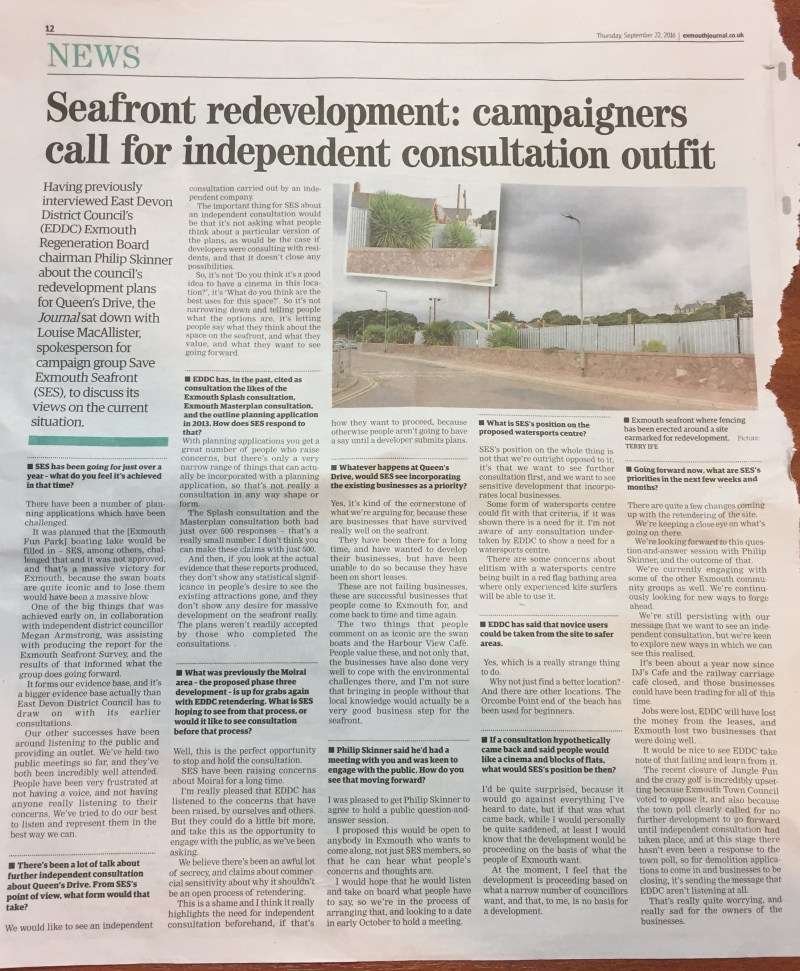
Exmouth seafront regeneration: an alternative view

In this week’s Exmouth Journal an interview with Dr Louise McAllister, spokesperson for Save our Seafront:

img_1304

EDDC parking meter overpayments

According to the response below “What is this excess revenue spent on? – This income is not separated from the total income received from car parking, which is used to fund the service itself and helps to fund a range of services provided by the Council.”

Er, what range of services? Income from parking is meant to be spent only on parking related projects and creaming-off the overpayments for “other services provided by the council” is very questionable to say the least and possibly illegal, though Owl will bow to the expertise of EDDC’s legal eagles on that point – and fortunately we do gave an expert councillor too – Chairman Hughes.

Let’s hope they follow correct procedure for using surplus funds, which is:

Safer Parking:
In deciding how to spend their parking surplus, local authorities should have regard for the advice given in the Local Government Association’s Circular 535/00. This circular urges authorities to work towards Safer Parking Accreditation (Park Mark®), and to consider using parking surpluses to fund the necessary measures.

The circular refers to section 17 of the Crime and Disorder Act 1998 and argues that this Act together with the provisions of section 55 of the 1984 Act makes it both necessary and desirable for authorities to prioritise spending on crime prevention measures in car parks before consideration is given to spending parking surpluses in other areas.”

Click to access PPN1%20-%20Charging%20for%20Parking%20-%20Aug%202011.pdf

Here is the Freedom of Information request:

“Date submitted: 15 September 2016

Summary of request

• Over the past five financial years how much money has the council made through parking-overpayments from its meters i.e. “over-vend” in parking meters that do not give out change?
• What is this excess revenue spent on?
• How many of these parking meters do the council manage?
• Over the past five financial years how much money has the council made in total through car parking meters?
Summary of response

• Over the past five financial years how much money has the council made through parking-overpayments from its meters i.e. “over-vend” in parking meters that do not give out change? – There were no overpayments in the financial years up to and including 2013/14 as our machines were programmed then to give the appropriate time for the money inserted into ticket machines. Because we wanted to add more choice to the customer, from the 1st April 2014 we introduced 2, 3 and 4 day permits. This meant that the memory available in the current ticket machines did not allow for the previous increments and so we introduced 50p increments without the option to give change.

2014/15 – £16,946 Gross inc VAT ( NET £14,122); 2015/16 – £15,066 Gross inc VAT (NET £12,555)

• What is this excess revenue spent on? – This income is not separated from the total income received from car parking, which is used to fund the service itself and helps to fund a range of services provided by the Council.

• How many of these parking meters do the council manage? – Currently we have 61 ticket machines.

• Over the past five financial years how much money has the council made in total through car parking meters? – The figures below are the NET income (which is how we report in the accounts/budgets etc) for the respective years just for the ticket machine income and Parkmobile charges.

2011/12 – £2,401,376
2012/13 – £2,244,874
2013/14 – £2,346,703
2014/15 – £2,477,864
2015/16 – £2,554,583

Date responded: 23 September 2016

show details
http://eastdevon.gov.uk/access-to-information/freedom-of-information/freedom-of-information-published-requests/

“Inclusive Devolution”

Here are the main points of the RSA publication referred to in the previous post:

A new policy framework to promote inclusive growth

The report proposes a policy framework based on the following elements:

Integrating economic and social policy — we argue for a model which combines economic and social policy to generate inclusive growth. That means integrating people-focused policies on skills, family support and education with economic development strategies linked to investment and industry policy.

Devolution that is social as well as economic — up until now, devolution to cities has mostly related to strategic economic functions. The next phase of devolution needs to have a much stronger social policy focus so that public service reform can support local growth.

More funding to support inclusive growth at local level — the context for devolution so far has been fiscal neutrality and austerity. The establishment of investment funds and the transfer of economic functions has been good for cities, but at the same time their overall revenue budgets have shrunk substantially. The next phase of what we call ‘grown up devolution’ will need to provide more funding for social and capital projects.

Prioritising prevention and early intervention — it is widely accepted that we spend too much on picking up the pieces of social and economic failure. Now is the time to begin the process of shifting the balance of spending towards prevention and early intervention, so that public services can support inclusive growth, rather than respond to the lack of it.

View at Medium.com

Devolution “myths” not myths at all, says Devon County Councillor

From the Facebook page of Lib Dem Councillor for Totnes, Robert Vint:

“On Monday Devon County Councillors were presented with a “Myth Busting” training session on Devolution. On Thursday there was a repeat session for South Hams District Councillors.

The “Myths” they were attempting to “bust” were that the Devolution process was led by the LEP, was undemocratic, would result in local government reorganisation / centralisation etc.

The explanations – or non-explanations – only strengthened my concerns. It was confirmed that there would be no public consultation on the economic development plan but only on the Combined Authority proposal and that the LEP had played a central role.

I asked why the plan did not start by identifying local needs such as rural unemployment and affordable housing then consult communities and small businesses on how to tackle these problems. They said not to worry as this was an outline economic plan – but later they confirmed that there would be no consultation on the economic plan or any opportunity to change it.

We have a Devolution Prospectus written by the few big businesses in the LEP to serve their own needs rather than those of the wider community of Devon and Somerset. This has then been rubberstamped by local authorities who did not have the staff, time or vision to rewrite it to meet our real needs and who failed to consult residents and small and family businesses. As a result we will be subjected, without any opportunity to comment, to a local economic development strategy that will serve the wealthy rather than the majority and that will fail to provide jobs where they’re needed or houses to the people who need them most.

In contrast the RSA – Royal Society of Arts – outlines how we should be delivering genuine, fair and inclusive devolution (see below).

The UK’s economic status-quo has resulted in huge sections of our population being ‘left behind’. So the RSA are proposing a radical programme of devolution, inclusive industrial strategies and investment in human capital to create a more inclusive, equal society.

https://www.thersa.org/discover/publications-and-articles/rsa-blogs/2016/09/inclusive-growth-proposals

Review of how regeneration boards operate

Residents will be pleased to hear that the Overview Committee at EDDC is considering a review how regeneration boards operate.

They will probably not be pleased to hear that no date has been set for the review.

Click to access 270916-overview-agenda-combined.pdf

(page 26)

Poor quality of new housing in Axminster

The EDDC Overview Committee deliberated about the poor quality of new private housing being built in East Devon, particularly in Axminster:

“A number of concerns and issues were noted by the Think Tank including common problems such as the quality of finish of plaster and cracking, the fitting of kitchens and bathrooms and other internal cosmetic issues.

More specific issues such as a development in Axminster where the retaining structures supporting split levels between gardens had been made of timber which had subsequently rotted leaving residents with gardens that were subsiding and concerns over who is
responsible for rectifying these fault.”

Click to access 270916-overview-agenda-combined.pdf

They had nothing useful to say about how this could be improved.

“We need to talk about Devon”

Emeritus Martin Shaw joined Sussex as Professor of International Relations and Politics in 1995, and became Research Professor in 2008. He was head of department at Sussex from 1996-99. After graduating from the London School of Economics in Sociology, he held lecturerships in Sociology at Durham and Hull (from which he gained his PhD) and was Professor of Political and International Sociology at Hull. He currently holds a Professorial Fellowship at Roehampton University, London, and is a Visiting Professor at the Institut Barcelona d’Estudis Internacional.

Professor Shaw is currently a town councillor in Seaton, Devon.

“The Conservative hold on power in Britain is stronger than might be implied by its slim 17-seat majority in the 650-seat House of Commons. Labour, the only other party with a hope of forming an electoral majority, would need to gain around 100 seats even before the impact of the newly announced boundary changes is taken into account. Alternatively, it could settle for a coalition, and forge an agreement with the Scottish National Party; but this looks no more possible now than in 2015. As the Labour leadership contest draws to a close, the party’s road to power, whoever wins, is extremely difficult to forsee.

The Tory elective dictatorship rests on an almost complete dominance in southern England (outside large cities and university towns), which was also the principal area of support for Brexit. In the 2015 general election, the Tories’ targeted wipeout of the Liberal Democrats across the South West delivered their unexpected majority. South and west of Bristol there is only one non-Tory MP (Labour’s Ben Bradshaw in Exeter). Even more than in the much-discussed case of Scotland under the SNP, the South West has become a virtual one-party state.

Some outside the region have speculated that a Liberal Democrat recovery might help enable a ‘progressive alliance’ to form as an alternative to Theresa May’s Tories. However, a recovery to pre-2015 levels would not only be insufficient to offset Labour’s deficits in Scotland as elsewhere, it also ignores the extent to which the Tories have concentrated power to make it difficult for any opposition party to change the regional balance.The situation in the region’s largest county, Devon, shows the depth of the problem. But at the same time, it is where local activists are devising new ways of doing politics that are challenging Tory control.

A microcosm of Tory power
The Tory monopoly in Devon is even more complete than in neighbouring Cornwall and Somerset. Conservatives have overwhelming control of local government (both unitary authorities, the County Council and almost all the districts). In the urban areas, the general election results were close, and opposition parties remain in contention. Labour has strong representation in Plymouth, as well as Exeter where they recently consolidated their control of the City Council, and the Lib Dems enjoy considerable support in Torbay. But in the rural areas and small towns, the majority of the county, Tory dominance is almost absolute at every level – barring some town and parish councils where politics is less partisan.

Some rural areas have never had a non-Tory MP. The Tories had six of the seven non-urban Devon seats even in 2010. At least one council, East Devon, has been Tory since it was created in 1973. In semi-rural Devon, even an unlikely Lib Dem revival would make little difference. How then can things ever change?

Minority rule
It is important to understand that Conservative rule is based neither on majority support or extensive party membership. In 2015, the party gained under 45 per cent of all votes. Even in the seven non-urban seats, the 2015 increase in Tory support brought them only up to a 49 per cent average; in the urban seats they squeaked in on the same 37 per cent that gave them their national majority. Yet the non-Conservative majority are virtually unrepresented.

The Tory party is hollowed out and probably has far fewer members than Labour. The party could only take Torbay and North Devon from the Lib Dems with the aid of the notorious ‘battle bus’ activists, whose costs their Torbay agent, Alison Hernandez – like many others – failed to declare. Even after Channel 4 broke the scandal in 2016, Hernandez was narrowly elected as Devon and Cornwall Police and Crime Commissioner, but refused to stand aside as she was investigated (the case was transferred to another force and is still pending).

As ever where one-party rule is so entrenched, corruption is not far away. Revelations like those in 2013, when East Devon Tory councillor Graham Brown was forced to resign after telling a journalist he could obtain planning permission in return for cash, fuel widespread cynicism about local power which make the ruling party vulnerable.The flexibility of local Tory MPs over Brexit is likely to create a new constituency for opposition; ‘pro-Remain’ Neil Parish MP, Chair of the parliamentary Environment committee, quickly backed Boris Johnson and Andrea Leadsom in quick succession for the leadership and now describes Brexit as a ‘glorious opportunity’.

Failure of the opposition parties
That non-Tory votes largely fail to make an impact is partly the repsonsibility of previous Labour and Lib Dem politicians. They have repeatedly failed to reform the electoral system, both at the national and local level. Tony Blair’s government never held the referendum on Proportional Representation to which its 1997 manifesto committed it. Current Labour leader, Jeremy Corbyn, has never campaigned for PR during his 33 years in Parliament, and together with his rival Owen Smith continues to fudge the issue in recent responses to the Electoral Reform Society.

Nick Clegg abandoned the Lib Dems’ longstanding committment to proportional representation to obtain office in 2010, settling for the promise of a referendum on the weaker ‘alternative vote’ system without even securing government support for change. In the South West, the Lib Dems’ collective political suicide through the Coalition has broken the residual credibility of the first-past-the-post system.

Failing services
Because Tory dominance is so extensive, the party has largely taken voters for granted. Devon is suffering sharply from the general underfunding, balkanisation and creeping part-privatisation of public services. The NHS trust running the flagship Royal Devon and Exeter Hospital has been forced from a healthy surplus into deep deficit. The NEW Devon Clinical Commissioning Group, also in chronic deficit, tried to bar some patients from routine operations until obliged by public pressure to abandon its plans. Local Community Hospitals have lost beds and have been handed over to NHS Property Services, which can put up rents or, worse, sell off the sites.

Devon is a region of heavy immigration, mainly of retirees from other English regions (although with some international migrants, concentrated in its cities). As in the NHS, the gap between funding and need threatens adult social care. Child protection services are deemed inadequate. Since Tory Devon retains grammar schools, there are concerns about the effects of Theresa May’s proposed expansion of these schools on the excluded majority of children.

Phoney devolution
The unaccountability of Devon Tories is also evident in how they have embraced the half-baked, patchwork ‘devolution’ launched by George Osborne, which offers limited ‘additional’ money – while core government funding for local services is pared down or eliminated. Although Devon is a much larger and more populous county than neighbouring Cornwall which has a sole devolution deal, Devon is being forced into a merger with Somerset in a new brand, an affront to local identities, ‘Heart of the South West’.

The principal rationale for the linkage seems to be to create a larger base for the anachronistic and hyper-expensive Hinckley C nuclear project. Any benefits, if they materialise, will be overwhelmingly for the neighbouring county. The proposed devolution, with a hyper-aspirational prospectus which bears comparison to Vote Leave’s notorious offer, is being run through the Local Economic Partnership, dominated by unelected business leaders.

The county election challenge
Devon County Council comes up for reelection in May 2017. In 2013, the Tories won 38 of the 62 seats on a mere 35 per cent of the vote. Under first past the post, the divided Lib Dems, Labour, Greens and Independents between them won only 20 seats for 41 per cent of the vote. (UKIP, which polled 23 per cent, won 4 seats.) It is obvious that none of the three centre and left opposition parties can win a majority in 2017. The Lib Dems may keep some strongholds, but they are still picking themselves up from their 2015 battering, and elsewhere local activists are thin on the ground.

Despite a deep conflict between Bradshaw and pro-Corbyn Momentum activists, Labour will probably keep its Exeter seats, but is unlikely to win in the rural areas and small towns. Rural Labour parties have seen the Corbyn surge in membership but with modest benefits for local activism: a constituency party which has trebled its membership to 500 may still only get about 15 people to its meetings. Members vote for their preferred leader, but have too little scope to change things locally. Even if it advances, Labour is starting from a very low base, and the Greens are smaller.

New politics?
The 2015 elections saw important steps forward for a different kind of politics in semi-rural East Devon. From a standing start, Independent candidate Claire Wright leapfrogged UKIP, Labour and the Lib Dems to take second place in the East Devon parliamentary constituency of Hugo Swire, a ‘Cameron croney’ since knighted in his resignation honours. It was the only Independent second place anywhere in England, after a grassroots campaign typically ignored by the national press.

In parallel, the East Devon Alliance, formed in 2013 out of revulsion at the Brown case and East Devon’s pro-developer bias, put up over 30 district council candidates and succeeded, despite the simultaneous Tory general election victory, in taking ten seats from the Tories (this writer was an unsuccessful candidate). Independents led by EDA replaced the Lib Dems as the official opposition.

An investigative blog, East Devon Watch, has played an important informational role in the new politics, now matched by a South Devon Watch site. An Independent group successfully challenged for control of Buckfastleigh Town Council, in the Teinbridge district, at the same time as the better-known ‘flatpack democracy’ of Frome in Somerset. A loose Independent network is emerging across the South West, including Cornwall.

Although social media played an important part in these campaigns, many relied heavily on old-fashioned doorstep campaigning. A new campaign to influence the County Council elections, Devon United, is perhaps the first – certainly the most ambitious – initiative to be actually launched through social media. Its first meeting in October will be addressed by Paul Hilder, co-founder of OpenDemocracy.net and CrowdPac and former global campaigns director for Avaaz and Change.org.

I have written recently about the limitations of the national progressive crowdsourcing campaign organisation, 38 Degrees, during and after the Brexit vote. It remains to be seen what happens when crowdsourced politics meets local electioneering, and how the division of the anti-Tory vote will be overcome. But this initiative shows that the new politics is alive and kicking in a county where the old politics has so manifestly failed.”

https://www.opendemocracy.net/uk/martin-shaw/we-need-to-talk-about-devon

Councillor Claire Wright’s objection to Sidford Business Park

“12 acre industrial site proposed for Sidford – my objection

A planning application for a 12 acre business park in an area of outstanding natural beauty in Sidford has caused huge controversy.

The proposal first emerged when I was a local plan panel member in 2012. It suddenly appeared in the papers for our final meeting in the March. The proposal caused such uproar that it spawned the birth of Save Our Sidmouth, which ploughed much funding into fighting the allocation of this land in EDDC’s Local Plan.

Things looked up for a while after a full council meeting last year saw Stuart Hughes and Graham Troman manage to overturn the decision to allocate this land.

However, the planning inspector had other ideas and late last year, reinserted the contested piece of land back into the Local Plan.A planning application was submitted by Fords earlier this year.

Last Monday evening (12 September) I attended a public meeting at Sidford Village Hall where the application was discussed. The hall was absolutely packed with angry residents who wanted the plans thrown out. There was talk of a boycott of Fords to express the deep unhappiness with a local business who wants to build an industrial estate in sensitive countryside adjacent to houses. The meeting concluded that residents would fight the application tooth and nail.

I am familiar with the proposal as a former Local Plan panel member, however, it was a very useful meeting where I heard first hand from residents exactly how the application might have an impact on their communities.

I have now submitted an objection, which is below.

Highways The road through Sidbury is narrow, congested with parked cars and already experiences very high levels of traffic.

As Sidbury’s Devon County Councillor I have tried to address many complaints about the road, its narrowness, twistiness and the increasing level of traffic and heavy goods vehicles travelling through to the A30 at Honiton. Sidbury Primary School has a very difficult parking situation, with many parents having to park on the opposite side of the road and dash across with their children.

There are inadequate pavements around the school and any increase in traffic and HGVs could make things even more hazardous for parents and young children travelling to and from school. A school governor at the public meeting at Sidford Village Hall on 12 September, expressed huge concern about the increase in traffic and the impact it will have on parents and children at school pick up and drop off times.

I question the assumption in the developer’s highways report that only 20 per cent of traffic generated by the business park would travel through Sidbury, with the remaining 80 per cent opting to go via Sidford crossroads. I would have thought it was far more likely that a bigger percentage of the traffic would choose to travel to the nearest fast road – in this instance the A30 – via Sidbury. Much quicker than travelling to Exeter along the A3052.

I believe that the developers are vastly underestimating the impact of the traffic on Sidbury. There are many old listed properties which line the roads in Sidbury, which could be damaged by the increase in HGVs along this road. The NPPF states that a highways objection can be sustained if the traffic impact is severe. I agree with many Sidbury residents and local councillors, who believe that it would be. The application should be refused on highways grounds alone.

Landscape impacts

I agree with the AONB team and Natural England both of which assert that the proposed development would have a significant adverse affect on the setting of the AONB. The team also states that the current building plans, despite being in outline do not comply with NPPF policies relating to development in AONBs. It has the potential to set a precedent and so must be planned extremely carefully, which it is not. The landscape architect also believes that the scheme would have significant adverse impacts on the surrounding sensitive countryside, with information on design missing from the application. The landscape architect concludes that the application is unacceptable on landscape grounds.

Natural England recommends “substantial revision” on the grounds of visual intrusion. I believe that the application should be refused on landscape grounds and poor design within an AONB.

The cycleway from Sidbury to Sidford

As the Devon County councillor for Sidbury this cycleway is a significant project that I am anxious to finalise. Progress has been slow mainly due to matters outside Devon County Council’s control. I note the AONB team’s comments relating to the proposed cycleway as being disjointed, fully exposed to the road with the rural character of the route being removed.

The AONB team observe: “If approved, it would be completely at odds with the principle of providing an integrated and well connected and accessible development not to include a fully linked route at the outset of the development. Without this, at present, the proposal will not fully “deliver cycle and footway improvements which should aid sustainable travel in the area, not just the business park”; furthermore it could not be regarded as a “highly permeable and appealing walking and cycling environment”.

The application should be refused on the grounds of not providing an acceptable cycle route.

Flooding

The Environment Agency advises that new more stringent guidelines as set out in climate change documentation should be used as a material planning consideration for this application.

Given that the fields are close to a major watercourse and the area is prone to regular flooding, I very much hope that EDDC will use these guidelines to assess the application. Devon County Council flood and coastal risk officer has also recommended refusal on the grounds of insufficient information relating to water run-off. The application should be refused on these grounds.

It is clear that the evidential comments from residents and key consultees can only leave EDDC with no option but to refuse the application. Pic. The area of outstanding natural beauty close to where the proposal is targeting.”

http://www.claire-wright.org/index.php/post/12_acre_industrial_site_proposed_for_sidford_my_objection

“East Devon continues to be one of most active districts in UK with 40 Neighbourhood Plans in production”

EDDC produced the above press release headline as spin:

http://eastdevon.gov.uk/news/2016/09/east-budleigh-with-bicton-neighbourhood-plan-undergoing-consultation/

Unfortunately, the truth is more likely that EDDC is so keen on its developers and developing anything and everything, that neighbourhoods are scrambling as fast as they can to protect what few green and pleasant places they still have left after the Local Plan hoovered most of them up, before developers get their sticky mitts on them!