“Have your say on the Jurassic Coast’s future” [suggestion: new National Park]

Now Mr Diviani is no longer leader of EDDC perhaps the idea of a Jurassic National Park can be resuscitated – he and his council were against this as they didn’t want to lose their control over planning (over-developing) the site:

https://eastdevonwatch.org/2018/10/09/new-national-park-for-east-devon-not-while-people-like-diviani-are-councillors/

And surely we are not in the situation of caring what our CEO then and now thinks?

“The public is being asked to help draw up a new blueprint for the future management of the Jurassic Coast.

https://jurassiccoast.org/what-is-the-jurassic-coast/world-heritage/looking-after-the-jurassic-coast/partnership-plan-consultation/

The survey is here:

https://www.surveymonkey.co.uk/r/QLGGNSD

The trust which manages the site, stretching from Exmouth, in East Devon, to Studland, in Dorset, is creating a new partnership plan document in collaboration with a wide variety of stakeholders.

It will be published towards the end of this year and will guide management of the World Heritage Site over the next five years.

The plan will take in conservation and preservation of the site, how the site impacts on the local economy and how it can play an active role in the lives of local communities.

As part of the creation of the new partnership plan, a consultation process is being untaken from now until the end of September.

A spokesman for the Jurassic Coast Trust said: “The new partnership plan is an important document, representing a tangible expression of the partnership that looks after the Jurassic Coast.

“It explains the reasons for the Jurassic Coast’s World Heritage designation, and how it is protected and managed.

“It also outlines the aims, policies, actions and aspirations for managing the site over the coming years.”

The partnership plan is a formal requirement and will replace the current site management plan, which, along with a copy of the new draft plan, can be seen by clicking on the Trust’s website here Alternatively a copy can be requested by telephoning the Trust’s office on 01308 807000.

People going online can contribute their views directly or they can download a printed version of the survey to fill in later.

The completed surveys should be sent directly to the

Jurassic Coast Trust,
email at:
info@jurassiccoast.org

or by post to:

Partnership Plan Consultation,
Jurassic Coast Trust,
Mountfield,
Bridport,
Dorset DT6 3JP

The Jurassic Coast Trust will also be running drop-in consultation sessions across the World Heritage Site area in September. Dates and venues will be announced towards the end of this month.

The deadline for responses to the survey is Friday, October 4. All comments received as part of the consultation will be collated. A report will be produced by the Jurassic Coast Partnership detailing the responses and indicating how the plan will be subsequently amended.

The report will be made available online and to anyone who has asked to be sent updates on the progress of the plan.

Once an amended version of the plan is agreed by the Jurassic Coast Partnership and approved by Historic England, it will be adopted by Dorset Council and Devon County Council before being formally submitted to DCMS and UNESCO.”

https://www.midweekherald.co.uk/news/consultation-on-management-of-the-jurassic-coast-1-6203990

Clinton Devon Estates: “‘Deceit and lies’ – Councillors speak out Newton Poppleford GP campaign looks to be over”

Wonder if EDDC’s CEO had any private advice for CDE?

This has gone into the most spectacular orbit of deceit and betrayal in the planning system.”

Those are the words of one councillor as the district authority agreed at a meeting on Tuesday (August 6) not to fight a developer’s appeal over a Newton Poppleford site.

Clinton Devon Estates (CDE) lodged an appeal after East Devon District Council (EDDC) delayed a decision on an application to build two homes on land originally earmarked for a GP surgery.

A wider plan for a 40-home development at King Alfred Way, including a doctors’ surgery, was approved in 2013. CDE was unable to find a tenant, so instead applied to build two more homes.

At that stage the parish council expressed an interest in running the surgery.

EDDC twice delayed a decision – the second to allow the parish council to meet with the developer to find a solution.

The developer lodged an appeal with the planning inspector, who will now also decide whether the council should pay costs.

Planning officers recommended the authority should not fight the appeal arguing the surgery was not ‘legally justifiable’. Councillors voted by seven votes to five not to fight it.

Councillor Mike Howe, chairman of the development management committee, told the meeting CDE had acted ‘atrociously’ and could not be considered an ‘ethical or nice developer’.

Cllr Olly Davey said, unless ‘legally enforceable’, ‘any promise that a developer makes is not worth the paper it is written on’.

Councillor Paul Arnott put forward a motion to reject the application, on the grounds the developer had failed in its ‘commitment’ to deliver the surgery – but it was thrown out by seven votes to four.

Councillor Paul Arnott said the application was the most ‘spectacular orbit of deceit and betrayal’ and the council should mount a challenge despite the costs. He said: “It’s so mired in lies and deceit going back years, betrayal, treachery, accusations of wording.

“We cannot afford, as a rule, to be spending council taxpayers’ money on appeals we may not win, but on this occasion we have to. It is a notorious case and we have to draw a line.”

Cllr Eileen Wragg said the committee needed a ‘damn good reason’ not to agree with the officers’ report.

Council officer Henry Gordon-Lennox, strategic lead, said nothing in planning law could stop the developer applying for a different use of them land, despite the original plan for a surgery.

He said: “I do absolutely understand the frustration and the annoyance and the disappointment, but from our point of view as officers there is nothing to defend precluding them from doing this, unpalatable as that may be.”

CDE was represented at the meeting Amy Roberts, who said there has never been a planning justification for the surgery, within the original plan. She said CDE did not want to appeal, but that the developer’s ‘hands were somewhat forced’ by the non-determination, despite planners’ recommendations.”

https://www.sidmouthherald.co.uk/news/clinton-devon-estates-slammed-for-newton-poppleford-homes-plan-1-6203178

EDDC “Independent” Leader firmly nails his colours (blue?) to his CEOs mast


Owl sees no “misunderstanding”.

Another “TiggerTory” policy?

And what does Mr Marchant, the person accused of being “misunderstood” – and Ford’s QC who perpetuated the “misunderstanding” several times at the public inquiry – think about this?

And where’s Councillor Hughes’s explanation for not sharing information about the meeting with other councillors, particularly those on the Development Management Committee – or did he share it with only a select few of his colleagues?

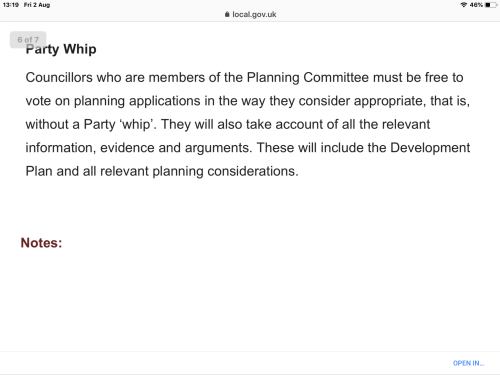
Remember, the Development Management Committee is a STATUTORY committee with rules and regulations … and it must NOT be subjected to party whipping or interference, nor must they “avoid undue contact with interested parties”.

Click to access planning-committee-manage-1cd.pdf

Officers advise councillors not to fight Clinton Devon Estates over withdrawal of Newton Poppleford doctors’ surgery in planning application

EDDC fight CDE – not on your life say officers …unless, of course, councillors instruct them to do so …

https://www.sidmouthherald.co.uk/news/newton-poppleford-home-appeal-meeting-1-6194658

“‘Questions hang in the air’ over council HQ relocation project”


Owl says: Leader Ingham seems to be thoroughly persuaded that the previous Tory majority council is whiter than white on the relocation project. Many disagree and had hoped that his new broom might be doing some sweeping – but not under the carpet as seems to be happening.

“A full report will be provided that will analyse in detail East Devon District Council’s relocation from Sidmouth to Honiton as ‘questions hang in the air’ over the project.

East Devon District Council’s moved into their new headquarters at Blackdown House in Honiton on February 11.

The new HQ, which replaced the council’s existing HQ at The Knowle in Sidmouth, cost the council £8.7m, while an additional £1.5m was spent on upgrading Exmouth town hall where one third of the council staff are to be based.

The controversial decision to relocate offices was taken back in March 2015 as it was decided the council needed to relocate into buildings that are affordable, cost efficient, and would significantly reduce the overheads of the council.

But the relocation project has faced criticism over the lack of transparency throughout the project, the procurement process, and the amount of cash the council received for the sale.

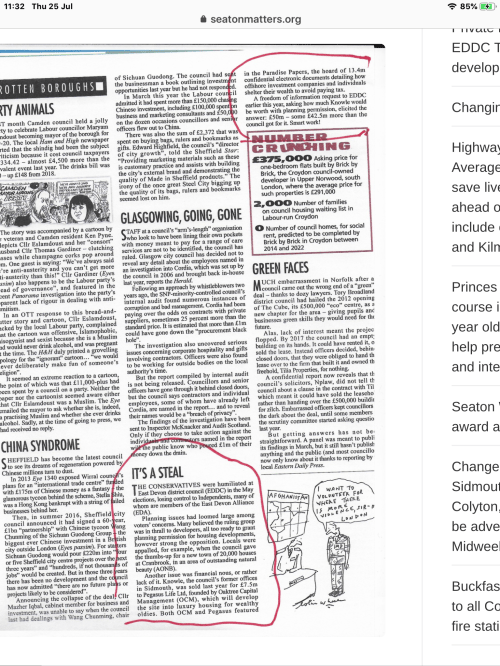
A freedom of information request asking how much the Knowle would be worth with planning permission said the answer was £50m, £42.5m higher than the council agreed to sell the land to Pegasus Life for, the latest edition of Private Eye states, naming the council as a ‘rotten borough’ because of it.

At Wednesday night’s full council meeting, Cllr Paul Arnott, leader of the East Devon Alliance, said that ‘questions hang in the air’ over the project.

He asked: “Both the disposal of the Knowle HQ and the procurement of the new Honiton HQ are matters of great concern to thousands of people in East Devon. Questions will hang in the air until they are fully addressed.

“Will the leader of the council support the immediate creation of a councillor-led working party, politically balanced, of up to 10 members, all of them newly elected in 2019, reporting to the scrutiny committee, to look into these matters in the public interest?”

In response, Cllr Ben Ingham, the council leader, said: “Relocation has been a key element of the council’s transformation agenda in terms of delivering against priorities of reducing council operational costs and introducing modern ways of working.

“Throughout its lifetime the relocation project has been subject to regular reporting to cabinet and council, dedicated project management, senior member and officer oversight through the Office Accommodation Executive Group, regular risk review and the scrutiny of South West Audit Partnership.

“Prior to the decision to move to Exmouth and Honiton and dispose of the Knowle site an independent audit was carried out to inform the decision to relocate and to test the financial projections for the project. These findings were included as part of the report to cabinet in March 2015 seeking approval of the move.

“Both Audit and Governance and Overview and Scrutiny committees met jointly to consider the relocation project programme and gave their endorsement. Cabinet and Council were provided with extensive detail, independent evaluation and wider committee endorsement as part of their approval.

“Relocation has been delivered successfully in terms of the physical moves and performance of the council. Furthermore this complex project has been delivered within budget.

“A project closure report will be provided to council at the one year anniversary of the project which will include a full project cost analysis and detail of operational costs for the first year of operation of Blackdown House and annual running costs of Exmouth Town Hall.

“If Scrutiny were so minded they could ask to consider the officer report or undertake a piece of work themselves and as Leader I would not want to restrict or pre-empt their independence to set their own forward plan. The Scrutiny Committee is politically balanced and already well placed to do this without the imposition of a working party which is constitutionally unsound in terms of its suggested membership.”

Cllr Arnott said that ahead of the May elections, the East Devon Alliance manifesto on their website saw their page on the relocation project have page views that were ‘streets ahead’ of anything else.”

He asked: “Can I be assured that if anyone on scrutiny wanted to commission a piece of work on sale off the Knowle and procurement of this, there would be nothing to stop them?”

Cllr Ingham confirmed if a member of scrutiny wanted to request that, then they could do so.

He added: “At the moment the project is coming in favourably to the target budget. The idea of waiting a year before the report was to establish more accurately exactly the savings that the council is making in the new building.”

https://www.devonlive.com/news/devon-news/questions-hang-air-over-council-3148843

Greater Exeter Strategic Plan – latest housing needs figures shows East Devon bearing greatest load

As at June 2019, ast Devon to bear the brunt of new housing:

Page 10:

Click to access Local-Housing-Need-Assessment-for-the-Greater-Exeter-Area-1st-Edition-June-2019-web.pdf

EDDC CEO tries to slither out of responsibility (NOT successfully!) for his planning advice to developer in private meeting

Owl has SO many questions!

First, Mr Williams’ ‘explanation’ defies belief, he basically accuses the developer of lying about the meeting. Then, he issues his denial of the circumstances of the event to the press, rather than to the councillor who asked him for an explanation. THEN, there appears to have been a totally undocumented meeting between him, Stuart Hughes and the developer – something that is extremely worrying – how many other such meetings with developers and hand-picked councillors have occurred? How do they happen?

But judge for yourself from the full text of the DevonLive article.

Owl thinks the very least EDDC majority councillors should do is suspend him until this is satisfactorily sorted.

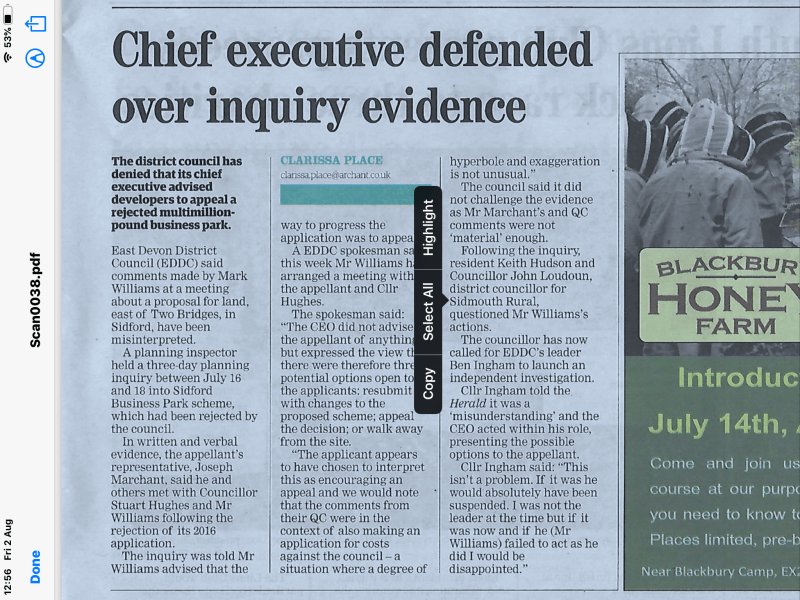
“Calls have been made for an independent investigation after East Devon District Council’s chief executive allegedly told developers to appeal his own council’s refusal of planning permission for the Sidford Business Park.

East Devon District Council in 2018, on the grounds of harm to highway safety, relating to increased heavy goods vehicle usage of the area’s narrow roads, refused the plans for land, currently used for agriculture, the east of Two Bridges Road in Sidford.

A larger scheme submitted by the applicants was rejected previously by the council in 2016.

Applicants Tim and Mike Ford challenged the 2018 refusal of the council and three days of arguments for and against the development took place in July.

At the planning inquiry though, Richard Kimblin QC, on behalf of the applicants OG Holdings Retirement Benefit Scheme, and Joseph Marchant, their planning agent, said that following the refusal of the 2016 scheme, Mark Williams, the council’s chief executive, advised them they should appeal.

The claims, made both in writing and verbally, were unchallenged by East Devon District Council during the inquiry.

Paragraphs 13 and 14 of the Mr Kimblin QC’s final closing arguments at the Inquiry said: “After the 2016 application was refused, there was a meeting with Councillor Stuart Hughes and the CEO of the Council. The CEO advised that the way to progress was to appeal. That is an extraordinary state of affairs.”

Following a request for comment from the Local Democracy Reporting Service on the remarks allegedly made by Mr Williams, an East Devon District Council spokesman said that the he did not advise the appellant of anything, the applicant chose to interpret the comments he did make as encouraging an appeal, and the comments were made in a ‘situation where a degree of hyperbole and exaggeration is not unusual’.

Cllr John Loudoun, who represents the Sidmouth Rural ward, though has called for an independent inquiry into the meeting and the comments, saying that the while the council says there was a ‘misinterpretation of events’, “misinterpretation is a nice way of calling someone a liar.”

The claim that was made by Mr Marchant was set out in his written evidence to the inquiry, which said: “Subsequent to the refusal of the 2016 application, an approach was made to Members, including Councillor Stuart Hughes and the CEO (Chief Executive) of EDDC, Mark Williams.”

The following paragraph added: “We were advised by Mark Williams….that in his opinion, the applicant (Fords) may make more advance in progress towards delivery through appealing the Council’s decision to refuse the 2016 planning application rather than resubmission.

Paragraphs 13 and 14 of Mr Kimblin’s final closing arguments at the Inquiry added: “After the 2016 application was refused, there was a meeting with Councillor Hughes and the CEO of the Council. The CEO advised that the way to progress was to appeal. That is an extraordinary state of affairs.”

Asked to comment on the claims made at the inquiry, an East Devon District Council spokesman said: “The council officers and legal representative, acting on behalf of the local planning authority, did not consider the comments made by Mr Marchant or the appellant’s QC as material in specifically defending the reason for refusal, which is of course their role in the inquiry.

“The simple point is that the circumstances described have no bearing or relevance to the local planning authority’s decision and nor therefore to the focussing of all of their efforts in seeking to persuade the Inspector that the proposed development was unacceptable.

“As for the meeting itself, as was made clear at the inquiry the CEO was asked by the applicant/appellant to facilitate a meeting between them and Cllr Hughes to ascertain what options there might be available to them in the light of the refusal of planning permission.

“At the meeting, as reflected in Mr Marchant’s proof of evidence, Cllr Hughes expressed his opinion that he could not foresee any circumstances under which planning permission would be acceptable, notwithstanding the Local Plan allocation.

“The CEO did not advise the appellant of anything, but expressed the view that there were therefore three potential options open to the applicants: resubmit with changes to the proposed scheme; appeal the decision; or walk away from the site.

“The applicant appears to have chosen to interpret this as encouraging an appeal and we would note that the comments from their QC were in the context of also making an application for costs against the council – a situation where a degree of hyperbole and exaggeration is not unusual.”

However Cllr Loudoun said that having read the council’s response, he was even more convinced of the need for what he originally asked for, a genuinely independent inquiry in these issues, and he was appalled that the response to his concerns was sent to the press and not him.

He added: “Evidence provided at the Inquiry was fully tested by both the Council and the applicants’ representatives because this is the way in which facts are established or challenged. The statements made verbally and in writing by Mr Marchant for the appellants are, according to the District Council statement, misinterpretations of the events and comments at the meeting involving the Chief Executive.

“This is an extraordinary state of affairs as we now have a challenge to Mr Marchant’s evidence at a point where he cannot defend himself and after the point when the Council allowed the statements to be accepted as fact. It would appear that the Council is now saying that Mr Marchant spoke untruths and that these were untruths were in turn repeated by the applicants’ QC.

“They are essentially accusing them of lying. When it was raised in the inquiry, no-one complained about it and or questioned it. To me, saying it was a misinterpretation is a nice way of calling them a liar.”

He added: “The Council’s statement is disingenuous in that it tries to down play the quotes of what the Chief Executive said as put forward by the applicants’ QC as “hyperbole and exaggeration” whilst pursuing a costs order. This ignores the fact that Mr Marchant made the claims whilst giving evidence and that the appellants’ QC repeated them not only in his arguments for costs but also, and more importantly, in his broader closing submissions in support of the applicants’ case.

“It was not a throwaway comment as it was in the both written and verbal statements and made by two people.

“I am even more concerned having read the Council’s public response to these matters and I am now even more convinced of the need for what I originally asked for, a genuinely independent inquiry in these issues.

“If he did say that they should appeal then he has it then he was undermined the officers, the council and his role on a very serious issues, and if not, then why wasn’t it challenged at the inquiry?

“I am bemused at the response from the council to this matter which seems to be now turning into as much a focal point as the planning application and subsequent Inquiry.”

A decision on whether to allow the appeal to allow the plans for 8,445sqm of employment space built on the outskirts of the village is set to be made by the Autumn. If the appeal was allowed, then a further planning application would need to be submitted for the details of the scheme.”

https://www.devonlive.com/news/devon-news/independent-inquiry-calls-after-claims-3158474

Greater Exeter Strategic Plan delayed

“A document that was set to reveal the possible locations for more than 57,000 new homes across four districts has been delayed.

The paper, which details sites put forward for developments of 500 homes or more in East Devon, Mid Devon, Teignbridge and Exeter (Greater Exeter) was due to be published in June.

More than 700 parcels of land were proposed by agents, developers and landowners during the ‘call for sites’ for the Greater Exeter Strategic Plan (GESP). Details of these options were due to be published in June.

However following the elections, a review of the timetable is ‘likely’ be needed, according to the GESP website.

Four councils are involved in the development of the plan – Exeter City Council, East Devon District Council, Mid Devon District Council and Teignbridge District Council.

But, in May’s elections the Conservative leadership at three of the district councils lost control.

The Local Housing Need Assessment for the Greater Exeter Area, published in November 2018, quotes an annual housing need figure in East Devon of 844. It states that the GESP authorities must plan to deliver at least 2,593 homes per annum between them up to 2040.

The assessment of larger strategic sites is being undertaken and the results will be published in a housing and economic land availability assessment (HELAA) alongside the draft Greater Exeter Strategic Plan.

The assessment of smaller sites will be undertaken by the four individual councils (as relevant). And, the results in HELAA will support the respective local plans.

The timetable is:

The Greater Exeter Strategic Plan timetable:

– Issues Consultation – February 2017 (completed).

– Draft policies and site options – June 2019 (Now under review).

– Draft Plan Consultation – November 2019 (Now under review).

– Publication (Proposed Submission) – February 2021.

– Submission – July 2021.

– Hearings – September 2021.

– Adoption – April 2022.

If approved, then the GESP would supersede and sit above the existing local plans, but they would not be scrapped.”

https://www.midweekherald.co.uk/news/greater-exeter-strategic-plan-document-is-delayed-1-6190128

Possible new East Devon “villages” (mostly extensions to current ones) are detailed here:

https://www.midweekherald.co.uk/news/possible-locations-for-new-devon-villages-set-to-be-released-1-6061225

EDDC, Tiggers, EDA and global heating crisis – names to be named

East Devon aims to be carbon neutral by 2040 following motion from 20-year-old (Lib Dem) councillor:

https://www.devonlive.com/news/devon-news/east-devon-aims-carbon-neutral-3138282?

Straightforward? Er, no – several councillors (Tory and Independent Group) refused to back this because they said it was too ambitious.

Councillors voted by 30 votes to 23 to agree to adopt a 2040 target for the council to be carbon neutral by.

East Devon Alliance were councillors happy to back the young Lib Dem who brought the motion to council. So who didn’t?

As explained by EDA Councillor Paul Arnott in his unique style:

Anyone hearing Devon flannel merchant and Tory grotesque Geoffrey Cox talking through his fundament on Any Questions with unreassuring ease about climate change may see why I had to back this. Superb speeches from 3 20 year old East Devonians at our full council last week and a motion from Luke, the splendid 19 year old Liberal, said it all.

Needless to say, all Tories, and Cabinet loyalists voted against. I called for a recorded vote. When the names of those who voted for are published with the minutes, that, in my opinion, is the group likely to deliver real change as demanded by the electorate in May.”

Some councillors showing a lot more independence and a lot less Group …

EDDC Tories appear in Private Eye’s “Rotten Boroughs” column

From the blog of DCC EDA Independent Councillor Martin Shaw:

Private Eye goes to town on EDDC Tories’ handout to developers of the Knowle

Oh dear – and now “The Independent Group” led by EDDC Leader Ben Ingham has chosen to cosy up to Tories, rather than East Devon Alliance independents, whom he has frozen out.

With current Councillor Ingham having the been a member of all 3 groups and Leader of 2 of them (former Tory, former Leader of East Devon Alliance and current leader of ‘The Independent Group’) he really has to decide which side of the fence and his cohort are on!

Or maybe he has already decided – given that he appointed a Tory as Chairman of the Development Management Committee, who then used his casting vote to push through a controversial planning applucation in Axminster, opposed by Axminster EDA councillors on safety and pollution grounds:

https://eastdevonwatch.org/2019/07/19/eddc-tory-dmc-chairman-uses-his-casting-vote-in-controversial-planning-application/

Reality check needed for some of his colleagues, perhaps?

New unitary authorities … the criteria restated for counties AND districts

The Communities Secretary, James Brokenshire, has set out the circumstances in which he would be prepared to issue a formal invitation to councils under the Local Government and Public Involvement in Health Act 2007 to submit proposals for the establishment of new unitary councils.

In what could be one of his last acts as Secretary of State, with the prospect of Boris Johnson becoming Prime Minister and choosing a Cabinet, Brokenshire said in a written ministerial statement yesterday that he would also set out how he intended to assess any unitary proposals councils make in response; and the Government’s continued approach to any proposals two or more district councils may make to merge in order to form a new larger district council.

The Secretary of State said: “Locally-led changes to the structure of local government, whether in the form of unitarisation or district mergers, can – with local support – be an appropriate means of ensuring more sustainable local government and local service delivery, enhanced local accountability, and empowered local communities. This statement …. continues the Government’s commitment to supporting those councils that wish to combine, to serve their communities better and will consider unitarisation and mergers between councils when locally requested.

“However, I recognise that unitarisation may not be appropriate everywhere. I also recognise that it is essential that any local government restructuring should be on the basis of locally led proposals and should not involve top-down Whitehall solutions being imposed on areas. The Government does not support top-down unitary restructuring. This has been the Government’s consistent approach since 2010.”

The Secretary of State said he also wanted to provide further clarity for those councils who might consider the possibility of restructuring, by setting out the factors councils should consider and the processes to be followed – including with regard to local support.

For councils wishing to restructure to form unitary local government, the first step of the statutory process as set out under the 2007 Act is for the minister to issue an invitation to councils to submit proposals.

Brokenshire said there were two circumstances in which he would consider issuing such an invitation.

The first circumstance, he said, is where the following two conditions are met:

There is a local request for an invitation.

That he considers that the request “demonstrates local opinion is coalescing around a single option which is reasonably likely to meet the existing publicly announced criteria for unitarization”.

The Secretary of State said, in forming his view, he would carefully consider the request, including the groups making and supporting it and their reasons for so doing. “Where I issue an invitation, I would do so to all those councils that I consider to have regard to the area concerned, whether or not they were among those who had made the original request.”

The minister said the second circumstance was where he considered that doing so would be appropriate given the specific circumstances of the area, including in relation to the long-term sustainability of local services. This was the situation in which his predecessor, Sajid Javid, issued an invitation to the councils in Northamptonshire, he said.

“Following such an invitation, it would be for the councils concerned to decide whether to develop and submit proposals for unitarisation, either individually or jointly by two or more councils.”

In the statement Brokenshire confirmed that he would assess any locally-led unitary proposal that he received against the criteria for unitarisation announced to Parliament in 2017.

These criteria state that subject to Parliamentary approval a proposal can be implemented, with or without modification, if the Secretary of State has concluded that across the area as a whole the proposal was likely to:

improve the area’s local government;

command “a good deal of local support across the area”; and

cover an area that provides a credible geography for the proposed new structures, including that any new unitary council’s population would be expected to be in excess of 300,000.

On district council mergers, the Secretary of State confirmed that where two or more district councils submit a proposal to merge, he would assess this against the criteria for mergers announced to Parliament in November 2017 and which had been used since then.

“The statutory process for such mergers does not involve my inviting proposals, and I recognise that particularly small district councils may wish to propose merging as a natural next step following a number of years of successful joint working, sharing of services and senior management teams,” he said.

The criteria for district council mergers are that, subject to Parliamentary approval, a proposal to merge would be implemented if the minister had reached a judgement in the round that if so implemented it would be likely to:

improve the area’s local government;

command local support, “in particular that the merger is proposed by all councils which are to be merged and there is evidence of a good deal of local support”; and

the area is a credible geography, consisting of two or more existing local government areas that are adjacent, and which, if established, would not pose an obstacle to locally-led proposals for authorities to combine to serve their communities better and would facilitate joint working between local authorities.

Brokenshire said: “This statement is intended to provide clarity to councils and communities and help ensure that time and effort are not wasted on pursuing proposals which are unlikely to get the go ahead. It is important that those seeking to pursue locally led proposals are confident that there is a broad basis of common local support for the proposals to avoid unnecessary local conflict and distraction from the delivery of quality public services. The statement underlines the need for any proposals to be innovative, improve services, enhance accountability, have local support and deliver financial sustainability if they are to be taken forward.

“Moreover, restructuring is only one of the different ways that councils can move forward. Joint working with other councils and partners could also be an appropriate and sustainable way forward. Such joint working can take a variety of forms ranging from adopting joint plans, setting up joint committees, and sharing back office services, to establishing Combined Authorities, and may extend across county boundaries. Those in an area will know what is best – the very essence of localism to which the Government remains committed.”

https://www.localgovernmentlawyer.co.uk/governance/396-governance-news/41073-communities-secretary-sets-out-circumstances-in-which-unitary-proposals-would-be-considered

Talk: The Impact of Climate Change on East Devon Wildlife (Seaton)

The Impact of Climate Change on East Devon Wildlife
Hosted by Extinction Rebellion Seaton

Wednesday, 14 August 2019 from 19:00-21:00

Tickets by Eventbrite

No venue stated and tickets seem not yet to be available.

Report on Sidford Business Park Planning Inquiry

Owl says: an excellent summary – but particularly pay attention to one interesting point in it:

QUOTE: …it transpires that after their 2016 application was refused by the District Council the appellants representatives met with the Council’s Chief Executive where he encouraged them to appeal the decision. UNQUOTE

Since when did the CEO give planning advice to appelants – and who (if anyone) was with him at that meeting. And to whom, who, if anyone did he/they subsequently disclose it?

“Apologies for this lengthy Update but we wanted to provide the full flavour of the Planning Inquiry.

As we are sure you all are aware last week there was the Planning Inquiry into the appeal lodged by Tim and Mike Ford, trading as OG Holdings Retirement Benefits Scheme, into the planning application to build a Business Park in Sidford that was refused by East Devon District Council at the end of last year. The Inquiry was held in public in front of a Planning Inspector.

The District Council was represented by a very competent barrister and had one of its planning officers and a highways officer from Devon County Council as their witnesses. On the other side, the Fords, known throughout the Inquiry as the appellants, were represented by a QC and had a plethora of witnesses.

Four representatives from this Campaign were present continuously at the Inquiry from the very moment when it commenced and over three days until the moment that it concluded. Indeed, three of the Campaign’s representatives gave evidence to the Inquiry, were cross examined by the appellants’ QC and were able to direct questions to be put to witnesses, as well as participating in several “round table” discussions on specific issues related to the matters under consideration.

The three Campaign representatives who gave evidence were District Councillor Marianne Rixson, Keith Hudson and John Loudoun. There were also three other witnesses, all speaking against the proposed Business Park. These were – Town Councillor Jeff Turner, County Councillor Stuart Hughes and Sidford resident Jackie Powell. In reality, and for all other appearances, this Campaign’s representatives were treated as, and able to participate as, full participants alongside the Council and the appellants.

At all stages of the Inquiry it was pleasing to have a number of members of the public in attendance for what on a number of occasions must have been a rather dry affair, particularly when legal arguments were being exchanged and technical data argued over.

The bulk of all of the evidence and legal arguments centred primarily, as one would expect, around the issue of the suitability and safety of the highway (the A375 through Sidford and Sidbury) as this had been the grounds upon which the District Council had refused the latest planning application. Its worth recalling that for the appellants the planning application which was the subject of this Inquiry was the latest on for that site, with the first one being back in 2012, whilst the Fords submitted their first in 2016, which as we know was refused in the same year.

On the final day of the Inquiry this Campaign’s representatives were able to make strong interventions on what could become an important set of issues. As in any such Inquiry the Inspector, whilst they have all the parties together, go through what planning conditions would apply should the Inspector uphold the appeal. None of this is meant to signify that the Inspector has made a decision one way or another, but rather makes good use of everyone’s time.

We were able to put arguments on behalf of local residents for some of the main planning conditions. These conditions include important matters such as the days and hours when noisy machinery could be operated, the days and times when deliveries or collections could be made to businesses using the Business Park, having an agreed site lighting scheme which would include the use of illuminated advertising, the days and times of when the construction can take place and when construction vehicles can access the site.

Both parties agreed that if the site becomes operational there will be provision made at it for a cycle/footpath through it. This would link to the existing cycle/footpath that goes from Two Bridges Road down to the Byes and is meant to be an additional link to join through to the centre of Sidbury. The only problem here is that the County Council appears to have made no progress in developing the route into Sidbury.

This Campaign argued that the appellants, if successful at the appeal, should agree to fund the full cost of the cycle/footpath from Sidford to Sidbury and that such a condition should remain for the next 10 years. The appellants, not unsurprisingly, did not accept that this should be a condition that either legally or voluntarily should be applied!
We were very pleased to hear from the Inspector that the day before the Inquiry started, he had visited the site, as well as key areas within Sidford and Sidbury.

At the end of the Inquiry the Inspector invited both parties and this Campaign to identify sites that we wanted him to revisit. We are pleased that our proposed locations were accepted by the appellants representatives.
During the Inquiry we were able to persuade the Inspector to pay five videos that we had submitted as part of our evidence. These videos, we argued illustratively show the effects on the A375 in both Sidford and Sidbury of traffic problems given the current level of traffic, and we argued that with the additional traffic that would be generated by the Business Park this would only get worse. Links to each of these videos are set out at the end of this Update.

Interestingly, three new pieces of information came from evidence provided on behalf of the appellants.

The first is that the appellants argued that the planning application as it currently stands is the least that would make the site financially viable for them. In other words, if the appeal is lost then there is no point in the appellants submitting another application as it wouldn’t make them enough money.

Secondly, it transpires that after their 2016 application was refused by the District Council the appellants representatives met with the Council’s Chief Executive where he encouraged them to appeal the decision.

The third was that even if the appeal is successful and the appellants are able to build the Business Park, they would not be intending to build a phase two development in the neighbouring field as was expected.
The documents that both parties, this Campaign and members of the public have submitted to the Inquiry, and which the Inspector assured us he has diligently all read are available via this link –

https://planningapps.eastdevon.gov.uk/Planning/lg/dialog.page?Param=lg.Planning&org.apache.shale.dialog.DIALOG_NAME=gfplanningsearch&SDescription=18/1094/MOUT&viewdocs=true

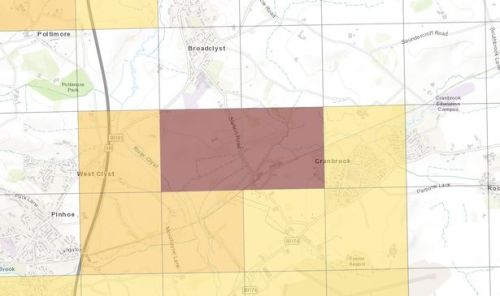
Area around Science Park and western Cranbrook has high radon levels

“Radiation: You would imagine it’s more of a concern for those living near the Chernobyl and Fukushima nuclear disaster exclusion zones.

But in truth Devon is notably radioactive and one of the worst affected parts of the UK as our soil and rock constantly seeps decaying uranium gas: Radon.

Above average levels of radon in Devon and Cornwall remains a silent killer in the rural parts of the county – and some residents are sat in homes that pose a greater risk of radiation absorption than working in a nuclear plant.

A map by Public Health England shows starkly how bad it is in comparison to other places. Even in the same county. For example, Exmouth shows little sign of radiation whereas Cranbrook has high than average levels.

Sobering facts also reveal thousands of deaths in the UK are linked to radon induced lung cancer, as the government works to help those impacted by it by ‘making safe’ their homes and workplaces. …”

https://www.devonlive.com/news/devon-news/devon-surprisingly-radioactive-parts-worst-3111033

EDDC Leader promises consultation on Phase 3 of seafront development

https://www.exmouthjournal.co.uk/news/door-open-for-meeting-about-exmouth-seafront-1-6167223

EDDC Tory DMC Chairman uses his casting vote in controversial planning application

“Plans for 10 new homes in Axminster have been approved, despite fears children could be flattened by lorry drivers who wouldn’t notice them until ‘they heard the screams’.

East Devon District Council’s development management committee via the chairman’s casting vote gave the go-ahead last week for outline plans for 10 homes to be built on land adjacent to the co-op supermarket in Axminster.

Serious concerns about highways safety had been raised by councillors as the front doors of the houses would open almost onto the road delivery drivers heading to the Co-op use.

But the committee heard that Devon County Council’s highways department had no concerns over the plans and hadn’t objected, and committee chairman Cllr Mike Howe used his casting vote to approve the application, saying: “I have to vote in favour as I cannot see a reason for refusal that would stand up and would not cost this council money at an appeal.”

Cllr Paul Hayward had said that he was very concerned about the safety aspects of the plan. He said: “This is building family houses next to a car park and the front doors will open directly onto the path of a reversing HGV from the Co-op. The lorry driver would only be focused on reversing into his spot and he wouldn’t even notice if a child run out of the doors after a ball or a dog or if they saw a friend across the road.

“A child wouldn’t even be on the radar until he heard the screams. Safety is paramount and I cannot conceive a worse place to build family houses.”

Cllr Sarah Jackson added: “The development is situated opposite a car park and alongside the car park access road. Family properties are likely to be occupied by young children who lack road sense and can easily run out unexpectedly, particularly as they may not perceive this as a road in the traditional sense.

“Equally, articulated lorries have incredibly limited visibility and when turning may not see a child in time. The nearest playing field/recreation areas are at Foxhill and Jubilee field. Both would require children to cross several roads.

“It’s worth noting that the play park at Jubilee Field is currently out of action due to a legal dispute and it is unknown as to when this will be returned to proper use, so it is therefore likely that children will end up playing in the car park.

“I just question the logic of putting family homes right next to somewhere where lorries will be reversing in and out to make their deliveries.”

Cllr Tom Wright added his concerns about kids running out and being run over, and added: “I also have environmental concerns. Encouraging people to live in an area which is being heavily polluted and there will be lorries running with their diesel engines is unbelievable and an absolute nonsense.”

And Cllr Paul Arnott said the development was the kind of thing you may see in inner-city London, but that ‘even there it would be turned down on environmental grounds.”

Planning officers though had recommended that the scheme, which would consist of three blocks, be approved.

Six homes would be on a terrace row which fronts on to the car park, with two semi-detached properties situated adjacent to the supermarket building and two further properties fronting onto the proposed car park for the new three bedroom homes.

Development manager Chris Rose said: “The application seeks to address the two reasons for refusal on a previous application which related to the unsuitable access and conflict with the loading area to Co-op and the lack of affordable housing contribution.

“The development can be accommodated without harm in terms of amenity, highway safety, visual impact or loss of character. Although these types of development would usually result in an offsite contributions toward affordable housing, in this instance viability information has been submitted which has demonstrated that such a contribution would render the development unviable.

“The proposal adequately addresses the two previous reasons for refusal on the previous application and as such is considered to meet the social, economic and environmental and thus achieves sustainable development.

Cllr Helen Parr proposed that the application be approved in line with the recommendation, saying: “It is going to be difficult to refuse this on highways safety grounds as Devon County Council’s highways team are satisfied that there is appropriate separation. I don’t see how we can object on highways grounds if they won’t support us. The other reason why development was refused was on affordable housing but there is now evidence that it would be unviable.”

Cllr Eileen Wragg seconded the proposal to approve the plans, saying: “If we don’t, I think that this is one that we would fail to defend on appeal.”

The vote to approve the application saw seven councillors vote in favour and seven against, before Cllr Howe broke the deadlock with his casting vote in favour of approval.”

https://www.devonlive.com/news/devon-news/homes-approved-despite-fears-reversing-3111980

“Councils in country have far less to spend on elderly than those in cities”

“Councils in rural areas like Dorset have five times less than to spend on care of the elderly than those in cities, new analysis reveals.

The study by the Salvation Army warns that areas with lower house prices are unable to properly fund social care, because they cannot raise enough from council tax and business rates.

Experts said the findings were evidence of a “dementia lottery” which meant the chance of receiving help were a matter of geography.

The analysis suggests that typically councils in Dorset would have around £5,762 a head to spend on elderly care – while those in Lambeth in London could have more than £31,000 at their disposal.

Leicestershire, Derbyshire, Somerset, East Sussex, Staffordshire, Lincolnshire and North Yorkshire were among other areas with the most limited resources, according to the analysis.

All the councils which fared best were in London.

The trends also show an increasing gulf, with “spending power” in rural councils falling, while it is rising in urban areas.

The organisation said it was now having to subsidise places in its own care homes, to the tune of an average £302 per person were week.

Lieut-Colonel Dean Pallant, of The Salvation Army, said: “Rural local authorities have been set up to fail with this flawed formula and it urgently needs revision.

“People are living longer and the population is ageing, the adult social care bill is rising but the local authority funding streams aren’t enough to cover the demand, especially in areas where there are not many businesses or people to tax.”

“The Government must prioritise its spending and properly fund adult social care. …”

https://www.telegraph.co.uk/news/2019/07/18/councils-country-have-far-less-spend-elderly-cities/

“Now the wait – Sidford Business Park’s fate in inspector’s hands”

https://www.sidmouthherald.co.uk/news/sidford-business-park-planning-inquiry-1-6168347