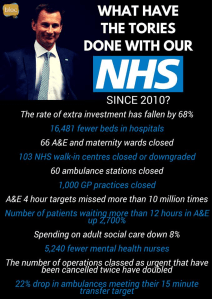
The human cost of austerity cuts

“One in ten councils faces running out of money in the next three years after exhausting its reserves to pay the dramatically rising cost of social care, the government’s financial watchdog has concluded.

The National Audit Office (NAO) warned that many councils were on the verge of insolvency having had their central government funding cut by almost 50 per cent in eight years. It found that authorities’ financial positions had “worsened markedly” since they were last audited in 2014, with two thirds of councils with social care responsibilities dipping into their reserves last year. The report also revealed that government cuts had led councils to:

• Reduce the number of households having their bins collected each week by 33 per cent since 2011;

• Cut the number of food hygiene checks on cafés and restaurants by 40.9 per cent;

• Make savings of £1.6 billion by closing Sure Start centres and services for young people.

In addition, bus route subsidies have been cut by 48 per cent, 10 per cent of libraries have been shut and 67 per cent fewer health and safety enforcement notices are being handed out.

The NAO found that despite these cuts, councils were still unable to balance their books because of the increased demand for social care combined with cost pressures such as the new national minimum wage. It said that the estimated number of people aged over 65 in need of care had increased by 14.3 per cent. Social care accounts for 54.4 per cent of local authorities’ total service spending, up from 45.3 per cent in 2010-11.

As a result, 66 per cent of local authorities with social care responsibilities drew on their reserves last year. The NAO said that at the current rate of deficit 10 per cent of councils would have exhausted their reserves by 2020.

Last month Northamptonshire county council had to impose strict in-year spending controls after effectively going bankrupt. The Timesrevealed that Surrey, Britain’s richest county, is facing a £100 million cash crisis. Councils are not legally allowed to run up deficits and so they would be forced to cut services to ensure they remained solvent. Many of the councils affected are in solid Conservative areas. Surrey, for example, is a county represented at Westminster by seven government ministers.

Amyas Morse, head of the NAO, said that while the government had given local councils several “short-term cash injections” this funding had only been available for adult social care and uncertainty remained over the long-term financial plan for the sector.

Meg Hillier, chairwoman of the Commons public accounts committee, said funding cuts had led to “stark choices” about which services local authorities continue to provide. “Many councils are raiding their rainy day funds to pay for social care, and we have seen Northamptonshire reach the brink of financial failure,” she said.

A government spokesman said councils needs and resources were being reviewed and a real-terms increase had been provided over the next two years.”

Source: Times (pay wall)

“PM wrong to blame councils for housing crisis but big builders have a case to answer”

Owl says: Couldn’t have put it better than this Tory leader of the Local Government Association!

“Theresa May seems to like giving “major” speeches. She’s delivering them everywhere right now. If she’s not careful she’ll end up with the sort of sore throat that made her speech at the Tory Party conference rather more entertaining than usual last year.

The latest one is on housing, for which the over used adjective “crisis” is for once apt. Cue a telling-off for developers and “nimby” local authorities for failing to “do their duty” to foster the British dream of home-ownership.

It’s a standard, and cheap, tactic of central government to blame others for its own failings, particularly local government.

Some 321,000 new homes were greenlighted in 2016 to 2017. Just 183,000 were actually built. There is a bank of 423,000 homes with planning permission awaiting construction. If there’s something stopping housebuilding it wouldn’t appear to be the planning system.

By the way, Lord Porter is a Conservative.

The figures supplied by his Local Government Association would certainly suggest that there is something to the claim that the big housebuilders have been sitting on land banks with the aim of profiting from rising values.

There are perverse incentives on them not to build, not just through those land values but also because of the fact that a genuine increase in the supply of homes might serve to reduce asking prices and thus the developers’ profits, not the mention the crazy bonuses they have been handing to executives.

The PM, in her speech, railed against the latter, and no wonder given their companies have made huge profits on the back of her Government’s Help to Buy scheme without doing much to increase the supply of homes.

Councils quite like the idea of being given powers to force their hands. Whether the limp measures suggested by the PM would do that is open to question, if they ever reach the statute book. Allowing councils to revoke permissions after two years if a building doesn’t get started feels like a half measure.

We, said, Lord Porter, a council leader and chair of the Local Government Association, are doing our bit and we have the figures to prove it.

Nine out of every 10 planning applications are approved and when the rare refusals are appealed to the Planning Inspectorate nearly three out of every four (73 per cent) of council decisions are upheld.

One thing that would help increase the supply of available homes would be to allow councils to borrow to build so that they could pick up the development slack. It’s a suggestion that has found favour with Communities Secretary Sajid Javid in the past, but not, so far, with his colleagues.

Another might be a windfall tax on developers’ profits, and perhaps on their executives’ bonuses, like the one Labour imposed on bankers, too. They could help to provide desperately needed funding to cash-strapped councils.

They might also prove to be rather popular. But they would be controversial, and require a PM with some gumption to force through. This one prefers to talk and talk and talk, and to moan a bit about local government while she’s doing it. She’ll be needing more cough sweets before too long. The rest of us will be after headache pills and prozac.”

http://www.independent.co.uk/news/business/comment/housing-crisis-theresa-may-councils-builders-construction-a8240516.html

How do you solve the housing crisis? With great difficulty given vested interests

Matt Ridley:

“Sajid Javid, the housing secretary, is right — and brave — to go on the warpath about Britain’s housing crisis in his new national planning framework, to be launched today. Britain’s housing costs are absurdly high by international standards: eight times average earnings in England, fifteen in London. A mortgage deposit that might have taken a few years to earn in the early 1990s can now take somebody decades to earn. Average rents in Britain are almost 50 per cent higher than average rents in Germany, France and crowded Holland.

Britain really is an outlier in this respect. Knightsbridge has overtaken Monaco in rental levels. Wealthy, crowded Switzerland has falling house prices and lower rents than Britain. Over recent decades, most things people buy have become more affordable — food, clothing, communication — and the cost of building a house has come down too. Yet the price you pay for it in Britain, either as a buyer or a tenant, has gone up and up.

Speculation exacerbates the problem. British people, and foreign investors here, borrow money to invest in housing on the generally valid assumption it will rise in value. This distorts our economy, diverting funds from more productive investments and exacerbating labour shortages in expensive places such as London and Cambridge.

The fastest take-off in house prices relative to earnings has been in the past two decades, when cheap money has further fuelled the house-price spiral, rewarding the haves at the expense of the have-nots. The high cost of housing is by far the biggest contributor to inequality. The reason people have to turn to food banks is not because of high food prices, but because of high housing costs. It is a rich irony that the Attlee government’s Town and Country Planning Act 1947 is probably as responsible as anything for the continuing prosperity of most dukes.

Yet seeking out profiteers misses the point. At the root of the problem is supply and demand. Britain restricts the supply of housing through its planning system far more tightly than other countries. That keeps prices going up, enabling developers, landlords and speculative buyers to make gains. We are building not much more than half as many houses each year as France, despite a faster population growth rate, and a quarter as many as Japan.

So why is British planning so restrictive? Until 1947 Britain regulated housebuilding in most cities the same way other countries did: by telling people what they could build, rather than whether they could build. As Nicholas Boys Smith, director of Create Streets, told a recent conference at the Legatum Institute, in the centuries following the Great Fire of 1666 “there was a series of pieces of legislation that set down very tight parameters: ratio of street width to street height, the fire treatment of windows etc. That is how most of Europe still manages planning. They have not taken away your right to build a building.”

Britain switched to deregulating what you could build, but nationalised whether you could build, by adopting a system of government planning in which permission to build was determined by officials responding to their own estimate of “need”. This brought great uncertainty to the system, because planning permission now depended on the whims of planners, the actions of rivals and the representations of objectors. Today local plans are often years out of date, if they exist at all, and are vast, unwieldy documents, opaque to ordinary citizens and subject to endless legal challenge and revision.

This makes Britain both far more subject to centralised command and control, and far more dominated by big corporations than other countries. It is a good example of how socialism and crony capitalism go hand in hand. Barriers to entry erected by planning play into the hands of large companies and make it hard for small, innovative competitors to take them on. In turn, this leads developers to produce unimaginative, repetitive designs to get the best return on their huge investment in land and permission.

Getting planning permission to build houses in Britain requires you to spend big sums on consultants, lawyers, lobbyists and PR experts, as you wear down the councils’ planning teams and their ever-growing lists of questions over several years. Not that the two sides in such debates are really antagonists: it is more like a symbiosis, a dance in which both sides benefit, because the fees to be earned by everybody from ecologists to economists are rich. And that is because at the end of the process the reward can be huge: a hundredfold uplift or more in the value of a field that gets turned into housing.

As a property owner, I have experience of this system and, I freely admit, a vested interest in it. I should be arguing for it, rather than against. However frustrating planning authorities can be, the rewards they bring to property owners can be large, either through upward pressure on prices and rents by their restrictions on permissions, or through uplifts in the value of land zoned for development.

Our mostly centralised taxes make things worse. In Switzerland, cantons compete for the local taxes that residential property owners pay, encouraging them to agree promptly to building bids, whereas here development brings headaches for local councils in providing infrastructure and services, only partly redressed with “section 106” agreements that make developers pay for schools and roads.

The system also creates opportunities for nimbyism on a greater scale than elsewhere. Opposing new development because it blocks your view, increases congestion on the roads and crowds the doctor’s surgery and local school, is rational everywhere. But it is much easier to organise a protest when the decisions are taken by council officials and the permissions are for big projects, rather than where many small decisions to build are taken by many dispersed owners and builders.

If Sajid Javid is to succeed in revolutionising Britain’s housing market, he must tackle the underlying causes. Rent control, Help to Buy, affordable housing and bearing down on developers’ land banks mostly address the symptoms. Forcing councils to set higher targets for housebuilding is a start, but if he were to succeed in unleashing a building boom across the country sufficient to bring down house prices, he would create a debt crisis among those with negative equity. So it will not be easy to cure Britain’s addiction to property, but he must try.”

Source: The Times (pay wall)

More than 2,000 deaths due to cold snap Ministers were warned about 3 months ago

Fuel poverty – does our CCG take this into account when sending people home with a “care package” – no. And we are the 6th richest country in the world.

“The death toll from Britain’s big freeze could rise to more than 2,000, as it emerged the Met Office had warned ministers a month ago about the cold snap.

The number of people who have died in cold homes in the UK might reach 100 per day this winter, a charity warned in an analysis of Office for National Statistics figures. …

But amid the expected lift in most travel restrictions on Monday, experts have begun to assess the health impacts of the cold snap.

The estimated rise in deaths, compared to a five-year average, comes as thousands face broken down boilers and fuel poverty, preventing them from heating their homes to safe temperatures.

Campaigners claimed that public health officials had been too slow in warning the public – particularly the vulnerable and elderly – of potential health risks so they could protect themselves. …

Peter Smith, director of policy for National Energy Action, said that the weather would likely see an average of as many as 100 people per day perishing in cold homes this winter, compared to a five-year average of 80 people per day.

The total number of cold-home deaths due to the “Beast from the East” cold front is therefore estimated to be more than 2,300.

At least ten deaths have so far been attributed to the cold weather, but the true death toll is likely to take longer to emerge due to the increase in strokes and heart attacks linked to cold weather.

Mr Smith’s analysis is based on ONS data from previous years and a comparable period of cold weather in the winter of 2010-11.

The World Health Organisation estimates that an overall proportion of 30 per cent of excess winter deaths are due to cold homes. … “

https://www.telegraph.co.uk/news/2018/03/04/uk-weather-big-freeze-death-toll-could-rise-2000-emerges-met/

Javid says build more expensive houses to solve housing crisis

So, where houses are expensive MORE expensive even more houses must be built because Javid thinks that will bring prices down! Yet developers will still be allowed to make more than 20% profit on EACH development before affordable housing has to be built.

Just watch for the first developer to blame Brexit for house prices that don’t go down, and watch Letwin’s report on land banking get kicked into the long grass!

Remember this is the man who has just given more than £800m earmarked fo4 affordable housing back to the Treasury.

And it will be COUNCILS which are sanctioned when developers keep land with planning consent bare NOT DEVELOPERS.

Well done, Javid, well done. Your developer donors getting bigger profits and councils being forced to bend to developer will – and still youngsters won’t be able to get on the housing ladder.

“Thousands of new homes are to be approved and council Nimbyism curbed, the housing secretary Sajid Javid tells Tim Shipman.

Up to five new garden towns are to be approved for the corridor between Oxford and Cambridge under government plans to launch a “housing revolution” this week.

In an interview with The Sunday Times, Sajid Javid, the housing secretary, said he would give the go-ahead to at least two new towns in the next few weeks and could push for up to three more. The decision comes after ministers agreed to fund a high-speed rail line and an “expressway” for cars between the two leading university towns.

“Along that corridor there’s an opportunity to build at least four or five garden towns and villages with thousands of homes,” Javid said. The first step will be to establish “new town development corporations” for the chosen sites, which will help developers and town planners to “cut through a lot of the bureaucracy”, he said.

Referring to the creation of Milton Keynes in 1967 and the transformation of London’s Docklands in the 1980s, Javid said: “We haven’t been that ambitious for a long time.”

Now that Theresa May’s latest Brexit speech is behind it, the government will return this week to what Javid calls “our No 1 domestic priority”.

He said: “We have a housing crisis in this country. Average house prices in England are eight times average earnings. In London, where we have the most acute shortage, it is 15 times average earnings. That’s not just the worst we have had in England , it’s the worst of any major developed economy.”

Last year 217,000 homes were built, more than double the total in 2010, but well under the 300,000 a year the government is aiming for by 2025.

This week ministers will change the planning rules to try to kick-start house-building “where it is needed” and turn the heat up on “Nimby councils” who have refused to build what is needed.

Tomorrow Javid will unveil a new version of the National Planning Policy Framework (NPPF), to get councils to give more land for development. “You’ve got to release it where people are demanding more homes,” he said.

The NPPF will contain new national rules determining how many homes councils should be building each year — taking account of local house prices and wages and the number of key workers in the area. Javid is clear that will force many councils to set higher targets.

“It will no longer allow Nimby councils that don’t really want to build the homes that their local community needs to fudge the numbers,” Javid said. “For the first time it will explicitly take into account the market prices. If you are in an area where the unaffordability ratio is much higher you will have to build even more. It will make clear to councils that this number is a minimum, not a maximum.”

Javid will also launch a crackdown on councils who do not meet targets. He said: “The other thing we’ll introduce is the delivery test. If they say we’re going to plan for 300 a year at the moment there is nothing in the system that checks to see they are actually delivering the 300 and that is going to change.”

Councils who fail to step up will be stripped of their right to decide what gets built in their areas, with decisions made by independent planning inspectors instead. “Developers can only apply for planning permission in the areas the council has identified,” he said. “If the protection of that plan is switched off, a developer can apply for planning permission anywhere in your area.

“This is quite a big sanction for every local authority to not just come up with the right number, but once that number is in place, we are going to be breathing down your neck to make sure you are actually delivering on those numbers.”

Javid says that does not mean building on the green belt, “but it does mean that outside of naturally protected land like woodland and green belt they can pretty much roam everywhere outside that”.

The housing secretary has shown he is prepared to intervene after he threatened 15 councils who had failed to draw up any local plan for development.

“The last time York had a plan was 1954,” he said. “There was the chancellor’s district council, Runnymede. They responded positively. It doesn’t matter who you are or who your MP is, if you haven’t got a plan you will be hearing from me. If a council keeps ignoring its responsibility we can take that planning responsibility away from them and give it to someone else.”

The new planning framework will also seek to make local plans more responsive to their populations’ needs. Javid said: “Our nurses, police officers and fire officers want to live as close as possible to where they serve the British public. We want to make it easier it build and take their needs into account.”

In cities he is keen to see more building upwards. New rules will make it easier for homeowners to add two storeys to their houses — and will clear the way for a large number of mansion blocks to be built.

“The density of London is less than half that of Paris. We don’t want London to end up like Hong Kong,” Javid said, but he wants more “mansion blocks, the kind you might see in Kensington and Chelsea”. He said: “It will be quite surprising how easy we want to make it for people who want to build upwards.”

Further proposals to force developers to build more quickly will be revealed next week when the former cabinet minister Oliver Letwin publishes the interim findings of his report into the problem of land banking by developers.

“We need planning permission to turn into homes,” Javid said. “I don’t think Oliver is going to hold back.”

Javid is aware that failure to deliver could cost the Tories the next election. “We need a housing revolution. We have to show the British public that we are doing everything we reasonably can because if we don’t they will turn to the hard-left ideas of [Jeremy] Corbyn. If that means taking on councils, developers and others that’s what we’re going to do.”

Source: Sunday Times (pay wall)

Tory donor puts screws on tenants in Grenfell-type block

“A company run by a property tycoon who recently made a five figure donation to the Tories is forcing the residents of a block of flats with flammable cladding foot the bill for safety measures.

The latest party funding figures reveal the Tories pocketed £10,000 from Ashcorn Estates Limited, which is owned by James Tuttiett, a multimillionaire who lives in a £1.6 million farm house which has its own vineyard.

Another of his companies, E&J Estates, has been in the news recently.

It owns an apartment block in Salford which was found to have been constructed with a similar type of cladding to the one used on the Grenfell Tower.

The Guardian reported last month that E&J have told residents that they have to pay the £100,000 cost of interim fire wardens needed to make the building safe until the cladding is replaced.

The company even took legal action to enforce the charge, which one resident said would cost him an extra £235-a-month.

Matthew Crisp told the Manchester Evening News:

“I’m worried this now sets a precedent for us to foot the bill for the cladding too, and that’s devastating, as I don’t know if I’ll be able to continue living in my home.”

Crisp’s fears aren’t unfounded.

Scrapbook revealed in January how residents living in a building owned by a separate millionaire Tory donor were forced to pay the £2 million to replace flammable cladding.

The Government say they are clear that “private sector landlords follow the lead of the social sector and not pass on the costs of essential fire safety works.”

So why do the Tories keep taking their money?”

https://politicalscrapbook.net/2018/03/company-of-tory-donor-forcing-residents-of-flats-with-grenfell-style-cladding-to-pay-for-fire-safety-measures/

“Judge agrees costs capping in action over NHS accountable care organisations”

“Campaigners including scientist Professor Stephen Hawking have secured a costs order for their judicial review of the government’s planned creation of accountable care organisations (ACO) in the NHS.

In January the claimants gained permission to bring the case against Health and Social Care Secretary Jeremy Hunt and the National Health Service Commissioning Board.

Cheema-Grubb J held that the crowd funded campaign met the statutory test for a costs capping order, being a group of responsible individuals acting in the public interest without a personal interest in the outcome.

The campaigners will challenge the lawfulness of accountable care organisations, which they argue Parliament has not given the Department of Health the power to create.

During the January hearing the court declined to cap costs and the campaigners feared they could face a £450,000 bill were they to lose.

Cheema-Grubb J said it was highly likely that some of the concerns raised in the judicial review had a high degree of public interest and accepted evidence that the case would be dropped in the absence of a cost order.

The claimants could not be criticised for being unreasonable in not proceeding in a case with open-ended potential liabilities, the judge said.

She also noted that Mr Hunt and the NHS were publicly funded through taxpayers’ money in defending the case.

Under the order, if the campaigners lose their liability for Mr Hunt’s and the NHS’s costs would be capped at £80,000 each.

If they won, the two defendants’ liability to pay their costs would be capped at £115,000.”

http://localgovernmentlawyer.co.uk/index.php

Dominic Lawson: Big bonuses the fault of former Chancellor and help-to-buy

Owl says: While Lawson blames Osborne it should be noted that May and Hammond have not closed the loophole … which could easily be done …

“At first he said he deserved his £110m bonus, and resisted all the pressure to assign a large chunk of it to charity. Then he said he would give some of it to good causes, but not how much (“a private matter”). Finally, on Friday, after three months of hectoring by the media and investors, he said he’d forgo . . . £25m.

I’m referring to Jeff Fairburn, chief executive of the housebuilder Persimmon and the principal beneficiary of a remarkably generous share-based incentive scheme that has sprinkled more than £500m of equity around 140 of the company’s “top individuals” as if from a fairy godmother’s wand. Except it doesn’t come out of thin air, but by diluting all the ordinary shareholders’ stakes in the business.

Their representatives — pension fund managers, principally — have spent those past three months moaning about it. But when the incentive scheme was drawn up in 2012 — linking the rewards to share price performance and dividend payments — it was approved by 85% of shareholders. So Fairburn’s resistance is understandable; and, indeed, Persimmon’s investors have done fine — since 2012 their shares have quadrupled in value.

But the main reason is not the ingenuity of Fairburn and his colleagues. No, if there was a fairy godmother in this, it was George Osborne. As chancellor, he launched the help-to-buy scheme, which economically crazy but politically astute subsidy supports about half of Persimmon’s recent house sales. We as taxpayers are not directly funding those £500m worth of bonuses, but we have underwritten the personal mortgages that made that colossal windfall possible. Don’t mention it, Jeff: happy to help.

The person most annoyed by this is actually a lot richer than Fairburn — and another housebuilding boss. Steve Morgan, the head of Redrow, complained: “For somebody who has not taken a salary for 20 years it sticks in the craw, being called a greedy housebuilder because of that one company.” And why has Mr Morgan not taken a salary for 20 years? Because he founded Redrow in the 1970s and is worth about £830m. He would be a billionaire (according to the compiler of The Sunday Times Rich List) had he not passed £226m of Redrow shares to his charity, the Steve Morgan Foundation, which supports disadvantaged and disabled people in north Wales and northwest England.

Here we see, in instructive proximity, the sort of wealth that compels admiration and the sort that provokes contempt. That stark divergence is not because Morgan has been philanthropic. It is because he has created his own business and, at the outset, would have been at personal risk if it had not worked out (perhaps, like so many entrepreneurs, he had offered whatever he owned as security for bank loans). Fairburn had a good story to tell, too: he began in the building trade as a youth training scheme apprentice, studying to become a quantity surveyor while mixing concrete. But he did not create the firm of which he is, after all, just another employee: he is taking the rewards of entrepreneurialism without the risks.

He is not, in the true sense of the word, a capitalist. But Morgan is. And the point is that while there has in the decade since the credit crunch been a gale blowing the sails of those who denounce “capitalism”, the public hostility is actually — and rightly — directed against those who are not capitalists (as Karl Marx defined them), but who have seized capital from its owners. After all, that is what the discredited banking executives, both here and in America, did. They leveraged the capital of which they were merely managers, to generate vast bonuses for themselves: when that blew up the banks, the exploded corporate balance sheets were rescued by the taxpayer . . . while the executives kept all their winnings.

In his latest book, Skin in the Game (which I review today) Nassim Nicholas Taleb calls this “the Bob Rubin trade”, in (dis)honour of the former US Treasury secretary who kept his $120m compensation from Citibank: “When the bank, literally insolvent, was rescued by the taxpayer, he didn’t write any cheque — he invoked uncertainty as an excuse.”

The risk — to the market system now under attack from the unreconstructed Marxists at the helm of the British Labour Party — is that the bonny baby of entrepreneurial endeavour will be thrown out with the dirty water of executive self-dealing.

Much of that self-dealing — which I first wrote about as long ago as 1989 in a Spectator cover piece titled “How the bosses help themselves” — is promoted by the argument that it makes senior managers behave more like proper owners, rather than mere time-servers. Specifically, the executive compensation committees of FTSE companies have argued that through the awards of share options, the interests of those managers are aligned with the investors who, collectively, own the businesses.

It is a theory generally accepted and, like many such established doctrines, false. The ordinary shareholders have actually paid for their equity, so if things go pear-shaped, they stand to lose what they have invested; and those who have created businesses can lose everything, even their homes. But share options are free. There is an upside, but as no capital is at risk, no real downside.

One result is that share option schemes have encouraged undue risk-taking by executives, for example by borrowing heavily to finance acquisitions — which is what happened at Carillion. It also encourages a more short-term approach to business-building than a true owner would adopt: share option schemes tend to last for a few years, not the decades that a good business should be measured in.

I should confess, at this point, to having been a beneficiary of just such a scheme. When I was an executive of the Telegraph group I was assigned, for the first and only time in my life, some share options . . . and within just a few months they were most unexpectedly realised when the majority shareholder decided to buy out everyone else. Without any effort on my part — other than just continuing to do my job of editing a newspaper — I was suddenly presented with a cheque sufficient to pay off my mortgage.

I was delighted, of course. But it also felt wrong, somehow. I suppose I might feel the same way if I won the national lottery, although that is most unlikely to happen, and not just because of the odds: I don’t enter it. At least the lottery winners have paid for their stake. We should expect our best-remunerated business leaders to have done the same.”

Source: Sunday Times (pay wall)

“Westminster councillor received gifts and hospitality 514 times in three years”

Surely not the only one. So many councillors in Devon accept such hospitality …..particularly at sporting events …..

Full list of this councillor’s freebies here:
https://www.theguardian.com/society/2018/feb/19/full-list-of-westminster-councillor-robert-daviss-514-freebies

“Westminster city council’s deputy leader has emerged as a contender for the title of the most schmoozed politician in Britain, receiving entertainment, meals and gifts more than 500 times in the last three years.

From tickets to the hottest West End shows to exclusive dinners in London’s finest restaurants and trips to the south of France, the official declarations reveal an extraordinary lifestyle that included one day in Mallorca, when Robert Davis managed two lunches, the first at the home of Andrew Lloyd Webber and the second at the home of the Earl of Chichester.

Davis, the Conservative deputy leader of the central London borough and until last year the chairman of its powerful planning committee, was entertained by and received gifts from property industry figures at least 150 times since the start of 2015 – a rate of almost once a week.

His entertainment was paid for by some of the country’s wealthiest property developers including Gerald Ronson, Sir Stuart Lipton and Sir George Iacobescu, the chief executive of Canary Wharf Group.

The Cambridge-educated solicitor was entertained or received gifts on 514 occasions since the start of 2015, suggesting he received benefits worth at least £13,000 although then overall total is likely to be several times higher.

Councillors must declare gifts and hospitality worth £25 or more, but some of the hospitality would have been worth much more. For example, property developers twice flew Davis to the south of France and put him up for four-day stays.

He was also gifted a ticket to the musical Hamilton by the impresario Cameron Mackintosh, which can cost as much as £250. Steaks at the M steakhouse, where he dined 20 times at others’ expense cost up to £100 each. Other property figures treated him to lunch at exclusive restaurants including Sexy Fish, Scott’s, the Colony Grill Room, the Ritz and the Ivy.

Davis was entertained 15 times at the expense of the Westminster Property Association, which represents major developers, including an expenses-paid trip to the south of France and dinners at the Grosvenor House and Goring Hotels in London.

Labour said the extent of Davis’s register of interests was evidence of a “broken culture at Westminster council” and said there was a “clear perception that senior Conservative councillors have a very close relationships with developers”. It has accused the council of letting developers get away with building far fewer “affordable” homes than required under Westminster’s planning policy.

Between 2013 and 2016 only 12% of the new homes built in Westminster were classed as “affordable” while the target was 35%. Davis chaired the council’s planning committee, which approves deals with developers over how much affordable housing they must build as part of private developments, between 2000 and January 2017. …

… a spokesman for Westminster city council hit back saying: “The idea that any councillor has been ‘bought’ by the property lobby is demonstrably untrue.”

“Westminster is a target for investment for UK and national developers, so it is hardly surprising that the chair of planning for Westminster city council – the largest planning authority in the UK – undertakes a large number of meetings,” he said. “Where hospitality is offered, these meetings are all declared in the register of interests and have absolutely no sway on planning decisions.”

Davis added: “As planning chairman it was an important part of my job to meet groups ranging from developers to residents, property agents, heritage associations, arts groups and trade organisations. These meetings were all properly declared and open to anyone to examine. Their sole purpose was to ensure and encourage the right kind of development in Westminster and ensure that anything put before the council was going to benefit the city as a whole.”

The records show Davis also dined with several planning consultancy companies whose job it is to help their clients secure planning consent. When he was chairman of the planning committee he was given breakfast at the Carlton Club in St James by the consultancy Thorncliffe which boasts on its website: “We get clients planning committee approval.”

There is no suggestion that Davis breached any rules.

Davis’s declared entertainment dwarves that of the leaders of his own council and the neighbouring Royal Borough of Kensington and Chelsea. The current leader of Westminster, Nickie Aiken, has registered only nine instances of gifts or hospitality for the first half of 2017. Nick Paget-Brown, the leader of the Royal Borough of Kensington and Chelsea until the Grenfell tower disaster, recorded 43 instances since the start of 2015.

Hug said the extent of the entertainment Davis received during some periods was “ludicrous”.

On one day, while in Mallorca during August 2015, he registered two lunches: the first at the home of Madeleine Lloyd Webber, Andrew Lloyd Webber’s third wife, and the second at the home of the Earl of Chichester.

The property developers that entertained or gave gifts to Davis include: the Crown Estate (13 times), Clivedale Properties, Capco, Irvine Sellar, Derwent London, Berkeley Homes, British Land, Land Securities, Grosvenor Estates, Soho Estates, Dukelease. Architects included Zaha Hadid, Make, Terry Farrell, Michael Squire and John McAslan.

There is no suggestion of wrongdoing on the part of Davis or any other named individual.

Davis was also gifted seats at 10 theatre shows at the expense of the impresario Cameron Mackintosh and a further 51 performances at venues including the Royal Opera House and the Regent’s Park open air theatre. In 2016 he was entertained at the expense of Harvey Weinstein at the after-party for the Bafta awards.

Since January he has been in charge of council policy on theatres and major public realm schemes.

Labour said that if elected to run Westminster council in May’s elections its councillors will not accept hospitality from individual developers or their agents.”

https://www.theguardian.com/society/2018/feb/19/westminster-councillor-received-gifts-and-hospitality-514-times-in-three-years

Another toothless tiger – a rented housing “watchdog”

Owl says: more money to be spent on another useless quango. Can you imagine the correspondence? Instead of a long-running battle with a landlord, it will be an everlasting problem with a taxpayer-funded quango, which could go something like this:

I live in a flat with no heating, my landlord refuses to fix it.
Rate your heating and explain your problem in as technical way as possible, on this 20 page form. (end of week 1)
I don’t have any heating, I can’t get more technical than that, I’m not a plumber or electrician.
We cannot process your complaint unless you fill in the form and have it certified by a plumber or electrician. (end of week 4)
(You fill in the form as best you can).
Sorry, you did not include information about the warranty and the plumber you engaged said he could not provide more information without a full inspection. (end of week 8)
I don’t have the warranty, my landlord has it and won’t let me see it, it’s my landlord’s responsibility to engage and pay for an inspection
Sorry, we can’t help you if you do not have a copy of the warranty and a copy of the inspection report from your landlord (end of week 12)
So what do I do now – I have no heating, I’ve paid for a plumber’s visit out of my own pocket and my landlord refuses to give me a copy of the warranty and refuses to call a plumber? (week 16]
Email: Thank you for using our service. Please rate our service on the attached questionnaire: was it
excellent,
brilliant or
outrageously, miraculously wonderful?

“HOUSEHOLDERS will soon be spared long-running battles with rogue landlords and builders to get their homes repaired.

A new watchdog will be appointed to adjudicate in disputes over damp walls, broken boilers and crumbling plasterwork.

The government appointed housing ombudsman will have sweeping powers to resolve disagreements between dissatisfied residents and landlords or builders.

He will also be encouraged to name and shame dodgy housing or repair providers.

It will be a lifeline for millions of tenants or home-owners locked in long-running rows over everything from outstanding repairs to cracks in new-build homes. …”

Housing Secretary Sajid Javid will today launch an eight-week consultation on the precise role of the new official.”

https://www.thesun.co.uk/news/5604478/new-housing-watchdog-to-be-set-up-to-deal-with-rogue-landlords-over-home-repairs/

“Poverty is now so visible that even the richest can see it”

Owl wonders how many will cough up for a guilt tax – most of these people didn’t get rich by helping the poor!

“Officially, it’s not a guilt tax. Westminster council prefers the term “community contribution” to describe the idea that its millionaire residents might like to make a voluntary donation on top of council tax. It is, they say, merely a chance for the wealthiest to “invest in their neighbourhood”. Perish the thought that they may have anything to feel guilty about.

But whatever you call it, attempting to appeal to the social consciences of the super-rich is surely a sign of changing times. That a flagship Tory council should be dabbling in new forms of redistribution is interesting in itself. That it began considering the idea a few months after the Grenfell Tower fire, which had some of Kensington’s more liberal-minded millionaires asking why their council hadn’t charged them more and housed their neighbours decently, is more interesting still, given that Westminster’s guilt money is earmarked partly for tackling homelessness….

The significance of the guilt tax is that, according to the council leader, Nickie Aiken, the idea came from wealthy residents themselves, who began asking last year if they could pay more. Most tellingly of all, she says it is most popular among those living in “the most expensive homes”, reversing the normal finding that tax rises are wildly popular only with people who won’t actually be paying them. This is starting to feel less like a conventional tax, and more like the biblical concept of guilt offerings: pay up, cleanse yourself of the perceived sin of unwittingly perpetuating gross wealth inequality, and perhaps you might avoid a plague of locusts.

… Relying on charitable donations, which could dry up overnight, to fund essential public services feels precarious and wrong. But the pragmatic attraction of a guilt tax is that, like the decision by the Manchester mayor, Andy Burnham, to donate part of his salary to a homelessness fund, it is quick and achievable, and it beats wringing hands.”

https://www.theguardian.com/commentisfree/2018/feb/17/poverty-visible-richest-grenfell-homelessness

Question: how many homes in the south-west have planning permission but not yet built?

Answer:

34,929

out of a total number of 423,544 in England.

https://www.mirror.co.uk/money/more-400000-homes-planning-permission-12035753

Be rich, live long, be poor, live short

The fall in death rates of England’s richest and poorest aged between 60 and 89
Group Fall in death rates*
Richest men
32%
Poorest men
20%
Richest women
29%
Poorest women
11%
Source: The LSP *Death rates measure the likelihood of somebody within this age range dying.
The fall in death rates charts an improvement in life expectancy.

http://www.telegraph.co.uk/money/consumer-affairs/ever-live-determines-long-live/

“Britain’s bus coverage hits 28-year low”

“Britain’s bus network has shrunk to levels last seen in the late 1980s, BBC analysis has revealed.

Rising car use and cuts to public funding are being blamed for a loss of 134 million miles of coverage over the past decade alone.

Some cut-off communities have taken to starting their own services, with Wales and north-west England hardest hit.

The government has encouraged councils and bus companies to work together to halt the decline.

One lobbying group fears the scale of the miles lost are a sign buses are on course to be cut to the same extent railways were in the 1960s.” …

http://www.bbc.co.uk/news/uk-england-42749973

Home ownership amongst the (non-wealthy) young has plummeted in 20 years

“New research from the Institute for Fiscal Studies shows how an explosion in house prices above income growth has increasingly robbed the younger generation of the ability to buy their own home. For 25- to 34-year-olds earning between £22,200 and £30,600 per year, home ownership fell to just 27% in 2016 from 65% two decades ago.

Middle income young adults born in the late 1980s are now no more likely than those lower down the pay scale to own their own home. Those born in the 1970s were almost as likely as their peers on higher wages to have bought their own home during young adulthood.

Andrew Hood, a senior research economist at the IFS, said: “Home ownership among young adults has collapsed over the past 20 years, particularly for those on middle incomes.”

The IFS said young adults from wealthy backgrounds are now significantly more likely than others to own their own home.

Between 2014 and 2017 roughly 30% of 25- to 34-year-olds whose parents were in lower-skilled jobs such as delivery drivers or sales assistants owned their own home, versus 43% for the children of those in higher-skilled jobs such as lawyers and teachers. …”

https://www.theguardian.com/money/2018/feb/16/homeownership-among-young-adults-collapsed-institute-fiscal-studies

Public sector workers’ children in poverty: highest rate is in South West

“Tens of thousands of children of public sector workers will be living in poverty by the end of next month, unions warned.

Parents working for the NHS, schools and councils may not be earning enough to make ends meet due to the government’s cap on public sector pay and in-work benefit cuts.

Research by the TUC found that one in seven children of public sector workers will be pushed below the poverty line by the end of March. Around 550,000 children living with a public sector worker in the family will be classed as being in poverty by the end of the current financial year, said the union organisation.

The South West has seen the biggest increase in child poverty rates among families with a public sector worker, followed by the North West and East Midlands, the study found. TUC general secretary Frances O’Grady said: ‘The Government’s pay restrictions and in-work benefit cuts are causing needless hardship. …”

Read more: http://metro.co.uk/2018/02/15/children-nhs-school-council-staff-living-poverty-7314885/

Oxford Tory toffs club (hon President Jacob Rees-Mogg) goes on rampage

The honorary president of this club is Jacob Rees-Mogg; Theresa May and her husband were both members when they were at Oxford.

“Arrogant young Tories ran riot at a prestigious university event where they allegedly groped women before going on to abuse pub locals.

The disgraceful behaviour came during a popular Port and Policy party run by the Oxford University Conservative ­Association, which has PM hopeful Jacob Rees-Mogg as honorary president.

Horrified students told how they saw sozzled men try to kiss and fondle women while downing up to 43 glasses of port each in boozing competitions.

Organisers who refused to serve the drunks more booze were shouted down with one reveller allegedly screaming: “I’ll buy their families.”

They then besieged the nearby King’s Arms pub and shouted “Buller, Buller, Buller” – a ­reference to the infamous ­Bullingdon Club society of boozing yobs.

The louts were also heard yelling at locals: “My castle’s bigger than yours.”

The braying mob also smashed glasses and bottles outside the building. …

“There have been numerous reports from members that last Sunday several attendees at Port and Policy groped, touched, kissed (or attempted to), or otherwise harassed female guests.

“We have also heard rumours of similar incidents occurring in previous weeks. I hope there is no doubt that everyone here today finds it totally ­unacceptable that women were made to feel uncomfortable in this way.

“We believe senior members have been ignoring sexism and misogyny, not because they are themselves sexist, but they are worried about the public image of themselves and the association.

“Instead of trying to address the bad PR caused by this issue, we should be addressing the issue itself.”

OUCA President Timothy Doyle said tonight: “The association takes very seriously indeed all allegations of misconduct at its events.

“A member has been suspended until the end of term, following drunkenness at an event. Any allegations of sexual harassment are passed on to university authorities. No allegation received has been ignored.” …”

https://www.dailyrecord.co.uk/news/politics/tory-students-oxford-club-linked-12022112

The Daily Mail goes into more detail and names some participants here:

http://www.dailymail.co.uk/news/article-5394811/Bullingdon-Club-students-groped-women-Tory-bash.html

“NHS chiefs pocket £166 MILLION in bonuses – while nurses suffer 1% pay cut”

“Nurses, midwives and other carers battered by David Cameron’s assault on NHS wages are night furious at revelations their bosses’ pay packets have risen by 36%.

Senior managers pocketed £166million in bonuses and other extras last year – as the Tory-led Coalition slashes £20billion in costs from the beleaguered service.

That is up 36% from £122million the year before.

The rise, on top of their annual salaries, could have paid for an extra 4,000 nurses, who have suffered a 1% cut. …”

https://www.mirror.co.uk/news/uk-news/nhs-bonuses-chiefs-pocket-116-3553527

Our NHS but not “OUR” NHS

Another post from the Save Our Hospital Services Facebook page, which has nearly 11,000 (yes, ELEVEN THOUSAND) members

“The STPs have driven a huge wedge between hospitals and areas within the “footprints” people have been horrified to find that their services have been down-graded and moved to other hospitals some distance away.

In Devon there were threats made to move maternity and acute services from North Devon to Exeter some 55 miles away and even further away from some of the outlying villages.

The various committees and groups set up to implement the STPs have wasted vast sums of money on wages, premises, expenses and admin staff. There have been endless ridiculous consultations with all sorts of groups where the public’s views were dismissed—the public have watched on while these people have wasted money.

The STPs have been successful in taking huge sums of money from the system and putting it in the hands of people who should actually have been working in hospital. Management consultants and makers of pretty information books have had a great time too.

Meanwhile back in the hospitals beds have been closed to save money and then we find that there are not enough beds. The boards of hospitals ( NDDH – North Devon District Hospital) have been taking pay rises in some cases already earning a quarter of a million pounds per year- this individual has now had a vote of no confidence made against him by the consultants – yet still he cashes in.

The CCGs across the country have been following orders and cutting community hospitals and beds relentlessly rather that protesting and thinking about patient safety in their areas. They have all done great jobs at implementing STPs – well done but you should have been advocating for your patients.!!!!!

The public are furious across the country about this government’s shameful treatment of the NHS and its front line staff. They see the staff run off their feet, suffering stress and leaving. The hospitals which are under threat of closing or losing services have staffs that have no confidence in the system and no job security. How has this come about? The STPs have demoralised everyone, put hospitals against hospitals, made the public feel that because they live in certain areas that their lives are not as important as the lives of people in neighbouring areas.

The STPs are now morphing into ACOs and ACSs and goodness knows how many quangos and private companies (yet again) will be raking in their pounds of flesh before patients are considered. The whole nation is up in arms about the effects of cost cutting.

Deficits in hospitals do not represent overspending- they represent the needs of the people in that area.

No area is the same – we do not all fit into a formula – some populations have more elderly people, some have more babies, some have more people drinking and smoking, some are more polluted, some are deprived, some are wealthy. The STPs do not address these considerations.

ACOs are very suspicious- a move to the American (rubbish for the people) insurance based system. They break up the system even more and are not accountable to anyone. Private companies such as Virgin bully and sue if they do not get their own way over contracts already. What will happen when even more is thrown open to the sharks waiting to take a profit out of people’s ill health?

The demise of Carillion should send a warning shot across the bows of anyone who feels that public services are safe in the hands of profiteers.
People are angry- STPs started this – put a stop to it now and reinstate the NHS.”

Tories auction off access to PM and ministers at their annual ball

Readers may recall the tasteless joke made by Hugo Swire about the unemployed at the £10|15,000 per table Tory fundraising ball attended by porn barons, sex shop owners, former jailbirds and assorted other rich riff-raff in 2015:

“Joke of the night
Auctioneer Hugo Swire, a Tory MP, inviting bids for the flight, said: ‘For an extra £1,000 we will throw in a case of wine. For an extra £5,000, we will throw in Greece as well.”

http://www.dailymail.co.uk/news/article-2948470/Porn-barons-Shady-financiers-Hedge-fund-kings-Welcome-secret-Tory-ball-ANDREW-PIERCE-reveals-went-closed-doors.html

as reported here:

https://eastdevonwatch.org/2015/02/11/hugo-swire-is-auctioneer-at-15000-per-head-tory-ball/

Readers will be pleased to know that this annual event continues to be a highlight of the posh-toff Tory donor calendar. The dinner was held, appropriately enough, in the Natural History Museum, home to many other dinosaurs, though perhaps not as rich as the living ones!

Reports include:

A Tory donors paying £55,000 in an auction to spend a day with Theresa May.

Other auction lots included a dinner at a restaurant hosted by Stanley Johnson and the Made in Chelsea star Georgia Toffolo – who appeared together on the ITV reality show I’m a Celebrity – which went for £15,000.

Another auction lot was a chance to “walk in the footsteps of Churchill” by having dinner with the defence secretary, Gavin Williamson, in the Churchill war rooms, which reportedly went for £30,000.

A bidder is understood to have paid £12,500 for a home-cooked dinner with the environment secretary, Michael Gove, and his wife, Sarah Vine, at their west London home.

Dinner in Edinburgh with Ruth Davidson, the Scottish Conservative leader, attracted bids of more than £15,000, while lunch with Liam Fox, the international trade secretary, proved somewhat less alluring, with bids around the £2,000 mark.

Departing guests were reportedly greeted by a flashmob of taxi drivers honking horns in protest at May’s speech at the World Economic Forum in Davos last month in which she said Uber had got things wrong but should not be shut down.

As reported in

https://www.theguardian.com/politics/2018/feb/08/black-and-white-ball-dinner-with-defence-secretary-goes-for-30000-at-tory-fundraising-ball