“Number using food banks in part of Devon doubles in six months”

“The number of people using food banks in the Sid Valley has more than doubled in the last six months.

The Sid Valley Food Bank’s co-ordinator Andie Milne told East Devon councillors on Wednesday night of the alarming numbers of people and the stark rise in numbers of people they are seeing.

She said that six months ago, they were dealing with 15 families a week, but last week, more than 30 families came through their doors, with 36 children being helped.

And she added that last week they helped a family from Axminster as there was no help available in the East of the county for them, and raised concern over what would happen to the emergency food bags located at the council’s Knowle HQ, that sometimes are refilled four times a week, when the council offices move to Honiton early in 2019.

Her comments came prior to the full council unanimously supporting a motion brought forward by Cllr Cathy Gardner, of East Devon Alliance, calling for a report on the potential impacts of benefits changes and spending cuts on people in East Devon and whether there was a need for further support from the council in supporting the roll-out of Universal Credit, homelessness prevention or for local food banks.

Proposing her motion, Cllr Gardner said: “Most of us are doing okay and are comfortable, some are doing extremely well, but some are struggling, and we have a civic duty to see if we can do more. I would be horrified to learn if a child suffered as we failed to something in some way to help.

“I am not criticising the council or the hard work that our officers do to help people but simply to ask if there is anything more that we could do, as we know that people are struggling with Universal Credit.

“If the report says it is all perfect, then we can rest easy, but I want the report to come forward so we can be seen as outstanding, caring and vigilant.”

Cllr Marianne Rixson, supporting the motion, added that some people are being forced to use food banks just to make ends meet, even though they are in employment. …”

https://www.devonlive.com/news/devon-news/number-using-food-banks-part-2323249

Knowle Flog It: statement raises more questions than answers

An “explanation” of the Knowle Flog It fiasco appears in today’s Sidmouth Herald. It appears to be printed verbatim from a council statement.

Owl wonders why this statement was printed without challenging some of its very, very vague claims – one hesitates to use the word ‘facts’. “Journalism”? Not as Owl knows it!

Guess some answers MIGHT come from the Freedom of Information request by an Exmouth resident on 8 January 2019:
https://eastdevonwatch.org/2019/01/10/the-knowle-flog-it-scandal-rumbles-on/

In the meantime:

Amongst Owl’s questions:

It seems Councillor Skinner paid £400 for the table he wanted so urgently – earlier reports mentioned it being valued at a very low price, much lower than £400. Which is correct? And including just how many chairs?

Who decided on the “three disposal methods? It does not appear to be the Asset Management Group.

Which councillors have bought items? Have they declared these on their Registers of Interest?

Which groups were offered ‘free’ items, how were they chosen and by whom? Have any of these groups taken items – and if so, which groups and how much did they pay for them?

What exactly is the Chairman’s Civic Fund and how and when has it been used recently and in the past? What are its rules? Who oversees the disbursements?

Which local groups and charities will be able to bid for what is left after officers and councillors have taken their pick? How have they been chosen and by whom?

Are internal and external auditors happy with the procedures?

Will the Scrutiny Committee be scrutinising these actions?

Owl is sure readers have many more questions!

Chilling report on NHS sustainability – it isn’t sustainable

Owl says: anyone who cares about the NHS should read EVERY PAGE of this 58-page report, which is written in clear and accessible language.

Every page signals a death-knell for the NHS sooner rather than later.

It is hard to pick out anything – every page tells a story of (deliberate?) mismanagement, underfunding and chaotic accounting.

For example:

“Key findings

The funding settlement for the NHS long-term plan

8 The long-term funding settlement does not cover key areas of health spending. The 3.4% average uplift in funding applies to the budget for NHS England and not to the Department’s entire budget. The Department’s budget covers other important areas of health spending such as most capital investment for buildings and equipment, prevention initiatives run by Public Health England and local authorities, and funding for doctors’ and nurses’ training. Spending in these areas could affect the NHS’s ability to deliver the priorities of the long-term plan, especially if funding for these areas reduces. The government will consider proposals in these areas as part of its 2019 Spending Review. In addition, without a long-term funding settlement for social care, local NHS bodies are concerned that it will be very difficult to make the NHS sustainable (paragraphs 2.27 and 2.28).

9 There is a risk that the NHS will be unable to use the extra funding optimally because of staff shortages. Difficulties in recruiting NHS staff presents a real risk that some of the extra £20.5 billion funding will either not be used optimally (more expensive agency staff will need to be used to deliver additional services) or will go unspent as even if commissioners have the resources to commission additional activity, health care providers may not have the staff to deliver it (paragraphs 1.19 and 2.29).

10 From what we have seen so far, the NHS long-term plan sets out a prudent approach to achieving the priorities and tests set by the government, but a number of risks remain. The long-term plan describes how the NHS aims to achieve the range of priorities and five financial tests, set by the government in return for the long-term funding settlement, which NHS England believes are stretching but feasible. As with all long-term plans, it provides a helpful indicator of the direction of travel, but significant internal and external risks remain to making the plan happen. These risks include: growing pressures on services; staffing shortages; funding for social care and public health; and the strength of the economy. Our reports have highlighted how previous funding boosts appear to have mostly been spent on dealing with current pressures rather than making the changes that are needed to put the NHS on a sustainable footing (paragraphs 2.24 to 2.26).

Financial and operational performance of NHS bodies

11 In 2017-18, NHS commissioners and trusts reported a combined deficit of £21 million. This was made up of:

The combined deficit of £21 million does not include adjustments needed to report against the Department’s budget for day-to-day resources and administration costs.

12 It is not clear that funding is reaching the right parts of the system.
The overspends by trusts and CCGs were broadly offset by the underspend by NHS England. In 2017-18, NHS England’s underspend included: £962 million from non-recurrent central programme costs, including efficiencies from vacancies;

a £280 million contribution to the risk reserve and £223 million from centrally commissioned services, mostly specialised services (paragraphs 1.4 and 1.8).

13 Most of the combined trust deficit is accounted for by a small number of trusts, while the number of CCGs in deficit increased in 2017-18. The net trust deficit hides wide variation in performance between trusts, with 100 out of 232 trusts in deficit. In 2017-18, 69% of the total trust deficit was accounted for by 10 trusts. NHS Improvement has committed to returning the trust sector to balance in 2020-21, but it is difficult to see how this will be achieved for the worst-performing trusts under current arrangements. Although support provided to trusts in NHS Improvement’s financial special measures programme has been successful in improving the position of some trusts (by £49 million in 2017-18), the financial performance of the 10 worst-performing trusts deteriorated significantly in 2017-18. Between 2016-17 and 2017-18, the number of CCGs reporting overspends against their planned position increased from 57 to 75. The NHS long-term plan sets out the national bodies’ aim that no NHS organisation is reporting a deficit by 2023-24 (paragraphs 1.6 and 1.11).

14 There are indications that the underlying financial health in some trusts
is getting worse. In 2017-18, trusts reported that their combined underlying deficit was £4.3 billion, or £1.85 billion if the Provider Sustainability Fund (which replaced the Sustainability and Transformation Fund in 2018-19) is allocated to trusts in future years. There is no historical data on the underlying deficit that takes account of one-off savings, emergency extra cash and other short-term fixes that boost the financial position of the NHS, so it is not clear whether this position is getting better or worse. However, indicators such as cash support and one-off efficiency savings suggest the position has not improved. For example, in 2017-18, the Department gave £3.2 billion in loans to support trusts in difficulty, up from £2.8 billion in 2016-17. In 2017-18, 26% of trusts’ savings were one-off. Trusts will need to make additional savings in 2018-19 to replace these one-off savings (paragraphs 1.13, 1.14, 2.13, 2.17 and 2.18).”

Click to access NHS-financial-sustainability_.pdf

How many pensioners might lose free TV licenses in East Devon?

The plan is to offer free licenses only to those on Pension Credit and/or only those over 80 years of age.

Actually, what is just as worrying is just how many people in East Devon are already receiving pension credit because they have incomes below the poverty line.

“In Tiverton and Honiton (Neil Parish), there are 9,730 households with someone over 75 who qualifies for a free TV licence; 3,640 households would lose free TV licence eligibility if the age threshold was raised to 80, and 7,980 households would lose eligibility if it the benefit was linked to Pension Credit.”

In East Devon (Hugo Swire), there are 10,350 households with someone over 75 who qualifies for a free TV licence; 3,590 households would lose free TV licence eligibility if the age threshold was raised to 80, and 8,830 households would lose eligibility if it the benefit was linked to Pension Credit.”

https://www.mirror.co.uk/news/politics/free-tv-licences-search-see-13871591

Auditers warned about council manipulation of funds for commercial ventures

“Auditors have been encouraged to scrutinise council accounts to ensure that balance sheets are not being manipulated in order to justify commercial ventures.

The National Audit Office has released a new guidance note for local government auditors, covering a range of issues thrown up by recent changes in regulation and council practice.

The section on commercialisation has been produced in response to the growth in council commercial activity as a means of dealing with substantial funding reductions, the note said.

“Auditors should be mindful of any incentives to achieve a particular balance sheet position that arise from an authority’s commercial activities when planning their audit work,” the note said.

The note also brought auditors’ attention to the changing nature of investment activity, primarily in commercial property, carried out through asset-backed joint-venture arrangements, rather than traditional debt-backed approaches.

It said: “The scale and nature of authorities’ commercial activity brings both risks to the auditor’s value for money arrangements conclusion and the opinion on the financial statements.

“The former covers the reasonableness of decision making, including the relevant risk assessment, appropriate skills of the authority and the appropriateness of advice.”

Councils need to consider the impact of commercial ventures both on the accounts of any standalone entities, as well as the group accounts, it said.

The note also warned councils that the general power of competence, introduced in the Localism Act 2011, does not give them unlimited powers over their decisions relating to commercial ventures.

It said: “Auditors in considering their value for money arrangements conclusion will need to assure themselves that schemes have been entered into following appropriate legal and financial advice, having regard to Wednesbury principles of reasonableness.

“While the general power of competence has made it easier for authorities to undertake commercial activity, this power does not override the need for authorities to comply where there is already an existing legal duty, for example, compliance with the capital financing regulations.”

Elsewhere,the NAO note encourages auditors to ensure that councils are complying with rules allowing councils to use certain capital receipts on revenue funding.

“With pressure to find revenue funding authorities may incorrectly apply the guidance to apply capital receipts for a revenue purpose contrary to the requirements of the capital financing regulations,” the NAO said.

In March last year, auditor KPMG warned that warned that plans by Northamptonshire County Council to spend £40.9m in capital receipts on transformation projects were “not on any view achievable”.

Auditors,the NAO said, should determine whether councils have complied with the capital receipts flexibility guidance, and review the “reasonableness and realism” of councils’ assumptions.

“Auditors should be alert to the risk that authorities may misapply the flexibility to convert ineligible capital receipts to support their general fund expenditure,” it said.

The NAO note also reiterated the role of the auditor in cases where councils might decide to issue a section 114 notice.

In situations where a section 114 notice could be issued, auditors should seek discussions with the NAO and “engage with the section 151 officer regarding consequent courses of action should the section 151 officer’s actions not be successful in averting an unbalanced budget.”

Stephen Sheen, managing director of local government finance consultancy Ichabod’s Industries, said: “Auditors are required to have regard to the guidance when planning and carrying out their audits.

“This doesn’t mean that they have to agree with it, but they must have considered it in arriving at any position that they take on the relevant issues.”

http://www.room151.co.uk/funding/nao-urges-close-watch-on-commercialisation/

Students and student nurses caught in poverty trap

“Students – including trainee nurses – are losing hundreds of pounds when they move over to Universal Credit, because the new all-in-one benefit classes student loans as a from of income.

The Royal College of Nursing is now advising its students to avoid moving to the new Universal Credit system until it is compulsorily rolled out in their area, reports Nursing Notes. One student nurse told Nursing Notes her family was around £170 a month because of Universal Credit, and she was worried she may not be able to continue her studies.

The UK is already facing a nurse shortage, with the Nursing Times reporting that parts of the NHS are hiring only one nurse for every 400 jobs advertised. In September The BBC reported the NHS staffing crisis was becoming a ‘national emergency’, with then health Secretary Jeremy Hunt saying Brexit was to blame.

The Department for Work and Pensions has confirmed that, despite having to be paid back, the maintenance element of the student loan, which is intended to cover living expenses such as rent and bills, is classified as ‘unearned income’ and would impact a Universal Credit award. …”

https://www.devonlive.com/news/devon-news/universal-credit-leaves-trainee-nurses-2439029

Hitachi suspends Wales nuclear plant – what is the business case for Hinkley C

Hinkley C is leaking out money from Devon via the Heart of the South West Local Enterprise Partnership, whose board (past and present) includes people with direct and tangential interests in the nuclear industry and that particular site.

Now we hear that Hitachi is suspending work on the nuclear plant it was meant to build in Wales. It is prepared to take a hit of more than £4 billion to walk away.

It begs questions:

How can the French (EDF) and Chinese – who now own Hinkley C – make a business case for Hinkley C even with the massive subsidy for its (eventual) electricity?

Just how much of OUR money is propping up these French and Chinese businesses?

What is the Plan B if one or both of the companies fail; how much of OUR money will be used to plug financial holes?

What effect has this had on renewable energy sources in Devon and Cornwall?

How much more money is our LEP going to divert to this project?

Squatters in Persimmon and Redrow homes that buyers can’t move into “because access road not completed”

“SQUATTERS have invaded brand new £300,000 houses after a legal ruling banned residents from moving into their own homes.

The luxury family homes, which have already been bought, are still unoccupied after a bitter row over an access road erupted. …

… Developers Persimmon and Redrow are jointly building 500 properties on the Yew Tree Hill estate, which is on the outskirts of Droitwich, Worcs.

But a dispute broke out last February between the companies and Wychavon District Council.

Planners had initially agreed for 188 finished homes to be occupied before an access road on the A38 leading to the estate was completed.

But the council became concerned the roadworks were not on track to be finished properly so it took the developers to court.

They then secured an injunction banning any more people from moving into the properties until the access road was widened.

Residents say no new homes have been built for months and the completed houses have become a haven for squatters.

‘THEY’VE LIED TO US’

Retired police officer Mark Naylor, 52, who moved into one of the first homes with wife Dawn, 51, in December 2017, said: “There has been crime on the estate with people breaking into unoccupied houses.

“Vans have turned up with people trying to break down fencing and get inside to try and take whatever they can.

“Homeless people are sleeping rough in the houses.

“I do feel sorry for people who have put down deposits but can’t move in.

“Persimmon are happy for the residents to just soldier on. They’ve lied to us.”

‘OVERRUN WITH SQUATTERS’

Another resident living in the finished side of the development added: “It’s a nightmare.

“The estate is being overrun with squatters and gangs targeting the empty houses.

“Sometimes at night you can hear them trying to snap the locks on the fences around the empty houses and sometimes the sound of glass breaking.”

The resident says “squatters and undesirables” have “exploited the window of opportunity created by the legal row”.

They added: “It must be torture knowing you’re dream home is being abused by squatters and rough sleepers while you’re powerless to do anything to stop it.

“It’s not right. The developers aren’t interested and the people who already live here and those waiting to move in have been hung out to dry.”

https://www.thesun.co.uk/news/8209327/squatters-take-over-new-homes-droitwich-yew-tree-hill/

Allegation Clinton Devon Estates fixed brakes on other trailers after fatal accident on the one day between police arranging date and turning up for inspection

“… Earlier, the prosecution concluded its opening by alleging that Kevin died because the farm company failed for enforce its own safety rules.

Clinton Devon Farms Partnership is a division of Clinton Devon Estates which manages 2,800 acres of organic farmland in the Lower Otter valley.

Clinton Devon Estates is Devon’s biggest private landowner with 17,000 acres in East and North Devon and 350 houses. It manages the holdings of Lord Clinton.

Mr Simon Laws, QC, prosecuting, said the brakes on the Richard Western trailer which Mr Dorman was towing failed completely and led to him losing control and crashing.

He said it was Mr Perrott’s job to maintain the trailer but checks after the crash showed the brakes had not been tightened correctly and the work had been ‘dreadful’.

Mr Laws said the company did not have the systems in place to ensure regular and efficient work was carried out and the only manual dated back to 1994, and was ‘hopelessly out of date’.

He said: “There was a simple failure to engage with reality and run the business in a way that did not put workers’ lives at risk through a lack of basic maintenance.

“Nobody either internally or externally had any proper oversight of Mr Perrott’s work so the trailers were neglected to the extent that one did not have any brakes at all.

“Our case is that this breach is so bad, it amounts to a crime. You might think it is a basic and vital step to check if the brakes were working after they had been adjusted.

“That cannot have been done or the problem would have been discovered. To allow a trailer in this condition to be used by an unsuspecting driver is grossly negligent.

“There is no suggestion that Mr Perrott intended this outcome but what he did was exceptionally bad and therefore a crime. The case against CDFP is that no system was in place to ensure maintenance was carried out to a reasonable standard.

“The failure by senior management was extremely serious. A man died because no steps were taken to ensure he was driving a safe trailer.

“They had written policies to ensure safety but they were in a filing cabinet somewhere and not applied on the ground. Having systems is one thing and making sure they are implemented is quite another thing. It was simply a paper exercise.”

He said police arranged to check the brakes on the other two trailers in use on the farm but arrived to find that they had been serviced in the day between organising the visit and carrying out the inspection.

Mr Laws said it was apparent that work had been done on the brakes of the two Bailey trailers before police experts had a chance to examine them.

The trial continues.”

https://www.sidmouthherald.co.uk/news/jury-hears-from-family-of-newton-poppleford-tractor-crash-victim-as-trial-continues-1-5854051

Brexit: East Devon – a district divided.

So, Swire voted against May’s Brexit deal, Parish voted for it.

Just where does this leave East Devon?

Piggy-in-the-middle.

Not a good place to be!

The no confidence vote later today will be interesting. If Swire votes to retain May after voting down her deal will that make him a hypocrite?

Tory councillor bemoans planning mess

Owl says: What the councillor neglects to say is that the mess he describes is entirely down to HIS own party!

“Cllr Stephanos Ioannou is a councillor in Enfield. He is studying Public Policy at King’s College London:

“Local councillors across the country will know the struggle is real in the planning system. Not only does it seem to be irresponsive to the real needs of our local communities that are in need of mixed residential, commercial, office, public buildings and green space. But we see planning applications that pose more negatives than positives being allowed to pass through for ‘the greater good, and the bigger picture’.

One surprising reason for this can be derived from the fact that awarding planning permission in the UK comes down to a Faustian pact. If the devil is in the detail, then the detail is Section 106 of the Town and Country Planning Act 1990. Specifically, a clause which formalised “planning gain”, making it in the local authorities’ interests to allow schemes to balloon beyond all reason, in the hope of raking some of the developers’ profits for the public good.

Introduced as a negotiable levy on new development, Section 106 agreements entail a financial contribution to the local authority, intended to be spent on offsetting the effects of the scheme on the local area. The impact of a hundred new homes might be mitigated by money for extra school places, or traffic calming measures. In practice, since council budgets have been reduced, Section 106 has become a primary means of funding essential public services, from social housing to public parks, health centres to highways, schools to play areas. The bigger the scheme, the fatter the bounty for both developers and authorities. Vastly inflated density and a few extra storeys on a tower can be politically justified as being in the public interest, if it means a handful of trees will be planted on the street.

My borough, Enfield, is seeing a surge in young families moving to our borough to escape the surge in housing costs elsewhere in the capital. Predominantly the reasons for the rising demand in our borough are those highlighted by an article in the Evening Standard which mention the ease of accessibility with good motorway connections, good transport links into central London, as well as a the fact that average house prices are modestly rising only 0.4% in our borough, which is something to be reckoned with compared to other parts of London.

But things start to go wrong when planning departments do not take into account, aspects of the local area that make our borough unique. Whether looking at local heritage, the mix of commercial, residential, offices, and the style of new builds, often Enfield Council is quick to bow to the demands by developers and architects for the simple reason of referring to ‘the housing shortage and the need for new homes’. This is a poor state of affairs, and I am worried that the council is moving towards the path of jeopardising local beauty and conservation for the sake of housebuilding. Particularly for a borough such as Enfield which is lucky to have the green-belt it does, this is a real problem for councillors who have to defend their communities.

The issue of planning is also one that concerns the issue of bureaucracy within the council, that sometimes leads to poor decisions and outcomes on certain issues. I remember a local constituent having issues with an application for the property behind her. The Council had, instead of looking at the issue and reopening the planning decision, moved on ‘under delegated powers’ despite major resident objections, to see this build through. This point is echoed by a piece in the Enfield Independent which mentioned that the construction caused ‘considerable cracks in the neighbouring properties of other residents’, and that despite objections being raised within the given time-frame of the regulated pre-planning decision consultation, the planning committee on the council did not even bother to respond to residents’ concerns, and even after ringing, residents could not get in touch with the department.

This goes fundamentally to the heart of what us Councillors try to do, and sometimes can’t do, that is to help our residents most when they need it. Why? Because the failures of planning departments, in this case, mean bureaucracy causes delays, which then causes miss-representation, which then lead to poorly made planning decisions that affect not only the aesthetics of the area, but the general confidence residents have in the council dealing with their concerns in future.

It also raises a bigger question, as to how many similar cases are there, where other developments have gone through without the necessary vigorous scrutiny they need? I agree that we must build for new families and promote a home-owning democracy, but if departments simply rubber stamp applications without giving the power to residents and councillors to scrutinise for the greater good, then what’s the point in even having these departments anyway. We might as well pack up and go home as Councillors, because they are making a major part of our job redundant.

Overall, we have a conundrum of problems. Firstly, local councils are disregarding the necessary mix of residential, commercial and office space for the sake of building homes to fix the housing crisis. This is further worsened by the fact developers can ‘help’ plug the funding pressure of new homes, and contribute towards the funding of some local services, and this makes it increasingly tempting for councils to bow to these demands so that they can increase provision because budgets are tight. And then there is the nitty-gritty issue of local residents who struggle to even express their concerns to local planning departments, and this does not help residents build trust in councils who clearly disregard their concerns.

Local council planning departments such as those in Enfield need a major rethink as to how they approach future planning applications. Otherwise we can expect poor decisions on planning to continue into the future, to the detriment of existing residents.”

https://www.conservativehome.com/localgovernment/2019/01/stephanos-ioannou-councils-have-financial-incentive-to-rubber-stamp-bad-development-proposals.html

Rights of way – action needed

Ramblers Association:

“We have until January 2026 to save our historic rights of way.
Well over 140,000 miles of public paths criss-cross England and Wales. This network has evolved over centuries with many paths dating back to medieval times – or earlier! These paths link villages, hamlets, roads and towns – they describe how generations before us travelled to the pub, field or shops and reflect the changing patterns of human interaction with the landscape. To this day, millions of people across our towns, cities and countryside, use this fantastic network. However, miles and miles of our public paths are unrecorded and if they are not put on the map by 1 January 2026, they will be lost for ever.

Download our guide below and get started on the hunt for lost rights of way in your area (requires form fill-in)

https://e-activist.com/page/34392/data/1

Clinton Devon Estates accused of “criminal negligence” over death of farm worker at Newton Poppleford

“… Exeter Crown Court was told that the brakes on the John Western Suffolk trailer which he was towing failed completely, leading to him losing control of both vehicles, leaving them to career 16 feet down into a sunken lane.

The trailer, which contained grass cuttings and weighed a total of ten tons, landed on top of the cab of the tractor. Mr Dorman died of head injuries at the scene.

Clinton Devon Farms Partnership, (CDFP) of Hawkerland Road, Colaton Raleigh, and George Perrott, aged 51, of Colebrook, Crediton, are both accused of manslaughter and failing to ensure the safety of an employee.

Mr Simon Laws, QC, prosecuting, said Mr Dorman’s death was ‘completely unnecessary’ and was caused by the poor maintenance of the trailer and its brakes.

He added: “The prosecution case is Perrott was the man responsible for the maintenance of the brakes. He performed that task in a way that can only be described as criminally negligent.

“He was allowed to do his job in that grossly negligent way because his employers at CDFP had no proper system in place to monitor or supervise his work to ensure the trailer brakes were properly maintained.

“As a result, a man died a death that was completely unnecessary. Trailers pose a very well-known risk to farm workers and the maintenance task was a simple one.

“Perrott failed to carry it out properly and senior management at CDFP appeared to have no proper grip at all on what was happening on their farm with regard to their trailers. …”

https://www.sidmouthherald.co.uk/news/kevin-dorman-tractor-crash-trial-1-5852076

“Spending watchdog urges ministry to address weaknesses in local authority governance”

“The National Audit Office has sounded the alarm about local authority governance and audit for the second time in a week.

In its latest report, Local Authority Governance, the spending watchdog said the government should improve its oversight of the local governance system in the face of increasing financial pressures on councils.

It said councils’ responses to these pressures had “tested local governance arrangements”, as some had pursued large-scale transformations or potentially risky commercial investments that added complexity to governance arrangements.

But spending to support governance fell by 34% in real terms between 2010-11 and 2017-18.

The NAO said external auditors issued qualified conclusions for around 20% of unitary and county councils, and “several authorities did not take appropriate steps to address these issues”.

A NAO survey of auditors found 27% did not agree that their authority’s audit committees provided sufficient assurance about governance arrangements.

Some councils had questioned the contribution of external audit to providing assurance on their governance arrangements, with 51% of chief finance officers wanting to see changes, including a greater focus on the value for money element of the audit.

The NAO said the Ministry for Housing, Communities & Local Government (MHCLG) did not systematically collect data on governance, and so it could not assess whether issues that arose were isolated incidents or symptomatic of failings in aspects of the system.

Ministry intervention at councils was not always made public “meaning its scale and effectiveness is not open to scrutiny or challenge”, the watchdog said.

The report’s recommendations include that the MHCLG should work with local authorities and stakeholders to assess the implications of, and possible responses to, the various governance issues it had Identified.

This would include examining the status of section 151 officers and the efficacy of their statutory reporting arrangements, the effectiveness of audit committees, the effectiveness of overview and scrutiny functions, and the sustainability and future role of internal audit. …”

http://www.localgovernmentlawyer.co.uk/index.php

“Persimmon expects higher profits as help-to-buy props up prices”

“… Persimmon is one of the main beneficiaries of the taxpayer-funded help-to-buy scheme, first launched by George Osborne in 2013. When the scheme was extended in 2017, a report by Morgan Stanley found that the £10bn of taxpayers’ cash had mainly benefited housebuilders, rather than buyers, by pushing up prices.

Persimmon said it was in an “excellent market position” ahead of the key spring selling season, despite “increased levels of uncertainty” due to Brexit. It had £1.39bn of forward sales reserved at the end of last year, up 3%. Rival Taylor Wimpey was also upbeat about its outlook last week.

Both housebuilders are more cautious when it comes to buying land. Persimmon said it was taking a “selective approach” and Taylor Wimpey revealed that it had walked away from or was trying to renegotiate 2,000 plot purchases – amounting to about 11% of the total land it bought last year. …”

https://www.theguardian.com/business/2019/jan/15/persimmon-profits-help-to-buy-prices

“Surge in outsourcing after Carillion collapse ‘staggering’, unions say”

“Trade unions have accused the government of failing to learn lessons from the collapse of Carillion, instead pumping even more money into outsourcing companies, a year on from the firm’s high-profile demise.

The lifetime value of outsourcing contracts awarded in 2017-18 “rocketed” by 53% from £62bn to £95bn in the past year, according to the GMB union, which pointed to nearly £2bn in contracts awarded to Capita and Interserve despite both issuing profit warnings.

The GMB said this showed a government “hell-bent” on privatisation, despite the warning signs given by the collapse of Carillion, which managed public sector contracts to provide services such as prison maintenance and school dinners.

The GMB national secretary, Rehana Azam, said: “What other explanation can there be for this huge increase on outsourced contracts in the year Carillion went bust and when other outsourcing giants look like they’re on life support?”

The GMB’s criticism comes on the first anniversary of Carillion’s failure, which has cost the taxpayer an estimated £150m and has caused major delays to two multi-million pound hospital construction projects in Liverpool and Birmingham.

Unite, Britain’s largest trade union, bemoaned a lack of action taken against former Carillion directors, who were accused by a committee of MPs of “recklessness, hubris and greed”, reiterating calls for a criminal investigation. …”

https://www.theguardian.com/business/2019/jan/15/surge-in-outsourcing-after-carillion-collapse-staggering-unions-say

Persimmon “Mystery remains over extent of new homes health and safety fire risk breaches”

Persimmon, whose MD recently retired with a £75 million bonus(reduced from £100 million after public outcry.

“One of the UK’s largest house builders has refused to answer vital questions about properties in one of its developments – including how many have failed vital fire safety barrier inspections.

An imminent health and safety risk to residents of Greenacres, and the Newcourt area near Topsham, was exposed following a ‘ferocious’ blaze which broke out in Trafalgar Road off Admiral Way and Topsham Road, last April, which spread into the roof spaces of two of the adjoining properties.

Firefighters had to dig through cavity walls between properties to ensure the fire was fully out. The fire was caused by cigarettes dropped into the under floor vent, and during the blaze the roof structure held up.

It later emerged all three properties, owned by social housing provider LiveWest, were found to be missing vital fire barriers in their cavity walls.

It has not been confirmed when all the homes were inspected, but there is believed to have been a significant delay in doing so. …”

https://www.devonlive.com/mystery-remains-over-extent-new-2425681

Swire and Parish to vote against May deal tomorrow

Swire on Twitter:

“I do believe that there is still a deal to be done with the EU but that this is not that deal. I simply do not think it right for an MP to bind this country into the backstop from which there is no unilateral right to withdraw. Statement on the eve of the vote.”

Parish on his website:

“There is much that I like in the Withdrawal Agreement and my preference is to vote for a deal to ensure a smooth and orderly exit. The deal can protect citizens’ rights, give businesses certainty, ensure frictionless trade, no hard border in Northern Ireland, co-operation on security – and provide an agreed process moving forward.

But as I have explained to the Prime Minister, the current deal needs work, or it will not pass in the Commons, with or without my vote. Vital issues remain on the indefinite nature of the Northern Ireland ‘backstop’, both in terms of annexation and CJEU jurisprudence, but also as a loss of leverage for leaving the terms of the Withdrawal Agreement – and getting a good future trade deal.

Until I am convinced these are sufficiently resolved, I cannot support the Withdrawal Agreement.”

https://www.neilparish.co.uk/news/my-position-brexit-withdrawal-agreement

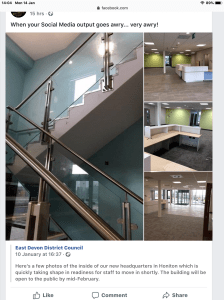
EDDC new HQ: take pics, post and boast on social media and ….

On 10 January 2019 EDDC posted pictures of its glam new shiny HQ building in Honiton

Unfortunately, they didn’t think it through and here are a few comments on that post:

Excellent!! So whilst many many families can’t afford to eat and are having to use food banks, or can’t afford gas and electric, you decide, the best thing to do is to put on your page pictures of your new offices, that the people who can’t afford to eat, have paid for it. …

They do as they please because they’re a law unto themselves. They can do what they want with your money and get away with it. You can argue with them til your blue in the face and NOTHING. They will always win. …

Shame you sold all the stuff from the old building off dirt cheap to the staff and councillors. £50 for a 24 seat mahogany table. Shame shame shame on you. …

My god, the more I see this, the more it’s unbelievable, really EDDC, you should be ashamed, not only is this building an eye sore on our towns landscape, the disgusting amount of money it is costing is nothing short of a disgrace, and then you have the audacity to show off the extravagant interior on Facebook, when there are families struggling to pay your thieving council tax. Let’s hope your illustrious leader, whoever he or she is, comes on here and apologises for this self indulgent, disgraceful post, shame on you EDDC!!!!!