DCC Health and Social Care “Scrutiny” – Claire Wright continues her battle

“Health and Adult Care Scrutiny Committee meeting: A PACKED AGENDA….

I asked for several items, including the future of our community hospitals, the plight of local carers, the local NHS deficit and what is being done to reduce it.

Also, on the agenda is how the local NHS coped with winter pressures (something I have asked for, for months and even resorted to a Freedom Of Information request on – it was refused, I have issued a formal complaint)……..

I have been really disappointed in recent months and years at what I see as a systemic lack of accountability in the NHS. As a Health Scrutiny Committee member, I would expect to get straight answers to straight questions at meetings, but unfortunately this rarely happens, which is why I was forced to submit a Freedom of Information request about a basic set of data tables relating to winter pressures.

I will not hesitate to do this again.

The report on carers starts on page 55 of the link below. This came about after I read a detailed survey and saw that local people who are caring for loved ones may not feel very supported.

I subsequently had a meeting with senior officers and saw the raw (anonymised) data from local focus groups. It was disturbing and it appeared to me that many local carers are having a really hard time managing, because of the government’s austerity agenda. I asked for the report to be referred to the Health Scrutiny Committee, but was told this wasn’t possible as consent had not been given by the participants of the focus group.

A version of the report has been submitted instead. I am pleased that a number of measures have been put in place by officers to try and improve matters, however, I have already told senior officers that leaving out the comments has meant that the voice of carers has been lost, in my view.

I believe that there should have been an attempt to secure retrospective consent for the publication of the report, as without a proper voice, the government will simply carry on ignoring carers’ plight – and they deserve better.

If you want to read the reports – and if you care about our NHS I would urge you to! The link is here
http://democracy.devon.gov.uk/ieListDocuments.aspx

Members of the public are permitted to address the committee in the 15 minute slot at the beginning of the meeting, but need to register four days ahead to do so. Email Gerry.rufolo@devon.gov.uk

The meeting starts at 2.15pm on Thursday 7 June. It will be webcast from this link:

https://devoncc.public-i.tv/core/portal/home

and archived afterwards.

Sidford residents say resounding no to new industrial zone in village

“Residents and representatives blasted fresh plans for a business park between Sidford and Sidbury this week.

The reduced outline application failed to win over civic leaders and members of the public as it was unanimously opposed by Sidmouth Town Council’s planning committee on Wednesday.

Access, inadequate roads and flooding risk were among the reasons.

More than 150 residents, as well as town, district and county council representatives packed into Sidford Social Hall.

A change of use is being sought for the agricultural site, in Two Bridges Road, to provide 8,445sqm of employment floorspace.

District councillor Marianne Rixson said there was ‘zero requirement’ for the development and that the A375 was not wide enough to cope with traffic. She claimed the ‘only beneficiaries’ from the scheme would be the applicants, not ‘the people of the Sid Valley, nor the local economy’.

“It’s all about greed, not need,” added Cllr Rixson.

John Loudoun, of Sidbury, said it was ‘laudable’ for the applicants to promote alternative transport to the site, but the details were vague.

He added: “This is the wrong development in the wrong place. I support the need for local infrastructure – but not there. It will not be good for Sidford and I can assure you it will not be good for Sidbury.”

David Addis backed the application and said: “The Sid Valley needs to have a future supporting our families and the families that come after us. It should not just be a place for retired people or a holiday destination – we need a diverse economy.”

Joseph Marchant, agent for the applicant, said concerns from the previous proposals, submitted in 2016, had been listened to, adding: “It is quite substantially different, there is a huge reduction in volume. It represents 37 per cent of what was previously submitted. The volume of buildings would provide for 250 jobs and that is important in terms of providing the need identified in your allocated Local Plan as a district.”

Councillor Ian McKenzie-Edwards, who represents Sidford, said: “We know how busy that road gets. Putting this employment site where it is projected is going to exacerbate traffic. It’s going to lower the quality of life. The village of Sidbury; the traffic there is horrendous sometimes.”

Cllr Ian Barlow recommended that the council did not support the plans over the same concerns expressed about the 2016 application.

He said: “It is in the Local Plan, we know it is, and we fought to keep it out. Mistakes were made and we have seen it already. The Local Plan is a massive document and no council, however good or bad, can get it all right. If it is wrong, change it and have the guts to admit the mistake was made. It is a stupid place to put it. It’s expensive to build, it’s not required, certainly not the size of it – there has been no demand proved.”

A public meeting over the plans is due to be held in Sidford Social Hall on Tuesday, at 6.30pm.

The fate of the application will be decided by the district council.”

http://www.sidmouthherald.co.uk/news/resounding-no-for-sidford-business-park-proposal-1-5542075

“Town council ordered to disclose contract with developer for sports complex sale” [for housing]

“The First-tier Tribunal has upheld a decision by the Information Commissioner’s Office that required a town council to disclose a contract entered into more than five years ago with a developer over the multi-million pound sale of a sports complex.

The case of Hemsworth Town Council v Information Commissioner & (Dismissed : Freedom of Information Act 2000) [2018] UKFTT 2017_0120 (GRC) involved conjoined appeals as the separate requests for information were materially identical.

The requests centred on the contract between Saul Construction, the developer, and Hemsworth Town Council in respect of the sale of the Hemsworth Sports Complex.

Entered into in early 2011, the development was to consist of more than 150 homes. It was agreed that the town council would take over a new community centre and new football facilities. That has happened.

Planning permission was sought for the site but was quashed by the High Court. Permission has been re-granted but is the subject of another judicial review.

Because of the hiatus caused by the judicial reviews, Saul Construction has refused to complete the contract. Title therefore remains with the council. The developer has paid £360,000 pursuant to a section 106 agreement and paid part of the contract price. Some £1.4m remains outstanding from the purchase price. The council and the developer are seeking to renegotiate the contract.

The requesters are local residents who have expressed concern about various environmental issues resulting from the sale and loss of open space.

The town council refused their request, arguing that the documents were exempt from disclosure under s. 43(2) of the Freedom of Information Act 2000, which covers commercial interests. This was upheld on review.
When the solicitors to one of the requesters cited the Environmental Information Regulations 2004 (“EIR”), the council relied on the exemption in regulation 12(5)(e) (legitimate economic interests). It did not however explain why.

On review, the council maintained its decision and argued that the public interest favoured withholding the requested information.

After receiving a complaint, the ICO concluded that the EIR, rather than FOIA, applied.

The ICO decided that the town council had failed to discharge the burden on it of establishing that regulation 12(5)(e) was engaged. “With regard to legitimate economic interests, under Tribunal caselaw it had to be shown that, on the balance of probabilities, adverse effects would accrue.” [Tribunal’s emphasis]

The authority had failed to identify any specific adverse effects arising from the disclosure of the disputed information (or parts of it), the ICO found. It concluded therefore that it did not need to apply the public interest test.

Hemsworth Town Council appealed, but this has now been rejected by the First-tier Tribunal.”

http://localgovernmentlawyer.co.uk/index.php?option=com_content&view=article&id=35511%3Atown-council-ordered-to-disclose-contract-with-developer-for-sports-complex-sale&catid=59&Itemid=27

Dirty money?

“Tories take Putin’s pal £50,000… on the day Theresa May blamed Russia for Skripal poisoning”

… On the very day Mrs May was firmly pointing a finger at Vladimir Putin over the Salisbury murder bid, a former Kremlin aide’s wife ploughed the cash into the Tory party’s coffers.

And Lubov Chernukhin gave a further £50,000 to the Conservatives as police investigated the assassination attempt on Sergei Skripal and his daughter Yulia – bringing the total donated in the two weeks after the poisoning to £100,000.

Lubov’s husband Vladimir is Putin’s former deputy finance minister.

Lib Dem leader Sir Vince Cable branded the payment “sheer hypocrisy”.

He said: “The Conservatives should have returned the money straightaway.

The very least they can do is return this now.”

Labour Party chairman Ian Lavery added: “It smacks of hypocrisy for Theresa May to accept tens of ­thousands of pounds from a donor with links to Putin’s regime on the same day she denounced the Kremlin over the Salisbury attack.

“The Tories need to come clean with the public about what checks they have made on the wealth amassed by their super-rich donors.”

It comes after we revealed two Tory peers – Lord Hague and Lord Barker – are both earning thousands of pounds a year from firms slammed by MPs over links to the Kremlin.

Lubov’s gift was on March 12, according to official records seen by the Mirror.

… When she took office in July 2016, the PM said it would not be “business as usual” with Russian donors amid growing tensions between Moscow and the West. But her party has since received more than £800,000 from Russian-linked supporters.

Banker Lubov alone has donated more than £600,000 since 2010.

It is understood she has lived here for many years and is a British citizen. There is no suggestion she has no right to donate to the Tory party. …”

https://www.mirror.co.uk/news/politics/tories-given-50000-kremlin-aide-12630498

Councils’ end-of-year accounts – the effects of austerity on the accounting function

[The bold highlighted sections are those of Owl]:

“Under the Accounts and Audit Regulations 2015, English local authorities are expected to have their 2017–18 statement of accounts prepared, audited and published by 31 July, a reduction of two months (33%) on previous years.

Changes are obviously being implemented in different ways at different authorities, but some common themes and early learning is starting to emerge.

These can be summed up under four separate headings: Leadership, process, capacity and co-operation, and external audit.

Leadership

If year-end closedown is not seen as a priority by senior management, either the deadlines will not be achieved or the quality of the end-product will suffer. The statement of accounts should be seen as a corporate priority, because it explains how the authority has spent taxpayers money.

Successful section 151 officers “walk the talk” by:

Allowing key staff to focus on closure and not distracting them with other tasks in this important period.

Leading, not just attending, meetings to plan closedown work and monitor progress made to date.

Providing strategic direction on complex and potentially contentious accounting issues.

Fostering good working relationships with the external auditors at director/audit manager level — this pays dividends when unexpected problems crop up late in the day.

Process

First of all, start early. Prior year comparatives, accounting policies, and around half of all disclosure notes can all be drafted and audited well in advance of the year end. Secondly, avoid unnecessary effort by taking the following steps:

Keep journal postings up to date, clear suspense accounts regularly and reconcile bank accounts and feeder systems monthly.

Use estimation techniques to simplify accruals, provisions, overhead re-allocations and similar calculations.

Apply materiality levels and de-minimis thresholds intelligently to avoid unnecessary work and to “de-clutter” core statements and disclosure notes.
Capacity

Following eight years of austerity many back-office services in local government are running at not much more than minimum staffing levels and have insufficient headroom to deal with the additional workload year-end closure represents.

Take a pragmatic approach to staffing needs and recruit accordingly.

Increasingly, local authorities are buying-in short-term capacity to provide specialist skills or improve team resilience.

An alternative approach is using existing resources more flexibly. Some year-end tasks are complex, but many disclosure notes can be prepared by anyone with basic numeracy and spreadsheet skills.

Managing a cast of thousands does take time initially but this reduces as they gain confidence, and most employees will welcome the opportunity to try something new.

All finance staff, including budget holders and treasury management teams, should expect to be involved in closedown.

Co-operation with external audit

Spare a thought for the auditors. Practitioners, in most cases, will only have one set of accounts to worry about, whereas an external audit team might have five or six.

Inevitably, clients who provide good quality raw material and respond quickly to audit queries are expecting to receive earlier certificates and opinions. Auditors also seem to be trying to save time by looking to clients to provide audit evidence and accounting views that they might previously have obtained for themselves, or referred back to specialist technical teams.

Working pro-actively with the local audit team to resolve outstanding issues and avoid unnecessary delays, will be key to meeting the new deadlines this year so I suggest the following:

Operate a no surprises policy: Hold early meetings to discuss complex or contentious issues and any proposed changes to the accounts, working papers or key personnel.

Document the basis of any judgements exercised and assumptions made when preparing the accounts, and the rationale for any changes in accounting policies.

Be prepared to draft, at short notice, briefing notes on any technical issues arising. This forces you to understand the technicalities and provides the auditor with a much clearer answer to the question being raised.

Provide a range of calculations for estimated accruals and provisions so that auditors can confirm these represent the average, or most likely outcome.

Evidence all quality assurance and review processes undertaken at pre-audit stage so that auditors can rely on this work to reduce their own levels of testing.

Prepare comprehensive working papers that provide a clear audit trail and demonstrate that key code requirements have been met.

And finally, don’t forget to manage the on-site audit process. Nominate a key contact point who will take on responsibility for ensuring that audit queries and requests for further information are dealt with promptly (and comprehensively) and that changes to the accounts are processed as agreed.

Peter Worth
director at Worth Technical Accounting Solutions.”

George Osborne courts controversy – cash for brand placement allegations

“Former Chancellor George Osborne was embroiled in a row on Thursday over claims that London’s Evening Standard promised ‘money-can’t-buy’ coverage to big businesses for £3million.

The newspaper faced accusations it had effectively sold positive news coverage to brands including Google and the controversial taxi app Uber, in return for sponsorship of a planned campaign.

The two were among six firms to each pay £500,000 to be part of the paper’s ‘London 2020’ project which will highlight issues including air pollution and housing.

The Evening Standard said it had agreed partnerships to support its campaign but denied the deals threatened its editorial integrity and independence. It said any commercial content would be ‘clearly identifiable’.

Mr Osborne became the newspaper’s editor last year and was said to have directed the London 2020 project, pitched to potential commercial sponsors as offering ‘money-can’t-buy’ coverage.

A sales presentation to businesses said: ‘We expect every campaign to generate numerous news stories, comment pieces and high-profile backers.’

Details of the deal were revealed on the news website open-Democracy, which claimed the Standard offered ‘favourable’ editorial comment and news coverage as part of its sales presentation. …

Blurring the line between journalism and advertising, or allowing commercial pressures to influence editorial content is generally seen as a breach of Britain’s robust tradition of Press freedom and independence.

Mr Osborne’s appointment as editor attracted criticism after it emerged that he had a £650,000-a-year part-time advisory job with City firm BlackRock, which holds a £500million stake in Uber.

The Cameron-Osborne government also came under fire for its close links to Uber. Black cab drivers brought Westminster to a standstill in a protest over claims that former prime minister David Cameron and Mr Osborne told aides to lobby against a planned crackdown on the online firm in 2015.

Rachel Whetstone – a friend of Mr Cameron who is married to his former strategist Steve Hilton – quit her job as Uber’s policy chief as it emerged the information watchdog had begun an investigation into the affair. Critics had raised concerns about the extent of her influence over the Cameron government, both in her role at Uber and in her previous job at Google. …

The Evening Standard was owned by the Daily Mail’s parent company but was sold to Russian-born businessman Alexander Lebedev and his son Evgeny in 2009. …”

http://www.dailymail.co.uk/news/article-5793155/George-Osborne-faces-backlash-cash-editorial-claims-London-Evening-Standard.html

“Judge quashes grant of planning permission for watersports hub”

“The Administrative Court has quashed Cheshire West & Chester Borough Council’s grant of planning permission for a watersports centre after finding that this changed from a facility for members to one for the public without proper notice to objectors.

HHJ Raeside said Clive Sykes, who lives next door to the site concerned, argued that the council failed to consult on a submission of last-minute information altering the nature of the application from members only use to that of the general public.

In Sykes v Cheshire West & Chester Borough Council [2018] EWHC 3655 (Admin) Mr Sykes argued there was no opportunity for the public to make representations on this late information and the failure to consult was contrary to rules of natural justice.

The judge said: “Any fair reading of a combination of one or more salient planning documents published…prior to the day of the planning hearing make it palpably clear that it was their intention…that the Watersports Hub was to be for use of a private club mainly the boathouse and that had existed for many years before, well-known for its members only [policy].”

He rejected the council’s claim that the change from this to an application for a facility for public use could be reasonably called “a clarification”.
“It is difficult to imagine how a change of use of facility from members only to those of the public can possibly be described as a ‘clarification’,” he said.

“In the ordinary use of the English language this is best described as a volte-face (of course allowing the introduction of French into the English language).”

The judge though dismissed two other grounds argued by Mr Sykes, that the council failed to heed environmental protection team advice that a full assessment was needed of the noise impact, and that planning committees were misled into believing that consultees had been aware the wider public would have access to the facility.”

http://localgovernmentlawyer.co.uk/index.php?option=com_content&view=article&id=35472%3Ajudge-quashes-grant-of-planning-permission-for-watersports-hub&catid=63&Itemid=31

“8,900 checks on NHS ‘health tourists’ find just 50 liable to pay”

It almost certainly cost more to find the 50 than to leave this alone.

So, knock on the head – it is underfunding to speed privatisation that is bringing our NHS to its knees NOT health tourism!!!

https://www.standard.co.uk/news/health/8900-checks-on-nhs-health-tourists-find-just-50-liable-to-pay-a3850121.html

Buying votes – Tories in the lead

“The Conservative Party accepted £4.7 million of donations in the first three months of 2018, new data shows.

Theresa May’s party received more than three times as much as Labour between January 1 and March 31.

Labour accepted £1.49 million in donations.

The Liberal Democrats received £564,135 and the Green Party just £1,800.

This is £2.4 million less than what was accepted during the same period last year (£9.3 million). …”

https://www.mirror.co.uk/news/politics/tories-rake-donations-almost-5million-12620324

Swire and his investment in “emerging economies”

Our MP Hugo Swire is investing in “emerging economies” with his controversial pal, Lord Barker:

https://eastdevonwatch.org/2018/05/28/swire-and-eaglesham-investments-still-not-on-his-register-of-interests/

But what is an “emerging economy”? Fortunately, a business publication has an explanation:

” … Top of the list of emerging markets is China, according to Ross Teverson, co-manager of Jupiter Emerging & Frontier Income Trust. China’s economy is predicted to grow by 6.6 per cent in 2018, compared to 1.6 per cent for the UK economy, as stated by the International Monetary Fund.

“China is the obvious example of an emerging market country making rapid and dramatic economic progress; today, a number of Chinese companies rank among the largest and most innovative globally.”

Another region to consider is sub-Saharan Africa, according to Teverson, where a growing middle class, as well as improved infrastructure, communications, and technology, is creating several attractive long-term investment opportunities.

“Gradually increasing penetration of financial products, combined with remarkable demographics – the median age in Kenya is just 20 years – should create a backdrop that, for well-placed financial institutions operating in the region, should prove conducive to strong and sustained earnings growth for a long time to come.”

While some savers might be sceptical of putting their money at risk in these markets, it’s worth remembering that the emerging economies of today may likely grow into leading, developed ones in the future.

After all, the world’s largest economy, the US, was actually considered an emerging market 150 years ago. …”

Source: City AM
http://flip.it/V6OcZV

So, no investment in East Devon then!

What can a National Park do for East Devon?

“Following Michael Gove’s announcement that the Government will look at creating new National Parks – what will it mean to East Devon if a Dorset East Devon National Park were to become a reality?

A National Park is an exciting vision for our countryside, communities and economy and it can become a reality. It would work in partnership to:

• Conserve and enhance our great landscapes and heritage
• Boost our economy and attract new funding, investment and jobs
• Make the new National Park a global brand and destination; adding opportunity and value to our tourism businesses and local producers
• Help farmers and land managers to access funding and other support
• Work with communities for appropriate development, affordable homes for local people and a thriving, successful location
• As the planning authority for its area, partner with Councils and help deliver what our communities need

IT WILL LOOK AFTER OUR ENVIRONMENT

The Dorset landscapes and heritage are very special. They have been judged to be amongst the top 4 percent in the country.

The environment is Dorset’s and East Devon’s greatest economic asset and the National Park would have a duty to look after and promote our environment and heritage.

IT WILL SUPPORT COMMUNITY LED DEVELOPMENT IN THE RIGHT PLACES

The National Park would work with communities, councils and businesses to meet local needs, including housing and affordable homes for local people. National Parks are not against development, and they build on neighbourhood
plans to support thriving local communities.

The National Park would be a one-stop-shop for co-ordinated planning advice and would work in partnership with other local authorities.

IT WILL BOOST THE RURAL ECONOMY

A National Park would boost the rural economy and attract investment and jobs. Tourism is the area’s largest economic sector, and a National Park brand would put the area on the world map and encourage visitors to stay longer and spend
more.

It would help develop an area wide marketing strategy, manage tourism pressures and could attract funding for sustainable transport.

IT WILL HELP FARMERS AND LANDOWNERS

A National Park would help farmers and landowners to access funding and other support, and help them diversify and thrive as well as pursue conservation and recreational opportunities.

IT WILL BRING NEW AND EXTRA FUNDING

National Parks are separately funded by Government and not by residents or businesses. They also bid for extra funds which are invested in the local economy, in partnership with communities, not-for-profit and commercial businesses, farmers and landowners.

A National Park will be an asset and a close, efficient partner for the Councils and complement their work. It would bring additional resources and free up some council funding to help support local services and communities.

The South Downs NPA has secured over £100m in core and project funding since 20115.

HOW WOULD NATIONAL PARK STATUS HELP DORSET AND EAST DEVON?

National Parks have a responsibility to:

• Conserve and enhance the environment.
• Promote recreation, health, and the enjoyment and understanding of the special qualities of their area.
• Foster the economic and social wellbeing of their communities.

Let’s hope East Devon District Council make the right decision!

Boundary problems and a headache for EDDC’s new leader

What is fascinating about this spat is that a park and ride scheme can be deemed a harmful impact in an AONB.

Owl wonders if this will therefore similarly be a material consideration for a new industrial park planned in Sidford?

“A park and ride service which operated to the West of Lyme Regis has been halted.

East Devon District Council last week refused planning permission for a further temporary consent for the site, off the A3052, in Uplyme.

The application, from Lyme Town Council, was rejected on the basis of a lack of evidence provided to justify a need for the facility and that, as a result, this would have a harmful impact upon the Area of Outstanding Natural Beauty (AONB).

East Devon’s planning department had previously granted temporary consents for the park and ride use to support businesses in Lyme Regis and visitors to the town, but despite ample time being given to Lyme Regis Town Council to justify the park and ride’s continued use, the required information had not been received, say officials.

Since 2014, the district’s planning authority says it has consistently asked Lyme Regis Town Council to gather evidence to justify the need for a park and ride in the location in Sidmouth Road.

Despite the town council having four years in which to do this, the work has still not been carried out, says EDDC.

In addition, East Devon is not convinced that the proposed site is the best location for a park and ride facility, or that a further park and ride site is required, given that the majority of the traffic does not enter the town from the West on the A3052 where the site is located, and that the park and ride on Charmouth Road, to the East of Lyme Regis, has very recently been granted planning permission to operate 400 spaces over a longer seasonal period.

EDDC says it is happy to entertain a future planning application for the site, but it needs to be supported by justification for the use of the site. In addition, robust evidence of the need for the facility and justification that the proposed site is the most appropriate location to serve visitors to the town must be provided.

Cllr Ian Thomas, Leader of East Devon District Council and ward member for Trinity, which includes Uplyme, said: “East Devon planners, Uplyme Parish Council and I have worked for several years, in the interest of Lyme Regis traders, residents and visitors, in what has become a uniquely frustrating process.

“Last Summer, contrary to planning guidelines, I was able to secure a further last minute temporary consent.

“I was only able to do so: ‘….to allow the newly formed working group, including representatives from Devon and Dorset County Councils, East Devon and West Dorset District Councils. Lyme Regis Town Council and Uplyme Parish Council, to use such information in the development of a strategic approach to the management of traffic and parking requirements…”

“Sadly, this group has never met…

“It is disappointing that another planning application (validated on 19 March 2018) was submitted by Lyme Regis Town Council, seeking further temporary consent from 30 March 2018. The application is essentially a copy of that submitted in 2017, so it again neither offers supporting evidence requested following the 2014 application, nor demonstrates any significant progress in that direction.

“This lack of progress makes it impossible for me to intervene again on the grounds I used in 2017.

“Despite several instances of ‘factual inaccuracy’ by the applicant, I commend both East Devon planners and Uplyme Parish Council on their rigorous adherence to dealing professionally with each successive application, according to planning policy and guidelines.

“Notwithstanding difficulties experienced to date, I am confident that East Devon District Council, Uplyme Parish Council, other local authority neighbours and I, remain willing to work with Lyme Regis Town Council to develop the best possible long-term solution to the management of traffic and associated parking requirements in and around Lyme Regis and Uplyme.”

Lyme Regis deputy mayor, Cllr Steve Miller, said: “Lyme Regis Town Council was extremely disappointed to learn, immediately prior to a busy bank holiday and the school half term, that East Devon District Council refused the application for continued temporary use of the Sidmouth Road park and ride site.

“We are surprised by the tone and content of the press release issued by East Devon District Council, a copy of which was not supplied to the town council. We believe such a release is not normal practice on refusal of a planning application.

“The town council will obviously review available options before deciding how to proceed, which may involve appealing the planning authority’s decision.

“In the meantime, the work to obtain the evidence previously requested by East Devon District Council has already been commissioned via independent experts Hydrock and will continue. However, this has been made more difficult by the refusal of the Sidmouth Road application.

“This work will ascertain the best parking, transport and signage strategies for the town and will be pursued by the town council in the best long-term interests of the residents and businesses of Lyme Regis and those visiting the town we all love.

“The 400-space Charmouth Road Park and ride site will continue to operate throughout the peak summer periods. In addition, the town council has just agreed to extend the bus service to include all June weekends.

“The town council is grateful for the help and support it received from West Dorset District Council, its local representative and the landowner in achieving the permanent permission for the use of the Charmouth Road facility, which is also in an area of outstanding natural beauty.” …

http://www.midweekherald.co.uk/news/planners-reject-lyme-park-and-ride-application-1-5538074

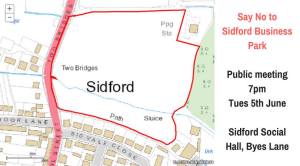
Sidford Industrial park: planning meeting 30 May, 6.30 pm, Sidford Social Hall

It will be interesting to see which side Councillor Hughes backs …

Press release:

“While many of us were hoping it wouldn’t happen, it’s not a huge surprise that Tim and Mike Ford have submitted a new application to build a business park in Sidford. If you haven’t already heard about it you can read this article from last Friday’s Herald:

http://www.sidmouthherald.co.uk/news/new-business-park-plan-is-unveiled-1-5522422

The council is holding a public planning meeting on

Wednesday 30 May 2018
at 6.30pm
at Sidford Social Hall
in Byes Lane

Please come along and have your say. And please tell your friends about it.

If you want to keep up with the campaign as it develops please like the Say NO Facebook page:

https://www.facebook.com/sayNOtoSidfordBusinessPark/

Has East Devon missed out already on a joint East Devon/Dorset National Park?

PRESS RELEASE:

Dorset National Park Welcomes Michael Gove’s Announcement

A press release Monday 29 May 2018 x the Dorset National Park Team

“The Dorset National Park Team welcomes the statement by Michael Gove, Secretary of State for DEFRA, that the Government’s review of designated areas to be led by Julian Glover will consider whether more national parks are needed. A Dorset National Park was first proposed along with others which have subsequently gone ahead in a Government report of 1945. For reasons specific to the time it was not then progressed. But now there is cross-county and cross-party support for conserving and enhancing a landscape that includes the World Heritage Jurassic Coast, inland Ridgeways and the area of Thomas Hardy’s novels.

A Dorset National Park would be at the heart of southern England, next to the largest non-industrial conurbation in the country – Poole/Bournemouth – and within easy public transport reach of London, the South East, Midlands and Bristol. The Purbeck area of Dorset has the greatest biodiversity of any area in the country. But Dorset’s landscape, heritage and wildlife need to be safeguarded and enhanced.

A Dorset National Park would work in partnership with its communities, councils, landowners, farmers and businesses to ensure its communities thrive and are sustainable.

We look forward to working closely with Julian Glover in his review.
For more information see http://www.dorsetnationalpark.com/”

The key arguments East Devon District Council had in 2015 to reject a joint National Park were:

1. Loss of planning powers
however South Downs NP uses the Local Authority to administer the Parks Planning Process.

2. Prevention of ‘good growth’ in areas of low skill, low wages, economic weakness and housing shortage, especially affordable.
It has been shown that growth can be achieved in National Parks and provision of housing especially affordable is achievable with grants and government support.

3. Restriction and concentration of jobs and housing growth in the west of the District with minimal benefit deriving eastwards.
The GESP and the Local Plan are already doing this anyway!

4. Sensitive but non- National Park or AONB designated areas of the District may come under increasing and concentrated pressure of development.
As 3 above. Look at Cranbrook, Ottery St Mary, and Clyst St Mary!

There is a danger that the East Devon areas outside the already designated AONBs will be the major growth point as Dorset and other Devon Councils lobby and possibly achieve special status for their own areas.

EDDC must work with the National Parks/AONBs together with Greater Exeter to provide the best possible outcome.

Auditers and privatisation

“It is difficult to get a man to understand something”, wrote Upton Sinclair, “when his salary depends upon his not understanding it.”

https://www.theguardian.com/news/2018/may/29/the-financial-scandal-no-one-is-talking-about-big-four-accountancy-firms

“May’s £2bn housing pledge not enough, say Tory council leaders”

“The survey of 121 Tory council leaders and heads of housing from across the country, funded by the Joseph Rowntree Foundation, found an overwhelming majority – 96% – wanted low-cost rented homes to form part of the solution.. …”

https://www.theguardian.com/society/2018/may/29/mays-2bn-housing-pledge-not-enough-say-tory-council-leaders

How “Big 4” auditors went bad

Long read but very meaty. Basically, auditors can be rogues, too. Well, fancy that!

https://www.theguardian.com/news/2018/may/29/the-financial-scandal-no-one-is-talking-about-big-four-accountancy-firms

“Government’s Help to Buy housing scheme increasingly benefiting higher earners”

“The government’s flagship, multibillion pound scheme for helping people to buy a home is increasingly giving taxpayer-funded loans to higher earners, The Independent can reveal.

The Help to Buy initiative was designed to help cash-strapped buyers, but analysis reveals the average salary of people receiving equity loans has shot up since it was introduced.

Official government data reveals the average household income of people benefiting from the £8.3bn scheme is continuing to rise, and now stands at just under £50,000.

London, the figure is even higher, with the average recipient of a Help to Buy loan having a household income of almost £72,000….

Almost one in five Help to Buy beneficiaries are already homeowners, and on average these recipients are wealthier than first-time buyers, with an income £8,500 higher.

The Independent has previously revealed how millions of pounds of public funds are being loaned to people with an income of more than £100,000.

The latest figures reveal that more than 6,200 households with an income of more than £100,000 have benefited from taxpayer-funded loans.

The Department for Housing, Communities and Local Government has been contacted for comment.”

Source:Independent