“Further defects found at housing [new-build apartments] with Grenfell-style cladding”

“More than a dozen fire safety concerns have been uncovered in a new housing complex covered in Grenfell-style flammable cladding, built by one of Britain’s biggest housebuilders, Galliard Homes.

In the weeks after the Grenfell Tower fire, which claimed 71 lives, defective fire doors, missing fire-stopping, dangerous fire escapes and holes in plasterboard meant to stop the spread of flames and smoke were identified by fire officials at New Capital Quay in Greenwich, London, which is home to about 2,000 people and opened in 2013.

The Guardian has learned that another deficiency notice from the London Fire and Emergency Planning Authority (LFEPA) was issued on 25 January in relation to all 11 blocks in the complex.

It identified 16 fire safety issues, including a lack of arrangements to evacuate vulnerable and elderly residents, an ineffective maintenance regime, a broken firefighting lift and a broken fire hydrant outside one of the blocks.

It also found that “the procedures to be followed in the event of serious and imminent danger to relevant persons are inadequate”, raising residents’ fears about being trapped in the event of a fire.

Ruth Montlake, 85, who lives on the seventh floor of one of the blocks, said: “The fire situation is very worrying. I am hard of hearing; how will I know to evacuate?”

Simone Joseph, 35, a fashion buyer and mother of a seven-year-old boy, said there had been three fires in her block in the time she had lived there.

“To know that seven months down the line we are living in this property with this cladding is upsetting,” said Joseph, who rents from Hyde Housing, the head leaseholder of two of the blocks. “People have been cutting corners for so many years and are putting people’s lives at risk and they have to be held accountable.”

With more than 1,000 homes, New Capital Quay is believed to be one of the biggest single private housing developments in the country discovered to have flammable cladding in the wake of Grenfell. Galliard sold two-bedroom apartments for £700,000.

A fire warden patrol was put in place when the cladding was discovered last summer, but residents are concerned that it is still in place seven months after the west London disaster.

“We simply do not feel safe living in buildings with defective cladding that could rapidly go up in flames while we are sleeping,” one woman told the local council in an email exchange.

Galliard said some of the defects identified in July had been addressed and there had been no issue with missing fire-stopping material, just an error during the inspection.

It said the building was different to Grenfell: “Totally unlike Grenfell, NCQ was built and still has full and proper fire precautions with fire doors, fire-stopping, fire alarms, smoke-extract systems and no gas in apartments. The block at NCQ which has the most cladding has a full sprinkler system throughout.”

It also said that three of the 16 issues raised by fire authorities in its latest report were “not true” and questioned two further issues.

Asked whether residents were safe, Galliard said LFEPA was the leading expert. “They have the statutory power to issue notices to evacuate the homes. They have to date decided not to do so,” it said.

While residents fear their lives are at risk while the cladding remains, they are also concerned they will be asked to pay the estimated £20m-£40m bill – between £20,000 and £40,000 a flat – to make it safe. In addition, they face a £1.25m bill for round-the-clock fire patrols.

But they are particularly concerned about how difficult it is to get information and said they were forced to use a freedom of information request to uncover the fire safety notices from the London Fire Brigade (LFB).

Galliard, which is facing a bill of up to £40m, is planning to sue the warranty and insurance provider, National House Building Council. NHBC has indicated it will defend the claim.

Meanwhile, 30 fire marshals are patrolling the 11 buildings 24 hours a day at an estimated cost of £25,000 a week. But residents are concerned that wardens are not the solution.

Annabel Parsons, 54, a business psychologist who lives in the complex, said one marshal had been spotted asleep and another had brought a blanket with him. Before they were equipped with hand-held klaxons, one warden said their plan to raise the alarm in the event of a fire involved throwing stones at windows, residents claimed. Galliard said that without a date, time, name and other details of the fire marshal, it was an “impossible allegation to investigate”.

Hyde Housing, which has interests in six of the blocks as well as being head leaseholder in two, said the situation was “very distressing” for residents.

“We urge all those bodies involved in resolving this matter to do so speedily,” said Brent O’Halloran, director of asset management at Hyde.

A recent tribunal regarding a building in Croydon was told that official guidance was that fire wardens were the “least-efficient, most resource-intensive” solution of three recommended by LFB.”
https://www.theguardian.com/society/2018/feb/15/further-defects-discovered-at-housing-with-grenfell-style-cladding

Public sector workers’ children in poverty: highest rate is in South West

“Tens of thousands of children of public sector workers will be living in poverty by the end of next month, unions warned.

Parents working for the NHS, schools and councils may not be earning enough to make ends meet due to the government’s cap on public sector pay and in-work benefit cuts.

Research by the TUC found that one in seven children of public sector workers will be pushed below the poverty line by the end of March. Around 550,000 children living with a public sector worker in the family will be classed as being in poverty by the end of the current financial year, said the union organisation.

The South West has seen the biggest increase in child poverty rates among families with a public sector worker, followed by the North West and East Midlands, the study found. TUC general secretary Frances O’Grady said: ‘The Government’s pay restrictions and in-work benefit cuts are causing needless hardship. …”

Read more: http://metro.co.uk/2018/02/15/children-nhs-school-council-staff-living-poverty-7314885/

Has Clinton Devon Estates completely lost its moral compass (if it ever had one)?

Background: Background: in 1887 to mark Queen Victoria’s Golden Jubilee the philanthropist and benefactor Hon. Mark Rolle “leased” the Budleigh Salterton hospital site and garden to the people of the Town. After his death in 1907, the Rolle Estate passed to the 21st. Baron Clinton and was absorbed into the Clinton Devon Estates. 131 years later CDE have fenced off two-thirds of the garden from use by the newly formed Hospital Wellbeing Hub just as the children attending a nursery there were beginning to use it for recreational purposes and Spring arrives.

Article in Journal:

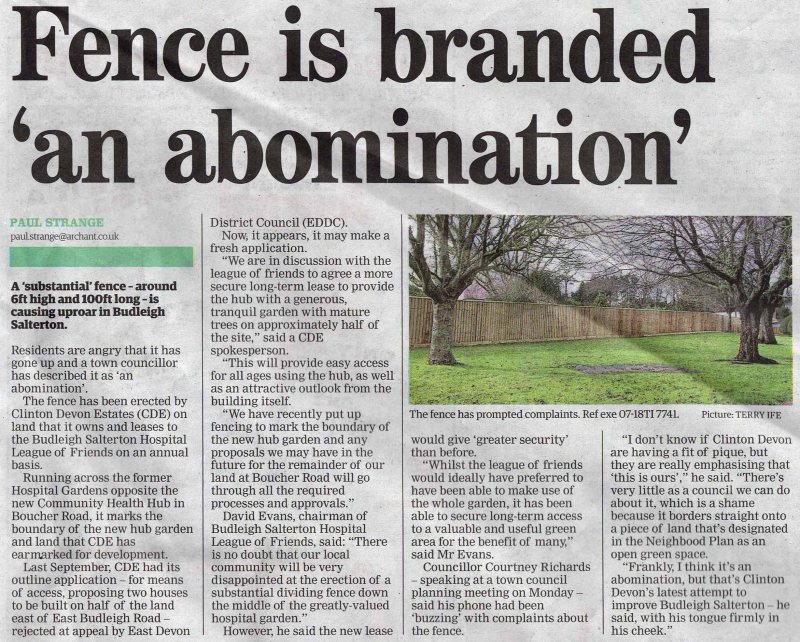
“A ‘substantial’ fence – around 6ft high and 100ft long – is causing uproar in Budleigh Salterton.

Residents are angry that it has gone up and a town councillor has described it as ‘an abomination’.

The fence has been erected by Clinton Devon Estates (CDE) on land that it owns and leases to the Budleigh Salterton Hospital League of Friends on an annual basis.

Running across the former Hospital Gardens opposite the new Community Health Hub in Boucher Road, it marks the boundary of the new hub garden and land that CDE has earmarked for development.

Last September, CDE had its outline application – for means of access, proposing two houses to be built on half of the land east of East Budleigh Road rejected at appeal by East Devon District Council (EDDC).

Now, it appears, it may make a fresh application.

“We are in discussion with the league of friends to agree a more secure long-term lease to provide the hub with a generous, tranquil garden with mature trees on approximately half of the site,” said a CDE spokesperson.
“This will provide easy access for all ages using the hub, as well as an attractive outlook from the building itself.

“We have recently put up fencing to mark the boundary of the new hub garden and any proposals we may have in the future for the remainder of our land at Boucher Road will go through all the required processes and approvals.”

David Evans, chairman of Budleigh Salterton Hospital League of Friends, said: “There is no doubt that our local community will be very disappointed at the erection of a substantial dividing fence down the middle of the greatly-valued hospital garden.”

However, he said the new lease would give ‘greater security’ than before.
“Whilst the league of friends would ideally have preferred to have been able to make use of the whole garden, it has been able to secure long-term access to a valuable and useful green area for the benefit of many,” said Mr Evans.
Councillor Courtney Richards – speaking at a town council planning meeting on Monday said his phone had been `buzzing’ with complaints about the fence.

“I don’t know if Clinton Devon are having a fit of pique, but they are really emphasising that `this is ours’,” he said. “There’s very little as a council we can do about it, which is a shame because it borders straight onto a piece of land that’s designated in the Neighbood Plan as an open green space.

“Frankly, I think it’s an abomination, but that’s Cl in ion Devon’s latest attempt to improve -Budleigh Salterton in, said, with his tongue firmly in his cheek.”

Oxford Tory toffs club (hon President Jacob Rees-Mogg) goes on rampage

The honorary president of this club is Jacob Rees-Mogg; Theresa May and her husband were both members when they were at Oxford.

“Arrogant young Tories ran riot at a prestigious university event where they allegedly groped women before going on to abuse pub locals.

The disgraceful behaviour came during a popular Port and Policy party run by the Oxford University Conservative ­Association, which has PM hopeful Jacob Rees-Mogg as honorary president.

Horrified students told how they saw sozzled men try to kiss and fondle women while downing up to 43 glasses of port each in boozing competitions.

Organisers who refused to serve the drunks more booze were shouted down with one reveller allegedly screaming: “I’ll buy their families.”

They then besieged the nearby King’s Arms pub and shouted “Buller, Buller, Buller” – a ­reference to the infamous ­Bullingdon Club society of boozing yobs.

The louts were also heard yelling at locals: “My castle’s bigger than yours.”

The braying mob also smashed glasses and bottles outside the building. …

“There have been numerous reports from members that last Sunday several attendees at Port and Policy groped, touched, kissed (or attempted to), or otherwise harassed female guests.

“We have also heard rumours of similar incidents occurring in previous weeks. I hope there is no doubt that everyone here today finds it totally ­unacceptable that women were made to feel uncomfortable in this way.

“We believe senior members have been ignoring sexism and misogyny, not because they are themselves sexist, but they are worried about the public image of themselves and the association.

“Instead of trying to address the bad PR caused by this issue, we should be addressing the issue itself.”

OUCA President Timothy Doyle said tonight: “The association takes very seriously indeed all allegations of misconduct at its events.

“A member has been suspended until the end of term, following drunkenness at an event. Any allegations of sexual harassment are passed on to university authorities. No allegation received has been ignored.” …”

https://www.dailyrecord.co.uk/news/politics/tory-students-oxford-club-linked-12022112

The Daily Mail goes into more detail and names some participants here:

http://www.dailymail.co.uk/news/article-5394811/Bullingdon-Club-students-groped-women-Tory-bash.html

240 councils have taken out high-risk “toxic” loans

“A cash-strapped council which has banned all new spending is currently repaying £150m in “toxic” loans.

Northamptonshire County Council has invoked the ban on expenditure as it faces a £21m overspend for 2017-18. It said it would cost more than a quarter of a billion pounds to immediately repay the LOBO – or Lender Option Borrower Option – loans, described by critics as “risky”.

A council spokesman said “interest rate risk is inherent” in all borrowing.
The county council has a total of 19 LOBO loans, which are unregulated and typically spread over 40 to 70 years. They were used to meet expenditure on highways, infrastructure, schools and other such assets.

The authority said said it would cost £256m to repay them straight away.

Critics say the repayments would be better spent on under threat services such as bus subsidies and Trading Standards. Joel Benjamin, from campaign group Debt Resistance UK, called the loans “toxic”. He said the county council has “fallen victim to a lethal cocktail of cuts”, poorly run shared-services and “high interest, risky LOBO borrowing.” Financial expert Abhishek Sachdev said LOBOs “contained huge quantifiable risk at the outset”.

Mr Sachdev, who gave evidence about LOBOs to the Communities & Local Government Select Committee in 2015, added: “There is a reason why none of our large PLC corporate clients would ever enter into such a loan.”
Freedom of Information requests by Debt Resistance UK show around 1,000 LOBO loans have been taken out across 240 local authorities.

The figures show these have a face value of £15bn, while Mr Sachdev estimated it would cost about £26bn to exit them straight away.”

http://www.bbc.co.uk/news/uk-england-northamptonshire-42977061

Carillion healthcare contracts sold to Serco at hefty discount

“Outsourcing giant Serco has secured a hefty discount on its deal to buy a raft of healthcare contracts from failed rival Carillion.

Serco said it would now pay £29.7m – down from the £47.7m price first agreed in December, before Carillion’s dramatic collapse into liquidation.

The move reflects the fact the contracts will have no working capital and will come with none of the usual warranties in place as a result of Carillion’s failure, according to Serco. …

… Serco’s deal will bolster its healthcare business, seeing it add a string of healthcare contracts spanning five acute hospital trusts and another 20 public sector organisations.

Just under 1,500 employees work on the contracts being acquired under the deal.

Serco’s existing health operations already generate revenue of over £350m, employ over 8,000 people, and provide services to institutions such as St Barts in the UK.

Serco employs more than 50,000 people across five sectors, including defence, justice and immigration, transport, health and citizen services.”

http://www.independent.co.uk/news/business/news/carillion-serco-healthcare-contracts-large-discount-collapse-latest-news-a8210136.html

Police numbers plummet as crime rises

“The number of police officers in England and Wales has fallen by 1,213 in six months and is now 16% below its 2009 peak, official figures have shown. The latest Home Office statistics put the number of officers in the 43 police forces in England and Wales on 30 September last year at 121,929, down from 123,142 on 31 March last year and from 144,353 in 2009.

In evidence submitted to the police remuneration review body last week, the Home Office made clear that no more central funding would be available for the pay settlement, describing the recruitment and retention of officers as “stable”. But Labour said that was out of touch with reality, given the figures.

The shadow policing minister, Louise Haigh, said: “Once again we see how out of touch the Conservatives are with the lives of people across this country. Over 1,200 officers lost in just six months, more than 21,000 in total under this Tory government, against a backdrop of the highest rises in recorded crime in a decade.

“And yet ministers apparently think everything’s fine. Labour in government will add 10,000 police officers and provide the resources they need.” …

https://www.theguardian.com/uk-news/2018/feb/13/police-numbers-drop-by-1200-in-six-months-as-wage-bill-frozen

“Government spent £108m in failed attempts to stop people’s disability benefits” (to which they were entitled)

And how are they going to fix this? By employing 190 more officers!!!

“The Government has spent £108million in two years trying to prevent disabled people claiming benefits they are entitled to, it has emerged.

Freedom of Information requests have revealed how much taxpayers’ cash has been spent on unsuccessful legal battles to prevent vulnerable people receiving help.

The Department for Work and Pensions spent £108.1million on appeals against disability benefits in just two years, new figures reveal, reports The Mirror.

Neil Heslop, chief executive of disability charity Leonard Cheshire, said: “To spend this amount on admin fighting to uphold flawed decisions that shouldn’t have been made in the first place is staggering. “Thousands of disabled individuals have had to fight to receive support to which they are legally entitled.” …

The monthly cost has been steadily rising and in December the DWP spent £5.3million on mandatory reconsiderations and appeals for PIP and ESA.

The equivalent figure for October 2015 was £2million.

Since October 2015, 87,500 PIP claimants had their decision changed at mandatory reconsideration, while 91,587 claimants won their appeals at tribunal.

In the first six months of 2017/18 some 66% of 42,741 PIP appeals went in the claimant’s favour. …

A DWP spokeswoman said it was working to improve the process, including recruiting around 190 officers who will attend PIP and ESA appeals to provide feedback on decisions.

DCC Independents say use reserves for essential services

From Claire Wright’s blog. What sensible Independents we have and 50% of them (Claire Wright and Martin Shaw) are from East Devon!

“The additional £5m that Devon County Council is squirrelling away in reserves this year, should be spent on vital services, say the Independent Group, ahead of Thursday’s budget meeting.

This Thursday (15 February) will see the council set its budget and put back an extra £5m in the Business Rate Risk Management Reserve, in case of unexpected financial difficulty.

Devon’s four-strong Independent group of councillors – Frank Biederman, Claire Wright, Martin Shaw and Jacqi Hodgson (Green Party) are opposing this move and proposing instead that it is spent on funding vital services that are set to be lost.

The group’s proposal is:

– no health visitor posts are cut (30 posts are proposed to be lost)
– no foster carer loses any income (there are proposals to reduce the income to some foster carers)
– there are no cuts to the schools counselling programme (there is no money for this)
– dangerous pavements in the county’s towns and villages are repaired (this is an ongoing problem and people are falling and hurting themselves)

Frank Biederman, Leader of the Independent Group said: “We’re frustrated at further government cuts, which means higher council tax, again, for far fewer services, again.”

Claire Wright, Deputy Leader of the Independent Group, who seconded the motion, added: Devon’s council tax has soared by almost 20 per cent in just seven years. That’s £250 for an average band D property.

“This year it is set to rise by a further almost five per cent. It’s quite wrong and it is adding huge pressures to those people on low incomes.

“I put the blame on the Conservative government and those MPs in Devon who yet again have voted in favour of unacceptable cuts that damage people’s lives.”

“It’s a predictable disgrace. We are asking Devon County Council to write an open letter to all Devon MPs, expressing disappointment to those who let down the people of this county yet again.

“The government finds money to fund the projects it wants to but unfortunately, it doesn’t appear to support the provision of public services.”

Devon County Council’s government grant has been cut by £155m (76 per cent) since austerity began in 2010.

A further £20m is set to be cut from this year’s county council budget.

Jacqi Hodgson said: “We need to encourage people into fostering, at a time when record numbers of children are coming into the service. Not reduce pay. We know the use of private homes is not in the best interests of children and are much more costly.”

She added: “Frontline services cannot be sustained with persistent chipping away at budgets; any available monies should be spent on keeping them viable, not squirrelled away.”

Cllr Martin Shaw said: “Average earnings for a full-time male employee increased by 0 per cent – nothing – in the last year, while inflation is at 3 per cent, i.e. a decline in real income of 3 per cent. That’s the context in which massive council tax rises are being proposed.”

“Ignoring our pavements is not good for local businesses and has a tremendous cost to the person and the public purse when slips, trips and falls happen.”

The full motion is below:

A – That this council does not put a further £5millions into reserves, at the same time as asking hard pressed, low paid Devon residents to pay more council tax for fewer services than ever before.

B – that part of the five millions is used to maintain the level of pay for all Devon’s Foster Parents, so no one sees a drop in their income.

C – That part of the five millions is used to maintain numbers of Health Visitors so that no posts are made redundant.

D – that part of the five millions is used to maintain the schools counselling services, currently likely to be lost via the public health budget

E – that this council writes an open letter to Devon MPs expressing deep disappointment with those who voted in favour of cuts to Devon’s council core funding

F – that any remaining monies as part of the £5millions, is transferred to repairing pavements in our city, town and village centres.

Frank Biederman added: “We hope Councillors from across the chamber support these amendments, we all have to stand together for the people of Devon, it is clear Rural counties like Devon are the poor relation, when it comes to government funding.”

http://www.claire-wright.org/index.php/post/extra_5m_earmarked_for_reserves_should_be_spent_on_at_risk_services_say_gro

“Male MPs ‘seat-blocking’ safe constituencies in the Commons, says new report”

East Devon has two safe(ish) seats (though getting less safe by the day)!
Hugo Swire and Neil Parish are male.
Claire Wright is Independent and female.
Just saying …

“Male MPs are effectively “seat-blocking” safe seats in the Commons and holding back gender progress, according to new research that calls for an overhaul in the way politicians are elected to Parliament.

The new study from the Electoral Reform Society (ERS) claims that hundreds of seats have effectively been “reserved” by male politicians – forcing women to contest in marginal constituencies in order to enter public life.

The research, published on Tuesday, shows that of the 212 currently-serving MPs first elected in 2005 or before, just 42 are women. …

Jess Garland, the director of policy and research at the ERS, added that while Britain has experienced progress in gender equality at recent elections, it is being “held back by Westminster’s broken voting system, which effectively ‘reserves’ seats for men”.

She continued: “Over 80 per cent of MPs first elected in 1997 or earlier are men, with the one-MP per seat one-person-takes-all nature of First Past the Post leaving few opportunities for women’s representation once a man has secured selection. Sitting MPs have a huge incumbency advantage, and since open selections are relatively rare, we face a real stumbling block in the path to fair representation. …

“Financial Peer Review Northamptonshire County Council”

Northamptonshire County Council is effectively bankrupt. This is a peer review report if their financial situation last year. Some worrying similarities!

Some lessons for officers and councillors.

For example:

“4.3.8 There is a lack of sufficient challenge among officers and from members. There is a considerable amount of trust in plans that are presented without evidence that those plans have been challenged. Some Portfolio holders readily accept the information they are given without systematic and robust challenge. There is a tendency for cabinet members to trust that the relevant individual portfolio holder has challenged proposals.

4.3.9 Decisions taken by the Cabinet need greater transparency. Council members and scrutiny chairs need access to more information. There was a desire expressed from some cabinet members for greater discussion and challenge across portfolios. However, where challenge has been provided, for example from the Audit Committee, that has not been welcomed.”

Northamptonshire CC – FINAL Feedback Report

“Firms on Caribbean island chain own 23,000 UK properties”

[The article says £1.5 billion of property is owned by these companies in the south-west of England]

“A quarter of property in England and Wales owned by overseas firms is held by entities registered in the British Virgin Islands, BBC analysis has found.

The Caribbean archipelago is the official home of companies that own 23,000 properties – more than any other country.

They are owned by 11,700 firms registered in the overseas territory.
The finding emerged from BBC analysis conducted of Land Registry data on overseas property ownership.

The research found there are around 97,000 properties in England and Wales held by overseas firms, as of January 2018. It adds to concerns that companies registered in British-controlled tax havens have been used to avoid tax.

Close behind the British Virgin Islands (BVI), which has a population of just 30,600, are Jersey, Guernsey and the Isle of Man.

Of the properties owned by overseas companies in England and Wales, two thirds are registered to firms in the British Virgin Islands, Jersey, Guernsey and the Isle of Man.

Many foreign UK property owners are also officially headquartered in Hong Kong, Panama and Ireland.

The analysis provides a new picture of ownership of property by overseas companies in England and Wales following a decision last November to make the database public and free to access.

It found:
Close to half (44%) of all properties owned by overseas companies in England and Wales are located in London

More than one in ten (11,500) properties owned by overseas companies in England and Wales are located in the City of Westminster

More than 6,000 properties owned by foreign companies are in the London borough of Kensington and Chelsea.

The government of the British Virgin Islands said it was incorrect to label the country as a tax haven.

It said that there were many practical reasons why UK properties might be owned by companies incorporated in the BVI. It argued that BVI companies can bring together multiple investors and owners, which is useful for big commercial property deals that have investors in more than one country.
The BVI also said that it shared “necessary information” including ownership details with relevant authorities. …”

http://www.bbc.co.uk/news/business-42666274

Swire says developers “gamed” Cranbrook to its detriment and Neighbourhood Plans aren’t working!

He says developers refused to create a town centre because there weren’t enough people living there! He says the council is now having to step in to rectify this!

Owl thinks that perhaps there are not enough people living there (question: how many is enough?) because there is no town centre!

Privatised services group Interserve to be monitored by government

“The government has brought in Deloitte to help it to monitor Interserve, a troubled rival to the collapsed construction and outsourcing group Carillion.

The accountancy firm was hired by the Cabinet Office to advise on the sustainability or otherwise of the broad range of public sector contracts held by Interserve, Sky News reported.

EY is already advising Interserve and its lenders.

Concerns about the future of Interserve have grown since it was forced to take a £195 million hit on delivering energy-from-waste incinerator projects, which started going wrong in 2016.

Like Carillion, Interserve is a construction company and public services contractor. With projected debts of £430 million, it has been in talks with its banks since the end of last year, when it broke its lending covenants.

Interserve generated revenues of £3.5 billion last year. It has 80,000 employees, including 25,000 in the UK. It is a provider of probation and rehabilitation services in England and Wales, maintains the Ministry of Defence’s training base on Salisbury Plain, the Cookham Wood youth offenders institution and provides flood defences from Truro to Harwich.

Interserve, whose financial results are due in March, declined to comment.”

Source: The Times (pay wall)

Accountants accused of “feasting on Carillion carcass”

“MPs have accused the “big four” accountancy firms of “feasting on what was soon to become a carcass” as it emerged they banked £72m for work linked to collapsed government contractor Carillion in the years leading up to its financial failure.

Less than a fortnight before Carillion’s auditor KPMG is due to face questions from MPs on two select committees, the accountant and rivals Deloitte, EY and PricewaterhouseCoopers (PwC) submitted evidence to the inquiry.

Responses to questions from the committees revealed that the quartet of firms issued bills worth £71.6m over 10 years from 2008 for work for Carillion, its pension scheme and its government contracts.

Details of accountants’ fees emerged as more than 4,400 former Carillion staff working in prison maintenance, as well as catering and cleaning on military bases were told that they will keep their jobs.

The total number of jobs saved has now reached 6,668, more than a third of Carillion’s 19,500-strong workforce. But nearly 1,000 people have already been made redundant, while a further 11,800 staff still face an uncerttain conditions….”

https://www.theguardian.com/business/2018/feb/12/carillion-jobs-prison-defence-staff

Swire takes on another job: non-executive director of an airport lighting company

Following on from the previous 2 posts, here’s another source of income in the last few months:

“From 18 June 2017, non-executive director of ATG Airports, Newton Road, Lowton St Mary’s, Warrington WA3 2AP:

24 November 2017, received £10,086.72. Hours: 15 hrs. (Registered 05 December 2017)”

Only £1,000 an hour for this one!

ATG Airports describes itself as

“A SAFE PAIR OF HANDS FOR AIRFIELD LIGHTING PROJECTS”
From a simple system controlling a single runway airstrip to the complex multi-runway operation of a major international airport, each and every atg airports airfield lighting control system is designed with the future in mind.”
https://www.atgairports.com

Swire’s latest income – £2,500 per hour advice

From the post below, we glean that Swire recently had a new source of income: £25,000 for 10 hours of advice given to a new company (incorporated in November 2017) “Apiro Real Estate Fund 1 L.P”.

Its website states that the fund “is focused exclusively on the real estate of the UK supply chains, a defensive investment sector that will continue to grow, despite the broader economy, as the penetration of delivery based e-commerce increases.”

Is the fund expecting a problem? “Despite the broader economy” they say.

Its Managing Director is:

“MANAGING DIRECTOR
Shezi Nackvi

Shezi is a highly experienced investment banker who has transacted investments valued at more than USD 1 billion over the last 20 years. He is currently CEO of Peninvest Limited, the Private Office of the Kamel family, one of Saudi Arabia’s most respected business families. As CEO of Dallah Albaraka (Europe) Limited, he also heads up the corporate side of the family’s business. An expert in real estate and private equity transactions, Shezi is an insightful and discreet investor who has worked closely with a wide range of government and business leaders. Previously, he held senior positions with Lehman Brothers, Bank of America International and the Abu Dhabi Investment Company.”

Let’s hope Swire’s £2,500 per hour gave them good advice!

Swire: is this ethical?

This is Swire’s current declaration of interests:

“From 9 November 2016, Adviser to KIS France, a manufacturer of photo booths and mini labs. Address: 7 Rue Jean Pierre Timbaud, 38130 Echirolles, France. I expect to be paid £3,000 every month until further notice. Hours: 8 hrs per month. I consulted ACoBA about this appointment. (Registered 16 November 2016)

From 15 November 2016, Deputy Chairman of the Commonwealth Enterprise and Investment Council. Address: Marlborough House, Pall Mall, London SW1Y 5HX. I expect to be paid £2,000 every month until further notice. Hours: 10 hrs per month. I consulted ACoBA about this appointment. (Registered 16 November 2016)

16 November 2017, received £25,000 for acting as adviser to Apiro Real Estate Fund 1 Limited Partnership, 1 Connaught House, Mount Row, London SW1K 3RA. Hours: 10 hrs. I consulted ACoBA about this appointment. (Registered 22 November 2017)

From 18 June 2017, non-executive director of ATG Airports, Newton Road, Lowton St Mary’s, Warrington WA3 2AP:
24 November 2017, received £10,086.72. Hours: 15 hrs. (Registered 05 December 2017)”

https://publications.parliament.uk/pa/cm/cmregmem/180205/swire_hugo.htm

Now read the article below that he penned for Conservative Home – about why people should not be allowed to take selfies for passports but should use photo booths. He says in the article that he ” once chaired” a photo booth company does not say explicitly that it still employs him at a monthly salary of £3,000 for up to 8 hours work per month.

Is this ethical? Is it a conflict of interest? Should the website provide a disclaimer to make his relationship with the company clear?

The article:

“A few weeks ago a Belgian court convicted 14 people of falsifying ID documents, some of which were sold to Islamist militants involved in the terror attacks on Paris and Brussels.

For many of my generation fake IDs were about getting into pubs and clubs, or buying a pint and a packet of cigarettes a couple of years before we were supposed to. For this generation, as the families of those slain in Paris, Brussels and countless other attacks will testify, the end results of fake IDs can now be unimaginably awful.

As a former Minister for Northern Ireland and more recently Minister of State at the Foreign and Commonwealth Office I am all too aware of the threats we face at our borders. As a father of two teenagers I am also more than aware that we live in the “selfie” age. You only have to step outside the gates of Parliament to see hundreds of tourists with selfie sticks smiling in front of Big Ben. When it comes to passport and other ID documents, people are increasingly demanding a similar quick DIY approach.

The Passport Office has been testing the idea of selfie photos since April 2016 in line with the Government’s drive to get more business online. The idea was unsurprisingly popular as photos are free, quick and easy to take. Unfortunately it also exposes the passport process to unnecessary risks and it is often difficult for people to capture an acceptable image. Such selfies can easily be manipulated, for vanity or for more sinister criminal purposes, creating convincing false IDs.

Having already allowed the use of self-taken photos for their Passport card, the Irish Passport Office have identified the need and importance to provide a fully secure but easily accessible digital photo upload system. The Photo-Me photobooth has been approved for this process.

France has already rolled out that system. Here in the UK we are trialling a similar system, but it will not be operational until next year at the earliest.

In Ireland the Department for Foreign Affairs is working with Photo-Me International, a company I once chaired and one of the many providers of photobooths in the UK and across Europe. Following the Brexit vote one of the most important areas in need of resolution is the preserving of the Common Travel Area between the UK and Republic of Ireland, a vital aspect of which is commonality in terms of documentation. The DFA is working on an innovative scheme which will mean 90 per cent of the population are located within 10km of a photobooth.

Pictures taken in these booths will possess a number of key security features which smart phones do not. It will be impossible for the photo to have been edited in any way as the encrypted image is always held on secure servers. The images submitted have the highest acceptance level in meeting International Civil Aviation Organization standards which saves a considerable amount of time and money as the need for manual checks is greatly reduced. The images are automatically deleted six months after being taken providing passport providers with 100 per cent assurance the maximum six month old photo regulation is complied with. In addition, the technology present in the photobooths is already fully scalable for future biometric security regulations such as 3D, Iris reading, signature, fingerprint and facial recognition. This service will also be available in selected booths across the UK but for Irish citizens only. Importantly there is also no cost to the Government.

We already know that the number of forged passports seized at our borders is on the rise, with more than 1,000 confiscated a year. Britain’s exit from the EU gives us a golden opportunity to redesign and modernise our passports. It might be nice and convenient if we could upload selfies for our passport pictures. However, we live in an incredibly dangerous world. We owe it to our citizens to do everything we can to make sure our passport system is as secure as possible to help combat ID fraud and its sometimes deadly results.”

https://www.conservativehome.com/platform/2017/02/hugo-swire-brexit-gives-an-opportunity-to-improve-our-passport-security.html

Swire’s Conservative Middle East Council accused of bias towards Gulf Arab states

In a long article about the group, whose chairman Hugo Swire receives a salary of £2,000 per month, a number of allegations are made about CMEC, a couple of which mention Swire by name:

“CMEC’s rapprochement with the UAE extends beyond the Gulf to the country’s ambitions in north Africa. There it has become a key supporter of the Dubai’s controversial foreign policy towards Libya, backing Field Marshal Khalifa Haftar, a notorious warlord and one-time ally of Muammar Gaddafi, rather than the internationally recognised government in Tripoli.” …”

and

…”Some of CMEC’s donors also seem to have links to Libya’s former leaders.

Marwan Salloum is registered as a director of CC Property Company Ltd and is also owner of Consolidated Construction Company, the largest engineering firm in the Middle East which has interests in Libya.

Electoral Commission records show that CC Property Company Ltd made donations of £30,000 ($42,000) to CMEC in March 2017 and £17,000 ($24,400) in donations in 2011 and 2013.

Salloum is a former close friend and business associate of Saif al-Islam Gaddafi, son of the deposed leader. The pair reportedly enjoy each others company. During the revolution, photos emerged of Salloum partying with Saif on a luxury yacht in Brazil.

Crucially, Haftar is also supportive of Saif and once said of him: “If he wants to play a political role, there’s no problem,” also adding: “I have nothing against him, on the contrary, he is welcome.”

In June 2017, Saif was released from prison. He now lives under the protection of Haftar, despite being wanted for war crimes by the ICC.

The impact of the CMEC report on Libya is hard to gauge. Hundreds of such reports are published around Westminster each year. But such lobbying can have consequences.”

and

“The ties between Bahrain and CMEC go back further still. Each year, CMEC organises a delegation of MPs to attend the Manama Dialogue conferences, which take place under the auspices of the International Institute for Strategic Studies (IISS). At least 30 percent of the think tank’s budget comes from the Bahraini government, according to rights group Bahrain Watch.

The conference is an international forum for discussions of foreign affairs, but also acts as a soft power initiative for the Bahraini elite. According to Bahrain Watch, CMEC is “a central player in the visits” each year. Kwarteng is the only Conservative MP to have attended all Manama Dialogue conferences since 2011.

and

“Perhaps the most generous CMEC donor has been the property developer and financier David Rowland. A regular donor to the Conservative Party, he has given more than £465,000 ($660,000) towards CMEC’s running costs, including £60,000 ($85,000) in October 2017.

Rowland has close ties with the leaderships of both the UAE and Saudi Arabia and is presently in the process of creating a joint banking venture with the sovereign wealth fund of Abu Dhabi, Mubadala.

Rowland has also helped to secure multi-billion pound defence deals between British firms and the Saudi Arabian government. In 2011, Rowland offered his private jets to Prince Andrew for free, while the British royal visited Saudi Arabia to help secure deals for BAE Systems.”

and

“A second key donor with links to Saudi Arabia is Rosemary Said, wife of Wafic, a billionaire and key fixer in the al-Yamamah deal which delivered billions in British military equipment manufactured and maintained by BAE Systems to the Saudi armed forces from the mid-1980s onwards under the government of then-prime minister Margaret Thatcher.

Rosemary Said donated £50,000 ($71,150) to CMEC in September 2016, with further donations to CMEC of £20,000 ($28,460) in 2015 and £100,000 ($142,310) in 2008.

In June 2016, she also made a £10,000 ($14,230) donation to CMEC chairman Hugo Swire, which helped him get re-elected as an MP..”

and

“… the group was quiet on the most momentous decision to affect the Palestinian dispute of late – Donald Trump’s order on 6 December 2017 to move the US embassy in Israel to Jerusalem.

CMEC is yet to issue any formal statement, other than a tweet reporting the news on their Twitter feed.

A second tweet showed former chairman, Alan Duncan, now in his capacity as a government foreign office minister, giving a TV interview expressing the government’s disapproval. … But from the other CMEC officers there has been silence, including Docherty – now serving as vice chairman of CMEC.

There has also been silence from Kwarteng, despite publicising his CMEC report on the Libya migration crisis earlier in the year; and Hugo Swire, chairman of CMEC, who did not respond to the news on his otherwise active Twitter feed, even though he was attending a speech by Johnson, specifically about the Middle East, on the same day.”

and

“Swire told MEE it is wrong to think that CMEC has failed to stand up for Palestinians, pointing to the fact that the organisation’s affiliation to the Conservative Party made it subject to very strict funding rules.

He also said that CMEC had not acted as an advocate for British support for Haftar in Libya. “We don’t have a corporate view on these things. We do not lobby. We are merely a facilitator to encourage Tory MPs to get a better understanding of the Middle East as a whole.”

http://www.middleeasteye.net/fr/node/68869

Note: this entry was amended to Conservative Middle East COUNCIL.