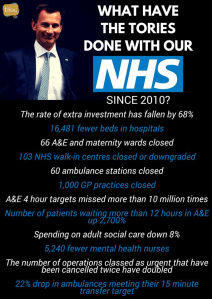
“Tories accept £30,000 from Vladimir Putin’s crony to dine with Defence Secretary”

“The Tories have accepted £30,000 from the wife of a former crony of Vladimir Putin to dine with Defence Secretary Gavin Williamson. The donation by Lubov Chernukhin, who is married to an ex-Russian deputy finance minister, comes just a fortnight after Mr Williamson said a Russian cyber attack on Britain’s electricity supply could kill thousands.

Mr Williamson will give Mrs Chernukhin a private tour of Churchill’s War Rooms in Whitehall. He will then host a dinner for her and a group of her friends there after she made a successful bid at last week’s Tory lavish Black and White Ball.

Banker Mrs Chernukhin previously successfully bid £160,000 at a Tory fundraiser to play tennis with Boris Johnson, and also paid £20,000 to dine with Scottish Conservative leader Ruth Davidson in Edinburgh.

The Tories deny that Mrs Chernukhin, now a British citizen, is a Putin crony. Her billionaire husband, Vladimir, 49, fell out of favour with the Russian president when he was forced out of his post running a state-run Moscow bank.

Mr Williamson said last month that Moscow had been photographing UK power stations in a threat to damage our infrastructure.

The Conservative Party declined to comment.”

https://www.mirror.co.uk/news/politics/tories-accept-30000-vladimir-putins-12009563

Tonight’s Countryfile: how to rewild a disused quarry – one for Clibton Devon Estates to watch?

“Ellie and Matt are in Cambridgeshire where Matt is looking at a huge project to turn a quarry into the UK’s biggest reed bed. Thousands of tons of sand and gravel are being shifted at Ouse Fen to create the perfect habitat for wildlife.”

BBC1 18.30 hrs

How does a council become effectively bankrupt?

“… Earlier this month, Northamptonshire went effectively bankrupt, becoming the first local authority in two decades to issue a section 114 notice. This signalled that its finances were so precarious it would be unlikely to balance the books this year and was at risk of being unable to set a legal budget for 2018-19.

As a result, One Angel Square [its new HQ] is likely to be put up for sale, three months after it was formally opened by the communities secretary, Sajid Javid. A fire sale of assets is the only way to keep the council afloat, say officials, though even this temporary fix may not be enough to save it.

… The council’s predicament has triggered bitter recrimination among local Tories. Northamptonshire’s seven MPs, all Conservatives, accused the council of mismanagement. Heather Smith, the council leader, said the government had starved it of funds. Eighteen backbench Conservative councillors called on Smith to resign.

The irony is not lost on some observers that the first local authority to go bust under austerity is not the profligate Labour municipality of media caricature, but a Tory-run council in the heart of middle England.

Penny Smith, the council’s Unison branch secretary, said: “Can you just imagine if this was a Labour authority? They’d be saying ‘Typical Labour, can’t run anything’.”

Furthermore, it has crashed after rigid adherence to the Tory ideological rulebook for local government. Northamptonshire embarked on a “next generation” reform plan in 2014. Services would be outsourced or turned into profit-making companies. The council would drastically shrink in size and be run like a business. “The old model of local government no longer works,” it declared.

The grand plan failed at a cost, say critics, of more than £50m on consultants and rebranding. Expected efficiency savings did not materialise, some privatised services have since been hauled back in-house, and the scheme’s political architects, including the then council leader Jim Harker and the then chief executive Paul Blantern, have departed. After years of freezing council tax bills on principle, the authority has raised them by 6% from April.

… Northamptonshire’s future remains precarious. A government inspection into alleged financial and governance failures will report back in March. Staff morale is at rock bottom, said Smith. There is speculation that the county could be abolished and merged along with its five constituent district councils into two new unitary authorities.

There are fears that a handful of councils could follow Northamptonshire into bankruptcy. Conservative-run Surrey county council has a deficit of more than £100m. A survey by the Local Government Information Unit thinktank found eight out of 10 councils were concerned about their finances.

McLaughlin has warned Northamptonshire’s councillors that they should not assume the government will ride to the rescue. Ministers have promised a review of council funding, but this “is more likely to be concerned with the distribution of an ever-shrinking quantum of support than a major injection of spending power”.

https://www.theguardian.com/uk-news/2018/feb/11/northamptonshire-county-council-effective-bankruptcy-tories-cuts

Unitary authorities – the austerity measure that can’t be stopped?

Wonder what that new £10m EDDC HQ will be used for?

“Simon Heffer writes in the Sunday Telegraph to call on the Government to simplify and streamline the UK’s councils, replacing the system of county and district councils with county-level unitary authorities.

The need for “wholesale reform”, he says, has been made urgent by the problem of “social care that will break local government” and former chancellor George Osborne’s “disastrously flawed business rate system, which has had a profound effect on revenue-raising”.

He says that a system of unitary authorities would reduce payroll, offer the chance to sell off assets, and improve the handling of planning decisions, while the Government should remove “huge strategic questions such as social care from council control altogether”.

The Sunday Telegraph, Page: 21

“Fears of cover-up as government departments wipe staff mail boxes”

One imagines this is replicated at all levels …

“A Sunday Telegraph investigation found that the vast majority of departments are automatically deleting staff mail boxes within three months of their departure – prompting concern that the system is a recipe for cover-ups.

… A former government adviser on freedom of information said “It is hard to resist the thought that there is a happy coincidence between the approach to record management and getting rid of material that may contain unwanted answers about how particular decisions were reached – answers a department may prefer were unavailable if an FOI came in …”

Source: Sunday Telegraph

“Sleaze watchdog to look at tighter curbs for councillors”

” … The inquiry comes after a government adviser warned that the Coalition “threw out the baby with the bathwater” when it abolished the controversial Standards Board for England that enforced a nationwide code of conduct for councillors.

Dr Jane Martin, the member of the Committee leading the inquiry says she “regularly receives correspondence” from the public expressing concern about councillors’ behaviour. …

There are concerns that council standards committees can only “censure” politicians, rather than suspend them in the most serious cases. …”

Source: Sunday Telegraph

Owl says: once again, too little too late:

See and hear our own disgraced Tory ex-councillor Graham Brown (ex-chief of the equally disgraced council-run East Devon Business Forum) explaining that “if I can’t get planning, nobody will” but that he won’t work for peanuts:

http://www.telegraph.co.uk/news/politics/9920971/If-I-cant-get-planning-nobody-will-says-Devon-councillor-and-planning-consultant.html

and the chapter on East Devon in Anna Minton’s Spinwatch report “Scaring the living daylights out of people – the local lobby and the failure of democracy”:

https://www.annaminton.com/single-post/2016/03/21/Scaring-The-Living-Daylights-Out-Of-People

“NHS chiefs pocket £166 MILLION in bonuses – while nurses suffer 1% pay cut”

“Nurses, midwives and other carers battered by David Cameron’s assault on NHS wages are night furious at revelations their bosses’ pay packets have risen by 36%.

Senior managers pocketed £166million in bonuses and other extras last year – as the Tory-led Coalition slashes £20billion in costs from the beleaguered service.

That is up 36% from £122million the year before.

The rise, on top of their annual salaries, could have paid for an extra 4,000 nurses, who have suffered a 1% cut. …”

https://www.mirror.co.uk/news/uk-news/nhs-bonuses-chiefs-pocket-116-3553527

“Things are going to get worse, nurse …” a poem

Northern poet John Cooper Clark on his 60th birthday in 2008 – a prophet!
Warning: some mildly bad language, understandable given the topic!

“What me worry? I should care,
Shit for brains, wire for hair,
I’ve seen the future and I ain’t there,
Things are gonna get worse.

Velcro slippers and a spandex wasteband,
Washed up on Planet Wasteland,
Zipped up like a nylon spaceman,
Things are gonna get worse.

Things are gonna get worse, nurse,
Things are gonna get rotten.
Make that hearse reverse, nurse,
I’m trying to remember everything that I’ve forgotten.

Things are gonna get worse nurse,
things are gonna get crappy,
colour me perverse nurse,
bad news always makes me happy.

Things are gonna get worse nurse,
things are gonna get dismal,
smite me with a curse nurse,
make it something real abysmal

Things are gonna get worse nurse
I ain’t optimistic
I’ve got a mouth like a purse nurse
and a bungalow smelling of piss and biscuits

things are gonna get worse nurse,
murder by statistics,
take me back to the first verse,
the last ones just too pessimistic

Euthanasia – that sounds good,
An Alpine neutral neighbourhood,
Then back to Britain, all dressed in wood,
Things are gonna get worse.”

“https://www.clc.sllf.qmul.ac.uk/?p=387

Privatised profit, public loss – a masterclass

Virgin – running vast parts of our NHS; Stagecoach – a virtual monopoly on bus services in East Devon and Greater Exeter.

“For the third time in a decade, an East coast rail franchise operator has shown little of the financial prudence once associated with the great cities linked by its trains from London to Yorkshire and Scotland. Following the failures of GNER in 2007 and National Express in 2009, Virgin Trains East Coast has run out of steam, with the government declaring a financial covenant breached and the contract set to fail in months.

The latest incumbent has, like its predecessors, bid too much to run a lucrative line whose potential revenues have fallen short, at a time when economic uncertainty has gnawed away at ticket sales.

But exactly why Stagecoach, the 90% lead partner to Virgin’s 10% stake in the current franchise, promised £3.3bn to run the line, and how that contract is now resolved, remain key questions – amplified by East Coast’s unique place in the blazing political row over how the UK rail network is run.

In 2013, when bidding started, East Coast was nationalised, run by Directly Operated Railways (DOR), a government-owned firm returning around £200m a year in premium payments to the Treasury.

The previous year, the parallel line north, the West Coast intercity service from London to Glasgow run by Virgin with Stagecoach since privatisation, had been the subject of a bidding competition gone bad. The award of the franchise to First Group was overturned on legal challenge after Virgin argued that its rivals had won with a colossal but unsustainable bid.

Pointing at the lessons of the past, failed East Coast franchises, the Virgin founder Sir Richard Branson railed: “Insanity is doing the same thing over and over again and expecting different results. When will the Department for Transport learn?”

Not soon enough. A government-commissioned inquest concluded that franchising remained the best model. A queue of rail contracts were almost up, not least the Virgin-run West Coast. But the reletting of East Coast to the private sector was prioritised ahead of a 2015 election that was expected to see a hung parliament, potentially keeping the line in public hands.

The dust had hardly settled when the DfT invited bids with a vision that would lead to Branson and Stagecoach promising undeliverable riches of their own.

Investment was coming to the East Coast line, including track and power upgrades, critically bringing a new fleet of InterCity Express IEP trains, with more than half of a £5.7bn government order earmarked for the line. What was promised, pledged or inferred – and how relevant it is to the collapse of VTEC’s contract – is contested.

Stagecoach claim upgrades were promised and not delivered that materially impacted its franchise; a review by Peter Hendy axed or deferred engineering works around the country after the infrastructure body Network Rail blew its budget on the electrification of the Great Western mainline.

However, Network Rail is clear it has already done the work necessary to bring in new trains and a timetable that would have turbocharged passenger numbers – and Stagecoach’s premium payments – after 2019. Chris Grayling, the transport secretary, has also said that no cancelled upgrades have affected the franchise to date.

What was wrong, it appears, was Branson’s conviction that a new livery and “people hungrily trying to make a real difference” could propel passenger numbers upwards from when Virgin took over. Instead, fares went up and the outlook went down.

They got their forecasts wrong, Stagecoach’s chief executive, Martin Griffiths, admitted this week. But, he added, the DfT “decided we offered a high quality and realistic bid … indeed, I was personally told at the time that it was the highest quality bid they had ever seen”.

In March 2016, a year after taking over, Branson and Stagecoach’s chair, Brian Souter, rode into King’s Cross on one of the first government-bought IEP trains, now in Virgin livery and rechristened Azumas by the private operators, a name with echoes of the Japanese rising sun. “Like a new day dawning on the railway,” said Souter.

But City analysts were flagging concerns. And by the time Grayling came to the Commons in November 2017 to announce a “rail strategy” that slipped in news that VTEC’s contract would be replaced in 2020 by an East Coast Partnership, investors had already factored in heavy losses.

Stagecoach’s share price bounced back on Grayling’s plan, widely described as a £2bn bailout – the value of the remaining payments to the government due from VTEC’s owners had the contract continued from 2020 until 2023. Condemnation was largely led by Lord Adonis, the former Labour transport secretary who nationalised the line when National Express failed to meet payments in 2009.

It is not clear why Grayling then waited until this week to announce the franchise’s imminent collapse – stoking fury by simultaneously confirming a direct award to extend Virgin’s West Coast deal, a contract now held, without competition, from 2012 to 2020.

Officially, Stagecoach had “breached a financial covenant”, although the company has not acknowledged this, and the financials have not altered significantly. The mooted East Coast Partnership was met with some bemusement – one well-placed rail industry figure said there was “no chance of it being up and running, and absolutely the last place you’d do something like that”. A Stagecoach statement spoke of “a hardening of the DfT’s negotiating position, coinciding with increased media and political scrutiny”.

Adonis himself sees it differently – that once the ink was dry on the West Coast extension, the rules had changed and Grayling had lost his bargaining chips. He said: “I’ve sat around a table from Brian Souter. He knows when he’s got his man. Stagecoach are playing Grayling.”

DfT officials are now assessing the relative cost of returning the East Coast franchise to public sector control or allowing VTEC to continue on a “not-for-profit” basis – which would nonetheless relieve them of paying hundreds of millions due to be paid to the government in the original deal. Other train companies will be watching intently as they too grapple with franchises whose ambitious promised payments to the government rely on passenger growth that has not materialised, or even gone into reverse.

Had Stagecoach continued to deliver its payments, which in the second and third year were roughly 30% higher than East Coast under its previous operator DOR, and improved the service, it would have been compelling vindication for those who urged its restoration to the private sector. Instead, Virgin joins the ranks of those who bet high on East Coast and saw it all go south.“

https://www.theguardian.com/uk-news/2018/feb/10/east-coast-line-bailout-rail-privatisation-spotlight

Clinton Devon Estates PR team working overtime on Blackhill Quarry!

Sent to Friends of Pebblebed Heaths

“Dear Friends,

Many of you will have seen the recent coverage in local newspapers and on social media concerning a planning application lodged by Clinton Devon Estates for the former quarry plant area adjacent to Blackhill Quarry, enabling a nearby engineering firm to expand.

Unfortunately lots of inaccurate rumours were also circulating.

As you know the primary aim of the Pebblebed Heath Conversation Trust is to ensure threatened heathland ecosystems are protected, to ensure all wildlife associated with this habitat flourishes, to protect public access and encourage responsible public enjoyment of the heaths.

The most important conservation partner of the Trust is the public and we strive to keep our Friends of the Commons well-informed, so the Trust continues to develop with public support.

Our staff live in nearby villages and understand the issues local people have. Our neighbours are concerned about development, volume and types of traffic, change of use in rural areas and we recognise these topics can bring about many questions as well as strong feelings and differences of opinion.

We hope by providing the facts of this complex issue, especially given the amount of misinformation and speculation there has already been, you will have more of the information needed to make up your own mind.

Please take time to view the maps, statements and explanations we have included here, plus links to the EDDC planning application, where you can read and see what others think.

Blackhill Quarry has no statutory conservation designations, although it is registered as a County Wildlife Site. Attempting to restore heathland on industrial sites can be extremely problematic due to the raised nutrient enrichment of the land due to lime. Similar issues are already the case on East Budleigh common, where the remains of buildings from Dalditch Camp, make management of this site, extremely difficult. To mitigate the loss of 1.09 ha heathland (from total area of 63 ha for the quarry) not restored from hard-standing, we would be looking to create significantly more heathland and of a better quality. This is likely to be through the conversion of existing coniferous plantations to heathland. Our goal is certainly for there to be a biodiversity uplift above and beyond that proposed under the existing restoration scheme.

Later in the year we will organise a visit to Blackhill so you can see the restoration work in progress and ask any questions. In the meantime please contact any one of the team if you have any further queries.

The Pebblebeds Team”

The communication continues with some extraordinary reasons why CEE thinks the engineering works are a special case including:

* Specialising in steel fabrication and design, Blackhill Engineering has recently been involved in many prestigious projects including the design of flood defence gates for New York City Hospital, work for the European Space Agency and the pier at Hinkley Point for which Blackhill has been recognised with two awards from EDF Energy.
[aahhhh!!! now Owl understands!]

* The site proposed is currently covered in concrete and any restoration to high quality habitat will be problematic …”

Who knew that concrete couldn’t be so difficult to remove! If it’s THAT difficult perhaps we shouldn’t allow any development at all at this site since more and more concrete will be needed to expand it!

Our NHS but not “OUR” NHS

Another post from the Save Our Hospital Services Facebook page, which has nearly 11,000 (yes, ELEVEN THOUSAND) members

“The STPs have driven a huge wedge between hospitals and areas within the “footprints” people have been horrified to find that their services have been down-graded and moved to other hospitals some distance away.

In Devon there were threats made to move maternity and acute services from North Devon to Exeter some 55 miles away and even further away from some of the outlying villages.

The various committees and groups set up to implement the STPs have wasted vast sums of money on wages, premises, expenses and admin staff. There have been endless ridiculous consultations with all sorts of groups where the public’s views were dismissed—the public have watched on while these people have wasted money.

The STPs have been successful in taking huge sums of money from the system and putting it in the hands of people who should actually have been working in hospital. Management consultants and makers of pretty information books have had a great time too.

Meanwhile back in the hospitals beds have been closed to save money and then we find that there are not enough beds. The boards of hospitals ( NDDH – North Devon District Hospital) have been taking pay rises in some cases already earning a quarter of a million pounds per year- this individual has now had a vote of no confidence made against him by the consultants – yet still he cashes in.

The CCGs across the country have been following orders and cutting community hospitals and beds relentlessly rather that protesting and thinking about patient safety in their areas. They have all done great jobs at implementing STPs – well done but you should have been advocating for your patients.!!!!!

The public are furious across the country about this government’s shameful treatment of the NHS and its front line staff. They see the staff run off their feet, suffering stress and leaving. The hospitals which are under threat of closing or losing services have staffs that have no confidence in the system and no job security. How has this come about? The STPs have demoralised everyone, put hospitals against hospitals, made the public feel that because they live in certain areas that their lives are not as important as the lives of people in neighbouring areas.

The STPs are now morphing into ACOs and ACSs and goodness knows how many quangos and private companies (yet again) will be raking in their pounds of flesh before patients are considered. The whole nation is up in arms about the effects of cost cutting.

Deficits in hospitals do not represent overspending- they represent the needs of the people in that area.

No area is the same – we do not all fit into a formula – some populations have more elderly people, some have more babies, some have more people drinking and smoking, some are more polluted, some are deprived, some are wealthy. The STPs do not address these considerations.

ACOs are very suspicious- a move to the American (rubbish for the people) insurance based system. They break up the system even more and are not accountable to anyone. Private companies such as Virgin bully and sue if they do not get their own way over contracts already. What will happen when even more is thrown open to the sharks waiting to take a profit out of people’s ill health?

The demise of Carillion should send a warning shot across the bows of anyone who feels that public services are safe in the hands of profiteers.
People are angry- STPs started this – put a stop to it now and reinstate the NHS.”

Our local health services: our last line of defence

From the Save Our Hospital Services Facebook site:

:… these guys are our last line of defence. They need to work harder at not being manipulated.

Health and Adult Care Scrutiny Committee, County Hall, 25 January 2018

“I take my Scrutiny duty very seriously,” declared Cllr Brian Greenslade (Barnstaple North) at the Devon County Council Health and Adult Care Scrutiny Committee meeting at County Hall on 25 January. Save our Hospital Services (SOHS) members from North Devon who attended this and many other such meetings know this to be only too true.

Indeed, were it not for Cllr Greenslade and his meticulous colleague, Cllr Claire Wright (Otter Valley) it is doubtful how much scrutiny by the Scrutiny Committee there would be at all. One thing is certain: given the scale, speed and scope of the changes now being pushed through in health and social care services in Devon, real information, real questions and real answers have never been so vital. It is literally a matter of life and death.

At a previous Scrutiny meeting, the Chair, Cllr Sara Randall Johnson, in clear cahoots with Cllr Rufus Gilbert, manipulated proceedings. The two managed to prevent Cllr Wright putting a motion she had already tabled, thus shutting down a debate that may have saved in-patient services at some community hospitals.

This so outraged some councillors and members of the public that their chorus of complaints and the consequent internal investigation prompted the county’s lawyers to lecture councillors as to their legal obligations to scrutinise. The investigation and warning came too late for the community hospitals, but could better behaviour be expected from now on?

Indeed, it could. But then, on 25 January, the Chair of the Standards Committee was sitting in. This time Cllr Wright was allowed to say quite a lot, pose many more questions, and state much more of the obvious in defence of our health and social care services.

However, far too many of our County Councillors still appear unwilling to spend time and effort educating themselves as to the issues, facts and figures, whilst being only too willing to swallow propaganda and projections put out by overpaid health bosses bent on making severe cuts to our NHS services.

No one, even councillors who have barely raised a whisper in opposition, is in any doubt as to the real motive for all these health service changes: cuts and cutbacks designed to save £557 million over the next five years. The aim is to ration, restrict and remove elements of care and treatment for however many people it takes to save that amount of money. Cost comes first, clinical need a poor second.

Dr Sonja Manton was again allowed to speak at great length. She is NHS Devon’s lead cost-cutter, qualified by means of a doctorate in Systems Dynamics, not qualified in Medicine or any form of clinical care. Which sort of gives the game away –as does her most obvious skill, talking for a very long time without saying anything at all.

When questioned by Councillor Wright, she appeared, as ever, not to have the required data or evidence to hand. Cue the now customary promise to look it up and pass it on. The pattern that follows has been obvious for more than 15 months now. The Scrutiny Committee ends up waiting a long time for what they have asked for – if they get it at all — making real scrutiny in public for the public impossible. The lack of real information, the failure to meet requests, the failure to resolve contradictions in presentations cause real difficulties for our County Councillors meeting after meeting – not least again on 25 January.

It has been reported that Devon’s Clinical Commissioning Groups are bent on steamrollering ‘Accountable Care Organisations’ into position from 1 April. To prove that the joke is on us for what is, after all, April Fool’s Day, they have given the Scrutiny Committee no information about them at all. This is particularly scandalous and frightening. As Brian Greenslade stated: “I want to know where we are…..we need to understand where we’ve got to and what this may mean.”

One faint beacon of light is the announcement, on the same day as the Scrutiny meeting was held, that NHS England will hold 12 week consultations on the implementation of ACOs https://www.england.nhs.uk/…/consultation-aco-contracts/ which puts a very slight delay in place. But the website does not elaborate on how much time after closure of consultation implementation could happen. The Consultation could well be the outcome of an exchange between Sarah Wollaston, Chair of the Health Select Committee, and Jeremy Hunt, Secretary of State for Health and Social Care, as well as an attempt to water down the possible impact of a Judicial Review, which is being filed by a group of Health Care professionals, to challenge the government’s attempt to circumvent Parliament and democratic scrutiny and allow ACOs to operate

ACOs are financially constrained, business-based American-style systems of healthcare purchasing and provision, which will pave the way for further privatisation and still more rationing and restriction of provision. Councillor Martin Shaw from Seaton had done a lot of research on ACOs and put his findings online. But, incredibly, he had to force the whole issue onto the Committee’s Agenda just to secure the very limited discussion that took place.

Until this announcement it was the case that ACOs (unless the Judicial Review has effect) were to be imposed without any debate, discussion or statute. So an ACO could be and, in many cases, will be, a private business, primarily accountable to shareholders and managers rather than patients and the public. And even now we don’t know how ‘public’ the consultation will be. As Jan Goffey, Mayor of Okehampton, declared, “Sick people should never be regarded as a profit-making opportunity.”

Eventually even the Chair, Sara Randall Johnson said, “We need more information.” We have heard her, and others, say this before. Is this a way of avoiding doing anything? Or is it something more cynical: a way of helping to destroy our NHS, but giving themselves the excuse that they just did not know?

If so, it will only be because they failed to find out – or scrutinise.”

Inaugural meeting – “Plastic Free Sidmouth” – 22 February, 7 pm

Starting in Sidmouth and hopefully spreading across a “Plastic Free East Devon” and “Plastic Free Devon”.

PRESS RELEASE:
“Futures Forum of the Vision Group for Sidmouth

Press release: Thursday 8th February 2018

The Futures Forum of the Vision Group for Sidmouth will be holding a meeting open to all later this month to facilitate the bringing about of a ‘Plastic Free Sidmouth’.

This follows in the wake of several key campaigns in the Sid Valley, including the beach cleans by Sidmouth in Bloom’s Sidcombers, Surfers Against Sewage and the Sidmouth Plastic Warriors.

All of these groups are concerned about the amount of plastic making its way into our seas – and the devastating effect it has had, as seen on the BBC’s Blue Planet.

Denise Bickley of the Plastic Warriors has also been at the forefront of an on-line petition to ‘Make Sidmouth a single-use-plastic-free town’ at Change.org.

As for their part, the Town Council is going to be installing water fountains, and more businesses are looking at their use of plastic – including offering a free refill of water bottles.

And in Penzance, Surfers Against Sewage have been pioneering an ‘action plan’ for towns who want to go ‘plastic free’ with their Plastic Free Coastlines community toolkit.

On Thursday 22nd February there will be a public meeting to look at how Sidmouth could take a plastic free project forward – starting 7pm at the Leigh Browne Room of the Dissenters’/Unitarian Church Hall, opposite the Hospital.

It will be hosted by the Futures Forum of the Vision Group for Sidmouth and will be chaired by Robert Crick.

“Plastic waste on our beaches has doubled over the last decade”, he says. “Other towns have initiated town wide schemes to reduce plastic. Could this be an initiative for Sidmouth to adopt?”

Meanwhile, the Plastic Warriors will be having another plastic clean up on Saturday 17th February around the Woolbrook area, starting and finishing at the Youth Centre, 2 to 3pm: join the group on Facebook.

Their group’s founder Denise Bickley says: “We have lots of big ideas in the Sidmouth Plastic Warriors group and are keen to discuss the way forward at the public meeting on the 22nd.”

Anyone interested in a ‘plastic free Sidmouth’ is welcome to come along.

For more information go to http://www.visionforsidmouth.org”

“A Chief Executive to Lead the Heart of the South West LEP Towards Prosperity for All” ***

*** Prosperity for all LEP Board Members perhaps? !!!

“The Heart of the South West (HotSW) Local Enterprise Partnership is looking for a new chief executive to start in the summer following the retirement of Chris Garcia, who has led one of England’s most successful LEPs for five years.

The role demands a high calibre candidate for this increasingly pivotal role in the HotSW economy, which covers Devon, Plymouth, Somerset and Torbay.

Chair of the Heart of the South West LEP, Steve Hindley CBE DL [Chairman if the Midas construction empire], said: “We’re a strong business-led partnership between the private sector, social enterprises, local authorities, universities and colleges throughout Devon and Somerset and the unitary areas of Plymouth and Torbay, making us one of the largest LEPs in the country, so we’re looking for strong leadership and talent.

“Across the HotSW area, there’s a mix of urban and rural economies, stunning natural capital, rich heritage and a tremendously exciting range of business opportunities.

“We’ve established an impressive track record with a £750m investment programme to support our mission to see better productivity and better jobs; and we’re poised to launch a new delivery plan for a step change in productivity.

“The role of LEPs is increasing as we become firmly aligned with the delivery of the government’s Industrial Strategy, our funding is secured for at least another two years, and we’ll now have regular meetings with the Prime Minister.

“I look forward to meeting some exceptional applicants for this exciting role as HotSW LEP enters the next phase in its journey towards prosperity for all.”

Applications are open until 16 February and a candidate briefing pack is available at: http://www.heartofswlep.co.uk/news”

http://heartofswlep.co.uk/news/chief-executive-lead-heart-south-west-lep-towards-prosperity/

Seaton Heights on the market – again!

How many times is this? Four, five …? More? It will certainly be more difficult to sell now the centre-sited Premier Inn is up and running as from tomorrow.

“… The site is overgrown and presents certain hazards associated with derelict buildings. Accordingly, all viewers are strongly advised
to wear appropriate footwear and clothing. All viewers enter the site at their own risk. The vendors, and their agents, cannot accept
any responsibility or liability for any injury or damage caused.

Viewing Arrangements
There will be three scheduled viewing events:

Friday 9th February
Tuesday 13th February
Thursday 22nd February

Appointments to view must be pre-arranged
and confirmed with either of the joint agents.

Method of Sale
For sale by informal tender with all bids to be received no later than 12pm noon on Thursday 8th March 2018.”

http://www.rightmove.co.uk/property-for-sale/property-71192222.html

Particulars here (or via link above):
http://assets.reapit.net/stp/live/pdf.php?p=EXE180009&t=S

Clinton Devon Estates and Blackhill Quarry – trying to be Mammon AND God!

From a correspondent:

“I am still trying to get my head around the extent of the gap between Clinton Devon Estates (CDE) publicity campaign and how much care they have actually taken over the ecological aspects of the application to extend the Blackhill Engineering site.

A previous blog:
https://eastdevonwatch.org/2018/02/05/clinton-devon-estates-desperately-tries-to-justify-quarry-industrial-units/comment-page-1/

provided a link to a Devon Live article on CDE’s application under the headline: “Quarry expansion plans will provide ‘space for nature and sustain local economy’”.

In the article Mr Rix (CDE) said: “Prior to submitting this application, we commissioned a comprehensive ecology report, which shows that, because the application involves replacing existing industrial equipment, the work is unlikely to impact on nearby designated sites, nor the County Wildlife Site. Nevertheless, we will be implementing an ecological mitigation plan.
But how much emphasis has “Space for Nature” actually been given in the application so far?

Outline planning was validated on 20 December. Formal closing date for comments was set for 6 February, this Tuesday, the day Natural England submitted their comments. Natural England is the government’s adviser for the natural environment in England, helping to protect England’s nature and landscapes for people to enjoy and for the services they provide. What do their comments at the end of formal consultation say?

“SUMMARY OF NATURAL ENGLAND’S ADVICE:
FURTHER INFORMATION REQUIRED TO DETERMINE IMPACTS ON:
EAST DEVON AREA OF OUTSTANDING NATURAL BEAUTY (AONB)
EAST DEVON PEBBLEBED HEATHS SSSI
EAST DEVON PEBBLEBED HEATHS SPECIAL AREA OF CONSERVATION (SAC)
EAST DEVON HEATHS SPECIAL PROTECTION AREA (SPA)

As submitted, the application could have potential significant effects on the East Devon AONB, East Devon Pebblebed Heaths SSSI, East Devon Pebblebed Heaths SAC and East Devon Heaths SPA. Natural England requires further information in order to determine the significance of these impacts and the scope for mitigation.”

Natural England is also awaiting further information on the effectiveness of the proposed ecological mitigation. So the comprehensive ecology report can’t have been as comprehensive as advertised and the mitigation would seem to be missing!

Further reading shows that CDE slipped Natural England an “updated” Landscape and Visual Impact Assessment on 5th February (this Monday), one day before the deadline for comments.

Why the need for an updated LVIA? A clue can be found in a Devon County Council comment of 16 January:

“Given the current requirement to remove the existing plant and restore the site to heathland, the District Council may wish to ask the applicant to take this into account for the “baseline” for the Landscape and Visual Impact Assessment. Paragraph 6.18 of the Planning supporting statement appears to assess the proposed visual impacts set against the baseline of the existing plant and machinery. It would be more appropriate if the landscape assessment acknowledged that the existing plant, machinery and buildings are not permanent features and that there is a current agreement to restore the site to heathland which needs to be considered as a part of the overall planning balance. This is especially important given the location within the AONB and the NPPF policy tests for new development in such locations.”

In other words the assumption that this can be treated as an established Industrial brownfield site, as suggested by Mr Rix, is incorrect.

The evidence emerging from these expert consultees shows just how insensitive this application has been to the particular sensitivities of this site.

Clinton Devon Estates are now desperately trying to catch up. Their credibility to care for the countryside has, in my view, been severely damaged.

Although the formal consultation period is closed comments can still be made by e-mail to planningwest@eastdevon.gov.uk quoting 17/3022/MOUT.

“Councils used as ‘human shields’ for cuts, says John McDonnell”

“John McDonnell has accused the government of using cash-strapped local councils as “human shields” to absorb deep spending cuts by the Treasury.

The shadow chancellor seized on reports that Surrey – where the Runneymede and Weybridge constituency of the chancellor, Philip Hammond, is located – was facing a £100m cash crisis.

Analysis by the Bureau of Investigative Journalism identified Surrey as the council facing the largest gap between expected revenues and expenditures in the coming financial year. The average deficit at the 150 councils the bureau examined was £14.7m.

Meanwhile, a survey of senior council officials by the Local Government Information Unit thinktank found that almost 80% had no confidence in the future sustainability of council finances.

McDonnell said: “If you ever wanted to see the utter failure of this government, look no further than your local council. Many are struggling to maintain many basic services because they are being forced to pass on Tory cuts.

“There needs to be an urgent change of direction in local government funding in this country. We need to see an end to a situation whereby Tory governments are using local councils like human shields as they continue to drive ahead with their failed austerity agenda.”

McDonnell appeared at a conference in Preston alongside the shadow communities secretary, Andrew Gwynne.

Many of the councils under greatest financial pressure are in Tory-held areas, and Conservative MPs have put pressure on the government to relieve the squeeze in particular areas.

Sajid Javid, the communities secretary, announced an extra £150m this week specifically to be spent on social care in areas of greatest need, amid a growing backlash from backbenchers.

But council leaders said it would not be enough to meet rapidly increasing needs.

The LGIU’s survey of councils’ finances suggested that 94% are planning to raise council tax in the coming year to make ends meet, and 65% will be dipping into their financial reserves.

In his speech, McDonnell highlighted alternative approaches to delivering local services.

Labour believes the threat to council services, such as social care and support for children, are the latest stark illustration of the ongoing impact of austerity.

The government has promised to put social care funding on a sustainable footing; but a green paper on the issue is not due to be published until next summer.”

https://www.theguardian.com/society/2018/feb/08/john-mcdonnell-councils-used-human-shields-funding-cuts