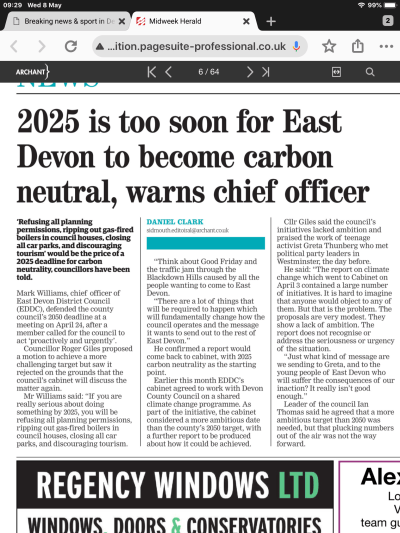
Wasn’t aware Williams was in charge ….. print quality of the article is poor but you get the gist – I won’t be rushed …
 the
the

Wasn’t aware Williams was in charge ….. print quality of the article is poor but you get the gist – I won’t be rushed …
the
Well, if you strip out the projects that are actually “stand alone” and directly-funded by its members from its latest newsletter – not very much at all – and all funded by money that used to go directly to local authorities (and not a murmer about their biggest project – Hinkley C nuclear power station:
https://mailchi.mp/heartofswlep/hotsw-lep-march-newsletter?e=9367babecc
Bet MINORITY party Tories will be MUCH more keen on this than they were when in power!
“The Ministry for Housing, Communities and Local Government has issued new statutory guidance for local and combined authorities in England on scrutiny of their decision-making.
It said councils were being “encouraged to embrace scrutiny of their spending decisions to achieve value for money, improve services and address the public’s concerns”.
The guidance, which can be viewed here
stresses the role of scrutiny committees in holding authorities to account over local decision-making. It outlines what effective scrutiny looks like and the positives it can bring to local authorities.
Key points highlighted by the Ministry include:
councils should adopt a position of sharing any information asked for by their scrutiny committee, and if information cannot be shared in public they should consider sharing it in a closed session;
scrutiny committees should be constructive ‘critical friends’ with a vital role of amplifying the voices and concerns of the public when councils take important decisions;
local authorities should also consider whether contracts with companies delivering services should include a requirement to supply information to scrutiny committees.
Rishi Sunak, Minister for Local Government, said: “Scrutiny committees form an integral part of the work of councils in delivering services by acting on behalf of residents to hold councillors and staff to account for the important decisions they make.
“That is why I have set out new guidance to ensure authorities and residents can reap the benefits of effective scrutiny, by instilling a culture that welcomes challenge.”
The Centre for Public Scrutiny assisted the Ministry in developing the guidance. Its chief executive, Jacqui McKinlay, said: “We welcome government’s timely revision of its statutory guidance on scrutiny, and particularly its focus on leadership buy-in, culture and behaviours that are so central to ensuring that effective overview and scrutiny can operate, and make an impact, at local level.
“We look forward to working closely with our colleagues at the Local Government Association and individual councils to use the new guidance as an excellent opportunity to reflect and review their current approach to scrutiny.”
This communication from ex-Leader and now also ex-councillor Paul Diviani really deserves a far wider audience than former Yarty voters:
“Dear All
As there is not a lot of substance to report other than repetition and the ghastly shenanigans afoot nationally, regionally and within the Conservative Party, I feel I should draw a line under my 20 years representing Yarty.
I have appreciated the many friendships I have made in that time and will always have your best interests in mind.
For the sake of clarity, I was deselected by the Conservative Executive as a result of a personal vendetta from standing in Yarty and had to find another ward away from Tiverton and Honiton with a disastrous personal result.
Wishing you all the best for the future and if I can help in any way (without interfering!) I am at the end of a call.”
No, Paul, everything really is fine in Yarty, the voters have spoken, so its time to hang up your Tory council boots … no-one appreciates old Grandpa insisting he’s the only one who knows how things should be done! And those disastrous results would almost certainly have been just as bad in Yarty.
Though, for the sake of even more clarity, Owl thinks you might name a few names before you hang them up!
And it certainly shows that there is definitely “something VERY nasty in the woodpile” if the current and ex-Leader complain about the party that served them so well until recently.
Owl is STILL waiting for Ian Thomas to explain exactly which of the national Tory policies he disagreed with (since he is on record as saying all was fine among East Devon Tories when it so obviously wasn’t).
“Optimism will be short-lived among the 1,560-plus new councillors – Liberal Democrats, independents, Greens – elected last week in the cities and shires of England, where countless councils changed hands.
These newcomers may have worthy ambitions to transform their councils. But reality kicked in on Tuesday. Entering town halls for briefings, one issue became clear: there’s barely any money left to fund even adult and children’s care, which swallows the majority of cash – let alone keep the rapidly shrinking library service running, the leisure and swimming pool afloat, parks and highways maintained.
Countless warnings from respected organisations, notably the government’s own spending watchdog, have gone unheeded by the government. Last year, the National Audit Office cautioned that council financing is unsustainable and that 10% of the larger councils could have exhausted their reserves – which prop up social care – within three years.
It gets worse. The Commons public accounts committee said recently that the government is in denial about a crisis in which councils are overspending alarmingly on social care, while some are courting “greater risks” through property speculation. …
How did we land in this mess? Look no further than George Osborne, the former chancellor, whose parting gift was a wheeze to make English councils almost self-sufficient by slashing central government grants while handing back control of most business rates. Until Osborne’s intervention, rates had been collected centrally, then redistributed relatively equitably, since 1993.
In 2016, the government initiated a “fair funding review” to work out how Osborne’s reforms might be implemented – and it’s turning out to be anything but fair. Why? Because ministers are taking little account of need and deprivation in poorer areas, with a £7.8bn funding gap emerging overall in council finances. Up to now, these areas have been compensated to take account of low tax bases because they have few expensive houses which deliver higher council tax receipts. Furthermore, business rates from run-down high streets generate a pittance in poorer areas compared with thriving city centres in London and elsewhere. No matter: for this lot, inequity is compounding denial.
Something has to give in a system where almost 60% of council spending now goes on adult and children’s social care – although, overall, social care spending is still falling. Everyone in Whitehall and town halls knows that the social care system is in freefall. A review of how it should be funded – locally, or nationally – is promised. So why introduce a new funding system for local government while its largest single service is awaiting a review?
True, some councils – sometimes smaller districts, with no social care responsibility – are plugging gaps in their finances by morphing into de facto property developers, borrowing heavily to buy shopping and office centres to deliver an annual income. In 2017-18 alone, councils spent £4bn on commercial property, in spite of NAO warnings that finances could be “strained” in the event of a downturn.
But radical action is needed. Rob Whiteman, head of the public sector accountants body Cipfa, argues that authorities should have the power to set council tax rates locally, based on up-to-date property values. His call should not go unheeded.”
Self-interest and ego – title before right person for the job
Power games – valuing being top-dog over best person for job
Infighting – not sorting out best person for job, letting personalities rule
Really being a closet Tory – and ensuring they are your first oriority
Dishonesty to voters, unaccountability
Lack of transparency – scrutiny, scrutiny, scrutiny and then more scrutiny
Being developer or officer-led – letting Sir Humphrey sabotage policies
But it isn’t going to happen is it Independents?
“Owl may like to hear from other indigenous flocks of birds that have, over decades, chosen to settle in small, rural nesting places, free from predatory, vulture-like species, whose aim appears to have been the destruction of the East Devon natural environment, primarily to further their own self-sustenance.
Without suitable culling, these raptorial groups with such voracious, insatiable appetites would have caused the ruination of many distinct, valued habitats throughout East Devon. This species is commonly known as “The Feather Their Own Nests Birds” (Latin name – ‘torymemberus senioradmindominari’)!
However, it appears that when birds of a feather flock together, their collective birdsong is so momentous that it can effect change. Most can hear the birdsong but few actually pay attention, fully understand and LISTEN. The East Devon resident bird population remains territorial, watchful and perched in anticipation.
Data supplied by a Local Ornithologist who wishes to remain anonymous for fear of targeted, defensive bird attacks!
The problem with two-site operations for EDDC HQ is that sometimes the south hand doesn’t know what the north hand is doing.
The count at Exmouth had to be halted for 45 minutes and the room cleared so that a double-booking – a wedding – could take place.
“If voters wanted to reward parties committed to making Brexit happen, why would Ukip get wiped out at the polls? If a People’s Vote is such an anti-democratic proposal why did we not see losses to the Liberal Democrats and the Greens? …
… Voters who supported Brexit then or now share something in common with many pro-Remain voters: they want Westminster to pay greater attention to concerns on the doorstep and reconnect with the issues that matter most to them. Brexit was a way of giving the establishment a wake up call. If this was really about making Brexit happen, Liberal Democrats and Greens would be wiped out and swept away. But that did not happen either north or south.
The local election results indicate that bringing the country back together is achievable. It will require offering policies bringing tangible benefits, not playing it overly safe and support for a confirmatory People’s Vote. Those parties learning these lessons stand to weather the European elections best and will have the winning results when a general election is called. Banging on about a Brexit plan no one wants to the exclusion of everything else is a fast track to political extinction, as some parties may find out, unless a swift change in direction is made.”
Thom Brooks is Dean of Durham Law School and author of Becoming British
https://www.huffingtonpost.co.uk/entry/local-elections_uk_5ccc3103e4b0076cfb2a8a23?guccounter=1
Something to cheer on our new councillors … “municipalism”
” … At the heart of the crisis in local politics is a deep contradiction. For 15 years at least, Westminster politicians have habitually talked up somehow reviving local government. But power has continued to be snatched from people on the ground. (Consider, for example, the story of how elected local politicians have been shoved out of any control or oversight of state education.) Meanwhile austerity has ensured that helpless local politicians are answerable for nonsensical policies authored by Westminster, just as our exit from the EU and the noise made by moronic opportunists has poisoned debate at every level.
Yet here is the fascinating thing. Despite cuts, crises and the sense that far too many councils are locked into decline, there is some cause for hope. The realisation that central government is too remote to solve a whole host of problems, and most things are best dealt with at the most local level, feels like it has become unanswerable: something highlighted not just by failures at the top (picture the transport secretary, Chris Grayling, and the point will instantly become clear), but by a host of trailblazing examples of how to do things differently.
The biggest recent news about childhood obesity came not from the Department of Health, but a programme created in Leeds. The new Labour party is setting great store by the so-called Preston model, whereby that city’s council is boosting the local economy by using its financial clout to help local business. If you want to know about the cutting edge of regeneration, it is best to talk to people who have either created local success stories or are trying to, in Manchester, Plymouth or Doncaster.
This continuing revolution, moreover, is not restricted to big places. Where I live, in the 25,000-population town of Frome, the coalition of independents in charge of the town council – who last week won all 17 of its seats, a feat they pulled off for the second time – have spent eight years encouraging sustainable transport, assisting local charities and helping to ease the realities of poverty and inequality. Among their achievements is the town’s “community fridge”, which encourages people to donate food that would otherwise be thrown away – and is now saving 90,000 items annually as well as enabling emissions savings equivalent to taking 43 cars off the road. This was not an idea authored in a central ministry: it is a classic example of an initiative that has proved successful and which now deserves to be adopted elsewhere: an opportunity for local politics to influence what happens nationally, rather than the other way round.
Across Europe and beyond, this kind of thinking is known as the new municipalism, and its lessons are obvious. If you want representatives who reflect the places they serve, we will have to pay them more. If councils are to attract and retain new people, they need not warm words but meaningful power. Many town, city and county halls are due a huge change in culture. Above all, if we are eventually going to push beyond the anger, silliness and polarisation of Brexit politics, it is obvious where we will have to start: not among grandstanding celebs and the white noise of social media, but in close proximity to the problems we need to solve, in the places where millions of us actually live.”
Owl is not convinced several “Independent” councillors have their hearts in true independence …
The proof of the pudding will be seeing how they vote over the coming months … Owl is betting a small number will find themselves voting again and again with old Tory pals.
But not enough of them to break the new Independent majority …
Interesting times.
Owl says thank you to EVERYONE who voted, however you voted. Those who did not vote cannot now moan!
It may surprise some to know that Owl will continue to hold the new council to account in the same way as the old one! Rest assured!
In the meantime, an exhausted Owl is flying away to pastures different for the weekend – back on Monday refreshed and beady-eyed bright!

Sidmouth Sidford (three seats)
Stuart Hughes (Conservative) – 1,089 ELECTED
Dawn Manley (East Devon Alliance) – 1,303 ELECTED
Zachary Marsh (Conservative) – 721
Colin Mills (Labour) – 381
Marrianne Rixson (East Devon Alliance) – 1,326 ELECTED
Jenny Ware (Conservative) – 757
Ken Warren (UKIP) – 369
West Hill and Aylesbeare (one seat)
Jess Bailey (Independent) – 956 ELECTED
John Sheaves (Conservative) – 285
Newton Poppleford & Harpford – 1 seat
David Graham Atkins, Conservative 114
Val Ranger, Independent East Devon Alliance 710 ELECTED
Rebecca-Jayne Lipscombe (Liberal Democrats) – 397
Rob Longhurst (Conservative) – 345
Chris Pepper (Conservative) – 506 ELECTED
Eleanor Rylance (Liberal Democrats) – 555 ELECTED
Sarah Louise Chamberlain (Liberal Democrats) – 612 ELECTED
Paul Diviani (Conservative) – 319
Henry Frederick Gent (Green) – 426
Fabian King (Liberal Democrats) – 378 ELECTED
Kevin Wraight (Conservative) – 289
16 spoilt
Mark Lloyd Evans-Martin (Conservative) – 234
Kathy McLauchlan (Independent) – 702 ELECTED
5 spoilt

 East Devon Watch