Bats versus Building [and Clinton Devon Estates] in East Budleigh

From the East Budleigh Parish Conservation and Wildlife Protection Group.

What they do not mention is that the barn is owned by Clinton Devon Estates – the company that puffs itself up as “gold standard” when it comes to conservation …..

Planning application, 18/1464/ful. The Pound, East Budleigh.

Since April 2018, the East Budleigh Parish conservation and wildlife protection group, have sought to do its utmost to protect the rare, and the not so rare species of Bat, as well as the other wildlife that inhabit the barn and adjacent green space known as ‘the Pound’ in East Budleigh.

All through this application we have researched extensively, bat law, wildlife protection, mitigation studies, European and domestic legislation and directives from the Bat conservation trust, the Back from the brink project, and Natural England to name but three.

Each body has standing advice on how to protect and conserve EPS (European Protected Species). We have shared that information with all the concerned councillors from parish to district level.

The advice from Natural England and Conservation bodies state that for rare species, the avoidance method should be taken, yet here we are fighting for those methods and laws designed to protect to be implemented.

Through our many conversations with various conservation trusts, the overwhelming response has been, “the laws are there to protect these species, if the LPA follow the directives and adhere to legislation, permission will be denied.”

Having studied the plans for mitigation, We have found shortcomings in all of the mitigation offered by the agent on this application, and areas of complete misunderstanding, or disregard for the laws that are supposed to protect all wildlife. So much so, that this contentious application has reached the next stage of the planning….. the development management committee.

Getting the application to this point is a small victory for the wildlife, as we feel sure, that had we sat by and done nothing, by now, the site would have been levelled, the new house been built and the wildlife displaced, gone, or even worse, dead.(as suggested possible in Richard Greens ecology report) So we have done incredibly well to get this far.

Now…according to EDDC planning agenda, the application is recommended for approval with conditions. It is due to be discussed at the next DMC, on

Tuesday February 12th at
11AM, in the
Council chamber at Exmouth town hall.

But, of course, as is usual in a ‘democracy’, free speech and independent opinion is subject to what the ‘powers that be’, decide on as to what can be discussed and what should be taken in to consideration, so that an informed decision and vote can be made!

During this long process, it has been, and still is, the groups aim to get the best possible outcome for our precious, rare wildlife and our local green space.

We are putting forward the argument that:

1) the Pound is a significant site, regardless of numbers, with no less than four rare species of Bat,( with up to fourteen species recorded by ourselves), evidence of Hazel Dormice and an active Badger sett.

2) the mitigation measures are not adequate, with little to no evidence that these measures are successful for the rarer, disturbance intolerant, more light adverse species such as the Grey long-eared, Greater and lesser horseshoe Bats. An opinion upheld by DWT’s conservation manager in his ‘neutral’ letter to EDDC.

3) the lighting plan is not in line with current research provided by the bat conservation trust, nor the ILP,(institute of lighting professionals) suggesting the maximum light spill should not exceed 0.45 lux lumen on a moonless night. whereas the current proposed lighting plan stands at 0.95. so still more than double.

4) These species ARE protected by law, but human interest is, once again, being favoured above the interest and protection of rare species and local wildlife.

We are, teetering on approval being granted, everything hinging on a committee of councillors who may not be able to see the bigger picture. Which is, if we all stand by and do nothing to protect our local patch and its inhabitants, we will lose more and more green space, more and more species and biodiversity.

Now we may not be able to make a difference globally, but if we all made a stand for our own little corner, couldn’t we, wouldn’t we, make East Devon a better place to be, not only for our wildlife, but ourselves too?

PLEASE STAND WITH US ON THE 12th.

We are meeting at around

10.15am outside the town hall in Exmouth,

to hold a peaceful protest prior to the DMC. So if you have time, We would greatly appreciate your support to stand beside us and be a voice for East Budleighs wonderful wildlife.

EBPCWP Group
ebpcwpgroup@yahoo.com
Axminster Masterplan “consultation ” this Friday 8 February

The Crown Estate is holding a public consultation event from

2pm to 8pm

on

Friday (February 8)

at Millwey Community Centre,

to seek residents’ input on its proposals for land east of Axminster.

The Crown Estate’s site forms part of East Devon District Council’s (EDDC) Masterplan for the area, approved last week by councillors, for up to 850 homes, employment space and community uses as well as green space and a relief road.

The Crown Estate’s application would look to provide 441 homes – 25 per cent of which would be affordable – the central section of the proposed relief road, as well as space for new offices, shops and community facilities.

The event is an opportunity for local people to hear more about the plans and share their thoughts, ahead of a planning application being submitted to EDDC later this year.

Steve Melligan, strategic land portfolio manager for The Crown Estate, said: “Our proposals will help deliver a significant part of the new relief road for Axminster, as well as new homes and employment space for the area. We’re excited to present our plans to the community and look forward to hearing their views.”

https://www.midweekherald.co.uk/news/plans-unveiled-at-millwey-community-centre-1-5879374

Volunteers wanted for Brexit crisis centre

“Government officials are preparing to deal with “putrefying stockpiles” of rubbish in the event of a no-deal Brexit, according to documents leaked to the Guardian.

If the UK leaves the EU on 29 March without a deal, export licences for millions of tonnes of waste will become invalid overnight. The Environment Agency (EA) officials said leaking stockpiles could cause pollution.

The EA is also concerned that if farmers cannot export beef and lamb a backlog of livestock on farms could cause liquid manure stores to overflow. A senior MP said the problems could cause a public health and environmental pollution emergency. An EA source said: “It could all get very ugly, very quickly.”

The emails leaked to the Guardian were sent to EA staff, asking for 42 volunteers to staff crisis management centres that would deal with incidents. On Tuesday, the chief executive of the civil service revealed plans to move up to 5,000 staff into an emergency command and control centre in the event of no deal.

An EA email sent on Thursday, labelled “importance: high”, said crisis centres could go live on 18 February and run from 7am to 8pm, seven days a week, with plans to operate 24/7 if needed. To explain the potential tasks, the email gave two examples.

“If there is a no-deal scenario, the current export of waste may cease for a period. This could result in stockpiled waste which causes licence breaches,” the email said. “Odours will obviously be an issue as the stockpiled waste putrefies and there may be runoff of leachates, causing secondary pollution.

The email warned the situation could become a high-profile issue: “It will quickly escalate into a political one because the operators will state that they have no means to move the waste.”

The second example related to animal slurry: “Problems may arise in exporting livestock to the EU. In that situation, farmers may be overstocked and unable to export lamb/beef etc. That means that they may have problems with slurry storage capacity and insufficient land spreading capability.”

“The examples seem like real possibilities,” said the EA source. “There’s a serious amount of panic going on.” One of the emails told EA staff: “We are interested in any volunteers across [the environment and business division] no matter what their level of experience is, their grade, location or incident knowledge.”

Mary Creagh MP, chair of parliament’s environmental audit committee, said: “The UK’s waste and recycling system is already fragile but these shocking emails show it will grind to a halt if customs checks and WTO tariffs prevent the export of millions of tonnes of waste.”

“No deal would be a green light to criminal fraudsters and create a public health and environmental pollution emergency,” she said. “EA officials should not carry the can for the failings of government to get a deal through and this shows how hollow the prime minister’s promises were about protecting the environment if we leave the EU.”

An EA spokesman said: “As with the whole of government and the rest of the public sector, we are preparing responsibly for all scenarios as we exit the EU.”

As well as recycling waste, the UK ships about 3m tonnes of rubbish a year to the EU to be burned in incinerators that generate electricity. Most of this is household rubbish, which is sometimes shredded and has metal removed before being sent abroad. If waste is stockpiled after a no-deal Brexit, industry experts say the populous south-east of England would be worst affected. The UK’s lack of incinerator capacity and shrinking number of landfill sites drives the exports.

The government issued a technical notice in December stating that if the UK leaves the EU without a deal, import/export licences issued by the UK would no longer be valid for shipments of waste to the 27 remaining EU countries from the day the UK leaves. The notice added: “There is currently no process set out in the EU waste shipment regulations on how notified shipments … should be re-approved. Defra is contacting other EU countries to discuss arrangements.”

Stuart Hayward-Higham, who leads Brexit planning for Suez, one of the UK’s largest waste management firms, said the EA’s planning was sensible: “It is them just putting things in place in case they need them.” ….”

https://www.theguardian.com/politics/2019/feb/01/revealed-plan-to-deal-with-putrefying-stockpiles-of-rubbish-after-no-deal-brexit

“Sidmouth sea defences could cost double the £9m expected”

NOT unexpected to Owl! At the moment, decisions on whether to fund are done on a “cost per dwelling saved” and that factors in the value of the dwelling. As costs rise (and possibly house prices level out ot fall) and austerity continues, the less likely DEFRA is to fund projects.

“The current estimated cost of the project is around £9milion over its entire lifespan – around £5.7million is expected to be funded by central government, leaving a funding gap of around £3.3million.

At a recent steering group committee, additional offshore breakwaters were discussed and it was explained again that although the breakwaters may present a more robust solution technically, they would come at almost double the cost.

The cost has been re-examined recently by consultants Royal HaskoningDHV and they have confirmed that the previous costings as part of the Beach Management Plan were correct.

Royal HaskoningDHV also presented some of the more detailed outline design drawings they are now working on, which have been developed with the use of 3D models to help ensure that costs for the volumes of rock and shingle are estimated accurately.

Additional surveys are being carried out along the seafront to help inform the outline design of the splash wall.

The proposals also include improving maintenance access onto East Beach for future recycling and replenishment.

Royal HaskoningDHV’s thorough tests and methodical approach has resulted in a proposal to recharge the beach with a 10 metre flat section at the top, and a suggested increase in the height of the splash wall of up to 0.5 metres from its existing level, with sections of lower height where the beach is less exposed. …”

https://www.sidmouthherald.co.uk/news/sidmouth-sea-defences-could-cost-double-1-5875210

Councils investing in commercial property and regeneration feel the chill

Owl wonders how EDDC is getting on with Grenadier in Exmouth …..

“Uncertainty over the impact of Brexit on the UK property market has hit two major council investment projects.

Essex County Council this week formally removed £6m from the budget for its £50m property investment fund after pausing further purchases due to worries over Brexit.

Meanwhile, Brighton & Hove City Council has been forced to delay the signing of a development agreement on a regeneration scheme in which it is planning to invest £8m.

The problems emerged in a week that communities secretary James Brokenshire announced allocations for councils under a new £56m fund to help them prepare for Brexit.

In a report to councillors, Margaret Lee, executive director for corporate and customer services, recommended the £6m reduction in Essex’s property investment fund, saying: “Due to the uncertainties caused by Brexit and the potential impact on the property market, the scheme has been paused with no further purchases planned.”

The pause in investment was originally agreed by Essex councillors in November, after advice from its adviser Hymans Robertson not to expand its commercial property programme “due to the current market conditions including the unknown impact of Brexit”.

However, the council has now decided to remove £6m from the investment programme budget as part of a package of measures that will help the authority reach a forecast underspend of £29.6m in its 2018/19 capital spending programme.

Before the programme was halted, £44m of the fund had been spent on property, which the council says is already yielding £1m for council services.

Essex is set to review whether to restart commercial property investment through the fund during the summer.

Meanwhile, in Brighton, councillors have been forced to delay a deadline they set for housebuilder Crest Nicholson to sign the development agreement on the King Alfred leisure centre and housing regeneration scheme.

Originally, councillors had proposed to walk away from discussions with the developer unless it signed the deal by 31 January.

However, it extended the deadline until 30 March – the day after the UK’s date for leaving the European Union (EU), following a last minute plea from Crest.

In a letter to the council, it cited “challenging economic uncertainties surrounding Brexit and the impact this could yet have on the construction industry workforce and wider confidence and stability of the property market”.

It added that “as soon as we have greater certainty over the nature and form of the Brexit arrangement which we all hope and expect will be achieved shortly, and assuming this does give reasonable certainty over the future trading relations with Europe, then we will enter into the development agreement and commit the team and resources required to promote the scheme, develop the design and seek planning in accordance with the conditions and programme”.

In 2016, the council committed £8m to the project, which comprises a sports centre, swimming pool, underground parking and 565 homes in blocks of up to 18 storeys high.”

http://www.room151.co.uk/funding/brexit-fears-hit-council-property-investments-as-contingency-funds-confirmed/

Strategic Planning pitfalls? Certainly for Axminster

A reporter … reports:

“At Tuesday’s Strategic Planning Meeting at Knowle (29 /01/2019), chaired by Paul Diviani, the masterplan for increasing Housing in Axminster by a whopping 30% , was voted through almost unanimously (there was one abstention), despite serious cross-Party criticism of the plan.

As the debate ended, the considerable number of Axminster residents in the public gallery were astonished to hear the Chair’s quip, to Cllr Jill Elson, “ I felt confident that you would come out with something that would stir things up”.

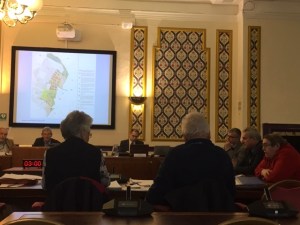
Cllr Elson (shown on right of the photo, beside Cllr Philip Skinner), had argued firmly that “the problem with plans is that they change” , citing her Ward as an example.

“Exmouth ended up with two huge estates with no play space or amenities whatsoever”, she said. Cllr Mike Howe (Con) shared her concerns, saying, (the masterplan) “doesn’t give us much credence or security that we will get the right houses”. But the Deputy Leader of the Council, Philip Skinner (Con ), expressed his view that “Give and take is needed in negotiations with a developer”.

Shortly afterwards, when Cllr Geoff Jung (East Devon Alliance, EDA) observed that the plan might not suit young families, it became apparent that Cllr Skinner was not aware that the proposal to include a primary school had been dropped.

Cllr Eleanor Rylance (Lib Dem) had noticed significant typing and other errors in the masterplan document. Cllr Rob Longhurst (Independent) observed there was no mention of the words ‘Neighbourhood Plan’ in the document.. although Cllr Moulding had told the meeting that he had designed one for Axminster… and suggested this Strategic Plan Committee would like to see “if the community wants and needs” the masterplan.

Cllr Susie Bond (Independent) asked for clarity about the legal implications for the Council if the costs for the relief road “went through the roof” (So far, EDDC has agreed to borrow £7m to ensure the road, estimated cost £16.7m, can be delivered.)

Ian Hall (Con) admitted “this masterplan doesn’t sit easily with the residents of Axminster”, which Alistair Ferguson’s speech in Public Question Time, confirms. The text is reproduced below, with Mr Ferguson’s permission):

In support of the objections, other District Councillors, Cathy Gardner and Marianne Rixson (both EDA), also attended the meeting, though not on the Strategic Planning Committee themselves.

Cllr Gardner pointed out that agreeing to a massive increase in the town’s housing numbers “would not be for the right reasons”, if it was done primarily to fund a relief road. The masterplan “was being done to the people of Axminster, not for them”, she said.

And Cllr Marianne Rixson added that “delivery of affordables does not have a good record” in East Devon.

Having listened to the comments aired, Cllr Geoff Pook (Ind) cautioned the committee not to be “persuaded by the opposition”. “There are just as many people in favour”, he opined.

Finally, the fear that the time-limited government funding for the relief road would be missed, therefore putting in jeopardy the 650 homes allocated in the Local Plan, swayed the committee members to approve the masterplan, albeit with caveats based on their misgivings.

Is this how the wrong sort of housing so often gets built in the wrong place?

In Axminster’s case, how much will the masterplan impact on the historic former deer park? As Cllr Mike Howe, Chair of the Development Management Committee (DMC) told yesterday’s meeting, there’s an urgent need to know….’

EDDC agrees Axminster masterplan with 200 extra houses (now 850)

Persimmon and Crown Estates say they won’t be able to afford to build a relief road unless they build 850 houses rather than the original 650.

So EDDC majority rolled over to have their tummies tickled … and agreed.

Do try to remember this if the developers say they got their sums wrong and will need to build hundreds more …. or no road at all.

https://www.bbc.co.uk/news/live/uk-england-devon-46947635

Budleigh Salterton and Tesco … accelerating high street decline

Tesco has announced it is cutting out butchers, fishmongers, bakeries and delis from its stores.

Spare a thought then for the poor traders of Budleigh Salterton High Street.
The Budleigh Salterton Journal of 23rd January reports that a variation of an approved planning application has been submitted to EDDC by Tesco because “a review has concluded that a smaller store could work better in this site than that of the approved plan”

Many inhabitants of the town are fearful, as before in 2014, that its wonderful delicatessens, butcher, greengrocer, florist, stationers and its 2 invaluable general stores would be put at risk of surviving with the opening of a Tesco. Locals had all dared to hope that the 5 years that this project had been gestating meant that it was no longer viable.

This move just doesn’t make sense when as Owl of 28th January highlights:

“TESCO is set to axe 15,000 jobs as part of £1.5bn cost-saving measure that will see fish, meat and deli counters across the country close down. Bakeries will also be overhauled, with the supermarket giant now ordering staff to use pre-frozen dough instead of making it on site. ..”

Many in Budleigh Salterton will not be happy to contribute to (last year’s) CEO Dave Lewis’ £4.87million pay packet and the chief executive’s short-term bonus of £2.28million on top of his base salary of £1.25million.

AND on top of that see the decimation of Budleigh Salterton’s High Street.

Councils relied too much on informal cabinet briefings: contract legality now being probed

“A CATALOGUE of errors detailing how two district councils were run have been exposed in a ‘gobsmacking’ report.

Initial findings from an investigation into contracts signed by Vale of White Horse and South Oxfordshire district councils between 2010 to 2016 show councillors’ knowledge was stymied by a ‘lack of information’.

The two councils are conducting reviews into several contracts after fears were raised last year that contracts could have been handed out improperly.

All of them have a value of or more than £10,000. Between the two councils, there are 162 of those in total.

A report also highlights there was an ‘over reliance’ on briefing cabinet members informally, rather than decisions being made at public cabinet or council meetings.

‘A lack of detail’ was also found to be a problem in papers for those cabinet briefings and at cabinet meetings.

The review also found there was ‘poor procedural compliance by officers and members, most notably in documenting decision making’.

Debby Hallett, Lib Dem councillor on Vale council and former group leader, said the ‘gobsmacking’ papers seemed to indicate a ‘culture of sloppiness and shortcuts’ over key contracts.

But she added: “The thing that surprised me is [the councils] have promised to have this done by March, which is putting this in the public domain before the local elections [in May].”

That, she said, showed the councils’ willingness to conduct the reviews in a spirit of ‘transparency and integrity’.

Adrianna Partridge, the councils’ head of corporate service, notes in the report: “This review has identified a significant risk that the councils have incurred expenditure that has not been adequately approved in accordance with the councils’ constitutions, which could have both financial and reputational risk.”

In the report which will go to the councils’ joint audit and governance committee on Monday, she states: “Action has already been taken to address and strengthen the decision making process on individual projects, and it is acknowledge that a greater transparency is needed, including an increase in the number of formal papers taken to cabinet and full council which the senior management team is enforcing.”

The councils have set aside a budget of £30,000 for legal advice if they need to take any action over contracts in the future.

Confidential papers will be discussed next week.

They are understood to refer to specific details of the councils’ eight to 10 contracts which are being reviewed.

https://www.oxfordmail.co.uk/news/17377868.gobsmacking-errors-in-how-oxfordshire-councils-awarded-contracts/

Do you want to put a rocket under slow East Devon developers?

If so, EDDC is searching for a “Development Delivery Project Manager”
Salary: £31,401 – £39,961

The brief explains:

“This challenging and exciting role involves managing a series of projects where the Council will be working with land owners, developers and other stakeholders to enable large scale development proposals to come forward where they are currently unable to do so.

The Council has an excellent track record of delivering housing in the district but has a number of key sites where for various reasons the sites are not coming forward as planned. You would project manage the Council’s intervention in these sites working with colleagues across the Council co-ordinating resources to address the various issues and unlock the sites.

You will provide valuable expertise in carrying out development briefs, masterplans and development appraisals as well as providing support on development viability issues and work with our partners on each site to ensure their timely delivery.”

https://jobs.eastdevon.gov.uk/

Greater Exeter Strategic Plan – where are we? In trouble!

All change on the Planning Front for East Devon.

Ever since David Cameron’s coalition government’s efforts to provide local communities with a say in local planning decisions with the “Localism Act” in 2011 (giving communities the power to draft “Neighbourhood Plans,” designed to provide a degree of self-determination to how local communities could be developed in the future) the powerful developers and landowners lobby has been active to reclaim their powerful grip on developing our communities.

First was the new National Planning Policy Framework (NPPF) in 2012 which threw out the old planning regulations and provided a “developer-driven” new planning policy, with just a “nod” to the Localism Act, Neighboured Plans and District wide plans.

The new NPPF introduced a policy that if the District or Neighbourhood Plan was not “up to date” then there would be a presumption of allowing any proposed development from a developer. Therefore, Councils and local communities quickly set about drawing up their Neighbourhood Plans and District Plans to plug the gap created by the new 2012 NPPF policies.

East Devon District Council who had been dragging their feet for years to complete their Local Plan, finally managed to obtain the approval of the Planning Inspectorate in January 2016 to cover the period up to 2031. Lympstone had got its Neighbourhood Plan approved in 2015 and since then over 30 Neighbourhood Plans are either approved or in the process of being drafted by community groups within East Devon.

It was therefore thought that East Devon and its communities had substantial protection from greedy landowners and developers up to 2031 and with the extra protection of the East Devon Villages Plan, approved in July 2018 (which gave further defined policies for larger Villages and some large Business Parks) residents and developers appeared to understand where development would or would not be allowed.

However, in late 2016 Exeter City Council, whose Chief Executive Karime Hassan (previously East Devon’s District Council officer who created and developed the concept of the new town of Cranbrook) proposed a joint “Strategic Plan”, along with neighbouring councils East Devon, Teignbridge, and Mid Devon.

The four councils then started a joint over-riding masterplan for Exeter and the surrounding area known as the GESP (the Greater Exeter Strategic Plan).

It was clear that Exeter was almost completely built-out and the infrastructure in roads and transport required for further city centre and commercial growth was urgently required if the continued success known as the “Exeter Growth Point” was to continue. Without a joint plan for infrastructure, the commute into the City would become intolerable and hinder the targeted housebuilding requirements set by the Government for each of the 4 separate councils.

In October 2018 the Government draw up yet another updated version of the NPPF (National Planning Policy Framework) very much on the lines of the 2012 Policies, but with various tweaks to assist in the over-riding government strategy of encouraging developers to build many more dwellings.

The new 2018 NPPF provided clearer guidance that if an individual Council was unable to provide enough development land for extra dwellings required by the government’s growth targets, neighbouring councils may be allowed to build out extra housing for their partner and other neighbouring authorities.

According to East Devon District Councils Strategic Planning Committees agenda item 12 for discussion on the 29th January 2019:

“Timetable for production of a new East Devon Local Plan”

Within the introduction to the agenda item it states:

…given changing circumstances and other factors, that a “light touch” review of the currently adopted local plan is unlikely to be a practical option for a new local plan.”

What the changing circumstances and other factors are, is not explained but it is clear from the report it is clearly in relation to GESP.

Because the GESP Strategic Plan policies will over-ride the East Devon Local Plan policies, the report seems to suggests that the “changing circumstances and other factors” relate to the new GESP policies which override the Local Plan, Village Plan and probably most Neighbourhood Plans – affecting a large area of East Devon! So much so that, rather than the GESP plan dovetailing into the 3-year-old approved East Devon Local Plan and 1-year-old Villages Plan with all the years of public consulting, Council debate and literally years of work by the planning team, it will be jettisoned for a brand-new Local Plan to dovetail into the strategies of the GESP plan!

Although the GESP plan has been in preparation for 2 years, no formal discussion or meeting has been held at any Council Chamber at any of the four Councils involved. Meetings have taken place to consider the 700 plus sites throughout the Greater Exeter area submitted for assessment by what is known as the “Housing and Economic Land Availability Assessment (HELAA) panel” The Panel is made up of “key stakeholders”, with a recognised interest in the development of land for housing and employment, and housing and economic development sector, including housebuilders, social landlords, local property agents and other related professionals together with local community representatives and other agencies. The membership of these meeting has been confidential and there has there been no publication of their deliberations or recommendations.

To be clear: meetings between two lead councillors from each Authority, plus officers have kept the draft policies and site options totally under lock and key – with none of the meetings been reported or minuted.

However, all is to be revealed AFTER the local council elections in May 2019 – consultation has always been scheduled to begin no earlier than June 2019.

This suggests that the draft policies and site options affecting East Devon will be so radical and so totally at variance to the East Devon Local Plan and Villages Plan that they will all require total re-writing, with a brand-new Local Plan (subsidiary to GESP) and all the costs and uncertainties this will bring.

Why have these Councils been so secretive on the GESP proposed development site considerations for proposed strategies for commercial and housing development for this part of Devon? Could it be that Tory controlled East Devon, Teignbridge, and Mid Devon Councils have elections on May 2nd this year (Labour Exeter elects only one-third of its council this year) and a brand new super-growth plan – superseding their Local Plans – will not be considered much of vote-grabber?

Don’t say you weren’t warned!

EXCLUSIVE: Seaton Mayor resignation: business owner’s statement last night

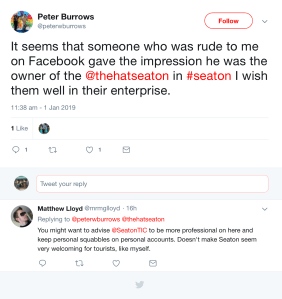
This is the full statement by Mr Gary Miller (owner, The Hat micropub) as given to Seaton Town Council last night, along with a screenshot and transcript of the now deleted tweets to which he refers:

THE TWEETS:

Transcript:
Twitter @peterburrows 1 January 2019 11.38 am
Burrows tweet:
It seems that someone who was rude to me on Facebook gave the impression that he was the owner of @thehatseaton in #seaton I wish them well in their enterprise.

Comment on above Tweet
Matthew Lloyd @matthewlloyd 16 hr
replying to @peterburrows @thehatseaton
You might want to advise @seatonTIC to be more professional on here and keep personal squabbles on personal accounts. Doesn’t make Seaton seem very welcoming to tourists like myself.

THE STATEMENT BY MR MILLER LAST NIGHT:
(verbatim)

“Good evening. I am Gary Millar, the sole owner of The Hat Micropub in Queen Street. I am addressing the issue of Mr. Peter Burrows, the then Mayor and current Councillor on both a local and district level, attacking my livelihood and business.

On the afternoon of New Year’s Day, Mr. Burrows had a very public argument about fox hunting with a private individual on the Facebook page ‘Seaton Views’. This escalated to a robust exchange of views between the two protagonists. (Amusingly both share the same perspective on the matter). Mr. Burrows, who is surely used to the rough and tumble of political debate, took exception to being called a very naughty word. His inexplicable reaction was to use his title of Seaton Mayor to make a direct attack on me, accusing me of being disparaging to the mayor, and to tell thousands of subscribers to a Twitter page called @SeatonTIC, to avoid my business. On the face of it this was the official Seaton Tourist Information Centre page.

This is a grossly stupid response from any public official in any circumstances. You could not make it up.

It is not at all clear why Mr. Burrows chose The Hat as opposed to the many other local businesses that his detractor frequents. Surely, as a public official involved in my various applications, he would have known who I was?

I do not use social media for anything other than professional reasons. If social media users followed the guidelines given in the Hat including “No nasty opinions” and “Be respectful and remember there are other people around you”, the internet would be a kinder place.

Both @SeatonTIC and Seaton Views are ostensibly neutral and exist for the benefit of the people of and visitors to Seaton. However, they are administered by Mr. Burrows which gives him the control over their content. Reportedly, other supposedly impartial social media sites revolving around Seaton are also administered by him. Personally, it disturbs me that a public official has such a domination of information without a clear declaration of interest.

For example – Mr. Burrows selectively deleted his unsavoury exchange on Seaton Views and blocked his detractor from the site. Yet he also closed the @SeatonTIC page entirely, not at the request from the Council as reported, but unilaterally overnight on the 1st/2nd January after legal action was threatened against the then unknown poster. This had two effects – first; we are unable to see how many people viewed his tweet to assess the damage caused. Secondly; imagine the impression given to thousands of potential holidaymakers following what they would reasonably have considered the formal Seaton Tourist Information Twitter page – A strange tweet from the town Mayor attacking a local small business, followed by an unexplained blackout.

This cannot be good for either my business nor the image of the town as a whole. Surely, directing subscribers to the official Tourist Information Site would at least have been a productive step.

I would argue that these actions were not a selfless act by Mr. Burrows, or in the interests of myself or Seaton, but a means of covering tracks. A clear case of canting.

I have yet to receive a proper apology from Mr. Burrows. His statement of resignation last week did not make it clear that I was not the person who insulted him, then he justified his actions, and finally boorishly he ended with him giving himself a pat on the back for a job well done. Unfortunately, any apology at this time now sounds hollow.

Mr. Burrows was high profile in his role as Mayor and councillor on both local and district levels. As such I view both the local and district councils legally culpable for his actions, regardless of these being rogue or not. I expect both the local and district council to do their legal duty and mitigate any damage against me. This includes a full and open investigation of Mr. Burrows conduct in office, including on social media, and disciplinary or legal action wherever possible. This motion of no confidence, and the complaint to the East Devon Monitoring Officer is a positive response by the Seaton Town Council.

Despite undoubted damage to my business, the support of my regulars, and other public support helps me believe that moving to Seaton to open up a new and innovative business was the right decision. My sincere thanks to you all and I hope to continue to serve you real ales, ciders and other fine beverages in a friendly environment for many years to come.

There is however still much to do from both Councils to support the current small traders and promote the opening of new dynamic, interesting small shops in Seaton. Encouraging visitors to move to the traditional trading area, now called The Cultural Quarter, from the lower end of town is an urgent requirement to start. Regrettably, after a year of trading in Seaton and having contributed in various forums, I have yet to see any concrete or effective steps to this end by the Council. This is an opportunity for both the Council and traders to reset and have a fresh start.

In conclusion I would urge all councillors to support this motion of no confidence. What most surprises me is that Mr. Burrows has not recognised his position as being untenable and has not resigned already on his own volition.

Thank you for your time and attention.”

BREAKING NEWS:Seaton’s disgraced ex-Mayor fails to turn up to meeting about his behaviour

Seaton’s disgraced ex-Mayor Peter Burrows failed to turn up to a meeting this evening which called him to further account for his recent behaviour and to hear a statement from the businessman he (mistakenly) maligned on a Twitter account since deleted:

https://eastdevonwatch.org/2019/01/11/seaton-disgraced-ex-mayor-peter-burrows-town-council-responds-names-names/

The meeting confirmed councillor Ken Beer as mayor and Councillor Jack Rowlands as his deputy.

The person originally and erroneously maligned by former Mayor Burrows (Garry Miller of The Hat micropub) made a personal statement.

It is believed that the ten remaining councillors voted unanimously for a resolution calling on Burrows to stand down as both a town and District councillor for bringing both councils into disrepute.

Owl gathers that, as well as a complaint to the EDDC monitoring officer, there will also be a complaint made to the regional Liberal Party about Burrows’s behaviour within the next few days

Sidford Business Park – disproportionate industrial development?

Recently posted comment:

“At the full EDDC Council meeting at the end of October 2018, independent Councillors Ben Ingham and Roger Giles, supported by 11 other councillors, tabled a motion to discuss the over provision of housing needs in our Local Plan and called for an independent assessment. In answer to a question as to why East Devon is taking a disproportionate share of development [58% more than Exeter, 53% more than Teignbridge and nearly three times that of Mid Devon according to independent analysis conducted by CPRE] Councillor Paul Diviani said:

“Because we have the land and we are good at it”!

[Perhaps he should be reminded that two thirds of East Devon lies in an AONB, or perhaps he doesn’t care].

This is not the argument that was put to Inspector Thickett at the public examination of the EDDC local plan in 2015 by Ed Freeman. Then, the argument for pitching the EDDC target at a minimum of 950 houses/year [about 30% more than could be supported by the evidence] was that we had jobs coming down the line. Specifically he mentioned 1,000 full time equivalent jobs a year.

Thankfully, we are effectively at full employment. Office for National Statistic population projections shows the South West population as a whole growing over the local plan period at around 0.8% per annum, including expected migration. However, we have an ageing population and the annual increase of those classified as of working age is only going to be 0.16% (16 to 64 for all genders). To satisfy this annual demand to find new jobs in East Devon [population 142,300] would only require around a couple of hundred a year, nowhere near the 1,000 that are being planned for.

The creation of jobs is generally a good thing but pursuing jobs as a primary objective is, I suggest, not what we need in Devon. What we need are better quality jobs to lift earnings and I am pleased to see that that is what ratepayers’ investment of £1.1M in the Exeter Science Park is aimed at achieving. But it only creates a one-off 158 jobs against the 1,000 a year needed to justify the development plan.

Can anyone provide an evidence based explanation of where these housing and job targets come from? Anyone believe that this is what they were voting for when they elected their councillors? And who are the “we’s” in Councillor Paul Diviani’s explanation?”

Why do we “need” Sidford Business Park when we have the Science Park Enterprise Zone down the road?

Enterprise Zones give favourable start-up arrangements such as business rate relief to businesses that take space in them – Sidford is not in an Enterprise Zone.

“East Devon District Council’s Cabinet last night agreed to invest £1.1m in the development of a new Open Innovation Building at Exeter Science Park, in the Exeter and East Devon Enterprise Zone.

The investment will bring forward 20,000 square feet of space under one roof for growing small and medium sized enterprises (SMEs) in science, technology, engineering, maths and medicine (STEMM) sectors.

Funding has been raised against future business rates income from the growing list of businesses seeking to establish offices and laboratories alongside leading regional science and tech companies already based at Exeter Science Park.

Councillor Ian Thomas, Leader of East Devon District Council said: “The Exeter and East Devon Enterprise Zone is a significant and strategically important development site for the area, with the potential to create over 10,000 jobs.

“This investment will bring forward the opportunity for up to 158 high value jobs in the Open Innovation Building for local people as well as boosting the local economy.

“The £1.1m grant is 15% of the total cost of the building, providing an additional 20,000 square feet of employment space at the Science Park. It means the Open Innovation Building can be ready for occupation in the second half of 2020.”

The Enterprise Zone investment will help fund the building, including the fitting-out.

Dr Sally Basker, Chief Executive of Exeter Science Park Limited said: “Exeter Science Park is growing rapidly and is on-track to become a community of around 700 people by 2021.

“The Science Park helps innovative STEMM companies to deliver extraordinary growth and this Enterprise Zone grant will help us meet accommodation needs of STEMM businesses – both those already located at the Science Park and new firms wishing to take the next step in their growth journey and create a sustainable business.”

Steve Hindley CBE DL, Chair of the Heart of the South West Local Enterprise Partnership, said: “Exeter and East Devon Enterprise Zone is part of the Heart of the South West’s multi-site enterprise zones offering economic opportunities in the area’s key sectors. These enterprise zones, with other sites at Oceansgate in Plymouth and at Gravity in Somerset, enable the local areas to retain a greater share of business rates to re-invest and attract new jobs and growth.”

Councillor Rufus Gilbert, Devon County Council Cabinet Member for Economy and Skills, said: “This is another welcome investment in the Exeter and East Devon Enterprise Zone. The site is key to economic growth in Devon and the Open Innovation Building will add to the portfolio of excellent facilities being developed within the Zone. New infrastructure will attract new businesses and help create high value job opportunities in the area.”

The Exeter and East Devon Enterprise Zone is in its second year of operation, with businesses benefiting from Government-funded business rate relief.

In April 2018 the Council agreed in principle to borrow up to £8m, with detailed approval for £3.4m of expenditure. Projects include the launch in September 2018 of an enhanced ConnEXions bus service with free wifi, a park and change site near Exeter Science Park which will be delivered this year, and design work for an upgrade to Long Lane adjacent to Exeter Airport.”

https://heartofswlep.co.uk/news/east-devon-district-council-agrees-1-1m-enterprise-zone-investment-exeter-science-park/

Workplace parking charges -will EDDC officers and councillors finally have to cave in

Just about every year, Ottery independent councillor Roger Giles – whose environmental credentials are strong – has petitioned for EDDC councillors and officers to introduce parking charges to encourage them to think more about the need to use their cars. Every year, the Conservative majority has voted him down.

Maybe this will change – though with rural public transport so poor, it seems likely that they may have to stump up the cost! Particularly when what is left of it often stops so early!

Buses from the new Honiton HQ to Sidmouth will end at 8 pm, to Axminster they will end at 6.10 pm and to Seaton at 3.40 pm (yes, that’s right 15.40!).

Owl’s guess – allowances and salaries will be raised to cover the extra cost.

“The AA says plans to charge drivers up to £1,000 a year to park at work could become a “poll tax on wheels”.

Under plans to cut congestion, reduce pollution and raise money for public transport, a workplace parking levy is being considered by at least 10 councils.

The charges would affect businesses with more than 10 parking spaces and the AA said the costs would be passed on to workers.

The levy has already been rolled out in Nottingham where four in 10 companies pass on the costs to staff.

Since it was introduced in 2012, the charge has raised £53.7m which has been used to improve Nottingham’s tram network.

Hounslow Council in west London is proposing to charge between £500 and £1,000 a year for every parking space and at least nine other councils are considering imposing the levy.

Other cash-strapped authorities are likely to consider the measure because of a shortage of funding for road improvements and public transport.”

https://news.sky.com/story/drivers-could-be-charged-up-to-1000-a-year-to-park-at-work-11611486

Austerity – carries on after you die with “funeral poverty” thanks to your local authority

Owl says: EDDC expects to make £150,000 from crematoria fees next year – up from £105,000 last year – a 50% increase.

Click to access 020119bpcabinetcapitalestimatesbook2019-20.pdf

(page 40]

“Inflation-busting rises in cremation and burial fees meant council profits from funerals leapt to almost £100 million last year.

Fee increases have been so steep that local authorities’ cremation, burial and mortuary services are operating on an average profit margin of more than 43 per cent. If these services were collectively listed as a single publicly traded company, they would make the FTSE 250 index of leading businesses.

Critics have described the level of charges as immoral and accused local authorities of pushing residents into “funeral poverty”.

Source: Times (paywall)

“Number using food banks in part of Devon doubles in six months”

“The number of people using food banks in the Sid Valley has more than doubled in the last six months.

The Sid Valley Food Bank’s co-ordinator Andie Milne told East Devon councillors on Wednesday night of the alarming numbers of people and the stark rise in numbers of people they are seeing.

She said that six months ago, they were dealing with 15 families a week, but last week, more than 30 families came through their doors, with 36 children being helped.

And she added that last week they helped a family from Axminster as there was no help available in the East of the county for them, and raised concern over what would happen to the emergency food bags located at the council’s Knowle HQ, that sometimes are refilled four times a week, when the council offices move to Honiton early in 2019.

Her comments came prior to the full council unanimously supporting a motion brought forward by Cllr Cathy Gardner, of East Devon Alliance, calling for a report on the potential impacts of benefits changes and spending cuts on people in East Devon and whether there was a need for further support from the council in supporting the roll-out of Universal Credit, homelessness prevention or for local food banks.

Proposing her motion, Cllr Gardner said: “Most of us are doing okay and are comfortable, some are doing extremely well, but some are struggling, and we have a civic duty to see if we can do more. I would be horrified to learn if a child suffered as we failed to something in some way to help.

“I am not criticising the council or the hard work that our officers do to help people but simply to ask if there is anything more that we could do, as we know that people are struggling with Universal Credit.

“If the report says it is all perfect, then we can rest easy, but I want the report to come forward so we can be seen as outstanding, caring and vigilant.”

Cllr Marianne Rixson, supporting the motion, added that some people are being forced to use food banks just to make ends meet, even though they are in employment. …”

https://www.devonlive.com/news/devon-news/number-using-food-banks-part-2323249

Knowle Flog It: statement raises more questions than answers

An “explanation” of the Knowle Flog It fiasco appears in today’s Sidmouth Herald. It appears to be printed verbatim from a council statement.

Owl wonders why this statement was printed without challenging some of its very, very vague claims – one hesitates to use the word ‘facts’. “Journalism”? Not as Owl knows it!

Guess some answers MIGHT come from the Freedom of Information request by an Exmouth resident on 8 January 2019:
https://eastdevonwatch.org/2019/01/10/the-knowle-flog-it-scandal-rumbles-on/

In the meantime:

Amongst Owl’s questions:

It seems Councillor Skinner paid £400 for the table he wanted so urgently – earlier reports mentioned it being valued at a very low price, much lower than £400. Which is correct? And including just how many chairs?

Who decided on the “three disposal methods? It does not appear to be the Asset Management Group.

Which councillors have bought items? Have they declared these on their Registers of Interest?

Which groups were offered ‘free’ items, how were they chosen and by whom? Have any of these groups taken items – and if so, which groups and how much did they pay for them?

What exactly is the Chairman’s Civic Fund and how and when has it been used recently and in the past? What are its rules? Who oversees the disbursements?

Which local groups and charities will be able to bid for what is left after officers and councillors have taken their pick? How have they been chosen and by whom?

Are internal and external auditors happy with the procedures?

Will the Scrutiny Committee be scrutinising these actions?

Owl is sure readers have many more questions!

Auditers warned about council manipulation of funds for commercial ventures

“Auditors have been encouraged to scrutinise council accounts to ensure that balance sheets are not being manipulated in order to justify commercial ventures.

The National Audit Office has released a new guidance note for local government auditors, covering a range of issues thrown up by recent changes in regulation and council practice.

The section on commercialisation has been produced in response to the growth in council commercial activity as a means of dealing with substantial funding reductions, the note said.

“Auditors should be mindful of any incentives to achieve a particular balance sheet position that arise from an authority’s commercial activities when planning their audit work,” the note said.

The note also brought auditors’ attention to the changing nature of investment activity, primarily in commercial property, carried out through asset-backed joint-venture arrangements, rather than traditional debt-backed approaches.

It said: “The scale and nature of authorities’ commercial activity brings both risks to the auditor’s value for money arrangements conclusion and the opinion on the financial statements.

“The former covers the reasonableness of decision making, including the relevant risk assessment, appropriate skills of the authority and the appropriateness of advice.”

Councils need to consider the impact of commercial ventures both on the accounts of any standalone entities, as well as the group accounts, it said.

The note also warned councils that the general power of competence, introduced in the Localism Act 2011, does not give them unlimited powers over their decisions relating to commercial ventures.

It said: “Auditors in considering their value for money arrangements conclusion will need to assure themselves that schemes have been entered into following appropriate legal and financial advice, having regard to Wednesbury principles of reasonableness.

“While the general power of competence has made it easier for authorities to undertake commercial activity, this power does not override the need for authorities to comply where there is already an existing legal duty, for example, compliance with the capital financing regulations.”

Elsewhere,the NAO note encourages auditors to ensure that councils are complying with rules allowing councils to use certain capital receipts on revenue funding.

“With pressure to find revenue funding authorities may incorrectly apply the guidance to apply capital receipts for a revenue purpose contrary to the requirements of the capital financing regulations,” the NAO said.

In March last year, auditor KPMG warned that warned that plans by Northamptonshire County Council to spend £40.9m in capital receipts on transformation projects were “not on any view achievable”.

Auditors,the NAO said, should determine whether councils have complied with the capital receipts flexibility guidance, and review the “reasonableness and realism” of councils’ assumptions.

“Auditors should be alert to the risk that authorities may misapply the flexibility to convert ineligible capital receipts to support their general fund expenditure,” it said.

The NAO note also reiterated the role of the auditor in cases where councils might decide to issue a section 114 notice.

In situations where a section 114 notice could be issued, auditors should seek discussions with the NAO and “engage with the section 151 officer regarding consequent courses of action should the section 151 officer’s actions not be successful in averting an unbalanced budget.”

Stephen Sheen, managing director of local government finance consultancy Ichabod’s Industries, said: “Auditors are required to have regard to the guidance when planning and carrying out their audits.

“This doesn’t mean that they have to agree with it, but they must have considered it in arriving at any position that they take on the relevant issues.”

http://www.room151.co.uk/funding/nao-urges-close-watch-on-commercialisation/