Joke of the millenium: Paul Diviani’s “vision” for East Devon!

We have had clean, green and seen – now we have the ultimate in hypocrisy. a full critique will appear after Owl has lain in a darkened room for some hours mulling on this triumphalist nonsense.

Moses and his Ten Commandments and Ed Milliband’s Tablet of Stone have nothing on this guy!

On the “Conservative Home” website today:

We aim to secure an outstanding and sustainable quality of life for everyone in East Devon.

Where we live, work and play has a tremendous influence on our well-being. We shall seek to conserve and enhance the environment through the social and economic well-being of the people who live and work here. We must achieve a proper balance between the environment, the economy and our communities by weighing the relative merits to ensure sustainability and resultant harmony.

We want to be safe in our communities and to that end we will work in partnership with the other authorities to achieve that. We will look after the disadvantaged of all ages, to ensure that lack of finance and opportunity is not a barrier to the quality of life we all desire. With local housing for local people our top priority, we shall enable good quality and sustainable development to produce the 250 affordable homes we need every year. Then, at last, we will enable families to live and work in close proximity to each other, emulating the cohesive neighbourhoods we remember and desire.

We want our public realm to remain attractive; whether it be the award-winning parks and gardens or the pavements and pathways we traverse daily. We are fortunate that we can all share not only the nationally designated Blackdown Hills and East Devon AONBs (Areas of Outstanding Natural Beauty), but also the only English, internationally recognised, natural World Heritage Site, known as the Jurassic Coast, which together comprise two thirds of our District. As our landscape defines our style, so we shall recognise that renewable energy will have an increasingly important part to play in the way our district looks and powers itself.

We want there to be equal opportunity for work and in particular to achieve high quality jobs in the emerging high tech and green industries. No longer should our young people be forced to leave through lack of housing or employment. Those who wish to depart will always have the option to return to their roots in later years. If they do, we will be there to look after them.

Recognising our foremost economic activity, we welcome visitors drawn to our stunning coastline, our vibrant market towns and villages set in our beautiful countryside, which would not be so but for the custodianship of our farmers who we will support in their efforts to maintain food security and in the process, bring delicious local produce to market. In recognition of the many small rural businesses which are the backbone of our economy, we shall continue to lobby for fast broadband which will also stop our youngsters being disadvantaged solely through location.

We shall communicate in a positive manner with all our residents which will ensure positive leadership and positive partnerships. We want people to feel they really can influence public decision making but realise, in the spirit of localism, individual and community initiatives reflect responsibilities rather than rights. Truly sustainable places are about happy communities, living and working together in wonderful places.

We all want to be proud to live in East Devon and when that is realised, we shall be content.”

http://www.conservativehome.com/localgovernment/2015/07/cllr-paul-diviani-our-mission-in-east-devon.html


A masterclass on how to turn bad news into no news into good news

To read this EDDC spin you would assume that the project on Sidmouth coastal defences has gone fantastically well. In reality it has dragged on, and on, and on. And reading between the lines, that is exactly how it will continue.

A particular masterpiece of spin that has us laughing out loud is this from Andrew Moulding:

It is tremendously exciting to have reached the fourth stage of this long and technically challenging coastal defence project – we are now only a short step away from being in a position where we can actually start to produce the BMP itself and provide a detailed plan for the short, medium and long-term management of the beach and cliffs.”

http://www.sidmouthherald.co.uk/news/progress_in_sidmouth_s_coastal_defence_project_1_4162256

A short step away from STARTING!

Oh, and they forget to mention that, with 25-40% cuts in government spending, the chances of anything happening are slim.

Contrast this with Lyme Regis where a £20m four-phase scheme was completed in one year in 2014 which consisted of a 390m (1,200ft) stretch of sea wall should last 50 years and will safeguard nearly 500 homes and access to the town.

http://www.bbc.co.uk/news/uk-england-dorset-28898711

Fracking will be allowed on Sites of Special Scientific Interest

“Government makes ‘outrageous’ U-turn over fracking in precious wildlife sites”

“There are 4,000 SSSIs in England, more than 1,000 in Wales and 1,425 in Scotland.”

“Fracking will still be excluded from national parks, areas of outstanding natural beauty, the Broads and world heritage sites, under the new plans, though shale companies will be allowed to put a rig outside a national park and drill horizontally underneath it.

Some of the SSSIs will fall within the borders of those other protected areas, but even so the RSPB believes thousands of SSSIs could potentially be affected.

Matt Williams, a policy officer at the RSPB, said: “The government has reneged on its commitment to rule out fracking in some of our most important wildlife sites.

“Despite promising in January to exclude fracking from SSSIs, today’s announcement ignores any such commitment, leaving some the UK’s most valuable wildlife sites exposed to risk from future fracking.”

SSSIs are described by government officials as the “best of our wildlife, geological and physiographical heritage”.

Daisy Sands, head of energy at Greenpeace UK, said: “With a few days before recess, this looks like nothing but a blatant attempt to bypass democracy to sneak this deeply unpopular policy in through the back door while no one is looking. Ministers have given concerned citizens up and down the country no opportunity to voice their opposition to the plans that could ruin the countryside, contaminate the water supply and have a devastating impact on the climate.”

The draft regulations, which will be debated in September, also said that fracking would be allowed under protected groundwater source areas, where drinking water is gathered.

Even under the most sensitive of those groundwater areas (SPZ1s), fracking will be allowed so long as it at depths of more than 1,200 metres. A limit deeper than that would “hinder the exploitation of potentially valuable shale gas reserves”, the regulations said.

No public consultation was held on either the dropping of SSSIs from the list of protected areas from where fracking would be excluded, or how deep the groundwater limits should be set.”

http://gu.com/p/4am9k?CMP=Share_iOSApp_Other

Build on the green belt; who says – developers, of course!

Green belt is mostly found around London and the Home Counties green field is what we have but no doubt developers MUCH prefer it to brownfield!

http://rss.feedsportal.com/c/266/f/3496/s/4803fe85/sc/31/l/0L0Sindependent0O0Cnews0Cuk0Cpolitics0Cbuild0Eon0Ethe0Egreen0Ebelt0Eto0Esolve0Ethe0Ehousing0Ecrisis0Esay0Edevelopers0E10A3815290Bhtml/story01.htm

Devolution, Relocation – spanners in works

“Fixing the foundations: Creating a more prosperous nation”, published by the government today:

“15.3 To rebalance the economy, cities need effective governance. OECD research has shown that cities around the world with fragmented governance structures have up to 6% lower levels of productivity than those that do not.

15.4 England currently has 353 local authorities with over 18,000 elected members.5 This can lead to fragmented decision making and blurred accountability; even within the same city region, urban and suburban leaders do not always work together on shared objectives. The experience of London and other major international cities suggests that a directly elected mayor can cut through these difficulties. The government has therefore been clear that devolution of significant powers will rest on cities agreeing to rationalise governance and put in place a mayor to inspire confidence.”

Click to access Productivity_Plan_print.pdf

Planning – what planning? Localism – what localism

So here it is, page 48 onwards (page 43 on the document). Localism? What was that? This was obviously decided well in advance of the election but not publicised then.

Click to access Productivity_Plan_print.pdf

EDDC Tories, pro-development to their core, will LOVE it!

It’s true: localism is dead – murdered!

“Automatic planning permission would be granted on many brownfield sites in England in an attempt to boost house-building, under government plans.

Ministers would also get powers to seize disused land, while major housing projects could be fast-tracked, and rules on extensions in London relaxed.

Chancellor George Osborne said reforms were needed because Britain had been “incapable of building enough homes”.
It follows a warning this week’s Budget would cut investment in new homes.

The proposed changes feature in a 90-page document to address Britain’s productivity record, to be released later.
It is aimed at boosting British workers’ output levels, which experts say lag behind other leading nations – an issue dubbed the “productivity puzzle”.

The chancellor’s Fixing the Foundations package has been billed by the Treasury as the second half of the Budget.

Upwards extensions

BBC political correspondent Ross Hawkins said Treasury sources argue house-building boosts productivity, as it is helpful to have workers living close to their workplaces.
Housing is just one part of a broad plan, they say.

The report also features proposals on higher education, transport, devolution of powers to cities and trade.

George Osborne says reforms are needed to planning laws so more homes are built.

Under the new proposals – which will need to be approved by MPs – automatic planning permission would be granted on all “suitable” brownfield sites under a new “zonal” system, the Treasury said.

The term brownfield refers to land that has previously been developed but is vacant or derelict.

Another change would see ministers seek to scrap the need for planning permission in London for developers who want to extend buildings to the height of neighbouring properties.
Planning powers will be devolved to mayors in London and Manchester, while enhanced compulsory purchase powers will allow more brownfield land to be made available for development.

There would also be new sanctions for councils that do not deal with planning applications quickly enough, and the government would be able to intervene in councils’ local development plans.

House prices

This week, the Office for Budget Responsibility warned government plans for rent reductions in social rented homes would hit housing investment.

The OBR said 14,000 fewer affordable homes would be built and cut its forecast for investment in private housing by 0.7%.

It also said house prices were expected to rise compared with both consumer prices and household incomes.

A Treasury source said the OBR assessment considered only the impact of the Budget and did not reflect the new policy.
In his Mansion House speech in June 2014, Mr Osborne said 200,000 permissions for new homes would be made possible by 2020 as councils put in place orders to provide sites with outline planning permission.

Housing ladder

The Treasury said the new plan went further – in effect stripping away the need for any planning permission in some brownfield locations.

The Conservative manifesto pledged to “ensure that 90% of suitable brownfield sites have planning permission for housing by 2020”.

In a statement released before the publication of the productivity plan, Mr Osborne said: “Britain has been incapable of building enough homes.

“The reforms we made to the planning system in the last Parliament have started to improve the situation: planning permissions and housing starts are at a seven-year high.
“But we need to go further and I am not prepared to stand by when people who want to get on the housing ladder can’t do so.

http://www.bbc.co.uk/news/uk-politics-33472405

East Devon District Council and “dark rooms”

At yesterday’s local plan hearingss Natural England spoke of mitigation strategy and associated habitats assessment discussions which should not take place in “in a dark room”.

What on earth could they mean!

CPRE on housing

From the blog of Susie Bond, Independent councillor, Feniton

I have been banging on for years about the naivety of assuming that releasing more greenfield land for housing will lead to a big increase in housing supply. The big house builders, who dominate the market to an unhealthy extent, have no great interest in significantly increasing supply. They will build the number of homes they want to build and which they think the market will support; but if they are allowed to build them in the countryside they will do so, rather than building them in towns.

Now CPRE’s housing researcher, Luke Burroughs, has written Getting Houses Built, a report that pretty well confirms this view, backed up by plenty of hard evidence. It strongly suggests that questions of land availability or housing targets, which dominate both debates on housing and the politics of planning, are side shows relative to the question of who is going to build the houses.

There is an increasingly influential narrative on housing, familiar to any reader of the Times or Financial Times, that goes something like this. We need to build 250,000 or more houses a year, around double current output. There may be lots of brownfield land, but some of it needs remediation or is in places people don’t want to live. The need is urgent and if we are to solve the housing crisis we must develop more greenfield land, in particular the land around the towns and cities where people most want to live. That means building in the Green Belt and reforming planning policy so that local people cannot stand in the way of necessary development.

It is surprising how few of the clever people peddling this line stop to ask who is going to build the houses, surely a first order question that must be answered before we consider the second order question of where the houses should go. Once we start to build 200,000+ houses a year, we may need to make difficult choices about where they go. But until we sort out how to get them built we will continue to fall short however many impossible targets are imposed (there have been many) or planning reforms introduced (there have been many and the Chancellor is now promising more) or impossible targets imposed (ditto).

The analysis in Getting Houses Built is not anti-developer. The big house builders act rationally and in the interests of their shareholders. It is not their fault that in Britain, unlike much of Europe, land acquisition and house building is left almost entirely to private companies. They can make big make profits but they also bear significant risks.

The need for developers to maximise profits on each housing unit has seen them adopt business strategies which focus on land trading as much as on actually building houses. Once they have secured land, they build at a rate that will hold up prices. This puts extra pressure on the countryside as land still to be developed on a site with planning permission is removed from the estimate of a local authority’s housing land supply, meaning that it has to allocate land or approve new developments elsewhere.

Getting Houses Built has a number of proposals for improving things. It argues for giving local authorities a bigger role in acquiring land by reforming compulsory purchase provisions and implementing ‘use it or lose it’ measures against those (generally not house builders) who are sitting on land without developing it. The intention would be to remove from the system some of the volatility that suppresses supply. It would also have the effect, potentially, of improving design and encouraging custom building by SMEs.

One of Luke’s earlier reports, Better Brownfield includes a case study of Vauban a 40 hectare, 2,000 home urban extension to Freiberg in Germany. The local authority bought the land at close to current use value; ensured a tramline into Freiberg; then sold the individual plots to small builders and groups of residents. It is hard to imagine similar developments in England, and that is a pity.

The report argues for making the development process far more transparent, including through the compulsory registration of all land ownership, options and sales agreements with the Land Registry. At present, land is often traded, as it were, under the counter. Much of it does not enter the open market, making it hard for small builders to get a look in. Developers buy between 10 and 20% of their land from each other, and having bought a parcel of land the new owner will often renegotiate planning permissions, further delaying the process of getting houses built and, in many cases, lowering the quality of schemes and the number of affordable homes in it.

If they really believe that a lack of developable land is the main thing holding back house building, it is amazing that the advocates of planning reform are not keener to throw some light on the extremely opaque business of land trading.

Transparency should extend to the vexed question of ‘viability’. Negotiations around viability delay many developments, with house builders whittling down planning obligations (design standards, the number of affordable homes, support for infrastructure) on the grounds that they make a scheme unviable. But there is no agreed methodology for assessing viability and much of the data is redacted on grounds of commercial confidentiality, making it impossible for a local authority to assess its accuracy. There is now a growing ‘viability industry’, with agents incentivised to reduce developer obligations.

The report proposes that in order to increase transparency and speed up house building, there should be an open book approach to assessing viability. Guidance should be given on assessing viability, with a single methodology to reduce uncertainty and give greater clarity to developers (who are obliged to game the system as it now stands), local authorities and land owners.

Finally, the report has recommendations for improving the identification of potential sites for new housing. Only 8% of planning permissions for new houses are for sites of under 10 units. These tend to be developed much quicker than larger sites (22 months from planning permission to completion, compared to an average of 47 months for schemes of more than 250 units). Much more effort should be made to identify small sites for development (CPRE hopes to do some work on this).

If the Government is serious about building more houses while at the same time fulfilling its manifesto commitments to protect the countryside, it should seriously consider the practical proposals in Getting Houses Built and other recent CPRE reports on supporting small and medium-sized builders and improving the viabilityand quality of brownfield development. We really are trying to be constructive. Alternatively, it could take its lines from a handful of think-tanks who want to have yet another round of planning reforms (‘one last push’, as generals used to say a hundred years ago). This will be diverting. But it is unlikely to result in a single extra home being built.

https://susiebond.wordpress.com/2015/07/06/getting-houses-built-a-view-from-the-cpre/

Devon urban sprawl

The region saw just over 5,000 acres consumed by urban growth in six years, according to a the survey, which shows the loss of an area almost the size of the Quantock Hills or Windsor Great Park, in the outskirts of London.

Almost 4.5% of the arable land in Devon, Cornwall and Somerset saw was turned into bricks and mortar between 2006 and 2012, the new map shows.

This represents around a seventh of the 35,000 acres of agricultural land lost to the spread of towns and cities across the whole UK.

http://www.westernmorningnews.co.uk/Satellite-shows-4-5-Westcountry-swallowed-urban/story-26816236-detail/story.html

“Improved recycling” = fewer collections!

EDDC believes that by including cardboard in recycling collections it can reduce collection of other waste from once a fortnight to once every three weeks. There is concern from families that this will be inadequate and the problem of build-up of disposable nappies will increase. In the past, East Devon has responded to this by suggesting parents change to terry cloth nappies and wash them instead:

http://eastdevon.gov.uk/news/2015/06/trials-announced-for-improved-recycling-collection-service/

Straitgate Farm Quarry Application for 100 acre quarry, near Ottery

A planning application for a 100 acre quarry at Straitgate Farm, near Ottery St Mary has been made by Aggregate Industries to Devon County Council.

A separate application has been submitted for processing the sand and gravel at Blackhill Quarry on Woodbury Common, which would result in a minimum of 140 lorry movements each day along the B3180.

Residents now have until 2nd July to comment on the application, by Aggregate Industries.

Also, the draft minerals plan (long term strategic quarrying document), in which Straitgate Farm is a preferred site, will be considered by Devon County Council’s development management committee on Tuesday 15 July, before being consulted on for three months. It is vital that as many people attend this meeting as possible. It starts at 2pm.

For more information about the proposed quarry visit  Straitgate Action Group
This is Claire Wright’s thoughts   Cllr Claire Wright’s Blog
Cllr Rob Longhurst has posted his views Cllr Rob Longhurt’s Web site
Here’s the link to the documentation – Planning Applications – Devon County Council

Send your comments to planning@devon.gov.uk

If you want to add comments – please do – if you want to add links to more information – tell Owl

Owl says – These applications effect the whole of the West of East Devon – it is therefore a MAJOR EDW issue.  Apart from the obvious environmental damage to our ancient heritage the impact on the B3180 is immense – this road is not wide enough in many sections to allow a large 40tonne articulated lorry and a car to pass – these lorries are not slow and meeting one is scarey in the extreme.  Write to this blog or better still Devon County Council but oppose these applications.

Another major (unwanted) planning application – Budleigh Salterton

I have just been notified of another major planning application for houses and a care home in the Area of Outstanding Natural Beauty around Budleigh Salterton.

The application is for a 60 bed care home, 30 houses, 7 bungalows, 12 retirement apartments and 2 live/work units.

Objections to the Development would be:
It is outside the Built-Up Area Boundary of Budleigh Salterton and within the AONB. It is the second time the developer has tried for development of this land.
It is on Grade 1 agricultural land which is protected by Government guidance and EDDC planning policies
There are not sufficient non-car transport modes to enable elderly residents to access shops and other facilities in Budleigh Salterton so it is not sustainable because it will increase car traffic within the area
It is superfluous to current requirement for housing and care homes within Budleigh Salterton
It is contrary to the emerging Local Plan
It is close to the Grade II* Tidwell House and the large care home would dominate views of this property.

The application number is  15/1118/MOUT and the closing date for comments is 18th June so there are only 3 days to submit comments. The BS town Council is debating this on the 22nd June.

Comments should be made by logging in to East Devon District Council’s online planning system via https://planning.eastdevon.gov.uk/online-applications/ (or write to EDDC at Knowle).

Please can you also send a copy of your comments to office@budleighsaltertontowncouncil.gov.uk before their meeting on the 22nd June.

“Is the Deputy Chief Executive fit for purpose?”, some are now asking

EDDC’s press release today (see our previous post) speaks of ‘lessons to be learned’ from the Tribunal’s scathing report, though it overlooks the fact that the criticism was “unanimous”, and not solely from the judge. There is no reference to the reportedly “discourteous” manner exhibited by EDDC , though the Council regrets  that the Tribunal found it at times “unhelpful”.

To compare this press release with the one posted earlier today from Save Our Sidmouth (which contains the the Tribunal’s devastating comments), go to these links:
http://eastdevon.gov.uk/news/2015/05/council-prepares-to-release-documents-that-sparked-tribunal/
and http://saveoursidmouth.com/2015/05/05/sos-press-release-on-tribunal-decision/

EDDC loses its appeal to keep Knowle relocation reports secret, with scathing commentary on Council’s behaviour!

The Judge’s report ends with this REMARKABLE paragraph:

‘ This Tribunal takes the unusual and unfortunate step of commenting on the conduct of the appeal itself.

We are unanimous in our view that this appeal has taken much longer than it should have done and the reason for this seems to be the failure on the part of the public authority, the appellant, to address itself with sufficient attention to the details of what information and documents it was sup- plying to the Commissioner and ultimately also to the Tribunal.

It was not until March 2015 that a fully legible copy of the disputed information was supplied and seemed to be complete. This is, in our collective experience, wholly exceptional and the time spent dealing with what we believe to be five different sets of disputed information is simply not a good use of the Tribunal’s time nor fair, in terms of delay, to the requester.

Correspondence on behalf of the Council, rather than ensuring the Tribunal was assisted in its function, was at times discourteous and unhelpful including the statement that we had the most legible copies possible. A statement, which was clearly inaccurate as subsequently, we have been provided with perfectly legible documents.

We believe this appeal could and should have been dealt with completely at the hearing in August 2014 and the decision promulgated six months ago had the Council discharged its responsibilities properly’.

A press release is due shortly, from Save our Sidmouth.

Local Tories show their true colours

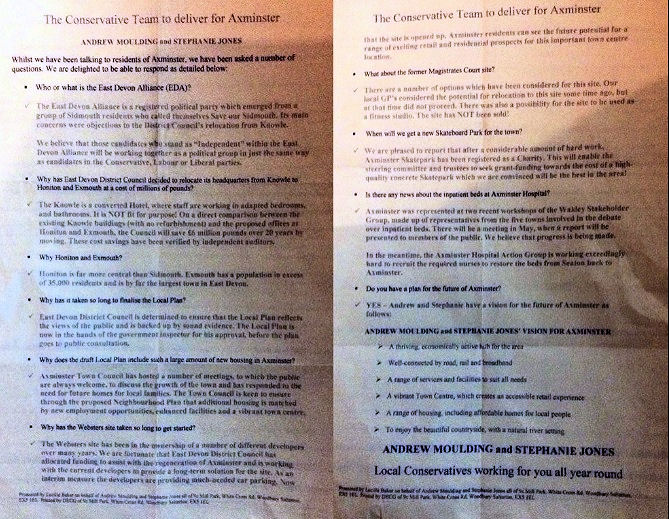
Andrew Moulding and Steph Jones’s election leaflet issued in Axminster, seems designed to misinform.

AxmstrLeaflet

A close look at the leaflet (above..click to enlarge) reveals some apparent misconceptions and economies with the truth:

Moulding/ Jones: Imply East Devon Alliance is centred in Sidmouth.
Incorrect: EDA Chair lives in Colyton; Vice-Chair in Feniton; vast majority of East Devon Alliance Independent candidates are from other parts of the District.

Moulding/Jones: Suggest Knowle is just adapted bedrooms and bathrooms.
Incorrect: Only the old part, which was once used as a hotel, then as flats.  No serious attempt has been made to market this individually to fund update of the newer building, which consists of purpose built offices in 1970-80s, with outside space for extension if required.

Moulding/Jones:  Move will save £6m over 20 years.
Figures are disputed ( posts on http://www.saveoursidmouth.com may explain why ‘Sidmouth’ is a painful subject for EDDC Deputy Leader, Cllr Moulding) – and some withheld documents concerning office relocation are still under legal review (Tribunal decision imminent: Information Commissioner and J. Woodward vs East Devon District Council).

Moulding/Jones: Why Honiton and Exmouth? “Because Honiton is more central, and Exmouth is the largest town.”
Then why did they previously support Skypark (which could not be less central) and selling the site in Honiton? In reality, a newbuild office at Honiton is just the fall-back plan, as the Honiton site couldn’t be sold for enough money to make a move to Skypark financially viable. And Exmouth has only now come into the equation, as space at the Town Hall has become available. The leaflet makes no mention of the issues of running a split site; nor of existing air pollution problems where the £7m newbuild HQ at Honiton would be sited (no such problem in Knowle parkland!), etc.,etc. 

Moulding/Jones; Why is Local Plan taking so long? “Because we want to get it right”
Or is it because EDDC are struggling, having got it so wrong in the past, and exasperating the Inspector, who rejected the previous one? (Remember the 53 ‘minor changes’ which the Inspector found to be ‘major’? SIN blogged the story: https://sidmouthindependentnews.wordpress.com/2013/11/30/sum-thing-amiss/)

Moulding/ Jones: Why so much new housing in Axminster? “Because you wanted it!!”
Who are ‘you’? Does it embellish the town and help it to thrive? Or is it symptomatic of consequences when deciding where to build the massive number of new houses EDDC has chosen to opt for?

Moulding/Jones:  Do you have a plan for the future of Axminster. “Yes, we have a vision.”
Who are ‘we’, and has the vision, with no neighbourhood plan yet in place, been led by speculative development?

This leaflet, along with quotes from Hugo Swire in the local press yesterday (https://eastdevonwatch.org/2015/05/02/east-devon-alliance-responds-to-hugo-swire-misinformation/), show tired tactics which are looking rather stale. On May 7th, East Devon voters may well show they’ve had enough of them.

Who shapes our future?

Anyone who’s been to the new town of Cranbrook lately, will be interested in this link: http://futuresforumvgs.blogspot.co.uk/2015/04/where-we-live-now-new-town-home-town.html

Was it Churchill who once said, we shape our buildings and our buildings shape us…