Who will take the decision whether to appeal the appeal for disclosurof Knowle relocation documents?

The Chief Executive (Williams) and Deputy Chief Executive (Cohen) along with ? who else must have taken the original decision to suppress the reports discussed in secret meetings when they were requested by Mr Woodward,

This decision to suppress the reports, to our knowledge was never brought to any public council committee.  Who took the decision to suppress?

Eventually, the Information commissioner said that (redacted) reports should be published.

The ” council” then decided to appeal this decision.  Who made that decision and why?  Who reviewed it and agreed with it?  How many councillors knew what was happening?  Who thought up the idea of saying reports could not be published because the consultant was “an embedded employee” of the council?

The Deputy Chief Executive (Cohen) was chosen to present the justification for suppression and appeal at the court case in August 2014.  The council’s solicitor (Lennox Gordon) presumably must have been asked for advice (though at the Court case they had engaged an outside barrister to present the case).  The Chief Executive and ? who else must have then sanctioned this course of action.  It was, to our knowledge, never brought to any public council committee.  Who else knew about this?

At the Court case, Deputy Chief Executive Cohen admitted that at least one report from the outside consultant (Pratten) had been changed by him – Cohen – before being given to the Overview and Scrutiny Committee.  The Overview and Scrutiny Committee were not aware of this at the time and (as far as we know) still do not know what was changed or why.  Who else (if anyone)  was involved in the decision to change the document before it went to them?  Have members of the Overview and Scrutiny Committee since seen the original?  Would it have changed their views if they did not see it and have not since seen it?

Are there more reports (changed, not changed) other than those under review that they and other councillors should have seen prior to making an informed decision about relocation either to Skypark or Honiton/Exmouth and then sale of Knowle that might have affected their decision?

After the Court case in August 2014 it appears that EDDC dragged its heels in providing the judge with documents and insisted that some of them were illegible.  However, subsequently, legible copies were found and submitted as late as March 2015.  Who insisted that only illegible copies were available?  Who knew that there were legible copies available and why were they delayed?  Why the long delay?

Now that the court has heavily criticised all those involved, the decision can again be appealed, at probably even greater cost than the last appeal.  We do not yet know the full cost of the last appeal except that it is more than £11,000 PLUS officer time, as EDDC never apportions cost of officer time to its work.

So, who takes the decision to appeal the appeal?  The same people who suppressed the documents?  The person/people who altered at least one document before it went to a committee?  The people who said that some documents were illegible when they were not?   The people criticised by the court for being “unhelpful and discourteous?

Who is left who has not been involved in this sorry saga who can be trusted to find out the answers and make decisions now?  If we return the “same old” how can we be sure this will not be brushed under a carpet so precariously balanced on all that is now underneath it?

Brave independent councillors kept bringing this subject up time and time again only to be told to stop tilting at windmills.  What is here is definitely not windmills.

Only a vote for Independents tomorrow can ensure that the carpet is lifted so that we can all see what has been swept underneath it all these years.

Including, of course, some searching questions about the seven year delay to a Local Plan which has left us at the mercy of rapacious developers.

The  future is in your hands tomorrow.


Should Council officers shamed by QC’s comments, be considering their position?

SOS may not be alone in thinking so. This press release has just been issued: http://saveoursidmouth.com/2015/05/05/sos-press-release-on-tribunal-decision/

Local Tories show their true colours

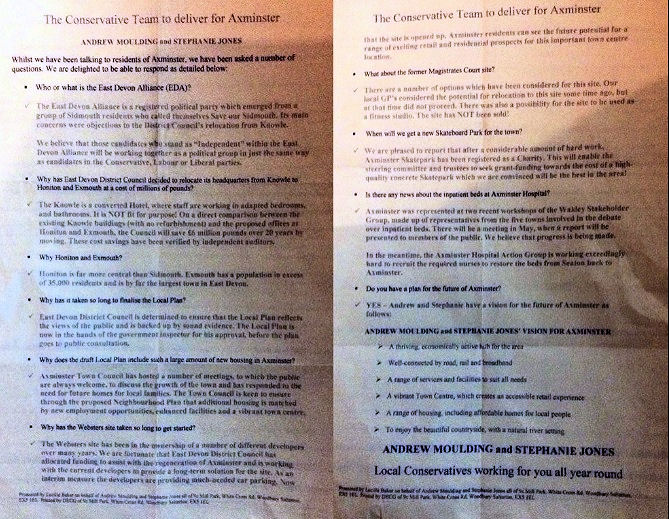
Andrew Moulding and Steph Jones’s election leaflet issued in Axminster, seems designed to misinform.

AxmstrLeaflet

A close look at the leaflet (above..click to enlarge) reveals some apparent misconceptions and economies with the truth:

Moulding/ Jones: Imply East Devon Alliance is centred in Sidmouth.
Incorrect: EDA Chair lives in Colyton; Vice-Chair in Feniton; vast majority of East Devon Alliance Independent candidates are from other parts of the District.

Moulding/Jones: Suggest Knowle is just adapted bedrooms and bathrooms.
Incorrect: Only the old part, which was once used as a hotel, then as flats.  No serious attempt has been made to market this individually to fund update of the newer building, which consists of purpose built offices in 1970-80s, with outside space for extension if required.

Moulding/Jones:  Move will save £6m over 20 years.
Figures are disputed ( posts on http://www.saveoursidmouth.com may explain why ‘Sidmouth’ is a painful subject for EDDC Deputy Leader, Cllr Moulding) – and some withheld documents concerning office relocation are still under legal review (Tribunal decision imminent: Information Commissioner and J. Woodward vs East Devon District Council).

Moulding/Jones: Why Honiton and Exmouth? “Because Honiton is more central, and Exmouth is the largest town.”
Then why did they previously support Skypark (which could not be less central) and selling the site in Honiton? In reality, a newbuild office at Honiton is just the fall-back plan, as the Honiton site couldn’t be sold for enough money to make a move to Skypark financially viable. And Exmouth has only now come into the equation, as space at the Town Hall has become available. The leaflet makes no mention of the issues of running a split site; nor of existing air pollution problems where the £7m newbuild HQ at Honiton would be sited (no such problem in Knowle parkland!), etc.,etc. 

Moulding/Jones; Why is Local Plan taking so long? “Because we want to get it right”
Or is it because EDDC are struggling, having got it so wrong in the past, and exasperating the Inspector, who rejected the previous one? (Remember the 53 ‘minor changes’ which the Inspector found to be ‘major’? SIN blogged the story: https://sidmouthindependentnews.wordpress.com/2013/11/30/sum-thing-amiss/)

Moulding/ Jones: Why so much new housing in Axminster? “Because you wanted it!!”
Who are ‘you’? Does it embellish the town and help it to thrive? Or is it symptomatic of consequences when deciding where to build the massive number of new houses EDDC has chosen to opt for?

Moulding/Jones:  Do you have a plan for the future of Axminster. “Yes, we have a vision.”
Who are ‘we’, and has the vision, with no neighbourhood plan yet in place, been led by speculative development?

This leaflet, along with quotes from Hugo Swire in the local press yesterday (https://eastdevonwatch.org/2015/05/02/east-devon-alliance-responds-to-hugo-swire-misinformation/), show tired tactics which are looking rather stale. On May 7th, East Devon voters may well show they’ve had enough of them.

Another hustings packed to overflowing last night, this time in Sidmouth

The third in the series of hustings organised in Sidmouth (for District,Town and Parliamentary elections, respectively), admirably had all five of the Prospective Parliamentary Candidates (PPCs) there to meet the public face to face.

Andrew Chapman (UKIP), Hugo Swire (Cons) , Stuart Mole Lib Dem), Claire Wright (Ind) and Steve Race (Labour) gave their views clearly and characteristically, from their various standpoints, showing that politicians are NOT all the same!

The evening began with an element of almost high comedy, as a phalanx of Tory supporters arrived half an hour early, having been informed in an e-mail from the party office of the wrong start time…rather conveniently enabling them to claim the front row seats.

There was not enough time to cover all the questions submitted, but topics were wide-ranging. They included Trident,and defence spending; decarbonising the energy sector; provision of mental health services; and housing figures in East Devon’s latest draft Local Plan.
The audience was clearly strongly divided, but for the most part listened attentively to the speakers.,although there were outbreaks of heckling when the Party lines were rolled out,  as when Hugo Swire (Con) said repeatedly that Labour + the SNP would make a chaotic combination in government; and UKIP’s Andrew Chapman insisted our housing shortage was caused by EU immigrants. There was also applause, as when Claire Wright declared, in her closing speech, that as an MP she would never belittle people who were poorer than herself.

At the end of the meeting, VgS Chair, Dave Bramley, praised the courage of the five PPCs, for being prepared to stand on their platform in front of the large audience (about 200 people), and answer questions in person. Regrettably, the bulk of the District Councillors representing Sidmouth, sitting in those front row seats last night, had not been so keen to do so themselves, having boycotted the previous two Sidmouth hustings as “too political”, we hear. Last night all that was required of them was to clap in unison, on cue.

EDW note: If the hustings in progress right now, at St Martins School, Cranbrook, is equally well-attended….is it a sign of the times?

EDDC in secret talks with DCC to build (some) affordable housing in Exmouth

But remember that “affordable” means 90% of market rent.

Why not a Community Land Teust for 100% affordable housing for lical people as has been done in other areas. And what about self-builds?

And surely these political decisions did not take place behind closed doirs during the Purdah period?

And it will be SO interesting to see which housebuilder they pair with!

http://www.exeterexpressandecho.co.uk/East-Devon-Council-buy-buildings-Exmouth-site/story-26400487-detail/story.html

What do you know about your district council candidate?

If they are Conservatives you know almost nothing, unless it is Stuart Hughes in which case you probably know too much!

If they are East Devon Alliance Independent candidate you will know their key issues, priorities, motivation and background and be able to consult a video, blog, gallery and contact information

http://www.eastdevonalliance.org.uk/
Transparency and true  localism – knowing exactly what they stand for and why and what they intend to DO without party political interference at district level – that’s the name of the game … but it seems some people in some old parties haven’t yet grasped this.

Judge who led Tower Hamlets inquiry calls for urgent electoral reform

Good to see a member of the judiciary recognises this problem, even if political parties and the police don’t:

“Last year Mawrey repeated his warning that postal voting enabled electoral cheating on an “industrial scale”. …

…”Challenges should be governed by simpler, modern and less formal rules of procedure allowing judges to achieve justice in the case while having regard to the balance between access and certainty,” it proposes. …

” … In his 200-page judgment on Rahman, Mawrey pointed out that although the election court is a civil hearing, “the criminal standard of proof, namely proof beyond reasonable doubt” is applied. Candidates, unless “a mitigating factor is established”, are deemed responsible for the acts and omissions of their agents. …

“Dr Toby James, senior lecturer in politics at the University of East Anglia and author of Elite Statecraft and Election Administration, said the long delay between last May’s mayoral vote in the east London borough and the election court’s ruling this week highlighted the need for a more speedy resolution process in electoral disputes.

“Imagine what would happen after the general election in two weeks’ time when you have disputes arising from a couple of constituencies and very close party results,” he told the Guardian. “It’s a Victorian procedure. Election justice should be quicker and then we would see if there’s more signs of fraud.”

http://gu.com/p/47ztq

When is a Tory not a Tory?

When standing for a town council, of course: http://eastdevon.gov.uk/media/1051007/sidmouth-north.pdf
Confusing for voters, though, when the very same Stuart Hughes (or a different one?) was the proposer for Tory PPC Hugo Swire. See  http://eastdevon.gov.uk/media/1050699/spn-nop-sps.pdf
EDW note: The second link, above, has a useful list of polling stations…which voters are sometimes unsure of. 

Parish council told co-option meetings for additional councillors must be in public

A story in today’s Western Morning News (page 3 no online link available) says that a parish council in Cornwall (St. Agnes) has been told to “forget” a meeting it held behind closed doors to co-opt councillors when too few councillors stood for the available seats – something that has happened in many East Devon towns and parishes.

A parishoner objected and said the meeting should have bee  held in public and the Cornwall Association of Local Councils agreed that this was the proper procedure to follow.

One wonders how, in this day and age, any council could consider holding such a meeting behind closed doors but, alas, there are still some dinosaur councils which seem to be unable to adapt to demepocracy and transparency ….. and Clerks and CEO’s who seem to like that situation …..

Important dates for new councillors

Wednesday 13 May 6-9 pm  New councillor induction

Wednesday 20 May 6-9 pm – second new councillor induction meeting (NOT a repeat)

Wednesday 27 May 5.30 pm – Chief Executive Briefing

Wednedsay 27 May 6.30 pm – Annual Council Meeting

Tips:  

Do not be intimidated or misled by any information given to you, check it for yourself and sort out the subjective advice and objective advice, the wheat and the chaff.

Much is made of what councillors CANNOT or SHOULD NOT do rather than what they CAN AND SHOULD do.  Always double-check what you have been told.  You have wide powers and basically you are free to do anything that is lawful and of benefit to the district.

Some “old guard” councillors who may be re-elected may be very reluctant to let go of the reins of power – they may have to be wrestled from them.

The Chief Executive and his officers must maintain political neutrality throughout the life of the council.

Much will be made of ” this is how it has always been done”.  To which the reply should be: “Why?  Is there a better, more democratic and transparent way to do it in future”.

The curse of leaders who get too powerful

Editorial in today’s Independent newspaper:

Editorials

Rahman rumbled


Tower Hamlets is a warning. Local politics will be open to abuse so long as mayors can run their councils unopposed


Local government has long been the weakest link in the country’s democratic infrastructure. The verdict that LutfurRahman, the one-time mayor of Tower Hamlets, was guilty of corrupt and illegal practices represents only the latest episode in a long line of crooks and chancers, of whom T Dan Smith, the corrupt leader of Newcastle upon Tyne in the 1960s, was the flashiest and most audacious.


Too often local council leaders become national figures for all the wrong reasons, either purely political or personal – Shirley Porter, in Westminster, for alleged gerrymandering, and Derek Hatton in Liverpool, for sacking his own workers, their redundancy notices delivered by a fleet of taxis.


Mr Rahman’s disqualification is unprecedented for a directly elected mayor, though some others, not least Ken Livingstone in London, have had their share of (much less serious) scrapes. Mr Livingstone may now regret defending Mr Rahman against what he called “smears” when the initial investigation began last year. The verdict vindicates the journalists who first raised doubts about Mr Rahman – and were dubbed “Islamophobic” for their troubles, as were many of those, including political opponents, who stood against him.


In any case, local democracy is certainly not receiving the attention it deserves. On 7 May, people will also be voting in contests covering all 36 metropolitan boroughs, 194 districts, 49 of the unitary authorities, and for various directly elected mayors.


In most of these elections, much more than Westminster this time round, the results are a foregone conclusion. One of the more regrettable consequences of the decline of the Liberal Democrats was their disappearance in council chambers where they were usually the only opposition to an overwhelmingly Labour or Conservative administration.


Outside Scotland and Wales, where the Scottish National Party and Plaid Cymru are now making local politics more competitive, Ukip and the Greens are still a minor, though sometimes significant, force. (Not always an effective one, as the chaotic Green-run Brighton and Hove administration and tweets from the madder Ukip councillors prove.)


So far too many councils are virtual one-party states. Take the local authorities covering the constituencies of the Prime Minister and the Leader of the Opposition. In the Tory West Oxfordshire, the Conservatives have a grip on 40 of the 49 seats; in Doncaster, Labour holds 50 of the 63 places on the council. In the Miliband family’s home borough of Islington, Labour represents 47 of the 48 wards.


Where such one-party dominance is coupled with a powerful directly elected mayor, as was sometimes the case in TowerHamlets, democracy cannot flourish. By contrast, the London mayoralty works so well because the Mayor’s actual powers are very limited, his ability to raise funds confined to public transport and congestion charging, and he spends comparatively little. Despite the big personalities of Mr Livingstone and Boris Johnson, real power is actually dispersed through the 32 London boroughs. But the mayors in other cities have far too much power and budget for comfort.


The solution is to introduce proportional representation in local councils, which would encourage councillors to work together, blur tribal distinctions and help politics to mature generally. In “hung” councils this has become the norm, and there is no evidence that these are worse run than their one-party state counterparts. The second stage is to end the experiment of directly elected mayors, outside the special case of London.


In many cases they lack legitimacy. In cities such as Leicester the electors were not even offered a referendum to say whether they wanted this radical constitutional innovation in the first place. In Hartlepool, the voters signalled their disaffection by voting in a man in a monkey suit, who served three terms in all before the directly elected mayoralty was abolished by referendum three years ago.


As part of the “Northern Powerhouse” scheme, the Government and local authorities of Lancashire seem determined to create a mayor of the “Greater Manchester Combined Authority” by 2017. That promises the worst of all worlds: a one-party regional government in an unaccountable mega-council. With so much focus on devolution for Scotland, and coalitions at Westminster, local democracy seems set to continue on its path of benign neglect.”

Information Commissioner v EDDC: surely our officers and councillors are not holding this up until after the elections?

This is the case where the Information Commissioner ordered release of (redacted?) information on relocation discussions and costings, only for EDDC to appeal this decision.

Initially, after a hearing at Exeter Magistrates Court in August 2014, we were told at that time by the judge that a judgment could be expected in late 2014 or early 2015,

It is now late April 2015 and no sign of it.

Surely our officers and (current) councillors are not dragging this out until after elections?

What could possibly be in these documents that would cause such a delay?

Sidford business park

Whilst it is true that, at EDDC, it was Councillors Troman (in particular) and Hughes (in general) who helped to get the ridiculous Sidford Fields business park deleted from the draft local plan, it was the constant work of EDA members in Sidford, Sidmouth and beyond, that kept the issue at the forefront of the discussions and publicity that led to the change:

http://www.midweekherald.co.uk/news/victory_in_fight_to_see_12_acre_sidford_business_park_ditched_1_4020613

The remarks of CEO Mark Williams about that change are mind- blowingly insulting. He said:

The inspector has already heard everything we have said and is yet to tell us what his view is on that part of the application. He may recommend that this site is not suitable and should be removed. It’s his decision now, not yours.

“It’s your funeral if you want to take it out.”

What he did not add is that, entirely without consultation or reference to any committee, except the Development Management Committee on the day, FIVE extra business parks, closer to Exeter, had been added to the draft recently.

A massive number of changes have been made to the latest draft, yet this one amendment, made by democratic decision in a transparent way, is the only one Mr Williams was worried about.

The Sidford Fields site was added AFTER public consultation on the first draft local plan, with no explanation whatsoever for its inclusion, as noted in a letter in this week’s Sidmouth Herald.

Councillor Mike Allen, in the same article, laid the blame squarely on Councillor Andrew Moulding:

“Cllr Moulding was accused by Cllr Mike Allen of being the person responsible for the allocation’s original inclusion in the plan.

“Cllr Allen said: “There’s no demand, no economic case and it would damage the tourism industry in Sidmouth. There’s no justification for keeping it. Please could we get rid of this site once and for all.”

Anyone making a Freedom of Information request for correspondence or meetings about inclusion/exclusion of the site?

“BIG MONEY” INFLUENCE NEEDS TO BE TAKEN OUT OF UK POLITICS


Commenting on the publication of a new poll by the Committee on Standards in Public Life outlining widespread mistrust amongst the public towards major donors to political parties, Director of Unlock Democracy Peter Facey commented:

“It is clear from the Committee on Standards in Public Life that the public do consider the influence ‘big money’ has on politics is important and that it makes very little distinction between influence from individuals, companies and trade unions.

“This research should make sobering reading for politicians from across the political spectrum. It ought to spur them into action. Let us hope that it does not take another funding scandal before they are prepared to do so. With public confidence in politicians continuing to plummet, urgent action is required.

“Introducing a cap on donations to political parties may be risky but not as risky as doing nothing. It is high time government and opposition parties alike ended the rhetoric and got around the negotiating table.”
Summary of the polls findings:

82% of people considered party funding to be an issue of “some” or “great” importance.

81% of people believed people donated to political parties in the hope of receiving favours, special treatment or special access and influence over the party.

85% of people thought that politicians very often or sometimes do special favours for donors.

76% of people thought that politicians very often or sometimes based decisions on what their donors wished.

52% of people thought that giving special favours to donors was never acceptable.

In a separate poll, the CSPL also found that the percentage of people in England who believe that MPs are dedicated to doing a good job for the public dropped from 46% to 26% between 2008 and 2010.

Both polls can be found here:
http://www.public-standards.org.uk/OurWork/Public_Attitude_Surveys.html

http://unlockdemocracy.org.uk/media/news/entry/big-money-influence-needs-to-be-taken-out-of-uk-politics

The only Parliamentary candidate who does not take donations from Big Business or Unions is Independent Claire Wright.

Westpoint- Planning application to remove exemption for Speedway/Timed Car Trials. Public Meeting planned 15th April (tbc).

New concerns for Save Clyst St Mary campaigners, outlined in this message today from organiser Gaeron Kayley:

‘ In case you weren’t aware, Westpoint has applied for an exemption to its planning permission to allow timed car trials on its site. Obviously this is a concern as it is likely to be very noisy and could potentially cause additional pollution to the area too..

This is the link to the planning application (15/0139/VAR):
https://planning.eastdevon.gov.uk/online-applications/applicationDetails.do?activeTab=summary&keyVal=NIGLWSGHHHM00

As you can see, there is barely any info about what it actually entails at present

Here are the links to the company’s website:
http://www.bhpperformanceshow.com/

and

http://www.bhpperformanceshow.com/gallery

It might also be useful to have a look at their own clip on YouTube:

Although the application is for one day, we fear this will be a sliding slope and that there might be additional requests for more days – hence the reason we have brought it to your attention.

Having spoken to The Parish Council, I can confirm there will be a public meeting in the School Hall on Wednesday 15th April Starting at 19.30 (This date and time is subject to confirmation once the school has re-opened).

On a different note, we understand there have been some recent changes in personnel at East Devon District Council, including a new Head of Planning. However, at present, there is no clarification of this on their website. To save time and ensure that we can have direct contact with the right people, if and when this is required,we would be grateful if any member of our group working for EDDC could contact us to confirm appointments and contact details. This will ensure we can get in contact with the right people and not disturb those unconnected with our interests!’
<!

Scrutiny: one to file away for the next council

Which, with any luck, will have many more Independent councillors prepared to scrutinise decisions of the council demicratically and transparently:

“12. Petitions asking for officers to give evidence

If your petition contains more than 750 signatures your petition may ask for a senior council officer to give evidence at a public meeting about something for which the officer is responsible as part of their job.

Your petition may ask the officer to explain progress on a particular issue or to explain the advice given to the Leader and/or councillors to enable them to make a particular decision. The petition must relate to the officer’s job and cannot relate to their personal circumstances or character.

The evidence will be given at a public meeting of the council’s Overview and Scrutiny Committee and not at a meeting of the Council. The officer giving evidence at the meeting may be accompanied by another officer, technical expert or a representative from a partner agency. You will be given details of the meeting so that you can attend. The Committee meetings are normally held in public, but the Committee has the option to exclude the press and public from any part of the meeting that discusses confidential information. If the Committee does exclude the press and public you will also have to leave the meeting. If possible you will be given the opportunity to present your petition first. If it is likely that the press and public will be excluded from the whole or any part of the meeting you will be notified of this and given the reason(s) for this when we give you the details of the meeting. You should be aware that the committee may decide that it would be more appropriate for another officer to give evidence instead of any officer named in the petition – for instance if the named officer has changed jobs. The committee may also decide to call the Leader or relevant councillor to attend the meeting. Only the Committee will ask questions at this meeting, but you will be able to suggest questions you would like them to ask by contacting the Democratic Services Manager (by telephone 01395 517541 or Team number 01395 516546 or e-mailing dvernon@eastdevon.gov.uk) by 4.00 pm three working days before the meeting.”

http://eastdevon.gov.uk/council-and-democracy/committees-and-meetings/petitions/petitions-asking-for-officers-to-give-evidence/

From the archives: the siege of Newton Poppleford

Wherin EDDC had to be threatened with a judicial review before they would admit to “errors”

https://sidmouthindependentnews.wordpress.com/s=newton+poppleford&submit=Search

and Freedom of Speech meant freedom to attempt to gag a councillor:

https://sidmouthindependentnews.wordpress.com/2013/06/25/another-month-another-chaotic-planning-meeting-at-newton-poppleford/

and here:

https://sidmouthindependentnews.wordpress.com/?s=Graham+Salter&submit=Search

No action was taken against Councillor Salter as all complaints were found to be groundless and unactionable in law.

The eleventh hour: why you should vote Independent

For those who do not click on links, here is the text of Paul Arnott of the independent East Devon Alliance’s hopes for change at the crucial district elections as they appear in the current Devonshire magazine:

My first published book about fifteen years ago concerned a subject with a very boring name – adoption – with its potentially dull backdrop of social services and filing cabinets. The only way to animate it was by my personal story. I did not know until my mid-thirties that I had been illegitimately conceived in 1961 by a scared young Irish couple in London, who later went on to marry in Dublin and have four more children, my full-blood siblings. I was a devoted Englishman who it transpired had flesh and blood from County Carlow.

Now here is another boring word – planning. How to persuade a reader that at its dark heart may be the seedbed for the rebirth of our moribund national democracy? It has to be me again, for which I apologise. I was diagnosed with leukaemia four years ago, had a bone marrow transplant three years ago, am fully recovered and should be doing something quiet and nurturing with this reborn life – learning to paint, taking up the harp etc.

Instead I find myself chairman of a movement called the East Devon Alliance, which is supporting a network of Independent candidates to fight the majority of ward seats in the district election happening on the same day as those for Parliament.

It is the biggest Independent effort in British electoral history, more than 40 individual, plucky people who have decided they cannot trust our beloved environment to the whims of a one-party council dominated by pals of developers any longer. They have realised, in supposedly sleepy East Devon, that democracy can only be revived by entirely changing the guard. Indeed, perhaps in this roots-up path may be found the eventual route to national reform?

When I first fell amongst these lovely people, their horror stories from about twenty towns and villages were of a piece with my experience before being ill, making J.K Rowling’s A Casual Vacancy seem like a Year One show-and-tell project. To all of us, it was now beyond doubt that many dominant parish, town and district councillors (and sometimes clerks) mainly sought office to grease the wheels for planning consents for their allies.

Dysfunction was endemic in even the loveliest communities. Rigged agendas, bullying in meetings, and fixed minutes, were all product of the ugly elephant in too many civic rooms. In 2011, the coalition government, announced that in Planning the mantra would now be a “presumption in favour of development”.

It was game on for many well-placed councillors. The only protection against ill-conceived building in the wrong places (key agricultural land) for the wrong people (we need low-cost housing, not executive homes) was for a district to have an adopted (that boring word, again) Local Plan in place. By extraordinary chance, East Devon District Council has managed its affairs in such a way that after an unopposed four year term of office, in a relatively simple area to deal with, it has no such Local Plan at all. Naked in the conference chamber.

Instead, as in the Ireland of my genetic forebears, there is a rush for re-zoning arable for industrial estates, and a gross over-inflation of need at the upper end of the housing market. Of equal concern, there is no positive vision either. Nimbys is the stale acronym thrown at the likes of us. This is unjust.

All of us have identified adjacent to our towns and villages former factories or farmyards which are ideally located for brownfield development, many derelict for years.

Why isn’t the District Council making a united effort to build on these? Is it because this would reduce the need to build on the greenfield locations owned or agented by councillors’ pals, who have long favoured decisions to be made in skittle alleys, lodges and clubs.

We are now at the eleventh hour. I emerged from five months incarceration in a sterile, isolated hospital room to recuperate not in the pollution and tarmac of the London where I was born, but the valleys and hills of the county I love, the landscape which sustains our two essential industries of agriculture and tourism. I, and my fellow Independents, cherish and understand the meaning of stewardship – that we are but passing through. And if we can take back the reins of our afflicted district from the one-party group who now have hold, it is not too late for East Devon to become governed not as the land for robber barons but for a new era of stewards protecting democracy and environment alike.

Click to access devonshire_magazine_april-may_2015-return_of_the_good_stewards.pdf

Information Commissioner and Woodward v East Devon District Council decision close

AFTER a seven-month wait, the outcome of a costly tribunal which examined whether East Devon District Council should publish reports regarding its controversial relocation project, is expected imminently.

So far, the council has spent £10,200 on legal costs in its appeal against the Information Commissioner’s decision that it should have disclosed certain information regarding its relocation project, as a result of a Freedom of Information request made by Sidmouth resident Jeremy Woodward.

Following the hearing at Exeter Magistrates’ Court on August 28, further written submissions were made and, at the time, a four-week wait was expected. However, the legal process instead continued for almost seven months, and due to legal sensitivities the authority has not been able to give any details as to why.

In February 2013, Mr Woodward requested all internal correspondence between council officials regarding the office relocation. This, and requested minutes from Office Relocation Working Party group meetings, were refused.

However, the commissioner ruled that reports written by an outside consultant were not covered by exemptions and should be revealed.

Deputy chief executive Richard Cohen told the First Tier Tribunal at Exeter Magistrates’ Court that the role of the author of the reports, project manager Steve Pratten, who works for Davis Langdon LLP, closely resembles that of an officer and therefore the contents of his reports should not be disclosed.

The judgement was expected last Friday, March 27, but was not forthcoming.

Criticism was heaped on the council for scheduling its full council meeting, to decide upon its office relocation, two days before the tribunal decision was due. On Wednesday, March 25, members resolved to relocate from its Sidmouth headquarters to new purpose-built offices in Honiton, and Exmouth Town Hall.

A council spokesperson, said: “The council is surprised that the target date has passed and the outcome of the tribunal’s deliberations has not yet been handed down.

“Along with all the other parties, we await the judgment and hope that the waiting will soon be over, but we are subject to the tribunal’s scheduling.”

http://www.exeterexpressandecho.co.uk/Tribunal-end-sight-East-Devon-District-Council/story-26271724-detail/story.html

From the archives 3: public speaking, curtailment of …

Last year saw a massive assault on public speaking by Tory councillors, particularly Councillor Ray Bloxham (a man not known for using one word when 100 will do the job!).  This post from Claire Wright’s blog sums up this issue which led to a reduction in people allowed to speak, at planning meetings in particular, and an increase in bureaucratic red tape to gain permission to speak which would daunt most potential speakers:

http://www.claire-wright.org/index.php/post/restrictions_imposed_on_public_questions_at_eddc/