Housing and age segregation

Young families are being “ghettoised” in inner city areas by the housing crisis while older homeowners become isolated in the suburbs, a report says.
The Intergenerational Foundation says the number of areas dominated by over-50s has risen sevenfold since 1991 as young people move into the cities.
Even within urban areas, older people, children and young adults are living increasingly separate lives, it adds.

The government said housebuilding was an “absolute priority”.
The foundation, which aims to protect the rights of younger generations in policy-making, analysed segregation by age in local areas across the UK. …

… Mr Hanton said that now only 5% of people living in the same area as someone over 18 are over 65, compared to 15% in 1991.

This was weakening the bonds between the generations and leads to a lack of understanding of each other, he said.

Nigel Wilson, chief executive of Legal and General, said: “We have created an inter-generationally unfair society. …”

http://www.bbc.co.uk/news/education-37385292

And in East Devon we put the rich home-owning old in Sidmouth and the young renting poor in Cranbrook

Chief Constables want complaints against them kept secret

“Britain’s most senior police officers are demanding that official complaints about their conduct and behaviour be kept secret.
The Chief Constables’ Council recently discussed moves that could be made to stop the public finding out about investigations into alleged corruption and misconduct. …

… David Burrowes, a lawyer and MP on the Home Affairs Select Committee, said: ‘There are many people like doctors and politicians who are named when allegations are made against them, so I don’t think police officers should have a special rule. It’s very important that law enforcers aren’t treated differently.’ …

http://www.dailymail.co.uk/news/article-3794690/Keep-complaints-against-secret-say-Britain-s-police-chiefs.html

And what stance will our Police and Crime Commissioner, also under investigation herself, take about this one? Agree, so that future PCCs could be included in anonymity? Or prefer the disinfectant of sunlight?

And what about representatives on Police Panels? Hide away the dirty linen or wash it for all to see?

Important High Court decision on the residual impact of development

“The High Court recently rejected a challenge to refusal of planning permission for 650 homes in Cheltenham. The ruling is important on the issue of residual cumulative impacts of development, writes Ashley Bowes.

Mr Justice Holgate has refused Bovis Homes and Miller Homes permission to proceed to challenge the decision of the Secretary of State to withhold planning permission for 650 new homes in Cheltenham, finding the claim to be “unarguable”.

The challenge was of particular note for its analysis of paragraph 32 of the National Planning Policy Framework, which provides that development should be prevented if the “residual cumulative impacts of development are severe”.
The Inspector had concluded at IR,225 that:

“Whilst I can agree therefore that the development should not need to solve all existing unrelated transport problems, the existing or future “in any event” situation on the highway network, is not an unrelated problem which evaluation of the proposed development ignore. It is a related problem which is highly pertinent to the evaluation of the current appeal proposal”

He went on to have regard to the guidance in DfT Circular 02/2013, paragraph 9 which provides:

“Development proposals are likely to be acceptable if they can be accommodated within the existing capacity of a section (link or junction) of the strategic road network, or they do not increase demand for use of a section that is already operating at over-capacity levels, taking account of any travel plan, traffic management and/or capacity enhancement measures that may be agreed …”

Mr Justice Holgate was not persuaded that the Inspector and Secretary of State arguably erred in law by taking into account of the existing highway situation when resolving the paragraph 32 NPPF questions.

In particular, the Judge noted that it would be open to a decision taker to rationally conclude that a given development could wash its own face in highway impact terms, but due to existing over capacity, the residual cumulative impacts of the development could be severe.

Whilst the decision that the claim is not arguable does not create binding authority on the meaning of para.32 NPPF, it does provide an interesting insight into the breadth of discretion open to a decision taker when resolving whether the residential cumulative impacts of development are severe.

Ashley Bowes is a barrister at Cornerstone Barristers. He acted for the successful Interested Parties (Leckhampton with Warden Parish Council and Leckhampton Green Land Action Group Ltd, instructed by Richard Stein at Leigh Day) before the High Court, and on behalf of Leckhampton Green Land Action Group Ltd before the planning inquiry.”

Notes
Appeal decision letter reference: LAND AT KIDNAPPERS LANE, LECKHAMPTON, CHELTENHAM APP/B1605/W/14/3001717

Case reference: Bovis Homes Ltd & Miller Homes Ltd v SSCLG (CO/3029/2016) (2 September 2016).

http://localgovernmentlawyer.co.uk/index.php?option=com_content&view=article&id=28286%3Aresidual-cumulative-impacts-of-development&catid=63&Itemid=31

Swire: the answer, my friend, is blowing in the wind …

Swire’s Twitter feed today informs us how excited he is that Hinkley C is going ahead.

Does anyone recall him saying anything at all about Hinkley C in the last few months?

Why does he wait until things are decided to tell us he supports them?

Might it be that he watches which way the wind blows and then bends with it?

Hugo Swire appointed Chairman of Conservative Middle East Council

So you thought we would see more of our constituency MP now that he is a backbencher – now he has even MORE reasons to be away from East Devon.

He won’t have time to save our NHS, he will be too busy brokering arms deals.

“I’m delighted to become Chairman of the Conservative Middle East Council this week, taking over from Sir Alan Duncan. Alan has been a superb Chairman over the last year and leaves CMEC firmly established and respected among Conservatives.

I am particularly delighted to be back in a role I much enjoyed before the 2010 election and my renewed involvement in CMEC reflects my longstanding interest in the Middle East.

Having been a Minister of State in the Foreign Office for the last four years I understand British foreign policy. And without doubt, the Middle East is of unparalleled importance.

For that reason CMEC is more active and more important than ever before. It’s imperative that Conservatives seek to understand the Middle East and appreciate the many challenges facing that region. But we must also recognise and celebrate the diversity and dynamism of the region. And we must appreciate the wealth of commercial opportunities the Middle East presents and – more importantly – the many longstanding friendships and historic alliances we have across the region.

CMEC has a busy program for this autumn and I am delighted that we will also be launching a new and improved website in the coming days.

Whether on Syria, Palestine, the Gulf, Egypt, Iran or the many other countries across the region CMEC will continue under my Chairmanship to facilitate a greater understanding of the issues, and to allow Conservative parliamentarians to travel to different parts of the region to see it for themselves.

I look forward to seeing you at a CMEC event soon.

The Rt Hon Sir Hugo Swire KCMG MP”

http://cmec.org.uk/depth/news-analysis/rt-hon-sir-hugo-swire-mp-takes-over-cmec-chairman

“Hinkley: where Tories’ private bank balances are going nuclear”

“On 15 September, Prime Minister Theresa May officially gave the go-ahead for the controversial Hinkley Point C nuclear power station. After May put the project under review in July, there were rumours that it might be cancelled. But today’s sudden announcement appears to have cemented the deal.

But the move should come as little surprise. Because when you look at who is behind it, and who benefits from it, it appears that the Tories (once again) have their snouts firmly in the trough.

An eye-watering white elephant

The £18bn new plant in Hinkley, Somerset is being built by French energy company EDF, and financed by both them and the Chinese government. The latter agreed to the financing, in return for approval of a Chinese-led and designed project at Bradwell in Essex. But there are concerns about escalating costs and the implications of nuclear power plants being built in the UK by foreign governments.

The deal been slammed by both Labour and environmental campaigners. Green Party MP Caroline Lucas, meanwhile, has called Hinkley “the biggest white elephant in British history”. She said that it was absurd and disappointing that the deal was to proceed when the government is reducing support for cheaper, safer and more reliable renewable alternatives:

Instead of investing in this eye-wateringly expensive white elephant, the government should be doing all it can to support offshore wind, energy efficiency and innovative new technologies, such as energy storage.
But a quietly released report by Greenpeace shows that the deal was probably always going to go ahead.

EDF: in bed with the government

Analysis done by Greenpeace found that ten advisers and civil servants who worked at the former Department for Energy and Climate Change (DECC) in the last five years had links to EDF. One was recently employed by the DECC and was also a manager at the Office for Nuclear Regulation, the regulator for the nuclear industry. This was before they became a licensing officer for EDF.

An EDF Strategy Manager had a 13-month secondment to the DECC commercial team while working for auditors KPMG. As Greenpeace notes, the DECC commercial team “played a crucial role in deciding to press ahead with the Hinkley project”. It was this team which had oversight on who invested in Hinkley Point C. Additionally, a communications officer for EDF was previously the Senior Ministerial Visits Manager at DECC until early 2016. And a policy adviser and analyst for the now-defunct department had previously done the same job at EDF.

This is on top of the fact that former Liberal Democrat Energy Secretary, Ed Davey, now works as a lobbyist for MHP Communications – where EDF just happens to be a client. As Martin Williams describes in his book Parliament Ltd: A journey to the dark heart of British politics:

When he lost his seat in 2015, he [Davey] went off to join MHP Communications. He had connections with the firm already: MHP acted as lobbyists for EDF Energy, who Davey “had dealings with as a minister”… When MHP’s Chief Executive announced Davey’s appointment he was able to speak candidly about the benefits of employing a former energy minister. “Ed’s unique insight into the energy sector will be particularly valuable to the companies that we work with in that sector. His knowledge of the top-level workings of Britain’s political system will also prove immensely useful to a range of our clients and to MHP itself”.

It was Davey who was responsible for the initial agreement between the government and EDF. But the links to EDF Energy and the Tory government run deeper than the Greenpeace analysis. And go right to the top of the Conservative Party.

Tories: in bed with EDF

Sir Richard Lambert heads EDF’s Stakeholder Advisory Panel. It gives EDF “strategic advice and direction”. Knighted under David Cameron, he’s a non-executive director of the Foreign and Commonwealth Office, acting as lead advisor to the Foreign Secretary. He was in this role under Philip Hammond, who appears to have been crucial in getting the Hinkley deal pushed through. Lambert said of the Hinkley deal:

The Stakeholder Panel will be taking a particular interest in the final investment decision on Hinkley Point C.

Also advising EDF is Dame Helen Alexander. She is a non-executive director at Rolls-Royce, which has £100m worth of contracts at Hinkley, Alexander is also the Deputy Chair of the “women on boards” review. She was appointed by Sajid Javid in February 2016.”

http://www.thecanary.co/2016/09/15/hinkley-tories-private-bank-balances-going-nuclear/

Sovereignty- an example

The [Parliamentary]committee [on Arms Export Control]is split into three factions and its constituent parts have released two reports [recall that arms export to Saudi Arabia was a Hugo Swire ministerial responsibility and he was accused of being ‘economical with the truth’ about the Foreign Office’s involvement in the deals and their ethical implications]:

“In a bizarre twist of parliamentary protocol, three competing cross-party factions on Committee on Arms Export Control (CAEC) are putting out two separate reports recommending different conflicting courses of action.

Members of the Business and International Development committees have banded together to recommend a harsher approach against the autocratic petro state. They want a ban on arms to Saudi until an international investigation into alleged war crimes by the autocracy during the course of its operation in Yemen has concluded.

The Foreign Affairs Committee faction, led by Conservative MP Crispin Blunt, however believes that the legality of the weapons sales should be left to the courts. Campaign Against the Arms Trade has already launched legal challenge, set to be heard in the coming months, meaning arms sales will continue for now. It also backs an international investigation and says arms export control should be more widely addressed.

Meanwhile a third group, MPs drawn from the Defence Committee, are understood to be in such deadlock themselves have backed neither report. The split within CAEC is so bitter than MPs have not even been able to agree to designate one of the reports a “minority” report, as would be the usual practice when MPs have disagreements.

But don’t worry it won’t make a difference because the UK government – that great believer in parliamentary democracy have said PARLIAMENT WILL NOT BE ALLOWED TO VOTE ON IT”

http://www.independent.co.uk/news/uk/politics/saudi-arabian-arms-sales-uk-row-ban-vote-committee-arms-export-control-senate-a7309291.html

Devolution and scrutiny

It is no coincidence that George Osborne, whose current Cheshire parliamentary seat will be lost in boundary changes and who wishes to remain an MP, has created a ‘Northern Powerhouse Partnership’ think tank and put himself in charge of it:

http://www.bbc.co.uk/news/uk-politics-37380653

If Owl lived in the area it would be VERY afraid!

“The proposed reduction in the number of MPs in the House of Commons will affect how government is held to account and how Whitehall’s devolution schemes are scrutinised.

The publication of the Boundary Commission for England’s plans for new parliamentary boundary has received heavy press coverage. Inevitably a lot of this has focused on the fate of some high profile MPs, and the possibility of increasing the country’s democratic deficit through the reduction of the number of parliamentarians in the House of Commons from 650 to 600.

However, some of this coverage is speculative in nature. We won’t know until 2018 the details of the boundaries on which constituencies will be fought in the 2020 election. And we don’t really know what the effect will be on politics both national and local.

What we do know is that it will create uncertainty in Westminster – and is likely to have an impact on the devolution agenda, too.

It’s early days but here are what I think could be some of the likely outcomes.

• MPs may find themselves distracted from their parliamentary activities. For some this will be because they are having to deal with reselection battles; for others it will be because they are having to prepare to campaign in a new constituency without the benefit of incumbency. This probably won’t affect the government’s legislative programme but it may affect scrutiny in select committees and the quality of scrutiny in Public Bill Committees, as MPs direct their time to the more pressing business of reselection and re-election. For progress on devolution, it could mean that the progress of deals – and a continued focus on pursuit of the devolution policy in the heart of government – is not held to account as effectively by MPs;

• Some MPs – those who fail to be reselected and/or those who choose not to stand again – may start to be more independent-minded. This may serve, in contrast to the point above, to enhance parliamentary scrutiny, and place government under pressure to do more to pas power down to local levels;

• In areas where prominent MPs have been a driving force in pushing forward devolution, the possible disappearance of those people from the current political scene may cause uncertainty and difficulties both for local areas and for government.

For local areas, this will bring additional uncertainty. Between now and 2018 comes a period during which local authorities can attempt to capitalise on what they have achieved so far, and can use existing channels to try to achieve more. Local areas will need to press on with more, and more ambitious, deals while the opportunity exists.

The pace of this exercise reflects the fact that between 2018 and 2020, boundary changes will lead to the reorganisation of political parties at a local level and the ramping up of the 2020 general election, not to mention the need to direct resources (parliamentary and otherwise) to the Brexit negotiations, which will presumably by then be in full swing.

The next two years, therefore, are crucial in embedding some results for local areas that are as positive as possible, and arguing successfully for more powers. This will be important if devolution is to maintain momentum over the 2018-20 period, which is likely to be more politically febrile.

Effective member-led scrutiny at local level can help to play a part in this. Local councillors, through scrutiny, can keep up pressure to continue to argue for strong deals which will make a difference for local people; they can help to demonstrate and promote an appetite within the local area for more powers. They can also help to draw together the evidence to support new proposals to government. Even where combined authorities have been set up and the election of Mayors is on the horizon, good scrutiny can still – in the next two years – help to get that message across both to government and to local people. Beyond 2018 at the latest, all bets are off – the prospect of boundary changes and Brexit will make Westminster a strange and unpredictable place, and government’s (and parliamentarians’) interests are likely to have moved elsewhere.”

Ed Hammond is the head of programmes (Local Accountability) at the Centre for Public Scrutiny

http://www.publicfinance.co.uk/opinion/2016/09/what-parliamentary-boundary-changes-mean-scrutiny

“Community Voice on Planning National Conference NIMBY – reality or slur?”

The Queen’s Hotel Leeds, Saturday October 15th 2016

Welcome and Introduction 10.45-10.55 Cheryl Tyler

Statement from Clive Betts, Chairman CLG committee 10.55-11.00 Cheryl Tyler, CoVoP

Saving the Green Belt 11.00-11.40 (speaker TBA)

The Best Laid Plans? Does the NPPF work? 11.40-12.10 Jenny Unsworth, CoVoP.

Housing targets- fact or fiction? 12.10- 12.45 Julie Mabberley, Chairman, CoVoP

LUNCH 12.45- 1.30 (included)

Communities and the House Builders
1.30- 2.10 Dr Quintin Bailey, Senior Lecturer in Housing and Planning, Leeds Beckett University

Providing sustainable affordable housing
2.10-2.50, Dr Hugh Ellis, Head of Policy, Town and Country Planning Association.

Plenary Session and “manifesto”.
Facilitator Geoff Rice. 2.50 – 3.45
Jason McCartney MP (Con), Greg Mulholland MP (Libdem) and Paula Sherriff MP
(Lab) will be present.

Closing remarks and close of meeting 3.50

Cost: £5
For details on how to book by 22 September 2016 contact:
cheryltyler.thebarn@btinternet.com
07866 496 469

“Devon’s ‘devastating’ hospital cuts to be scrutinised”

We await Hugo Swire and Neil Parish’s plans on how to deal with devastating health and social services cuts in Devon. In the meantime, DCC councillor Claire Wright continues her long and tireless campaign on behalf of East Devon residents.

“Plans to cut nearly 200 community hospital beds across Devon by 2020/21 will come under the scrutiny of county council health bosses on Monday (September 19).

Councillor Claire Wright (pictured) described the proposals in a leaked document as ‘devastating’ and said the underfunding of the NHS should not mean that patients suffer.

More than 400 acute hospital beds in the county – one in six – could close, as the NHS in Devon looks to plug a predicted funding gap of £572million by 2020/21.

The leaked Sustainability and Transformation Plan (STP) for Wider Devon states: “The changes we are proposing will result in a reduction in the number of acute and community beds across our system of the order of 590 by 2021.

“NEW Devon Clinical Commissioning Group (CCG) are developing consultation proposals on the overall strategic direction of travel and provision changes, the components of new models of care and specific intentions to close a number of community hospital beds.”

NHS bosses were approached for comment, but would not specify how the cuts would affect different localities.

Cllr Wright said: “My understanding is that the document was submitted to NHS England for its consideration in June.

“That’s three months ago – why on earth it has been kept so secret from residents, and councillors including those like me on the health and wellbeing scrutiny committee?

“As an Ottery St Mary councillor, I am very worried indeed now for Ottery Hospital’s future – and the impact that so many acute and community bed closures in general will have on patient care all over the county.

“The fact that the NHS is massively underfunded should not mean that patients have to suffer.”

A statement issued by NEW Devon CCG says more analysis and consideration was to be undertaken before a further submission is made in October.

It said: “The STP creates the opportunity for health and local authorities to work together and formulate plans to improve and secure the sustainability of services we deliver to people across Devon.

“The programme of work to review acute and specialised service across Devon will commence in October.”

A report on the STP will be given to Devon County Council’s health and wellbeing scrutiny committee on Monday.

http://www.sidmouthherald.co.uk/news/devon_s_devastating_hospital_cuts_to_be_scrutinised_1_4698027

When planning goes (very) wrong

“The Local Government Ombudsman, Dr Jane Martin, has strongly criticised a city council for failing to comply with her recommendations in a planning case, and issued a reminder to local authorities that she has the same powers as the High Court to require evidence.

The LGO’s comments came after an investigation into complaints from two separate homeowners about errors by planners at Plymouth City Council when approving a second application on an uncultivated field.

The Ombudsman concluded that “during the planning process, officers failed to publicise the new application properly in the neighbourhood, failed to ask for a flood risk assessment from the Environment Agency, included the wrong plans in the report to the planning committee, and significantly misrepresented how the new proposals would affect neighbours in the report”.

One resident/complainant said she no longer had late afternoon sunshine in her kitchen, sitting room and dining room and had a Juliet balcony overlooking her garden. Decking in the new garden afforded an uninterrupted view into her bedroom, she said.

The other couple/complainants felt that they are overlooked and their outlook is dominated by a two-storey house.

Both sets of complainants also said that their properties flood because of inadequate consideration of drainage of surface water from the site.

The LGO claimed that Plymouth had been obstructive and had her findings of fault.

“It has had a number of opportunities to acknowledge the errors made but has refused to do so or to follow recommendations made.”

The Ombudsman recommended that to remedy the injustice the council should:

apologise to both families;
ask the District Valuer to assess the current value of the complainants’ properties and the value each would have had if the developers had built according to the original plans and pay the difference between the two valuations;
pursue the proposals in the drainage report completed in the course of the investigation and ensure adequate drainage is in place before the onset of winter;
arrange for all members of its planning committee to have at least one day’s training from professionally qualified planning officers who are not employed by the council to ensure they can robustly challenge planning officers’ views prior to making decisions;
pay both families £500 each in recognition of the time and trouble to which they have been put.

Dr Martin said: “The role of the Local Government Ombudsman to hold councils to account when they get things wrong is well established and has a statutory basis.

“Authorities can and do have the chance to comment on my decisions before they are finalised, including providing evidence if they wish to challenge the findings, but they should cooperate with the investigation process. Compliance with LGO recommendations is extremely high, based on a relationship with local authorities of mutual trust and respect. This is essential for achieving redress for citizens.

“I would now urge Plymouth council to learn from my report and accept the recommendations for remedy I have made.”

Leader of Plymouth City Council, Cllr Ian Bowyer, said: “This investigation has taken nearly three years to conclude and we understand this process has been difficult for the complainants so we are pleased that the Ombudsman has finally reached a decision.

“The council takes this matter very seriously and has been working with the Ombudsman over the last three years to address procedural matters that have led to changes in the way Plymouth City Council considers issues raised in planning applications of this nature.

“The council has already apologised to the complainants and provided financial compensation where it accepts it is at fault. However, there are still matters that the council does not agree with in the Ombudsman’s report.

“The recommendations suggested by the Ombudsman will now be carefully considered by the council before responding formally.”

http://localgovernmentlawyer.co.uk/index.php?option=com_content&view=article&id=28366%3Algo-raps-council-over-failure-to-implement-recommendations-in-planning-case&catid=63&Itemid=31

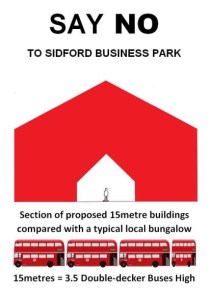
Fords Sidford Business Park: “massive unrest”

image

“There is massive unrest in Sid Valley over plans top build an industrial estate at Sidford

Fords of Sidmouth wants to build industrial, storage and distribution units totalling 22,800 square metres on agricultural land to the east of Two Bridges Road.

The fourth generation business employs around 70 people, carrying out plumbing and electrical engineering work across the district.

However, various groups East Devon are strongly concerned about the project with regards to a possible risk of flooding, traffic congestion, pollution and the impact on a designated area of outstanding natural beauty.

Sidford Social Hall saw a massive gathering of objectors on Monday.

Among the speakers at the Public Meeting, organised by Sid Valley Residents and chaired by Cathy Debenham, was Alan Green, the Director of the Norman Lockyer Observatory

He said the light pollution from the development would be “a total disaster” for the observatory and will “destroy us after 104 years.”

Marianne Rixson, East Devon District Councillor for Sidmouth and Sidford, added that Exeter and Honiton currently have 1.6 million square feet of available employment units, and that meant the area “did not any more.”

Pam Ward, a governor of Sidbury School, said that the increased traffic, including HGV’s, would become a serious safety issue for local children.

As a result of the meeting many said they were likely to ‘boycott’ Fords, and even calls for an eventual public enquiry.

They will also urge planners to impose restrictions on how big the industrial units can be over worries they will dwarf their surroundings.

There are already over 150 objections filed on the council website.

A planning document submitted earlier this year by agents Context Logic, of Colaton Raleigh, said Fords & Sons plans to make a “substantial capital investment in delivering an employment site for Sidmouth.”

They added: “The proposal would generate jobs and opportunities for new and expanding businesses in Sidmouth. In total, the business park could create as many as 300 jobs over both phases throughout the local plan period.

“The park would offer business support facilities for the wider business community and it is hoped that the Business Support Centre would become a popular and well used asset.

“The future detailed applications will seek to create a business park with the highest regard given to design, energy efficiency, safety and security and will look to support a vibrant economy for Sidford and Sidmouth.”

The application will be decided in the coming weeks.

We have approached Fords of Sidmouth for comment.”

http://www.exeterexpressandecho.co.uk/fury-at-sidford-business-park-plan-which-could-destroy-observatory/story-29719231-detail/story.html


MPs should be on zero-hours contracts: don’t turn up, don’t get paid

MPs should be on a zero-hours contract. Don’t turn up? Don’t get paid. [OPINION]

Personally, Owl would settle for detailed timesheets and diary information showing exactly what our MPs are doing and, more importantly, with whom.

Hello, Hinkley C, goodbye green energy (and the NHS)

The champagne corks will be popping at our Local Development Partnership (though we can’t tell you where that will be as they don’t tell us where their offices are). Many pockets to be lined by those members with nuclear interests.

Green energy will now be the Cinderella and the money that could have got our NHS out of debt will now be poured into Chinese and French pockets.

And our LEP can hold us all to ransom as it holds all our purse strings.

Happy days.

‘ “State of Nature”reveals the destructive impact of intensive farming, urbanisation and climate change on plants, animals and habitats’

“More than one in 10 of the UK’s wildlife species are threatened with extinction and the numbers of the nation’s most endangered creatures have plummeted by two-thirds since 1970, according to a major report.

The abundance of all wildlife has also fallen, with one in six animals, birds, fish and plants having been lost, the State of Nature report found.

Together with historical deforestation and industrialisation, these trends have left the UK “among the most nature-depleted countries in the world”, with most of the country having gone past the threshold at which “ecosystems may no longer reliably meet society’s needs”.

The comprehensive scientific report, compiled by more than 50 conservation organisations, spells out the destructive impact of intensive farming, urbanisation and climate change on habitats from farmland and hills to rivers and the coast. It found that the fall in wildlife over the last four decades cannot be blamed on past harm, but has continued in recent years.

“It wasn’t just all back in 70s and 80s, it is still happening now,” said Mark Eaton, at RSPB and the lead author of the report. “We are getting ever more efficient in our farming. In a way it is something to be celebrated, how good our farming science and technology is, but it does squeeze nature out.” …

… The report includes a new “biodiversity intactness index”, which analyses the loss of species over centuries. The UK has lost significantly more nature over the long term than the global average, the report said, with the UK the 29th lowest out of 218 countries.

“It is quite shocking where we stand compared to the rest of the world, even compared to other western European countries: France and Germany are quite a way above us in the rankings,” said Eaton. “The index gives an idea of where we have got to over the centuries, and we are pretty knackered.”

http://www.theguardian.com/environment/2016/sep/14/one-in-10-uk-wildlife-species-faces-extinction-major-report-shows?CMP=Share_iOSApp_Other

You want to meet Hugo Swire? Go to Kensington and Chelsea Conservatives and pay £25

“Royal Hospital Autumn Party

Date Wednesday, 21st Sep 2016
Time 6:30pm until 8:30pm

***SPEAKER CONFIRMED!***

*** ONLY 40 TICKETS AVAILABLE ***

Join us for an evening with Hugo Swire MP for East Devon. The event will be held at 32 Royal Avenue [Royal London Borough of Kensington and Chelsea] by kind permission of Mr and Mrs Toland. There will be wine served throughout the evening.

Tickets £25″
https://www.kcfc.org.uk/events

Properties in Royal Avenue are currently selling for £6 million upwards.

Is Hugo Swire not sorry to see Cameron quit?

Hugo usually twitters endlessly about his pals but not a peep about his Eton mate Cameron’s resignation. And after Dave gave him a knighthood – albeit in rather tacky circumstances. Ungrateful.

Sidmouth Blackmore Health Centre protest Monday 19 September 11.15 am

Press release from the Patient and Public Involvement Chair, Di Fuller:

“The public response to fears over the future of the Blackmore Health Centre have been very encouraging.

Increases in rent and other costs, as well as plans from NHS Property Services (NHSPS) to redevelop the Blackmore Health Centre with added flats and a pharmacy, would radically increase costs to the Practice and threaten the future viability of the Practice on that site.

Hugo Swire MP, is visiting the Blackmore Health Centre on Monday 19th September to discuss the issues in detail with Dr. Joe Stych, other Partners and patient representatives. NHS Property Services and EDDC planning department have also been invited.

We ask members of the public who are concerned about the future of the surgery and agree with our request to purchase the

Blackmore Health Centre

to demonstrate their support outside of the Centre from

11.15 a.m. on

Monday 19 September.

Joe Stych said, “The ideal solution here would be for NHSPS to sell Blackmore to the practice so we are in charge of its future.

We would like to ask patients to write to Hugo Swire and Jeremy Hunt to campaign for the building to be sold to the practice to protect it.

We need people to question NHSPS as to why an operational building cannot be sold to motivated health care providers who will make them more efficient and responsive to our communities needs for healthcare provision.”

Di Fuller, Chair of Sid Valley Patient Participation Group has asked that people turn up on Monday to show their support for the Practice. We also want them to sign a petition asking Jeremy Hunt to allow NHSPS to sell Blackmore to the Practice to protect its future and to write to Hugo Swire and Jeremy Hunt with the same request.”

EDDC and its Section 106 Black hole

What makes the response below so puzzling is that for at least the last decade, EDDC has had a dedicated S106 officer. Time for some scrutiny …

“Freedom of Information request
Section 106 planning agreements

Date submitted: 25 August 2016

Summary of request

Please provide the following details for all developer contributions agreed (not received) under Section 106 planning agreements including affordable housing contributions:

– Value of contribution
– Purpose of contribution
– Planning application reference number

Please provide these details for the following 10x financial years:

– 01/04/2004 – 31/03/2005
– 01/04/2005 – 31/03/2006
– 01/04/2006 – 31/03/2007
– 01/04/2007 – 31/03/2008
– 01/04/2008 – 31/03/2009
– 01/04/2009 – 31/03/2010
– 01/04/2010 – 31/03/2011
– 01/04/2011 – 31/03/2012
– 01/04/2012 – 31/03/2013
– 01/04/2013 – 31/03/2014

Summary of response

We do not hold this information in a format which enables us to easily identify the financial contributions that were due to EDDC arising from s106 agreements in each financial year, or identify the purpose of a contribution. To find this detail we would need to check through each agreement during the stated time period.

We know that it has taken an experienced officer some 6 hours to search through 200 of these documents and we estimate that to search through each of the agreements per year over a ten year span to locate the ones specifically relevant to your request, will exceed the 18 hours permitted. This information is therefore exempt from disclosure under s12 of the Freedom of Information Act 2000.

Date responded: 1 September 2016

http://eastdevon.gov.uk/access-to-information/freedom-of-information/freedom-of-information-published-requests/

38 Degrees petition: Say No to Sidford Business Park

“Please reject the application to build a three hectare Industrial Business Park on AONB land in the village of Sidford in East Devon.

Why is this important?

This is prime agricultural land in an Area of Outstanding Natural Beauty, situated on a known flood risk plain, and home to much wild life, including several protected bat species.

The typically narrow Devon access roads to this area are woefully inadequate to cope with the existing traffic and more expected large vehicles, would add to this problem. The lack of pavements in Sidbury village already put school children at risk and there is still no cycle path to link the two villages.

The sheer size and height of the development would dominate the landscape, devalue adjacent existing properties and cause noise and light pollution (hugely affecting the nearby 100 year old Norman Lockyer Observatory).

Flooding of roads and properties occurred 4 times in 2012.

Finally there is far more suitable employment land available on existing Industrial sites, in Sidmouth, Honiton and Cranbrook to better serve those who are seeking employment. Please sign this petition to preserve the quality of life for many people and to stop this heartless, uncaring proposal going ahead.”

https://you.38degrees.org.uk/petitions/say-no-to-east-devon-business-park?bucket&source=facebook-share-button&time=1473757444