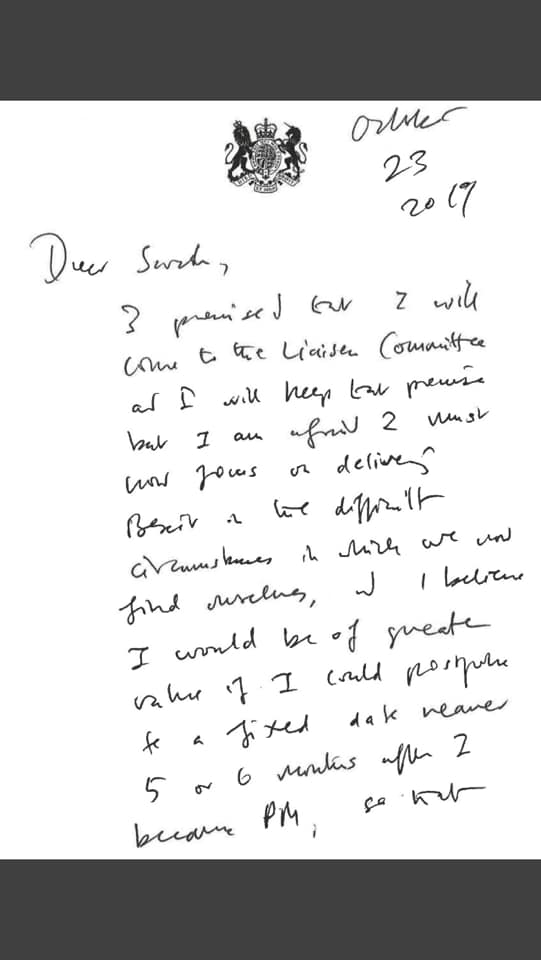
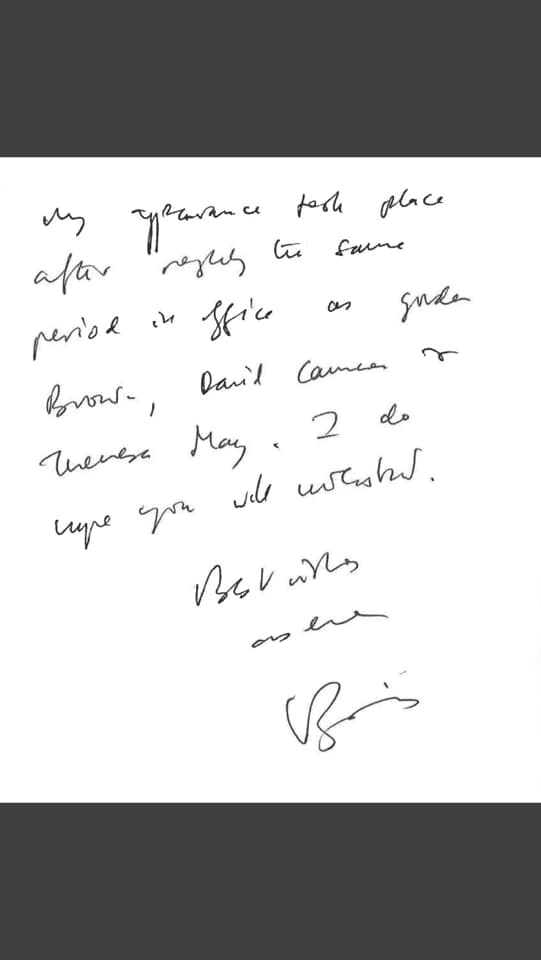
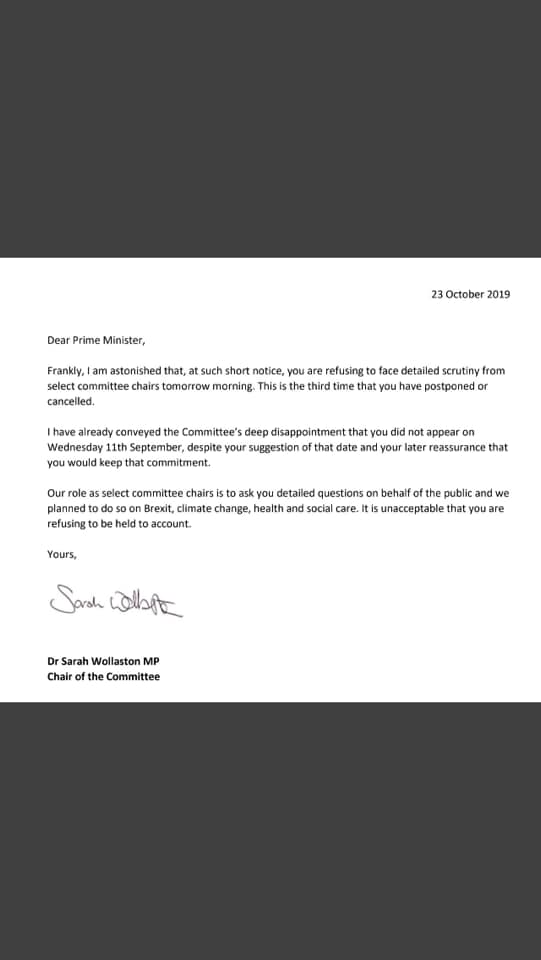
Swire can change his mind on Brexit – we can’t

Owl says: Remember Swire started out as a Remainer!

“When the Withdrawal Agreement negotiated by Theresa May was debated in the House of Commons many Conservative MPs argued that they could not vote for an arrangement that would treat Northern Ireland differently from Great Britain. The revised deal negotiated by Boris Johnson envisages far greater divergence within the UK, yet is far more popular among Conservatives. Jack Sheldon and Michael Kenny explain how this about-turn has come about. …

During the debates on May’s deal, Boris Johnson himself argued from the backbenches that it would ‘not be good enough to say to the people of Northern Ireland that… they must be treated differently from the rest of the UK’. Jacob Rees-Mogg, now Leader of the House, claimed previously that by treating Northern Ireland separately the deal ‘seeks to divide our country’. Many other MPs made similar arguments even more forcefully, including Sir Hugo Swire, for whom placing part of the UK in a different position from the rest was ‘an appallingly dangerous precedent’. Our analysis showed that 49 different MPs argued May’s deal was bad for the Union ahead of the first meaningful vote in January, and 47 of those went on to vote against the deal. …

While there was little attempt to justify this u-turn in thinking on Northern Ireland’s relationship to the Union in Saturday’s debate, the editor of the influential Conservative Home website has made the case that ‘just because [Northern Ireland] is British as Finchley doesn’t mean that it can or should be governed in exactly the same way as Finchley – any more than Scotland or Wales should’. The dissonance between this line of argument and the claims pervading Conservative circles when May’s deal was being debated is very marked – as the DUP will certainly have noticed. Recent events in parliament have shone a harsh glare upon a fundamental tension between the delivery of a Brexit acceptable to its Conservative proponents and the implications of the DUP’s brand of political unionism. It was always likely that Brexit-supporting Conservative MPs were going to have to choose which of these goals to prioritise, and it should not come as a huge surprise that they have ultimately opted for delivering Brexit. What this decision means for the party’s relationship with the DUP will now become one of the most important, and unpredictable, questions in British politics. …


Whatever happened to Tory unionism?

Water companies enraged that OFWAT is putting consumers before investors

“Top investors in the water industry have complained to the Treasury that the regulator Ofwat is being politicised and warned of a flood of appeals against its financial demands.

International investors that control suppliers including Anglian, Yorkshire, Affinity, South East and South Staffs led a delegation this month ahead of a crunch ruling on prices by Ofwat, due in December. They are reeling from the toughest draft settlement from the regulator in years and fearful of Labour’s pledge to renationalise the sector at a big discount to market value.

After years of taking huge dividends from water companies and piling debt onto them, while paying minimal corporation tax and overseeing scandals such as sewage spills and water leaks, utility investors have seen the industry and political environment turn toxic.

Ofwat, chaired by former Anglian Water boss Jonson Cox, stunned the sector in July when it rejected the spending plans of all but three companies and sent the other 14 back to the drawing board, demanding more efficiency, faster paydown of debt and better customer service. It will publish its final ruling on their 2020-25 spending plans in December.

The meeting on October 14 is believed to have included blue-chip investors such as German insurer Allianz, Singapore sovereign wealth fund GIC, Deutsche Bank’s wealth division and Australia’s IFM Investors. Among the issues raised was Ofwat’s independence and the dangers of it reacting to political pressure.

Cox has been on a crusade to clean up the sector. In an interview last year, Cox told The Sunday Times: “This industry still doesn’t accept that customers should be at the heart of this business. We are unwinding one of the last bits of the pre-crash bonanza: buying an asset and gearing it up.”

Investors also asked senior mandarins whether the Competition and Markets Authority had the resources to deal with simultaneous appeals against Ofwat’s financial stipulations. At least five suppliers are believed to considering appeals.

The funds called on the Treasury to assess the financial resilience of the sector, after companies including Thames and Northumbrian complained that Ofwat’s demands were “unfinanceable”.

Global investors have ploughed billions of pounds into former state-owned companies since the privatisation wave of the 1980s and 1990s, yet are increasingly reassessing whether the UK is still an attractive place to park their cash.

Ultra-low interest rates and the need for returns inflated asset values and led to a bidding war for infrastructure companies. However, the appetite for water companies has cooled over the past two years. The Sunday Times revealed in April that Labour planned to renationalise the industry at a big discount to market value, making deductions for “asset-stripping since privatisation”.

That and Ofwat’s clampdown have spooked local authority pension funds, which have belatedly begun pouring cash into infrastructure. GLIL, which invests the pensions of council staff, was among the attendees at the Treasury meeting.

Last month, Alain Carrier, European boss of the CAN$400bn (£239bn) Canada Pension Plan Investment Board, which owns a stake in Anglian, said: “It’s difficult for the regulator under the current political climate not to be seen to be very tough. The independence of the regulator is under some pressure.”

Ofwat said: “Our decision-making is independent from government and based on delivering the very best for customers. Investors have always made clear they value the independence of the regulatory regime.”

Source: Sunday Times (pay wall)

Indie councillor wastes no time holding EDDC Leader to account**

And some very interesting answers he gets too (and the questions of other councillors are also pertinent):

To answer questions asked by Members of the Council pursuant to Procedure Rules No. 9.2 and 9.5

** Apologies for the deletion of this post earlier today due to technical problems with the attachment.

Planning, dogs and tails: another correspondent writes

“The East Devon electorate were, indeed, hoping for a significant change by voting for an Independent Council and, therefore, it is frustrating to read such controlling comments from the Tory Councillor Philip Skinner (he who was responsible for the extending mahogany table fiasco and who lives in the rural village of Talaton which is not one of the proposed GESP Clyst Villages) stating that  ‘this is a really exciting project and I hope people grasp it with the enthusiasm, that I have so we get the good things for the area that we live in’!

Who are the ‘we’ he is referring to? Perhaps, not the numerous residents of the 10 rural  village communities of Poltimore, Huxham, Clyst St Mary, Clyst St George, Ebford, West Hill, Woodbury, Woodbury Salterton, Exton and Farringdon who appear to be the prime targets for his exciting large scale development? Living in the small, rural idyll of Talaton, he should be aware that those who have also chosen to live in rural village communities may not wish them to mutate into sprawling suburbs of Exeter and, therefore, many may question Councillor Skinner’s motives?
Yes – we all have to be forward thinking – but aren’t these 10 villages the very essence of the intrinsic nature and indispensable quality of East Devon? Some may be persuaded that the proposed idyllic concept of happy, peaceful, picturesque environments labelled ‘Garden Villages’ would be pure nirvana – but, unfortunately, the vision in planning terms is not always what you get in reality! 
 
Sizeable growth in this North West Quadrant, without adequate road infrastructure improvements in the surrounding districts, already results in the regular gridlock of the entire highway network! ‘The cart before the horse’ approach of continuing large-scale commercial growth and adding more people to the equation before the provision of an appropriate, sustainable transport system is an unsatisfactory method for success.
 
There is no doubt that we must do better with designing new communities than we have in the past and East Devon District Council Planners  are fully aware that there are lessons to be learned from pursuing misguided judgements and courses of action by barking up the wrong tree!
Hopefully, the Independents are canines with character strength and principled, with adequate bite at the sharp end! Dogs can control their tails but often wagging lacks conscious thought!  Canine body language is so much more than just tail movements, so to achieve control, it is very important to pay attention to other factors. Furthermore, excessive tail wagging  can often be associated with fear, insecurity, social challenge or a warning that you may get bitten!

Planning: is the tail wagging the dog at EDDC?

From a correspondent:

“I had thought that the people of East Devon had voted for an Independent Council. So this correspondent finds it perplexing that it is the conservative Philip Skinner who is extolling the virtues of “the potential for strategic scale development in the North West Quadrant area of East Devon was identified and a network of linked villages, referred to as Clyst Villages” and “this is a really exciting project and I hope people grasp it with the enthusiasm that I have so we get the good things for the area that we live in.”

https://eastdevonwatch.org/2019/10/22/least-devons-north-west-quadrant-of-linked-villages-or-exeters-north-east-suburbs/

Are the “independent” chairman of the Strategic Planning Committee and Portfolio Holder of Strategic Development, Susie Bond, the great “independent” leader, Ben Ingham, and the “independent” Portfolio Holder for the Environment  whose Woodbury ward will be part of the exciting network of the linked villages, Geoff Jung,  in full agreement?

Does the cabinet have too much power? Why is “tory” Philip Skinner the spokesman for development in our district?

Is the old tail wagging the new dog?”


Sidford Business Park already being touted for relocated Lidl

Or Alexandra Business Park – where its inadequate size and location for businesses was given as a reason for development of Sidford Business Park!

Shafted.

https://www.sidmouthherald.co.uk/news/sidmouth-lidl-relocation-possibility-raises-concerns-1-6335164

Independent councillor gets policy on car parking charges changed

“A motion put forward by councillor Paul Millar, to add car parking strategy to the list of policy areas which need the approval of full council, was approved on Wednesday (October 23).

Previously, final decisions on parking were made by the cabinet, which is made up of councillors from the ruling party.

As a result of Cllr Millar’s motion, cabinet can make recommendations to full council which will have the final say.

In its last meeting, cabinet decided to launch a consultation process on proposals to increase the hourly rate in East Devon car parks from £1 to £1.20.

The decision has been called in by the district council’s scrutiny committee which was due to hold an extraordinary meeting on Thursday (October 24).

A task and finish forum has also been set up to look at the issue.”

https://www.midweekherald.co.uk/news/east-devon-full-council-given-car-parking-strategy-decision-1-6339334

Tories pretend to try to solve problems they caused!

Er, who caused these problems?

“The housing secretary has warned that developers building poor-quality homes will have to “change their practices”.

Robert Jenrick called for a “systemic change” in Britain’s approach to planning and design, saying: “For too long there has been a misconception in the housebuilding industry that quality is the enemy of supply.

“In fact, experience shows us that it is those developments of the highest quality and the most attractive designs which are approved faster, sell faster and which are the most enduringly popular.”

Speaking at an event hosted by the Policy Exchange think tank and Create Streets, a research institute, he said: “Design now matters in this country and developers who bring forward poor-quality designs are going to have to change their practices.”

The government issued a national design guide this month setting out ten principles of good building. There was previously no accepted standard for new homes. The guide will be followed by a more detailed “national model design code” early next year. Local authorities will be encouraged to create their own versions of the code, giving communities a legal right to hold developers to account.

James Brokenshire, the former housing secretary, warned housebuilders in March that they must end “unacceptable” punitive costs and “nightmare” snagging problems in new homes if they wanted to continue to benefit from Help to Buy — the government-backed equity loan scheme that has supported home ownership. Some of its biggest housebuilder beneficiaries, such as Persimmon, have been criticised about the quality of their homes.

Mr Jenrick, 37, said that he would give “careful consideration” to how his department could use a revised version of the scheme in 2021 to stipulate improved build quality.

He also announced a “heritage preservation campaign” under which the government will commit £700,000 of funding for a campaign to encourage people to nominate buildings and assets in their local areas to be protected with listed status.”

Source: The Times

Local Enterprise Partnership: DCC scrutiny committee in crisis?

Comment as post:

“This positive change has long been requested by East Devon Alliance DCC Councillor Martin Shaw (Colyton and Seaton). See …

On 13 October I made a comment on the Heart of the South West (HotSW) Joint Scrutiny Committee meeting scheduled for the 17 October. I pointed out that attendance at this essential exercise in democracy had steadily fallen through the year from eleven to just five councillors [correction, should read six] and added my opinion that this scrutiny committee has all the appearance of being in crisis.

https://eastdevonwatch.org/2019/10/13/local-enterprise-partnership-scrutiny-laid-bare-and-a-chance-to-see-for-the-scrutiny-not-working-for-yourself/

Sadly this view seems to have been confirmed from the October 17 meeting.

From the minutes and associated documents of this Joint Scrutiny meeting of 17 October attendance is recorded as follows, down again to a bare quorum of five:

(https://democracy.devon.gov.uk/ieListDocuments.aspx?MId=3572&x=1)

Present:
Councillor Jerry Brook Devon County Council (Chair)
Councillor Richard Hosking Devon County Council
Councillor Julian Brazil Devon County Council
Councillor Gareth Derrick Plymouth City Council
Councillor Barrie Spencer South Hams District Council

Apologies:
Councillor Ray Bloxham Devon County Council
Councillor Mike Lewis Somerset County Council
Councillor Jonny Morris Plymouth City Council

Absent:
Councillor Rod Williams Somerset County Council (Vice-Chair)
Councillor Ann Brown Somerset County Council
Councillor Simon Coles Somerset County Council
Councillor Lee Howgate Torbay Council
Councillor Karen Kennedy Torbay Council
Councillor Norman Cavill Taunton Deane Borough Council
Councillor Richard Chesterton Mid Devon District Council
Councillor Ian Dyer Sedgemoor District Council

[Only 16 councillors are listed though the Terms of Reference of the Scrutiny Committee sets the number at 17 – see Appendix 1 of the October briefing pack]

Three of these attendees: Councillors, Hoskins, Brazil and Derrick were also among the six attending the previous meeting in June. These Councillors deserve credit for taking their scrutiny responsibility seriously where the majority clearly have not. Note that not a single Councillor from Somerset attended. This is democratic deficit writ large.

As reported by Owl, the meeting did agreed that future meetings be webcast to continue to increase transparency of the Committee; and that public participation be adopted at future Committee meetings in line with Devon County Council’s public participation scheme. This is something that should have been included at the beginning but nevertheless represents progress.

In my comment I conjectured a number of reasons why members might find attendance to be a waste of their time and, mischievously, raised the rhetorical question as to whether HoTSW might be using creative administrative devises to make scrutiny difficult or seem unimportant. So it is interesting to read, from the minutes that among the topics discussed were the following:

1. the challenge of actively scrutinising the LEP when funds had already been allocated and projects begun;
2. the need for Scrutiny to have sight of policies before they are agreed and implemented by the LEP, to add value and effectiveness to the governance process;
3. the requirement of the Committee to scrutinise strategic documents and the cost effectiveness of the LEP.

These are excellent questions which would certainly have benefitted from members of the public being able to follow the details through webcasting. We now need to know the HotSW’s response.”

Berlin to freeze rents for 5 years

“… Berlin’s state cabinet has agreed on a rent freeze for five years to counter rising housing costs in the German capital.

The city’s leftwing coalition government wants to freeze the rent for apartments built before 2014, according to a report by the German news agency dpa.

Only a minority of Berliners own their homes or apartments and rent has been rising sharply in recent years, forcing many to move outside the city. …”

https://www.theguardian.com/world/2019/oct/22/germany-berlin-cabinet-agree-five-year-rent-freeze?CMP=Share_iOSApp_Other

“Plan for fracking ‘years behind schedule’ and has cost taxpayer £32m”

Imagine what we could have done with £32m!

https://www.theguardian.com/environment/2019/oct/23/plan-for-fracking-years-behind-schedule-and-has-cost-taxpayer-32m?CMP=Share_iOSApp_Other

DCC opens up its Local Enterprise Partnership Scrutiny Commmittee to public scrutiny and participation

This positive change has long been requested by East Devon Alliance DCC Councillor Martin Shaw (Colyton and Seaton).

See minutes below for a full account of discussion at the meeting – about what is working well and (more importantly and interestingly) what is not:

https://democracy.devon.gov.uk/ieListDocuments.aspx?MId=3572&x=1

“UK to use £1bn meant for green energy to support fracking in Argentina”

“The UK is planning to invest in Argentina’s controversial oil shale industry using a £1bn export finance deal intended to support green energy, according to government documents seen by the Guardian.

UK Export Finance, the government’s foreign credit agency, promised in 2017 to offer loans totalling £1bn to help UK companies export their expertise in “infrastructure, green energy and healthcare” to invest in Argentina’s economy.

Instead official records, released through a freedom of information request, have revealed the government’s plan to prioritise support for major oil companies, including Shell and BP, which are fracking in Argentina’s vast Vaca Muerta shale heartlands.

One government memo, uncovered by Friends of the Earth, said that while Argentina’s clean energy sector was growing, it was “Argentina’s huge shale resources that offer the greatest potential” for the UK. …”

https://www.theguardian.com/environment/2019/oct/22/uk-to-use-1bn-meant-for-green-energy-to-support-fracking-in-argentina?CMP=Share_iOSApp_Other

EDDC ex-Tory councillor doesn’t like the idea of a Jurassic National Park

Can leopards change their spots?

Interestingly, his objection seems to be entirely about losing control of housing development:

https://exmouth.nub.news/n/house-prices-could-rise-39considerably39-if-national-park-created-in-east-devon-and-dorset

His objections seem eerily reminiscent of the objections raised when Paul Diviani was Leader of EDDC:

https://eastdevonwatch.org/2018/10/09/new-national-park-for-east-devon-not-while-people-like-diviani-are-councillors/

East Devon’s “North West Quadrant” of “linked villages” – or Exeter’s North East suburbs?

“The potential for strategic scale development in the North West Quadrant area of East Devon was identified and a network of linked villages, referred to as Clyst Villages, has been put forward

The concept of a ‘network of linked villages’ being built in the North West Quadrant area of East Devon will be investigated.

East Devon District Council’s Strategic Planning Committee on Tuesday morning unanimously recommends to the Cabinet that East Devon supports the Exeter and East Devon garden communities status.

The Exeter bid would see around 12,000 new homes built in the city as part of the Liveable Exeter vision and has already been agreed by their council. …”

“The villages of Poltimore, Huxham, Clyst St Mary, Clyst St George, Ebford, West Hill, Woodbury​, Woodbury Salterton, Exton and Farringdon would be most likely to be included as ones that could be expanded further, based on them being in the quadrant and close to existing infrastructure….”

Cllr Philip Skinner said: “We are going to have the housing numbers whether we like it or not, and we cannot put off and delay this as there is a much bigger vision than just focusing on that. This is a really exciting project and I hope people grasp it with the enthusiasm that I have so we get the good things for the area that we live in.

“This is an extremely important document that we should be signing up to this now and I am bang up for seeing this comes forward in the right way.” …

https://www.devonlive.com/news/devon-news/east-devon-could-getting-network-3454612