“Promised £8bn extra for NHS is not enough, says hospitals boss”

Theresa May will have to rip up the government’s financial plans for the NHS and commit more than the promised £8bn extra by 2020, a hospitals boss has said.

Chris Hopson, the chief executive of NHS Providers, said ministers must come up with a new plan to fix the health service’s crumbling finances or risk it becoming unable to function properly.

In a submission to the Treasury before next week’s autumn statement, NHS Providers, which represents 96% of NHS trusts in England, says a rethink is necessary because the calculations underlying the government’s £8bn pledge are flawed.

It says demand for care is rising faster than envisaged in the blueprint drawn up by NHS bosses in 2014, the Five-Year Forward View, and social care has deteriorated.

Hopson said: “Some of the key assumptions in the Five-Year Forward View, on which the current financial and NHS delivery plans for this parliament are based, have turned out to be wrong. There is now a clear and widening gap between what is being asked of the NHS and the funding available to deliver it.

“The NHS simply cannot do all that it is currently doing and is being asked to do in future on these funding levels.”

Andrew Lansley, the health secretary from 2010 to 2012 in the coalition government, recently said the NHS needed a “Brexit bonus” of £5bn on top of the £8bn already pledged, given the widespread public demand for higher NHS funding revealed by the EU referendum.

NHS Providers does not specify how much more it wants invested. But Hopson said more than £8bn was justified because “demand for care is a lot higher, social care is in a much worse state, general practice is turning out to be more unstable, and the starting point for the deficit among hospital, mental health, community and ambulance trusts has turned out to be much larger.”

He said the overall health budget would go up by only £4.5bn by 2020, not the £8bn ministers pledged last year, because money was being taken from key areas such as public health in order to give the NHS its promised increase. Independent experts agree £4.5bn is the true increase that healthcare will get.

The NHS’s inability to deliver the £22bn of savings it had promised to make by 2020 – a target that had always been “too ambitious” – further underlined the need for more money to be found before the end of this parliament, said Hopson.

May has been under pressure recently over her repeated claims that the government is giving the NHS £10bn more, and more than the NHS England chief executive, Simon Stevens, asked for in 2014. Sarah Wollaston, the Conservative chair of the Commons health select committee, and other members of the committee wrote to the chancellor Philip Hammond to say the claims were untrue. Labour has asked the UK Statistics Authority to rule on whether the £10bn claim is justified.

Jeremy Hunt, the health secretary, has subtly distanced himself from the £10bn figure and said the NHS will need a lot more money after 2020, at the end of its unprecedented decade-long budget squeeze.

Ministers have already told Stevens that the NHS will not receive a funding boost in the autumn statement. But NHS and local council leaders hope the chancellor may find some extra money to prop up the ailing social care system.

“NHS funding increases from next year onwards are not enough to maintain standards of care, meet rising demand from patients and deliver essential changes to services,” said Richard Murray, director of policy at the King’s Fund thinktank.

“If additional [NHS] funding is not forthcoming later in the parliament, the government will need to be honest with the public about the impact on quality of care and access to services.”

The Department of Health did not respond directly to Hopson’s comments. A spokesman said: “This government has taken tough economic decisions that have allowed us to invest in our NHS, which is meeting record patient demand whilst improving standards of care. We have prioritised funding for the NHS with £4bn extra this year.”
https://www.theguardian.com/society/2016/nov/17/promised-8bn-extra-for-nhs-is-not-enough-says-hospitals-boss

Franksy writes to East Devon Watch

See below the letter Franksy asked a correspondent to send to East Devon Watch:

“To Tyrannosaurus Exe, also known as EDDC,

I marched with 386 others on Saturday to try and save Exmouth Seafront.

Did you not see us because your head is so high in the clouds filled with your own obstinate dreams of power?

Did you not hear us because you can only hear the sound of your own species? Maybe you cannot hear at all.

With your big and brutish attitude and your enormous footprint, you can barely see the ants you look down upon.

But ants are strong and resilient. They work hard, communicate and co-operate to achieve a common goal.

Important to note that ants are not extinct.

We hope this troubles you in your arrogance.”

Franksy.

More/fewer unaffordable/affordable homes

“Fewer affordable homes were built in the past year than any time in the past 24 years, while there was a 52% fall in the supply of new homes in just 12 months.

Builders put the finishing touches to 32,110 affordable homes in England in the year to the end of March 2016, compared with 66,600 over the previous year, according to figures from the Department for Communities and Local Government (DCLG).

Of those, just 6,550 – about 20% – were for social rent, which critics say is the only truly affordable housing tenure, with the rest made available to rent or buy at “affordable” rates of up to 80% of market value.

Critics said the figures were disastrous, and called on the government to do more to encourage housebuilding. They come as the proportion of households that own a property is at a 30-year low and rising house prices have driven the cost of buying a home to more than 10 times the average salary in a third of England and Wales.

“The Tories have made ‘affordable housing’ a meaningless term”

Neal Hudson, a property market analyst for Savills, said the fall came as no surprise after 2014/15’s figures were inflated by developers racing to use up funds as the government’s previous affordable housing programme came to an end. Funds for a new programme were initially much lower, until more cash was released in last year’s autumn statement, he said.” …

https://www.theguardian.com/society/2016/nov/17/number-of-affordable-homes-built-in-england-slumps-24-year-low

Or, as George Osborne is alleged to have said: “Why should we build social and affordable homes? The people in them vote Labour”

Sidmouth meeting on NHS bed and services cuts – 9 December 2016 7.30 pm

OUR FUTURE CARE!

Sid Valley patients and carers invite all residents to a public meeting in the Parish Church, Sidmouth Church Street,
on Friday 9th December at 7.30 pm

The Consultation (ending 6th Jan)
“YOUR FUTURE CARE”
proposes closing 600 hospital beds all over Devon, including at Honiton, Okehampton, Seaton, Exmouth, Barnstaple, Exeter and Sidmouth.

Beds have already gone from Axminster, Ottery St Mary, Budleigh Salterton and Torrington – without consultation

Let us talk about this urgently with friends, family, clubs, churches, WI groups, etc. and bring ideas from all in our valley to the meeting on 9th December

For more information call 01395 519292

Health transformation “fantasy”: For Norfolk read Devon and the rest of the country

“… In Norfolk and Waveney, the latest Sustainability and Transformation Plan (STP), under guidance from NHS England, has only been seen by a small group of health chiefs.

It has been kept from MPs, councillors, NHS staff, GPs, unions and some hospital board members.

An initial version of the plan was published in June, which warned there would be a deficit of £440m by 2020 in the NHS and social care budget, if action was not taken.

The plan proposed keeping patients out of hospital by expanding community and social care, but little detail has been given so far about what that action might be or how they hope to save a proposed £160m.

The full STP plans have been published in several areas of the country, but Norfolk and Waveney STP is following NHS England guidance by not making their proposal public yet.

Managing director of Norfolk County Council Dr Wendy Thomson, who is leading on the STP, said their plan was “at an earlier stage in its development compared to many others around the country.”

““Plans are not yet at the point where they have clear messages about things the public want to know”
Dr Wendy Thomson, Norfolk County Council
“Plans are not yet at the point where they have clear messages about things the public want to know,” she said.

“As service plans are developed, EDP readers can be assured that changes will be subject to the right public engagement and statutory consultation.” The Norfolk and Waveney STP is expected to be published in late November, but it is understood there will still be little detail in the document about what health chiefs propose to do with Norfolk an Waveney’s health system to plug the financial blackhole.

North Norfolk MP and former health minister Norman Lamb said there would be little hope of the getting the public involved in the plans if they were presented as a “fait accompli”.

He said he supported the idea of saving money by having more people being cared for in the community and joining up health and social care, but said the idea that hundreds of millions of pounds could be saved through STPs was fanciful.

“It is in the realms of fantasy to imagine this is achievable,” he said. “I don’t think when it is published people will get that excited about it. It will not say anything significant in terms of detail of changes. What lies beyond that is much more disturbing for many.”

Jeff Keighley, Unison regional organiser, said STP leaders should have consulted the public “at the earliest possible opportunity”.

Although the union said it was not against “sustainable transformation”, Mr Keighley said he was concerned the proposals would not be sustainable.

“If they had found a wonderful way of saving this money by enhancing the services it would be amazing – and they would have not been keeping it a secret,” Mr Keighley said. …

… What’s happening in other areas

Some councils have objected so strongly to the lack of public involvement they have ignored NHS England’s demand to keep the documents private until a later stage and have published them on their websites.

The plans on how local NHS areas will move forward over the next five years focus on several key themes.

These include cutting costs, moving care closer to home, putting a greater emphasis on preventing people becoming ill in the first place and concentrating services in a smaller number of units or hospitals.

Some argue this will enable increased access to consultants around the clock and make the best use of specialist NHS staff and resources. There are also plans to streamline back-office functions.

So far, more than a dozen plans have been published or leaked. Here are details from some of the key ones:

•The plan for Durham, Darlington, Tees, Hambleton, Richmondshire and Whitby set out how either Darlington or North Tees could lose their emergency department, with one becoming a “specialist emergency hospital” and another becoming a “local hospital”.

The plan says this will drive up standards, ensure a seven-day consultant presence with at least 16 hours per day consultant specialist access. More than 75% of patients could be assessed by a specialist consultant on admission and 100% assessed within 12 hours by a consultant.

Consolidating these services, together with other departments, could save millions of pounds, the plan said.

•The south-west London document outlines plans to cut the number of acute hospitals on the patch from five to four. Currently there are five hospitals at Croydon, Epsom, St Helier, St George’s and Kingston.

The plan says: “The only site which we believe is a ‘fixed point’ is St George’s Hospital in Tooting since it provides hyperacute stroke, major trauma and other services which are serviced by highly-specialised equipment and estates, which would be very expensive to re-provide elsewhere in south-west London.”

The document says reduction in sites is necessary to provide seven-day services with enough doctors and consultants – one of Health Secretary Jeremy Hunt’s main aims.

“We are very unlikely to be able to deliver services that meet clinical quality standards across five acute hospital sites. In particular, clinicians do not believe that we will be able to recruit or pay for sufficient workforce to deliver seven-day services at five acute sites.”

•In Birmingham and Solihull, the plan states that by 2021 there could be a deficit of £712 million across the health and care sector if nothing is done to address issues in the local health economy.

It says it will establish a single “lead provider” for maternity care and look to “immediately” implement a shared service for back-office functions across its four main acute providers and create a centralised laboratory for routine pathology work.

There are currently two main providers of maternity care – Birmingham Women’s Foundation Trust and at the Heart of England.

Plans to merge Birmingham Women’s and Birmingham Children’s Hospitals by next year have already been announced while University Hospitals of Birmingham and Heart of England FT announced in September the intention to create a “single organisation”.

•North-west London’s draft STP, seen by the Health Service Journal (HSJ) last month, aims to “consolidate acute services on to five sites” from the current nine.

Two London councils – Ealing and Hammersmith and Fulham – have said they cannot agree to a plan that assumes Charing Cross Hospital will be downgraded.

Stephen Cowan, leader of Hammersmith and Fulham council, said: “At the heart of the STP is an acceptance that Charing Cross Hospital will be demolished and replaced with significantly downgraded facilities, with the capital receipts from the sale of much of the hospital’s land intrinsic to the delivery of the STP. 1/8We are 3/8 strongly opposed to this, and therefore the STP.”

•The Cheshire and Mersey plan includes the downgrade of at least one A&E department along with a major consolidation of elective care.

The A&E at Macclesfield hospital would become a minor injuries unit. According to the Health Service Journal (HSJ), there will be a formal “major service review” at Southport and Ormskirk Hospital Trust, and the document includes options that could reduce the number of 24-hour A&E departments across three acute trusts.

•The north central London document sees officials over the next year examining whether some key services “would benefit from consolidation or networking”.

These services include maternity, out-of-hours emergency surgery, orthopaedics, mental health crisis care and dermatology.

http://www.edp24.co.uk/news/health/bid_to_transform_nhs_in_norfolk_and_waveney_and_save_160m_in_realms_of_fantasy_1_4774673

Is the “Success Regime” really that successful?

From a correspondent:

“I just took a look at the CCG document “Devon Pre-Consultation Business Case” and found the following:

This document says that NHS England has four tests for service reconfiguration, one of which is “Clear, clinical evidence base”. This seems to come from an NHS England document “Planning, assuring and delivering service change for patients” which says the same thing and says that they are “set out in the Government Mandate to NHS England” however I cannot find anything referring to this in “The Government’s mandate to NHS England for 2016-17” and I can’t find any other similar document.

So “Clear, clinical evidence base” seems to have been made up by NHS England, which does go on to say:

“Service reconfiguration must be evidence-based and this evidence should be publicly available during the consultation and decision making stages.

A clear clinical evidence base

This ensures service reconfiguration proposals are underpinned by clear clinical evidence and align with clinical guidance and best practice. Commissioners should oversee the development of the clinical case for change, as part of the outline case. Medical directors and heads of clinical services of any providers involved can help build the clinical evidence base.”

Indeed this document could be very useful as it is some sort of blueprint for what CCGs need to do – and therefore something we can compare the CCG’s plans to.

NEW Devon CCG’s “Clear, clinical evidence base” is the following:

“The clinical evidence is clear that prolonged hospital stay increases long term physical and psychological dependence”

“The clinical evidence is clear that prolonged hospital stay increases long term physical and psychological dependence” a second time

“The Case for Change sets out clearly the evidence on gaps in existing services which we aim to address through the proposed changes. As part of this diagnostic work clinicians have undertaken a detailed review of care models for four groups of high-impact patients, who currently use significant resources in the community. This is based on identifying good practice both nationally and locally. In particular, the development of services in North Devon following development of community health and social care teams to be a single point of co-ordination for people with complex needs and a reduction in community hospital facilities”

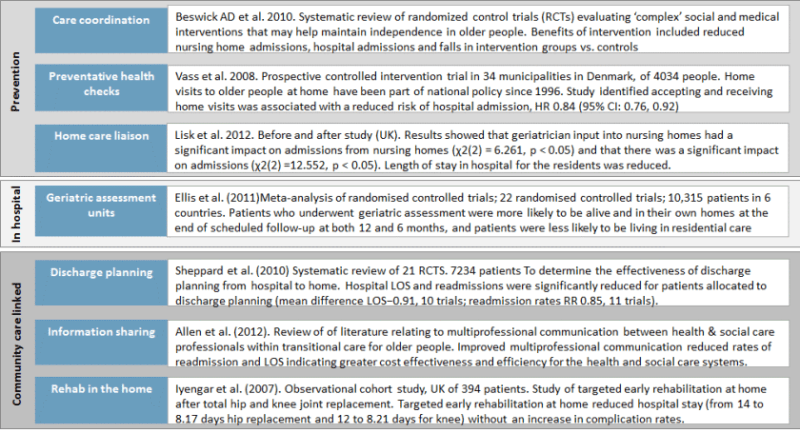
Whilst I have not read in detail the N Devon documents that have been circulated, as far as I can tell the N Devon experience cannot genuinely to be considered to be a positive reference, and in any case the evidence linked to in the CCG documents is not “clinical evidence” but is instead a subjective survey of patients asking them whether the administration of their home visits (i.e. bookings, turning up on time) was satisfactory and says NOTHING (and I mean that in absolute terms – nada, zilch, zero, absolutely nothing) about whether the treatment was clinically effective or indeed as clinically effective as hospital care.

On page 89 there is a table which does provide some anecdotal clinical evidence, but there are no links to the underlying evidence (though we might be able to find it to verify that they have used it correctly if we search for it):

img_1340

However the only evidence above directly relevant to their home-care proposals relates only to one specific type medical condition (total hip and knee replacement), and they then seem to have made a leap of faith that they can apply this to every medical condition which currently results in a stay in hospital beyond the point that hospital medical care is needed.

So it would seem that one target for “consultation feedback” is whether the CCG has met the requirements set by NHS England for a “Clear, clinical evidence base” that shows that their proposals are 1) effective and safe when considered alone, and 2) are at least as effective and safe as hospital care.

Another target for “consultation feedback” is to look at all the other areas defined by NHS England that the CCG has to meet, and see whether they have in fact done so.”

Whatever happened to ….. EDDC councillor ” champions”?

A year or two ago, you couldn’t move for EDDC councillor “champions” – Tory councillors without cabinet portfolios but with “special responsibilities” for specific tasks. Now, without fanfare, they seem to have disappeared without trace.

Those recently memorable to Owl were Councillor Phil Twiss, who had special responsibility for broadband services in East Devon and a councillor who had “special responsibility” for tourism who seems never to have said anything meaningful about it – ever. And who could forget the councillor with “special responsibility” for construction design – whose legacy is … er … perhaps best not go there!

History tells us that at least two councillors in the past declined these “champion” roles, having been awarded championships without even being consulted, of what might be perceived as “poisoned chalices – “beaches and foreshores” (Councillor Wragg) and “affordable housing” (then EDDC councillor Claire Wright)

http://www.plymouthherald.co.uk/councillors-reject-role-champions/story-12682633-detail/story.html

And who could forget Councillor Philip Skinner being stripped of his role as “rural champion” by then EDDC leader Sarah Randall-Johnson when he sent her what she perceived to be offensive Christmas greetings:

http://www.cornwalllive.com/leader-sacks-rural-champion-christmas-card-message/story-11517317-detail/story.html

Oh, and finally, perhaps the “creme de la creme” of champions, disgraced ex- councillor Graham Brown who was excommunicated and stripped of his “business champion” role (and his Chairmanship of the notorious East Devon Business Forum”) after a Daily Telegraph front page sting in which he asserted:

“If I turn a green field into an estate, I’m not doing it for peanuts”

http://www.telegraph.co.uk/news/uknews/9921333/If-I-turn-a-green-field-into-an-estate-then-Im-not-doing-it-for-peanuts.html

Ah, perhaps Owl has accidentally solved its own conundrum!

£117.3m spent on tourism in East Devon

And does our Local Enterprise Partnership value tourism in its ” growth” agenda? Not on your life, unless you count trips around Somerset nuclear plants, perhaps! And does EDDC have a dynamic tourism strategy? Attempts to find a councillor “champion” for tourism on the EDDC website were fruitless.

“New figures have revealed that the value of tourism in East Devon is continuing to rise.

In 2015 alone, tourism contributed £3.5million more to the local economy than it did in 2014, rising to £252.5million.

“The figures come from a new report provided to Visit South Devon and the Devon Tourism Partnership, which analyses trends in tourism year-on-year.

The latest findings show that UK-originated and overseas trips to East Devon increased four per cent to 521,000 trips in 2015, compared to 502,000 trips 2014.

The average number of nights per East Devon trip rose by eight per cent, equivalent to 166,000 additional nights in the local area.

Associated spend by tourists visiting from outside the local area leapt by £7.6million to £117.3million in 2015.

However, income from day trips fell by £4.1million to just over £135million – equivalent to a three per cent drop.”

http://www.midweekherald.co.uk/news/figures_reveal_that_value_of_tourism_in_devon_is_rising_1_4779567

“Elderly failed by ‘shameful’ care system”

“Age UK and the Alzheimer’s Society criticised both the quality of care and the way it was rationed as they published fresh evidence on the state of the care sector.

It includes figures that suggest the number of older people not getting help has risen by nearly 50% since 2010. …

… three pieces of research showed:

There are now an estimated 1.2 million over-65s going without help for care – nearly one in eight of all older people

Some 300,000 of them have difficulty with three or more tasks, including dressing, bating and going to the toilet

Councils agreed to help under half the 1.3 million people who approached them for care last year

The BBC identified 11 councils that rejected more than 75% of applications
Where home care was provided “serious problems” were identified in the way dementia patients were treated

Staff said they had not been given enough training to cope with the complex needs people had

Families reported examples of poor care, including loved ones not being given medication, being left in dirty clothes for days and going missing after homes had not been properly secured

Caroline Abrahams, of Age UK, said she was “extremely worried” about the “shameful” state of the care system.

“The sad irony is that it would be far more effective as well as infinitely more humane to give older people the care and support they need,” she said. …

…Councillor Izzi Seccombe, of the Local Government Association, said: “Unless social care is properly funded, there remains a growing risk to the quality and safety of care, and the ability of services caring for our elderly and vulnerable to meet basic needs such as ensuring people are washed and dressed or helped out of bed.”

http://www.bbc.co.uk/news/health-37992488

Skypark: 30,000 sq ft let – only 1,300,000 sq ft or so left to go!

“Exeter-based housing association DCH is set to relocate its city centre headquarters to a new office building at Skypark.

It will be the first office occupier on the new business park near Exeter Airport when staff move into a new 30,000 sq ft office space at the 1.4 million sq ft scheme.

The new offices will join the Ambulance Special Operations Centre (ASOC West) and DPD UK’s new 60,000 sq ft distribution centre on the site.”
http://www.exeterexpressandecho.co.uk/housing-association-dch-to-move-exeter-headquarters-to-skypark/story-29906748-detail/story.html

30,000 sq ft out of 1.4 million sq ft available!

The (quite small) ambulance centre opened in 2014 and the 60,000 sq ft DPS distribution centre opened in 2015. With DCH in (probably) 2017 this will be 3 tenants in 4 years.

No wonder EDDC mooted having their HQ there – and plans are now being changed to accommodate things such as a nursery and hotel … remember, Diviani promised us all 6,500 new jobs from this development.

And how will people from areas outlying Exeter area find their way to Skypark? At the moment one bus will take most people (tenants, potential tenants and employees) into the central offices in Exeter – getting to Skypark will entail another journey out, with consequent expense.

But selling off the offices in Exeter (for student housing? which already surrounds the bus station) will be very lucrative.

Clinton Devon Estates wants to make it easier to build in AONB – Part 2

A correspondent writes:

“Also relevant to CDE’s approach to development in Newton Poppleford is their latest attempt to get planning permission on Frogmore Road in nearby East Budleigh. This is in the prominent field that slopes up towards Syon House (CDE’s old HQ) on the south side of Oak Hill along the road between Budleigh Salterton and Newton Poppleford. The site is outside the built up area boundary, subject to recurrent flooding problems, and, as with Newton Poppleford, within the AONB. It is also Grade 1 agricultural land, of which there is very little in East Devon.

The East Budleigh emerging neighbourhood plan, now in its final phase and just about to be submitted to the Inspector, has identified suitable sites for future development in the village but the Frogmore Road site is not one of them. It was comprehensively rejected in place of other sites during the statutory democratic Community Consultation conducted by EDDC in 2012 as part of the process of formulating the East Devon Village Plan.

Despite this, CDE made an outline planning application in 2014 (14/2959) for 18 dwellings covering approximately half the field. This was eventually withdrawn. Now a new outline planning application (16/1673) has been lodged for only 5 dwellings. This obviously covers a smaller part of the field, but, curiously, the application includes 14 car parking spaces on roads that appear to lead nowhere. Flooding, however, is a reserve matter (as it has been with Newton Poppleford).”

38 Degrees petition: “Save Community Hospital Beds in East Devon”

Already at close to 1,000 signatures:

https://you.38degrees.org.uk/petitions/save-community-hospital-beds-in-east-devon

Facebook page:
https://www.facebook.com/events/779686012163579/

Telegraph: “Secret plans to shut hospitals could put lives at risk, say doctors”

“STEALTH NHS plans for sweeping closures of hospitals and accident and emergency departments are “potentially catastrophic” and could put lives at risk, leading doctors have said.

The warning came as a major report by the King’s Fund lambasted health officials for ordering the suppression of proposals that will affect millions of people.

The respected think tank suggests the plans – being drawn up behind closed doors in every part of England – may be doomed to fail patients.
Secrecy about the process, combined with “breakneck” timescales and a lack of funding for new services means patients could bear the brunt of brutal cuts, they suggested.

Two weeks ago, The Daily Telegraph disclosed that half of NHS leaders are planning bed cuts, with one third intending to close accident and emergency departments.

It follows orders to produce “sustainability and transformation plans” (STPs) to tackle the greatest financial crisis in the history of the NHS and meet unprecedented patient demand.

On the critical list:

Some of the plans floated so far

♦ South West London: closure of one of five major hospitals
♦ North West London: closure of two A&E units
♦ North East: Darlington Memorial Hospital or North Tees Hospital to lose A&E unit
♦ Devon: cuts to almost 600 beds, with the loss of maternity and paediatric services from north Devon site
♦ Cheshire and Wirral: downgrade of at least one A&E department
♦ St Helens and West Lancs: possible closure of two A&E units

The country has been split into 44 areas, with each told to produce proposals to balance the books and change the way care is delivered.
NHS leaders have pledged to shift more care into the community, and to strengthen GP services, in efforts to boost health.

But cost-cutting has now taken precedence in many of the plans, the head of the King’s Fund warned. Today’s report criticises NHS England for telling local leaders not to publish plans until the details have been checked by senior officials.

In recent days, increasing numbers of NHS bodies and councils have broken ranks, publishing or leaking documents that set out plans for major changes to their services, arguing that the public deserves honesty.
The plans issued so far warn of the closures of whole hospitals as well as A&E and maternity units.

The King’s Fund criticised health officials for keeping patients in the dark, warning that the public has been “largely absent” from debate.
As well as telling local NHS managers not to publish their proposals, health officials also told them to block Freedom of Information requests seeking the information, the report says.

“National NHS leaders wanted to be able to ‘manage’ the STP narrative at a national level – particularly where plans might involve politically sensitive changes to hospital services,” the report says.

Local managers in the study said the approach was “ludicrous” and meant that controversial plans were being drawn up with no local involvement – which was likely to end in a “massive fight.”

Dr Tajek Hassan, president of the College of Emergency Medicine, said: “Secretly producing plans without involving those who are – or should be – at the heart of the NHS; the patients, is wholly unacceptable and will not result in effective or sustainable services.

“Transparency is also needed to address the current speculation regarding the potentially catastrophic closure of emergency departments, which – if true – would only add to the substantial difficulties emergency medicine faces and put lives at risk.”

Chris Ham, chief executive of the King’s Fund, said the NHS had been told by Government that “we don’t want too much noise” about the controversial plans.

Sir Bruce Keogh, the NHS medical director, said changes were needed to meet the needs of the country’s ageing population, and to ensure specialist care was available round the clock.

“We are talking about steady incremental improvement, not a big bang. If we don’t, the problems will only get worse,” he said. ”

http://digitaledition.telegraph.co.uk/editions/edition_1mboe_2016-11-14/data/239163/index.html

Guardian reporter asks for Devon NHS changes feedback

Hello – I’m a Guardian reporter. I’m writing about the proposed changes to hospital services and am keen to speak to people who worry they will be directly affected. steven.morris@theguardian.com if anyone would like to contact me. Steve Morris

KPMG Section 106 report: high-level risks identified by external auditor

Verbatim from the report to be discussed by the Audit and Governance Committees

17 November 2016, 2.30 pm, Knowle

“The Council currently has no summarised monitoring document which shows the value of all s106 contributions outstanding at any one point, with the trigger which would lead the contribution to be payable and, if the contribution is liable to be paid, the current status of the collection process. In addition to this the Council does not currently have the information in a format which is consistent with s106 contribution triggers so it cannot determine if triggers have been met.

From our understanding there is no challenge or enforcement of the developers’ legal obligation to provide the Council with details of the number of dwellings constructed, sold and occupied, instead only information on completions is supplied. In addition this information should be received quarterly but our testing suggests that it is received on an ad hoc and untimely basis. This means that there is a risk that the Council has inaccurate information on which to track outstanding s106 contribution monies.

It has been found that at present there is a gap in the understanding of the financial and accounting implications of a contribution trigger being met within Planning, due to an oversight in communication between Finance and Planning over the treatment. When contributions become virtually certain to be received, but are not invoiced for practical or commercial reasons, they should be recognised as accrued income.

At current however, given this gap in understanding in the planning team, the Council’s Finance team only accounts for s106 contributions when the cash has been received or an invoice has been raised. This has led to the financial accounts having an incomplete accrued income balance on the Statement of Financial Position.”

Click to access item-12-management-of-s106-contributions-report.pdf

“Virgin Care”: like a measles rash all over the country, including Devon

Want to know where Virgin Care operates? Look here:

Explore our services

Plenty of those red dots in Devon – with at least a dozen locations operating in East Devon.

It is currently advertising 24 job vacancies in Devon including Locality Pathway Coordinator”, Health Visitor, Speech Therapists and several mental health practitioners.

Owl thinks the contract to run many, many more Devon services is ready and waiting until that pesky bed closure “consultation” is over with …

Clinton Devon Estates wants to make it easier to build in AONB

A landowner is using its drawn-out application to build 40 homes and a doctors’ surgery in Newton Poppleford as a case study to lobby for changes to planning rules.

Clinton Devon Estates (CDE) was awarded outline permission to develop a field south of King Alfred Way in 2012, but its detailed, reserved-matters, plans have failed to win over decision-makers.

It initially expected that construction would have finished by the end of February 2017, but now it is unlikely before 2019.

CDE is appealing the refusal – but is also calling for it to be made easier to develop in Areas of Outstanding Natural Beauty (AONBs), harsher sanctions for ‘poor’ decisions, and for the potential for legal challenges to be reduced.

East Devon District Council (EDDC) has told CDE that the 16 ‘affordable’ houses should be ‘pepper-potted’ throughout the King Alfred Way development, as this is a policy in its Local Plan.

The landowner, now in a joint venture with developers Cavanna Homes and Pencleave 2, has also faced opposition from residents, who voiced fears about flooding and that the doctors’ surgery would not be delivered.

A CDE spokesperson said the report is an early draft of a case study that was submitted in its final form to the Royal Institute of Chartered Surveyors (RICS) in May. It was also copied – for information only – to EDDC and a Cabinet Office representative.

The spokesperson said: “It is interesting to note that since the paper was submitted to RICS six months ago, the planning application is no closer to determination. A series of legal arguments and appeals have stalled the progress and a hearing date has still not been set for the latest appeal.

“It is disappointing that, five years after a housing needs survey in Newton Poppleford identified the pressing need for 18 affordable new homes in the community, that they are no closer to being delivered.

“Even if the appeal is heard early in 2017 and the development is given the go-ahead, it is unlikely that the first homes and the surgery will be available before 2019.”

http://www.sidmouthherald.co.uk/news/devon_landowner_lobbies_for_planning_rule_changes_1_4770875

“Fears that secretive NHS reforms will put savings before patients”

“Widespread bed cuts, closures of accident and emergency units and even shutting hospitals have been proposed by NHS bosses

A “secretive” plan to reorganise the NHS risks failing patients, a report warns.

Widespread bed cuts, closures of accident and emergency units and even shutting hospitals have been proposed by NHS bosses who are often more focused on saving money than improving care, the King’s Fund think tank says.

Simon Stevens, head of NHS England, has conceded that managers in many areas are not up to the job of implementing his vision for the health service and is warned today that it risks failure in most of the country.

Mr Stevens is attempting to undo Andrew Lansley’s 2012 NHS reforms without the need for another structural reorganisation, and has divided England into 44 areas where local bosses have been told to come up with “sustainability and transformation plans (STPs)” to move care closer to home.

He insists that doing more in local clinics will keep older people with long-term illness out of hospital. The report published today endorses that aim, but says that STPs are the “right thing being done badly”. Short-term savings are being prioritised over long-term improvements as the NHS faces a £22 billion black hole by 2020, it says.

Plans have been drawn up behind closed doors with patients “largely absent” and with little input from frontline staff, the King’s Fund says. Uncertainly over accountability for the plans is hampering the ability to get anything done, it adds. Chris Ham, chief executive of the fund, estimated that a third of plans were likely to succeed, a third had little hope and the rest would need more help.

“I don’t think the deliverability of STPs is something we can be confident about,” he said. “If STPs do not work then there is no plan B.”

Katherine Murphy, chief executive of the Patients Association, said the plans were “more about saving money”, adding: “They cannot axe services in a secretive way and expect the public to be happy.”

Professor Ham said that cutting hospital services was unlikely to work without money for local clinics to replace them. “GPs and district nurses are under massive pressure. It’s unrealistic to expect them without more staff and resources to take on more of the workload,” he said.

About a quarter of the plans have now been published or leaked and many include centralisation or shutting hospital units or cutting beds. In southwest London, one of Epsom, St Helier, Kingston and Croydon hospitals would be shut entirely.

Taj Hassan, president of the Royal College of Emergency Medicine, said that shutting A&E units would be “potentially catastrophic” and put lives at risk. “Furtively producing plans without involving patients is unacceptable,” he said.

Mr Stevens has acknowledged problems, telling NHS bosses last week that councils might need to take over from health service managers. “In some parts of the country the reality is we are short of leadership that is capable of engaging in the task ahead,” he said.

Sir Bruce Keogh, medical director of NHS England, insisted the plans would be “making it easier to see a GP, providing more specialist services in people’s homes, speeding up the diagnosis of cancer and offering help faster to people with mental ill health”.

He conceded that “to realise these benefits some communities might need to make choices about where to put resources and the NHS will need to be clear with the public about the options” but argued: “Claims of secrecy have been overtaken by the fact that we’ve asked that all STPs are now published over the next few weeks.”

Analysis

Most patients would agree that it makes more sense to keep elderly patients well at home rather than letting them tip into crisis and have to go to hospital (Chris Smyth writes).

In essence, this is what Simon Stevens’s “sustainability and transformation plans” are trying to achieve: getting the local NHS to pay more attention to preventing illness, improving mental health and working with social care.

Of course, it is not quite that simple. Nothing brings patients out on to the streets faster than plans for hospital closures. When Theresa May met Mr Stevens for the first time, she warned him not to use the threat of closures as a weapon to try to prise extra cash out of the government.

Often, there are good clinical reasons for shutting poorly performing units. But when so much emphasis is put on saving money, many in the NHS understandably fear this will mean cost-cutting masquerading as better care.

Among the possible cuts…

Southwest London One of St Helier, Epsom, Kingston or Croydon hospital to shut.

Northeast Stockton or Darlington could lose A and E.

Devon Cut 600 hospital beds and A and E, maternity, stroke and children’s services are deemed “not sustainable”.

Northwest London Ealing and Charing Cross hospitals to be downgraded.
Merseyside Merger of four Liverpool hospitals.

Cheshire Downgrade Macclesfield A and E.”

Source:Times (paywall)

The Great EDDC Section 106 Scandal of 2016 – and probably earlier years

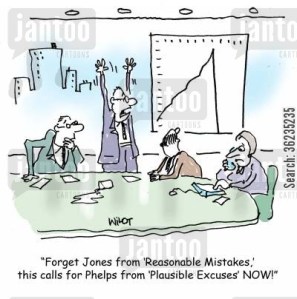
Forget Jones from Reasonable Mistakes, this calls for Phelps from Plausible Excuses NOW!

OWL’S SUMMARY:  EDDC HAS NO EFFECTIVE MONITORING OF SECTION 106 PAYMENTS DUE AND OFTEN RELIES ON DEVELOPERS TO TELL THEM WHAT THEY OWE TO THE COUNCIL.  THIS IS NOT JUST A PROBLEM FOR THIS FINANCIAL YEAR BUT, ACCORDING TO EXTERNAL AUDITORS, COULD HAVE HAPPENED IN PAST YEARS TOO.

Due to the explosive nature of the report detailed below, it is hardly surprising that the Audit and Governance Committee is meeting in the afternoon on 17 November 2016 at 2 pm, while most people have to be at work.  Had it been held in the evening there might well have been some seriously embarrassing problems for the committee.  As it is, even the afternoon session is likely to throw up some VERY tough questions.

Only recently added to the EDDC Audit and Governance Committee agenda papers is this little nugget of a report – it is only 21 brief pages and deserves very focused reading.  The report is as per the link below:

KPMG: Management of s106 contributions

and boy, what interesting reading it makes!

It seems that a local elector complained to EDDC’s external auditors – KPMG, new to the job this year – that it appeared that management of Section 106 payments (the money due from developers) was, in Owl’s lay-owl opinion, not fit for purpose – as reported in recent East Devon Watch postings:

HERE and HERE

The elector concerned alleged serious mismanagement of the listing, monitoring and collection of Section 106 money – the payments due from developers as part of their requirement to mitigate any problems that the development might cause and for the provision of green, open and play spaces within and around their developments.  This was as a result of a Freedom of Information request to which EDDC responded that it did not have the information the elector required.

BEAR IN MIND THAT DETAILED BELOW ARE SUMS FOR THE LAST FINANCIAL YEAR ONLY AND THE EXTERNAL AUDITOR DID NOT EXAMINE PREVIOUS YEARS.

After a very light-touch investigation by the new auditors KPMG (which simply sampled various agreements in this financial year only rather than forensically analysing them all over a period of several years), they found:

     “As at 31 March 2016 the Council had £5.8 million of s106 contributions held on its Balance Sheet.  During the 2015/16 financial year it accounted for £1.9 million of s106 receipts.
      We found that at the Balance Sheet date there was a gross amount of £636,000 in s106 contributions due to the Council where it had not identified that conditions had been met which triggered liability for payment from the relevant developer.
     No invoices had been raised seeking payment and consequently this amount had not been included in the 2015/16 financial statements, meaning the accounts were understated.
      When other audit findings are taken into account there was a net understatement of £227,000 in the Council’s financial statements. This is because our financial statements audit work had separately identified that the Council had incorrectly accounted for an amount totalling £409,000 for a different s106 agreement which actually related to another body.
     Whilst we have not exercised formal audit powers in response to the objection, our work has indicated that the issues raised by the objector are correct and we have upheld the objection.”

Here are the external auditors findings FOR THIS YEAR ONLY in more detail:

“Our evaluation of the processes has identified the following control weaknesses.
1. An absence of summarised financial information to facilitate the monitoring of s106 contributions
The Council currently has no summarised monitoring document which shows the value of all s106 contributions outstanding at any one point, with the trigger which would lead the contribution to be payable and, if the contribution is liable to be paid, the current status of the collection process. In addition to this the Council does not currently have the information in a format which is consistent with s106 contribution triggers so it cannot determine if triggers have been met.
2. Lack of challenge or enforcement of the Cranbrook developers’ legal obligation to provide information
From our understanding there is no challenge or enforcement of the developers’ legal obligation to provide the Council with details of the number of dwellings constructed, sold and occupied, instead only information on completions is supplied. In addition this information should be received quarterly but our testing suggests that it is received on an ad hoc and untimely
basis.
3. Understanding of financial and accounting implications of triggers being met and the communication between Planningand Finance over this
It has been found that at present there is a gap in the understanding of the financial and accounting implications of a contribution trigger being met within Planning, due to an oversight in communication between Finance and Planning over the treatment.  When contributions become virtually certain to be received, but are not invoiced for practical or commercial reasons, they should be recognised as accrued income.  At current however, given this gap in understanding in the planning team, the Council’s Finance team only accounts for s106 contributions when the cash has been received or an invoice has been raised. This has led to the financial accounts having an incomplete accrued income balance on the Statement of Financial Position.
In addition to the evaluation of the s106 processes and controls, we performed testing to enable us to quantify the potential misstatement as a result of the control weaknesses found in the system.
We focused this testing on s106 agreements associated with the Cranbrook development, as these agreements (individually and in total) represented the major value of all agreements in place. We requested a listing to be prepared of all s106 contributions that the Council has in place at the Cranbrook site and found that there were nine contributions that had been triggered and are due to the Council. It was also found that there was a tenth contribution where it was uncertain if the trigger point had been met and the financial value of the contribution, this is therefore not included within the misstatement below. The contributions ranged from £5,000 to £200,000 in value individually, see page 12 for further details.
It was found that the planning Officer was aware of the individual cases, but not the aggregate position of the un-invoiced amounts. None of the contributions had been invoiced or accrued in the financial statements but as noted previously, there is no evidence of financial loss and the misstatement is one of accounting treatment. If the total value of this misstatement was recognised in the Council’s accounts,the Grants in Advance balance would increase by £636,000, as documented below.
It is noted however that this is the gross misstatement as a result of the weaknesses in the system and that our final accounts audit procedures had already identified a misstatement that overstated the Grants in Advance balance by £409,000. This was because the Council had incorrectly accounted for a s106 contribution due from a developer but payable to another body, rather than the Council itself.

Consequently, when concluding effect of these misstatements on our audit opinion, we were able view the impact at 31 March 2016 as a net understatement to the balances is £227,000.  This was reflected in our reporting to the Council’s Audit & Governance Committee in September 2016.

Whilst neither the gross or net misstatement were considered individually material to the financial statements, they are nevertheless significant sums. Given the weaknesses identified in the Council’s controls, it is possible that understatements of a similar scale or even larger could be apparent at any point in time.”