Developers on a big roll – but still far too poor to provide truly affordable housing

Owl believes that the Conservative government’s policy is to destroy affordable and social housing in favour of private renting, where housing benefit is payable direct to landlords and councils have no responsibilities for their poorest residents and their families.

Current “affordable housing” provided by developers (at 20% less than average prices on the same site) are actually much smaller houses, with basic and/or cheap fittings on the least pleasant parts of sites – e.g. near main roads, parking areas, etc and require such discounting.

“[Persimmon] reported an 8 percent revenue rise, and said that the sales rate was up 15 percent between July and December, confounding the notion that the Brexit vote could take the wind out of property-related companies.

However, the stock remains down 9.2 percent since the referendum last June.

Sector peers also rose on Thursday, with Taylor Wimpey (TW.L) and Barratt Developments (BDEV.L) both up nearly 3 percent.

“This latest positive update from a sector major adds to yesterday’s positive UK PMI Construction read and improving mortgage approvals data while the UK mortgage market remains highly competitive and government initiatives supportive,” said Mike van Dulken, head of research at Accendo Markets.

“Although house price data does remain notoriously mixed, the post-Brexit crash foreseen by many simply hasn’t materialised and prices held up remarkably well”.

http://uk.reuters.com/article/uk-britain-stocks-idUKKBN14P0YK

“Brexit negotiations will fire the starting gun on the decade – so understanding these changes key for negotiations”

New IPPR report shows an accelerating wave of economic, social and technological change will reshape 2020s Britain

In a landmark report, leading think tank the IPPR has analysed factors shaping the UK up to 2030. It sets out the choices that must be made now if these changes are to lead to a fairer and more equal society.
The report highlights key facts that will change the way we live in the 2020s:

As the population grows, the UK is set to age sharply and become increasingly diverse. The 65+ age group will grow by 33% by 2030.

The global economy and the institutions that govern it will come under intense pressure as the Global South rises in economic and political importance.

Half of all large companies will be based in emerging markets;

Due to demographic trends, a structural deficit is likely to re-emerge by the mid-2020s, with adult social care funding gap is expected to hit £13 billion – 62% of the expected budget – in 2030/31;

Up to two-thirds of current jobs – 15 million – are at risk of automation.

These changes in technology have the potential to create an era of widespread abundance, or a second machine age that radically concentrates economic power;

The income of high-income households is forecast to rise 11 times faster than for low income households in the 2020s;

Climate change, biodiversity degradation, and resource depletion mean we will increasingly run up against the limits of the physical capacity of the Earth’s natural systems;

The UK has the richest region in Northern Europe but also 9 of the 10 poorest regions.

Mathew Lawrence, IPPR research fellow and report author said:

“By 2030, the effects of Brexit combined with a wave of economic, social and technological change will reshape the UK, in often quite radical ways.

“In the face of this, a politics of nostalgia, institutional conservatism and a rear guard defence of the institutions of 20th century social democracy will be inadequate.

For progressives, such a strategy will not be robust enough to mitigate against growing insecurity, ambitious enough to reform Britain’s economic model, nor sufficiently innovative to deliver deeper social and political transformation. They would be left defending sand castles against the tide of history.

Britain’s progressives should be ambitious, seeking to shape the direction of technological and social change. We must build a ‘high energy’ democracy that accelerates meaningful democratic experimentation at a national, city and local level, and also in the marketplace by increasing everyone’s say over corporate governance, ownership and power.”

http://www.ippr.org/news-and-media/press-releases/new-ippr-report-shows-an-accelerating-wave-of-economic-social-and-technological-change-will-reshape-2020s-britain

The full report is here:

Click to access future-proof_Dec2016.pdf

Halt those bulldozers at Hinkley C?

Just how much money is our LEP throwing into this eerily-glowing black and bright green hole? Though maybe it doesn’t think it is such a bad deal when lots of people (perhaps including board members with nuclear interests) are lining their pockets with lucrative pre-construction contracts, training courses and consultancies.

Remember, Somerset County Council is the accountable body for LEP spending, not Devon County Council – and it may also see spending, any spending, in Somerset as a good thing. After all, it’s “growth” – isn’t it?

“After eight years of prevarication, French firm EDF was panicked by Brexit into finally making the “decision” to build a new nuke at Hinkley. Concrete progress? No. Construction of the reactor cannot begin until it has been re-engineered to satisfy regulators here and in France, after discovery of fundamental metallurgical flaws in several French nukes.

Following this, a major component already manufactured in France was tested to destruction (literally) and found to be unsound. Since there is only one foundry in France making these huge steel forgings, and this is unable to meet safety standards, EDF doesn’t know what to do next. We will hear a lot more on this in 2017.”

Source: Private Eye, “Keeping the lights on”, page 9, issue of 23 December 16 – 12 January 17

“NHS groups ‘paying millions to private firms that block GP referrals’ “

“NHS organisations are paying millions of pounds to private firms that stop patients being referred to hospital by their GPs, an investigation has found.

Controversial referral management centres are used by some clinical commissioning groups (CCGs) to scrutinise patient referrals to hospitals by family doctors.

Supporters say they can reduce inappropriate referrals, saving the NHS money, but critics argue that adding an extra layer of scrutiny risks delaying diagnosis. There is also doubt over the effectiveness of such schemes.

GP practices ‘offered rewards’ for not referring patients to hospitals

In an investigation, the British Medical Journal (BMJ) sent freedom of information requests to all 211 CCGs in England. Of the 184 that responded, 72 (39%) said they commissioned some form of referral management scheme.

Almost a third (32%) of the schemes are provided by private companies, while a further 29% are provided in-house and 11% by local NHS trusts. Some 69% of the CCGs with schemes gave details of operating costs. These CCGs combined have spent at least £57m on schemes since April 2013.

Most CCGs were unable to provide evidence showing the scheme saved money. Only 14% could show that the scheme had saved more cash than it had cost to operate, while 12% showed that their schemes had not saved money overall.

Meanwhile, 74% of CCGs (53 groups) failed to supply figures to show whether any money had been saved, the BMJ reported.

Some CCGs did not collect data on savings, some said their referral scheme was designed not to save money but to improve the quality of referrals, and others declined to disclose details of savings on the grounds of commercial confidentiality.

Overall, there were 93 referral management schemes in operation across 72 CCGs, with some CCGs having more than one.

Dr Richard Vautrey, deputy chairman of the British Medical Association’s GPs committee, told the BMJ: “[CCGs] are leaping at these schemes without any clear evidence of benefit. They are just hopeful that it might reduce their costs.

“It is a very short-term approach to healthcare management. We need to see much more evaluation … and not just keep making the same mistakes year after year. As public bodies, there should be an expectation on every CCG to account for what it is doing.”

Vautrey said some schemes were helpful because they gave GPs rapid access to advice from local specialists.

Graham Jackson, co-chair of NHS Clinical Commissioners, the membership organisation representing CCGs, said referral management was only one way of managing demand for services.”

Owl bets that, if NEW Devon CCG hasn’t yet done this, it will be champing at the bit to commission a scoping study for a feasibility study for a consultants report for a pilot study at a health hub near you!

“In many cases they provide a useful and effective role which is more than a redirection service,” he said. “CCGs will balance the cost of commissioning with the benefit they provide to GPs and patients in terms of peer review, education, caseload management and choice.”

In October, Roberta Blackman-Woods, Labour MP for City of Durham, criticised a local scheme to screen referrals for conditions including cardiology, gynaecology and gastroenterology.

The North Durham CCG has awarded a contract to the private firm About Health to manage referrals.”

https://www.theguardian.com/society/2017/jan/04/nhs-paying-millions-private-firms-block-gp-referrals-hospital

“Exmouth regeneration board chief threatens to ignore key community group”

A press release from “Save Exmouth Seafront”:

“Councillor Skinner’s initiative with the previously unknown ‘Exmouth Creative Group’

Councillor Skinner, Chair of the secretive Exmouth Regeneration Board has threatened to ignore both the Save Exmouth Seafront (SES) Group and the Exmouth public as he goes to a previously unheard of group of elites for their opinion on the seafront.

In recent months Cllr Skinner has repeatedly avoided engaging with the Exmouth public. He has been avoiding a public Q&A meeting and stated at the East Devon District Council (EDDC) Full Council meeting of 21/12/16 that independent consultation with the public, as requested in the Town Poll, will not happen.

It has now come to light that while Cllr Skinner consistently refuses to engage with the Exmouth public he has meanwhile been in contact with the previously unheard of ‘Exmouth Creative Group’ and asked them to ‘create a vision for Exmouth’, and ‘develop proposals to deliver this vision’. Spokesperson for SES, Louise MacAllister reacted to this news:

“When I heard that Cllr Skinner was seeking the opinion of Exmouth residents regarding the future of the Exmouth Seafront I was really pleased. This is exactly what SES have been requesting through an open and independent consultation.

However I soon learned that Cllr Skinner is liaising only with a group called the ‘Exmouth Creative Group’. There are many established community groups in Exmouth with an interest in the seafront who have not been asked for their opinion.

The ‘Exmouth Community Group’ does not appear to pre-exist Cllr Skinner’s contact with the group. This is concerning as the Exmouth public made themselves very clear through the Town Poll that they want to be consulted, and yet the public are now being ignored in favour of this unknown group.

It is an incredibly disappointing stance from the Chair of the Exmouth Regeneration Board who consistently ignores my emails and fails to live up to the responsibility of his role”.

SES asked the following questions of Cllr Skinner with regards to the Exmouth Creative Group:

– What criteria did you use when selecting potential groups to communicate with?
– Why does this one group get to play a role when you are so dismissive of majority opinion?
– Who is in this group and how does one become a member?
– Why did you select a previously unknown group for this important task?
– With whom in the ‘Exmouth Creative Group’ did you broker your links?

In response Cllr Skinner rudely dismissed the questions posed with the bizarre statement that he is:

“Not a delegate, I am a councillor and am certainly not in the business of responding to you within your time scales or even at all if I so choose.”

So just as Cllr Skinner has dismissed the opinions of the wider Exmouth public, he has made it clear he will respond to a key community group only if he so chooses, and in doing so makes it clear that he does not value the group, or the wider public that SES strive to represent. Meanwhile, he has gone to an unknown group with a brief to design a vision for Exmouth Seafront.

SES strongly welcome the opportunity for the people of Exmouth to feed into ideas on the future of the seafront but not when it is conducted behind closed doors and solely with a previously unknown group who are seemingly as secretive as the Exmouth Regeneration Board members themselves.”

“The 2017 local elections: time to bury councillors, or to praise them?” asks Cornwall blogger

“We are now less than five months away from one of our infrequent four-yearly opportunities to express our democratic view of Cornwall Council. As the Council’s leadership desperately clings on to the tiger of housing growth, no doubt people will be asking themselves as local elections near, ‘what have councillors ever done for us?’ Others won’t ask; they’ll be loudly calling down a plague on all of them.

This may be a bit blunt. I’m sure most councillors believe they’re doing their best for Cornwall and its communities and are not, as so many assure me, in the pay of upcountry developers and determined to transform our land into a Little England by the Sea as quickly as possible. The more proper question therefore becomes ‘why have councillors been unable to raise credible opposition to population growth policies and developer-led planning?’

While not actually wishing to bury councillors, it’s surely time to remind some of them of a few home truths. Many councillors are clearly beyond redemption, uncritically swallowing wholesale the advice of their officers, kowtowing to London’s orders with scarcely a whimper, or perhaps not possessing the wit or wisdom to challenge conventional ‘mainstream’ policies.

It’s the others I worry about.

Over the past month or so I’ve heard from three Cornwall Councillors (from different party groups), all genuinely concerned for the future of their land, all deeply worried by the lemming-like drive for massive building projects and renewed people-led growth that threatens to transform the landscapes around our towns and villages. Yet none of them seemed to have discussed their concerns much with fellow councillors across party lines who might share their views. None seemed fully aware of campaigns outside their particular patch. Intra-councillor communication is one problem, while external communication is the second.

Why are councillors unwilling to take a lead and organise? Why can’t those who rightly question the Council’s direction of travel forget their party labels and coordinate their opposition? Instead of moaning about the constraints imposed by central government, constraints that are all too real, why don’t they do more to publicise their dilemma? Is it not possible to oppose central government diktats publicly, while educating Cornish voters about the straitjacket the Government imposes? Can’t they do more to point out how the Council’s leadership complies too readily with those diktats?

At MK’s [Mebyon Kernow – The Party for Cornwall] recent Annual Conference for example, their councillors admitted that they ‘did too much without shouting about it’. So why not do more to shout about it? First, they could surely make more effort to publicise what they’re doing. Second, they could pro-actively disseminate information they come across that illustrates the absurdities of the current Council strategy or the various ways in which Cornwall is being treated unfairly. Look at the MK website and you’ll find surprisingly little such information.

Surely MK and other councillors could build more bridges to campaign groups and campaigners outside, who can then spread this information through the grassroots. There’s a huge amount of energy and anger building up in local campaign groups as people see the changes unfolding around them and begin to realise what the elites have in store for us. But there’s also a lot of confusion and ignorance as well as anger.

The danger is that people take a blanket view and blame ‘the council’ and all councillors for what’s happening. We’ve seen over the past year where this can lead, if left to stew unfocused in this way. People will vote for the first demagogue that comes along. They end up protesting against the establishment by electing slightly more marginal members of the same establishment, some just chancers and others who deliberately fan anger and fear into racism and bigotry and offer simplistic solutions but no substantial remedy for a system that’s unfit for purpose.

To prevent that, we need a grassroots populism, also anti-elitist, but confident in its ability to replace the failed elites, not with a set of chancers from similar backgrounds but with genuine and credible voices of localism and community democracy.

Councillors who can see through the Council’s corporate agenda need to stand up, join with campaigners and begin to discuss how to make the future of Cornwall an issue in next year’s local elections. We can’t let things go on the way they are. So how do we best challenge the people-led growth consensus that grips our policy-makers and replace it with a more sustainable vision of Cornwall? Who’ll make the first move?”

https://cornwalldevelopersparadise.wordpress.com/2016/12/12/the-2017-local-elections-time-to-bury-councillors-or-to-praise-them/

Could this sort of protest persuade our Tory MPs to back the NHS?

Conspiracy theorists and fake news enthusiasts are already saying that this was organised to make Trump look good – hhhm! And can we see parallels here – nationally and locally?

“WASHINGTON ―

After a torrent of bad headlines, countless phone calls to member offices, and two tweets from President-elect Donald Trump, House Republicans dropped their plans to gut the Office of Congressional Ethics Tuesday, just minutes before the House was set to gavel in for the 115th Congress and adopt their rules package for the next two years.

The amendment ― authored by Judiciary Chairman Bob Goodlatte (R-Va.) ― would have placed the independent congressional ethics office under the oversight of the House Ethics Committee, changed the OCE’s name and barred the office from releasing reports to the public. In effect, it would have neutered Congress’ most aggressive watchdog.

The decision to strip the Goodlatte amendment came just before noon on Tuesday as Republicans planned to begin the 115th Congress. Earlier in the day, responding to numerous news reports about Republicans gutting the OCE, Trump asked in a tweet whether Republicans really had to make the “weakening” of the ethics office their first order of business, though he also didn’t necessarily come out against the idea of eventually overhauling the OCE.

Ethics groups were quick to criticize House Republicans for the effort. A coalition of groups including the Campaign for Accountability, Citizens for Responsibility and Ethics in Washington and the League of Women Voters sent a letter to House Speaker Paul Ryan (R-Wis.) and House Minority Leader Nancy Pelosi (D-Calif.) on Tuesday calling for the reauthorization of the OCE.

Several other groups, including the conservative Judicial Watch, called the move “shameful.” The nonpartisan group Common Cause even pointed out that exactly 11 years ago, lobbyist Jack Abramoff ― whose crimes helped lead to the creation of the OCE ― pleaded guilty to charges including fraud conspiracy and tax evasion. (Abramoff told Politico Tuesday that Republican’s efforts to gut the ethics watchdog are “exactly the opposite of what Congress should be doing.”)

Members reported that they had started getting a flood of phone calls from constituents concerned that Congress was neutering a key ethics watchdog.

“The calls we’ve gotten in my district office and here in Washington has surprised me, meaning the number of calls,” said Rep. Walter Jones (R-N.C.), who noted before the amendment was stripped that he would vote against the rules package if it remained in the measure. “People are just sick and tired.”

Some Republicans, including South Carolina Reps. Trey Gowdy and Mark Sanford, were reporting Tuesday that they would vote against the typically party-line rules package.

Facing public pressure and an internal mutiny, GOP leadership called a special meeting and told Republicans they needed to strip the OCE amendment.

Leaders told members they would instead work with Democrats to come up with a proposal to reform the OCE before the August recess, though a number of Republicans were unsatisfied by the promise.

Rep. Steve King (R-Iowa) said he would now work to completely abolish the Office of Congressional Ethics, citing concerns over anonymous whistleblowers making accusations against members and the OCE leaking information to the press.

Asked to provide an example of the OCE leaking information to the press, King failed to come up with one and got testy.

“Just google it,” he said.

Pelosi issued a statement after the amendment was dropped, noting the “clear contempt for ethics in the People’s House” that she said Republicans showed with their plan.

“Once again, the American people have seen the toxic dysfunction of a Republican House that will do anything to further their special interest agenda, thwart transparency and undermine the public trust,” she added. “Republicans should remember the strength of public outrage they faced in the space of 12 hours as they scheme to do lasting damage to the health and economic security of millions and millions of hard-working families.”

http://www.huffingtonpost.com/entry/house-republicans-ethics_us_586bdb14e4b0de3a08f99e66?

“Us versus Them – The New World” – tomorrow, 9 am, Radio 4

“Us Versus Them – The New World”, Radio 4, tomorrow 9 am:

Political movements which proclaim themselves as anti-elitist challengers to the mainstream establishment have been achieving success, from Brexit campaigners to Donald Trump and various European parties.

John Harris explores the reasons behind this international phenomenon, examines the motivating forces for the anxiety and anger of voters, and considers the response of the political establishment in this new era.”

To be followed same time next week by:

“It’s the Demography, Stupid!
The New World

How is population change transforming our world?

Think of a python swallowing a pig: a big bulge makes its way slowly down the snake from the head end to the other end. That’s a bit like what’s happened to the UK demographically.

The baby boom generation – which has changed Britain politically, culturally and economically – is now retiring. That means a large bulge of pensioners with big implications for the generations that come behind them. Other advanced economies face a similar challenge and emerging economies – most notably China – will be dealing with an ageing bulge themselves soon.

But in Africa, the bulge is at the other end. A very young generation is about to make its way through the snake.

Former government minister David Willetts, now executive chair of the Resolution Foundation, wrestles with this python of population change.

What will these challenges of both ageing and very young populations mean for the world?
What are the implications for future migration patterns, for geopolitics and for global economic growth?

This programme is part of a special week of programmes for the first week of 2017, examining major forces which are changing the world around us.”

Hernandez thinks ” negative press” on election expenses allegations were good for her!

When does spin become bovine excrement? AND she says she is “not nationally media trained” yet was employed as a campaign manager for the Tories!

” … Back in October last year, when Ms Hernandez had not been contacted by West Mercia Police regarding the investigation, she spoke about the impact the negative press has had on her.

“This negative publicity has been a very helpful process because it’s made me approachable, it means that people will ask for help,” she said at the time. “It’s got to the point actually where I’m not seeing it as a bad thing.

“When I’ve gone out in the public domain I’ve had a lot of people come and say I feel sorry for you, and I’ve never felt more loved in my life.

“It was like a baptism of fire. I’m not nationally media trained, I don’t want people to think I’m shying away from them.”

http://www.plymouthherald.co.uk/crime-chief-interviewed-by-police-investigating-election-expenses-allegations/story-30027908-detail/story.html

East Devon Alliance organising coach to London Save NHS demo

East Devon Alliance (EDA) will be organising a coach bound for London on March 4, 2017, and people from the district are invited to present a united front of opposition.

More details will be released in the new year. Book via coach@eastdevonalliance.org.uk.

http://www.sidmouthherald.co.uk/news/sidmouth_campaigners_to_join_mass_protest_against_dismantling_of_nhs_1_4832538

“Outcry after Republicans vote to dismantle independent ethics body”

Well, we know all about this in Devon – we could probably give Trump some tips!

“House Republicans have gutted an independent ethics watchdog, putting it under their own control, in a secret ballot hours before the new Congress convened for the first time.

The unheralded vote severely weakens the Office of Congressional Ethics (OCE), which was set up after a lobbying scandal in 2008 to investigate corruption allegations against members of Congress. The move, led by the head of the House judiciary committee, defied the Republican congressional leadership and was reportedly supported by several legislators currently under OCE scrutiny.

The amendment was voted through by the House Republican conference over the New Year’s holiday with no prior notice or debate and inserted in a broad rules package the House will vote for on Tuesday. It turns the formerly independent OCE into the Office of Congressional Complaint Review, a subordinate body to the House Ethics Committee, which is currently run by the Republican majority and has a long history of overlooking charges of malfeasance by lawmakers.

The new body will not be able to receive anonymous tips from members of Congress or make its findings public.

The vote comes at a time when the Republicans control all three branches of government and are seeking to remove some of the residual constraints on their powers. The rules package to be voted through on Tuesday, for example, will limit the ability of the Democratic minority to block legislation like the repeal of Obama’s Affordable Care Act by staging a filibuster.

It also comes at a time when president-elect Trump is attempting to fend off scrutiny over multiple conflicts of interests questions arising from his bid to keep his business empire in his family’s hands even after he takes office on 20 January.

The House Republican vote triggered a wave of outrage from Democrats and government ethics specialists.

“Undermining the independence of the House’s Office of Congressional Ethics would create a serious risk to members of Congress, who rely on OCE for fair, nonpartisan investigations, and to the American people, who expect their representatives to meet their legal and ethical obligations,” Norman Eisen and Richard Painter, ethics counsels to Barack Obama and George W Bush respectively, argued in a joint statement.

“If the 115th Congress begins with rules amendments undermining OCE it is setting itself up to be dogged by scandals and ethics issues for years and is returning the House to dark days when ethics violations were rampant and far too often tolerated.”

The House Democratic leader, Nancy Pelosi, said: “Republicans claim they want to ‘drain the swamp’ but the night before the new Congress gets sworn in the House GOP has eliminated the only independent ethics oversight of their actions,” Pelosi said in a statement.

“Evidently, ethics are the first casualty of the new Republican Congress.”

Goodlatte defended the vote.

“The amendment builds upon and strengthens the existing Office of

Congressional Ethics by maintaining its primary area of focus of accepting and reviewing complaints from the public and referring them, if appropriate, to the Committee on Ethics,” the judiciary committee chairman said in a statement.

Goodlatte did not explain how the OCE had been strengthened by being stripped of its independence and stopped from making public statements.

The OCE was set up in 2008 after a string of corruption scandals involving two Republican politicians and a Democrat. Former congressman Randy “Duke” Cunningham, a California Republican, served more than seven years in prison on bribery and other charges.

Ohio Republican congressman Bob Ney pleaded guilty to corruption charges and a Louisiana Democrat and former congressman, William Jefferson, was convicted on corruption in a separate case.”

Our NHS? Well, no, it is now their private NHS

“One of Britain’s most famous NHS hospitals is on course to get as much, if not more, money from private patients, charities and commercial activities as it does from the NHS.

The Royal Marsden NHS Foundation Trust in London will earn 45% of its income from private patients and other non-NHS sources this financial year and is about to embark on a drive to raise its income from paying patients from £90m to £100m.

Other NHS trusts on the same path include Great Ormond Street, also in London, which received almost a quarter of its income from non-NHS sources last year. It is seeking a “step change in private patient activity”, according to its latest operating plan….”

http://www.thetimes.co.uk/edition/news/nhs-in-dash-for-private-cash-nsnjw569z

2017: the year the NHS dies (or gets murdered?)

“… And what about the money?

The frightening thing for ministers – and in particular the Treasury – is just how much cash the NHS is swallowing. Over £130bn is spent on the health service across the UK. In England, the budget was increased by 4% in real terms this year.

But still it hasn’t got enough. Hospitals continue to rack up deficits. And while the NHS will undoubtedly still manage to balance its books by year end in March because of surpluses elsewhere, the prospects for the next financial year are much gloomier.

The 2017-18 year will see a much smaller rise in the budget – under 1% once inflation is taken into account.

That – to borrow a phrase from former Manchester United boss Sir Alex Ferguson – really will be squeaky bum time. Yes you can always argue the Treasury will step in and provide more funds, but no area of government spending has had as generous a settlement as the NHS. Tough questions will be asked and cuts will undoubtedly have to follow.

Where is the axe falling?

Talking of cuts, isn’t there a whole host in the pipeline? Yes. In the coming months expect to hear plenty about the catchily named sustainability and transformation plans.

There are 44 of them covering the whole of England and some are pretty radical – involving closures of A&E and maternity units and, in some cases, whole hospitals. Consultations are likely to be getting under way over the next few months and these are bound to provoke local protests. …”

http://www.bbc.co.uk/news/health-38323184

“Musical Council Boundaries”

“When the music stops, your local council leader will be here to tell you a story [1]

First, there was “devolution” for the Heart of the South West, which wasn’t devolution at all because it would have sucked powers upwards from localities to a vast “combined authority” covering all of Devon and Somerset, including Plymouth and Torbay [2].

Then came the idea for a Greater Exeter Growth and Development Board (the GEGDB), which would be a joint strategic authority made up of Exeter, East Devon, Mid Devon and Teignbridge Councils [3]. Joint authorities are in practice run by their officers, not councillors, because the officers negotiate a common acceptable position on a given issue and then serve it up the councillors as the only available option that the four councils will agree on.

Finally (or perhaps not), proposals for a “South Devon” unitary council leaked out last week. This would be an all-purpose council covering East Devon, Exeter, Teignbridge, Torbay and Plymouth and, possibly, South Hams (sorry, Mid Devon, you’re out), discharging all existing district council functions plus those of Devon County Council within the new unitary area. Such evidence as is there is suggests the prime movers appear to be Exeter and Plymouth, if only because they refused to back further moves to support the “devolution” proposals.

The Exeter Green Party has written to the leader of Exeter City Council asking the following questions:

What mandate does the City Council have from the residents it serves to:
(a) attempt to reorganise local government decision-making structures?

(b) propose arrangements which would suck key decisions upwards from the elected representatives

of the people of Exeter to a new superior authority – the GEGDB – which would not be directly elected?

(c) propose a strategic authority – the GEGDB – which on the evidence of the 8 November paper would focus solely on economic growth to the exclusion of social and environmental considerations?

When does the City Council plan to publicise its thinking and actively consult residents and businesses on whether they actually want new local government arrangements and, if so, on the form they should take and how any new body might be fully accountable to local people?

It seems clear that the option favoured by Exeter and Plymouth is the South Devon unitary authority. Central government is believed to be offering £1 billion if the unitary is established, complete with an elected mayor. We don’t know what the money would be targeted at – improving public services, infrastructure, or grants to businesses? But a bribe’s a bribe.

A directly elected authority – which is what the unitary would be – is certainly preferable in democratic terms to the other options. But it would be a huge area, currently represented by 237 councillors elected by 105 wards (and that’s without South Hams). So a workable sized council will require a massive cull of elected members (no wonder the leaderships have been playing their cards close to their chests), leading to a weakening of the links between people and their councillors. On present ward boundaries, based on the most recent election results, 123 of the councillors would be Tories – a small majority, which gives pause for thought as to why Labour-run Exeter is so keen on the idea? Of course the new council could be a pathfinder, to be elected by proportional representation, which would change the political balance considerably. Look it’s a pig up there.

Many, many more questions. And meanwhile energy is being diverted away from service improvements into a potentially massive reorganisation. It still feels like the “old politics”. For the time being, we have to await the answers to the Green Party’s highly pertinent questions.

NOTES

[1] You have to have been an aficionado of BBC Radio Children’s Hour in the 1950s to understand the reference!

[2] See my post https://petercleasby.com/2016/09/30/devolution-is-not-control/

[3] The proposals adopted by Exeter City Council’s Executive are at http://committees.exeter.gov.uk/documents/g4903/Public%20reports%20pack%2008th-Nov-2016%2017.30%20Executive.pdf?T=10, page 73.”

https://agreeninexeter.com/2016/12/14/musical-council-boundaries/

Our NHS?

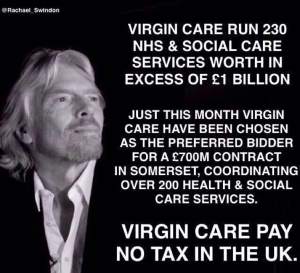
Virgin Care has many, many contracts in Devon:

http://www.virgincare.co.uk/explore-our-services/

It says it “pays its taxes” but it uses at least 13 tax havens for its money:

https://www.theguardian.com/society/2015/mar/21/ow-lucrative–deals-go-to-firms-that-use-tax-havens

ec9d8a67-fb0b-4857-a1cb-23075df73dbf-608-0000004972116ca2_tmp

Greendale business family accused of neglecting city centre pub

“A year has passed since a long-standing pub in Exeter city centre closed its doors. But the mystery continues as to the future of it.

The Mint on Fore Street has been shut since New Year’s Eve 2015, and has remained closed ever since, despite plans to reopen ‘soon’. …

… Owners Greendale Leisure Ltd, based at Woodbury Salterton, have remained tight-lipped about their plans for the venue.

It was initially thought that the pub closed over ‘management issues’.

David O’Callaghan, of Gentry barber shop, said: “There have been all sorts of rumours, but no one is any the wiser.

“We have seen people taking out pumps, coolers, chilling units, the fruit machine and pool table. So maybe they aren’t going to keep it as a pub.

It’s an eyesore, and I’m concerned squatters are going to get in there.”

http://www.exeterexpressandecho.co.uk/mystery-to-future-of-long-standing-pub-in-exeter-remains-one-year-on-from-closing/story-30021915-detail/story.html

Business must be going well for the Carter family if they can afford to leave a city centre property empty for a long period.

“Company boss who gave £930,000 to Tory party receives knighthood”

Owl wonders if it wins Euromillions it might be able to call itself “Croney Owl”? Hugo’s croney knighthood from old pal and Eton schoolfriend David Cameron is looking grubbier and grubbier.

“David Ord, who becomes a knight in the new year, is a co-owner of Bristol ports and a member of the Conservative party’s Leaders’ Group, who were granted exclusive access to cabinet ministers under David Cameron and George Osborne. He has given more than £930,000 to the party since 2013.

Ord, a major opponent of the Severn Barrage, was once embroiled in a donations row after it emerged in 2014 that Bristol North West MP Charlotte Leslie had failed to declare the port owner’s donations to her local party on time, despite making numerous parliamentary interventions about the project. She apologised and was cleared of wrongdoing by the parliamentary watchdog.

Jeremy Corbyn said the honours for Tory donors were an insult to those who had been rewarded for charitable work or achievements. “The Conservatives are making a mockery of our honours system,” the Labour leader’s spokesperson said. “Every crony appointment is an insult to the incredible people from right across Britain who are rewarded for the great contributions they make to our national life”.

A Downing Street source defended the honours for Conservative donors, saying: “Being involved in political parties is generally considered to be an important part of civic society, and the alternative is having state funding for political parties, which is not where the consensus lies. When people dedicate their time and service to civil society it’s appropriate they can be honoured.” …

https://www.theguardian.com/uk-news/2016/dec/30/company-boss-david-ord-tory-donor-receives-knighthood

More Knowle shenanigans- East Devon Alliance leader on the warpath

“Questions remain over East Devon District Council’s (EDDC) relocation project – amid rising costs and claims of a lack of transparency.

The authority has been accused of pushing ahead with the move away from Sidmouth to Honiton and Exmouth ‘at any cost’ after it approved adding nearly £700,000 to the bill.

Councillor Cathy Gardner last week argued proper scrutiny of the project cannot be achieved as long as documents are not made public. She also raised concerns about members being asked to endorse decisions relating to a contract – between the would-be developer of Knowle and the council – they have not even seen.

In response, EDDC leader Paul Diviani said the contract with PegasusLife is ‘commercially confidential’, but admitted that the developer could potentially ‘renegotiate’ a price for the site after its bid to build a retirement community was refused.

At a full council meeting last Wednesday, Cllr Gardner accused Cllr Diviani of failing to answer her questions and pressed for an answer on whether the contract with PegasusLife has an expiry date. Cllr Diviani said: “We have to wait to hear from PegasusLife. They have the option of coming through with re-submission, or appealing, and we will see what happens there.

“We will work to get the best possible result we can, but if it happens that the deal falls apart, then we will move forward.”

Cllr Gardner asked for reassurance that the £7.5million PegasusLife has agreed to pay could not be renegotiated.

Cllr Diviani said: “If the circumstances are such, then quite obviously they will be able to renegotiate, but let’s not have speculation about what’s going to happen, let’s have a decent dialogue with PegasusLife so we know exactly where we are going from here.”

Cllr Diviani refuted claims that EDDC’s approach to transparency involves releasing only documents relating to relocation that ‘no-one is interested in seeing and holding on to the rest’.

He said: “Documents will be released in due course. They are coming through on a fairly regular basis and it does take time to pull them all together, but they will be expedited as soon as they possibly can.”

Resident Richard Thurlow spoke out about increased costs relating to the refurbishment of Exmouth Town Hall ahead of relocation – which, he says, would now cost more than renovating the existing Knowle offices.

He claimed that there was no detail or adequate rationale to explain the reasons for the increased costs.”

http://www.eastdevonalliance.org.uk/in-the-press/20161230/sidmouth-herald-fresh-concerns-voiced-over-eddcs-relocation-from-sidmouth/

High Court backs approach taken by East Devon District Council in standards case

“A decision taken by East Devon District Council as principal authority over a code of conduct breach by a town councillor and the sanctions it recommended – including a requirement for training – was lawful, a High Court judge has ruled.

However, in Taylor v Honiton Town Council & Anor [2016] EWHC 3307 Mr Justice Edis quashed additional sanctions imposed by Honiton on the claimant, Cllr John Taylor, over and above those recommended by the district.

The case arose after Cllr Taylor, a member of the town council since 2007, became concerned about the funding of a major project in Honiton, the building of the ‘Beehive Community Centre’.

The councillor published a letter in January 2015 about the town council’s extension of borrowing from the Public Works Loan Board (PWLB) by £98,000 to cover a shortfall. It included an allegation of impropriety and a request for a police investigation.

Honiton’s town clerk complained that she had been slandered in the letter, details of which had appeared in a local paper, and her professional reputation had been affected.

Attempts by East Devon’s monitoring officer to resolve the complaint informally were unsuccessful as Cllr Taylor refused to make an unreserved apology. East Devon therefore asked Tim Darsley to investigate.

Mr Darsley concluded on the facts that statements made by the councillor had been inaccurate and given a misleading account of what the town clerk had said at the meeting about the PWLB loan extension. His findings also included that there was no evidence that the loan application was in any way illegal and was used for an improper purpose.

In his report Mr Darsley also found that Cllr Taylor had publicly made claims of illegality and impropriety associated with the town clerk and that, in the absence of any reasonable justification for his claims, this constituted a failure to treat her with respect.

The standards hearings sub-committee at East Devon subsequently found Cllr Taylor to have breached a paragraph of the code of conduct because he had not treated the town clerk with respect in that he had publicly accused her of criminal behaviour, namely conspiracy to obtain a loan by deception in that its true purpose was misstated on the application.

On advice from its officers, the sub-committee recommended that the town council:

censure Cllr Taylor for his breach of the code of conduct;
publish the findings of the hearing sub-committee. (East Devon would anyway publish the findings on its own website as a matter of procedure).
instruct East Devon’s monitoring officer to arrange training for Cllr Taylor in respect of the code of conduct and councillor conduct – such training by the end of the current financial year (“the training requirement”).

Honiton went on to impose the sanctions recommended by East Devon and also applied a new policy on code of conduct sanctions it had adopted in October 2015.

These additional measures – to remain in place until Cllr Taylor had complied with the training requirement – involved:

(i) A restriction preventing the claimant/Cllr Taylor from speaking at any meeting including the council meeting.
(ii) The removal of Cllr Tayor from the five committees and working groups on which he served.
(iii) A restriction preventing him from attending any meeting as a member of the public together with a restriction from speaking as a member of the public at any meeting.
(iv) A restriction preventing Cllr Taylor from attending at the council offices unless accompanied by the mayor of the council.

Cllr Taylor brought judicial review proceedings on the following grounds: illegality; the sanctions not being imposed on a proper basis in the light of East Devon’s conclusions on the investigation; and the hearing before the standards sub-committee being procedurally unfair.

Honiton subsequently withdrew all sanctions imposed on Cllr Taylor but said it would consider the issue of sanctions again after any fresh decision by East Devon, and/or the outcome of the judicial review proceedings against the district.

In the end the proceedings were issued against the town council. (East Devon becoming an interested party because it wanted to establish that imposing a requirement for training on Cllr Taylor was lawful).

Honiton expressed the hope that the claim would be withdrawn because, amongst other things, it agreed that its decision of 14 December 2015 should be treated as never having been made. It also agreed that it would not seek to re-impose all of the sanctions that were imposed.

Mr Justice Edis decided, given Honiton’s approach, he would address two questions:

whether Honiton was bound by the findings of East Devon as to the facts and as to whether there was a breach of the code.

“This is because the Decision actually involves two stages: breach and sanction. Honiton has certainly withdrawn the second, but says that it is still bound by the first. The point is not academic to the Decision and to the order which should be made.

Whatever the outcome of this issue, I will quash the Decision. This does not mean that the route to that result is irrelevant. If the claimant is right I will quash the finding that there was a breach of the Code because no such finding was made by Honiton which wrongly simply adopted East Devon’s decision. If Honiton and East Devon are right I will quash the Decision because Honiton has conceded that it wrongly included sanctions which are beyond its powers.”

Mr Justice Edis decided that the effect of provisions in the Localism Act 2011 was to place the duty of investigation and decision of allegations against members of Honiton on East Devon as principal authority.

“The arrangements for decision making must involve independent persons and it would frustrate that important safeguard to hold that a parish council had a duty to reconsider the principal authority’s decision and substitute its own if it chose to do so,” he said.

The judge noted that in this case East Devon had decided the issue of breach but made recommendations to Honiton about what action it should take consequent on that finding. Honiton then took the decision on sanctions.

“The challenge in these proceedings is based on the proposition that East Devon’s role was limited to that of investigator and adviser on both questions and contends that Honiton was the ultimate decision maker on both issues. This appears to me to be clearly wrong….,” Mr Justice Edis said.
“A natural reading of the Act gives decision making power to the principal authority and requires it to have arrangements for the exercise of that power in place. It would make a nonsense of that scheme if the parish council were able to take its own decision without having any of those arrangements in place.”

The judge added: “The whole point of the scheme is to remove decision making powers and duties from very small authorities which do not have the resources to manage them effectively and who may be so small that any real independence is unattainable. I therefore reject the challenge.”

Mr Justice Edis added that in doing so, he declined to decide that the Act required the splitting of the decisions as between breach and sanction between the two relevant authorities in the way in which this happened in Cllr Taylor’s case.

On the imposition of a training requirement, Mr Justice Edis said Honiton was under a statutory duty to maintain high standards of conduct under s.27(1) of the Localism Act 2011 in relation to its members. Section 27(2) required it to have a code of its own or to adopt that of East Devon.
The judge said: “The existence of a code of conduct is regarded by Parliament as an important aspect of the maintenance of standards. It appears to me to be proportionate to a significant breach of it for a relevant authority to require the person in breach to be trained in its meaning and application.

“There is no point in having a code of conduct if members of the authority are not aware of its meaning and effect and where a member has demonstrated by his conduct that this is the case, a reasonable amount of training appears to be a sensible measure. A local authority should be able to require its members to undertake training which is designed to enable them to fulfil their public functions safely and effectively.”

Mr Justice Edis said it had been reasonably open to the decision maker to conclude that there had been a serious breach of the code.

He added: “There is no finding as to the claimant’s motives and it may be that he acted in good faith, believing that his statement about the town clerk was justified. However, it was not. He accused her of criminal conduct when there was not the slightest justification for doing so. This was a very serious error of judgement. Therefore, a requirement of training was proportionate.”

The judge noted that if such a requirement was made but the member refused to comply, the only sanction was publicity.

“Such conduct may reduce the confidence of the electorate in the member so that he or she is not re-elected. Equally, it may not,” he said. “That is a matter for the electorate to decide which it can do only if it has the relevant information. For these reasons I consider that it is open to a relevant authority exercising its power as contemplated by s.28(11) to take action following a failure to comply with a code of conduct to require the member to undertake training. That decision will usually be published and it will be open to the authority to publish what happens as a result of the requirement.”

http://localgovernmentlawyer.co.uk/index.php?option=com_content&view=article&id=29497%3Ahigh-court-backs-approach-taken-by-district-council-in-standards-case&catid=59&Itemid=27

Heart of the South West LEP: where is OUR money going now?

It appears that the “Heart of the South West LEP is dead in the water now that three of its original members have refused to continue to back it and instead are considering their own grouping – the south-west “Golden Triangle” LEP.

Which brings us to that age-old concern: the money. Where did the HOTSW LEP money come from, where was it spent and now, more importantly, what is happening to it now that several big players – who originally underwrote it – have pulled out?

How do we find out [what little there is] – where is the paper trail and where does its “accountability” reside?

This correspondence with the National Audit Office gives some clues:

[Concerns have been raised] about lack of transparency around contracts and spending.

As part of the assurance framework each local enterprise partnership has a nominated local authority that acts as its accountable body, and Somerset County Council (the Council) is the accountable body for the Heart of the South West LEP.

You could therefore consider bringing the matters to the attention of the Council themselves.

Alternatively you may wish to consider bringing the matters to the attention of the Councils external auditor. For this Council, the appointed auditor is Grant Thornton UK LLP.

The engagement lead for the audit is Peter Barber, who can be contacted at peter.a.berber@uk.gt.com or on 0117 305 7897. You should be aware, however, that the NAO has no powers to direct the auditor take further action, as that is a matter of professional judgement to be exercised by the external auditor themselves.

If you are a local elector for the [Somerset?] Council, you also have rights in relation to inspecting and objecting to the Councils accounts, if you feel this appropriate. The NAO has produced Council accounts: A guide to your rights, which sets out these rights in more detail. The guide can be accessed from the link or from our website home page”.”

Council tax payers of Somerset – arise. You, and we, surely have many questions of the council (or better still its external auditors) as to where your (Somerset) and our (Devon and, in particular for us, East Devon) money is going now that the HOTSW LEP has had at least one of its legs cut off.

Have its fingers been cut off? Is the till snapped shut and locked?

Unlikely.