Meeting organised by EDDC Independent East Devon Alliance Councillor Geoff Jung and Independent DCC Councillor Claire Wright – several practical measures suggested but major worries over retrospective planning applications:
Category Archives: Misc
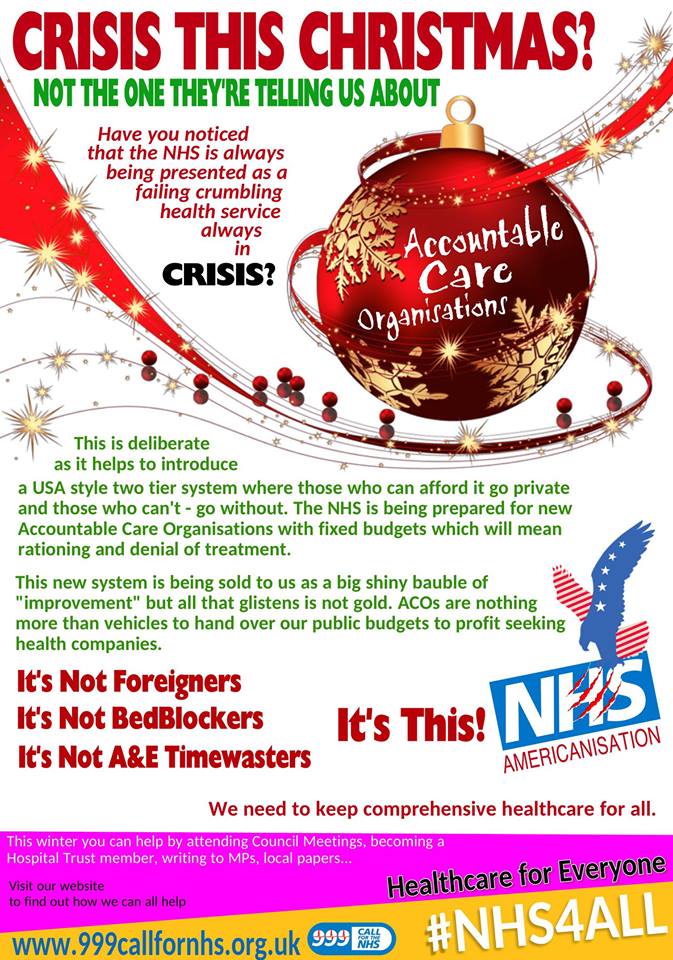
OUR NHS



OUR NHS
CPRE seminar 19/01/2018 10 am: New Housing and The Greater Exeter Strategic Plan – special guest: Hugo Swire
Friday 19th January 2018.
10am-12.30pm.
The Gipsy Hill Hotel,
Gipsy Hill Lane,
Pinhoe, Exeter
EX1 3RN
Guest speakers:
Rt Hon Sir Hugo Swire MP;
George Marshall, Greater Exeter Strategic Plan.
How many new homes are planned for your community and where?
Please join us for this important opportunity to find out more about the Greater Exeter Strategic Plan for Exeter, East Devon, Mid Devon and Teignbridge and the plans for new housing.
All welcome.
Places must be reserved – to book a place please contact us on
01392 966737
or email:
director@cpredevon.org.uk
Postcode lottery social care – the reality
A comment on the article posted directly below this one:
“Let’s get this absolutely clear….. : the Tories have cut £4.6bn from Adult Social Care since 2010.
The piece fails to mention that poorer local authorities don’t have the benefit of the so-called precept either – council tax income is considerably lower.
But the real issue beyond the cuts is that the marketisation of social care is a complete and utter failure.
There’s a massive recruitment crisis and services have been decimated – there’s over 4 million family carers quietly labouring away out of sight many with little support. Having money actually makes little difference in some areas…. there’s minimal respite or domiciliary care services available.
It’s going to get a lot worse when the Accountable Care Organisations are foisted on the NHS. The Dementia Tax was an open door to the insurance industry and the ACOs will open the NHS to more privatisation.
This needs shouting from the rooftops. It’s not an intergenerational issue – that’s a smokescreen – it’s inbuilt into an ideology that relies on shifting public money into private hands. Castrating local authorities is part of the deal.”
https://www.theguardian.com/society/2017/dec/16/social-care-for-elderly-postcode-gap-grows
(most popular comment)
Owl gets its talons tapped
Owl has received a comment which says it must immediately take down a comment that local tory parties, freemasons and developers get more listened to than town councils in matters of planning. The commentator says it casts aspersions on an upright and moral group of charitable people – specifically the freemasons (but does not mention the others).
Owl, of course, implied no such thing. Of course ALL the groups mentioned are upright and moral – including town councils. It is just that the town councils, which many think have greatest clout, have, in many cases in practice, less clout than practically every other group.
So, in the interests of fairness, Owl adds more upright and moral groups whose remarks are more likely to carry weight than those of a town council. They include, but not exclusively:
Ice-cream van sales people
Surfers
Lawyers
Hairdressers
Electricians
Dog groomers
Traffic wardens
Bank mamagers
Hope that clears up the misunderstanding.
Axminster and Sidmouth voted in worst 9 town to live in by locals!
“A website which lists the worst places to live in the UK lists nine places as the worst in Devon – and the reviews on the website iLiveHere.uk are all written by local people. It includes Axminster and Sidmouth.
7 – Axminster – Blink and you’ll miss it
Axminster is a small town where everybody knows everybody, in fact most people know about your business before even you do.
8 – Sidmouth, it is paradise… for the retired or elderly
Visit the Donkey Sanctuary, it’s the richest charity in the UK which takes the p*** a bit because donkeys are no longer needed for anything.”
http://www.devonlive.com/news/devon-news/nine-worst-places-live-devon-931270
Oh dear!
Isn’t 7 years in power long enough to stop blaming previous government for housing situation?
David Cameron came to power with the Lib Dems in May 2010 and began the “austerity” policy. One of the first things he did was arrange for developers to rewrite planning policies in their favour. Yet Theresa May still prefers to blame Labour for her housing disasters!
“The sombre shadow of the Grenfell Tower disaster hung over Prime Minister’s questions.
The six month anniversary of the tragedy was noted by Theresa May and Jeremy Corbyn, with the Labour leader saying it had shone a “light on the neglect of working class communities.”
The Labour then used all six of his questions to shine a forensic light on the Government’s record on housing.
Mr Corbyn struck a dignified, almost sorrowful tone as he listed how homelessness has risen by 50% under the Tories and rough sleeping has doubled.
“Will the Prime Minister pledge that 2018 will be the year when homelessness starts to go down?” he asked.
Theresa May ignored the question.
The Labour leader tried again. And again.
Would the Prime Minister ensure all rented homes are fit for human habitation?
Would she ensure no children would spend next Christmas in temporary accommodation?
Would the Prime Minister bring in a three-year rent cap?
You could tell Mrs May was uncomfortable as she went into full automaton mode, regurgitating her “I’m perfectly clear” and “we are clear” lines without actually saying anything of substance or even providing an answer.
The Prime Minister was stronger in her last couple of responses but she was forced to rely on the previous Labour government’s record to defend her own administration’s failure on housing.
Voters may have lingering gripes about what Tony Blair and Gordon Brown achieved but they will also know it is now seven years since they were in power.
May’s use of statistics was not so much brazen as shameful. At one point she claimed “statutory homelessness peaked under the Labour government and is down by over 50% since then.”
Yes, it peaked in 2003 but then fell every year until Labour left government in 2010. It is now rising again.
Corbyn could not resist ramping up the volume for his final question where he accused the Tories of putting the interests of private speculators and rogue landlords ahead of tenants.
Though clips of these attacks tend to play well with the faithful, he was at his most effective when asking quiet, penetrating questions.
It was not a walkover for the Labour leader but it was a return to form after an indifferent couple of weeks.
SCORE Jeremy Corbyn 2 Theresa May 1”
http://www.mirror.co.uk/news/politics/who-won-pmqs-jeremy-corbyn-11686939
Greendale Business Park: Planning Inspector supports the East Devon Local Plan Rejects Greendale Business Park Appeal against an Enforcement Notice
East Devon Alliance Independent councillor Geoff Jung and local residents have fought a long and heroic battle for the residents of the area and now have the satisfaction of seeing that David can still fight Goliath and win!
Press Release:
”The Inspector concluded that the East Devon Local Plan and the emerging Villages Plan indicated that the principle of development on the appeal site was unacceptable other than in respect of one section (compound 11 that benefitted from an extant permission and therefore within the Greendale Employment Zone in the emerging Villages Plan.)
The inspector concluded that the development was contrary to Strategy 7 and Policy E7 which indicated that the principle of development in this location would harm the intentions of the local authority’s strategic plan.
The inspector also stated that the development was harmful to the character and appearance of the wider countryside.
The site to which the enforcement notice applied was open countryside in what previously would have been an undulating rural landscape extending to about 2.14 ha and located to the north-east of the Greendale Business Park.
The compounds 11, 39, 47 and 48a which are all gated and have metal security fencing and concrete surfaces. Compound 39 is a large concrete yard which has been excavated into the slope of the ground to create a level site. In the corner of the site is a recently constructed prominent green clad mono-pitched warehouse building. Next to this are concrete footings and the service ducts.
The appellants state that the site is occupied by “Actavo”, a scaffolding company having 8 employees. Compound 48A, has a portacabin office and is occupied by Data Solutions Ltd having 13 employees. Compound 47 has several portacabins and is occupied by “Flogas” with 4 employees. Compound 11 is lower down the slope and has been excavated in part to create a level compound. EBCS Leisure Ltd with 5 employees uses the compound for the storage of park homes of which about 30 were present at the time of the inspectors visit.
The Enforcement notice required:
1. Permanently remove from the land the concrete hard standing, foundations and associated drainage works from compounds 39, 48A and 47;
2. Permanently cease the use of the land as compounds and for use as storage of mobile park homes, caravans, shipping containers, Portacabin type buildings and storage of associated items;
3. Permanently remove from the land all fencing from the perimeters of and within compounds 39, 48A, 47 and 11; (compound 11 now excluded from this notice)
4. Permanently remove from the land all gates from the perimeters of and within compounds 39, 48A, 47 and 11; (compound 11 now excluded from this notice)
5. Permanently remove from the land all CCTV cameras and supporting ancillary equipment from within compounds 39, 48A, 47 and 11; (compound 11 now excluded from this notice)
6. Permanently remove from the land all light fittings and cabling from compounds 39, 48A, 47 and 11; (compound 11 now excluded from this notice)
7. Permanently remove from the land the two permanent buildings sited within compound 39 shown indicatively edged and hatched in black on plan 2;
8. Permanently remove from the land the temporary buildings including the shipping containers;
9. Permanently remove from the land the cubicle identified outlined in yellow and coloured red on plan 3;
10. Permanently remove from the land the mobile park homes caravans and associated items ( this refers to compound 11 which requires a “change of use” planning application)
11. (This condition to be replaced).
The topsoil in compounds 39, 48A and 47 to a depth of 20cm and reseed with an agricultural grass mix which shall be retained and maintained in perpetuity; 11 Inspectors new condition: Reinstate the surface of compounds 39, 48A and 47 to its condition before the breach took place.
12. Permanently remove, to an authorised place of disposal, all materials associated with compliance with steps 1, 3,4,5,6,7,8,9 and 10. The period for compliance with the requirements will now be 6 months from the date the the inspectors report is published (05/12/2017).
The Inspector disagreed with the appellant’s (FWS Carter and Sons) contention that the Local Plan is silent on the matter of employment provision/future development at the major existing employment sites of both Greendale and Hill Barton Business Parks.
He stated that although there may be no specific policies for the business parks, Strategy 7 and Policy E7 is perfectly clear in that the Plan seeks to apply a “restrictive policy approach” to accommodating further development.
The Inspector also mentioned that the unauthorised development had generated considerable opposition from residents, the Parish Council and the Woodbury Salterton Residents Association.
He noted that there is widespread support for the Council’s enforcement action against FWS Carter and Sons who the residents state has persistently failed to respect the planning process.
District Councillors Comments
District Councillor Geoff Jung said of the appeal decision.
“This is a significant decision by the Planning Inspector as it now provides further support to the local plan strategy for Greendale Business Park which is located in my ward village of Woodbury Salterton.”
“Whilst I appreciate the employment that the Business Park provides to approximately 1500 local people, the site is in the open countryside located some distance from where people live.
The Government and Local Authority strategy is to provide employment in locations close to where people live”
“Local residents, the Woodbury Salterton Residents Association and Woodbury Parish Council should be congratulated in their persistence and tenacity. It is through their continued pressure to the Local Authority over twelve years that there may at last be a sensible restriction to the growth of this Business Park which has persistently floated the planning process as noted by the planning inspector.”
“At the last Local Election, I stood as an East Devon Alliance Independent candidate against inappropriate development in the countryside, and I have always given my full support to the residents of Woodbury Salterton in their continued efforts” This decision along with the East Devon Local Plan and the Villages Plan that includes the full extent of the Authorised Employment Area at Greendale Business Park will provide the clarity and certainty that local residents have been fighting for so long.”
Swire’s new preoccupation and Owl bets you would NOT have guessed it!

“Written Answers – Department for Environment, Food and Rural Affairs: Seahorses: Smuggling (8 Dec 2017)
https://www.theyworkforyou.com/wrans/?id=2017-11-30.116795.h&s=speaker%3A11265#g116795.q0
Hugo Swire:
To ask the Secretary of State for Environment, Food and Rural Affairs, how many prosecutions have taken place for the illegal sale of seahorses in the last five years.”
HONESTLY OWL HAS NOT MADE THIS UP!
What DOES this very odd Swire tweet about racist Trump mean?

Beware estate agents’ brochures!
“Computer-generated promotional photos of the site in West Oxford show new homes overlooking green fields and wooded pastures, but a local councillor said they will actually see allotments.”
“Grenfell: Plastic firms helped write safety rules”
“The disaster was also a wake-up call; a deadly warning that something has to be seriously wrong with fire safety regulation and enforcement in Britain. If so many people could die in Grenfell Tower, how can anyone be certain that their own home, school, hospital or workplace is safe?
Our investigation, conducted over the past four months, has attempted to answer that question, and it has exposed some disturbing issues.
People take part in a silent march for Grenfell Tower fire victims in west London
Image:
Seventy-one people died in the Grenfell Tower fire in west London
Even before the first bodies had been removed from Grenfell Tower, senior figures in the fire safety sector began revealing a number of uncomfortable truths: they knew plastic insulation was storing up problems; they had suspected a disaster would happen; and many of them had been telling the Government for years that the building regulation and control system was not fit for purpose.
And some went further; claiming that elements of the plastics industry were not only helping to write the rules that require more insulation to be fitted to buildings, but were also trying to silence people who questioned whether plastic insulation was safe.
Time after time we were told the plastic insulation industry was highly litigious, that speaking out about its fire safety was impossible, and that while the story should be told, no-one would go on camera. Eventually we found a former government scientist who agreed to talk, on condition of anonymity, about the pressures he faced. He said threats to sue him had made him unwell.
“If you’ve got no [legal] insurance you lose your house,” he said. “It was a worrying time and they were quite famous for it – people knew this was the way they reacted.” He says he doesn’t think the work he did was influenced by the threats, but they had an effect: “I think perhaps more than anything else other people were silenced – by saying ‘Oh, you’d better not say anything about that, look what happened to him,'” he told us.
We have identified several other similar cases. Among them Rockwool, the main producer of the non-combustible mineral-based alternative to plastic insulation. Rockwool sent out videos in 2007 showing how their product doesn’t burn and how plastic insulation does. They were sued for trademark violation and malicious falsehood. Despite the falsehood claim being thrown out the legal action tied up Rockwool for years and cost them millions of pounds.
In 2013 an insurance firm set fire to plastic insulation panels to demonstrate that they burned more fiercely in real life than they did in official tests and posted the video on YouTube. It might explain, they suggested, why hundreds of millions of pounds of fire damage had been caused in a spate of factory fires. They were immediately threatened with legal action and had to remove all references that could have identified the manufacturer.
And the week after the Grenfell Tower fire, six European plastic industry lobby groups complained in a letter to the respected publishers of a peer-reviewed paper on the dangers of toxic smoke from burning plastic insulation written by chemistry and fire safety expert Professor Anna Stec at the University of Central Lancashire. “We request that the article is withdrawn,” it said. “The consequences […] are enormous and could well lead to significant consequential losses.” It ended: “We feel you should consider this very seriously.”
Prof Stec told us her employers are supportive but even vaguely-worded threats are stressful. “All the complaints, all the attacks are taken very seriously by my university,” she said. “It worries me at some point that if you’ve got complaints coming in on an annual basis the university will come out and say ‘how long do we have to handle that?'”
While legal threats were being made in private, the plastic insulation industry was openly advertising its role in writing the rules that govern the fitting of its products to millions of buildings across the country.
The main lobby group for the plastic insulation trade was, until November 2017, called the British Rigid Urethane Foam Manufacturers’ Association [BRUFMA]. Partly in response to Grenfell Tower – or what it refers to as “events of this year” – BRUFMA changed its name to the Insulation Manufacturers Association.
They advertise that they are “influencing UK and local government, specifying authorities, relevant approval and certification bodies,” and have “high level involvement in the drafting and regular revision of British and European standards [and] the Building Regulations.” Its members are promised the “opportunity to influence Government bodies and NGOs” and “direct input into relevant British Standards committees.”
How that influence works in practice is exposed by examination of government efforts to meet the UK’s climate change commitments. Since the Kyoto agreement in 1997 to reduce greenhouse gas emissions, successive governments have created rules about how new and refurbished buildings must be insulated to reduce heat loss.
In 2011 the Department for Energy and Climate Change (DECC) turned to the insulation industry for help, inviting representatives onto a Green Deal committee to come up with ways to push more insulation into homes. We discovered that of the 10 firms and construction industry groups on that committee, four were members of BRUFMA. One of them was Celotex, the firm whose plastic insulation would be fitted to the outside of Grenfell Tower four years later.
Celotex technical director Rob Warren was a leading committee member who made his intentions clear on a now-deleted company web page. Under the heading “Celotex enter government,” he said his position on the DECC committee meant he was “working inside government” to “shape this critical policy enabling the insulation industry to maximise the benefits.” Construction expert Simon Hay who was also on the committee told us he was aware of the agenda: “The point from the insulation companies was that they were going to sell a lot more insulation,” he said
A few years later Celotex revealed that the rules the plastics industry helps to write are key to company profits. Trade magazine Urethanes Technology International reported in 2015 that Warren had told them regulatory change was the “greatest driver” of plastic insulation sales. Without new regulations he was reported as saying: “You cannot give insulation away and the public are not really interested.”
But while new guidance and legislation led to a doubling of the market value of the main plastic insulation products in the UK between 2012 and 2016, efforts to insulate buildings rarely considered fire safety. Simon Hay who sat alongside Celotex and the other insulation firms on the DECC committee says he doesn’t recall fire being mentioned in any of the meetings. The government’s 2012 Green Deal launch report “Opportunities for Industry” contains 126 mentions of “cost” and 119 of “saving”, but nothing about fire safety.
Several fire safety experts have told us it was Part L of the building regulations which deal with heat loss that had a significant impact on the fire safety of buildings of all sizes. Niall Rowan from the Passive Fire Protection Association told us: “Due to the green agenda we’ve had a push to insulate buildings and the easiest and cheapest way to insulate was using these combustible materials […] our eye was off the ball.”
While one government department was increasing demand for combustible plastic products, the government department responsible for Part B of the regulations, dealing with fire safety, was being warned that the increasing use of plastics was increasing the risk of fires and the regulations were not good enough.
When plastic cladding on Garnock Court flats in Ayrshire caught fire in 1999, killing a man and injuring five other people, a parliamentary inquiry reported that building regulations were “far from being totally adequate.”
In 2009 plastic insulation burned on Lakanal House in London, killing six people and injuring 20. The coroner wrote to the Department for Communities and Local Government (DCLG) in 2013 saying the building regulations were “a most difficult document to use” and calling for changes to include “clear” and “intelligible” guidance. The regulations were not changed.
Perhaps most puzzling of all, DCLG has refused to let us read 54 submissions they received in a 2010 consultation into how the fire safety rules needed to change. When we used the Freedom of Information Act to try to read them our application was refused on the grounds that releasing them was “not in the public interest.”
One of the submissions was from insurance industry trade group the Fire Protection Association (FPA) who sent us a copy. “Urgent research is required”, it warned the Government, into whether the building regulations were “fit for purpose.” It said “building regulations enforcement is not effective” with inspectors turning up “less frequently if at all,” and ministers “should act.”
Jonathan O’Neill, managing director of the FPA, told us he has seen other submissions sent in at the same time from other experts who independently warned DCLG that they must act urgently to review the fire safety regulations.
Amid the lack of building regulation review there were some significant regulatory changes. Building control – the enforcement arm of the fire safety system – was opened up to competition, pitting private building inspectors against council officers in what one architect told us was an “extremely stupid” form of privatisation.
Then the Regulatory Reform Order 2005 scrapped fire certificates for buildings, leaving landlords responsible for ensuring fire risk assessments are carried out. Technical expert Ian Abley said it was a significant weakening of fire safety protection: “A system of self-certification by building owners is weaker than a system of certification by a fire officer, somebody whose interest is directly to make sure his men and women fire officers don’t die in fighting fires,” he said. “There are holes in the regulatory reform order that don’t necessarily include the outside of a block of flats – which is Grenfell.”
Increasing pressure from the construction industry to use new insulation products coming into the market eventually led to some architects, developers and contractors making mistakes.
Mr Rowan, who has four decades of experience in the fire safety sector, described the failure to reform the regulations as “kind of creating a house of cards.” He said the lack of robust official guidance led to individuals deciding “I’m assessing that that’s OK, this document says that’s OK, and other people say well that authority and this authority say it’s OK so I can say it’s OK.”
Mr Rowan admitted that eventually it became an open secret that a disaster was looming. “The passive fire industry [has] been worried that someday we would have a fire with large loss of life because of what we know what goes on in buildings and design that it not adequate,” he said.
Throughout all the changes to the energy-saving Part L of the building regulations – three major revisions since 2010 – and the lack of changes to the fire safety Part B – none in the past 12 years – the Government has relied on fire safety advice from a group which also makes money from the plastics industry.
BRE, formerly the national Building Research Establishment, was privatised in 1997 and made to pay its way, with the plastics industry providing a significant revenue stream. In 2005, following the 1999 Garnock Court fire, BRE helped the Government to manage the risk from plastic insulation and cladding by creating a fire test called BS 8414.
Twelve years later it remains the only facility in the western hemisphere capable of conducting the test. Although BRE won’t say how much it has earned from BS 8414, its biggest plastic insulation client told us privately that BRE is currently being paid up to a million pounds a year.
After all the warnings from inside and outside the construction industry about the problems being caused by plastic insulation products BRE told the Government that the building regulations could cope. Under a rolling contract from DCLG to “investigate issues that may have implications for building regulations,” BRE reported in April 2016 that on high rise buildings there was “an increase in the volume of potential combustible materials being applied.”
It said “A number of significant fires… have demonstrated the potential risks,” but advised: “with the exception of one or two unfortunate cases, there is currently no evidence from BRE Global’s fire investigations for DCLG to suggest that current building regulation recommendations, to limit vertical fire spread up the exterior of high rise buildings, are failing in their purpose.”
The report told ministers that building controls, which BRE has influenced since 1948, were “adequate”.
The industry lobbying, the attempts to silence critics, the rules requiring more insulation, and the failure to heed warnings about the creaking building regulations have created what one respected expert has described as a fire safety crisis.
Simon Hay, who sat on the DECC committee in 2011, is an architect who worked inside the cladding industry and is now an expert witness with litigation services firm Diales. Since the Grenfell Tower disaster he has been commissioned to inspect high and low rise buildings and has found significant fire safety issues that had previously been missed. “These are not on anybody’s radar as yet,” he said, “I would say in all the investigations I’ve carried out I’ve found deficiencies.”
We asked him if he would describe the state of fire safety in Britain’ buildings as a crisis. “I think I would describe this as a crisis,” he told us. “I think fire safety is absolutely vital, and it’s not just about the premises that catch fire, it’s also about the fact that people should be able to live in their dwellings in the reasonable knowledge that they are safe in the sense that fire might break out.
“I’m afraid there will be buildings that are unsafe, and that must be a worry for people who are falling asleep in them.”
In response to the points we raised, BRE told us it “works with multiple partners across various sectors, including government, the emergency services and the private sector,” and said it is “working to improve the built environment through research and the provision of testing and certification services” which are “audited by the UK’s national accreditation body”.
Celotex told us that “because issues fall within the remit of the Grenfell Tower inquiry” it is “unable to provide any further information” but is offering “full cooperation with the ongoing investigations”.
A DCLG spokesperson said: “Nothing is more important than keeping people safe. After the coroner’s investigation into the Lakanal House Fire in 2013, government took action to implement all the recommendations,” and is “continuing to work on updating our fire safety guidance.”
And the Insulation Manufacturers Association says it “feeds into any building regulations reviews through all the usual public channels” and denied it or its members have used legal action to silence critics.
Grenfell Tower is still a crime scene and the Metropolitan Police says there are reasonable grounds to suspect offences of corporate manslaughter.
Sir Martin Moore-Bick has promised his public inquiry will “get at the truth” of what caused the fire, and Dame Judith Hackitt is conducting a review of building regulations and fire safety.
But it is far from clear whether anyone is asking why, with so little debate, so much material that burns is still being added to Britain’s buildings.
“District heating network outage leaves Cranbrook without heating or hot water”
Owl has brought up the dangers of this contract frequently!
“Cranbrook was left without heating and hot water on Sunday morning.
The new town in East Devon has its heating and hot water supplied by the UK’s first community-wide energy scheme based on emissions-free renewable energy sources.
The project, to be funded by the Department of Energy and Climate Change, is based at E.ON’s energy centre in Cranbrook to the east of Exeter.
The district heating network supplies the whole of the town and residents are required to sign up to the scheme.
But residents in the town reported that on Sunday morning they were left without heating or hot water and that it is not the first time that it has happened.
Sarah Jenkins, Acting Town Clerk for Cranbrook Town Council, said: “The Town Council is aware that there was an outage on Sunday morning and I understand that it lasted about one and a half hours. I do not know how many homes were affected.
“The Cranrbook Consortium was made aware immediately on Sunday morning and has followed up the matter with E.ON.”
Several residents contacted DevonLive.com to report they were facing problems.
E.ON have been contacted but have not responded to request for comment.
E.ON though has an 80-year contract to supply Cranbrook, and once people have bought into a development, residents are locked into a deal with E.ON and are not allowed to fit solar panels or heat source pumps and, whether or not they use their heating, remain liable for often large standing charges which include maintenance and repair of the infrastructure.”
http://www.devonlive.com/news/devon-news/district-heating-network-outage-leaves-850238
Citizen journalism in South Africa

Here’s an article about cash-strapped councils selling off town halls in order to save money. There is NO comparison with councils such as ours which are then SPENDING EXTRA MONEY on their new HQ.
£10million or so in our case:
Why is Swire the only politician to get a column in the Cranbrook Herald?
That’s a question two residents are asking in the latest Cranbrook Herald.
A full page, too. And just a rehash of an item on his blog.
Why indeed.

When is a lobbyist not a lobbyist? When he’s Swire or meets with Swire?
A correspondent writes:
“Something rather hypocritical about Swire’s comments about transparency and privileged access? Wasn’t privileged access the very reason he said he was a better MP than Claire could have been? [He made this claim when he said he could NOT speak about the local NHS in Parliament but did p
have privileged access to Jeremy Hunt]. Though fat lot of good that did us!
Penultimate paragraph on this link:
“The Tory MP Hugo Swire, a former Foreign Office minister, said in the Commons on Monday that Patel’s meetings raised questions about the influence of lobbyists. “What people want is transparency and accountability. It is time, finally, to address the issue of privileged access and lobbying and funding, if we are not to have this repeating time and time again,” he said.”
Bear in mind that Swire is Chairman of the Conservative Middle East Council and asks MANY, MANY questions on such things as boosting tourism in Egypt and accompanied (and maybe still accompanies) British arms manufacturers on their sales trips.
Is this lobbying? Can an MP lobby?
Or is this lobbying – getting fast access to Ministers – which Swire embraced when he was at the FO?
As Owl keep saying:
“Methinks he doth protest too much”
Dorset positive about national park – we can’t join up as Diviani doesn’t want to lose control of assets
Dorset enthusiastic, Diviani more worried about losing control of assets and Clinton Devon Estates (a big landowner) now running things on our side of the border – chances of an East Devon and Dorset National Park? Less than zero.
“The Government has said it is minded to support a move to two unitary local authorities in place of the present nine Dorset councils. How would the proposed Dorset National Park work with a possible new unitary system?
The National Park would be an asset and a valued partner for any future councils, under existing or possible new arrangements, helping to deliver a shared agenda for a successful, thriving and healthy Dorset, and benefitting our communities, economy and environment. As Purbeck District Council noted this summer, a Dorset National Park can help to keep Purbeck special. Within any new unitary system, a National Park would increase the representation, voice and influence of rural Dorset and its communities. …”
http://www.dorsetnationalpark.com/single-post/2017/11/07/DNP-partnering-with-future-councils
Meanwhile, here in East Devon:
“It has been suggested that the area might secure some £10million of annual central government funding with more than 90 per cent of this being invested in the local economy.”
Responding to the question, council leader Paul Diviani stated that EDDC is not directly involved in the proposals and awaits further consultation as it progresses through the process of consideration.
When asked if he agrees with claims that a national park would bring significant economic benefits to the district, Cllr Diviani said: “National parks and AONBs are not about making money. The AONBS are much more localised than national parks ever can be.
“It is an opportunistic type of approach that people in Dorset are taking about our assets here in East Devon.”
The Dorset and East Devon National Park Team behind the bid claims the new status is the ‘natural next step’ to protect the area’s greatest asset.”
AND now even more unlikely:
“An East Devon landowner is set to play a significant part in the future of the Jurassic Coast World Heritage Site.
Clinton Devon Estates, which owns and manages 25,000 acres of land across Devon, has pledged its support to the Jurassic Coast Trust which is taking over the management of the 95-mile stretch of world heritage coastline, from Devon and Dorset county councils this July.
The landowner is joining the Trust as one of four Lead Business Partners, currently the only partner in Devon alongside three based in Dorset, and will pledge £3,000 per year to the charity, helping to safeguard its future.”
MPs fiddle while the UK burns
“Keep calm and party on” is the Daily Mail’s headline for a 5-star party for MPs last night, with some photographs that are now etched on Owl’s eyeballs: