Which? Report: USA sets out wish list for post-Brexit food trade deal

Which report
31 January 19

USA sets out wish list for post-Brexit food trade deal

“UK could be asked to accept chicken washed in chlorine and beef and pork fed with growth-promoting hormones.

The UK could be asked to accept more ‘flexible’ food standards if it wants to make a trade deal with the US after Brexit – including accepting practices banned by the EU.

Our research shows people do not want these foods and 90% think it’s important that UK food standards are maintained after Brexit.

Industry groups in the US have given their government wish lists for a post-Brexit UK-US trade deal.

The recurring theme is for the UK to move away from EU food standards and be more flexible on rules on imported foods.

• The US meat industry wants the UK to accept beef and pork from animals that have been fed growth-promoting hormones banned by the EU.

• It also wants the UK to accept imports of beef cuts and pork that have been washed in lactic acid, and chicken that has been washed in chlorine. Currently only whole beef carcasses washed in lactic acid are accepted into the EU.

• Farming groups and medicine manufacturers want to see rules over genetically modified crops changed and those for meat, fish and dairy treated with antibiotics dropped.

• They also want to see crops produced using pesticides and herbicides banned in the EU being allowed into the UK, and for maximum residue limits for pesticides and herbicides to be amended.

Consumers want standards maintained

Our research shows that people do not want these foods and 90% think it’s important that UK food standards are maintained after Brexit.

Other requests from US industry include limiting geographical labelling rules to enable US manufacturers to use EU-protected terms on their products such as prosecco, stilton and parmigiano reggiano.

Sue Davies, strategic policy partner at Which?, says: ‘The US food safety and standards system is weaker than the UK system, and provides a lower level of consumer protection. ‘One in six Americans are estimated to suffer from food-borne illness every year, much higher than in the UK. There must not be any relaxing of food standards – whether for domestically produced food or food that we import – and we should instead be looking at opportunities to enhance standards.’”

Why are some new-build houses so cold? Corner cutting

“Newly built homes are more energy efficient than ever, the government said this week. But thousands of buyers are finding that their expensive new homes are cold and draughty with heating bills far higher than expected. The culprit? The finger of blame is pointing towards builders rushing to meet targets, lax standards and poor inspection, with badly installed dry lining at the heart of the issue.

Dry lining became popular in the UK in the 1980s, replacing traditional “wet” plastering with ready made plasterboard attached to walls and ceilings. It means plastering can be done in a couple of days rather than weeks.

There is nothing intrinsically wrong with dry lining, which is used commonly in Scandinavia and North America, where winter temperatures drop far below those of Britain. It gives a smooth finish and can be decorated straight away.

But what thermal imaging surveyors and other building experts are discovering is that widespread poor installation of plasterboard has resulted in the airtightness suffering badly.

Housebuilders rush to meet targets (their own and the government’s), often cutting corners, and airtightness suffers as a result. The plasterboard is attached to masonry with adhesive. But Paul Buckingham, a thermal imaging surveyor, says housebuilders often cut costs using “dot and dab” adhesive, rather than solid dabbing.

Thermal imaging often finds air pockets behind plasterboard walls, causing cold spots and reduced thermal efficiency.

“We don’t see any of this airflow in old houses,” he says. “In those built in the 60s and 70s, with concrete floors, the airtightness is pretty good.” (However, they may leak air elsewhere – through open trickle ventilators or fireplaces.)

Going even further back, case studies undertaken in 2011 by energy consultant Diane Hubbard found that most of the houses built before 1900 were more airtight than expected, and in some cases better than required by the 2006 building regulations, and “modern extensions may not be as airtight as the original building”. ….”

https://www.theguardian.com/money/2019/feb/02/new-build-homes-why-some-owners-are-left-feeling-the-cold

Somerset MP says Taunton is like a war-torn Syrian city!

Does a constituency REALLY get the MP it deserves? Well ….

“One is an English county town with an eighth-century castle, pleasant high street and national park right on its doorstep. The other is a Syrian city left in almost complete ruins after eight years of brutal civil war.

But these distinctions appear to have failed to register with the MP for Bridgwater and West Somerset, who chose to liken Taunton to Aleppo during a House of Commons debate on Thursday.

Ian Liddell-Grainger, whose own constituency neighbours the town, was attempting to draw attention to its boarded-up shops during a discussion about the high street.

The Tory said: “Exeter city has just brought out an excellent report looking 20 years ahead for the security and the growth of their city centre. Across the border, my county town Taunton is more like Aleppo than anything else.”

It is understood Mr Liddell-Grainger has never visited Syria’s second city but a quick perusal of pictures could have shown him it bears very little resemblance to the ancient Somerset town. …”

https://www.independent.co.uk/news/uk/home-news/taunton-aleppo-conservative-mp-ian-liddellgrainger-somerset-deane-council-a8758211.html

Volunteers wanted for Brexit crisis centre

“Government officials are preparing to deal with “putrefying stockpiles” of rubbish in the event of a no-deal Brexit, according to documents leaked to the Guardian.

If the UK leaves the EU on 29 March without a deal, export licences for millions of tonnes of waste will become invalid overnight. The Environment Agency (EA) officials said leaking stockpiles could cause pollution.

The EA is also concerned that if farmers cannot export beef and lamb a backlog of livestock on farms could cause liquid manure stores to overflow. A senior MP said the problems could cause a public health and environmental pollution emergency. An EA source said: “It could all get very ugly, very quickly.”

The emails leaked to the Guardian were sent to EA staff, asking for 42 volunteers to staff crisis management centres that would deal with incidents. On Tuesday, the chief executive of the civil service revealed plans to move up to 5,000 staff into an emergency command and control centre in the event of no deal.

An EA email sent on Thursday, labelled “importance: high”, said crisis centres could go live on 18 February and run from 7am to 8pm, seven days a week, with plans to operate 24/7 if needed. To explain the potential tasks, the email gave two examples.

“If there is a no-deal scenario, the current export of waste may cease for a period. This could result in stockpiled waste which causes licence breaches,” the email said. “Odours will obviously be an issue as the stockpiled waste putrefies and there may be runoff of leachates, causing secondary pollution.

The email warned the situation could become a high-profile issue: “It will quickly escalate into a political one because the operators will state that they have no means to move the waste.”

The second example related to animal slurry: “Problems may arise in exporting livestock to the EU. In that situation, farmers may be overstocked and unable to export lamb/beef etc. That means that they may have problems with slurry storage capacity and insufficient land spreading capability.”

“The examples seem like real possibilities,” said the EA source. “There’s a serious amount of panic going on.” One of the emails told EA staff: “We are interested in any volunteers across [the environment and business division] no matter what their level of experience is, their grade, location or incident knowledge.”

Mary Creagh MP, chair of parliament’s environmental audit committee, said: “The UK’s waste and recycling system is already fragile but these shocking emails show it will grind to a halt if customs checks and WTO tariffs prevent the export of millions of tonnes of waste.”

“No deal would be a green light to criminal fraudsters and create a public health and environmental pollution emergency,” she said. “EA officials should not carry the can for the failings of government to get a deal through and this shows how hollow the prime minister’s promises were about protecting the environment if we leave the EU.”

An EA spokesman said: “As with the whole of government and the rest of the public sector, we are preparing responsibly for all scenarios as we exit the EU.”

As well as recycling waste, the UK ships about 3m tonnes of rubbish a year to the EU to be burned in incinerators that generate electricity. Most of this is household rubbish, which is sometimes shredded and has metal removed before being sent abroad. If waste is stockpiled after a no-deal Brexit, industry experts say the populous south-east of England would be worst affected. The UK’s lack of incinerator capacity and shrinking number of landfill sites drives the exports.

The government issued a technical notice in December stating that if the UK leaves the EU without a deal, import/export licences issued by the UK would no longer be valid for shipments of waste to the 27 remaining EU countries from the day the UK leaves. The notice added: “There is currently no process set out in the EU waste shipment regulations on how notified shipments … should be re-approved. Defra is contacting other EU countries to discuss arrangements.”

Stuart Hayward-Higham, who leads Brexit planning for Suez, one of the UK’s largest waste management firms, said the EA’s planning was sensible: “It is them just putting things in place in case they need them.” ….”

https://www.theguardian.com/politics/2019/feb/01/revealed-plan-to-deal-with-putrefying-stockpiles-of-rubbish-after-no-deal-brexit

“Local authorities forced to cut council tax support sees surge in unpaid tax bills” (well, duh!)

“Around 90% of English councils have been forced cut council tax support for working age claimants, meaning many low-income households have fallen behind with their council tax bills, according to new research.

A report by the Institute for Fiscal Studies (IFS) has highlighted the impact of the government’s decision to abolish the centralised council tax support (CTS) for low-income households in 2013, which has seen an extra 1.3 million working-age households sent a council tax bill.

Nearly five million households received localised tax support in 2017-18, costing local authorities a total of £4.1bn – and 2.4 million working-age people received support, with an average benefit of £770 per year.
But the IFS has estimated that councils have failed to collect one-quarter of the extra council tax that low-income households have been billed as a result of the funding cuts.

This explosion of unpaid council tax is around 10 times higher than the 2.5% of council tax uncollected by local authorities under the old CTS system.

CTS schemes have also continued to become less generous since they have suffered funding cuts and were brought under local council control – and the report reveals that low-income households in poor parts of England are more likely to have been affected than those in affluent areas.

Director of welfare at the Nuffield Foundation, Mark Franks, said: “The fact that local authorities are unable to collect around one quarter of the additional council tax they have asked for indicates that support schemes are not working as effectively as they could.

“This important research should help in reviewing the design of council tax support schemes and the benchmarks they are based on.”

The report stated that giving people an entirely new bill is what seems so problematic with this type of tax collection.

Thomas Pope, one of the authors of the report and an IFS researcher, commented: “Many low-income households do not pay this new bill, almost regardless of its size. From their point of view, these changes have clearly increased problems with council tax arrears.

“From councils’ point of view, they are likely to receive significantly more council tax if they increase bills for those already paying some council tax than if they try to raise the same extra money from those who currently have no bill to pay.”

http://www.publicsectorexecutive.com/Public-Sector-News/local-authorities-forced-to-cut-council-tax-support-sees-surge-in-unpaid-tax-bills

Nuclear options?

“Nuclear power plants divide opinion. But on one thing everyone agrees: it’s nice if they’re welded together properly.

EDF still can’t convince France’s nuclear regulator that it can do it at Flamanville: the €10.9 billion nuke that’s years late and oodles over budget.

Still, not to worry. It’s only the prototype for Hinkley Point C.”

Source:
http://www.thetimes.co.uk
Business Commentary – Alistair Osbourne

Yes, all is well.

We know this because our Local Enterprise Partnership is still pumping oodles of Devon’s money into it – and coincidentally into their own pockets too!

So what does it matter if we don’t get it? The multi-billion pound “investment” will have helped a handful of people along the way and we will have had an invaluable (literally) experience!

“Sidmouth sea defences could cost double the £9m expected”

NOT unexpected to Owl! At the moment, decisions on whether to fund are done on a “cost per dwelling saved” and that factors in the value of the dwelling. As costs rise (and possibly house prices level out ot fall) and austerity continues, the less likely DEFRA is to fund projects.

“The current estimated cost of the project is around £9milion over its entire lifespan – around £5.7million is expected to be funded by central government, leaving a funding gap of around £3.3million.

At a recent steering group committee, additional offshore breakwaters were discussed and it was explained again that although the breakwaters may present a more robust solution technically, they would come at almost double the cost.

The cost has been re-examined recently by consultants Royal HaskoningDHV and they have confirmed that the previous costings as part of the Beach Management Plan were correct.

Royal HaskoningDHV also presented some of the more detailed outline design drawings they are now working on, which have been developed with the use of 3D models to help ensure that costs for the volumes of rock and shingle are estimated accurately.

Additional surveys are being carried out along the seafront to help inform the outline design of the splash wall.

The proposals also include improving maintenance access onto East Beach for future recycling and replenishment.

Royal HaskoningDHV’s thorough tests and methodical approach has resulted in a proposal to recharge the beach with a 10 metre flat section at the top, and a suggested increase in the height of the splash wall of up to 0.5 metres from its existing level, with sections of lower height where the beach is less exposed. …”

https://www.sidmouthherald.co.uk/news/sidmouth-sea-defences-could-cost-double-1-5875210

Councils investing in commercial property and regeneration feel the chill

Owl wonders how EDDC is getting on with Grenadier in Exmouth …..

“Uncertainty over the impact of Brexit on the UK property market has hit two major council investment projects.

Essex County Council this week formally removed £6m from the budget for its £50m property investment fund after pausing further purchases due to worries over Brexit.

Meanwhile, Brighton & Hove City Council has been forced to delay the signing of a development agreement on a regeneration scheme in which it is planning to invest £8m.

The problems emerged in a week that communities secretary James Brokenshire announced allocations for councils under a new £56m fund to help them prepare for Brexit.

In a report to councillors, Margaret Lee, executive director for corporate and customer services, recommended the £6m reduction in Essex’s property investment fund, saying: “Due to the uncertainties caused by Brexit and the potential impact on the property market, the scheme has been paused with no further purchases planned.”

The pause in investment was originally agreed by Essex councillors in November, after advice from its adviser Hymans Robertson not to expand its commercial property programme “due to the current market conditions including the unknown impact of Brexit”.

However, the council has now decided to remove £6m from the investment programme budget as part of a package of measures that will help the authority reach a forecast underspend of £29.6m in its 2018/19 capital spending programme.

Before the programme was halted, £44m of the fund had been spent on property, which the council says is already yielding £1m for council services.

Essex is set to review whether to restart commercial property investment through the fund during the summer.

Meanwhile, in Brighton, councillors have been forced to delay a deadline they set for housebuilder Crest Nicholson to sign the development agreement on the King Alfred leisure centre and housing regeneration scheme.

Originally, councillors had proposed to walk away from discussions with the developer unless it signed the deal by 31 January.

However, it extended the deadline until 30 March – the day after the UK’s date for leaving the European Union (EU), following a last minute plea from Crest.

In a letter to the council, it cited “challenging economic uncertainties surrounding Brexit and the impact this could yet have on the construction industry workforce and wider confidence and stability of the property market”.

It added that “as soon as we have greater certainty over the nature and form of the Brexit arrangement which we all hope and expect will be achieved shortly, and assuming this does give reasonable certainty over the future trading relations with Europe, then we will enter into the development agreement and commit the team and resources required to promote the scheme, develop the design and seek planning in accordance with the conditions and programme”.

In 2016, the council committed £8m to the project, which comprises a sports centre, swimming pool, underground parking and 565 homes in blocks of up to 18 storeys high.”

http://www.room151.co.uk/funding/brexit-fears-hit-council-property-investments-as-contingency-funds-confirmed/

Bankrupt Tory council gets special treatment and audit bill balloons

Owl wonders how it would have been treated if it had not been a Tory council …

Its audit bill has ballooned:

“In its final audit report released this week, auditor KPMG said delays have been caused by the slow and patchy provision of information by the council and departures of key staff at the authority.

The extra work caused by the delays would more than quadruple its original fee of £71,250, it said.

The report said: “We stated during the audit committee on 26 November 2018 that this had now risen, at that date, to approximately £300,000 in total (i.e. including original scale fee).”

http://www.room151.co.uk/funding/delays-cause-northampton-audit-bill-to-balloon/

and

It is being allowed to raise an extra 2% on council tax without the (legal) need to hold a referendum:

“The council had already proposed raising council tax by 2.99%, the maximum amount it could do before holding a local vote.

The final settlement stated: “For 2019-20, the relevant basic amount of council tax of Northamptonshire County Council is excessive if the authority’s relevant basic amount of council tax for 2019-20 is 5% or more than 5% greater than its relevant basic amount of council tax for 2018-19”. …

When classified as “excessive”, a local authority must hold a referendum on its proposed tax hike.

In November, in a bending of the rules by the government, Northamptonshire was given permission to use £70m of capital receipts to help balance its budget.

The final statement otherwise largely confirmed what was contained in the earlier provisional settlement in December, with core spending power rising by 2.8% in cash terms from £45.1bn in 2018-19 to £46.4bn in 2019-20.

In real terms this is almost a freeze.”

http://www.room151.co.uk/funding/northamptonshire-thrown-a-lifeline-again/

Parliament break cancelled – except for Tory MPs who want to go away with family!

Will Swire be off to the Maldives … or Saudi … with Parish on the Somerset farm?

“The cancellation of MPs’ two-week break to deliver Brexit on time has been branded a PR stunt after Conservatives were told they could still go away if they had “family” commitments.

On Thursday commons leader Andrea Leadsom formally ditched the half-term recess so more “progress” can be made on preparing to leave the EU.

But following a backlash from MPs who had apparently already booked holidays, chief whip Julian Smith informed Tories they are not obliged to attend the commons if they have pre-existing engagements. …”

https://www.independent.co.uk/news/uk/politics/brexit-tory-mps-pr-stunt-commons-recess-parliament-eu-andrea-leadsom-julian-smith-a8757341.html

Meanwhile, cleaners have to stay:

“Tory MPs jet off on ski holidays while parliamentary cleaners continue to work”:

https://www.mirror.co.uk/news/politics/parliamentary-cleaners-forced-scrap-holidays-13935427

Strategic Planning pitfalls? Certainly for Axminster

A reporter … reports:

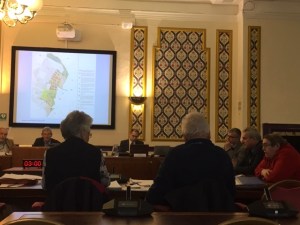
“At Tuesday’s Strategic Planning Meeting at Knowle (29 /01/2019), chaired by Paul Diviani, the masterplan for increasing Housing in Axminster by a whopping 30% , was voted through almost unanimously (there was one abstention), despite serious cross-Party criticism of the plan.

As the debate ended, the considerable number of Axminster residents in the public gallery were astonished to hear the Chair’s quip, to Cllr Jill Elson, “ I felt confident that you would come out with something that would stir things up”.

Cllr Elson (shown on right of the photo, beside Cllr Philip Skinner), had argued firmly that “the problem with plans is that they change” , citing her Ward as an example.

“Exmouth ended up with two huge estates with no play space or amenities whatsoever”, she said. Cllr Mike Howe (Con) shared her concerns, saying, (the masterplan) “doesn’t give us much credence or security that we will get the right houses”. But the Deputy Leader of the Council, Philip Skinner (Con ), expressed his view that “Give and take is needed in negotiations with a developer”.

Shortly afterwards, when Cllr Geoff Jung (East Devon Alliance, EDA) observed that the plan might not suit young families, it became apparent that Cllr Skinner was not aware that the proposal to include a primary school had been dropped.

Cllr Eleanor Rylance (Lib Dem) had noticed significant typing and other errors in the masterplan document. Cllr Rob Longhurst (Independent) observed there was no mention of the words ‘Neighbourhood Plan’ in the document.. although Cllr Moulding had told the meeting that he had designed one for Axminster… and suggested this Strategic Plan Committee would like to see “if the community wants and needs” the masterplan.

Cllr Susie Bond (Independent) asked for clarity about the legal implications for the Council if the costs for the relief road “went through the roof” (So far, EDDC has agreed to borrow £7m to ensure the road, estimated cost £16.7m, can be delivered.)

Ian Hall (Con) admitted “this masterplan doesn’t sit easily with the residents of Axminster”, which Alistair Ferguson’s speech in Public Question Time, confirms. The text is reproduced below, with Mr Ferguson’s permission):

In support of the objections, other District Councillors, Cathy Gardner and Marianne Rixson (both EDA), also attended the meeting, though not on the Strategic Planning Committee themselves.

Cllr Gardner pointed out that agreeing to a massive increase in the town’s housing numbers “would not be for the right reasons”, if it was done primarily to fund a relief road. The masterplan “was being done to the people of Axminster, not for them”, she said.

And Cllr Marianne Rixson added that “delivery of affordables does not have a good record” in East Devon.

Having listened to the comments aired, Cllr Geoff Pook (Ind) cautioned the committee not to be “persuaded by the opposition”. “There are just as many people in favour”, he opined.

Finally, the fear that the time-limited government funding for the relief road would be missed, therefore putting in jeopardy the 650 homes allocated in the Local Plan, swayed the committee members to approve the masterplan, albeit with caveats based on their misgivings.

Is this how the wrong sort of housing so often gets built in the wrong place?

In Axminster’s case, how much will the masterplan impact on the historic former deer park? As Cllr Mike Howe, Chair of the Development Management Committee (DMC) told yesterday’s meeting, there’s an urgent need to know….’

Local bus use plummets in Devon as routes cut

“”Local bus journeys in Devon are at a record low – with campaigners warning the national network is now in “crisis”.

The latest figures from the Department for Transport reveal that 24.2 million journeys were made on local bus services in Devon in 2017/18. That’s nearly two million fewer journeys than the year before, and the lowest number since at least 2009/10, when the figures were first published.

The Campaign for Better Transport say that the fall in the number of passengers taking the bus is due to ongoing cuts in funding for these services, resulting in fewer services and higher fares.

Nationally, average local bus fares across England have increased by 12 per cent since 2009, after inflation.

Darren Shirley, Chief Executive of Campaign for Better Transport, said: “The statistics back up what our research has been showing for years – that buses are in crisis.

“Local bus services are vital, linking millions of us to jobs, education, shops and services, friends and family. They open up opportunities and help to fight loneliness. …

… The Local Government Association says nearly half of all bus routes in England currently receive partial or complete subsidies from councils.

With councils in England facing an overall funding gap that will reach £8 billion by 2025, the LGA said councils will struggle to maintain current subsidies for bus routes across the country unless this is
addressed in the Spending Review.

Martin Tett, the Local Government Association’s transport spokesman, said: “Councils know how important buses are for their residents and local economies and are desperate to protect them.

“It’s nearly impossible for councils to keep subsidising free travel while having to find billions of pounds worth of savings and protect other vital services like caring for the elderly and disabled, protecting children, filling potholes and collecting bins.

“Faced with significant funding pressures, many across the country are being forced into taking difficult decisions to scale back services and review subsidised routes.” …

… Andy McDonald MP, Labour’s Shadow Transport Secretary, said: “These figures are alarming, and underline the devastating impact of Tory cuts on local bus services.

“Bus networks are in a spiral of decline, cutting people off from work and education and friends and family, particularly those in rural areas or from low income backgrounds.

“For many people, buses are the only form of public transport available. And the bulk of the people that use and rely on buses are often the poor, the young, the old and the vulnerable.

“At the same time, cutting and withdrawing services is worsening congestion, air pollution and our impact on climate change.”

“The government should give local authorities the powers to franchise and municipalise buses and boost bus funding, and allow them to take back regulatory powers so that they can set the fares, routes, and timetables that will put their communities first, ahead of the interests of private profit.”

https://www.devonlive.com/news/devon-news/crisis-local-bus-journeys-devon-2489912

“Bus Companies Earned Billions Amid Savage Cuts To Routes, Analysis Shows”

“Bus companies in England pocketed a total of £3.3bn in profits while they presided over swingeing cuts to vital routes, figures show.

Private firms together made hundreds of millions operating busses outside London each year since the coalition government came to power in 2010, official data has revealed.

Yet a report by the Transport Commissioner found almost 17,000 bus routes have disappeared over the past five years.

HuffPost UK reported last week how tightened council budgets have made bus services that were under-used, but previously considered essential, vulnerable to cuts.

Labour – which analysed the figures – said the stats highlighted how the bus industry “puts profit before millions of passengers”. …”

https://www.huffingtonpost.co.uk/entry/bus-companies-earned-billions-amid-savage-cuts-to-routes_uk_5c51b9f5e4b0d9f

MP tells it as it is …

Owl has a sneaky feeling it may know who she is talking about …

“Labour MP Jess Phillips takes aim at politicians considering imposing a £30,000 pay threshold for EU workers to be considered skilled, saying: ‘I have met many people who earn way more than £30,000 and have literally no discernible skills, not even one.’

The MP for Birmingham Yardley says the post-Brexit immigration proposal was ‘insulting’ to the care workers, nurses and teachers who live in her electorate. ‘I have definitely met some very rich people who earn huge amounts of money who I wouldn’t let hold my pint if I had to go and vote while in the bar,’ she says.”

See the speech here:

https://www.theguardian.com/global/video/2019/jan/31/jess-phillips-on-skilled-workers-ive-met-high-earners-with-literally-no-discernible-skills

Auditors: what are they FOR?

EDDC’s auditors say they aren’t there to detect fraud:

“The former auditor of the collapsed cake chain Patisserie Valerie has argued that it is not the role of accountants to uncover fraud.

Grant Thornton is under investigation for its audits of the chain that collapsed into administration earlier this month following the discovery of a £40m black hole in its accounts. Patisserie Valerie’s former finance director has been arrested on suspicion of fraud.

David Dunckley, chief executive of Grant Thornton, which was replaced by RSM as the chain’s auditor in mid-January, told MPs on the business, energy and industrial strategy committee that there was an “expectation gap” that “needs to be fixed”.

“We’re not looking for fraud, we’re not looking at the future, we’re not giving a statement that the accounts are correct,” he said, adding that his firm audits 7,000 companies. “We are saying [the accounts are] reasonable, we are looking in the past and we are not set up to look for fraud.”

In a heated exchange with Rachel Reeves, the Labour MP and committee chair, Dunckley reiterated: “If people are colluding and there is a sophisticated fraud that may not be caught by normal audit procedures.”

He said in an ideal world it would be spotted. Reeves replied: “But in a shop that sells tea and cakes, you’d sort of think that might be spotted. It’s not a multinational complex organisation. …”

https://www.theguardian.com/business/2019/jan/30/ex-patisserie-valerie-auditor-says-not-his-role-to-uncover

and it seems, even when they DO detect major fraud, they don’t seem to feel obliged to do anything about it:

“Deloitte has been fined 2.2m ringgitt (£415,000) by Malaysian regulators for failures in its audit of a firm linked to the scandal-ridden state fund, 1MDB.

The Securities Commission Malaysia said Deloitte was reprimanded because it failed to report the irregularities detected in the Sukuk Murabahah Programme, an Islamic bond issued by Bandar Malaysia Sdn Bhd (BMSB).

Deloitte was the statutory auditor for BMSB and its holding company 1Malaysia Development Berhad Real Estate (a subsidiary of state fund 1MDB) for the financial years ending March 2015 and 2016 when the bonds were issued.

The securities regulator said Deloitte’s failure to immediately report irregularities may have a material effect on the ability of BMSB to fulfil its obligations in repaying sukuk holders any amount under the programme.

Imposing a fine of 2.2m ringgit , the regulator said it “finds the breaches committed by Deloitte serious in nature as it has failed to discharge its statutory obligations”.

https://www.theguardian.com/business/2019/jan/30/deloitte-fined-by-malaysia-over-breach-linked-to-1mdb

Is this really how a manslaughter case should be reported?

Is it really necessary for a journalist to say that the CEO of Clinton Devon Estates “used a Land Rover to drive across country and through a river to reach the scene of the accident in which Kevin Dorman died”? Or that he has an OBE? Or to use the subjective headline that he was “choked with emotion”?

How is this relevant to the charge?

https://www.devonlive.com/director-choked-emotion-tells-manslaughter-2489109

Local authorities should be able to suspend councillors for up to six months says watchdog

Talk about reinventing the wheel! Before the system was changed local authorities were able to suspend councillors for the rest of the full council term, however long that might be or could ban them from office for years.

THIS government changed the rules now it wants to change them back – albeit
in a very, very lily-livered, watered-down way.

This lack if ability to censure councillors in any meaningful way is highlighted by the ongoing scandal of the disgraced ex-Mayor in Seaton, Councillor Peter Burrows. The rest of the council unanimously voted to urge his resignation from town and district posts but he has so far ignored all requests for him to go:

https://eastdevonwatch.org/2019/01/25/hat-gate-disgraced-seaton-ex-mayor-peter-burrows-scandal-update/

but it is unlikely the EDDC Monitoring Officer will conclude an investigation into his case before local elections on 2 May 2017, leaving voters in the dark as to any action to be taken.

“Local authorities should be given the power to suspend councillors without allowances for up to six months, the Committee on Standards in Public Life (CSPL) has recommended.

In a report, Local Government Ethical Standards, the CSPL said: “The current sanctions available to local authorities are insufficient. Party discipline, whilst it has an important role to play in maintaining high standards, lacks the necessary independence and transparency to play the central role in a standards system.

“The current lack of robust sanctions damages public confidence in the standards system and leaves local authorities with no means of enforcing lower level sanctions, nor of addressing serious or repeated misconduct.”

The Committee said councillors, including parish councillors, who are suspended should be given the right to appeal to the Local Government and Social Care Ombudsman, who should be given the power to investigate allegations of code breaches on appeal. The decision of the Ombudsman would then be binding.

The CSPL meanwhile described the Monitoring Officer as “the lynchpin” of the current standards arrangements, but accepted that the role was “challenging and broad”, with a number of practical tensions and the potential for conflicts of interest. Local authorities should put in place arrangements to manage any potential conflicts, it said.

However, the Committee concluded that the role was not unique in its tensions and could be made coherent and manageable with the support of other statutory officers.

It called for employment protections for statutory officers to be extended, and for statutory officers to be supported through training on local authority governance.

Other key findings and recommendations in the report include:

There is considerable variation in the length, quality and clarity of codes of conduct. This created confusion among members of the public, and among councillors who represent more than one tier of local government.

Many codes of conduct failed to address adequately important areas of behaviour such as social media use and bullying and harassment.

An updated model code of conduct should therefore be available to local authorities in order to enhance the consistency and quality of local authority codes.

The updated model code should be voluntary and able to be adapted by local authorities. The scope of the code of conduct should also be widened, with a rebuttable presumption that a councillor’s public behaviour, including comments made on publicly accessible social media, was in their official capacity.

The current arrangements for declaring and managing interests are “unclear, too narrow and do not meet the expectations of councillors or the public”.

The current requirements for registering interests should be updated to include categories of non-pecuniary interests. The current rules on declaring and managing interests should be repealed and replaced with an objective test, in line with the devolved standards bodies in Scotland, Wales and Northern Ireland.

The current criminal offences relating to disclosable pecuniary interests are “disproportionate in principle and ineffective in practice, and should be abolished”.

Local authorities should maintain a standards committee. This committee may advise on standards issues, decide on alleged breaches and sanctions, or a combination of these. Independent members of decision-making standards committees should be able to vote.

The safeguard provided by the Independent Person should be strengthened and clarified: a local authority should only be able to suspend a councillor where the Independent Person agrees both that there has been a breach and that suspension is a proportionate sanction. Independent Persons should have fixed terms and legal protections. The view of the Independent Person in relation to a decision on which they are consulted should be published in any formal decision notice.

Parish councils should be required to adopt the code of their principal authority (or the new model code), and a principal authority’s decision on sanctions for a parish councillor should be binding.

Monitoring officers should be provided with adequate training, corporate support and resources to undertake their role in providing support on standards issues to parish councils, including in undertaking investigations and recommending sanctions. Clerks should also hold an appropriate qualification to support them to uphold governance within their parish council.

At a time of rapid change in local government, decision-making in local councils was getting more complex, with increased commercial activity and partnership working. “This complexity risks putting governance under strain.

Local authorities setting up separate bodies risk a governance ‘illusion’, and should take steps to prevent and manage potential conflicts of interest, particularly if councillors sit on these bodies. They should also ensure that these bodies are transparent and accountable to the council and to the public.”

An ethical culture required leadership. Given the multi-faceted nature of local government, leadership was needed from a range of individuals and groups: an authority’s standards committee, the chief executive, political group leaders, and the chair of the council.

Political groups have an important role to play in maintaining an ethical culture. “They should be seen as a semi-formal institution sitting between direct advice from officers and formal processes by the council, rather than a parallel system to the local authority’s standards processes. Political groups should set clear expectations of behaviour by their members, and senior officers should maintain effective relationships with political groups, working with them informally to resolve standards issues where appropriate.”

An ethical culture starts with tone. “Whilst there will always be robust disagreement in a political arena, the tone of engagement should be civil and constructive.” Expected standards of behaviour should be embedded through effective induction and ongoing training.

Political groups should require their members to attend code of conduct training provided by a local authority, and this should also be written into national party model group rules. “Maintaining an ethical culture day-to-day relies on an impartial, objective monitoring officer who has the confidence of all councillors and who is professionally supported by the chief executive.”

An ethical culture will be an open culture. “Local authorities should welcome and foster opportunities for scrutiny, and see it as a way to improve decision making. They should not rely unduly on commercial confidentiality provisions, or circumvent open decision-making processes. Whilst local press can play an important role in scrutinising local government, openness must be facilitated by authorities’ own processes and practices.”

In a letter to the Prime Minister, contained in the introduction to the report, Lord Evans of Weardale, Chair of the Committee on Standards in Public Life, said: “It is clear that the vast majority of councillors and officers want to maintain the highest standards of conduct in their own authority. We have, however, identified some specific areas of concern. A minority of councillors engage in bullying or harassment, or other highly disruptive behaviour, and a small number of parish councils give rise to a disproportionate number of complaints about poor behaviour.

“We have also identified a number of risks in the sector: the current rules around conflicts of interest, gifts, and hospitality are inadequate; and the increased complexity of local government decision-making is putting governance under strain.”

The CSPL chair added: “The challenge is to maintain a system which serves the best instincts of councillors, whilst addressing unacceptable behaviour by a minority, and guarding against potential corporate standards risks.
“It is clear from the evidence we have received that the benefits of devolved arrangements should be retained, but that more robust safeguards are needed to strengthen a locally determined system. We are also clear that all local authorities need to develop and maintain an organisational culture which is supportive of high ethical standards. A system which is solely punitive is not desirable or effective; but in an environment with limited external regulation, councils need the appropriate mechanisms in place to address problems when they arise.”

Lord Evans said the Committee’s recommendations would enable councillors to be held to account effectively and would enhance the fairness and transparency of the standards process.

A number of the CSPL’s recommendations involve legislative change which it believed the government should implement. The Committee has also identified ‘best practice’ for local authorities, “which represents a benchmark for ethical practice which we expect that any authority can and should implement”. …

Source: Local Government Lawyer

Are the wheels falling off the East Devon growth wagon?

This is necessarily a somewhat technical summary of why Owl thinks EDDC has got its recent past and future jobs and housing numbers terribly wrong, and attempts to pinpoint why this is. If the assumptions below are correct East Devon cannot hope to match new jobs to housing number increases and hence to aspirational growth figures.

It has huge implications for the district – not least Cranbrook and Axminster, where huge housing growth does not appear to correlate with very modest job growth.

CURRENT STATISTICAL TREND 258 JOBS/YEAR
EDDC’s 2015 aspiration 950 jobs/year
EDDC’s “Jobs-led policy on scenario” 549 jobs/year
Ash Futures (Experian) “Upper end” 309 jobs/year
Ash Futures “more likely” scenario 200-234 jobs/year

Evidence from the first set of job growth statistics published by EDDC since the adoption of the local Plan are running at less than half the number used to justify the housing development target. This is only one quarter of EDDC’s aspiration to create one job per new household or 950/year.

A “Jobs-led Policy On” aggressive growth strategy lies at the heart of EDDC’s Local Plan for 2013 to 2031.

Consultants were employed to create a number of scenarios forecasting growth in jobs. They ranged from 162-191 jobs/year for forecasts based on past trends to a top estimate for above average “jobs led” growth of 309 jobs/year. This top estimate would justify a housing target of 13,050 for the period.

One of these consultants, Ash Futures, gave cogent arguments as to why this figure, in their opinion, lay at the upper end of likely growth and proposed a more modest, more realistic, set of growth assumptions generating 200-234 jobs/year. This more likely scenario was never converted from a jobs forecast to a housing assessment but it would have been just a bit higher than the 10,512 figure based on past trends. All these forecasts took account of demographic changes, migration into the region and economic growth.

Ignoring this, EDDC decided to add a further 240 jobs/year to the upper end 309 figure in a new “policy on” scenario to provide a total forecast of 549 jobs/year. (Something to do with Cranbrook but the details of this and whether there is any double counting remains a mystery). This 549 job/year figure was ultimately used to justify the final 17,100 minimum housing target for the 18 year period of the Plan adopted in 2016.

The plan requires a minimum average build of 950 houses/year. EDDC’s aspiration is to combine this with the creation of one job for every house built. But this demonstrates a complete failure to understand demographics and household formation. The need for houses and the need for jobs is not a simple equation of one with the other.

Papers attached to EDDC’s Strategic Planning Committee for 29 January 2019 (see footnote) contain data for East Devon employment covering 2009 to 2016. The explanatory text says: “It is recognised that it is an aspiration of Members [surely not every Councillor?] to deliver one job for each new home across the district but since the adopted Local Plan does not set out to deliver this it is not considered appropriate to formally monitor the relationship between the delivery of homes and the delivery of jobs.”

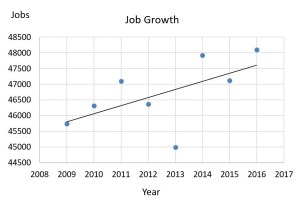
Here’s why – the real evidence, from the data, is of jobs growing at an annual rate of only 258 jobs/year.

This figure confirms the more modest forecasts presented by Ash Futures and, inconveniently for EDDC, is less than half of that used to justify the “Jobs-led Policy On” housing targets. It is only a quarter of the one job per house aspiration of “Members”.

Where does the 258 job/year trend come from? It is the gradient of the best fit linear regression trend line to the data given the Strategic Planning Committee and shown in the graph below. The full data source is referenced in the footnote.

This is a relatively small sample; and the extent of the fluctuations in the recorded number of jobs from year to year can be seen in the graph. For the technically minded the correlation coefficient of the trend line is 0.6, which is quite a strong one.

All the job number quoted above are for “full time equivalent” jobs (FTE).

Owl has been fortunate to find from the same official source as used by EDDC a set of estimates of the total number of jobs in East Devon which extends the time series to 2017. The significance of this is that the total number of jobs in East Devon fell between 2016 and 2017 and so we can expect the same to happen with FTEs. As a result Owl feels even more confident that the trend line shown above, despite the sample size, reflects what is actually happening.

The Local Plan has been in preparation since 2002 and EDDC has been following a growth policy for many years. So, although 2013 marks the formal start of the Local Plan, there is no statistical evidence to consider 2013 a “turning point” for job growth, though it does look to be an outlier.

With EDDC’s plan to build houses running ahead of creating the jobs needed for a sustainable community, just who are we building all these houses for?

Isn’t it time to cool the building programme, not ramp it up as Owl fears is being planned in the Greater Exeter Strategic Plan?

One of the key architects to all this is Councillor Paul Diviani. When asked at a recent council meeting why East Devon is taking all this development replied: “Because we have got the land, and we are good at it”.

Footnote: The combined minutes, agenda and reports of the Strategic Planning Committee with the job data for 2009 to 2016 on page 116 can be found here:

Click to access 290119strategicplanningcombinedagenda_opt.pdf