Are the wheels falling off the East Devon growth wagon?

This is necessarily a somewhat technical summary of why Owl thinks EDDC has got its recent past and future jobs and housing numbers terribly wrong, and attempts to pinpoint why this is. If the assumptions below are correct East Devon cannot hope to match new jobs to housing number increases and hence to aspirational growth figures.

It has huge implications for the district – not least Cranbrook and Axminster, where huge housing growth does not appear to correlate with very modest job growth.

CURRENT STATISTICAL TREND 258 JOBS/YEAR
EDDC’s 2015 aspiration 950 jobs/year
EDDC’s “Jobs-led policy on scenario” 549 jobs/year
Ash Futures (Experian) “Upper end” 309 jobs/year
Ash Futures “more likely” scenario 200-234 jobs/year

Evidence from the first set of job growth statistics published by EDDC since the adoption of the local Plan are running at less than half the number used to justify the housing development target. This is only one quarter of EDDC’s aspiration to create one job per new household or 950/year.

A “Jobs-led Policy On” aggressive growth strategy lies at the heart of EDDC’s Local Plan for 2013 to 2031.

Consultants were employed to create a number of scenarios forecasting growth in jobs. They ranged from 162-191 jobs/year for forecasts based on past trends to a top estimate for above average “jobs led” growth of 309 jobs/year. This top estimate would justify a housing target of 13,050 for the period.

One of these consultants, Ash Futures, gave cogent arguments as to why this figure, in their opinion, lay at the upper end of likely growth and proposed a more modest, more realistic, set of growth assumptions generating 200-234 jobs/year. This more likely scenario was never converted from a jobs forecast to a housing assessment but it would have been just a bit higher than the 10,512 figure based on past trends. All these forecasts took account of demographic changes, migration into the region and economic growth.

Ignoring this, EDDC decided to add a further 240 jobs/year to the upper end 309 figure in a new “policy on” scenario to provide a total forecast of 549 jobs/year. (Something to do with Cranbrook but the details of this and whether there is any double counting remains a mystery). This 549 job/year figure was ultimately used to justify the final 17,100 minimum housing target for the 18 year period of the Plan adopted in 2016.

The plan requires a minimum average build of 950 houses/year. EDDC’s aspiration is to combine this with the creation of one job for every house built. But this demonstrates a complete failure to understand demographics and household formation. The need for houses and the need for jobs is not a simple equation of one with the other.

Papers attached to EDDC’s Strategic Planning Committee for 29 January 2019 (see footnote) contain data for East Devon employment covering 2009 to 2016. The explanatory text says: “It is recognised that it is an aspiration of Members [surely not every Councillor?] to deliver one job for each new home across the district but since the adopted Local Plan does not set out to deliver this it is not considered appropriate to formally monitor the relationship between the delivery of homes and the delivery of jobs.”

Here’s why – the real evidence, from the data, is of jobs growing at an annual rate of only 258 jobs/year.

This figure confirms the more modest forecasts presented by Ash Futures and, inconveniently for EDDC, is less than half of that used to justify the “Jobs-led Policy On” housing targets. It is only a quarter of the one job per house aspiration of “Members”.

Where does the 258 job/year trend come from? It is the gradient of the best fit linear regression trend line to the data given the Strategic Planning Committee and shown in the graph below. The full data source is referenced in the footnote.
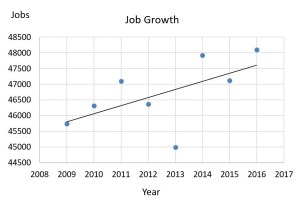
This is a relatively small sample; and the extent of the fluctuations in the recorded number of jobs from year to year can be seen in the graph. For the technically minded the correlation coefficient of the trend line is 0.6, which is quite a strong one.

All the job number quoted above are for “full time equivalent” jobs (FTE).

Owl has been fortunate to find from the same official source as used by EDDC a set of estimates of the total number of jobs in East Devon which extends the time series to 2017. The significance of this is that the total number of jobs in East Devon fell between 2016 and 2017 and so we can expect the same to happen with FTEs. As a result Owl feels even more confident that the trend line shown above, despite the sample size, reflects what is actually happening.

The Local Plan has been in preparation since 2002 and EDDC has been following a growth policy for many years. So, although 2013 marks the formal start of the Local Plan, there is no statistical evidence to consider 2013 a “turning point” for job growth, though it does look to be an outlier.

With EDDC’s plan to build houses running ahead of creating the jobs needed for a sustainable community, just who are we building all these houses for?

Isn’t it time to cool the building programme, not ramp it up as Owl fears is being planned in the Greater Exeter Strategic Plan?

One of the key architects to all this is Councillor Paul Diviani. When asked at a recent council meeting why East Devon is taking all this development replied: “Because we have got the land, and we are good at it”.

Footnote: The combined minutes, agenda and reports of the Strategic Planning Committee with the job data for 2009 to 2016 on page 116 can be found here:

Click to access 290119strategicplanningcombinedagenda_opt.pdf
“85 Million Fewer Bus Journeys Last Year Amid ‘Devastating’ Cuts”

“”Cutting and withdrawing services is worsening congestion, air pollution and our impact on climate change.”

“The number of passenger journeys made by bus in England fell by 85 million last year, amid “devastating” cuts on local services.

Passenger journeys declined by 3.2% outside London, continuing a decade-long trend, while bus use in the capital fell by 0.7%, according to the latest figures from the Department for Transport.

Out of 88 local authorities in England outside London, 70 saw a fall in bus use since 2009/10.

Labour said the new figures underlined the impact of Conservative policies, and underlined “the devastating impact of Tory cuts on local bus services”.

Andy McDonald, shadow transport secretary, said: “These figures underline the People are being denied opportunities in work and education and are cut off from friends and family, particularly those in rural areas or from low income backgrounds.”

These figures underline the devastating impact of Tory cuts on local bus servicesAndy McDonald, Shadow Transport Secretary
MacDonald added: “At the same time, cutting and withdrawing services is worsening congestion, air pollution and our impact on climate change.

“A Labour government will act in the interest of the many by putting investment back into bus services, protecting pensioners’ bus passes and introducing a new free pass for under 25s.” …”

https://www.huffingtonpost.co.uk/entry/85-million-fewer-bus-journeys-made-by-passengers-last-year-amid-devastating-cuts_uk_5c518a4ce4b0f43e410cceaa

“Housing developer backtracks on promised Yeovil road improvements despite signing contract to honour work”

Remember what Owl said only yesterday after the news that Persimmon and Crown Estates demanded 200 extra houses (from 650 to 850) in Axminster to be able to afford to build a new road?

“A housing developer is trying to get out of making improvements to Yeovil’s roads, claiming they are no longer required.

Barratt Homes has been constructing the Wyndham Park development on Lyde Road at the north-eastern edge of the town, for which outline planning permission was granted in 2008.

As part of a legal agreement with Somerset County Council and South Somerset District Council, the developer promised to make improvements to the junction of Lyde Road and Mudford Road, as well as the junction of Combe Street Lane, Mudford Road and Stone Lane.

However the developer, that recorded a pre-tax profit of £835.5 million in 2018, has now applied for these conditions to be removed, claiming these junctions are “under capacity” and therefore the improvements will no longer be necessary.

Planning manager Andrew Cattermole wrote to the district council on December 12, laying out the company’s reasons for not undertaking the work.

He said: “The implementation of these elements has not been completed to date and it is considered, having discussed this with Somerset County Council, that neither of these works are required.

“The existing junctions are under capacity, meet the required safety performance and no junction improvements are required.”

The Lyde Road/ Mudford Road improvements were due to be undertaken before the 400th home on the Wyndham Park site had been occupied.

The Combe Street Lane project, meanwhile, was required to be completed before the 500th dwelling was finished and occupied.

A traffic assessment carried out for Barratt Homes concluded that “the additional demand created during the completion of development can be accommodated on the existing high way network”.

A spokesman for Somerset County Council said: “We have discussed this matter informally with Barratt Homes and advised that we would not object to modifying the S106 conditions and removing the junctions if they provided sufficient evidence that they were no longer required.

“Now the application has been submitted, we will review the evidence and provide a formal response.

“This will then be considered by South Somerset District Council as the local planning authority, which will make a final decision.”

A spokesman for the district council added: “This application was received on December 13 and we are awaiting the key views of Somerset County Council as the highways authority on this matter.

“It would be inappropriate to make further comment until these views have been received and our officers have completed their reports.”

The district council is expected to make a decision on this matter by February 7.”

https://www.somersetlive.co.uk/news/somerset-news/housing-developer-backtracks-promised-yeovil-2483395

“Amid Brexit vote chaos, the government quietly finalises council cuts”

“In what’s becoming a bleak pattern, the government chose today – Theresa May’s second attempt to pass her Brexit deal – to finalise its next round of cuts to councils.

Ministers outlined the provisional local government finance settlement for 2019-20 last December. But they chose today to announce its final plans for short-term local government funding – in a written statement, the subtlest form of government announcement, by the Communities and Local Government Secretary James Brokenshire.

After eight years of austerity, cash-strapped councils have been waiting for the government to use its final settlement this month to provide the resources they desperately need for funding public services in 2019-20. But the new settlement – sneaked out while Westminster is distracted by Brexit – doesn’t deliver what councils need.

As first announced in the Budget, the government is releasing extra chunks of funding for social care and potholes, as well as more money for high streets. The government calculates that its settlement adds up to a rise in core spending power for councils from £45.1bn in 2018-19 to £46.4bn in 2019-20: a 2.8 per cent cash increase. (It has also reiterated the £56.5m across 2018-19 and 2019-20 to help councils prepare for Brexit, which we can’t really count as extra funding as it’s to fill a Brexit-shaped hole.)

Firstly, this money isn’t enough – councils still face a funding gap of more than £3bn this year, according to the Local Government Association. The pressure to set legal budgets, with an average 49 per cent drop in real terms spending power since 2010 and rising social care demands, means councils need substantially more than a 2.8 per cent raise. Labour’s shadow local government secretary Andrew Gwynne has called the plan a “shoddy deal”, and warns it “means more cuts to our councils”.

Secondly, the funding announced is simply a short-term one-off. There’s no new system for funding social care – with the long promised green paper on adult social care repeatedly pushed back. Decisions on other structural concerns – business rates retention and a fair funding formula for local government – have been put off, with consultations being published instead.

Councils are desperate for a long-term, sustainable funding settlement. As the head of the National Audit Office, Amyas Morse, said last March: “Current funding for local authorities is characterised by one-off and short-term fixes, many of which come with centrally driven conditions.”

“It does not solve medium term financial pressures so tough decisions will still need to be taken and our members will have little choice but to raise council tax to meet demand-led pressures in services,” warned Paul Carter, chair of the County Councils Network.

Plans for 2020 and beyond are yet to be determined, according to the Institute for Fiscal Studies, which concludes that “current plans imply further cuts for unprotected services after 2019-20”.

This means councils will continue to operate in a financial void, unable to fund public services properly, while waiting for something to change in the promised Spending Review later this year.”

https://www.newstatesman.com/politics/economy/2019/01/amid-brexit-vote-chaos-government-quietly-finalises-council-cuts

EDDC agrees Axminster masterplan with 200 extra houses (now 850)

Persimmon and Crown Estates say they won’t be able to afford to build a relief road unless they build 850 houses rather than the original 650.

So EDDC majority rolled over to have their tummies tickled … and agreed.

Do try to remember this if the developers say they got their sums wrong and will need to build hundreds more …. or no road at all.

https://www.bbc.co.uk/news/live/uk-england-devon-46947635

Local authority funding to cover Brexit

All unitary councils will receive £210,000 and combined authorities will receive £182,000. County councils will receive £175,000 each and all district councils will receive £35,000.

That won’t be enough …..

Environment watchdog ‘Natural England’ in crisis

“Thousands of environmentally important sites across England are coming under threat as the government body charged with their care struggles with understaffing, slashed budgets and an increasing workload.

Natural England has wide-ranging responsibilities protecting and monitoring sensitive sites, including sites of special scientific interest (SSSIs) and nature reserves, and advising on the environmental impact of new homes and other developments in the planning stages. Its work includes overseeing national parks, paying farmers to protect biodiversity, and areas of huge public concern such as air quality and marine plastic waste.

But these activities are being impaired by severe budget cuts and understaffing, Natural England employees and other interested parties have told the Guardian. “These are fantastically passionate staff who are worried that the environment is being affected so badly by these cuts,” one frontline staff member said. “There will be no turning back the clock” if we allow sensitive sites to be degraded.

The agency’s budget has been cut by more than half in the past decade, from £242m in 2009-10 to £100m for 2017-18. Staff numbers have been slashed from 2,500 to an estimated 1,500.

Conservation work on sites of special scientific interest is being cut, while farmers are finding it harder to access expert help on countryside stewardship. Work on areas such as air pollution and marine plastics has been cut and many nature reserves are being neglected as vital volunteers cannot be safely trained.

One 11-year veteran of the agency reported low morale and increasing difficulty in managing workloads, with sites left unmonitored for years. They said: “Our work brings economic benefits, environmental benefits, it helps communities. We have suffered disproportionately from the cuts to the Department for Environment, Food and Rural Affairs budget. It is such a shame as we have done some amazing and incredible work.”

The Prospect union has investigated the agency and concluded it is “at crisis point”, with staff overstretched and under stress after eight years of a 1% pay cap. The union will launch a report on Tuesday with a call on ministers to increase funding and remove the agency from the pay cap.

“Cuts have left Natural England at the point where its workers are saying they don’t have enough people or resources to do the things they need to do,” said Garry Graham, the deputy general secretary of Prospect. “If we are to be able to regulate our own environment properly after Brexit, it is vital that we cultivate and maintain the skills to do so domestically. We will no longer be able to rely on the EU to do bits of it for us. Once biodiversity is lost, it cannot easily be regained. Now is the time for the government to act.”

One senior manager told Prospect: “[Work on protected sites] is what many of us joined to work on and has been the central focus of much of our conservation work. There are currently no government targets for this work [so] cuts have fallen on work that is not protected, the largest area being SSSI work. That’s the stark reality.”

There have been widespread complaints from farmers over the agency’s failure to make timely payments for the countryside stewardship scheme, under which farmers undertake measures such as improving habitats for wildlife, wildflowers and pollinators. Payments have not been made on time, or fallen short, and many farmers complained of being unable to access the expert advice they need. This has discouraged farmers from applying to the scheme or continuing with it.

Guy Smith, the deputy president of the National Farmers’ Union, said: “We have thousands of members expecting payment from agri-environment schemes completely in the dark over when these already late payments will be made. It is imperative that Defra and its agencies give this priority.”

The Woodland Trust has called on Natural England to update a vital registry of trees, currently looked after by only one staff member. The registry helps campaigners to protect woodland resources that may be threatened by development and can help save money for developers at the planning stages. Updating it would cost about £1.5m over five years.

Abi Bunker, the trust’s director of conservation, said: “We recognise the pressures Natural England are under. It is frustrating when adequate progress cannot be made on updating the ancient woodland inventory, resulting in our rarest habitat being put at unnecessary risk.”

Caroline Lucas, the Green party MP who has asked a series of parliamentary questions on Natural England’s plight, said: “Behind the veil of Michael Gove’s fluffy rhetoric about caring for the environment, ministers have systematically gutted the agency that looks after irreplaceable habitats and beautiful landscapes. The result is plummeting morale as staff simply don’t have the resources to monitor thousands of protected sites across England, ultimately putting spaces for wildlife at risk of irreversible destruction.”

Tim Farron, the Liberal Democrats’ environment spokesman, said: “Farmers need certainty, the environment needs protection and Natural England needs a proper budget to do it. Instead Defra is failing in its duties.”

Defra’s budget has been one of those worst hit by austerity cuts. There has been a recent increase in staffing and funding but only to deal with the expected impact of Brexit on farmers and food supplies so those extra resources are unlikely to have a positive impact on Natural England’s work.

Marian Spain, the interim chief executive of Natural England, said: “Inevitably, cuts of almost 50% to the Natural England budget over the last five years have meant changes to the way we do things. Since taking on my role in December, meeting staff and hearing about the pressures they face has been one of my top priorities.”

A Defra spokesperson said: “The work of Natural England and its staff to protect our invaluable natural spaces, wildlife and environment is vital and its independence as an adviser is essential to this. As set out in the 25-year environment plan, Natural England will continue to have a central role in protecting and enhancing our environment for future generations,”

https://www.theguardian.com/environment/2019/jan/29/agency-protecting-english-environment-reaches-crisis-point

“An open letter on Permitted Development Rights”

This open letter on permitted development rights was sent to the Secretary of State for the Ministry of Housing, Communities and Local Government on 21 January 2019 and published on 28 January 2019.

“Dear Secretary of State,

Re: An open letter on Permitted Development Rights

Latest Shelter research shows that in England today, there are more than 270,000 people without a home. At the heart of the reasons for this is the simple fact that for a generation we have failed to build the homes the country needs.

In addressing this, however, it is important to think not only about the number but also the type of homes we build and where they need to be built. In particular, there is a pressing need to ensure that the homes we build are genuinely affordable. Last year we delivered just 6,463 social rent homes despite having more than 1.2 million households on council house waiting lists. These statistics begin to underline the scale of the crisis we face and the level of ambition we need to resolve it.

As well as increasing the focus on affordability, new housing development should also provide homes that are high quality, well designed, and served by the necessary community infrastructure.

These ambitions are currently in jeopardy, because of national policies that enable developers to avoid making such vital contributions. One of the most significant of these is permitted development rights allowing offices to convert to residential homes without the need for planning permission.

Since 2013, developers have had a national right to convert office space into residential homes, a right they have wholly embraced with nearly seven per cent of new homes provided in this way in the last three years. Unfortunately, because they are exempt from the full local planning process, they come forward with minimal scrutiny and outside of local authority control.

These homes are also delivered without making any contribution towards affordable housing, which other forms of developments are required to do. This means that we are losing out on thousands of affordable homes which would be delivered if these homes went through the planning system.

Separate research by both the LGA and Shelter has shown the scale of this loss. Both organisations have calculated that more than 10,000 affordable homes have potentially been lost in the last three years.

The result of this is that thousands of families remain in temporary accommodation and on council house waiting lists for years, despite levels of housebuilding rising – underlining that we need to think more about what we build as well as how many homes we build.

Permitted development rights have caused extensive problems. Therefore, we consider that the current proposals to allow for demolition of existing buildings and replacement with new residential ones, and for upwards extensions to existing buildings for new homes through a permitted development right, should not be pursued.

We call on the government to instead focus on delivering the affordable, high quality homes that people want and need through the local planning process. This would support the government’s own ambitions to improve the quality of homes and places, as outlined in the terms of reference of the ‘Building Better, Building Beautiful’ commission launched in November.

We also consider that there should be an independent review of the wide-ranging impacts of permitted development rights allowing change of use into residential homes.”

Yours sincerely
18 individuals or organisations – see below for link:

https://www.local.gov.uk/open-letter-permitted-development-rights

Budleigh Salterton and Tesco … accelerating high street decline

Tesco has announced it is cutting out butchers, fishmongers, bakeries and delis from its stores.

Spare a thought then for the poor traders of Budleigh Salterton High Street.
The Budleigh Salterton Journal of 23rd January reports that a variation of an approved planning application has been submitted to EDDC by Tesco because “a review has concluded that a smaller store could work better in this site than that of the approved plan”

Many inhabitants of the town are fearful, as before in 2014, that its wonderful delicatessens, butcher, greengrocer, florist, stationers and its 2 invaluable general stores would be put at risk of surviving with the opening of a Tesco. Locals had all dared to hope that the 5 years that this project had been gestating meant that it was no longer viable.

This move just doesn’t make sense when as Owl of 28th January highlights:

“TESCO is set to axe 15,000 jobs as part of £1.5bn cost-saving measure that will see fish, meat and deli counters across the country close down. Bakeries will also be overhauled, with the supermarket giant now ordering staff to use pre-frozen dough instead of making it on site. ..”

Many in Budleigh Salterton will not be happy to contribute to (last year’s) CEO Dave Lewis’ £4.87million pay packet and the chief executive’s short-term bonus of £2.28million on top of his base salary of £1.25million.

AND on top of that see the decimation of Budleigh Salterton’s High Street.

Greendale owner 30th most influential Devonian

Our old friend Karime Hassan (CEO Exeter City Council) is in 19th place, Steve Hindley (Chair,Local Enterprise Partnership) is 18th, Alison Hernandez (Police and Crime Commissioner) in 12th place, John Varley (CEO, Clinton Devon Estates) in 9th place, with Devon County Council’s CEO Phil Norey in 2nd place and DCC Leader John Hart in first place.

“30. Rowan Carter, Director Greendale Group

The company behind the Greendale Farm Shop and Waterdance fishing fleet, incorporates a diverse range of businesses. From its beginning as a farming enterprise set up by the Carter family more than 150 years ago, the group includes the farm shop, Waterdance Fishing, Greendale Living, Greendale Business Park, Greendale Haulage, Exmouth Marina and Greendale Leisure. Last year, the Carter family unveiled major expansion plans for the Greendale Farm Shop to create 30 jobs and provide ‘significant benefits’ to East Devon.

The family has also made a £5million commission of two new fishing boats, including the largest beam trawler to be launched under the British flag in over 20 years. The company also wants to build more agricultural buildings and intends to acquire more farmland in order to expand its farming business.”

https://www.devonlive.com/news/business/50-most-powerful-people-devon-2450702

Will Swire have anything to auction at this year’s Tory fundraising ball?

The annual Tory Black and White Ball is in trouble:

“Tory insiders have revealed that the annual Black and White fundraiser (it used to be called a ‘ball’, it’s now a mere ‘party’) is struggling to attract interest from donors and activists.

Less than a fortnight to go, mimimum-priced £500 tickets are not shifting, PoliticsHome reports.

https://www.politicshome.com/news/uk/political-parties/conservative-party/news/101400/excl-£15000-table-tory-fundraiser-turmoil

”Most donors now see the Prime Minister as toxic so prefer the private events, not the event that ends up on the front page of Mail Online,” one donor says.

Intriguingly, leadership contenders are now inviting donors for private dinners instead. An activist adds: “The obscene ticket prices go directly into CCHQ’s coffers and then local associations have to beg for that money back during elections.”

Source: The Waugh Zone, Huffington Post

So, will its usual auctioneer of very expensive goodies, Hugo Swire, have anything to flog?

https://eastdevonwatch.org/2015/02/11/hugo-swire-is-auctioneer-at-15000-per-head-tory-ball/

https://eastdevonwatch.org/2018/02/08/tories-auction-off-access-to-pm-and-ministers-at-their-annual-ball/

And why, oh why wasn’t he employed to flog off the contents of The Knowle!

Information Commissioner wants Freedom of Information Act extended to outsourced companies

“The Information Commissioner has called for the Freedom of Information Act 2000 (FOIA) and the Environmental Information Regulations 2004 (EIR) to be updated to include organisations providing a public function.

In a report to Parliament, ‘Outsourcing Oversight? The case for reforming access to information law’, Elizabeth Denham said: “In the modern age, public services are delivered in many ways by many organisations. Yet not all of these organisations are subject to access to information laws.

“Maintaining accountable and transparent services is a challenge because the current regime does not always extend beyond public authorities and, when it does, it is complicated. The laws are no longer fit for purpose.”

She added: “Urgent action is required because progress has been too slow. It is now time to act. This report sets out solutions that can extend the law to make it fit for the modern age.”

Denham said the main aim her report was to make an evidence-based case to extend the reach of FOIA and the EIR “to enable greater transparency and accountability in modern public services, which in turn improves services”.
The Commissioner said in the report that she would welcome a Parliamentary Inquiry via a select committee into the issues raised. The ICO has submitted the report to the Public Accounts Committee (PAC) and PACAC for their consideration. …”

http://www.localgovernmentlawyer.co.uk/index.php

More on Swire’s business pal Lord Barker

“… The lifting of sanctions [by Donald Trump yesterday, on Russian oligarch Oleg Deripaska – see post below] comes after a lobbying campaign led by Lord Gregory Barker, a former UK energy minister and now chairman of En+.

Lord Barker reportedly used lobbyists with ties to the Trump administration, law firms and public relations experts to make the argument Mr Deripaska was committed to giving up control of his companies.

Mr Deripaska is one of Russia’s wealthiest men. He amassed his fortune under Mr Putin and has bought assets abroad in ways widely perceived to benefit the Kremlin’s interests.

US diplomatic cables from 2006 described him as “among the two or three oligarchs Putin turns to on a regular basis” and “a more-or-less permanent fixture on Putin’s trips abroad”.

The 50-year-old achieved a deal of fame in the UK in 2008 when the then-business secretary, Lord Mandelson, and shadow chancellor George Osborne found themselves aboard his yacht off the coast of Corfu last summer.”

https://www.independent.co.uk/news/world/americas/us-politics/trump-russia-sanctions-putin-oleg-deripaska-treasury-department-rusal-en-a8749781.html

Swire, eagle and sham … an unfortunate choice of company name …

Swire has a dormant company (Eaglesham Investments) owned 50/50 with his friend Lord Barker, a former energy minister. It was originally described as being a vehicle for “emerging markets” but is now described as being for “renewable energy”.

Given recent developments involving Lord Barker, he and Swire pmight want to consider a change of name for the company – having an association with the eagle (symbol of the Russian Federation) and “sham” (dictionary: “something that is not what it purports to be; a spurious imitation; fraud or hoax” (online distionary.com) might not be such good PR!

Lord Barker is Chair of a UK-based Russian company set up by Russian oligarch Oleg Deripaska.

Owl reported the links between Deripaska and Barker recently:

“… Among the UK-based companies that have aroused the interest of congressional investigators is EN+, the energy company owned by Oleg Deripaska and chaired by Tory peer Lord Barker of Battle.

Mr Deripaska, a close ally of Mr Putin, is already under investigation from congressional committees over allegations, which the oligarch denies, that he was involved in efforts to interfere with the 2016 presidential elections.

Recent documents released by the FBI revealed Mr Deripaska loaned $10 million to Paul Manafort, Donald Trump’s campaign manager, who has been charged with fraud and money-laundering. Mr Deripaska is one of several Russian oligarchs who were hit with U.S. sanctions in April.

Now US investigators say they are interested in apparent links between British-based companies owned by Russian oligarchs and Russian intelligence agencies.

Their interest in EN+ comes after FBI officers identified Evgeny Fokin, who is the company’s Director of International Cooperation, as formerly being the SVR’s declared liaison officer with U.S. intelligence agencies in Washington DC in the mid-1990s.

Apart from being employed by EN+, Mr Fokin, who is said to be a close ally of Mr Deripaska, has previously been employed by Basic Element, another company owned by Mr Deripaska.

“There is particular concern in Congress about the links between Russian businesses owned by oligarchs and the Russian intelligence agencies,” a U.S. official told the Daily Telegraph.

“There is concern about the large numbers of former Russian intelligence officers who now hold senior positions in major Russian businesses.

“There are growing suspicions in Congress that the distinction between the Russian state and businesses owned by Putin’s supporters may be on paper only.”

Lord Barker, a former energy minister under David Cameron, provoked criticism from MPs earlier this year after he helped EN+ raise £1 billion on the London Stock Exchange, money that was then used to pay off Russian banks subject to U.S. sanctions.”

Swire’s business pal in more difficulty in United States

Mr Deripaska hit the headlines again this weekend when Donald Trump made good on his promise to make Mr Deripaska’s business life in the USA much easier as reported here:

“President Donald Trump officially lifted sanctions against Russian oligarch Oleg Deripaska on Sunday afternoon. At least one reporter is wondering if it’s because Trump is hoping the news will slip through the cracks of the news cycle.

As Sen. Kamala Harris (D-CA) was taking the stage in Oakland, California to formally announce her presidential campaign, the news was released Trump made Deripaska’s life easier.

“Ukraine-/Russia-related Designations Removals,” reads the headline on the Treasury Department’s sanctions site.

“The timing of this (Sunday evening) is not a coincidence,” said behavioral scientist and ArcDigi associate editor Caroline Orr. “This is a huge gift to Putin and his cronies, and the Trump administration is hoping this will slip through the cracks. Don’t let that happen.”…

https://www.rawstory.com/2019/01/trump-quietly-lifts-sanctions-russian-oligarch-sunday-think-no-one-notice/

Will Tesco cuts revitalise high streets? Almost certainly not

“TESCO is set to axe 15,000 jobs as part of £1.5bn cost-saving measure that will see fish, meat and deli counters across the country close down.

Bakeries will also be overhauled, with the supermarket giant now ordering staff to use pre-frozen dough instead of making it on site. …”

https://www.thesun.co.uk/news/uknews/8288025/tesco-axe-15000-jobs-meat-fish-deli-counters/

After putting so many butchers, fishmongers, bakeries and delis out of business, will this revitalise high streets?

Owl thinks not. The killer combination of high business rates, increased town centre parking charges and poorer public transport makes it uneconomic for small businesses to return to high streets.

Big business wins over public services with corporation tax black hole

“The government’s planned cuts to corporation tax look set to cost the public purse billions more in lost revenue than previously thought, according to new analysis.

The tax rate on company profits is slated to be cut from its current level of 19% to just 17% by the end of the decade. But even before the planned cuts, the UK already had one of the lowest corporation tax rates in the developed world.

An analysis based on HMRC data suggests that the loss of revenue from the planned cuts, initiated by former chancellor George Osborne but supported by incumbent Philip Hammond, could add up to more than £6bn.

HMRC recently raised its estimate for the amount a 1 percentage point increase in corporation tax could bring in for the Treasury from £2.8bn to £3.1bn per year – meaning the plan to cut taxes by 2p in the £1 could cost about £6.2bn.

Hammond confirmed in the autumn that he would go ahead with Osborne’s promises, despite the need to find £20bn a year more for the NHS by 2023-24.

There has been mounting opposition to the planned tax cuts, particularly as Britain’s public finances could come under huge strain from a disorderly Brexit.

Rupert Harrison, a former adviser to Osborne who now works at City investment firm BlackRock, said last week on Twitter that it was “hard to see why further cuts to corporation tax are good value,” while Labour seized on his comments.

Peter Dowd, the shadow chief secretary to the Treasury, said: “Even Osborne’s former adviser knows that further cuts to corporation tax are a bad use of public funds. Philip Hammond should cancel his plans for more corporate giveaways and invest in our public services.” …”

https://www.theguardian.com/politics/2019/jan/28/uk-corporation-tax-cut-to-cost-billions-more-than-thought

Government finally admits there is a teacher crisis

“Cash incentives and a better work-life balance are part of a new attempt to solve England’s teacher shortage.

Plans published on Monday by ministers will offer some young secondary teachers £5,000 in their third and fifth years in the classroom – on top of initial £20,000 training bursaries.

Young teachers could also have some protected time for extra training.
Head teachers’ unions said more help for young recruits was essential to tackle the crisis in teacher numbers.

Currently, teachers in subjects with shortages, such as physics, chemistry, and languages, can receive a bursary of up to £26,000, but there are no further payments.

The so-called “early career payment” scheme, which rewards teachers for staying in the classroom, has already been trialled for maths teachers.
Labour has criticised the plan, saying the plan will not reverse “six consecutive years” of missed teacher recruitment targets.

What’s the problem?

By 2025 the number of secondary school pupils in England will have gone up by 15%.

For several years England has had an unfolding teacher crisis, with too few starting to train and too many leaving.

In 2018/19 the number starting training as secondary school teachers was 17% below target.

Subjects such as physics, chemistry and computing face the largest shortfalls.

This has led to a growing proportion of lessons in some secondary schools being taught by teachers who are not specialists.

And there has been growing concern that young teachers are leaving because they feel overworked, burnt out and disillusioned.

Of those that started in 2012, a third were not teaching five years later. …”

https://www.bbc.co.uk/news/education-47023665

Councils relied too much on informal cabinet briefings: contract legality now being probed

“A CATALOGUE of errors detailing how two district councils were run have been exposed in a ‘gobsmacking’ report.

Initial findings from an investigation into contracts signed by Vale of White Horse and South Oxfordshire district councils between 2010 to 2016 show councillors’ knowledge was stymied by a ‘lack of information’.

The two councils are conducting reviews into several contracts after fears were raised last year that contracts could have been handed out improperly.

All of them have a value of or more than £10,000. Between the two councils, there are 162 of those in total.

A report also highlights there was an ‘over reliance’ on briefing cabinet members informally, rather than decisions being made at public cabinet or council meetings.

‘A lack of detail’ was also found to be a problem in papers for those cabinet briefings and at cabinet meetings.

The review also found there was ‘poor procedural compliance by officers and members, most notably in documenting decision making’.

Debby Hallett, Lib Dem councillor on Vale council and former group leader, said the ‘gobsmacking’ papers seemed to indicate a ‘culture of sloppiness and shortcuts’ over key contracts.

But she added: “The thing that surprised me is [the councils] have promised to have this done by March, which is putting this in the public domain before the local elections [in May].”

That, she said, showed the councils’ willingness to conduct the reviews in a spirit of ‘transparency and integrity’.

Adrianna Partridge, the councils’ head of corporate service, notes in the report: “This review has identified a significant risk that the councils have incurred expenditure that has not been adequately approved in accordance with the councils’ constitutions, which could have both financial and reputational risk.”

In the report which will go to the councils’ joint audit and governance committee on Monday, she states: “Action has already been taken to address and strengthen the decision making process on individual projects, and it is acknowledge that a greater transparency is needed, including an increase in the number of formal papers taken to cabinet and full council which the senior management team is enforcing.”

The councils have set aside a budget of £30,000 for legal advice if they need to take any action over contracts in the future.

Confidential papers will be discussed next week.

They are understood to refer to specific details of the councils’ eight to 10 contracts which are being reviewed.

https://www.oxfordmail.co.uk/news/17377868.gobsmacking-errors-in-how-oxfordshire-councils-awarded-contracts/

Do you want to put a rocket under slow East Devon developers?

If so, EDDC is searching for a “Development Delivery Project Manager”
Salary: £31,401 – £39,961

The brief explains:

“This challenging and exciting role involves managing a series of projects where the Council will be working with land owners, developers and other stakeholders to enable large scale development proposals to come forward where they are currently unable to do so.

The Council has an excellent track record of delivering housing in the district but has a number of key sites where for various reasons the sites are not coming forward as planned. You would project manage the Council’s intervention in these sites working with colleagues across the Council co-ordinating resources to address the various issues and unlock the sites.

You will provide valuable expertise in carrying out development briefs, masterplans and development appraisals as well as providing support on development viability issues and work with our partners on each site to ensure their timely delivery.”

https://jobs.eastdevon.gov.uk/

Flybe – trouble at the top

“A battle over the cut-price sale of Flybe will gather pace next week after the airline’s biggest shareholder demanded the sacking of its chairman.

Sky News has learnt that Hosking Partners wrote to Flybe on Friday to requisition an extraordinary general meeting (EGM) aimed at ousting Simon Laffin, the City grandee who has chaired Flybe for five years.

The fund management firm run by Jeremy Hosking, a prominent investor, wants to install Eric Kohn, an experienced aviation executive, in Mr Laffin’s place.

A statement confirming the EGM request is expected to be made by Flybe to the London Stock Exchange as soon as Monday morning….”

https://www.theguardian.com/business/2019/jan/26/small-supermarket-wales-owned-surrey-casino-property