Guess which council is very picky where it (sort of) recruits new councillors?

Teignbridge District Council is actively promoting new councillor candidates via numerous events throughout the district.

When challenged, EDDC it seems is not – choosing instead to send CEO (and supposedly neutral civil servant) Mark Williams to selected events, only upon invitation. Like trueblue Budleigh Salterton.

It’s almost like they don’t want any new candidates signing up – thus allow the incumbents to romp back home without a contest thus maintaining (their trueblue) status quo…

Odd that …..

And maybe time to check that electoral roll again.

We don’t want to find ourselves with 6,000+ too few voters again do we, Mr Williams.

As Private Eye might say: Shom mistake shurely …

UK-US trade deal: the gift that keeps on taking

“Preparations for a no-deal Brexit are intensifying in London, Dublin and Brussels.

We report today on 30 of 130 demands from American lobbyists from any future UK-US trade deal.

We all know about chlorinated chicken, but corporates have also asked to US Department of Trade for changes in NHS drug rules, weaker data protection, carcinogens in pistachio nuts, lowering food safety standards and fresh ways to sue the British government.

It’s quite a wish-list.”

Source: The Waugh Zone, 8 February, Huffington Post

Greater Exeter Strategic Plan – Exeter leaks its “vision”*

“But not yet in East Devon until July 2019 (see below). It seems East Devon is the only council keeping ALL its plans secret until after the 2 May 2019 district council elections.

Fishy? You bet!

Anyway, here’s what we currently know:
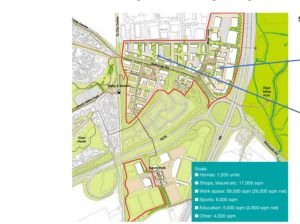
Interesting proposals for changes to Sidmouth Road and Junction 30 of the M5. The Motorway Services and Sowton Park and Ride being developed as a “Mixed Neighbourhood” (see image above).

The Governments require the Greater Exeter Housing target to be 53,200 new homes over the next 20 years. That is for the combined area governed by East Devon, Teignbridge, Mid Devon and Exeter.

Exeter’s housing ambitions

Karime Hassan, chief executive and growth director of Exeter City Council revealed this week a proposal for 12,000 new homes in the City of Exeter over the next 20 years. His vision of “Liveable Exeter”, for delivering a transformational housing programme for Exeter from 2020 to 2040. involves the creation of 8 new neighbourhoods.

Exeter’s published Vision

Red Cow Village (St David’s) – 664 homes in new neighbourhood, including new work space, on both sides of the railway around St David’s Station.

Water Lane (close to Exe Valley Park) – 1,567 homes. A space for expanding leisure attractions near the quay, with low traffic or car-free development with attractive cycle and walking connections.

Marsh Barton – 5,544 homes in a new neighbourhood. It will remain an important employment and retail area, but with the integration of living and working, to make better use of riverside location. Development linked to the new proposed train station. Creation of new types of work space, including light industrial, workshops, office and shared work space.

East Gate (Heavitree Road) – 962 new homes, an enhanced approach to the city centre from the east, reduced traffic on Heavitree Road and a greater provision for public transport, walking and cycling. New places to live close to the city centre will exist alongside existing neighbourhoods.

West Gate (Western Way) – 617 new homes, opening up access to the river and canal from the city centre, a new cultural destination, an expanded and connected park at the heart of the city, a “Green Bridge” promoting active travel across the river.

South Gate (Holloway Street/South Street linked via Topsham Road) – 300 new homes, establishing an improved link between the city centre and the historic quayside, with a greater emphasis on the wall, city gates and Southernhay.

North Gate (North Street) – 308 new homes, a new approach to the city from St David’s, uncovering the medieval city wall.
Sandy Gate (land off Sandygate roundabout) – 1,050 new homes in a new sustainable and well-connected mixed-use neighbourhood, bridging the city and the new and existing neighbourhoods to the east, providing recreational, cultural and entertainment space where Exeter meets the proposed Clyst Valley Park.

Mid Devon’s published ambitions.

Mid Devon’s Local Plan is almost complete with a Planning Inspectors hearing due in the next few weeks to consult on their final draft.

Culm Valley on the South side of the M5 opposite Cullumpton create a new community of up to 5,000, with a new Motorway junction and railway Station.

Junction 27. A landmark project for a leisure and tourism development involving Tim Smit from the Edan Project
Tiverton Eastern Urban Extension will cover 153ha, to the east of Tiverton.

Teignbridge future ambitions.

Teignbridge has just started a review of their Local Plan and therefore their plans are in the infancy.

Brownfield Their preferred option to develop brownfield land for development however, the required number of homes the government require Teignbridge to build, is not possible to meet the housing needs from brownfield land only. Therefore, open countryside will need to be considered for development to meet the housing needs.

Garden village is being considered with the new settlement proposal to be between 1500-10,000 homes.

So – What are East Devon’s Ambitions?

Hard to say.

Although the other 3 Authorities are keeping their residents well informed on their sections of the GESP proposals, East Devon has been an almost total blackout! There has been a Local Plan in place since 2016 with most of new development being built in an area known as the West End. That is an area close to Exeter’s border plus the new Town of Cranbrook.

At East Devon District Council Strategic Planning Committee on Tuesday 29th January it was hoped that Agenda item 12 would be able to explain more on the Greater Exeter Strategic Plan strategy and provide councillors some clarity on the East Devon Local Plan, plus the East Devon Villages Plan only agreed last year which most councillors only learned the previous week, would be jettisoned and replaced with a brand new East Devon Local Plan by 2023.

Local Plan to be replaced

At the meeting last week, the Head of Planning Ed Freeman explained that the present Local Plan was in 2 parts, with the section on Policies would require total re-writing because the Policies would be “substantially superseded” by the emerging GESP Policies. He also explained that the Villages Plan policies, will be merged into the new Local Plan.

Tory Councillor Philip Skinner who along with Tory Councillor Paul Diviani who are the only 2 East Devon`s elected representatives on the GESP “steering group committee” along with 2 elected members from the 3 other Authorities gave only a few hints on some of the latest thoughts for the GESP Strategy for East Devon.

Higher Density Housing for Exeter proposed for GESP

Regarding a question on Housing, he explained that it had been decided by the steering group, that each authority had a certain quota of dwellings proposed and it was not correct that if one Authority was unable to provide the housing numbers, other Authorities were required to build extra dwellings to offset the shortfall. He also explained that Exeter City Council had to return to the drawing board to enable extra dwelling numbers through “much higher density” within the confines of the City.

East Devon will take on most of the Industrial and commercial development for the GESP

Councillor Skinner also told the meeting regarding business development that he aimed to “Get the best for East Devon” and explained that to “Our strength and Exeter’s demise, they do not have the capacity, but we do!” and claimed most of the commercial and industrial development “will be in our patch”

After 2 years of joint secret meetings.

Exeter’s residents know what to expect with “Liveable Exeter”, Teignbridge residents are being told that their local plan is being re-assessed and are having public consultations, and Mid Devon residents have been through their public consultations and an agreed local plan about to be approved.

However, the residents of East Devon only know that their local plan is now being superseded by a new plan with substantial more housing and more industrial, commercial and business development.

All will be revealed in July 2019 after the District Council Elections. Who will you trust to steer East Devon through the next few years of obtaining the most appropriate and suitable Planning Policies. Leave it to the Tory Councillors who have kept everyone in the dark?

Or choose an Independent who are the major opposition for East Devon?

Ottery Town Council (particularly Councillor Carter) makes itself a laughing stock (again)

Owl says: It is well-known that Councillor Carter (one of the Greendale Carters) has no love for independent councillors!

https://eastdevonwatch.org/2018/11/07/majority-of-ottery-town-council-remarkably-unconcerned-about-the-future-of-their-hospital/

https://eastdevonwatch.org/2019/02/08/decision-overturned-to-set-up-ottery-hospital-working-group/

From the blog of Independent Councillor Claire Wright:

“Ottery St Mary Town Council revisited the contentious issue of whether it should support setting up a group to ensure the future of Ottery Hospital at yet another fraught meeting on Monday 4 February.

A bit of background information – at the town council meeting on 6 November a similar proposal was agreed by three votes to nil. Subsequently the town council abstainers (who thought that they had won) called for an extraordinary town council meeting to overturn the decision, which took place on 29 November.

Subsequently it became known that two members of the Health and Care Forum had established a limited company whose purpose is unclear.

I still find it hard to believe that a proposal to set up a working group to help retain the hospital, by a councillor – Geoff Pratt, who was asked as to help by the Health and Care Team Chair, has resulted in a bitter row lasting four months.

Our offer of help has been sullied, dragged through the dirt and subject to chicanery by political opponents who appear to be engaging in some kind of strange game of cat and mouse. I have been insulted on social media and mine and the town’s residents continued efforts over the years to retain the hospital and its beds have been rudely ridiculed and dismissed.

Myself and Dr Margaret Hall, who was also subject to unpleasantness, have both pulled out of any potential group as a result. It was difficult to believe the level of vitriol from a minority of people.

On Monday evening the town council finally agreed to meet with the hospital League of Friends Chair, Adrian Rutter, who came across as the voice of reason on Monday evening. However, as soon as the row seemed to abate, Cllr Paul Carter bizarrely decided to reignite it by insinuating that our offer of help was a bid to cause trouble.

One councillor announced that she didn’t think Mr Rutter should be allowed to speak as he hadn’t asked to do so at the beginning of the meeting!

Cllr Carter then accused me of smirking (I was doing anything but smirking!) and the mayor refused to let me respond. I did, however, manage to ask Cllr Carter why he was trying to reignite the row again.

Once again there were raised tempers, including from members of the public. One of whom told me afterwards it was one of the worst town council meetings he had ever attended.

It was not very clear what was agreed, but I believe the town council deferred a decision to establish the working group.”

http://www.claire-wright.org/index.php/post/ottery_town_council_to_meet_with_league_of_friends_chairman

“Decision overturned to set up Ottery Hospital working group”

What IS going on at Ottery town council? Sounds like a nest of vipers! AND a nest of political chicanery … Who IS it (or who are they) fomenting this silly behaviour – and why? If you can’t work together for the good of the community – should you even be a councillor at all?

“A proposal to create a working group to safeguard Ottery Hospital has been overturned following more heated debate over how to save it.

A motion was submitted on January 24, signed by councillors Glyn Dobson, Ian Holmes, Anne Edwards and Lynn Harding, to re-examine the decision to support or rescind a motion to set up the group.

The proposal was passed in November, with many councillors abstaining due to a lack of information or because they felt it would duplicate the work of the town’s health and care forum.

Residents had their say at an extraordinary meeting on November 29, when a motion was first made to re-examine the motion.

The decision was deferred until February to allow organisations involved in saving the hospital to meet and gather information.

Speaking at Monday’s town council meeting, Councillor Roger Giles, who supported the group, said: “The purpose of the working group was to bring all sorts of organisations and good people together to embrace the skill and expertise and energy of the LOF (League of Friends).

“I really can’t see why we are not doing something – we need to campaign, we need to get as many services as we can in Ottery Hospital.

“Fill it up, get it used to capacity, and ensure its future. That’s the essence of what I am trying to achieve.”

Adrian Rutter, chairman of the hospital League of Friends, said everyone had the same aim but did not share a way of working together.

Mayor Paul Bartlett offered to meet representatives from the health and care forum and League of Friends to discuss any problems between the two groups.

Members voted to rescind the group by five votes to three.

Following the vote, Deputy Mayor Paul Carter said he was ‘disappointed’ members were failing to pull together.

He said: “If you have expertise that can help what’s already happening, why not help and join in?

“I cannot believe we’re all grown-ups down this table and we keep going down different avenues.

“I would very much like, going forward, to try and pull together and look down the same road.”

He added: “We do not need to be going on independent routes to be a collective and a team.

“I always say we’re stronger together.”

https://www.sidmouthherald.co.uk/news/decision-overturned-to-set-up-ottery-hospital-working-group-1-5883068

“Firefighters to be trained as police officers for seven Devon towns”

Firefighters are already trained as first medical responders in many towns – now they will be fire/medical/police officers. Hope they get the salary increases that go with the extra responsibilities …..

And, no, it isn’t an “innovative project” as Ms Hernandez suggests – Owl believes it’s a cover-up for too few firefighters, paramedics and police officers.

“This innovative police and fire collaboration project is being funded by Devon and Cornwall’s police and crime commissioner Alison Hernandez who hopes it will improve access to the emergency services for communities in Devon.

The seven community responders have been recruited into locations where there is a need based on risk, vulnerability and harm – Cullompton, Crediton, Dartmouth, Honiton, Okehampton, Newton Abbot and Totnes.

Ms Hernandez has committed funding for an initial two years covering recruitment and ongoing training costs with the possibility of extending further. It forms part of her commitment to improving collaboration between the emergency services.

“I’m incredibly pleased to be able to support this collaboration. We don’t know what future funding will look like for any of our emergency services and working together on unique projects like this will improve the service both organisations can deliver to people in Devon.” said Ms Hernandez.

“I look forward to seeing the benefits that our communities will reap from this innovative work.” …

https://www.devonlive.com/news/devon-news/firefighters-trained-police-officers-seven-2521123

Devon Chief Constable: “thin blue line broken”

“The chief constable of Devon and Cornwall says the thin blue line of British policing is broken and lives in the two counties are more at risk than ever because of financial cuts.

Shaun Sawyer is supporting a proposal to increase the police council tax precept to fund 85 more police officers, but also said he would still be left with nearly 600 fewer than he had nine years ago. The force currently has just under 3,000 officers.

Mr Sawyer said the most vulnerable were at risk from the government’s decision to slash police budgets in 2010 and officers saw the “effects of those cuts every day”…

https://www.bbc.co.uk/news/live/uk-england-devon-47030320

“Government housing delivery plan ‘flawed’ “

Well, cover me in tar and call me the M5! Owl has been saying this for YEARS. The only question that needs to be asked is: Is this deliberate or unintentional? Either way, it’s a damning indictment of its mendacity and incestuous relationship with developers or a damning indictment of its totally inept ability to govern. Or, of course (and more likely) BOTH!

“The government’s housing planning system is unable to demonstrate it is meeting housing demand effectively, public spending watchdog the National Audit Office (NAO) has said.
The government wants 300,000 new homes a year from the mid-2020s onwards.

The Ministry of Housing, Communities and Local Government has a standard method, developed in 2017, for local authorities to assess the number of new homes needed.
The NAO says this has weaknesses.

It says these weaknesses will result in a cut in the number of planned new homes in five of nine regions, while in London, the method will mean that new builds need to double in order to meet what the department thinks is needed.
The Local Government Association (LGA) said the current formula did not take into account the needs of local communities.

‘Free-for-all’

Local authorities – by law – need to have an up-to-date plan for building new homes.

If they are unable to prove that they have a five-year supply of land for housing, developers have greater freedoms to build where they want.

The NAO points out that this risks ill-suited developments, while the LGA says it risks a “free-for-all”.

The NAO says that between 2005-06 and 2017-18, 177,000 new homes per year were built on average, with the number never rising above 224,000.

To meet its ambition for 300,000 homes a year, the department will need to oversee a 69% increase in the average number of new homes built.

The NAO recommends the housing department should regularly monitor the gap between its ambition for 300,000 new homes and what is being planned.

It also says it needs to work with local authorities and other government departments to ensure that infrastructure is delivered more effectively.

Amyas Morse, the head of the NAO, said: “For many years, the supply of new homes has failed to meet demand.

“From the flawed method for assessing the number of homes required, to the failure to ensure developers contribute fairly for infrastructure, it is clear the planning system is not working well.

“The government needs to take this much more seriously and ensure its new planning policies bring about the change that is needed.”

Councillor Martin Tett, the Local Government Association’s Housing spokesman, said: “We remain clear that the government’s housing needs formula does not take into account the complexity and unique needs of local housing markets, which vary significantly from place to place.”

https://www.bbc.co.uk/news/business-47157413

“Millions more on incomes too low to have acceptable living standards – study”

“Two million more people are on incomes considered too low to have an “acceptable” standard of living compared with 10 years ago, new research has found.

A study by Loughborough University suggested three quarters of lone parent families had earnings too low to meet their minimum needs – up by 65% since the financial crisis in 2008.

And the number of single women in their early 60s – a group affected by an increase to the state pension age – living below the minimum standard of living was found to have doubled in the last decade.

The University’s Centre for Research in Social Policy (CRSP) conducted the research as part of its Minimum Income Standards programme, which calculates the minimum budget individuals require to cover their material needs and to participate in society.

Its findings suggested that, compared to 2008, two in five women aged 60-64 who live alone have incomes too low to meet their minimum needs, up from one in five. …”

https://www.itv.com/news/2019-02-06/millions-more-on-incomes-too-low-to-have-acceptable-living-standards-study/

Swire loses his job as auctioneer at fancy Tory ball

Swire’s poor taste quips were missing at this year’s Tory Black and White Ball

https://eastdevonwatch.org/2015/02/11/hugo-swire-is-auctioneer-at-15000-per-head-tory-ball/

but conspicuous consumption ruled, as always.

“An unnamed donor paid £75,000 for a private night at the Proms with Theresa May at the Tories’ lavish Black and White Ball fundraiser.

Super-rich Tory donors splashed tens of thousands of pounds on cosy dinners with ministers, hunting trips and luxury holidays at the bash, as they dined on Michelin star food and drank fine wine.

Guests paid up to £15,000 a table to rub shoulders with Cabinet Ministers and take part in an exclusive auction.

Private dinners and events with nine cabinet ministers and the Prime Minister herself were sold to the highest bidder.

Labour Party Chair Ian Lavery said it was “stomach-churning”

Tory Chairman Brandon Lewis told guests: “Whatever you bid at the auction it is less than you’ll pay in tax under Corbyn.”

Revellers dug deep to fill Mrs May’s election war chest, with a set of Conservative Party campaign posters signed by the Prime Minister also selling for a staggering £175,000 – the cost of a three-bedroom terraced house in Sheffield.

And Philip May, the Prime Minister’s husband, pledged a donation of £4,200 to pay for ground campaigning in the month of May.

The auction was presented by Wynne Evans, star of the Go Compare adverts.

Lots included included Lunch at Ivy, one of London’s most exclusive restaurants, with Tory austerity architect George Osborne with a minimum bid of £6,000.

Restaurant tycoon Richard Caring, who owns the Ivy, attended the party and is understood to have donated the prize.

Also up for grabs were a Japanese dinner with Jeremy Hunt for at least £3,000 and Dinner with Home Secretary Sajid Javid for at least £2,500.

A ‘private cinema experience’ with Work and Pensions Secretary’ Amber Rudd sold for at least £2,000.

The lucky winner taking 19 friends to watch Ms Rudd’s favourite film, Samuel L Jackson spy thriller The Long Kiss Goodnight.

International Development Minister Penny Mordaunt, who was a magician’s assistant before becoming an MP, offered a private magic lesson for up to six people.

And Environment Secretary Michael Gove and wife Sarah Vine, offered a cosy, home-cooked meal, prepared personally at the kitchen table of their London family home.

And a streak of humour was added to the auction by offering a British cheese tasting session with Treasury Secretary Liz Truss.

Ms Truss shot to fame after a 2016 conference speech in which she overdramatically said it was a “disgrace” Britain imports two thirds of our cheese.

One lucky bidder won the chance to have their portrait painted by renowned artist Peregrine Heathcote for upwards of £20,000.

Labour Party Chair Ian Lavery said: “This sort of cash for access undermines our democracy and goes to the very root of why people have lost faith in politicians.

“People will be shocked to learn that there’s a price tag on keeping company with the Prime Minister.

“While millions of people are struggling with squeezed wages and Universal Credit , the Tories auctioning off a seat next to the Prime Minister for £75,000 is stomach-churning.”

https://www.mirror.co.uk/news/politics/inside-tory-black-white-ball-13968469

“More than 165k social homes lost in six years, says CIH”

“The number of social rent homes in England has plummeted by 165,697 in just six years, analysis by a trade body has found.

As many as 199,000 of social rent homes will have been lost between 2012 and 2020, according to analysis of government data by the Chartered Institute of Housing released yesterday.

The housing trade body estimated 140,828 council homes and 57,869 housing association properties will be lost by 2020.

Terrie Alafat, chief executive of CIH, said: “For many people on lower incomes, the only truly affordable option is social rent.

“It is simply unacceptable that we are losing so many of our most affordable homes at a time when more and more people are in need.”

The loss was mainly due to homes sold through right to buy but also demolitions and properties being converted to ‘affordable rent’, the CIH said.

Alafat added: “Government investment is still heavily skewed towards the private market.”

The CIH analysis found 79% of the central housing budget up to 2020-21 is directed towards private housing, with just 21% going to affordable housing.

“Rebalancing this budget could make a big difference – it is vital that the government supports councils and housing associations to build more homes for social rent,” Alafat said.

She added that CIH supports the principle of helping tenants move into home ownership but said “it cannot be at the expense of other people in need”.

Since 2010 funding for social rent, which tends to be around 30-40% cheaper than market rent, has been cut and funding has instead gone towards homes for ‘affordable rent’, which can be up to 80% of market rents.

CIH said the projection of 199,000 homes is lower than previous estimates because the government has made several “positive announcements” including funding for housing associations, lifting the HRA borrowing cap and abandoning plans to force councils to sell their most valuable empty homes to pay for an extension of right to buy.

Minister for housing Kit Malthouse said: “Providing quality and fair social housing is a priority for this government – evidenced by the fact we have delivered over 400,000 affordable homes since 2010.

“And by abolishing the borrowing cap, we’re also giving councils extra freedom to build the social homes their communities need and expect.”

https://www.publicfinance.co.uk/news/2019/02/more-165k-social-homes-lost-six-years-says-cih

“Flybe will wind up company if shareholders reject sale”

“Flybe has warned shareholders it will wind up the company if they do not back a sale to a consortium led by Virgin Atlantic and Stobart Air.

The airline said failure to approve a sale would mean investors were unlikely to get anything for their shares.
The airline’s board agreed the £2.2m sale to Connect Airways group last month, but the deal needs investor approval at a meeting on 4 March.

Flybe acknowledged the offer of 1 penny per share was “disappointingly low”.

However, it said it was the only rescue plan on the table.
In a statement on Thursday, Flybe said: “If the [sale] scheme is not approved, the Flybe directors intend to take steps to wind-up the company and shareholders are likely to receive no value for their shares in Flybe.”

Based in Exeter, Flybe carries about eight million passengers a year from airports such as Southampton, Cardiff and Aberdeen, to the UK and Europe.

It put itself up for sale last November, following a profits warning the previous month. …”

https://www.bbc.co.uk/news/47165902

“Council Cuts Could Wreck Chris Grayling’s No-Deal Brexit Ferry Plan”

“Chris Grayling’s plan to run no-deal Brexit ferries from Ramsgate is in danger of collapsing if the local council approves swingeing budget cuts to the port, a senior Whitehall source has admitted.

The transport secretary handed Seaborne Freight, a company with no ships, a £13.8m contract to lay on Channel crossings to relieve pressure on Dover if the UK leaves the EU without a deal on March 29.

But Thanet District Council is planning cuts of £730,000 to the port of Ramsgate, amid severe funding pressures.

If councillors approve the budget on Thursday night it would put the entire Seaborne venture “at risk”, the source told HuffPost UK.

The revelation prompted Labour to accuse Grayling of “incompetence on an epic scale”.

The transport secretary has already faced fierce criticism for giving the contract to Seaborne, a company which last month admitted error after apparently copying and pasting the terms and conditions section of its website from a takeaway delivery outlet.

The mayor of Ostend, at the Belgian end of the planned crossing, has also said it would be impossible to have a new service up and running by the end of March.

But the Department for Transport (DfT) said it continues to have “conversations” with the council, among other organisations, “over any plans to re-establish ferry services at the port of Ramsgate”.

The Ramsgate Action Group, which has been campaigning against the Seaborne plan, said it was now “dead in the water” unless the DfT steps in. …”

https://www.huffingtonpost.co.uk/entry/council-cuts-could-wreck-graylings-no-deal-brexit-ferry-plan-whitehall-source-admits_uk_5c5c53c8e4b073105bb9eadd

“Police force that axed PCSOs takes on zero-hours ‘scene guards’ “

“A police force that axed all its uniformed community support officers is hiring casual workers on zero-hours contracts to perform some of their duties.

Norfolk police are taking on a bank of “scene guards” to watch over crime scenes for £10 an hour. It is believed to be the first force in the country to take such a radical step, which critics say is policing on the cheap.

Labour said it was a sign of how far police forces were being stretched by government cuts.

Norfolk police say they believe it is the best way of getting value out of the resources they have. Those being recruited could be former police officers or people who have worked in the military.

Last year Norfolk eliminated its police community support officers, a decision that affected 150 people. The force said the money spent employing them had risen to the point where they cost almost the same as a fully trained police officer.

The more than £1m saved has been partly used for more police officers, who have wider powers, while some of the money will go to scene guards, who will be paid as and when they are required.

The advert for the role says duties will include “preserving the integrity of the crime/incident scene, detailing all persons entering/leaving the scene” and “dealing with enquiries from the public and media”.

Applicants need a set of skills including “ability to maintain concentration for prolonged periods” and it helps if those applying have “experience of working with confidential and sensitive information … experience of working in a police environment or similar … ability to problem-solve” and “experience of dealing with confrontation”.

Pay is £10.01 per hour and applicants must be free to stand guard four times a year at least. The advert also said: “Hours of work are on an ad hoc basis in line with the spontaneous nature of the policing environment. This post is offered on a casual (zero hour) basis.” …”

https://www.theguardian.com/uk-news/2019/feb/07/police-force-that-axed-pcsos-takes-on-zero-hours-scene-guards

Will Exeter take the pressure off East Devon with 12,000 new homes?

Owl says: unlikely!

“Plans for 12,000 new houses in Exeter will be unveiled today as the city expands over the next two decades.

The biggest house-building project will be in Marsh Barton, where more than 5,000 new homes are planned.

Thousands of others will be built in Sandy Gate, East Gate and Red Cow village.

Other schemes are also in the pipeline, including a new bridge over the Exe, cultural spaces and new schools.”

https://www.bbc.co.uk/news/live/uk-england-devon-47030319

Sidford Business Park – appeal lodged

“We have today received the news that most people living locally didn’t want to hear. Namely, that the applicants who submitted a planning application to build a business park on agricultural land in an AONB, have now submitted an appeal against the decision taken last October by the District Council to oppose their application.

This clearly is very disappointing and speaks volumes about the attitude of the applicants to the wishes of those who live locally. After all, the Town Council, the District Council and 1,400 local residents who signed our petition all oppose the proposed business park.

We are determined to immediately take steps to raise funds to allow the Campaign to represent the views of local residents at the planning appeal hearing that will now have to be held. Our next email will set out how we intend to raise the funds to do this.

However, in the meantime we would again remind you of our timely ceilidh fundraising event which is being held on Saturday 23 February in Sidford Social Hall, Byes Lane, Sidford, starting at 7.30 pm. Tickets cost £5.00 and can be obtained by emailing us or from the Rising Sun in Sidford, the Red Lion in Sidbury or Paragon Books in Sidmouth.

It’s more imperative than ever to support us!

This is what we have today issued as a press release –

The Campaign is disappointed but determined to fight on!
The news that the applicants have lodged an appeal, whilst not unexpected, is nonetheless a massive disappointment, particularly for local residents who have overwhelmingly made their views known about this unwanted and unnecessary business park.

The fact that the applicants are going to an appeal when the District and Town Councils and so many local residents have all said that they are against the proposed business park shows how little the applicants care about the local area and its people.

The Say NO Campaign is absolutely determined to support the District Council and its rejection of the planning application at the appeal. But to do this we need to engage professional representatives to forcefully make our case against the business park development. This will take a significant sum of money that we must raise from our supporters. We will now be publicising how people can donate directly into our recently opened bank account, as well as continuing to accept cash donations.

Sadly, our fundraising ceilidh on the evening of 23 February at Sidford Social Hall cannot be timelier. If anyone wants to support the Campaign financially, or in any other way, we would invite them to contact us at

nosidfordbusinesspark@yahoo.com.

Just about everyone puts the boot into the government on local authority funding

“The UK government is “in denial” over the sustainability of local government finances, a group of MPs has warned.

Councils are overspending on social care, reducing key services, relying on reserves and resorting to generating income from alternative sources, the Public Accounts Committee has claimed – adding that the government’s insistence that the sector is in fact sustainable is “extremely troubling”.

A PAC report, published today, noted that local authorities in England have seen their core funding from central government slashed by nearly 50% since 2010/11.

It added that such cuts have coincided with increasing demand for services such as housing – the number of homeless people in the UK has risen by one-third in the past eight years – adding that increased demand for social care means councils have had to cut spending in other areas. Spending on services outside of social care has fallen by 32.6% between 2010/11 and 2016/17, it stated.

The report added that, despite these figures, the Ministry of Housing, Communities and Local Government insists the sector remains sustainable.

“The government is in denial about the perilous state of local finances. It insists the sector is sustainable yet is unwilling or unable to back up this claim,” said Meg Hillier, chair of the PAC.

“Flimsy assertions have no place in financial planning. The fact that government has bailed out councils with short-term fixes should be evidence enough that all is far from well.

“Government needs to get real, listen fully to concerns of local government and take a hard look at the real impact funding reductions have on local services. And then it needs to plan properly for the long-term,” she added.

The cross-party group of MPs added that it was “deeply dismayed” that MHCLG views the financial sustainability of local authorities solely in terms of a “small set of statutory services”, such as social care, rather than the full range of services local people need.

“It is extremely troubling that the government views the financial sustainability of councils solely in terms of statutory services, rather than the full range of services local people need and can reasonably expect councils to provide,” Hillier said.

Overall local authority spending on services fell by 19.2% in real terms between 2010/11 and 2016/17, which the PAC says has pushed the MHCLG into using short-term cash injections, such as the £1.4bn allocated in the 2018 Budget.

Permanent secretary at MHCLG, Melanie Dawes, told the PAC in November: “We believe the sector as a whole is sustainable if the amount of resources available to it can deliver the statutory services that it is required to deliver.”

The report recommended that MHCLG should work with local authorities to collect evidence on the impact on service users of providing funding through one-off funding boosts as opposed to long-term funding arrangements.

In the 2019/20 local government finance settlement communities secretary James Brokenshire said that core spending power would increase from £45.1bn in 2018-19 to £46.4bn in 2019-20 – a cash increase of 2.8%.

“This year’s settlement paves the way for a fairer, more self-sufficient and resilient future for local government. That is why local authorities will have more control over the money they raise and a real terms increase in their core spending power,” he said.

The Local Government Association recently warned that discretionary services are under threat due to cuts to central government funding.

Further reaction to the report:

Rob Whiteman, CIPFA chief executvie, said: “It is widely accepted that the current funding model for local authorities is no longer viable, and without bold policy solutions vital public services will continue to be eroded in order to balance the budget.

“We should all share the concern that if current trends are allowed to continue, it will be some of the most vulnerable in society who will be missing out on services and experiencing worsening outcomes as a result.”

Richard Watts, chair of the Local Government Association’s resources board, said: “We agree with the Committee that the financial sustainability of local government cannot be defined by the ability of councils to just provide statutory duties.

“Pressures continue to grow in children’s services, adult social care, and efforts to tackle homelessness, and this is leaving increasingly less money for councils to fund other discretionary services, such as the maintenance of parks, certain bus services, cultural activities and council tax support for those in financial difficulty.”

Andrew Gwynne, shadow communities and local government secretary, said: “Nine of the ten most deprived councils in the country have seen cuts of almost three times the national average.

“And when you cut vital support services in such areas, social problems grow – and demand for those services only becomes greater.”

https://www.publicfinance.co.uk/news/2019/02/local-government-finances-unsustainable-mps-warn

“Devon is shamed for failing children with special needs and disabilities by having significantly weak services”

https://www.devonlive.com/news/devon-news/devon-shamed-failing-children-special-2512048

Bats versus Building [and Clinton Devon Estates] in East Budleigh

From the East Budleigh Parish Conservation and Wildlife Protection Group.

What they do not mention is that the barn is owned by Clinton Devon Estates – the company that puffs itself up as “gold standard” when it comes to conservation …..

“Planning application, 18/1464/ful. The Pound, East Budleigh.

Since April 2018, the East Budleigh Parish conservation and wildlife protection group, have sought to do its utmost to protect the rare, and the not so rare species of Bat, as well as the other wildlife that inhabit the barn and adjacent green space known as ‘the Pound’ in East Budleigh.

All through this application we have researched extensively, bat law, wildlife protection, mitigation studies, European and domestic legislation and directives from the Bat conservation trust, the Back from the brink project, and Natural England to name but three.

Each body has standing advice on how to protect and conserve EPS (European Protected Species). We have shared that information with all the concerned councillors from parish to district level.

The advice from Natural England and Conservation bodies state that for rare species, the avoidance method should be taken, yet here we are fighting for those methods and laws designed to protect to be implemented.

Through our many conversations with various conservation trusts, the overwhelming response has been, “the laws are there to protect these species, if the LPA follow the directives and adhere to legislation, permission will be denied.”

Having studied the plans for mitigation, We have found shortcomings in all of the mitigation offered by the agent on this application, and areas of complete misunderstanding, or disregard for the laws that are supposed to protect all wildlife. So much so, that this contentious application has reached the next stage of the planning….. the development management committee.

Getting the application to this point is a small victory for the wildlife, as we feel sure, that had we sat by and done nothing, by now, the site would have been levelled, the new house been built and the wildlife displaced, gone, or even worse, dead.(as suggested possible in Richard Greens ecology report) So we have done incredibly well to get this far.

Now…according to EDDC planning agenda, the application is recommended for approval with conditions. It is due to be discussed at the next DMC, on

Tuesday February 12th at
11AM, in the
Council chamber at Exmouth town hall.

But, of course, as is usual in a ‘democracy’, free speech and independent opinion is subject to what the ‘powers that be’, decide on as to what can be discussed and what should be taken in to consideration, so that an informed decision and vote can be made!

During this long process, it has been, and still is, the groups aim to get the best possible outcome for our precious, rare wildlife and our local green space.

We are putting forward the argument that:

1) the Pound is a significant site, regardless of numbers, with no less than four rare species of Bat,( with up to fourteen species recorded by ourselves), evidence of Hazel Dormice and an active Badger sett.

2) the mitigation measures are not adequate, with little to no evidence that these measures are successful for the rarer, disturbance intolerant, more light adverse species such as the Grey long-eared, Greater and lesser horseshoe Bats. An opinion upheld by DWT’s conservation manager in his ‘neutral’ letter to EDDC.

3) the lighting plan is not in line with current research provided by the bat conservation trust, nor the ILP,(institute of lighting professionals) suggesting the maximum light spill should not exceed 0.45 lux lumen on a moonless night. whereas the current proposed lighting plan stands at 0.95. so still more than double.

4) These species ARE protected by law, but human interest is, once again, being favoured above the interest and protection of rare species and local wildlife.

We are, teetering on approval being granted, everything hinging on a committee of councillors who may not be able to see the bigger picture. Which is, if we all stand by and do nothing to protect our local patch and its inhabitants, we will lose more and more green space, more and more species and biodiversity.

Now we may not be able to make a difference globally, but if we all made a stand for our own little corner, couldn’t we, wouldn’t we, make East Devon a better place to be, not only for our wildlife, but ourselves too?

PLEASE STAND WITH US ON THE 12th.

We are meeting at around

10.15am outside the town hall in Exmouth,

to hold a peaceful protest prior to the DMC. So if you have time, We would greatly appreciate your support to stand beside us and be a voice for East Budleighs wonderful wildlife.

EBPCWP Group
ebpcwpgroup@yahoo.com